From magic carpets to miniature mummies to a room simply containing "obscure objects," Curator Non overseas all that is housed in the Museum at Purgatory, and afterlife way station where artists and collectors comb over their lives, trying to discover whether they are headed for Heaven or Hell.As Non takes readers on a fascinating tour through each of the Museum's rooms -- along with its contents and their owners -- he picks up clues about his own forgotten life, piecing together a past that finally allows him to conclude his own story.
Nick was schooled in England and has a BA in Fine Art (painting). He has authored 25 books, 11 of which have appeared on the best seller lists, including 3 books on The New York Times top ten at one time. Griffin & Sabine stayed on that list for over two years. His works have been translated into 13 languages and over 5 million have been sold worldwide. Once named by the classic SF magazine Weird Tales as one of the best 85 storytellers of the century. He has written articles and stories for numerous international newspapers and magazines. His Wasnick blogs are much followed on Facebook and Twitter. His paintings, drawings, sculptures, collages and prints have been exhibited in shows in UK, France and North America. In 2010 Nick's major retrospective exhibition opened at the MOA in Denver. His works are in private collections throughout the world. Nick has a lifetime BAFTA (British Oscar) for the CD-ROM game Ceremony of Innocence, created with Peter Gabriel's Real World, featuring Isabella Rossolini and Ben Kingsley. He has two iPad apps, Sage and The Venetian and is working on a third. Three of his books have been optioned for film and his stage play based on the Griffin & Sabine double trilogy premiered in Vancouver in 2006.
Produced artwork for more than 300 book covers (including works by Roth and Updike), illustrated Viking Penguin's new translation of Chaucer's Canterbury Tales. He's designed theater posters for the London plays of Tom Stoppard and Alec Guinness.
For 20 years Bantock has spoken and read to audiences throughout North America, Europe and Australia. Given keynote and motivational speeches to corporations and teachers state conferences. He's given dramatic readings on the radio and the stage and has been interviewed (way too many times) for TV, radio and print.
Bantock has worked in a betting shop in the East End of London, trained as a psychotherapist, designed and built a house that combined an Indonesian temple and a Russian orthodox church with an English cricket pavilion and a New Orleans bordello. Between 2007 and 2010 was one of the twelve committee members responsible for selecting Canada's postage stamps.
Among the things Bantock can't do: Can't swim, never ridden a horse, his spelling is dreadful and his singing voice is flat as a pancake.
The premise of this book is that when people die, they move into Purgatory with their most prized possessions. Using these as a focus, each examines his or her life to resolve the major unresolved issue and then decides the best place to go next. We are treated to accounts of a number of individuals, both descriptive and a visual catalogue of their objects.
Plan to spend time with this book. It requires thought.
Bantock’s books speak directly to my center of understanding, bypassing language. I feel a bit disoriented until I can put words to “what just happened”. For now, I’m going to jot down my initial thoughts:
This book was so much deeper than the Griffin and Sabine books. While reading those books I felt I was an observer, outside the story (while snooping through someone else’s mail). But this story drew me in and demanded intense self-reflection on my own life. Can we not look at our prized possessions *before* we reach Purgatory and mold our lives into a more accurate alignment with our Soul’s desire?
I like that there is no sense of “right or wrong” against which to judge, nor is there an external judge. Each person examines him or herself against their own Soul’s intentions and purpose as well as what they added to the collective consciousness through their life experience.
The experience of this book is more verbal that visual, as compared to Griffin and Sabine. But the artwork is very thought-provoking in its own right. Many three-dimensional pieces rather than just collages, although there are a number of beautiful collages as well.
UPDATE: I sat down and re-read the entire book. Even more impressive the 2nd time. Using Purgatory to represent any period of transition and self-reflection, and reading each account as an aspect of oneself, this is very thought-provoking stuff. Excellent.
Having read Bantock's "Griffin & Sabine" series and enjoyed them, I carried on and have decided to check out his others, starting with "The Museum of Purgatory."
By the description, I was instantly hooked. A curator at the museum in Purgatory goes into great detail about the artists or the collectors of various art collections stored within its ever expanding walls and rooms. What I did not expect was such a rich, in-depth analysis of the collectors and their personalities, an analysis that gave thorough detail on where they moved on to from Purgatory and why.
Much of the book is centered not on the art itself (though there is plenty here to be enjoyed and pored over), but on the internal struggles that each character needs to overcome in order to move beyond Purgatory and into one of the other 9 or 10 kinds of permanent afterlife. These stories, while based in mostly fictional places containing incredibly fictional happenings, were surprisingly moving and psychological.
But the most gripping of the stories, personally, was the final chapter about Non, the curator of the museum and how he came to be there (which I won't spoil here). This was a really fantastic read and I recommend it highly to anyone who likes speculative, imaginative storytelling. Infinitely better than the "Griffin & Sabine" series.
Wow, I am not at all sure WHAT the heck I just read but…I really liked it?
Bantock is the author of the "Griffin & Sabine" trilogy, which is fascinating in its own right (a romance told through letters and postcards which are physically contained in the book — check it out). But in this later (albeit still back in 1999) book, he focuses less on his artistic skills — at least in the drawing/painting area — and more on the creation of the various Dadaesque constructions which fill the rooms of the Purgatory Museum, where artists and other creative types sort out their afterlife placement, (i.e., one of the 20 Utopian or Dystopian States) based on an evaluation of their lives and "collections" ("Obscure Objects," "Shrines & Navigational Boxes," "Entomological Amalgams," "Sfumatoglyphics," etc.; presented here in considerable and often bizarre detail).
So, yeah…the narrative part is a little weird (and ends with the narrator's/museum curator's own tale, which is the most "story-like" of the whole book), but still interesting in its own way. But the real pleasure here comes from the physical objects presented, either wholly created or assembled by Bantock and his surrealistic imagination.
(What I would REALLY like to do now is read a separate book just on the making of this book — where did Bantock get his ideas and raw materials from; are all those stamps and stickers and letters and labels all found objects, or did he create them fully from scratch; and — most importantly — just what the hell WAS he smoking…? That kind of thing.)
If you're a fan of museums and/or a collector of almost any sort (and I am a collector of MANY sorts), I'm sure you'll find this a fascinating read, (although probably to a greater or lesser degree depending on your own level of weirdness). For me, this was a charming and unexpected find in the "Arts" section of our local, massive used bookstore — which is most of the fun in going there; I rarely find anything I was actually looking for, but almost always leave with something I've never heard of and now can't live without! 4.5 stars, rounded up for sheer audacity.
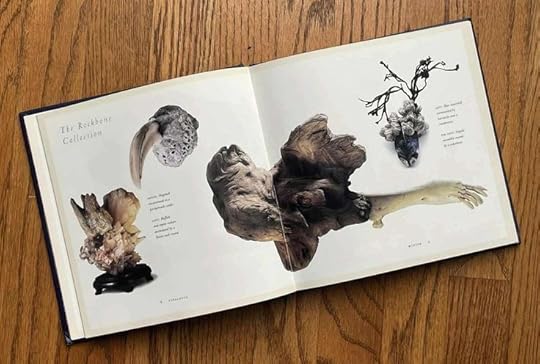
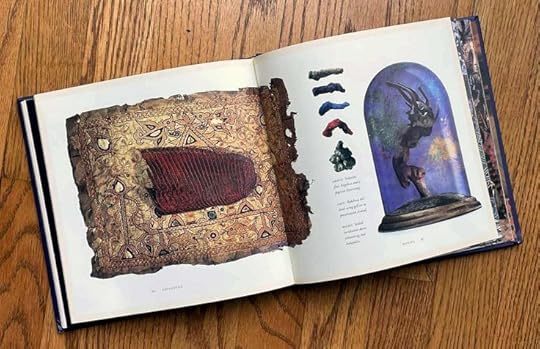
A few examples, as usual from my crap camera phone, (but you can get your own copy on Amazon for under $7) — and bear in mind, ALL THIS STUFF IS MADE UP: From "The Rockbone Collection" of fused natural objects; bone, stone, coral, claw, rock, etc.
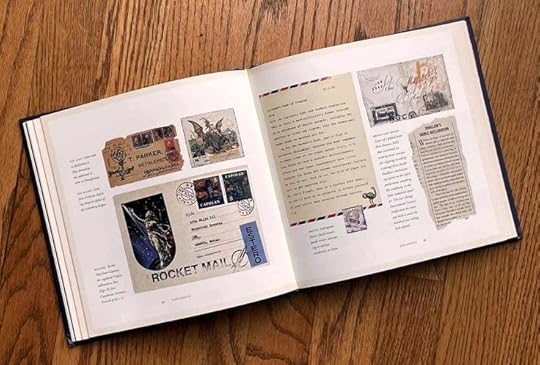
Samples of lost mail sent between the various Purgatory states
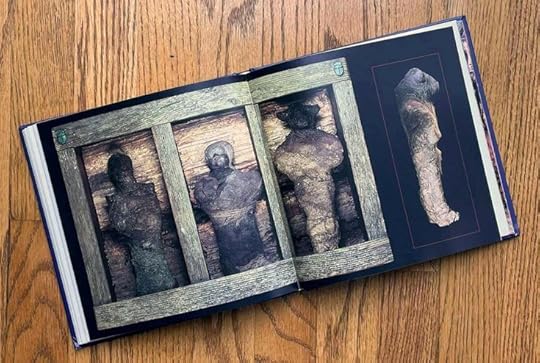
Miniature mummies of ancient animal gods Mana Ra, Pfatti and Buul — with an extra side view of Buul! :)
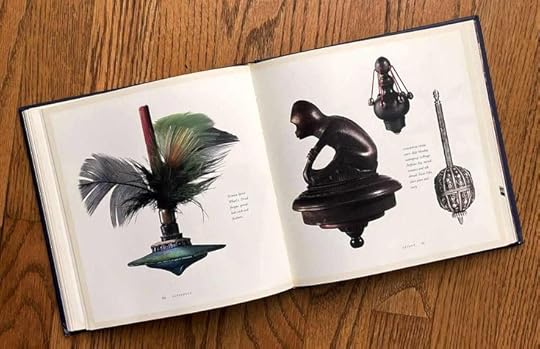
An assortment of spinning tops, some from the fictional island of Sicmon, which also appears in the "Griffin & Sabine" stories
Various items from the Angelic and Demonic realms, including a "sealed incubation dome containing root hobgoblin," (far right)
I thought it would be something for my spooky October reading, though it turned out to not be spooky at all (imo). Probably at the most extreme case, it might be odd in a few spots (some of the art displayed in the book). It kind of presents itself as a museum guide, a museum in Purgatory. The chapters each outline a particular person & his/her collection that is on display in the museum. Really, the purpose of looking at each display individually is to see each of these people as they looked back/examined their lives, what led them to collect or create the items or types of items they have displayed, & figure out what that means as far as their personalities, each person's past life, & each person's future. (Will s/he go to one of the utopian or dystopian places upon leaving Purgatory?) I guess it's more a philosophical/life/art musing more than anything else. The last chapter is 'autobiographical' by the museum curator himself (who had amnesia upon arriving in Purgatory) so his leading you through various rooms at the museum also leads to him finding out about himself.
It's unique, has some funky & cool art, & is probably a great little book for those who want 'spooky' October reading but who don't 'do spooky'.
This book is strange. It's mostly an art book, with a narrative created to allow Mr. Bantock to go from picture to picture. I've been curious about Mr. Bantock since perusing his earlier book Griffin and Sabine: An Extraordinary Correspondence, which is a fascinating book with all sorts of little envelopes and letters and pictures to tell the story. This book didn't have all the moving parts of G&S, but it had plenty of the strange illustrations I would expect. I'm also going to take a look at The Venetian's Wife, which appears to have a layout similar to The Museum at Purgatory.
By the way, just in case you are interested in the story that you will read in this book - the title, The Museum at Purgatory, is somewhat self-explanatory. Non is the Curator of The Museum at Purgatory where souls leave their collections when they pass through Purgatory on the way to the appropriate Utopia or Dystopia, as appropriate to the particular soul. There are descriptions of several of the collections (i.e., a story of those souls) and then there is the Curator's tale.
People define themselves by the things they collect in life and in the afterlife: that is the idea behind The Museum at Purgatory by Nick Bantock. Those who know themselves and are comfortable with what they've become can move on to one o the utopian or dystopian worlds. Those who can't come to terms with themselves (for good or bad) or those who don't know themselves must stay in Purgatory, the holding pen for the afterlife.
The narrator of The Museum at Purgatory is Non, curator of the museum. He came to the afterlife with amnesia, a rare but not unheard of condition. As he can't know himself, he is stuck in Purgatory. The hope is that he can jog his memory by cataloguing the items others have brought with themselves to the afterlife.
Any good museum book must have examples of its collections and Nick Bantock provides the illustrations but as drawings (as he does for the Griffin and Sabine books) and as photographs of what I assume are sculptures he produced for the book. The artwork isn't as big a player in the story as it is in the Griffin and Sabine books and the book suffers a bit for it. He's a better artist than he is a writer.
A creative break book for the soul. Rick Bantock creates a whole world in purgatory whereby ten people assess their lives through their personally curated collections they bring with them from life and sometimes create in purgatory. As a museum studies graduate and one who has worked with museum collections and archives, this book is appreciated so much more for its insights into the evolution of a soul. More a manual on how to assess how one's own life by making one reflect on what we collect personally and how our collections mirror our purpose here in physical form. Another book for my favorite shelf.
The past few days I’ve been stuck in one of those ruts where I’ve not been sure what I want to read next; I’ve picked up half-a-dozen books from my to-read shelf, gotten five to ten pages in on each, and decided now’s not the time for me to read that particular work. The Museum at Purgatory was a great book for such a rut, as it’s an intriguing novelty, and so short that it’s over before any of that novelty starts to wear thin. However, its novelty is not used to achieve anything greater, so don’t go into The Museum at Purgatory expecting more than an interesting curiosity.
The Museum at Purgatory is a collection of very short stories, all focused on individuals involved with the titular museum, an infinite space in which are displayed the objects brought to or created in purgatory by individuals after their deaths. For each of the focused-on exhibitions, the book gives you a short description of the character’s life, the objects they created or collected, and usually some information on where that character went after their sojourn in purgatory (whether that be one of the utopias or dystopias). Along with these short stories, the book shows you examples of the objects in the characters’ collections, which range from mummies, to carpets, to board games, to ahistorical tops, to letters and postage. The final piece of the book tells a similar short story about the museum’s current curator, referencing the short stories that came before it.
Bantock’s ability to make a multimedia work is impressive, but when reading The Museum at Purgatory it never rose above being a novelty to me. For it to have been elevated, the stories themselves must have been great, the art accompanying them must have been great, or, like Bantock’s Griffin and Sabine, the stories and the art must have built upon each other so that the whole was greater than the sum of its parts. Instead, the stories and art are both a mixed bag and certainly don’t rise to the level of greatness, and, even though the final part of the book tries, it doesn’t even come close to stitching the work together into one cohesive whole.
I think perhaps The Museum at Purgatory would work best as a very eccentric person’s coffee table book, something for guests to flip through so that they can see the inventive art, maybe read one of the very brief tales, before their host comes and they leave the book behind. Thus, the intriguing nature of the work would be preserved for that reader, while a complete reading reveals that there’s not much substance behind the unconventionality. Even as a coffee table book, though, Griffin and Sabine is better. 3/5.
This book’s concept of Purgatory and everyone’s purpose in it is remarkably brilliant but lacks the intrigue and connection to make it an engrossing read. The writing, one of a dry and scholarly style, will appeal to anyone with a taste for academics, but anyone with a creative side may be disappointed as it’s difficult to maintain focus despite the interesting concept and art.
The Curator’s Tale at the end of the book is both thought and soul provoking with several brilliantly worded passages that make the reader think twice about what Purgatory actually is and what it takes to honestly, adequately, and properly move on from it. However, even this wasn’t enough to make the chore of reading up to that point worthwhile. Because of this, I was left with an overall feeling of mediocrity, one that far outweighed what little inspiration I found within the pages.
I have to admit, I did not read all of this book. It is made up of imaginary rooms of people in purgatory. I think the idea is interesting but the actual stories accompanied by pictures, didn’t hold my attention. Each person, or room, in purgatory is a type of collector and their collections are explored by the curator of purgatory. This premise works out to be a collection of short stories. I have a low tolerance for having to realign myself with a new character and setting that reading a collection of short stories requires. I’m also not interested in this Victorian type of collecting and labeling. The language is again, like, The Forgetting Room, fusty, academic and weirdly theatrical.
This is a big no when I was sure it was going to be a yes.
“Museum at Purgatory”, is not a novel, not an essay, but which is more of a conceit, an imagining of a concept with lavish and imaginative illustrations. Purgatory serves here as a way-station of self-discovery for indiviuals as they make their way between the various concepts of Hell (including Inferno, Satanic Mills, Styx, Mordor, etc.) and Heaven (including Eden, Shangri-la, Fiddler’s Green, Avalon, Nirvana, etc.) The Catholic Church scratched its collective head and abolished the concept some years back, I think. They should have talked to Bantock.
This was a reread, and I did like and understand it better the second time, but I am not a huge fan of Bantock's whimsy.
I found the theme, writing, and illustrations to be beautifully mysterious. The ending astounded me and broke my heart, but also left me with a feeling of hope for the future. I don't often enjoy books that wring me dry emotionally, but Mr. Bantock is proof that some are well worth it!
This was an absolutely fantastic book for the pictures and items in it. However, I was disappointed with the stories that went with the pictures. I felt that I was just starting to get interested in the characters that the stories were about, and then they would die. I guess that's life.
An absolute visionary in braiding literature with art, Nick Bantock paints with words and tells stories with pictures. His view of purgatory - and the rules of engagement one finds there - are richly textured, inspired, and feel vividly real. Bantock successfully presents a structure for the unstructured, the unknown concept of purgatory. The result is a beautifully intertwined spiritual ecosystem where we have the privilege of wandering for but an instant in eternity.
A most satisfying read, a work of art.
P.S. the souvenir from the museum gift shop inside the back cover made me squeal with delight. A little tip of the hat to Gryphon & Sabine who may be wandering the galleries in the museum at purgatory themselves.
This book takes the reader on a journey through the ever expanding museum of Purgatory. Its collection comes from those whose worldly possessions have played such a pivotal role in their story that they bring them with them to Purgatory. It’s an easy read, like reading a real museum’s catalog. It feels like the type of book that would change or reveal more details upon each subsequent reading, though if it didn’t, I would be disappointed. Recommend if you’re looking for a light, easy read that you can pick up and put down as much as you’d like, but that is also a little poignant and macabre. The art itself is impressive.
In some ways this is a child of Calvino. Fantastical stories with whimsical and philosophical underpinnings.
I enjoyed it due to its length. If this was a longer piece, I would have some things to say. Most of the musings go on just enough time to start to get a little done with it. There is a special skill in knowing when to stop a bit before it goes too far.
I am running through the Griffin and Sabine stuff and thought that I would give these few books a whirl as well. I'm not disappointed but I do prefer the G&S stuff so far.
Bantock is always a fun read. His mix of mediums to tell a story is refreshing to read between other novels. Whereas the Sabine novels craft beautifully intricate people through correspondences, this story flips that idea and crafts beautifully intricate objects that become imbued/remind us of humanity.
This just seemed terribly self-indulgent to me. Bantock is a virtuoso of imagery, but his storytelling here feels like a novice def jam poet who snorted smarties ahead of their first gig for a confidence boost. Very cluttered and odd.
Strange and wonderful is a good way to describe this one. I really enjoyed the narrative that accompanied the images. It's an interesting take on the "art book."
I really thought this had such an original idea, almost like a Screwtape Letters premise, but it wasn't as well put together as Bantock's other works. I do think it would make a great novel though!
Lovely, Amazing premise. BUT it was as if you read the first 2 chapters of an amazing book, and the rest of the book had nothing but blank pages. ARGH! Where's the rest of the story? Yes, it does stand on it's own but gosh, it's so interesting, I would have loved more. Amazing illustrations of objects from the museum, but wait, aren't they fictional like the book? Well, you'll just have to see them to decide!
Eight years after marking this "to-read," I finally did! Flipping through the book last night, I almost decided to skip it - it seemed a bit weird to be reading all this "history" about things that never happened (hard to explain since I love fiction, but if this proved an exercise about how well Bantock could create fake historical art, I wasn't interested). However, this morning I looked at some of the reviews and decided to give it a go.
I agree that Part II, "The Curator's Tale," is the weakest. I think Bantock is an OK writer, not a great one. He has a great imagination and obviously has great artistic talent, but I wouldn't say his writing is exceptional. Part I, though, was fairly solid. There are 1o rooms at the museum, and he talks about each of the creators of the exhibit: their beginnings, what caused them to start their particular collection, and where they went once they arrived at Purgatory.
I like the idea that no godlike being chooses where to send a soul once he dies but rather the individual analyzes his life and determines where he belongs. Sometimes it might take a while for the decision to be made (hence the narrator's long-term role as Curator) but it happens.
My favorite chapters were: -The Fitzgerald room about magic carpets (they don't actually fly but provide a history or story about someone if you know how to decipher the message within); -The Sengler room about "sfumatoglyphics" or "smoky word pictures" (the idea that images are what humans dream in - the go-to way of seeing things - and that words as a rough translation of those images) and how "gargle" became a word; -The Delancet Room about postcards - though I've seen Bantock do postcards before in his Griffin and Sabine series, he's quite good at them and it's fun to think about a place where lost posts are housed (especially ones that go between the various Heavens and Hells).
I also appreciate the idea that angels and daemons work in partnership to ensure no bias is made when ruling the world of Purgatory (discussed more in the Daniel room).
I'm glad I gave it a try but I think I would recommend other Bantock books first.
Like Nick Bantock's other works, The Museum at Purgatory creates a dazzlingly complex world without feeling the need to explain all of it. Curator Non, the narrator and central figure in the story, tells the reader about the Museum he is responsible for, a Museum which helps deceased souls examine and evaluate their lives to determine the most suitable place to move on to. They do this by putting together exhibits of objects from their lives. Curator Non shows us several of these exhibits, complete with pictures of the various and sundry objects that made their way into Purgatory. The book is self-contained: we hear of worlds beyond it, but we see none of them. Curator Non seems, at first, to be an impartial judge of these stories, but as the tale continues, the reader finds that Curator Non has his own motivations and passes his own judgements on other souls. The book imagines a world where we are constantly evaluating our own lives for problems, and continuously growing and changing to address or compensate for those problems. Indeed, the very fabric of Purgatory flexes, changing every time you look at it. This constant reevaluation is sealed by through book's final words, centered on the last page: "Without End." Thus, though the book concludes before we see a true resolution to Curator Non's story, the reader is given the sense that he will eventually move on, only to circle back in his next lifetime, like an eternal spiral staircase.