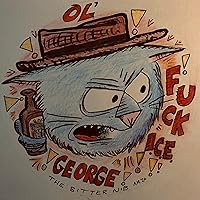
Scary and sweet! A spooky bruja (witch) unsettles Palomar in the title story, Heraclio courts Carmen, and more of Gilbert's tales. Jaime presents Maggie and Hopey, Rena Titanon and Rocky and her pet robot Fumble. One of the most requested volumes of the Love and Rockets library is the scariest and sweetest volume of all! Duck Feet ―Volume 6 of the complete Love and Rockets―showcases Gilbert's Palomar in the title story, in which a spooky bruja (witch) passes through town and leaves a load of trouble and weirdness in her raggedy wake. Meanwhile, in the city, Vincente has fallen on hard times and Israel tries to fill the void left by the disappearance of his twin sister whey were children. Gilbert shifts the gears from terror to romance with "For the Love of Carmen," telling of Heraclio's courtship of the diminutive bombshell. Not to be outdone, Jaime presents the best of his "hanging around" stories, "Locas vs. Locos" and "Mojado Power," featuring Maggie and Hopey, and guest-starring Hopey's lady-killer little brother Joey and Izzy's diary secrets. All this plus Rena Titanon, two stories featuring lost little girl Rocky and her pet robot Fumble, and a cover gallery. This is the volume that secured the Bros.' position on Time Magazine's "Top Innovators" of the last century! Black-and-white comics throughout
Gilbert and his brother Jaime Hernández mostly publish their separate storylines together in Love And Rockets and are often referred to as 'Los Bros Hernandez'.
Gilbert Hernandez is an American cartoonist best known for the Palomar and Heartbreak Soup stories in Love and Rockets, the groundbreaking alternative comic series he created with his brothers Jaime and Mario. Raised in Oxnard, California in a lively household shaped by comics, rock music and a strong creative streak, he developed an early fascination with graphic storytelling. His influences ranged from Marvel legends Jack Kirby and Steve Ditko to the humor and clarity of Hank Ketcham and the Archie line, as well as the raw energy of the underground comix that entered his life through his brother Mario. In 1981 the brothers self-published the first issue of Love and Rockets, which quickly drew the attention of Fantagraphics Books. The series became a defining work of the independent comics movement, notable for its punk spirit, emotional depth and multiracial cast. Gilbert's Palomar stories, centered on the residents of a fictional Latin American village, combined magic realism with soap-opera intimacy and grew into an ambitious narrative cycle admired for its complex characters and bold storytelling. Works like Human Diastrophism helped solidify his reputation as one of the medium's most inventive voices. Across periods when Love and Rockets was on hiatus, Hernandez built out a parallel body of work, creating titles such as New Love, Luba, and Luba's Comics and Stories, as well as later graphic novels including Sloth and The Troublemakers. He also collaborated with Peter Bagge on the short-lived series Yeah! and continued to explore new directions in Love and Rockets: New Stories. Celebrated for his portrayal of independent women and for his distinctive blend of realism and myth, Hernandez remains a major figure in contemporary comics and a lasting influence on generations of artists.
This, then, was my introduction to the idiosyncratic and fantastically imagined worlds of Jaime and Gilbert Hernandez. A landmark series from the alternative comics world of the 1980s, "Love and Rockets" followed the black-and-white serial narratives of indelible characters for 15 years, explicitly influenced by the renaissance of punk rock in the late 1970s; after a hiatus, it reappeared in 2001. The brothers don't collaborate on the same comics; rather, Gilbert created the "Heartbreak Soup" epic centered around the tiny fictional town of Palomar in Mexico, while Jaime created the "Las Locas/Los Locos" stories that follow a "modern day" (ie, 1980s) cast of young Chicanos with music-loving alternative lives in California. Interspersed among these ongoing narratives are curious side-pieces--sometimes self-contained, sometimes developed. While the stories and art of each Hernandez brother is unique, they shine extra bright by being juxtaposed, one to the other. Altogether: these rambling, lingering tales are bewitching.
The art of "Love and Rockets" is exceptionally physical: the Hernandez brothers delight in drawing an enormous range of bodies and movements. There is sex and pain, there are bodies that transform with puberty, age, injury, weight gain, muscle-building, haircuts, pregnancy, changing facial hair, emotion, costuming, dyed hair, and make-up. The heightened attention to physical form borders on the Grotesque--with all the exaggeration and wonder that that implies. The change of physical bodies is a fascinating way of marking time in a series that floats so easily among the "normal" beat of chronology.
These comics demand a lot from the reader. You can not passively consume this. You are expected to make leaps in time and space without having clear directional guides; you must keep up with an expansive multi-voiced ensemble cast of characters--many of which emerge in and out of each others' stories. The reader must entertain the possibilities of magic, coincidence, oddity, and synchronicity. There are flashbacks and layers to these characters. I found myself cheering inside when I saw the reappearance of, say, Maggie (a bright and insecure mechanic, who, when I met her, was recently kicked out of the place she was sharing with on-again, off-again lover, Hopey) or Cholo (the muscular woman who is the sheriff of Palomar, and, as a former midwife, helped birth the people she now chases down).
Oh, there is levity too. Light touches of humor and wit, of playfulness and silliness that disarm the reader; it gives us something to hold on to as we navigate the strange and compelling worlds of "Love and Rockets." This is notable: so many of the stories--especially the Palomar ones--risk melodrama, fully facing the implications of telling stories of high stakes, of acts of heroism and villainy, of romance and loneliness. For god's sake, we meet a witch ("la bruja") who happily clanks the skull of a baby as she toddles around town (see the cover image above). It is the humor that makes this keening, dream-like drama not only palatable, but charming.
As well: it is not lost on me that "Love and Rockets" is produced by two Hispanic men and features a cast of almost entirely brown people living in either Central America or California. There are a lot of gay people in the cast, too, as well complex female characters. On all ends of this, this is radically rare in the comics universe. Of course, the Hernandez bros. are well aware of the context they are working within. Says Jaime:
"When we got into the comic world, it was almost zero Latin. We were in this world with almost all white people. In the beginning, people were afraid of us, because they thought we were hoods. How racist is that? But people supported us. I like to think that we speak a universal language in the comic. So even though these people are Mexican, you can still relate to them as people, which was our main objective. I want people in China to like our stuff."
And also:
"When Maggie and Hopey became popular as two lesbian characters drawn by a heterosexual male, people said, 'Who do you think you are? Why do you think you can do it?' And I just said, 'Well, I do it. I make no apologies for them. These are the characters. If you don't like them, do your own comic.'"
Says Gilbert:
"Well, for writers and filmmakers, the more ethnic it is, the more universal it is. The more Swedish a film is, the more we like it, the more we understand it. It's when they try to water it down, and try to second-guess the foreign audience that you run into trouble. Even Spike Lee -- the more black his films are, the more universal they are. The whiter the Beach Boys are, the better they are. I know a lot of people don't like the Beach Boys because they say they are too white. I say, that's what's good about them. That's one of the main ingredients. Joni Mitchell, the Beach Boys, Buddy Holly are really great artists because they are as white as they can get. This is going to sound weird: White people, black people, Hispanic people, people of color -- I sound like MTV."
These days, the "Love and Rockets" stories are collected in all kinds of ways, as you might expect from a beloved ensemble story that spans decades. Some focus on particular characters, some on particular places, some break it down chronologically. If I fully understood the scope of the"Love and Rockets" epic before I began, I might have been intimidated away from it--feeling like I needed to start at the very beginning and read it straight through, if I were to meet it at all. Happily, I was able to simply accept the collection that was offered to me--which happened to be "Vol.6 - Duck Feet." This turned into an invitation to simply leap into the middle of this wild world, to turn my head back and forth among the shifting stories and just take it in. Though I've closed the book on this particular collection of the stories, I still feel like I'm in the middle of it. I'm not through with this yet. I'm not alone either: just a couple weeks ago, Los Angeles celebrated the work of Jaime Hernandez.
I despair of finding the correct entry for this, but there is a moment where one character is dismissive (putting it lightly) of her husband's books, and then on the final page you find out why, and it knocked me flat on my back and I still think about it probably once a week and what I'm saying is, you should be reading L&R.
Great work from both Bros in this work. Important world building, as they say. Great writing and drawing as the legends of Hoppers and Paloma’s expand.
Something I've neglected to point out in my previous reviews of this series is how much I love to see Maggie blowing up! Not that I'm happy for her character or anything for putting on weight, but the way Jaime accomplishes it subtly and effectively is notable. This volume's strongest efforts, though, are once again from Gilbert. The eponymous story of a bruja who comes to town and her effects on Palomar is a nicely self-contained example of how striking a storyteller he is (and possibly of his improvement as an artist). He also offers the beginning of Heraclio & Carmen, and the sad adulthood of Israel. Jaime contributes his usual fun-and-pretty Locas stuff, with some glimpses into the early days of Maggie y Hopey via a pilfered Izzy journal, as well as a pair of fun Rocky & Fumble tales. It's hard to imagine that in the next book we'd witness him take huge strides in his storytelling technique with 'The Death of Speedy.'
I feel sorry for people who haven't read Love and Rockets. It's some of the best comic book storytelling of all time. I personally like it when it gets a bit on the weird side. The two-part title tale in this volume is one of my favorite Gilbert Hernandez stories. Weird witch. Baby skulls. Luba trapped in a well. Mysterious disease. That story itself could have been stretched out to fill a whole volume.
I ordered a bunch of Love and Rockets trades to remind myself why I love comics. This is one of the series that made me a believer. This was the first to arrive... Still a bit wordy, but the brothers were beginning to trust their art to tell the story. The ability of both artists to swing time and place on their characters and never lose the reader is a gift. Viva Los Bros Hernandez!
More classic Gilbert Hernandez action, together with some inconsequential Maggie-Hopey stuff from Jaime. I do like the short Rocket Rhodes pieces by Jaime (about a girl and her robot who start travelling through dimensional holes to other planets. I wish Jaime had written more stuff like this.
Duck Feet showcases Gilbert's Palomar in the title story, in which a spooky witch passes through town and leaves a load of trouble and weirdness in her raggedy wake.