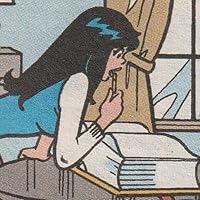
From the third book that collects the classic "Locas" comics storyline from Love and Rockets : Jaime drops a narrative bomb on Hopey in "Wigwam Bam." And Maggie contends with her inner demons, a murderer, a woman wrestler, and … gets married? The fifth book in The Complete Love and Rockets Library is the third in the classic "Locas" comics storyline. Perla La Loca begins with the "Wigwam Bam," arguably writer-artist Jaime Hernandez's definitive statement on post-punk culture. As Maggie, Hopey, and the rest of the Locas prowl Los Angeles, the East Coast, and parts in between, they try to recapture the carefree spirit of those early days. "Wigwam Bam" brings us up to date on all the members of Jaime's extensive cast of characters and then drops a narrative bomb on Hopey (and us) in the very last pages. Split up from Hopey yet again, Maggie bounces back and forth between a one-laundromat town in Texas (the "Chester Square" that serves as the title of two of the strongest stories in the book), where she has to contend with both her own inner demons, a murderous foe, and Camp Vicki, where she has to fend off her aunt Vicki's attempts to make her a professional wrestler and the unwanted advances of champ-to-be, Gina. These stories originally appeared circa 1990–1996 in the long-running (and ongoing) Love and Rockets comic book series, also featuring work by Jaime's brothers, Gilbert and Mario. Characters change as they age in "real-time" in stories that span generations. L&R has been called "the greatest American comic book series of all time" by Rolling Stone and "a great, sprawling American novel" by GQ . It broke ground with its craft and the casual intersectionality of its huge and diverse casts of nuanced characters (many of whom are LGBQTIA+) who live and have relationships in often-naturalistic settings and situations. Black and white illustrations throughout
Jaime and his brother Gilbert Hernández mostly publish their separate storylines together in Love And Rockets and are often referred to as 'Los Bros Hernandez'.
Omnibus volume three (of five, so far, 283 pages!) of Jaime Hernandez’s Locas stories features the graphic novel Wigwam Bam (which is also shelved separately as Love and Rockets volume 14 of the collected Los Bros Hernandez collected works). I like volume 2, the Hoppers volume, a bit better, because Maggie is separated from Hopey and the rest of her friends for much of this volume, but Wigwam Bam is a great portrait of post-punk (largely L. A.) culture, classic Jaime. The locas girls try to keep the locas alive, as we get caught up with each of the girls-now-women Maggie, Hopey, Izzy, Ray and Danita, Doyle, Daffy, Penny Century, Hopey's brother Zero, and others. In serialized format I imagine it would be just crazy as it is like (his part inspiration) Archie comics, jumping all over the place from character to character, episode to episode, but in one volume it is great, a kind of sprawling landscape, manic and affecting.
Perla, (a nickname for Maggie), has Maggie in Texas, dealing with hookers and pro wrestlers and advances from (wrestler) Gina. A lot of strong women characters, sometimes dealing with men, most often just trying to figure out how to be friends with each other. In the end Maggie is reunited with her bff Hopey. On to Penny Century, also a reread.
Perla la Loca collects materials from Love and Rockets #33-50.
After two volumes, I was hooked on the Locas. I thought the last volume would be hard to top but topped it was.
Maggie and Hopey split up again after a spat on tour. Maggie winds up in Texas and Hopey's face winds up on a milk carton. The st0ries within Perla la Loca deal with the fates of Maggie and Hopey and all the friends that come into their orbit, like Ray, Danita, Doyle, El Diablo Blancho, and Penny Century. Since there are a few more volumes after this, I don't think it's a spoiler that the locas eventually get back together.
I didn't think it was possible to improve on something that was already so good but both the artwork and writing are jacked up a notch since the previous volume. I didn't notice Jaime's Charles Schulz influence until I saw a lot of Peanuts looking kids walking around Danita's neighborhood. The looks of the characters continue to evolve but you can still tell who is who. Maggie has put on some weight and Hopey's hair is different but they're still unmistakable. I love that Maggie and Esther actually look like sisters. One thing I thought was hilarious was a dog taking shelter under that piece of machinery Spider-Man lifted off himself in Amazing Spider-Man #33.
Jaime doesn't mind putting his girls through the wringer. The girls go through some physical and emotional trauma on the long winding road back to each other. After the Death of Speedy Ortiz in the last volume, I was sure the book would end with Doyle or Ray dying. Neither of them did but it sure looks like Izzy is heading to the Clearing at the end of the Path.
On one hand, I'm disappointed in myself for only delving into the story of the locas as I cruise into middle age. On the other hand, I probably wouldn't have enjoyed it this much when I was younger. The writing is crisp and the art is a masterpiece of minimalism. Alex Toth would have been proud were he capable of such things.
Perla la Loca is the best Love and Rockets collection so far. Five out of five stars.
This book is beautiful. Fucking beautiful. It made me cry. I really loved the previous two volumes but this one makes me understand why love and rockets is fucking LOVE AND ROCKETS. Why every comics person has read it and how it became an indie comic empire. Because this is fucking BEAUTIFUL. The realist, craziest, most human, and most fucking beautiful story I've read in a long goddamn time
The amazing collection continues, after Wig Wam Bam the main story line moves with Maggie to Texas as she tries to build a life of sorts, meanwhile everyone thinks Hopey is missing! Superlative! 8 out of 12. The more I read of this, the less I can read of any graphic novel, the art and plotting has left me compelling to read me about this reality 8 out of 12.
It took me a very long time to reread Maggie the Mechanic enough times that I understood it, and it might have taken a quarantine to allow me the quiet and focus to make it through The Girl from H.O.P.P.E.R.S. a second time in order to get here. I think it's relatively common knowledge that Jaime's style of storytelling sort of always makes you feel like you're being dropped in medias res, and even reading through his "Locas" stories in a straight shot is still a continuous process of putting together narrative pieces as you go.
I remember never really being excited to read this volume because in Perla..., the kids have to grow up -- punk is dead (if it was ever alive) and it becomes more and more obvious that these are the stories of people scraping by at the edges of society, rather than obnoxious runaway teens fulfilling the obnoxious runaway teen fantasies (with dinosaurs and superheroes!) of the earlier "Locas" stories. I used to feel somewhat betrayed by that shift when I would try to read Perla.... I also used to be a little weirded out by Jaime's shift away from realism to a sort of Chester Gould-esque caricature, and I still don't know what to make of the fact that the setting of much of the story moves to a weirdly sex-positive but still exploitative strip club in its final act. I guess I am probably glad that I don't have anyone to talk about Jaime's Love & Rockets with, because I don't know how I feel about his stories or what I think their contribution to indie comics really is.
But I will miss not having unread L&R on my shelf, which is why I ordered Jaime's nextthreebooks fifteen minutes ago.
Uhhh I love Love & Rockets so much that I don't even think I'm up to the task of writing a Goodreads review about it. This collection was excellent with a few weird missteps, but the ending was absolutely perfect. It gave off that precise sort of "this is the perfect conclusion" feel that every ending should strive for. -- REREAD JUNE 2018
This is not my favorite L&R collection (VERY hard to follow the genius Girl from HOPPERS) but god DAMN, the conclusion to the Locas storyline is so perfectly executed. Maggie's breakdown--the collective moment of violence in her imagining everyone from her past slapping her one by one and all at once, the sudden rift with reality, the brief--so brief!--slip to an alternate timeline and the bittersweet desire of "it was all just a dream," the return to reality: Backseat of a police car, and the sudden fateful return of Hopey. Oh! God! It moves so fast, it encompasses so much, it ends on such a sweet and sad and inevitable note! Rarely does such a long-running storyline end in such an immaculate place.
The Locas series (which this and two other books encompass) is a soap in Comic Form, primarily following two girls as they have various adventures that range from Sci-Fi insanity, to Punk Rock mythologies. The stories appeared in the book Love & Rockets, along-side work by his brother, who's stories were centered around a village called Palomar. In a way, you need both to really absorb either story, but reading Locas in three-volumes, all at once is also extremely rewarding.
I will be up front: I am in love with the girls in these stories. Jamie Hernandez draws beautiful girls, and he loves to draw them, too. In many ways he manages to capture the voice of these women better than any man has ever captured a woman in comics, and it's this keen observation and well-written dialog that really drives everything forward. While there are definitely sub-stories within the Locas series, to me it seems more about the characters interacting, and less about events happening.
This is, perhaps, the only shortcoming of Jamie's work: much of it seems a little "light" compared to his brother. On the whole, it IS a soap, and people break-up and fight more often than anything else. There are other elements, true, but the stuff that sticks with me is Maggie & Hopey wandering around, having fun, while I find myself hard-pressed to find other connecting threads.
Which is fine. Light entertainment is good, too, and the art and dialog is superb. I never get sick of this guys work, and that is probably the best recommendation I can give.
I am becoming completely and utterly obsessed with these books. I read this one in just over 24 hours. I’ve not read a comic book (and very few "actual novels") that have as brilliant characterisation as this one. Things are not going well for Maggie, Hopey and co. in this book. It starts with Maggie and Hopey having a huge fight and they spend the entire book apart experiencing some pretty unpleasant things. The title of one of the stories, "Maggie the mechanic or Perla the prostitute" killed me. While I enjoyed the wrestler's and the Maggie and Hopey stories, I was less interested in the lives of Doyle, Danita and Maggie's ex-boyfriend. But the story of Izzy and the milk cartons during that made up for it! It is great to see how everyone grows up and changes. There were so many wonderful little moments, Izzy finding Maggie's description of her best friend from childhood who died, Hopey returning to Hoppers after 7 years, and of course the end. I'm totally loving these comics and may well try to find a way to buy the next one today. They've totally captivated me. They are just so messed up and strange and very very real at the same time.
Maybe I read this at the wrong time, but I couldn’t get into this volume as much as the first two. The longer stories ramble on and I wasn’t attached to the (many) characters. I don’t think Jaime Hernandez always conveys information clearly. There were a number of times when I was confused as to why people acted in certain ways or why a situation began as it did. The frequent shifts between plotlines don’t help. I still adore Hernandez’s art. It’s beautiful and timeless. Though I think I need to admit that I merely *like* and *appreciate* the Locas. No matter how good the art in a comic is, I need an engaging story first and foremost to love it. And I was not very engaged in this.
I thoroughly enjoyed this volume of the Locas story; the two main graphic novels collected here are heartfelt and emotional, concluding in what may possibly be one of the greatest reunions in comics history.
For most of this third volume in the Locas storyline of Love and Rockets, Hopey and Maggie (known as Perla to many in her family) are once again far apart. We begin with them in New York, now a full-fledged couple, clinging to their aimless mid-20s pinballing from one party to the next. For all their street punk cred, though, they clearly don't fit in. They're too working class for the thinly veiled classism of the New York artsy crowd, and even though Hopey is actually of Colombian descent, they're told that Mexican isn't one of the 'cool minorities'. Eventually, Maggie has had enough and wants to go back to Hoppers, but when Hopey refuses, they break up, and it's years again before they find their way back to each other.
It would take too long to summarize the incredibly rich tapestry of stories that follows. By this point, Jaime Hernandez is juggling the stories of dozens of characters, constantly introducing fascinating new ones along the way. Even though Maggie and Hopey are still the main characters, he does justice to virtually all of them. Any one character arc among these is rich and interesting enough to have made for its own story, but instead he skillfully weaves them together into a single, panoramic portrait of poor people of color, social misfits, and marginal communities in late 20th century America.
We get the story of Danita, the single black mother who lives in hiding from her violent ex and father of her son, dancing at a topless bar, but then leaves Hoppers to escape a stalker and become the sidekick to a Mexican wrestler with whom she's fallen in love. We witness the further decline of Doyle, who is handsome enough to still be chased after the ladies, but now sleeps in a tent by the railroad tracks with a gaggle of other burnouts. We watch Izzy the shut-in 'witch lady' descend into mental illness as she obsesses over the absence of Maggie and Hopey. We meet a now adult Esther, once the two-timing girlfriend of the late Speedy, and see her sabotaging her own life as she wrestles with guilt over her part in his death. And these are just a few examples of the many fully-realized character arcs we get. Even the stories of minor characters are truly compelling: for example, the story of Ruby, the prostitute who services a small group of Mexican farm workers in a dead-end corner of a tiny Texas town.
As for Maggie and Hopey, by the end of this volume they are clearly entering that period of their late 20s when what used to be romantic, free-spirited wanderlust starts to feel a lot like despair, like simply being an irremediable f*ck-up. And when they're finally reunited, it feels like a sea-change for them - like they're exactly where they need to be. So many people around them stew with envy over the connection they have, and we can definitely see why. Through Maggie and Hopey, Jaime Hernandez has created one of the finest and most romantic of contemporary love stories.
While not quite as strong as the previous collection of Jaime's Love and Rockets work ("The Girl from H.O.P.P.E.R.S"), there is a definite uptick in the rigorous cartooning and command of the formalism that goes into the stories collected in "Perla La Loca". The major feature here is "Wigwam Bam", a story about Hopey and Maggie on the road and a major falling out that happens between them. Hopey enjoying her time on the East Coast, decides to crash on couches there while milk cartons featuring her face pose desperate requests for her to come home. Maggie hightails it to Texas where she spends time with her Aunt Vicki and gets caught up with the local pro wrestling circuit. The falling out between lifelong friends flirts between the line of funny and tragic, but that's Jaime's ability to weave a complex range of feelings in his subdued stories. Artistically, "Wigwam Bam" is one of Jaime's greatest books with a lot of visual flair and precision being demonstrated. Charles Schulz's Peanuts serves as a clear inspiration for certain segments of the story, while Jaime adheres to a more stringent nine-panel grid compared to his more looser layouts in works past. The grid format does give off the vibe that Jaime was committing to the strip homage more, but he uses it expertly to craft fantastic compositions with a wonderful use of contrast between the heavy blacks and his sharp lines.
There are many shorter stories that follow "Wigwam Bam" in this collection, all to service the growing cast of characters in his Locas stories. It's the wrestling portions that continue to standout here for me, but almost everything he touches has a sense of grace and authenticity to it. Most notably, his characters are aged in a realistic fashion as most clearly seen with characters like Maggie and Rena who either sport a bit more weight or have noticeably grayer hair than before. It's almost novel to see a cartoonist depict women without a prominent male gaze - something that I've always felt makes Jaime Hernández stand out from the crowd.
The sprawling, uniquely charming world of Locas brings its initial era to a satisfying close for Maggie and Hopey and the huge, rotating cast of characters beyond them. The breadth of its believably low-stakes storytelling took me a minute to fit back in my head this time, but it’s such a rewarding place that I love returning to.
Maggie and Hopey see their lives pinball even further away from each other here based on a couple of spontaneous decisions and life’s inertia, and each tumble through several unplanned happenings far away from Hoppers, CA in what must now be their late 20s. Hernandez’s ability to portray how time passes both fast and slow continues to be brilliant. He does it through the story but more naturalistically through normal changes in appearance; the slow accumulation of weight changes and different haircuts for so many characters is such a subtle, sophisticated decision versus the typically static appearance of illustrated characters in other long-running stories.
Hernandez’s art continues to be striking and worth reading for all on its own. I love his mix of mostly believable anatomy mixed with occasional cartoon-exaggerated expressions to accentuate emotion, and the kids all being drawn in a cute Dennis The Menace style wordlessly depicts how far removed they are from the adult drama all around them.
When we last left Maggie and Hopey (in the previous omnibus volume), they’d split rather acrimoniously and seemingly permanently. This span of stories shows our ostensible “main couple” of the book spending the entire run apart from one other, with Maggie sometimes trying to chase Hopey down (she’s on tour with her band Ape Sex) while also working as a heel manager (and later a wrestler) with her aunt Vicki. While this gives us some time to see each person on their own merits, and there are some great storylines, this reads a little too much like that most hated of story arcs, in which a super-hero loses their super powers. Think of Animal in that first Muppet movie reboot, where he’s going through anger therapy and can’t hit the drums. Or the Superman movie where Superman turns into an angry drunk and hangs out in bars. The strength of the character is enough that we know they’ll bounce back and return to full strength, but there’s always part of us asking why this has to happen at all, what our author has against us to make us go through this narrative kneecapping.
Jaime's close to his original L&R run is him at his best, and that's primarily because of the bookends in this volume. Wigwam Bam offers a wonderful spiraling look through the various inhabitants of Hoopers. It really expands the scope of the story and gives everything much more depth. Bob Richardson then closes out the volume with a terrific 40+ page story that offers closure to everything so far. If this had been the end to Jaime's L&R, instead of just a hiatus, it would have been a great one.
(But I'm thrilled to know there's more; Locas is all I've read before, so from here it's all brand new!)
Wigwam Bam is the attraction here, but I might prefer the second half of the book with the focus on Maggie? Which isn’t to shade Wigwam Bam — it’s major — but I have some qualms with the Nan Tucker stuff and particularly Hopey’s reaction to it.
But the last story, Bob Richardson, is a beautiful way to close out the first era of Maggie and Hopey stories without falling into any cliched traps.
Rereading the Locas stuff from the first 50 issues has made me realize that — while it has some really high highs — a lot of my favorite stuff comes later in the series when the accumulation of time spent with the characters adds poignancy. I’m going to take a break before rereading volume two, but I am eager to revisit The Love Bunglers.
very cool volume that focuses a lot on some of the side characters in this world. Hopey is barely in this book, and Maggie doesn't really take the spotlight until the 2nd half. lots of fun stuff here, even if there are some confusing time jumps. as far as I can tell, some segments take place at different times, or take place before the previous story? not sure. it's mighty fine reading no matter how you read it!!
Sometimes I get confused by locations, but lots more dramatic, beautiful, sometimes stark storytelling. I just really the pacing in so much of these comics. I love that you can start to see characters acting a little older, if only a little. So much more character development! Excited to continue this series!
At this point, the stories start getting darker and grittier, and I didn't like that quite as much. The art is still fantastic. Lots of time jumps in this batch of stories, and sometimes that got a bit confusing.
Considering that I'm behind in my reading challenge, and I read 1-4 of these love and rockets books, I might as well add them here. Love, love, love, love. Love and Rockets is my most favorite thing in the world
Just a perfect comic. When I think of Love and Rockets, this volume is what comes to mind first. Especially the second half about Maggie's time in Texas. The slap montage really hit me (ha) this time.
Decades of reading Love and Rockets and I am just now beginning to keep all the characters straight in my mind. Perla IS Maggie, not her sister. Maggie's sister is Esther, right?
I don't want to write a review that just talks about how much Hopey sucks, so instead I will just say that every single other major character is fantastic.