

What do you think?

In the Forest
In the best of Edna O'Brien's novels, there is a lawless element, a violence, that springs up to satisfy some primal urge: revenge, desire, thwarted love, or even the seemingly contrasting need of a community for balance and order. In the Forest is based on a true story of a local terror, a murderer sprung from the fertile soil of the west Ireland countryside. Michen O'Kane is a loving boy gone bad. His father beat his mother, and his mother died young, leaving 10-year-old Michen to the indifferent care of relatives and teachers. A rich fantasy life and little outside guidance quickly lead to a detention center, where Michen is the prey of bullies, as well as of a kindly priest with an unfortunate use for small boys. But none of these factors fully explains Michen's transformation into a killer. It is one of the strengths of this difficult and beautifully written novel that the lyrical fragments of Michen's tale--told from various points of view--do not completely add up. The dark mysteries of psychosis are left intact. We have only evocative glimpses of Michen's inner world and a crystal-clear image of the ruin he left behind. --Regina Marler
273 pages, Paperback
First published January 1, 2002
About the author
Edna O'Brien
129 books1,424 followersEdna O’Brien was an award-winning Irish author of novels, plays, and short stories. She has been hailed as one of the greatest chroniclers of the female experience in the twentieth century. She was the 2011 recipient of the Frank O’Connor Prize, awarded for her short story collection Saints and Sinners. She also received, among other honors, the Irish PEN Award for Literature, the Ulysses Medal from University College Dublin, and a lifetime achievement award from the Irish Literary Academy. Her 1960 debut novel, The Country Girls, was banned in her native Ireland for its groundbreaking depictions of female sexuality. Notable works also include August Is a Wicked Month (1965), A Pagan Place (1970), Lantern Slides (1990), and The Light of Evening (2006). O’Brien lived in London until her death.
Ratings & Reviews
Friends & Following
Create a free account to discover what your friends think of this book!
Community Reviews
Displaying 1 - 30 of 236 reviews

September 22, 2011
My favorite movie of all time is 1978's "Halloween," & this book has all the elements which, to me, seem essential in a modern horror. Rob Zombie tried to justify the killer's motive in the 2007 version of that film, and pretty much messed the story up. Edna O'Brien, on the other hand, an amazing voice very particular about understating things and giving veneer to objects both alive and not, merges motive and magic. (The woods themselves are a character, perhaps the very main one.)
A man goes berserk, killing to satiate the voices in his head, and this account was based on true life. O'Brien, true to the tradition of modern Irish psychopaths (like McCabe's "The Butcher Boy") sounds a little like Joyce Carol Oates, a tad like Toni Morrison. Her tale is hair-raising and while the climax occurs halfway through, damn does she know how to keep the reader interested! Her woods are phantasmagorical, the fairy tale constructed here is a tragedy. I really must read her other books... & so should you.
A man goes berserk, killing to satiate the voices in his head, and this account was based on true life. O'Brien, true to the tradition of modern Irish psychopaths (like McCabe's "The Butcher Boy") sounds a little like Joyce Carol Oates, a tad like Toni Morrison. Her tale is hair-raising and while the climax occurs halfway through, damn does she know how to keep the reader interested! Her woods are phantasmagorical, the fairy tale constructed here is a tragedy. I really must read her other books... & so should you.

August 21, 2009
Several years ago, when I was first introduced to the work of the great Irish writer, Edna O’Brien, I immediately fell in love with the savage and poetic "word pictures" she paints. Her writing never fails to draw me in, emotionally and intellectually, on the very first page, and it really never lets me go. Edna O’Brien’s writing is writing that stays with me - resonating, enchanting, mesmerizing - long after I’ve read the final page.
O’Brien’s novel, In the Forest, is based on a true story that took place in County Clare, Ireland in 1994, during which a deranged local boy killed a young mother, her son and a local priest who had befriended him.
O’Brien sets the tone of her book with the very first words of her lush, incandescent, almost indescribably Joycean prose:
Woodland straddling two counties and several townlands, a drowsy corpus of green, broken only where the odd pine has struck up on its own, spindly, freakish, the stray twigs on either side branched, cruciform-wise. In the interior the trapped wind gives off the rustle of a distant sea and the tall slender trunks of the spruces are so close together that the barks are a sable-brown, the light becoming darker and darker into the chamber of non-light. At the farthest entrance under the sweep of a brooding mountain there is a wooden hut choked with briars and brambles where a dead goat decomposed and stank during those frantic, suspended, and sorrowing days. It was then the wood lost its old name and its old innocence in the hearts of the people.
This is Cloosh Wood, a place of horror and sorrow, of death and decay, for O’Brien lets us know the body of "a dead woman" lies in Cloosh Wood, undiscovered, decomposing. This woman is Eily Ryan, a wild, beautiful, vagabond. A woman whose very innocence may have contributed to her own murder, for Eily sees no evil in Cloosh Wood:
I would come here for the mornings alone. Everything fresh, sparkling, the fields washed after rain, the whole world washed. Daisies and clover and blue borrage springing up, and the young cattle on the other side of the fence, frisking, kicking their hind legs and their tails, as if they have taken leave of their senses. The apple and crab-apple trees are coming into flower, apparitions of white, cloaked in green.
O’Brien has chosen to tell her story in one long flashback, broken up into named chapters, so even though we know from page one that Eily, her child and Father John Fitzgerald are going to be murdered (this is not a spoiler!), we don’t yet know the circumstances under which these murders will occur, and this "need to know" suffuses O’Brien’s narrative with urgency and suspense and not least of all, horror.
Just as O’Brien introduces us to Eily in the book’s opening pages, she also wastes no time introducing us to Eily’s killer (again, not a spoiler), a youth she fittingly calls, with more than a nod to the Book of Genesis, Michen O’Kane, dubbed "the Kinderschreck" by a German man from whom he stole a gun at the tender age of ten.
In the Forest achieves even greater intensity as it follows Michen O’Kane from his genesis as the apple of his mother’s eye to his horrifying, though not surprising, descent into madness. And threaded through O’Brien’s remarkable and seamless narrative are the voices of the townspeople, the villagers, people who passively refuse to help Eily recognize the danger she’s courting during her exchanges with Michen O’Kane. Michen, monster though he’s become is, after all, "one of them," while Eily, though filled-to-overflowing with a sweetness born only of lack of familiarity with the evil of the world, is a stranger, a gypsy, a "Johnny-come-lately" who now occupies Michen’s former home in this closed and clannish community. O’Kane, the townspeople rationalize, is "...one of their own sons come out of the their soil, their own flesh and blood, gone amok." Eily Ryan has made the terrible mistake of venturing into "O'Kane country."
It might be O’Kane country, but Cloosh Wood, at least, after the murders, had changed:
The same woods, that filtered green, the constant leafy murmur, and yet not the same, no longer the harmless place it once was, marked now as a human can be marked by its violation, its wood memory, the habitation of their frightful pilgrimage, their hapless cries; three bodies soon to be wrapped in plastic and brought down to the waiting hearses.
O’Brien is truly a literary daughter of Joyce and of Faulkner, a descendant of whom both Joyce and Faulkner would be most proud. Her pure stream-of-consciousness prose is lyrical, tragic, bleak, soaring, poetic, seamless, transcendent. She transports her reader from the printed page to Cloosh Wood, itself. This is a book I loved to read for the language alone, as much as for O’Brien’s insight into what might have actually taken place in County Clare. Although In the Forest is breathtakingly and gracefully told, it is a book that is unremittingly bleak and never flinches from its look straight into the face of evil.
Although Edna O’Brien hasn’t lived in Ireland for years, her soul, like that of her self-exiled countryman, William Trevor, remains Irish to its core. Living in self-imposed exile in London, O’Brien, herself, has said, Irish? In truth I would not want to be anything else. Despite this, O’Brien refuses to sugar-coat her country’s sins, though she does understand why her countrymen may seem to turn a blind eye. The murders in Cloosh Wood, says O’Brien "...had opened wounds that were too deep, too shocking, too hurtful; it had been a human hemorrhaging and the country was depleted from it."
As for Eily Ryan and her child, and Father John, as well as Michen O’Kane, "Magic," writes Edna O’Brien, at the end of In the Forest "follows only the few."
A beautiful, heartbreaking book that should be far more widely read.
Read my book reviews and tips for writers at literarycornercafe.blogspot.com
O’Brien’s novel, In the Forest, is based on a true story that took place in County Clare, Ireland in 1994, during which a deranged local boy killed a young mother, her son and a local priest who had befriended him.
O’Brien sets the tone of her book with the very first words of her lush, incandescent, almost indescribably Joycean prose:
Woodland straddling two counties and several townlands, a drowsy corpus of green, broken only where the odd pine has struck up on its own, spindly, freakish, the stray twigs on either side branched, cruciform-wise. In the interior the trapped wind gives off the rustle of a distant sea and the tall slender trunks of the spruces are so close together that the barks are a sable-brown, the light becoming darker and darker into the chamber of non-light. At the farthest entrance under the sweep of a brooding mountain there is a wooden hut choked with briars and brambles where a dead goat decomposed and stank during those frantic, suspended, and sorrowing days. It was then the wood lost its old name and its old innocence in the hearts of the people.
This is Cloosh Wood, a place of horror and sorrow, of death and decay, for O’Brien lets us know the body of "a dead woman" lies in Cloosh Wood, undiscovered, decomposing. This woman is Eily Ryan, a wild, beautiful, vagabond. A woman whose very innocence may have contributed to her own murder, for Eily sees no evil in Cloosh Wood:
I would come here for the mornings alone. Everything fresh, sparkling, the fields washed after rain, the whole world washed. Daisies and clover and blue borrage springing up, and the young cattle on the other side of the fence, frisking, kicking their hind legs and their tails, as if they have taken leave of their senses. The apple and crab-apple trees are coming into flower, apparitions of white, cloaked in green.
O’Brien has chosen to tell her story in one long flashback, broken up into named chapters, so even though we know from page one that Eily, her child and Father John Fitzgerald are going to be murdered (this is not a spoiler!), we don’t yet know the circumstances under which these murders will occur, and this "need to know" suffuses O’Brien’s narrative with urgency and suspense and not least of all, horror.
Just as O’Brien introduces us to Eily in the book’s opening pages, she also wastes no time introducing us to Eily’s killer (again, not a spoiler), a youth she fittingly calls, with more than a nod to the Book of Genesis, Michen O’Kane, dubbed "the Kinderschreck" by a German man from whom he stole a gun at the tender age of ten.
In the Forest achieves even greater intensity as it follows Michen O’Kane from his genesis as the apple of his mother’s eye to his horrifying, though not surprising, descent into madness. And threaded through O’Brien’s remarkable and seamless narrative are the voices of the townspeople, the villagers, people who passively refuse to help Eily recognize the danger she’s courting during her exchanges with Michen O’Kane. Michen, monster though he’s become is, after all, "one of them," while Eily, though filled-to-overflowing with a sweetness born only of lack of familiarity with the evil of the world, is a stranger, a gypsy, a "Johnny-come-lately" who now occupies Michen’s former home in this closed and clannish community. O’Kane, the townspeople rationalize, is "...one of their own sons come out of the their soil, their own flesh and blood, gone amok." Eily Ryan has made the terrible mistake of venturing into "O'Kane country."
It might be O’Kane country, but Cloosh Wood, at least, after the murders, had changed:
The same woods, that filtered green, the constant leafy murmur, and yet not the same, no longer the harmless place it once was, marked now as a human can be marked by its violation, its wood memory, the habitation of their frightful pilgrimage, their hapless cries; three bodies soon to be wrapped in plastic and brought down to the waiting hearses.
O’Brien is truly a literary daughter of Joyce and of Faulkner, a descendant of whom both Joyce and Faulkner would be most proud. Her pure stream-of-consciousness prose is lyrical, tragic, bleak, soaring, poetic, seamless, transcendent. She transports her reader from the printed page to Cloosh Wood, itself. This is a book I loved to read for the language alone, as much as for O’Brien’s insight into what might have actually taken place in County Clare. Although In the Forest is breathtakingly and gracefully told, it is a book that is unremittingly bleak and never flinches from its look straight into the face of evil.
Although Edna O’Brien hasn’t lived in Ireland for years, her soul, like that of her self-exiled countryman, William Trevor, remains Irish to its core. Living in self-imposed exile in London, O’Brien, herself, has said, Irish? In truth I would not want to be anything else. Despite this, O’Brien refuses to sugar-coat her country’s sins, though she does understand why her countrymen may seem to turn a blind eye. The murders in Cloosh Wood, says O’Brien "...had opened wounds that were too deep, too shocking, too hurtful; it had been a human hemorrhaging and the country was depleted from it."
As for Eily Ryan and her child, and Father John, as well as Michen O’Kane, "Magic," writes Edna O’Brien, at the end of In the Forest "follows only the few."
A beautiful, heartbreaking book that should be far more widely read.
Read my book reviews and tips for writers at literarycornercafe.blogspot.com

November 2, 2019
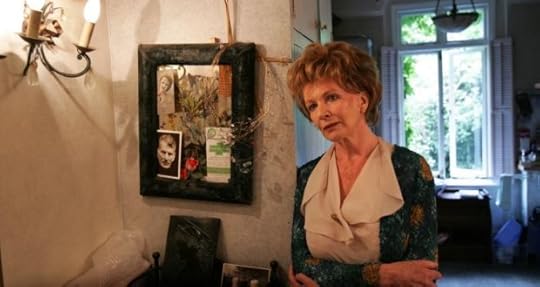
Edna O'Brien (n. 1930) - Fotografia: Frank Miller

April 18, 2019
Depois de lido à lupa, fica sobretudo a mestria da linguagem cuja tradução me exigiu uma multiplicidade de recursos — e me deu prazer em medida próxima. Confesso-me, todavia, algo aliviado por sair das profundezas destas trevas. Mas desengane-se quem pensa que isto é a mera história de uma psicose que assassina. A escrita de Edna O'Brien é de uma mestria irrepreensível e de uma profundidade rara.

December 4, 2014
I started into this novel with the wrong idea, thinking it would be a murder mystery—instead, I found a kind of murder documentary and it took me a while to get my mindset altered to properly appreciate it. I’m not sure I actually achieved that switch in outlook.
Based on an actual person and the murders he committed, In the Forest charts a life that has run off the rails. O’Kane starts life with mental illness, losing his mother, being brutalized by his father, and ending up in custody where things continue just as cruelly. When he is finally released, he returns to his home territory, hearing voices and determined to bring the same kind of horror to those who didn’t help him when he was a child.
We watch as he takes up residence in the forest (perhaps being wilderness as opposed to civilization) and takes the ultimate revenge on people who represent the things that he has desperately wanted: a little boy with a mother who loves him, a woman who would love him as an adult, and a male authority figure who is kind to him.
The writing is excellent, very evocative. I appreciated that the author did not describe the ultimate violence—however, I found that my imagination provided the details only too well. I will definitely be reading more of Edna O’Brien’s fiction in the future.
Based on an actual person and the murders he committed, In the Forest charts a life that has run off the rails. O’Kane starts life with mental illness, losing his mother, being brutalized by his father, and ending up in custody where things continue just as cruelly. When he is finally released, he returns to his home territory, hearing voices and determined to bring the same kind of horror to those who didn’t help him when he was a child.
We watch as he takes up residence in the forest (perhaps being wilderness as opposed to civilization) and takes the ultimate revenge on people who represent the things that he has desperately wanted: a little boy with a mother who loves him, a woman who would love him as an adult, and a male authority figure who is kind to him.
The writing is excellent, very evocative. I appreciated that the author did not describe the ultimate violence—however, I found that my imagination provided the details only too well. I will definitely be reading more of Edna O’Brien’s fiction in the future.

December 28, 2019
O'Kane matou um padre, uma mulher e uma criança.
Não tinha quem o defendesse porque a mãe estava morta e com dez anos surripiou uma arma para não sentir medo. Foi preso e enviado para uma casa de correcção onde foi torturado e violado por colegas e religiosos responsáveis pela sua educação/correcção. Fora uma criança de dez e onze e doze anos, e depois deixara de ser criança porque havia aprendido as coisas cruéis que lhe ensinavam nos lugares com nomes de santos.
Terminada a sua "educação" regressa a casa. Perante a indiferença da comunidade, tem comportamentos reveladores de loucura e ódio que culminam em assassínio.
Legalmente, O'Kane é o único culpado do triplo homicídio...
Não tinha quem o defendesse porque a mãe estava morta e com dez anos surripiou uma arma para não sentir medo. Foi preso e enviado para uma casa de correcção onde foi torturado e violado por colegas e religiosos responsáveis pela sua educação/correcção. Fora uma criança de dez e onze e doze anos, e depois deixara de ser criança porque havia aprendido as coisas cruéis que lhe ensinavam nos lugares com nomes de santos.
Terminada a sua "educação" regressa a casa. Perante a indiferença da comunidade, tem comportamentos reveladores de loucura e ódio que culminam em assassínio.
Legalmente, O'Kane é o único culpado do triplo homicídio...
December 17, 2019
«O que perverterá uma criança...o que fará com que uma criança deixe de ser uma criança?» - página 191
Foi a prosa de Edna O'Brien que, de imediato, me prendeu ao livro; sendo esta já motivo suficiente para ler «Na Floresta», mas a intrigante construção da história, o suspense que a acompanha e a terrível aura que a caracteriza mantém-nos interessados até ao fim - mesmo conhecendo o seu desfecho desde o início. «Na Floresta» alojou-se-me no pensamento, permanecendo comigo mesmo quando não o estava a ler.
Não é todos os dias que encontramos tamanha violência, loucura e sofrimento narrados de modo tão delicado e poético, sem que tal se faça sentir como grosso contraste, pelo contrário, prosa e conteúdo validam-se um ao outro.
A narrativa vai sendo enriquecida pelas diferentes perspectivas daqueles que, de uma maneira ou de outra, foram afectados por O'Kane. E aqui, mais uma vez, fica exposto o talento da escritora: não nos sentimos minimamente confusos por esta intercalação de pontos de vista, cada um vem acrescentar autenticidade à história, trazer novas variáveis a ter em conta para formarmos a nossa opinião e mostrar que as coisas não são lineares. Claro que o julgamento possível é apenas um, mas é importante tentar perceber o desencadeamento destas situações, o que leva a progressões tão negativas e drásticas.
«Na Floresta» expõe a falta de coragem da sociedade para lidar com casos do género, a facilidade com que finge não estar a ver, desamparando os mais necessitados e deixando que se tornem vítimas de algo pior até serem eles próprios os vilões. Uma sociedade que, no fim, se vê cinicamente surpreendida pelo resultado.
Este livro é muito mais do que a história de um triplo homicídio. Edna O'Brien construiu com enorme mestria uma alma em sofrimento, presa ao último fio de sanidade, convertendo toda a sua loucura em pura maldade.

February 9, 2023
" Na entrada mais distante sob a curva de uma montanha sombria há uma cabana de madeira estrangulada por um silvado onde uma cabra morta se decompôs e tresanda durante aqueles tumultuosos e tristes dias suspensos. Foi nesse tempo que o bosque perdeu o seu antigo nome e a sua velha inocência no coração das pessoas. "
Baseado num caso real, um triplo homicídio ocorrido em Abril de 1994 no condado de Clare, na Irlanda, Na Floresta conta-nos através da perspectiva da escritora Edna O'Brien, o que esteve por trás desta tragédia.
Michen O'Kane era um menino timido, amoroso e super protegido que aos 11 anos muda completamente de personalidade após a morte da mãe, torna-se uma criança revoltada, violenta e perturbada psicologicamente. Por ordem do Estado é institucionalizado no Castelo, dirigido pela Igreja Católica onde é abusado tanto física como psicológicamente, é tratado como lixo, humilhado, agredido e abusado sexualmente tanto pelos padres que o deviam proteger como pelos colegas mais velhos. Devido a todos estes abusos Mitch vai-se moldando como homem, e vamos acompanhando no decorrer da narrativa esta mudança, vamos "entrar" na sua cabeça extremamente perturbada e perceber realmente o que esteve por trás da sua obsessão por Eily e o que o levou a matá-la juntamente com o seu filho Maddie de 4 anos e pelo caminho matar um padre da região ( tudo isto não é spoiler).
Este livro tem uma carga emocional enorme, é doloroso ver o sofrimento de Michen e vê-lo a chegar a um estado de loucura e violência enormes que o levaram a cometer um crime horrível que chocou uma pequena comunidade rural irlandesa bem como todo o país.
Baseado num caso real, um triplo homicídio ocorrido em Abril de 1994 no condado de Clare, na Irlanda, Na Floresta conta-nos através da perspectiva da escritora Edna O'Brien, o que esteve por trás desta tragédia.
Michen O'Kane era um menino timido, amoroso e super protegido que aos 11 anos muda completamente de personalidade após a morte da mãe, torna-se uma criança revoltada, violenta e perturbada psicologicamente. Por ordem do Estado é institucionalizado no Castelo, dirigido pela Igreja Católica onde é abusado tanto física como psicológicamente, é tratado como lixo, humilhado, agredido e abusado sexualmente tanto pelos padres que o deviam proteger como pelos colegas mais velhos. Devido a todos estes abusos Mitch vai-se moldando como homem, e vamos acompanhando no decorrer da narrativa esta mudança, vamos "entrar" na sua cabeça extremamente perturbada e perceber realmente o que esteve por trás da sua obsessão por Eily e o que o levou a matá-la juntamente com o seu filho Maddie de 4 anos e pelo caminho matar um padre da região ( tudo isto não é spoiler).
Este livro tem uma carga emocional enorme, é doloroso ver o sofrimento de Michen e vê-lo a chegar a um estado de loucura e violência enormes que o levaram a cometer um crime horrível que chocou uma pequena comunidade rural irlandesa bem como todo o país.

July 21, 2013
I found this to be a strange novel because while I wasn’t grabbed by the plot, I was engrossed by the style. O’Brien’s prose is, in fact, lush, and she quite easily moves between points of view without confusing the reader. Her voice changes as she adopts different characters. The use of multi-view narrative to tell a tragic story of a mentally ill person who does not really elicit sympathy because of his language and actions combined with the people surrounding him who live in a combination of fear and pity. It ends, as most things do, badly. In this complex narrative, O’Brien nudges the reader to think about the society and the responsible the society has to each member. One does one deal with a person who transcends society not because of will but because of illness or disability. It’s a strange story and worth reading.


March 18, 2023
An engrossing, engaging, sometimes unsettling short novel about a menacing young man, Michael O’Kane. He lost his mother when a very young boy and by the age of ten he is incarcerated for petty crimes in juvenile detention centers. The killing instinct has kindled him. His neighbours call him “the kinderschreck”, that is, someone of whom small children are afraid. After being released from detention, he comes back to the countryside of Western Ireland where he was brought up and behaves in a manner that brings justified fear to the locals.
The novel is based on a true crime story that occurred in 1994.
Another well crafted, concisely written Edna O’Brien novel.
This book was first published in 2002.
The novel is based on a true crime story that occurred in 1994.
Another well crafted, concisely written Edna O’Brien novel.
This book was first published in 2002.

November 27, 2020
I'm not sure I've read a 'true crime' novel which sticks as closely as this does to the original murders. Perhaps unsurprisingly on its publication in 2002, it attracted plenty of controversy, the main complaint being that it was only 8 years after the shocking killings, dust had not had the chance to settle. It is understandable that an attempt to impose a fictional outline over the atrocities would stir up the grief in the local communities, and especially those more directly involved.
However, O'Brien writes with tact and sympathy, and the result is a memorial to innocence and unprovoked destruction of beauty. She excels in descriptions of the woodland early in the piece, such a contrast to its irreversible contamination by the horrors that were to follow. Along with those images of the woodland is the colourful, slightly offbeat Ireland of the 90s, musical pub sessions, and a festive atmosphere, giving effervescence to the desolation we know will follow.
Reading it 25 years after the murders is I suspect, very different; with the passing of time it is possible to see it as a sort of distorted fairy tale, the demented O'Kane, overcome by spite, the personification of terminal maladjustment.
However, O'Brien writes with tact and sympathy, and the result is a memorial to innocence and unprovoked destruction of beauty. She excels in descriptions of the woodland early in the piece, such a contrast to its irreversible contamination by the horrors that were to follow. Along with those images of the woodland is the colourful, slightly offbeat Ireland of the 90s, musical pub sessions, and a festive atmosphere, giving effervescence to the desolation we know will follow.
Reading it 25 years after the murders is I suspect, very different; with the passing of time it is possible to see it as a sort of distorted fairy tale, the demented O'Kane, overcome by spite, the personification of terminal maladjustment.

March 29, 2019
Κάτι μου πήγε λάθος σε όλο το βιβλίο... Δε μπόρεσα να συνηθίσω την γραφή και γενικότερα τον τρόπο παρουσίασης των χαρακτήρων και των γεγονότων... Ίσως δεν ήμουν στην κατάλληλη διάθεση για το συγκεκριμένο είδος...

June 18, 2008
Set in western Ireland, this novel is based a story of terror that took place in Ireland in 1994. It is a disturbing and devastating story of a mass murderer- from his tragic childhood to the height of his murder spree- and the community that seems helpless to stop him, or worse- that unwittingly aids him in his crime spree. It shows a society in denial of the abuse of children in detention and in school, easily abandoning its own, and unwilling to believe that they have unleashed a monster.
Paradoxically, O'Brien's writing is so lovely, so gentle and intimate- as much as you want to turn away from the horrific acts of violence, you are cradled in the beauty of her prose.
Paradoxically, O'Brien's writing is so lovely, so gentle and intimate- as much as you want to turn away from the horrific acts of violence, you are cradled in the beauty of her prose.

January 19, 2010
This was mostly a murder mystery, based on a true story. Trigger warnings: violence, animal abuse, a child dies. Not terribly grisly, mostly psychological thriller.
The families of the real life murder victims were reportedly not happy with O'Brien's fictional account of their loved ones' lives and deaths. She never said she was reporting, but instead basing her story on a very tragic real-life event. Still, in their place, I would probably not be happy either.
The families of the real life murder victims were reportedly not happy with O'Brien's fictional account of their loved ones' lives and deaths. She never said she was reporting, but instead basing her story on a very tragic real-life event. Still, in their place, I would probably not be happy either.

January 12, 2016
This book draws the best of every genre into this utterly heartbreaking book. It has been years since I read this and I can still remember sobbing uncontrollably and pleading with the writer not to do what I knew she was about to do. And she did it!
This book gave me nothing but pain but I would read it again in a heartbeat.
This book gave me nothing but pain but I would read it again in a heartbeat.

December 20, 2015
Based very loosely on a true story, this follows paranoid schizophrenic Michen O'Kane as he murders a mother and child, then the priest that he summoned to give them the last rites, before finally the guarda (cops) close in. The book falls into three very (very) roughly equal parts: (1) the back stories of both Michen and his first two victims, Eily and her toddler son Maddie; (2) the crimes and the manhunt; (3) the aftermath, as Michen goes on trial and descends ever deeper into his alienation and madness.
This is, I think, the first of O'Brien's novels that I've read, and for the most part I was very impressed. Her use of language can be, at its best, quite astounding, full of wonderful lyrical flourishes and brightly realized images. On the other hand, there's only a thin line between gloriously idiosyncratic prose and Pseuds' Corner, and every now and then -- not so very often but nonetheless too often -- O'Brien stumbles over this boundary: "He is crying then, his teeth eating his tears" (p248), for example.
Sometimes, too, the text lapses into incoherence, and there are some idiotic continuity errors -- idiotic in that there's no aesthetic reason for them, just sloppiness. On pp139-40, for example, we're told that "It was the first sound of [Fiona's] voice since he had come in," and yet, oops, at the top of page 139 Fiona has shouted to him, as he entered the shop, "We're not open, we're not open!"
Allied to this are willful changes of tense from present to past or vice versa mid-paragraph, and sometimes (if memory serves) even mid-sentence. O'Brien doesn't seem to be using this tense-related chaos for any particular narrative purpose, just, I think, in an effort to look artsy.
Much of the narrative is done from inside Michen's head, in what I assume is an attempt to depict paranoid schizophrenia, and I had problems with this aspect too. Like most of us, I haven't known too many paranoid schizophrenics, but I've known quite well a couple of friends who've suffered, at the very least, related diseases. O'Brien gets some parts of her portrayal of Michen's mindset right; it may be that she has the whole of it right, but often and again I was looking askance at the page at something that didn't seem to ring true. Michen's view of the world, in other words, seemed less like a paranoid schizophrenic's, more like an author's idea of what a paranoid schizophrenic's mind should be like.
So much for my reasons for unease with the test. What about the good things?
Well, as implied above, when O'Brien is getting her prose right, which is by far the most of the time, it's enough to make the hairs on the back of my neck stand on end. This she manages while making her text quite infernally readable. If some of her characters are straight out of Central Casting, enough of the main ones are so excellently drawn that it's hard to believe they're not real: Eily, Kitty (the girl whom Michen abducts as a sort of replacement Eily), O'Mara (the retired cop brought in to help in the interrogation of Michen), and others; and it's superb that O'Brien chose to dodge the cheap trick of painting the toddler Maddie as a cute, angelic little sweetie-pops and instead made him a bit of a self-centered brat -- a real child, in other words. Overall, the book has the pace of a thriller even if, at the end, there's no satisfying conclusion, no closure, of the kind a thriller might have.
In short, a book that's very well worth reading even if you might find you come away from it with reservations.
=====
As an aside, Goodreads (unless it's just moi) seems to have done away with the Preview function. Elderly geezers like me rely on the Preview function to help them get at least most of the typos and idiocies out of their texts. Let's hope the function is returned Real Soon Now.
This is, I think, the first of O'Brien's novels that I've read, and for the most part I was very impressed. Her use of language can be, at its best, quite astounding, full of wonderful lyrical flourishes and brightly realized images. On the other hand, there's only a thin line between gloriously idiosyncratic prose and Pseuds' Corner, and every now and then -- not so very often but nonetheless too often -- O'Brien stumbles over this boundary: "He is crying then, his teeth eating his tears" (p248), for example.
Sometimes, too, the text lapses into incoherence, and there are some idiotic continuity errors -- idiotic in that there's no aesthetic reason for them, just sloppiness. On pp139-40, for example, we're told that "It was the first sound of [Fiona's] voice since he had come in," and yet, oops, at the top of page 139 Fiona has shouted to him, as he entered the shop, "We're not open, we're not open!"
Allied to this are willful changes of tense from present to past or vice versa mid-paragraph, and sometimes (if memory serves) even mid-sentence. O'Brien doesn't seem to be using this tense-related chaos for any particular narrative purpose, just, I think, in an effort to look artsy.
Much of the narrative is done from inside Michen's head, in what I assume is an attempt to depict paranoid schizophrenia, and I had problems with this aspect too. Like most of us, I haven't known too many paranoid schizophrenics, but I've known quite well a couple of friends who've suffered, at the very least, related diseases. O'Brien gets some parts of her portrayal of Michen's mindset right; it may be that she has the whole of it right, but often and again I was looking askance at the page at something that didn't seem to ring true. Michen's view of the world, in other words, seemed less like a paranoid schizophrenic's, more like an author's idea of what a paranoid schizophrenic's mind should be like.
So much for my reasons for unease with the test. What about the good things?
Well, as implied above, when O'Brien is getting her prose right, which is by far the most of the time, it's enough to make the hairs on the back of my neck stand on end. This she manages while making her text quite infernally readable. If some of her characters are straight out of Central Casting, enough of the main ones are so excellently drawn that it's hard to believe they're not real: Eily, Kitty (the girl whom Michen abducts as a sort of replacement Eily), O'Mara (the retired cop brought in to help in the interrogation of Michen), and others; and it's superb that O'Brien chose to dodge the cheap trick of painting the toddler Maddie as a cute, angelic little sweetie-pops and instead made him a bit of a self-centered brat -- a real child, in other words. Overall, the book has the pace of a thriller even if, at the end, there's no satisfying conclusion, no closure, of the kind a thriller might have.
In short, a book that's very well worth reading even if you might find you come away from it with reservations.
=====
As an aside, Goodreads (unless it's just moi) seems to have done away with the Preview function. Elderly geezers like me rely on the Preview function to help them get at least most of the typos and idiocies out of their texts. Let's hope the function is returned Real Soon Now.

December 23, 2020
I've marked this book as "read" but actually I didn't finish the book because I knew how it ended - I remembered how it ended, and didn't want to relive it. Going in, I knew the book was based on the real murder case but assumed it would be altered, characters physical characteristics changed, in other words, that it would be a work of fiction. Instead I was reading an account, overlaid with the author's presumptions of knowing the people involved and their thoughts, of the tragic death of someone I had met. When I was young, I knew Imelda Riney's brother; not well but we hung out in the same figure of eight in Dublin; he was a sweet fellow and I enjoyed running into him. One night he brought Imelda with him to our regular haunt, the Bailey Pub, and introduced us. She was just 18 at the time, a gorgeous and luminous girl and without any trace of conceit - in fact just as described in the "novel" down to her waist-length wild curly red hair. Some years later, watching a news segment on the search for Imelda and her son, Liam, on TV, I saw her brother among the family members and was appalled to realize that the missing woman was the girl I had met that night in the Bailey. And then, a few days later, when they were found I, along with the rest of the country, was horrified and devastated at the outcome. So, it was with a creeping sense of horror and, yes, outrage, that I read the book, "In the Forest," to discover how closely O'Brien had kept to the real-life events, how she hadn't bothered to even alter the physical characteristics of Imelda. I reached a point where I had to put it down as, in reading it, I felt as if I was colluding in the exploitation of that tragedy.
There have been many apologists for this book and even some reviewers who have claimed the negative press in Ireland was Irish begrudgery and petty jealousy at O'Brien's international success, eg: Ronan Bennett in the Guardian. This, in my opinion, is a cheap shot at the reception of the book in Ireland, and untrue. For starters, O'Brien has never, to my knowledge, been resented in Ireland, the opposite in fact. Ireland was proud of her and she is widely read there; as a writer, she was the hero of my youth and that of my friends'. While the book certainly illustrates failings on the part of social services in Ireland, I feel O'Brien could have exposed those failings without exploiting, for profit, a real life tragedy and one so recent at the time the book was published that the families and friends of the victims were still raw and grieving. That said, I read it at least 10 or more years after it was published and, despite being only an acquaintance of Imelda's brother and since having lost contact with him, I still found it sickening.
There have been many apologists for this book and even some reviewers who have claimed the negative press in Ireland was Irish begrudgery and petty jealousy at O'Brien's international success, eg: Ronan Bennett in the Guardian. This, in my opinion, is a cheap shot at the reception of the book in Ireland, and untrue. For starters, O'Brien has never, to my knowledge, been resented in Ireland, the opposite in fact. Ireland was proud of her and she is widely read there; as a writer, she was the hero of my youth and that of my friends'. While the book certainly illustrates failings on the part of social services in Ireland, I feel O'Brien could have exposed those failings without exploiting, for profit, a real life tragedy and one so recent at the time the book was published that the families and friends of the victims were still raw and grieving. That said, I read it at least 10 or more years after it was published and, despite being only an acquaintance of Imelda's brother and since having lost contact with him, I still found it sickening.
August 24, 2011
This is the novel that gave O'Brien so much trouble b/c she was prompted to write it by a real and gruesome murder case in the 1990s. She was accosted by legions of people for using a painful tragedy to create a novel. On that topic: I have always believed that no one has the right to tell an author what to write, and if O'Brien wished to build a fictional narrative, having known of and researched a real crime, she had every right to do so. And, of course, she's never been one to run away from controversy. I thought the novel was excellent. As I've mentioned before, I am able to read about anything in terms of violence and gruesomeness, which is not to say that renderings do not disturb me and cause me pain; my barometer is whether or not it is well-written. O'Brien acquits herself admirably. The criminal is horrid, the victims are innocent, the portrayals of each of the characters (murderer, victims, an extensive, complicated cast of others, all of whom seem necessary) are totally believable and finely wrought, and the descriptions of all the rural settings are magnificent. The criminal has definitely been mismanaged and has sometimes been ill-handled during his troubled youth, but this does not lead O'Brien's narrative voice to exempt or excuse him in any way. While absorbing the horror of this man's actions and while absorbing the mad rantings of his thoughts, we are exposed to such tremendous flaws in the Irish social services' system, Church institutions, educational system, the Garda (they were probably disturbed mostly b/c they came across as complete idiots and/or unconcerned layabouts for such a long time before getting down to some police work) - in short, there was almost complete incompetence and inability to deal with serious situations, on many levels. By building these realities into the story and by not being didactic, O'Brien succeeds briliantly in this most troublesome, unhappy novel.

March 2, 2015
This story really happened. Maybe not quite the way O'Brien relays it, but it's true. A woman and her child were abducted and murdered, and then a priest was taken and killed soon after, all by a young man who heard voices and exhibited lots of signs of mental illness. He had been placed in institutions early in his life and suffered horrific abuse at the hands of authorities. Does this make him less responsible for his crimes? Is he a victim as well?
I found this book compelling. I'm a mental health professional and perhaps that's one of the reasons why, but I ended the book feeling so sad for all involved. The murderer, the victims, the psychiatrist who tried to treat him, the towns that were terrorized... what devastation. O'Brien's novelization is so well written. This is my first book of hers and I look forward to reading more. I understand why she was so controversial in Ireland- she writes about what no one wants to admit.
Food: unevenly cooked steak. Chewy in some parts, too bloody in others, but not a piece of meat you regret eating.
I found this book compelling. I'm a mental health professional and perhaps that's one of the reasons why, but I ended the book feeling so sad for all involved. The murderer, the victims, the psychiatrist who tried to treat him, the towns that were terrorized... what devastation. O'Brien's novelization is so well written. This is my first book of hers and I look forward to reading more. I understand why she was so controversial in Ireland- she writes about what no one wants to admit.
Food: unevenly cooked steak. Chewy in some parts, too bloody in others, but not a piece of meat you regret eating.

January 9, 2013
Although Edna O'Brien got a lot of negative feedback in regard to this novel from the loved ones of the murder victims, (who the story is based around) as well as from the public, something about this book is always going to stay with me. O'Brien manages to hold the reader's attention effortlessly with the way she tackled the many different perspectives of those portrayed in this work. This is the first time I have read a book that alternates between the mindsets of each personality so candidly and with such conviction. While reading this, you never know what new character you will meet, or what part of the grisly story they have to tell; the details conveyed from each person being integral.
Her narrative spins its web in a way that does not touch or reveal the emotions of the author; rather it is a story that serves its purpose and feeds the curiosity of the reader in all ways. I give this book an extremely high rating, because I know without a doubt that I will always remember it.
Her narrative spins its web in a way that does not touch or reveal the emotions of the author; rather it is a story that serves its purpose and feeds the curiosity of the reader in all ways. I give this book an extremely high rating, because I know without a doubt that I will always remember it.

March 14, 2020
I rarely read up on the books that I'm picking, which leads to me not knowing more about a book than whatever is written in the blurb on its cover. In reading In The Forest, I'm really happy I didn't look up more information on it before I started.
In The Forest is based on a true story. One that scared and shocked me. This is an exceptional example of how real life can be stranger than fiction. It tells the story of a triple murder in the west of Ireland where, in 1994, a young man with serious mental issues killed a young mother, her 3-year-old son and a priest. It's unnerving, it's devastating and it made me angry at Ireland back in those times.
Enda O'Brien has an undisputable gift for words. The way she makes all emotions run through you as you read her writing, the way she describes scenes of violence and affection in such an observant way. She does not try to convince you of anything, or push you into feeling a particular way, she is only there to write down the story of a horrible tragedy and leave you decide what you want to feel. I admired that in this book.
In The Forest is based on a true story. One that scared and shocked me. This is an exceptional example of how real life can be stranger than fiction. It tells the story of a triple murder in the west of Ireland where, in 1994, a young man with serious mental issues killed a young mother, her 3-year-old son and a priest. It's unnerving, it's devastating and it made me angry at Ireland back in those times.
Enda O'Brien has an undisputable gift for words. The way she makes all emotions run through you as you read her writing, the way she describes scenes of violence and affection in such an observant way. She does not try to convince you of anything, or push you into feeling a particular way, she is only there to write down the story of a horrible tragedy and leave you decide what you want to feel. I admired that in this book.
This entire review has been hidden because of spoilers.

November 12, 2011
Moody, even "Gothic" (as at least one reviewer suggested), this novel tells the story of three horrific murders in West Ireland countryside. Based on a true story, it recounts the story of a young man who was locked away in a juvenile facility, subject to horrific abuse both sexual and otherwise, who now returns to his home town to wreak revenge. He is obviously mentally ill. There is no sympathy for him and a lot of fear. The local constabulary is afraid of him. Soon he sets his sights on a young mother and her child....This is literary fiction at its best. It's not a fast read. I had to go back a few times to check things that I had read. O'Brien is an amazing writer. She lives in London. One article I read said that she is not welcome in Ireland. I can see why. She as no patience for the Irish adherence to Roman Catholicism. The abuse that children have suffered there at the hands of the clergy is well known. I loved this book. It challenged me. I enjoy the challenge of a literary writer such as O'Brien and plan to read more. I read a lot of crime fiction. This is crime fiction with a literary twist. No sex, no violence but dark, dark, dark....

July 25, 2018
As always with Edna O’Brien, the writing is gorgeous. But it isn’t an easy book to read, and despite ultimately deciding on four stars, it isn’t a book I can recommend to everyone. A reader has to be prepared to enter the chaotic mind of a young man who is turned into a killer through familial and societal neglect and failure by the various correctional institutions he passes through for first petty then increasingly violent crimes. Since it is based on a true story of a triple murder in County Clare some years ago (with some details changed to indicate that it is fictionalized), the outcome for the victims is sadly inevitable. But the book still retains a large aura of mystery: the why of this particular young man’s descent into horrific criminality and the varying reactions of the people in the district, ranging from fear and repulsion to attempting, many, in their own way to help him if only in small ways. There are really no answers in the telling of this tale, but there are many authentic renderings of human behavior laid bare that the reader is left to ponder, to no easy conclusion. Which seems to be O’Brien’s point.

December 15, 2008
Beautiful descriptions (and i usually feel like i'm slogging through a novel if it has this much descriptiveness about objects and places) and a great array of voices tell the story of a murderer and his crime and the place where it happened and the people it happened to.
Compare this Irish novel of murder with Flann O'Brien's The Third Policeman and John Banville's The Book of Evidence.
Highly recommended for anybody who loves good writing; anybody who wonders not only what madness might be like but what it might be like to have a madman among your people.
This book deserves a much better overview, but i don't feel up to the task. Just read it!
Compare this Irish novel of murder with Flann O'Brien's The Third Policeman and John Banville's The Book of Evidence.
Highly recommended for anybody who loves good writing; anybody who wonders not only what madness might be like but what it might be like to have a madman among your people.
This book deserves a much better overview, but i don't feel up to the task. Just read it!

June 20, 2016
#1001books #747left
This does an excellent job depicting mental illness and the damage it can inflict on a community/country when it is ignored and untreated. Again, people see and hear things, but do nothing to prevent awful, terrible things from happening. I'm not just talking about the police but the people from the villages who knew the guy and sat back because they were afraid he would come for them next. I understand cowardice. I truly do. But there are times in life when you really have to stand up for what is right--even if it is dangerous. That is what I believe, and if more people believed as I did, took threats more seriously--perhaps many terrible, awful, tragic things like the ones described in this book (based on a true story) would not happen as often as they do.
*end rant*
This does an excellent job depicting mental illness and the damage it can inflict on a community/country when it is ignored and untreated. Again, people see and hear things, but do nothing to prevent awful, terrible things from happening. I'm not just talking about the police but the people from the villages who knew the guy and sat back because they were afraid he would come for them next. I understand cowardice. I truly do. But there are times in life when you really have to stand up for what is right--even if it is dangerous. That is what I believe, and if more people believed as I did, took threats more seriously--perhaps many terrible, awful, tragic things like the ones described in this book (based on a true story) would not happen as often as they do.
*end rant*

February 25, 2008
This book was written the way I wrote horror novels when I was in the 4th grade and I was obsessed with R.L. Stine. Except less engrossing.
I have no idea why anyone would list this as a good book, let alone on the "1001 Books You Must Read Before You Die." The characters were completely undeveloped. I felt no pity for the victims, or the perpetrator, nor did I feel like O'Kane was even portrayed as a successful murderer or mental patient. He was sort of lame.
When I started reading it, I thought the first chapter was written like a child because we were supposed to be seeing through his eyes as a child, but it turned out the entire book was written that way. I just wanted it to be over, and I honestly didn't care at all what happened to any of the characters.
Don't bother.
I have no idea why anyone would list this as a good book, let alone on the "1001 Books You Must Read Before You Die." The characters were completely undeveloped. I felt no pity for the victims, or the perpetrator, nor did I feel like O'Kane was even portrayed as a successful murderer or mental patient. He was sort of lame.
When I started reading it, I thought the first chapter was written like a child because we were supposed to be seeing through his eyes as a child, but it turned out the entire book was written that way. I just wanted it to be over, and I honestly didn't care at all what happened to any of the characters.
Don't bother.

March 9, 2018
3.5 stars

August 15, 2025
4,5 ⭐️
isto foi muito muito bom!
isto foi muito muito bom!
Displaying 1 - 30 of 236 reviews