A simple system of 100 logical pictorial symbols which can be operated and read like 1+2-3 in all lanuages. It can be typed and printed and used in international communication and commerce, industy and science. It contains also a simple semantics, logic and ethics, which even children can learn to use in their problems.
This afternoon, we visited Kathryn Gunn, one of the world's foremost experts on Blissymbolics. She showed me her copy of Semantography and I spent a couple of hours leafing through it. Seeing how interested I was, she very kindly offered to lend it to me, but I couldn't accept: it's an incredibly rare book, and the cheapest copy I could find online was priced at around $400. There was one being offered on eBay for around three times that.
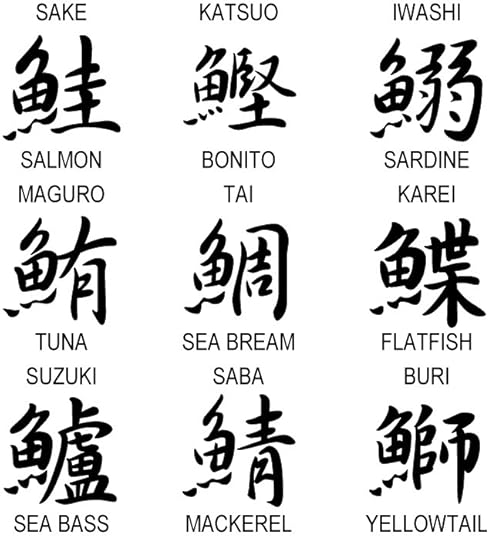
Kathryn, who knew Bliss personally, said he was both a very smart person and quite mad. This was indeed apparent from the book. The idea is elegant and clever: basically, Bliss symbols are to Chinese/Japanese characters as Esperanto is to Latin, in other words a reconstruction of the basic idea done in as rational a way as possible. As anyone who has tried to learn kanji will attest, real characters are ferociously difficult to remember. They do sort of make sense, in a way. Most large characters are composed of smaller elements, and the meaning of the large character is in many cases related to those of the elements. For example, if you look at this image:
you'll see that words for different kinds of fish generally contain the 'fish' element on the left. But, alas, it's rarely as good as this, and often it's impossible for anyone but an expert to understand why the character means what it does; as is so often the case, etymology depends on odd shifts and associations that are now deeply buried in the language. You are reduced to silly mnemonics and interminable rote memorization.
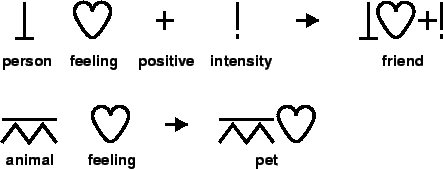
So why not start over? This what Bliss did, and the result is rather nice. Here are a couple of examples to give you the flavor of the thing:
In general, my feeling was that it would be very easy to learn to read Bliss symbols. Even after an hour of study, I knew a couple of dozen elements, and the combinations looked like they would be reasonably easy to remember. Some famous people liked Bliss's idea; he proudly displays an encouraging letter from Bertrand Russell. But somehow it never really took off. Kathryn and a few other people continue to work on it. It is used for teaching children with learning difficulties, and in some crisis situations. It's never become the major thing that Bliss wanted it to be.
The book is a mess - a thousand pages long, full of asides, with frequent rants about fascism, communism, religion and other things. I'm not sure if that's cause or effect. Bliss had had a hard life, and he was bitterly disappointed. But I still wonder if someone might pick it up and run with it one day. Basically, it seems to be a good idea that's just never found the right person to champion it. _________________________________________
It wasn’t actually the pope calling, it was one of his vatican underlings when my friend Kathryn picked up the phone.
‘Are you a Catholic?’
‘Err, no….’
‘Would you do your work for a Catholic?’
‘I do my work for anyone who needs it.’
‘What is the cost?’
‘I do not charge’
‘The pope needs a board for communicating. It needs to be in Latin, Polish and Italian.’
Kathyrn’s fame is world-wide if you are in the know. When the last pope was dying, he needed one of her boards to communicate. It is a combination of algebraic notation and Bliss symbols. She gave this example to me that she’d recently put together. It was for an English-speaking surgeon working in an operating theatre in Indonesia. Along the top is the local alphabet and along the side the local numbers for 1-10. This much the surgeon learns. In each square, referenced algebraic style is his word for something and then the Bliss symbol. Underneath is the local word for it. The Bliss symbol is most necessary in the case of users who have little or no literacy. The surgeon can also point, if necessary.
I’ve been finding out a little about speech recognition and translation between languages computer-style lately. It was eye-opening to see this technologically primitive method. According to Kathryn what she does is in demand because it is most reliable, both in terms of understanding between languages without hiccups and in terms of being technology free. It isn’t going to break down. It isn’t going to run out of power. In the field – and she gave the example of disaster situations – it is looked to because it works. I’m guessing also that these her boards can be developed very quickly for specific situations. I don’t know when software will be able to do that. Maybe it will transpire that however brilliantly software assisted speech recognition ends up developing, nonetheless at the level of disaster/emergency something like Kathryn’s system of Bliss symbols will always be used. Ie maybe the two methods will complement each other.
Bliss would be thrilled that his work was being recognised and utilised in such a way. When it was finally picked up in the early 1970s in Canada it was for the use of children to communicate who otherwise had difficulties. A laudable application, but Bliss had in mind something grandiose. He wanted a language of symbols to break down linguisitic barriers throughout the world and with that the negative cultural aspects of language. Growing up prior to WWII, being imprisoned in camps for a while, he associated language with evil intent in a way sociologists would deny these days, but which drove his ideas.
Another thing drove him. When he was young his father took him to a lecture given by a group of North Pole explorers. He was utterly taken by their fearless dedication to do this irrespective of danger to themselves. It gave him the desire to want to do great things, to give to the world. Like so many European migrants who came to Australia with wonderful gifts (he was a chemical engineer) to give in the post WWII period, he found he had to take on a manual factory line job. But perhaps it gave him the intellectual freedom to dedicate himself to the huge task he’d set himself to help mankind. Reading this reminded me of some of the scientists Smolen looks at in The Trouble with Physics, the ones who do the important big work are often not the ones in academia, who tend to spend a remarkably small amount of time doing research – ie thinking – but the ones who support themselves, again in menial labour, that frees their brains to do the important thinking that leads to major scientific breakthroughs.
An amazing man, I’m wondering now about visiting the NLA to look at his papers. I expect some fascinating tales are buried therein.
this book is a totem of idealism, if accompanied with the fragments of the authors biography that you could find online then you start to get personally attached to it. the idea presented is smart, although not as practical as the author likes to believe, and it probably won't be picked up by any real world political organizations but I see it as a very useful artistic concept that hasn't been used yet.
maybe someday Charles will be given the respect he deserves.