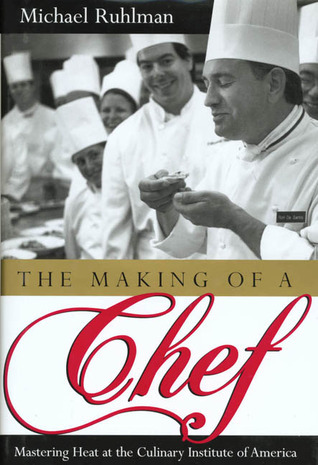
The distinguishing factor between a cook and a chef is the possession of a culinary degree. Michael Ruhlman had always considered himself a “cook”. While working towards his literature degree at Duke University, the author enjoyed trying new recipes and cooking for his friends, but never considered cooking as a profession. After graduating and realized his passion for food was only growing, he decided to enroll in the prestigious Culinary Institute of America in Hyde Park, New York. Documenting his experiences in The Making of a Chef, Ruhlman realized the amount of passion, time, and energy it takes in order to earn the title of “chef”. This memoir highlights the challenges of culinary school, shares different careers attainable with a culinary degree, and defines what traits are necessary to become a chef. Thus, this is a worthwhile read for anyone considering a career in the food industry.
Many regard the restaurant industry as stressful, grueling, but often rewarding. Michael provides the reader with a glimpse of the challenges he faced in culinary school, offering that these situations better prepared him for a cooking career. When a blizzard hit the school, Ruhlman called his chef instructor to tell him he was putting his safety in jeopardy by coming to class. Although the chef deemed this was an okay decision, Michael ultimately decided to venture through the snow. The instructor shared that if he did not make this decision, Ruhlman would have failed his class, sharing that, “’when chefs have to be somewhere, they get there. Chefs are the people who are working on Thanksgiving and Christmas, when everyone else is partying”’ (Ruhlman 68). Potential chefs have to be aware that there are no breaks or sick days in the profession. By sharing the facts and advice that chef instructors share with him in the memoir, Ruhlman effectively extends this knowledge to the reader. Further, Michael explains the frequent tests of morality that face you in culinary school. “I’d served numerous people chips that I knew very well were burnt, that I myself would never leave on the plate had they been served to me. I decided to do this. Why had I given something visibly inedible? Wasn’t this a question of morality? It was wrong, I knew it, but I did it anyway” (Ruhlman 142). The cooking industry is a very physical world; the food is either there in time for service or its not. Because of the pressure, sometimes culinary students would risk putting a less-than-perfect product on the plate versus no product on the plate. By later sharing the consequences of these actions, Ruhlman warns the potential chef to always use your best judgment in the kitchen.
Upon reading the title of the memoir, The Making of a Chef, one may believe the book shares the journey of Ruhlman working his way up in restaurants, as many believe the title of “chef” implies. However, he counters the belief that chefs only work in restaurants by sharing the professions his former classmates at the school are in. “Adam Shepard is the chef-owner of two restaurants called Lunetta, one in Manhattan and one in Brooklyn. Jill Davie has a show on the Fine Living Network and was a contestant on Iron Chef” (Ruhlman 6). This gives the reader an idea of what other culinary students pursue besides Ruhlman. Throughout the book, he is offering different perspectives on experiences during his time at the school. While he enjoyed the intense and fact paced nature of the school, he shared that other students felt burnt out and discouraged, “Dave said he was tired, had stayed up late the night before writing a paper on the cuisine of the American Norrthwest. ‘Food, food, food,’ he said, ‘that’s all you ever think about.’ He looked dizzy” (Ruhlman 131)
Through Ruhlman ’s anecdotes scattered throughout The Making a Chef, the reader learns the traits necessary to become a successful chef. After his blizzard incident, Michael shared a conversation with his instructor in which he gave him the key to achievement in the kitchen; presence. “’This is a physical world. The food is either finished at six o'clock, or it's not. You're either in the kitchen or you're not. Much of what was learned here here was why food behaved as it did. But sometimes there was no room for why. Sometimes why didn't matter. It wasn't simply that excuses were not accepted here-excuses had no meaning at all. The physical facts in any given moment-that was all.’" (Ruhlman 68). In addition, after serving a chef burnt chips and having to make new ones to deliver to the chef, Michael learned that a chef must own up to their mistakes. Any reader who is interested in entering the culinary industry learns through the author that these traits must be attained before entering the kitchen.
Stylistically, the memoir is very easy to read with short syntax and widely understood diction choices. Perhaps this is reflective of Michael’s newly learned communication methods during his time at The Culinary Institute of America. Michael frequently noted how chefs speak in short and simple words, often out of a need for efficiency and speed.
While Ruhlmann offers many pieces of advice to future chefs in the memoir, one question still plagues the reader after closing the book: should I attend culinary school? Ruhlmann provides no clear answer to this question. While the memoir centers around his experiences while attending one of the nation’s top cooking schools, he does not say if he recommends others to do the same. He begins the book by stating, “I’ve gotten a lot of e-mails over the years from people who have read this book. Many thank me for saving them from going to culinary school. A lot more say that this book is the reason they enrolled in culinary school. The most frequent question I get is this; ‘Is it worth it?’ Only you can make that call” (Ruhlman xvi) but offers no further information in the memoir about the advantages and disadvantages of either path. It is up to the reader to analyze the content of Ruhlman’s memoir and determine if attending secondary school for cooking is a good decision for themselves.
The Making of a Chef provides a glance of the experiences that attending culinary school entails. The author, Michael Ruhlman, effectively describes the challenges of earning a culinary education and highlights the traits required to succeed in the industry. Further, Ruhlman enhances his memoir by providing the perspectives of his classmates on their culinary journey. Whether one is serious about becoming a chef or simply enjoys trying new recipes, this memoir is a worthwhile read to get an insiders look into one of the nation’s fastest growing industries.