

What do you think?
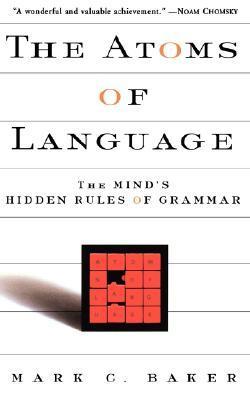
The Atoms Of Language: The Mind's Hidden Rules Of Grammar
Whether all human languages are fundamentally the same or different has been a subject of debate for ages. This problem has deep philosophical implications: If languages are all the same, it implies a fundamental commonality--and thus mutual intelligibility--of human thought.We are now on the verge of solving this problem. Using a twenty-year-old theory proposed by the world's greatest living linguist, Noam Chomsky, researchers have found that the similarities among languages are more profound than the differences. Languages whose grammars seem completely incompatible may in fact be structurally almost identical, except for a difference in one simple rule. The discovery of these rules and how they may vary promises to yield a linguistic equivalent of the Periodic Table of the Elements: a single framework by which we can understand the fundamental structure of all human language. This is a landmark breakthrough both within linguistics, which will herewith finally become a full-fledged science, and in our understanding of the human mind.
288 pages, Paperback
First published January 1, 2001
Ratings & Reviews
Friends & Following
Create a free account to discover what your friends think of this book!
Community Reviews
Displaying 1 - 30 of 43 reviews

February 3, 2009
The problem with linguistics is that it’s still wedded to the humanistic disciplines of anthropology and history, which have arbitrarily classified languages by lexicon, proximity or some other, unscientific criterion. In The Atoms of Language, Mark Baker uses the analogy of the periodic table of elements to argue that languages can be similarly – and more usefully – classified in terms of elements (“parameters”) that combine to produce the variety we see around us. As he writes in the preface: “These parameters combine and interact with each other in interesting ways…. Even though every sentence of Mohawk is different in its structure from corresponding sentences in English, and every sentence in English is different in its structure from corresponding sentences in Japanese, the ‘formulas’ for making sentences in these three languages differ in only one factor each.” (p. ix)
In Chapters 1-5, Baker identifies several preliminary parameters that identify a distinct language. These chapters can be heavy going for the general reader who doesn’t want to put forth some mental effort but Baker ameliorates matters by:
1. Warning you that it’s going to get complicated and telling you what to skip (though why anyone interested enough to pick up this book would want to skip parts is beyond me);
2. Providing you with a concise dictionary of linguistic terms that comes in handy when you forget what “ergative” means; and
3. Writing in a clear and accessible style.
These first chapters are interesting and informative and straightforward so I’m not going to dwell on them in this review; Baker illustrates 8 characteristics of language that he feels should be included in any parametric table, and for a linguistics geek like myself they’re fascinating:
1. Null subject
2. Head directionality
3. Subject side
4. Polysynthesis
5. Subject placement
6. Verb attraction
7. Serial verbs
8. Optional polysynthesis

It’s in the final two chapters, however, that Baker moves beyond the simple mechanics of parameters and gets into the philosophical “stuff,” and gets into the most interesting part of the book. He first tackles a schema for ordering his “elements”: “…parameters are ranked by their power to affect one another and their potentials for rendering each other irrelevant.” (p. 162) Using this criterion, “polysynthesis” become the first parameter – the “hydrogen” of the parametric table of languages. Whether a language opts to be polysynthetic (like Mohawk) or not (like English) determines how the remaining parameters interact, e.g., head directionality is prior to the subject side parameter, which is prior to verb attraction, etc. Baker commendably avoids over-determining language development. First, he’s offering only a preliminary suggestion of how a schema might be organized. And second, humans are not atoms subject to (relatively) iron-clad natural laws. Identifying parameters might help linguists predict a language’s syntax but can’t determine it. An example is Hindi, an Indo-European tongue, which is head-final and ergative in the simple past tense due to the influence of neighboring, non-IE languages on the Indian subcontinent. Another example is Amharic, where the verb follows its object. The parametric table would predict that Amharic should use postpositions but it doesn’t; it uses prepositions just like English and, as with Hindi, due to its proximity to SOV languages.
One cause of parametric change that’s observable is stylistic in origin. Old English is Japanese-like in having SOV word order but there is a convention that fronts the verb after conjunctions (e.g., Bob the ball threw, and bit the dog Mary). As verbs and their objects tend to attract each other, the tendency toward an SVO order became too powerful, and Middle English acquired the familiar syntax of modern English. A more recent example, and one that can be observed in real time, is the transformation of Quebec Eskimo from an ergative to an accusative language. (pp. 219-22)
Why does this occur? It occurs, in Baker’s estimation, because “human speech is unbounded, stimulus-free, and appropriate” and can’t be explained in wholly mechanical terms. (p. 223) A second factor is that people (esp. children) learn languages from the people around them. Studies have shown that absent “intentionality” and “interaction” people don’t learn a new language (so my dreams of learning Spanish by watching “Sabado Gigante” are just that – dreams). A third factor, also most present in the young, is that language learners can extrapolate from examples. It may be an inaccurate conclusion (like OE-speaking children coming to believe SVO was the correct English syntax) but if it reaches a critical mass it transforms a language. This latter factor is part of our general capacity to infer patterns and generalities from imperfectly understood specifics.
Baker is an acolyte of Noam Chomsky and assumes that there is a Universal Grammar lurking in the human brain. Most of my reading in linguistics has been with – if not outright anti-Chomskyans – at least authors with serious issues with UG. But I’m an agnostic on the subject; Chomsky’s insights (and those of his followers) are either going to be a part of any theory of language or their inadequacies will have to be addressed and resolved.
Baker defines the two prevailing viewpoints regarding diversity and development: “cultural transmission” and “evolutionary biology.” Neither of these can wholly account for the variety of languages nor for our ability to learn a language. Cultural transmission focuses on the plasticity of human nature and puts nurture before nature but adherents can’t explain why languages are diverse within a limited frame of reference. E.g., only 1% of nonpolysynthetic languages are OVS, and there’s only one (possibly) OSV language that has been studied to any extent yet 87% of nonpolysynthetic languages are SVO or SOV. (p. 128) (The proportions aren’t exact since they don’t incorporate every language but the ratios are probably close to reality.) There’s also the problem that a culture’s grammar bears no discernable relationship to other cultural artifacts.
Baker’s chief objection to evolutionary biology is that it doesn’t explain why language capacity doesn’t extend to a complete, fixed and truly universal grammar. Or why diversity confers any advantage at all. In fact, most theorists aren’t even concerned with the questions Baker wants to ask. Baker is limited to pointing out the limits of current theories since the state of knowledge is still in its infancy.
The first hypothesis we can dispense with is that there’s a physical reason why parameters are in a language. There’s no evidence for this, however. Even in the face of our ignorance, nothing suggests such a necessity so Baker dismisses this option.
A second theory says that parameter-based language ability (PLA) is an accident of evolution. A conceptual system similar to that of apes evolved with a parametric component and fortuitously conferred an advantage over other hominids. But Baker fiercely resists any suggestion that parameters are evolutionary spandrels. So this idea too is dismissed as inadequate.
Other possibilities have been offered by Steven Pinker and Paul Bloom: “…some facets of language might have been so easy to learn with the cognitive apparatus that was already in place when a gene-based language recipe appeared on the scene that there was no pressure to specify those facets.” (p. 213) This suggestion has significant problems, however, and ends up being as inadequate as other theories but it’s headed in the right direction. A second hypothesis, also derived from Pinker, argues that a PLA makes it possible for individual speech to stay in tune with a group’s communications. Essentially, people construct language from individual recipes that would express themselves externally in a common tongue. (p. 214) Unlike many other hypotheses, this one is potentially testable but studies that touch on the question tangentially suggests that this can’t be true.
Ultimately then there’s no remotely adequate explanation for why a parametric table of languages would exist. It’s here that Baker speculates most freely. He distinguishes between two types of problems: There are puzzles, which are questions that can be answered using traditional scientific theories and procedures, e.g., Fermat’s Theorem. Then there are mysteries, which are questions that appear irresolvable with current theory and practice, e.g., why would one language “opt” to be polysynthetic and another not? A mystery is a puzzle, the “difference is that those explanations happen to be outside the range of what the human mind can grasp.” (p. 228) It’s in this latter category that Baker puts PLA. For him, it’s dependent upon how the human mind relates to the external world, a subject we’re only beginning to understand and for which we have only the most primitive tools.
Baker doesn’t fall into the Intelligent Designers’ fallacy of saying we can’t understand a mystery – who would have believed a century ago how many “mysteries” have been reduced to “puzzles” if not solved? – and doesn’t say we’ll never resolve the dilemma but he entertains the possibility that our minds are simply not capable of resolving the dilemma.*
In the end I would recommend this book to my fellow linguistics geeks. It’s given me a new perspective for looking at languages, their histories and their development.
* Once again I am reminded of Olaf Stapledon’s Last and First Men and Star Maker: Two Science Fiction Novels. The First Men (us) were aware of “mysteries” but they didn’t have the brains to solve them, and it drove them insane as a species.
In Chapters 1-5, Baker identifies several preliminary parameters that identify a distinct language. These chapters can be heavy going for the general reader who doesn’t want to put forth some mental effort but Baker ameliorates matters by:
1. Warning you that it’s going to get complicated and telling you what to skip (though why anyone interested enough to pick up this book would want to skip parts is beyond me);
2. Providing you with a concise dictionary of linguistic terms that comes in handy when you forget what “ergative” means; and
3. Writing in a clear and accessible style.
These first chapters are interesting and informative and straightforward so I’m not going to dwell on them in this review; Baker illustrates 8 characteristics of language that he feels should be included in any parametric table, and for a linguistics geek like myself they’re fascinating:
1. Null subject
2. Head directionality
3. Subject side
4. Polysynthesis
5. Subject placement
6. Verb attraction
7. Serial verbs
8. Optional polysynthesis
It’s in the final two chapters, however, that Baker moves beyond the simple mechanics of parameters and gets into the philosophical “stuff,” and gets into the most interesting part of the book. He first tackles a schema for ordering his “elements”: “…parameters are ranked by their power to affect one another and their potentials for rendering each other irrelevant.” (p. 162) Using this criterion, “polysynthesis” become the first parameter – the “hydrogen” of the parametric table of languages. Whether a language opts to be polysynthetic (like Mohawk) or not (like English) determines how the remaining parameters interact, e.g., head directionality is prior to the subject side parameter, which is prior to verb attraction, etc. Baker commendably avoids over-determining language development. First, he’s offering only a preliminary suggestion of how a schema might be organized. And second, humans are not atoms subject to (relatively) iron-clad natural laws. Identifying parameters might help linguists predict a language’s syntax but can’t determine it. An example is Hindi, an Indo-European tongue, which is head-final and ergative in the simple past tense due to the influence of neighboring, non-IE languages on the Indian subcontinent. Another example is Amharic, where the verb follows its object. The parametric table would predict that Amharic should use postpositions but it doesn’t; it uses prepositions just like English and, as with Hindi, due to its proximity to SOV languages.
One cause of parametric change that’s observable is stylistic in origin. Old English is Japanese-like in having SOV word order but there is a convention that fronts the verb after conjunctions (e.g., Bob the ball threw, and bit the dog Mary). As verbs and their objects tend to attract each other, the tendency toward an SVO order became too powerful, and Middle English acquired the familiar syntax of modern English. A more recent example, and one that can be observed in real time, is the transformation of Quebec Eskimo from an ergative to an accusative language. (pp. 219-22)
Why does this occur? It occurs, in Baker’s estimation, because “human speech is unbounded, stimulus-free, and appropriate” and can’t be explained in wholly mechanical terms. (p. 223) A second factor is that people (esp. children) learn languages from the people around them. Studies have shown that absent “intentionality” and “interaction” people don’t learn a new language (so my dreams of learning Spanish by watching “Sabado Gigante” are just that – dreams). A third factor, also most present in the young, is that language learners can extrapolate from examples. It may be an inaccurate conclusion (like OE-speaking children coming to believe SVO was the correct English syntax) but if it reaches a critical mass it transforms a language. This latter factor is part of our general capacity to infer patterns and generalities from imperfectly understood specifics.
Baker is an acolyte of Noam Chomsky and assumes that there is a Universal Grammar lurking in the human brain. Most of my reading in linguistics has been with – if not outright anti-Chomskyans – at least authors with serious issues with UG. But I’m an agnostic on the subject; Chomsky’s insights (and those of his followers) are either going to be a part of any theory of language or their inadequacies will have to be addressed and resolved.
Baker defines the two prevailing viewpoints regarding diversity and development: “cultural transmission” and “evolutionary biology.” Neither of these can wholly account for the variety of languages nor for our ability to learn a language. Cultural transmission focuses on the plasticity of human nature and puts nurture before nature but adherents can’t explain why languages are diverse within a limited frame of reference. E.g., only 1% of nonpolysynthetic languages are OVS, and there’s only one (possibly) OSV language that has been studied to any extent yet 87% of nonpolysynthetic languages are SVO or SOV. (p. 128) (The proportions aren’t exact since they don’t incorporate every language but the ratios are probably close to reality.) There’s also the problem that a culture’s grammar bears no discernable relationship to other cultural artifacts.
Baker’s chief objection to evolutionary biology is that it doesn’t explain why language capacity doesn’t extend to a complete, fixed and truly universal grammar. Or why diversity confers any advantage at all. In fact, most theorists aren’t even concerned with the questions Baker wants to ask. Baker is limited to pointing out the limits of current theories since the state of knowledge is still in its infancy.
The first hypothesis we can dispense with is that there’s a physical reason why parameters are in a language. There’s no evidence for this, however. Even in the face of our ignorance, nothing suggests such a necessity so Baker dismisses this option.
A second theory says that parameter-based language ability (PLA) is an accident of evolution. A conceptual system similar to that of apes evolved with a parametric component and fortuitously conferred an advantage over other hominids. But Baker fiercely resists any suggestion that parameters are evolutionary spandrels. So this idea too is dismissed as inadequate.
Other possibilities have been offered by Steven Pinker and Paul Bloom: “…some facets of language might have been so easy to learn with the cognitive apparatus that was already in place when a gene-based language recipe appeared on the scene that there was no pressure to specify those facets.” (p. 213) This suggestion has significant problems, however, and ends up being as inadequate as other theories but it’s headed in the right direction. A second hypothesis, also derived from Pinker, argues that a PLA makes it possible for individual speech to stay in tune with a group’s communications. Essentially, people construct language from individual recipes that would express themselves externally in a common tongue. (p. 214) Unlike many other hypotheses, this one is potentially testable but studies that touch on the question tangentially suggests that this can’t be true.
Ultimately then there’s no remotely adequate explanation for why a parametric table of languages would exist. It’s here that Baker speculates most freely. He distinguishes between two types of problems: There are puzzles, which are questions that can be answered using traditional scientific theories and procedures, e.g., Fermat’s Theorem. Then there are mysteries, which are questions that appear irresolvable with current theory and practice, e.g., why would one language “opt” to be polysynthetic and another not? A mystery is a puzzle, the “difference is that those explanations happen to be outside the range of what the human mind can grasp.” (p. 228) It’s in this latter category that Baker puts PLA. For him, it’s dependent upon how the human mind relates to the external world, a subject we’re only beginning to understand and for which we have only the most primitive tools.
Baker doesn’t fall into the Intelligent Designers’ fallacy of saying we can’t understand a mystery – who would have believed a century ago how many “mysteries” have been reduced to “puzzles” if not solved? – and doesn’t say we’ll never resolve the dilemma but he entertains the possibility that our minds are simply not capable of resolving the dilemma.*
In the end I would recommend this book to my fellow linguistics geeks. It’s given me a new perspective for looking at languages, their histories and their development.
* Once again I am reminded of Olaf Stapledon’s Last and First Men and Star Maker: Two Science Fiction Novels. The First Men (us) were aware of “mysteries” but they didn’t have the brains to solve them, and it drove them insane as a species.

December 2, 2010
This book is amazing! It's one of those scientific books written for a general audience that finds just the right balance of good writing and rigorous science.
The only other book I could compare it to (not in terms of content but in terms of quality writing and cumulative effect) is Richard Dawkin's The Selfish Gene. Like that book, this one finds stories and metaphors that make it really easy to understand otherwise difficult concepts. Yet like that one, this book doesn't take the metaphors too far, it knows when to say "this is where the metaphor doesn't apply". Also, it isn't afraid to challenge the reader with some pretty hard concepts and technical terms. I will admit that I didn't understand everything, but I was able to follow along 95% of the time. He doesn't present only ideas with solid acceptance from the scientific community; instead, he sometimes goes into areas that are still highly controversial, but he always tells you where he stands (and why) as well as where the opposing viewpoints stand (and why). In other words, he treats the reader like his scientific peer.
I constantly had moments of revelation while reading this, where I just felt like AHA it all fits together, it all makes sense! Unlike The Selfish Gene, this book is about linguistics! Which is an area that I haven't given enough thought to, but will be soon.
The basic thrust of the book is this: it asks the reader to forget about the fact that certain languages are related to other languages (the Germanic languages, for instance) and instead asks: is there a meaningful way of comparing languages that are seemingly NOTHING alike and come from completely different lineages? For example: is there a way of comparing English to Navajo, or to Japanese? On the surface, it seems like these languages cannot be more different. The complexities of each language, once you get into the nitty gritty of learning them, seem insurmountable. Not that it is impossible to learn them, but you have to learn a whole new way of thinking. It is not a simple process of mapping over a set of vocabulary words.
But this book shows us where these seemingly complex differences come from. It uses a chemical analogy throughout... and also to make it even simpler, a cooking analogy (since cooking is a form of chemistry). The experience of crackers and the experience of bread is completely different. However, when making both, the only difference is ONE ingredient: yeast. Similarly, if you look into languages, there are some key ingredients that can potentially make languages differ widely. If you look at an example sentence in English and an example sentence in Japanese, the surface differences seem as incompatible as bread and crackers. But if you analyze the sentences for the hidden components that structure them, it turns out there is only one ingredient (he calls them parameters) that separates English from Japanese.
He outlines a set of parameters that they have discovered already that act as underlying rules of all language. It seems that when a new language comes into being, at some point it 'chooses' whether to set one parameter or not (like choosing whether to add yeast or not). It gets more complicated when more than one parameter acts/interacts on a language, so that its effects aren't as easily isolated (but can still be deduced if you're a smarty pants linguist). What is curious is that with the dozen or so parameters they've discovered, it would seem like each combination would produce an equal amount of languages. Instead, 90 something percent of all languages follow one of two paths… and within those paths, some of the other decisions are much more common than others. Why would this be the case?
Going back to the chemistry analogy, he explains that just like certain combinations produce more stable compounds, others create unstable ones that are not likely to stick around or are radioactive. This seems to be true for language too. Which creates an interesting question as to why our brains are adapted to certain patterns for language forming and not others? And also, why is there variation at all? If we are born with a language instinct, why don't we all develop the same universal rules for language instead of a set of parameters that can be set in slightly different combinations in each language? Is there value to having many different languages if all languages are capable of expressing all thoughts (a point that he makes early on). The book ends on a bunch of philosophical questions like this that are very interesting.
Chapter 5 (Alloys and Compounds) was the most difficult and challenging chapter. When you get to this point, don't be discouraged. Read it slowly. I understood the general idea of it, but the specific examples sometimes gave me a hard time. But I didn't worry too much about not understanding it fully, as long as the big idea made sense.
Also: there is a glossary of linguistic terms in the back.. I didn't know this until I got to the very end, this could have been useful if I knew about it.
Some weird factoids I learned:
The structure of English is more closely related to Indonesian than to any of the European languages that you'd think it would be closer to, like French, Spanish, German, etc.
Do Eskimos really have a lot of words for snow? No this is a myth.
Children cannot learn a language by just watching television.
In the sentence "It is raining" what does the word "it" refer to? I've never thought of this. (In Spanish, you can just say "Raining." and that would be a grammatically correct complete sentence)
Why does the phrase 'big white house' sound okay but 'white big house' sound a little wrong? This question does not come up in this book, but I thought I'd write it in this review anyway so I won't forget to think about it more later.
The only other book I could compare it to (not in terms of content but in terms of quality writing and cumulative effect) is Richard Dawkin's The Selfish Gene. Like that book, this one finds stories and metaphors that make it really easy to understand otherwise difficult concepts. Yet like that one, this book doesn't take the metaphors too far, it knows when to say "this is where the metaphor doesn't apply". Also, it isn't afraid to challenge the reader with some pretty hard concepts and technical terms. I will admit that I didn't understand everything, but I was able to follow along 95% of the time. He doesn't present only ideas with solid acceptance from the scientific community; instead, he sometimes goes into areas that are still highly controversial, but he always tells you where he stands (and why) as well as where the opposing viewpoints stand (and why). In other words, he treats the reader like his scientific peer.
I constantly had moments of revelation while reading this, where I just felt like AHA it all fits together, it all makes sense! Unlike The Selfish Gene, this book is about linguistics! Which is an area that I haven't given enough thought to, but will be soon.
The basic thrust of the book is this: it asks the reader to forget about the fact that certain languages are related to other languages (the Germanic languages, for instance) and instead asks: is there a meaningful way of comparing languages that are seemingly NOTHING alike and come from completely different lineages? For example: is there a way of comparing English to Navajo, or to Japanese? On the surface, it seems like these languages cannot be more different. The complexities of each language, once you get into the nitty gritty of learning them, seem insurmountable. Not that it is impossible to learn them, but you have to learn a whole new way of thinking. It is not a simple process of mapping over a set of vocabulary words.
But this book shows us where these seemingly complex differences come from. It uses a chemical analogy throughout... and also to make it even simpler, a cooking analogy (since cooking is a form of chemistry). The experience of crackers and the experience of bread is completely different. However, when making both, the only difference is ONE ingredient: yeast. Similarly, if you look into languages, there are some key ingredients that can potentially make languages differ widely. If you look at an example sentence in English and an example sentence in Japanese, the surface differences seem as incompatible as bread and crackers. But if you analyze the sentences for the hidden components that structure them, it turns out there is only one ingredient (he calls them parameters) that separates English from Japanese.
He outlines a set of parameters that they have discovered already that act as underlying rules of all language. It seems that when a new language comes into being, at some point it 'chooses' whether to set one parameter or not (like choosing whether to add yeast or not). It gets more complicated when more than one parameter acts/interacts on a language, so that its effects aren't as easily isolated (but can still be deduced if you're a smarty pants linguist). What is curious is that with the dozen or so parameters they've discovered, it would seem like each combination would produce an equal amount of languages. Instead, 90 something percent of all languages follow one of two paths… and within those paths, some of the other decisions are much more common than others. Why would this be the case?
Going back to the chemistry analogy, he explains that just like certain combinations produce more stable compounds, others create unstable ones that are not likely to stick around or are radioactive. This seems to be true for language too. Which creates an interesting question as to why our brains are adapted to certain patterns for language forming and not others? And also, why is there variation at all? If we are born with a language instinct, why don't we all develop the same universal rules for language instead of a set of parameters that can be set in slightly different combinations in each language? Is there value to having many different languages if all languages are capable of expressing all thoughts (a point that he makes early on). The book ends on a bunch of philosophical questions like this that are very interesting.
Chapter 5 (Alloys and Compounds) was the most difficult and challenging chapter. When you get to this point, don't be discouraged. Read it slowly. I understood the general idea of it, but the specific examples sometimes gave me a hard time. But I didn't worry too much about not understanding it fully, as long as the big idea made sense.
Also: there is a glossary of linguistic terms in the back.. I didn't know this until I got to the very end, this could have been useful if I knew about it.
Some weird factoids I learned:
The structure of English is more closely related to Indonesian than to any of the European languages that you'd think it would be closer to, like French, Spanish, German, etc.
Do Eskimos really have a lot of words for snow? No this is a myth.
Children cannot learn a language by just watching television.
In the sentence "It is raining" what does the word "it" refer to? I've never thought of this. (In Spanish, you can just say "Raining." and that would be a grammatically correct complete sentence)
Why does the phrase 'big white house' sound okay but 'white big house' sound a little wrong? This question does not come up in this book, but I thought I'd write it in this review anyway so I won't forget to think about it more later.

December 13, 2013
I checked this one out from the town library. Imagine that, a book about syntax from the local library. I think the librarian who bought the book must have been convinced that syntax was really hard science this time, not likely to morph in each coming decade. And anyway, according to Chomsky's latest, Chomsky is Galileo and Copernicus rolled into one.
If you have read this far you have guessed that I don't much care for this book. For starters, it is dishonest. There is no periodic table of syntactic parameters, nor will there ever be. Despite the gallons of good rationalist ink spilled on the matter, we are getting farther--not closer--from discovering a universal core of syntax and sets of delineable variations. There have been astute characterizations of individual languages, new good ones each quarter. But the honest academics are forced by the data to allow exceptions to the theory, modifying the framework to allow the language to be its own splendid self. Baker is not an honest academic. He grossly simplifies his argument to give it a sense of proportion, symmetry, and razor sharp simplicity. Unfortunately the truth is a lot messier than that. It would be nice to claim incontrovertibly that all languages are configurational (Chomsky), that all languages are subject-verb-object(Kayne), that in all languages there are dozens of universal landing places in syntactic topology (Cinque), that theta roles are the same in every language (Baker). It would be nice to claim these things because they would simplify the problem of explaining the seemingly endless Babel of tongues. Linguistics needs to be less conservative and allow languages to be themselves, not what our theory needs them to be. It could be that the only structural universal is structure itself. Not a very sexy universal, but it is the one we most likely will end up living with.
Baker's Atoms of Language is nevertheless a good book for linguistics beginners, even if the periodic table nonsense is a bit of a parlor trick. And it is short enough and well written enough to be an interesting sidebar to an introductory class on syntax. Just don't treat parameters as though they are the science of tomorrow's brain 'chemistry.' The real science students will smirk and laugh at you.
A better, more typologically valid book is Baker's Lexical Categories. If you know some linguistics, skip Atoms and head for Lexical Categories. It has some problems with mixed categories (participial verbs acting like adjectives, gerunds and infinitive acting like nouns), and it does not yet abandon the universal theta role alignment, a theory that simply does not work. A better introduction to the methods and findings of syntax can be found in the front chapters of Pinker's Language Instinct. Whatever his shortcomings, at least Pinker is honest.
If you have read this far you have guessed that I don't much care for this book. For starters, it is dishonest. There is no periodic table of syntactic parameters, nor will there ever be. Despite the gallons of good rationalist ink spilled on the matter, we are getting farther--not closer--from discovering a universal core of syntax and sets of delineable variations. There have been astute characterizations of individual languages, new good ones each quarter. But the honest academics are forced by the data to allow exceptions to the theory, modifying the framework to allow the language to be its own splendid self. Baker is not an honest academic. He grossly simplifies his argument to give it a sense of proportion, symmetry, and razor sharp simplicity. Unfortunately the truth is a lot messier than that. It would be nice to claim incontrovertibly that all languages are configurational (Chomsky), that all languages are subject-verb-object(Kayne), that in all languages there are dozens of universal landing places in syntactic topology (Cinque), that theta roles are the same in every language (Baker). It would be nice to claim these things because they would simplify the problem of explaining the seemingly endless Babel of tongues. Linguistics needs to be less conservative and allow languages to be themselves, not what our theory needs them to be. It could be that the only structural universal is structure itself. Not a very sexy universal, but it is the one we most likely will end up living with.
Baker's Atoms of Language is nevertheless a good book for linguistics beginners, even if the periodic table nonsense is a bit of a parlor trick. And it is short enough and well written enough to be an interesting sidebar to an introductory class on syntax. Just don't treat parameters as though they are the science of tomorrow's brain 'chemistry.' The real science students will smirk and laugh at you.
A better, more typologically valid book is Baker's Lexical Categories. If you know some linguistics, skip Atoms and head for Lexical Categories. It has some problems with mixed categories (participial verbs acting like adjectives, gerunds and infinitive acting like nouns), and it does not yet abandon the universal theta role alignment, a theory that simply does not work. A better introduction to the methods and findings of syntax can be found in the front chapters of Pinker's Language Instinct. Whatever his shortcomings, at least Pinker is honest.

February 9, 2017
I absolutely loved this book. The author is a riot!! I laughed aloud at least thirty times while reading this. Mark Baker is really quite an entertaining writer. Really an outstanding job.
The content was very interesting. It was not perfect -- there were a lot of strange examples of English, for example, and the Japanese was very unusual -- but all in all I thought it was very enlightening. Mark Baker did a good job of recognizing things that were imperfect or questionable as such. I appreciated his self-awareness and willingness to admit when things were built on shaky foundations. I can't say enough how much I enjoyed, liked, and respected his tone in general.
I have a strong interest in linguistics, but do not have an advanced degree in the field. I had absolutely no trouble reading or understanding anything in the book. I would consider the book to be middle-of-the-road when it comes to accessibility, as it requires a certain level of education and familiarity, perhaps, but does not require expert knowledge. And even if one does not grasp some of the specifics, there is still much to be gleaned from the book that would make it worthwhile. I'd recommend it just for the jokes!
All in all I loved it and strongly recommend it. I am not going to claim that it is groundbreaking or indispensable, but it was definitely entertaining. Five stars from me :)
The content was very interesting. It was not perfect -- there were a lot of strange examples of English, for example, and the Japanese was very unusual -- but all in all I thought it was very enlightening. Mark Baker did a good job of recognizing things that were imperfect or questionable as such. I appreciated his self-awareness and willingness to admit when things were built on shaky foundations. I can't say enough how much I enjoyed, liked, and respected his tone in general.
I have a strong interest in linguistics, but do not have an advanced degree in the field. I had absolutely no trouble reading or understanding anything in the book. I would consider the book to be middle-of-the-road when it comes to accessibility, as it requires a certain level of education and familiarity, perhaps, but does not require expert knowledge. And even if one does not grasp some of the specifics, there is still much to be gleaned from the book that would make it worthwhile. I'd recommend it just for the jokes!
All in all I loved it and strongly recommend it. I am not going to claim that it is groundbreaking or indispensable, but it was definitely entertaining. Five stars from me :)

April 29, 2025
A fundamental challenge for humanity is how to bridge the gap between languages. There is no doubt that there is linguistic diversity in this world, but the answer to this question is not to frame it as a certain language is better than another (e.g., Sapir-Whorf, certain tribes cannot *perceive* as English people can). This lends to prejudice and racism, when in reality the expressive power of one language over another is not so easy to evaluate.
Baker outlines the idea of the parametric theory of language, once introduced by Chomksy. This is a deeply technical book that highlights the idea of how certain parameters can be adjusted to resolve difference between languages, and moves towards creating a certain database of such parameters to codify the differences in everyday speak.
As a reader I walked away with the fact that language is a quasi-mathematical construct, that can be transformed algorithmically and detached from soft-factors such as culture. While culture and environment play a role in language formation, it is even more true that the innate cognitive functions play a larger part in this diversification of language.
Baker outlines the idea of the parametric theory of language, once introduced by Chomksy. This is a deeply technical book that highlights the idea of how certain parameters can be adjusted to resolve difference between languages, and moves towards creating a certain database of such parameters to codify the differences in everyday speak.
As a reader I walked away with the fact that language is a quasi-mathematical construct, that can be transformed algorithmically and detached from soft-factors such as culture. While culture and environment play a role in language formation, it is even more true that the innate cognitive functions play a larger part in this diversification of language.

March 9, 2018
Thought-provoking, original (in my limited experience). Before reading this book, I only thought about the differences in language, but afterwards I see more similarities among languages, which I think is a good thing. Humans do love categorization! I found the parameters a helpful way to think about grammatical language without getting bogged down by the differences in the lexicons. Worth a read, especially if you are interested in translation, natural language processing, or linguistics.

December 27, 2010
Linguistics knows of about 10000 languages. Each has a unique grammar, which native speakers more or less learn by age 5. Now, say Baker, Chomsky and other Chomskian linguists, each language has too many peculiar grammatical features that set it apart from other languages; it would have made more sense if there were Boolean "parameters": when a child learns the value of a parameter, he knows several grammatical features at once. English is a head-first language; in English, a verb usually comes before its direct object ("bit the man" in "The dog bit the man"), before a phrase that starts with a preposition ("ran to the doghouse" in "The dog ran to the doghouse"), and before a that-clause ("said that the dog bit him" in "The man said that the dog bit him"). Japanese is a head-final language; in Japanese a verb usually comes after all three. Also, in English a preposition comes before its noun phrase, and in Japanese a postposition comes after its; in English a noun usually comes before a prepositional phrase, a complementizer ("if", "whether", etc.) before its clause, and an auxiliary verb before its main verb; in Japanese it is the opposite. Presumably, a child can easily find out, whether its native language is like Japanese or like English, and learn all seven features at once. Baker has studied Mohawk, an Iroquoian language spoken in Quebec, Ontario and Upstate New York, which is polysynthetic: a verb can combine with its object into a single word, similarly to currying in functional programming languages (like the English "to baby-sit", but much more productively). Baker says that whether or not a language is polysynthetic is even more important than whether it is head-first or head-final, and if it is, then several things are true about its grammar at once, and if it isn't, then they are all false at once. Well, an expert on Basque reviewed the book; he says that all these things are true about Mohawk and false about English, but only some are true about Basque, and others are false. Baker himself mentions Amharic, a language related to head-first Semitic languages but surrounded by head-final Cushitic languages, where verbs come after their direct objects but there are prepositions instead of postpositions. He says that such languages are rare. I can't propose anything better, but the practice of counting languages with or without some grammatical feature looks suspect to me. Japan (sans the Ryukyu Islands) has had political unity since the times of Amaterasu, so there is only one Japanese language (as opposed to Okinawan and other Ryukyuan languages). In contrast, Italy was politically disunited from the 5th till the 19th century CE, so there are approximately 15 Romance languages native to Italy. If you match Japanese with Venetian, Sicilian, Piedmontese etc., will it reveal some profound fact about human nature, or artifacts of political history of the last two millennia?

March 3, 2015
Solid, interesting book about linguistics. A little heady and academic, and full of a few too many examples, but fascinating nonetheless.
October 22, 2025
Exceptionally clear and full. In the age of LLMs, the very concept of parameters of language is tantalizing. But the book goes far deeper; it shows how grammar is indeed a computational system with its massive diversity in external expression being an unexpected product of the combination of a far more limited set of parameters. The combinatorial element of the diversity-despite-minimal-kernel is so well explained. Further, the analogy with chemistry and the periodic table is powerful. It got me thinking about what it would have been like to study biology --- something akin to a specific language and its syntactic and semantic properties --- knowing minimal chemistry and zero atomic physics. It seems like LLMs may have derived a chemistry by only observing how proteins interact. Finally, the distinction between Sample and Recipe is so foundational and well explored (with the mundane example of bread being so easy to follow). Again, LLMs seem to have the recipe embedded in their structure, but nowhere can we find an interpretable set of ingredients, concentrations, and steps.

January 26, 2025
This "introduction" to linguistics is written in the same spirit as Pinker's "Language Instinct". But while the latter is more philosophical/methodological, the former is more technical/theoretical in the sense that Baker shows you how linguists solve problems when they work on bitesized questions in their daily research; however by that I do not mean that Baker avoids the big questions of his discipline -- on the contrary. So it might require a little more patience certainly, if not work, to read through the book but given Baker's ambitious thesis (an independent extension of the parameters paradigm first introduced by Chomsky quite a few decades ago), the effort is rewarding.

May 1, 2025
A thoughtful introduction. The register of address is inconsistent but the material itself is enough a curious thread to spin on. One gets the impression the author is an enthused scatter-brain. The periodic table analogy is a generic thesis middling executed. Nonetheless there should be more books like this. Quasi-technical surveys horizoned on grand thoughts and getting there by fascinating anecdotes and live example. Engaging from beginning to back.

February 22, 2019
Good thoughts; but I felt like there were too many exceptions that prove the rule to actually prove the rule. Or maybe I just didn't get it? I appreciate a lot that the author included these exceptions and made mention of them & I wonder if the whole thing still stands up after a decade or so of research.
April 18, 2022
One of the best linguistics book I have ever read. It goes into the parameters and how they are the atoms of language. The analogy to chemistry and the atoms that make up our world is fantastic and really brings clarity to the bigger picture. If you are looking for a deep thinking linguistics mind fuck this is your book.
July 17, 2017
This could have been a much better book. If the author had left conjecture aside and tread lightly with the language-as-chemistry metaphor I might have been able to hang in there the whole way. Part of this is my fault though, I'm sure: My interest in grammar exists but is finite.

February 21, 2019
Goed boek, deed me weer inzien waarom ol taal zo leuk vind. Op het einde volgde ik 'm niet helemaal meer, maar dat had waarschijnlijk meer met vermoeidheid te maken dan zijn redenaties... Dit was wel even genoeg non-fictie, tijd voor fictie <3

December 2, 2023
This is an interesting book, but a bit of a slog. If you're fairly well-versed in linguistics, you will find many of the ideas fascinating. If you are a beginner in linguistics, this is not a good place to start.
November 8, 2023
4.5 stars

May 21, 2024
Provided an interesting insight into the reasoning behind the use of macro parameters in generative syntax and provides in-depth reasoning into potential evidence for them in an accessible manner.

September 12, 2024
كتاب ثقييل

Read
August 29, 2025This was more like reading a college textbook than I anticipated. I skimmed some bits.
January 1, 2025
I really liked it as an introduction to the idea of parameters in language. I thought it was accessible/approachable and yet still gave pretty thorough introductory explanations of different parameters and competing theories about them. Why do we need parameters to explain language? How do parameters relate to each other. These are some important topics addressed. I enjoyed the more philosophical questions discussed too, but just as nice were the more linguistic-oriented questions sprinkled throughout the book with a genuine air of curiosity that helps feed your sense of wonder.

October 5, 2010
In short, I thought this book was excellent...with the caveat that you really have to have an interest in how language works to stay with it.
While there are a lot of sub-texts in the book, the major issue is that of the parameterization of language. Specifically, how do we give a scientific(ish) account for the diversity of language we see. Further, how, given the fact that languages appear so different from one another, are we able to effectively (more or less) translate from one to another.
The answer, I'm now convinced, is the concept of a parameter. This idea basically posits that there are pieces of grammar that can be set in one of a limited number of ways that interact with one another to produce a finite amount of variation among the worlds grammatical structures.
Baker does a really excellent job making this otherwise very technical topic both interesting and understandable. His approach uses humor to elucidate points and is generally very effective.
The only complain I have, and I honestly don't see a way that Baker could have gotten around it, is the technicality of some of the examples. Obviously, not having a background in Mohawk (or indeed, the polysynthetic language type it is a member of), made the explanation of concepts applicable to that language type rather daunting at points.
If one sticks with it, however, they will be rewarded with what I believe is a pretty amazing exposition of language. Not only does it provide a fairly comprehensive explanation of how languages come to be the way they are, in terms of grammar, but it offers some thoughts on more philosophical issues such as cognition and meaning.
I would only mention one other shortcoming in the book and that is its general lack of mention of grammatical semantics. While it does receive a very slight bit of attention in later chapters (essentially just noting that grammar assists with semantics), I would have like to see the concept of parameterization more fully applied to the semantic realm.
So, to conclude, I would recommend this book to anyone who has a real interest in linguists or an interest in how the language faculty works and has some patience for technical examples.
While there are a lot of sub-texts in the book, the major issue is that of the parameterization of language. Specifically, how do we give a scientific(ish) account for the diversity of language we see. Further, how, given the fact that languages appear so different from one another, are we able to effectively (more or less) translate from one to another.
The answer, I'm now convinced, is the concept of a parameter. This idea basically posits that there are pieces of grammar that can be set in one of a limited number of ways that interact with one another to produce a finite amount of variation among the worlds grammatical structures.
Baker does a really excellent job making this otherwise very technical topic both interesting and understandable. His approach uses humor to elucidate points and is generally very effective.
The only complain I have, and I honestly don't see a way that Baker could have gotten around it, is the technicality of some of the examples. Obviously, not having a background in Mohawk (or indeed, the polysynthetic language type it is a member of), made the explanation of concepts applicable to that language type rather daunting at points.
If one sticks with it, however, they will be rewarded with what I believe is a pretty amazing exposition of language. Not only does it provide a fairly comprehensive explanation of how languages come to be the way they are, in terms of grammar, but it offers some thoughts on more philosophical issues such as cognition and meaning.
I would only mention one other shortcoming in the book and that is its general lack of mention of grammatical semantics. While it does receive a very slight bit of attention in later chapters (essentially just noting that grammar assists with semantics), I would have like to see the concept of parameterization more fully applied to the semantic realm.
So, to conclude, I would recommend this book to anyone who has a real interest in linguists or an interest in how the language faculty works and has some patience for technical examples.
August 22, 2009
I see that some have called this book dull, and I can understand why--it's not for everyone. I can also see why the technical aspects of the book might put some off, but that wasn't the effect it had on me. I only had a semester of linguistics in college, and this was easy enough for me to follow. But, again, you'll need to be a serious language geek to care about this stuff. Luckily, that's what I am.
Baker's conceptual frame of parameters and the language parallels to Mendeleyev's early work on the Periodic Table strike me as compelling and potentially useful ways in which to examine how languages develop. To what purpose this new way of thinking can be put is a mystery to me, but apparently Baker isn't sure about that either. He just hopes that it will be useful. If it is, then this is important work.
Bottom line--if the technical aspects of language and language acquisition interest you, then you'll probably appreciate this book. If not, then it will put you right to sleep.
Baker's conceptual frame of parameters and the language parallels to Mendeleyev's early work on the Periodic Table strike me as compelling and potentially useful ways in which to examine how languages develop. To what purpose this new way of thinking can be put is a mystery to me, but apparently Baker isn't sure about that either. He just hopes that it will be useful. If it is, then this is important work.
Bottom line--if the technical aspects of language and language acquisition interest you, then you'll probably appreciate this book. If not, then it will put you right to sleep.
April 14, 2013
Very good introductory book - the idea of parameters has lost some of its ground in recent years with the advent of the Minimalist Program and Biolinguistics at large. But as Ian Roberts is now thinking about the Minimalist Parameter and about parameter hierarchies and macroparameters it is certainly worthwile to go back to this text written by one of the foremost theoreticians and practicioners of parametric syntax. The book is well written, alternating storytelling (about the Navajo code breakers, etc.) and theory, and always making comparisons between linguistics and the history of science and discovery in chemistry. The last feature might be very useful for those with a different intellectual background - but not really for me ..

Read
June 29, 2007oh boy... i think the guy has some really good ideas in there somewhere but this book is not for the novice or the faint-hearted. in fact, the initiated (i've an ma) may find this off-putting. the vast majority of the main section of this book is interminably dull: a catalogue of linguisti minutae which, though put together form something incredibly profound, find my view of the wood obscured by trees.[return][return]i'm going to have to put this to one side despite it being my second attempt and come back to it later... much later!

December 26, 2010
Well-written and interesting, although I'm not sure I would have been able to stick with it without the framework of my linguistics class. Baker tends to veer off into the very abstract without much warning but if you are interested in universal principles of language but take crazy old papa Chomsky with a grain of salt - not to mention very committed to bearing with Baker - this is the book for you. Overall this is a great introduction into contemporary issues in linguistics.

August 24, 2016
Fascinating and accessible intro to one particular school of linguistic theory & syntactic concepts through an extended chemical analogy. Obviously there is more to linguistics despite what this book presents as a universal framework for understanding language, but this seems as good a place to start as any. I found the concluding "Why Parameters?" chapter to be the weakest in that it suddenly pulls in a lot of new threads without quite enough space to play each one out.

June 8, 2014
Really not for those not interested in grammar and parameters. It's a good primer for one studying general linguistics, semantics, applied linguistics, or cognitive linguistics. It opened up a whole new way of looking at language for me. I thoroughly enjoyed it but it would take a couple reads to understand it fully. RIYL: John McWhorter's TTC series in linguistics.

October 11, 2015
I read this book as part of the MIT Open CourseWare Intro Linguistics course, and I liked it a lot. The book is a gentle-but-not-too-gentle overview of the theory of parameters. After finishing it, I find myself intrigued and excited to dive deeper into the study of syntax.

July 26, 2011
"The Atoms of Language" is a fairly whirlwind tour of linguistics' parameter theory, the author's synthesis of many others' work into a readable, non-textbook, light-on-the-philosophy digest.
Great if you're into that sort of thing ;)
Great if you're into that sort of thing ;)
Displaying 1 - 30 of 43 reviews