

What do you think?

The World to Come
A million-dollar Chagall is stolen from a museum during a singles' cocktail hour. The unlikely thief, former child prodigy Benjamin Ziskind, is convinced that the painting once hung in his parents' living room. This work of art opens a door through which we discover his family's startling history--from an orphanage in Soviet Russia where Chagall taught to suburban New Jersey and the jungles of Vietnam.
336 pages, Paperback
First published January 16, 2006
About the author
Dara Horn
27 books936 followersDara Horn is the award-winning author of six books. One of Granta magazine’s Best Young American Novelists (2007), she is the recipient of three National Jewish Book Awards, among other honors, and she was a finalist for the Kirkus Prize, the Wingate Prize, the Simpson Family Literary Prize, and the Carnegie Medal for Excellence in Fiction. Her books have been selected as New York Times Notable Books, Booklist’s 25 Best Books of the Decade, and San Francisco Chronicle’s Best Books of the Year, and have been translated into twelve languages.
Her nonfiction work has appeared in The New York Times, The Wall Street Journal, The Washington Post, The Atlantic, Smithsonian, Tablet, and The Jewish Review of Books, among many other publications.
Horn received her doctorate in comparative literature from Harvard University, studying Yiddish and Hebrew. She has taught courses in these subjects at Sarah Lawrence College and Yeshiva University, and held the Gerald Weinstock Visiting Professorship in Jewish Studies at Harvard. She has lectured for audiences in hundreds of venues throughout North America, Israel, and Australia.
She currently serves as Creative Adviser for The Weitzman National Museum of American Jewish History.
She lives in New Jersey with her husband and four children.
Her nonfiction work has appeared in The New York Times, The Wall Street Journal, The Washington Post, The Atlantic, Smithsonian, Tablet, and The Jewish Review of Books, among many other publications.
Horn received her doctorate in comparative literature from Harvard University, studying Yiddish and Hebrew. She has taught courses in these subjects at Sarah Lawrence College and Yeshiva University, and held the Gerald Weinstock Visiting Professorship in Jewish Studies at Harvard. She has lectured for audiences in hundreds of venues throughout North America, Israel, and Australia.
She currently serves as Creative Adviser for The Weitzman National Museum of American Jewish History.
She lives in New Jersey with her husband and four children.
Ratings & Reviews
Friends & Following
Create a free account to discover what your friends think of this book!
Community Reviews
Displaying 1 - 30 of 1,212 reviews

January 11, 2010
Unpredictable & not at all pedantic like other modern works, "The World to Come" is about heaven and did indeed serve as an anesthetic at times (it's January for g*dsakes!). A cloudy feeling sometimes fills the room. It is a book about faith: if you DO have it, then "The World to Come" will make you smile, wide, like Cheshire cat. It speaks of so many different themes, has stories within stories that validate a pulsating thesis: Live life. & discover for yourself its multidimensional complexity.
All of this philosophizin' gives some way for plot (a mystery?), based on an actual Chagall painting theft. Dara Horn is the perpetual child looking at a decondensing chilled mug--her brain wonders, awe in her face and pen, and it was hard for me to really take the end too seriously... the metaphor seems to go on for ages. She proves then RE-proves her point. Her characters, though fleshy, sometimes seem animatronic-like... which probably has more to do with their fates as dimestore prophets. I was even left not satisfied by the (always-welcome-in-my-book) deus ex machina! What DOES Ben Zuskind WANT?!?! (I was also a bit nauseated by the 76th time the title "The World to Come" was mentioned within the novel.)
All in all, I did savor the high intellect it took to construct something as outstanding and un-preachy as this. I get a more soothing (spiritual) feeling by making the acquaintance of this new, avant-garde novelist, one who obviously has worlds within worlds inside her brain, (in fact adding her to the canon of young revolutionaries) than to read about what happens to us after we die. I got the "hope" aspect of it down cold...
All of this philosophizin' gives some way for plot (a mystery?), based on an actual Chagall painting theft. Dara Horn is the perpetual child looking at a decondensing chilled mug--her brain wonders, awe in her face and pen, and it was hard for me to really take the end too seriously... the metaphor seems to go on for ages. She proves then RE-proves her point. Her characters, though fleshy, sometimes seem animatronic-like... which probably has more to do with their fates as dimestore prophets. I was even left not satisfied by the (always-welcome-in-my-book) deus ex machina! What DOES Ben Zuskind WANT?!?! (I was also a bit nauseated by the 76th time the title "The World to Come" was mentioned within the novel.)
All in all, I did savor the high intellect it took to construct something as outstanding and un-preachy as this. I get a more soothing (spiritual) feeling by making the acquaintance of this new, avant-garde novelist, one who obviously has worlds within worlds inside her brain, (in fact adding her to the canon of young revolutionaries) than to read about what happens to us after we die. I got the "hope" aspect of it down cold...

April 16, 2015
in 2015 i said that this book was amazing, and beautiful, and that every paragraph had a line i wanted to remember forever, and that it was one of the best books i'd ever read.
and now i can't even remember anything about it, really.
funny how life works.
but even in spite of it being one of the quote-unquote best books ever, i still had like 3 complaints. some things never change.
part of a series i'm doing in which i review books i read a long time ago
and now i can't even remember anything about it, really.
funny how life works.
but even in spite of it being one of the quote-unquote best books ever, i still had like 3 complaints. some things never change.
part of a series i'm doing in which i review books i read a long time ago
March 27, 2008
This is one of those books, if you're an aspiring writer, that either inspires you to take the plunge and give birth to that novel that's been lurking in your heart since you were fifteen or (to continue the swimming pool/underwater birth analogy) intimidates you back into the dressing room, forces you to put your street clothes back on, and makes you seriously think about giving up all creative endeavors to become an accountant. At a tire store.
This book amazed me. I borrowed it from a friend and now must own it and give it as a gift to friends. Horn's creativity is nearly unmatched, and I love the way she peppers the narrative with little oases of magical prose. I was especially deeply touched by the poignant force of the final chapter, with its distinctive take on heaven.
Wow.
This book amazed me. I borrowed it from a friend and now must own it and give it as a gift to friends. Horn's creativity is nearly unmatched, and I love the way she peppers the narrative with little oases of magical prose. I was especially deeply touched by the poignant force of the final chapter, with its distinctive take on heaven.
Wow.
September 26, 2007
An absolutely exquisite, beautifully written book! I loved the Yiddish folklore included throughout the book (especially the story of the already born returning to heaven to prepare the not yet born for their lives) and the ideas of the not yet borns "eating" art and "drinking" literature in heaven in preparation for their future life on earth. The author tells the story of a Chagall painting and the impact it has on all the individuals within three generations of the family who come to possess it. Ben is a 30 year old Jewish man recovering from divorce who recognizes a Chagall painting formerly owned by his family while attending an art reception as urged by his twin sister Sara. He steals the painting, setting off a series of events that will change his life and the lives of those around him. At times painful to read, the author traces the lives and circumstances of Ben, his sister, their parents and grandfather, who as an orphan in 1920's Russia, was taught art by Chagall himself. Absolutely stunning - one of the best books I've read in a long, long time. Read this book immediately!

July 9, 2009
In the beginning I had such high hopes for this book. The story got off to a very intriguing start when a man, Benjamin Ziskind, walks out of a museum with a Chagall painting he believes used to hang in his parents' house. The story then flashes back in time to Russia in the 1920s to begin to explain how the Ziskind family acquired the painting. I loved the parallel stories and though I sometimes found it hard to follow the connections, I figured it would be explained in time. And I grew to like the characters, each of whom had his or her own cross to bear. As the story proceeded it still didn't seem to be making much sense and the author launched into some strange tangents. Oh well, I thought, it'll work itself out. But no, it didn't. Instead the second half of the book degenerates into a muddled mess and the author's tangents become increasingly bizarre. How could any reader make sense of this? The author seemed to become so confused with her own story that in the end even she couldn't make sense of it. She certainly bit off more than she could chew. The last chapter, featuring the already-weres and not-yets, preparing baby Daniel for his arrival on earth (see what I mean?), is so painfully long and boring I thought I was going to scream. And to make matters worse, many very important things were left unexplained at the end. That's OK in some books but NOT in this one. I feel very cheated--this was so promising in the first half but I felt like I wasted my time on the dreadful second half.

October 9, 2018
This was a lovely story. It contains Jewish history, family history, family saga, artwork, writing, forgeries, Jewish mythology and more. It's a lot to be contained in these pages. And it works. Dara Horn manages to show, through a painting, a family and a history that being able to recognize the real from the forgery is what matters most.
I loved the Jewish mythology or legends sprinkled throughout. The paradise of the Mortals & Natals is marvelous.
Well told, great story, wonderful imagery.
I listened to an audio version narrated by William Dufris and really enjoyed the pacing and narration.
I loved the Jewish mythology or legends sprinkled throughout. The paradise of the Mortals & Natals is marvelous.
Well told, great story, wonderful imagery.
I listened to an audio version narrated by William Dufris and really enjoyed the pacing and narration.

January 1, 2014
Dara Horn's debut, In the Image, was one of the best novels you never heard of in 2002. Although it didn't generate the popular acclaim won by Jonathan Safran Foer and Nicole Krauss, it was a forerunner of their novels about precocious, grief-stricken young Jews searching for lost loved ones with the help of very old guides. Horn's lovely new novel, "The World to Come", builds directly on her earlier work, but it confirms that she won't rise into the Foer-Krauss hip-o-sphere. A doctoral candidate in Hebrew and Yiddish literature at Harvard, she's more devoted to ancient mysticism than chic magical realism. The haunting melody of her work arises from Judaism's spiritual chords rather than its cultural ones, which are far more prevalent in modern fiction. Horn writes about theology and moral imperatives and the afterlife -- as though she didn't realize that such things just aren't done in sophisticated literary prose. But that daring is endearing, especially when it flows from deeply sympathetic characters, an encyclopedic grasp of 20th-century history and a spiritual sense that sees through the conventional barriers between this life and the one to come -- or the one before.
The novel opens on Benjamin Ziskind, a severely depressed, recently divorced game-show researcher who's just stolen a $1 million painting by Marc Chagall from the Museum of Hebraic Art in New Jersey. Ben is not a professional thief or an art connoisseur (in fact, he's legally blind), but in the wake of his mother's death, the collapse of his marriage and a new sense of the silliness of his job, he's "sick, sick, sick of having things taken" from him. And so, recognizing the painting as one that used to hang in his parents' living room when he was a child, he grabs it off the wall and runs.
At this point, the novel fractures into a kaleidoscopic collection of stories that sprawl across the 20th century, around the world and through a variety of literary forms. In the present, Ben huddles at home with the painting, worrying about what he should do with it. A too-cute romance with one of the museum's staffers provides a little forward momentum, but this story in the foreground is really just an excuse to spin captivating tales in the background about Ben's family members and about how the painting was created and passed from generation to generation.
Working loosely with events in the Soviet Union during the 1920s, Horn takes us back to the time Chagall spent teaching art at the Jewish Boys' Colony at Malakhovka. His colleagues were a number of brilliant Yiddish writers, almost all of whom were eventually murdered by the Soviets, and his students were traumatized orphans of the pogroms in 1919. In a particularly touching scene, Horn imagines Chagall giving a disturbed little boy one of his paintings while Pinkhas Kahanovitch, the writer known as Der Nister (the "Hidden One"), looks on, wondering what he could give. When their three paths diverge, we follow the boy and his painting through several traumatic generations. Chagall manages to leave the Soviet Union and enjoy a life of fame and fortune. The most powerful sections, meanwhile, describe the deprivation and abuse suffered by his friend Der Nister, who's tormented most of all by spirit-crushing obscurity, swallowing his envy for the increasingly famous Chagall while he scribbles his symbolist legends on any scraps of paper he can find.
Mixed into this swirling plot are Yiddish stories -- some drawn from Der Nister's work, some from other writers of the same period. Babies figure prominently in much of this folklore as Horn tries to imagine a state of existence before ours in which the unborn prepare for their lives, only to forget everything in their fall to earth. The title phrase, "the world to come," shows up repeatedly, in reference to the afterlife but also, for those not yet born, to this life. (There's enough womb/tomb imagery here to make a devoted Freudian wish that sometimes a cigar were just a cigar.) Horn rubs the concepts of death and birth until their edges fray -- all part of her effort to create a mythology in which various states of existence revolve back to each other: "The already-weres and the not-yets of our world, the mortals and the natals," she suggests, "are bound together somewhere just past where we can see, in a knot of eternal life."
Horn's vision -- captivating and startling even when not entirely coherent -- grows from stories that range across the 20th century, from the Soviet Union to Vietnam to New Jersey. All of it is meant to show that the world to come is nothing less and nothing more than the world we make, day by day, with our choices and actions. "Everything counts," Ben's mother says. "Don't ever let anyone tell you that you're just rehearsing for your life."
The final section of the book takes one last daring risk, showing us the paradise before this one, where "the beds and hammocks . . . are made out of music, chained melodies and woven symphonies and firm fanfare mattresses and ropy-netted ballads and strong percussive massages." It's fanciful and mystical and arguably inadequate to staunch the grief or blot out the horrors that Horn portrays so powerfully throughout this novel. But it's all tremendously earnest and fraught with moral weight, and somehow, miraculously, it stays aloft in the mind like a dream you can't decide was sweet or frightening.
http://www.washingtonpost.com/wp-dyn/...
The novel opens on Benjamin Ziskind, a severely depressed, recently divorced game-show researcher who's just stolen a $1 million painting by Marc Chagall from the Museum of Hebraic Art in New Jersey. Ben is not a professional thief or an art connoisseur (in fact, he's legally blind), but in the wake of his mother's death, the collapse of his marriage and a new sense of the silliness of his job, he's "sick, sick, sick of having things taken" from him. And so, recognizing the painting as one that used to hang in his parents' living room when he was a child, he grabs it off the wall and runs.
At this point, the novel fractures into a kaleidoscopic collection of stories that sprawl across the 20th century, around the world and through a variety of literary forms. In the present, Ben huddles at home with the painting, worrying about what he should do with it. A too-cute romance with one of the museum's staffers provides a little forward momentum, but this story in the foreground is really just an excuse to spin captivating tales in the background about Ben's family members and about how the painting was created and passed from generation to generation.
Working loosely with events in the Soviet Union during the 1920s, Horn takes us back to the time Chagall spent teaching art at the Jewish Boys' Colony at Malakhovka. His colleagues were a number of brilliant Yiddish writers, almost all of whom were eventually murdered by the Soviets, and his students were traumatized orphans of the pogroms in 1919. In a particularly touching scene, Horn imagines Chagall giving a disturbed little boy one of his paintings while Pinkhas Kahanovitch, the writer known as Der Nister (the "Hidden One"), looks on, wondering what he could give. When their three paths diverge, we follow the boy and his painting through several traumatic generations. Chagall manages to leave the Soviet Union and enjoy a life of fame and fortune. The most powerful sections, meanwhile, describe the deprivation and abuse suffered by his friend Der Nister, who's tormented most of all by spirit-crushing obscurity, swallowing his envy for the increasingly famous Chagall while he scribbles his symbolist legends on any scraps of paper he can find.
Mixed into this swirling plot are Yiddish stories -- some drawn from Der Nister's work, some from other writers of the same period. Babies figure prominently in much of this folklore as Horn tries to imagine a state of existence before ours in which the unborn prepare for their lives, only to forget everything in their fall to earth. The title phrase, "the world to come," shows up repeatedly, in reference to the afterlife but also, for those not yet born, to this life. (There's enough womb/tomb imagery here to make a devoted Freudian wish that sometimes a cigar were just a cigar.) Horn rubs the concepts of death and birth until their edges fray -- all part of her effort to create a mythology in which various states of existence revolve back to each other: "The already-weres and the not-yets of our world, the mortals and the natals," she suggests, "are bound together somewhere just past where we can see, in a knot of eternal life."
Horn's vision -- captivating and startling even when not entirely coherent -- grows from stories that range across the 20th century, from the Soviet Union to Vietnam to New Jersey. All of it is meant to show that the world to come is nothing less and nothing more than the world we make, day by day, with our choices and actions. "Everything counts," Ben's mother says. "Don't ever let anyone tell you that you're just rehearsing for your life."
The final section of the book takes one last daring risk, showing us the paradise before this one, where "the beds and hammocks . . . are made out of music, chained melodies and woven symphonies and firm fanfare mattresses and ropy-netted ballads and strong percussive massages." It's fanciful and mystical and arguably inadequate to staunch the grief or blot out the horrors that Horn portrays so powerfully throughout this novel. But it's all tremendously earnest and fraught with moral weight, and somehow, miraculously, it stays aloft in the mind like a dream you can't decide was sweet or frightening.
http://www.washingtonpost.com/wp-dyn/...

August 18, 2007
If I had one complaint it's that the book was a bit too short. A great sweeping family drama mixed with magical fables and the wonder filled parts of religion (well Genesis actually). From my recent reviews it seems like the path to me loving a book is to have some combination of Angels (Children's Hospital) and/or violent Soviet oppression (Europe Central). This one had both.

January 26, 2023
Before reading the book, I was unprepared for just how sad, tragic and brutal it is. The novel reminded me of Anthony Marra's The Tsar of Love and Techno. Both books are beautifully written and deal with heavy subject matter. While Marra's book looks exclusively at life in Russia, Horn's characters originate in Russia and then emigrate to the U.S. Horn's focus is on Jewish characters and culture.
This is historical fiction combined with Jewish folk tales. The folk tales explore the duality of being born and dying. One such tale relates that before babies are born, they live as small angels in paradise. Mortals who have already lived and died, are there in paradise too. The babies have full knowledge before birth, but enter life with their knowledge erased. Before the baby is born, an adult angel taps him under the nose, which makes the baby forget.
The book opens with (the character) Ben attending a Chagall exhibit at a Jewish Museum for a singles event. He is newly divorced and feeling miserable. His married twin sister Sarah has pushed Ben to attend the event. In a strange sequence of events, quiet Ben finds himself stealing a small Chagall painting off the wall. He's convinced that the painting originally belonged to his parents. The story continues on from here.
I found the story to be too bleak. A little humor could have added some warmth. There is a small episode where the author's sense of humor was on display. I would have liked to have seen more of it.
Trigger Alert: Violent and brutal events are described in the book. Historical events include Russian pogroms, Stalin's purges of Jewish artists, the Vietnam War, the Chernobyl disaster, and a terrorist attack.
This is historical fiction combined with Jewish folk tales. The folk tales explore the duality of being born and dying. One such tale relates that before babies are born, they live as small angels in paradise. Mortals who have already lived and died, are there in paradise too. The babies have full knowledge before birth, but enter life with their knowledge erased. Before the baby is born, an adult angel taps him under the nose, which makes the baby forget.
The book opens with (the character) Ben attending a Chagall exhibit at a Jewish Museum for a singles event. He is newly divorced and feeling miserable. His married twin sister Sarah has pushed Ben to attend the event. In a strange sequence of events, quiet Ben finds himself stealing a small Chagall painting off the wall. He's convinced that the painting originally belonged to his parents. The story continues on from here.
I found the story to be too bleak. A little humor could have added some warmth. There is a small episode where the author's sense of humor was on display. I would have liked to have seen more of it.
Trigger Alert: Violent and brutal events are described in the book. Historical events include Russian pogroms, Stalin's purges of Jewish artists, the Vietnam War, the Chernobyl disaster, and a terrorist attack.

May 22, 2019
A celebration of storytelling and art that is (most likely deliberately) overwhelming.
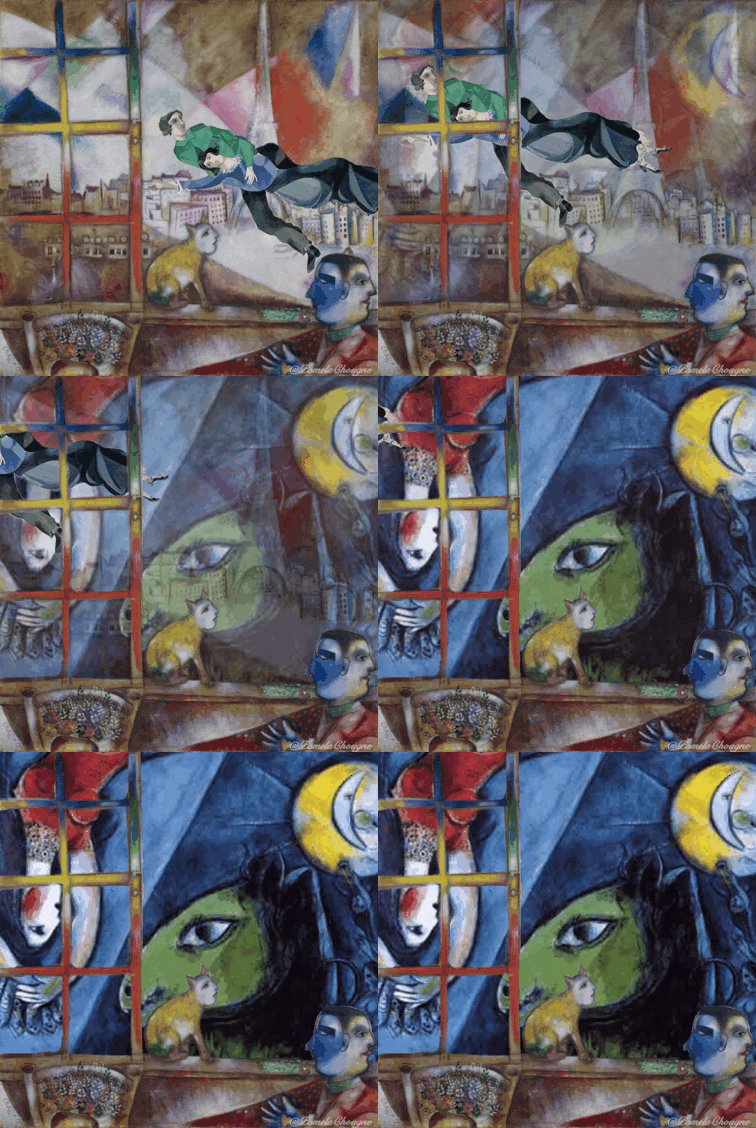
Original gif design by Pamela Chougne
This wistful, often tragic multi-generational tale centers on one Jewish family's experiences in the post-WWII USSR and subsequently in New York City. The author perfectly convincingly includes artist Mark Chagall as an influential character.
Some readers will undoubtedly love this book, which is packed with endearing, even inspiring, characters. But I grew impatient with the sprawling homages to folklore, especially when the homage-tales substituted for straightforward plot.
If you are the reader who's perfectly capable of listening to all of your grandparents' stories without squirming, you may be this book's ideal reader.* But you should steel yourself for the Vietnam experiences
Raising this to four stars on reflection because it will change how you see the world if you let it, and that's no small power.
*Me, I was never that nice.
Original gif design by Pamela Chougne
This wistful, often tragic multi-generational tale centers on one Jewish family's experiences in the post-WWII USSR and subsequently in New York City. The author perfectly convincingly includes artist Mark Chagall as an influential character.
Some readers will undoubtedly love this book, which is packed with endearing, even inspiring, characters. But I grew impatient with the sprawling homages to folklore, especially when the homage-tales substituted for straightforward plot.
If you are the reader who's perfectly capable of listening to all of your grandparents' stories without squirming, you may be this book's ideal reader.* But you should steel yourself for the Vietnam experiences
Raising this to four stars on reflection because it will change how you see the world if you let it, and that's no small power.
*Me, I was never that nice.

March 27, 2013
Manufactured misery. This effort reeks of the university workshop. Assembly was required. Ms. Horn appears to have taken the template of Nicole Krauss and where the latter has a character confront or be molded by The Shoah/Stalin/La Junta; Horn eschews the pivotal "Or" and asks why not cobble on a Chernobyl and Vietnam as well? You may think some characters are mistreated. My constructions really suffer from History (and goyim).
I already hated this novel when the absurdity was suddenly amplified at the end of the novel's second section. I won't discuss that. The final section is a magical realist dimension where Zuzu and Clarence can discuss the implications of bells and wings while sipping literature and ingesting art. That is simply sad.
The Chagall sections were engaging but so brief.
I already hated this novel when the absurdity was suddenly amplified at the end of the novel's second section. I won't discuss that. The final section is a magical realist dimension where Zuzu and Clarence can discuss the implications of bells and wings while sipping literature and ingesting art. That is simply sad.
The Chagall sections were engaging but so brief.

October 21, 2013
Loved this book. Loved it. Beautifully written, the tale weaves between new history and old history, through the current state and heritage of the main characters. The ending was lovely, even though it took several days for me to figure it out. I will read anything by Dara Horn. Highly recommend, this book was thoughtfully and carefully plotted, woven precisely and wonderfully done.

January 26, 2023
** Part of my 2023 reading challenge to read the books I bought in 2022 and never read **
** A Used Book Monthly selection **
** A Used Book Monthly selection **

April 13, 2009
I am adding this paragraph a few days later b/c somehow I think my previous review misses the mark. If I were to read the below review I might not be interested in a novel filled with bizarre philosophical thoughts and symbolism. Think of art, that too can be analysed to pieces and I hate that. It either moves you or it doesn't and the causes are different for different people. Well this book is like that too. See it as a wonderful piece of art that you can spend some time with. The quotes below will give you a hint of what the book offers.
I have given you enough to determine if it is the kind of book that you would enjoy. There are so many philosophical thought here to consider and also there is a plot line to follow if that is what you are after. Nevertheless if you prefer to follow an action filled plot rather than muse over ideas, well then I would say choose another book! What I have written in the following does not in any way reveal the action as it unfolds in the book. I think a spoiler alert is totally unnecessary. As I have pointed out previously, I suggest you read this book to enjoy the words, the thoughts or the images depicted. I do not think the following will in any way detract from your own reading of the novel.
My only criticism is the last chapter. Just plain too surreal, too many weird thoughts thrown at the reader in a helter skelter manner. The book still gets 4 stars. Don't miss the author's notes and the readers'group guide at the novel's end. They offer a nice neat tieng up and help the reader discover related classic Yiddish literature.
Page 247: Symbolism plays a vital role in the book. And colors - that is why Chagall fits so well. Here follows my final quote:
"It seemed to her that a person should see out of the white part of the eye, not the dark part. But that was not how things were. It was only through the deep hole of darkness that she could even perceive herself in the mirror."
Through page 218: Are you interested in a story with gripping suspense - in Vietnam and in NY? This book has it. Some bits in Vietnam are really gruesome. Such parts are easier to take in a book than in a movie, at least in a book you can close it for awhile. At a movie you are stuck in your seat. Do you want a love story? Well that too! But overall it is definitely surreal and filled with imagination. And it definitely helps to enjoy Chagall's paintings. If you don't like them well then I have a hard time imagining that you would like this either.
On page 168: This comment is so I can leave the book a bit. If you like war scenes and suspense, well the book has that too. Currently NOT easy reading. Can one be saved by a spider's web? I don't know.
On page 136; A delightful mixture of philosophy and imagination. I believe the reader will either not connect and hate "the stupid book" or will fall in love with the expressions and philosophical ideas. I HATE science fiction, but I adore this filled with biarre ways of looking at everything. Emotions play a central role in the characters' action. Who wouldn't do that if they had a starving child? Here is a quote:
"One night in Hamburg - or a not-yet night, a tired late afternoon in the winter of 1926 when the sun grew weary and decided to give up early, passing the world on to the moon and going off to get drunk...."
You decide - either you like this or you don't. There is so much I stop and pause over and think that is just a delightful way of looking at things. Whether it is true or not isn't really the point. However if the poinjt IS valid then maybe one should alter a bit how I, the reader, choose to live and appreciate my life!
I forgot this - I think the discussion of scoliosis from the point of view of the child is right on mark. The brace is a cage and a HUGE source of shame. It usually occurs unfortunately in the early teens right during puberty. No matter what any parent can do, little gets through to the child. Why, - well b/c it IS horrible and they alone have to live through it. The remark of the sibling was priceless - it is your armor, now nobody can hurt you. Kids are the best and often see things more clearly than any adult. Yeah the brace helps against bullying but relations with the opposite sex? Well, no way!
I am now on page 96, but here is a quote from page 85. Think about it a bit. It is about the difference between paintings and stories.
"A painting doesn't have to mean anything but a story does. Just barely, but it does. Der Nister (The Hidden One)often thought about that in the years that followed, as his own writing became more and more tangled and obscure. And he wondered: Why should paintings be exempt from meaning? Didn't everything need some sort of meaning, some purpose? Or did meaning emerge from what stories had and paintings lacked - a beginning and an end?"
The later discussion between Chagall and the Hidden One is also interesting - but you will have to read the book to follow that!
Page 49: The reader must root for the criminals! Look, the painting was stolen from them, why can't it be taken back? Another thing - the cover of this paperback is special. And also I enjoy the close relationship between brother and sister. So far a delightful mix of happiness and sadness and misery and laughter. And its craziness/imagination - my kind of book. Please let it continue this way.....
I am only on page 38 but this book simply MUST be written for me. Here are two quotes from page 38:
"Laughing is healthy. Doctors prescribe laughter."
and
"There are nor real endings in life either. Since when do things end?"
If you do not understand why these two quotes are for me, well then look at the review I wrote yesterday of Geraldine Brooks' novel Year of Wonders!
Page 24:Grim times - yes, but the writing is not grim, but very moving and filled with fantasy that keeps you floating. What a contrast to Geraldine Brooks' Year of Wonders!
Chagall enters as the art teacher at the Jewish Boys' Colony in Malakhovka outside Moscow. In regarding previous students' art work he asks what the students were told to paint. To the response that the students were told to paint what they saw he questioned: "To paint what you see, or to paint what you look at?" A huge difference, right?!
Page 18: For a book where Chagall plays a central role, the author's wording - "it was a beautiful day, one of those spring days when the air becomes like clear water rippled by a breeze and the ground loosens its grip and it feels as though you are not walking but swimming in air, flying weightless over the town." is wnderful! So appropriate since Chagall's paintings are filled with flying/floating people......
I have given you enough to determine if it is the kind of book that you would enjoy. There are so many philosophical thought here to consider and also there is a plot line to follow if that is what you are after. Nevertheless if you prefer to follow an action filled plot rather than muse over ideas, well then I would say choose another book! What I have written in the following does not in any way reveal the action as it unfolds in the book. I think a spoiler alert is totally unnecessary. As I have pointed out previously, I suggest you read this book to enjoy the words, the thoughts or the images depicted. I do not think the following will in any way detract from your own reading of the novel.
My only criticism is the last chapter. Just plain too surreal, too many weird thoughts thrown at the reader in a helter skelter manner. The book still gets 4 stars. Don't miss the author's notes and the readers'group guide at the novel's end. They offer a nice neat tieng up and help the reader discover related classic Yiddish literature.
Page 247: Symbolism plays a vital role in the book. And colors - that is why Chagall fits so well. Here follows my final quote:
"It seemed to her that a person should see out of the white part of the eye, not the dark part. But that was not how things were. It was only through the deep hole of darkness that she could even perceive herself in the mirror."
Through page 218: Are you interested in a story with gripping suspense - in Vietnam and in NY? This book has it. Some bits in Vietnam are really gruesome. Such parts are easier to take in a book than in a movie, at least in a book you can close it for awhile. At a movie you are stuck in your seat. Do you want a love story? Well that too! But overall it is definitely surreal and filled with imagination. And it definitely helps to enjoy Chagall's paintings. If you don't like them well then I have a hard time imagining that you would like this either.
On page 168: This comment is so I can leave the book a bit. If you like war scenes and suspense, well the book has that too. Currently NOT easy reading. Can one be saved by a spider's web? I don't know.
On page 136; A delightful mixture of philosophy and imagination. I believe the reader will either not connect and hate "the stupid book" or will fall in love with the expressions and philosophical ideas. I HATE science fiction, but I adore this filled with biarre ways of looking at everything. Emotions play a central role in the characters' action. Who wouldn't do that if they had a starving child? Here is a quote:
"One night in Hamburg - or a not-yet night, a tired late afternoon in the winter of 1926 when the sun grew weary and decided to give up early, passing the world on to the moon and going off to get drunk...."
You decide - either you like this or you don't. There is so much I stop and pause over and think that is just a delightful way of looking at things. Whether it is true or not isn't really the point. However if the poinjt IS valid then maybe one should alter a bit how I, the reader, choose to live and appreciate my life!
I forgot this - I think the discussion of scoliosis from the point of view of the child is right on mark. The brace is a cage and a HUGE source of shame. It usually occurs unfortunately in the early teens right during puberty. No matter what any parent can do, little gets through to the child. Why, - well b/c it IS horrible and they alone have to live through it. The remark of the sibling was priceless - it is your armor, now nobody can hurt you. Kids are the best and often see things more clearly than any adult. Yeah the brace helps against bullying but relations with the opposite sex? Well, no way!
I am now on page 96, but here is a quote from page 85. Think about it a bit. It is about the difference between paintings and stories.
"A painting doesn't have to mean anything but a story does. Just barely, but it does. Der Nister (The Hidden One)often thought about that in the years that followed, as his own writing became more and more tangled and obscure. And he wondered: Why should paintings be exempt from meaning? Didn't everything need some sort of meaning, some purpose? Or did meaning emerge from what stories had and paintings lacked - a beginning and an end?"
The later discussion between Chagall and the Hidden One is also interesting - but you will have to read the book to follow that!
Page 49: The reader must root for the criminals! Look, the painting was stolen from them, why can't it be taken back? Another thing - the cover of this paperback is special. And also I enjoy the close relationship between brother and sister. So far a delightful mix of happiness and sadness and misery and laughter. And its craziness/imagination - my kind of book. Please let it continue this way.....
I am only on page 38 but this book simply MUST be written for me. Here are two quotes from page 38:
"Laughing is healthy. Doctors prescribe laughter."
and
"There are nor real endings in life either. Since when do things end?"
If you do not understand why these two quotes are for me, well then look at the review I wrote yesterday of Geraldine Brooks' novel Year of Wonders!
Page 24:Grim times - yes, but the writing is not grim, but very moving and filled with fantasy that keeps you floating. What a contrast to Geraldine Brooks' Year of Wonders!
Chagall enters as the art teacher at the Jewish Boys' Colony in Malakhovka outside Moscow. In regarding previous students' art work he asks what the students were told to paint. To the response that the students were told to paint what they saw he questioned: "To paint what you see, or to paint what you look at?" A huge difference, right?!
Page 18: For a book where Chagall plays a central role, the author's wording - "it was a beautiful day, one of those spring days when the air becomes like clear water rippled by a breeze and the ground loosens its grip and it feels as though you are not walking but swimming in air, flying weightless over the town." is wnderful! So appropriate since Chagall's paintings are filled with flying/floating people......

May 17, 2017
Oh my, what this book put me through! Elation, wonder, perplexity, depression and back to a cautious wonder. It is jam packed with 20th century Jewish history, art, Yiddish literature, families with mysterious pasts, and perhaps the strangest philosophy of life I have ever encountered.
The story centers on Benjamin Ziskind and his twin sister Sara. They had that bond that twins often have in childhood but it has weakened in adulthood. Ben was a child prodigy who now writes questions for a quiz show. He was the boy who knew too much. Sara is a painter, an optimist in contrast to the depression that trails Ben like a smoky miasma. Their mother was a renowned author of children's picture books. Their dad died of lung cancer when the twins were still quite young.
When Ben, recently divorced, steals a small Chagall painting from a museum exhibit, a painting he is sure hung in their home when he was a child, he opens up a Pandora's Box of memories he and his sister barely knew they had.
Immediately after the museum incident, the story jumps to an orphanage in Communist era Russia, where both Chagall and a famous Yiddish writer share a house and teach at the school for the displaced Jewish orphans. This leaping back and forth in time eventually reveals the story of the Ziskind family, one of the saddest stories I have read in a genre full of sadness.
I have read Michael Chabon, Nicole Krauss, Jonathan Safran Foer, I B Singer, and many other Jewish writers and was looking forward to reading Dara Horn, but she took me on an emotional journey that left me enervated and depressed for quite a few days. I was thrust into my memories of certain losses I have had over the past decade or so, or else my hormones were acting up.
Near the end of the book, there is a long scene set in the author's idea of heaven, perhaps based on some Yiddish tales. She attempts to explain the meaning of the book's title, The World To Come. I generally have trouble with anyone's conception of heaven. While I realize they are all products of human imagination, this one was one of the more outlandish versions I have come across and yet it had a certain fascination for me. I wondered if perhaps she meant it to be a balance to all the sadness.
Last month, after our discussion of The Sympathizer, my Tiny Book Club felt we needed a break from the heavy fare we had been reading lately. After our lunch at Xioa, an especially good Vietnamese restaurant in the Echo Park neighborhood of Los Angeles, we stopped across the street to browse in the equally wonderful Stories Books. We came across this book and thought that a mystery about a stolen Chagall painting might be a delightful and lighter read.
We could not have been more wrong. The other two members purely hated the book, the writing, and the way the story was told. I am not sorry I read it and had to admire the sheer imaginative nature of the author. But I thanked them for dispelling my depression as they ripped the novel to shreds. So, read this one at your own risk!
Ah, the life of a woman who reads too much.
The story centers on Benjamin Ziskind and his twin sister Sara. They had that bond that twins often have in childhood but it has weakened in adulthood. Ben was a child prodigy who now writes questions for a quiz show. He was the boy who knew too much. Sara is a painter, an optimist in contrast to the depression that trails Ben like a smoky miasma. Their mother was a renowned author of children's picture books. Their dad died of lung cancer when the twins were still quite young.
When Ben, recently divorced, steals a small Chagall painting from a museum exhibit, a painting he is sure hung in their home when he was a child, he opens up a Pandora's Box of memories he and his sister barely knew they had.
Immediately after the museum incident, the story jumps to an orphanage in Communist era Russia, where both Chagall and a famous Yiddish writer share a house and teach at the school for the displaced Jewish orphans. This leaping back and forth in time eventually reveals the story of the Ziskind family, one of the saddest stories I have read in a genre full of sadness.
I have read Michael Chabon, Nicole Krauss, Jonathan Safran Foer, I B Singer, and many other Jewish writers and was looking forward to reading Dara Horn, but she took me on an emotional journey that left me enervated and depressed for quite a few days. I was thrust into my memories of certain losses I have had over the past decade or so, or else my hormones were acting up.
Near the end of the book, there is a long scene set in the author's idea of heaven, perhaps based on some Yiddish tales. She attempts to explain the meaning of the book's title, The World To Come. I generally have trouble with anyone's conception of heaven. While I realize they are all products of human imagination, this one was one of the more outlandish versions I have come across and yet it had a certain fascination for me. I wondered if perhaps she meant it to be a balance to all the sadness.
Last month, after our discussion of The Sympathizer, my Tiny Book Club felt we needed a break from the heavy fare we had been reading lately. After our lunch at Xioa, an especially good Vietnamese restaurant in the Echo Park neighborhood of Los Angeles, we stopped across the street to browse in the equally wonderful Stories Books. We came across this book and thought that a mystery about a stolen Chagall painting might be a delightful and lighter read.
We could not have been more wrong. The other two members purely hated the book, the writing, and the way the story was told. I am not sorry I read it and had to admire the sheer imaginative nature of the author. But I thanked them for dispelling my depression as they ripped the novel to shreds. So, read this one at your own risk!
Ah, the life of a woman who reads too much.
June 26, 2010
I almost gave this only one star, very rare for me. And I can see from other reviews that I'm squarely in the minority. I got the CD version to "read" during a car trip with my husband and had high hopes because I had read positive reviews of other books by Horn. But....two stars because there are very interesting themes and a lot of insightful forays into human behavior...but...to me she was desperately in need of a good editor. Long, long passages to make a point that was made over and over. There were characters to be interested in, a fascinating look (for me) into Yiddish literature, historical context, lots of positives. But it was long-winded and tedious. Then at the end, she leaves us hanging about what happens to our hero when he opens the door. OK, I can deal with that (although my husband was extremely annoyed about it). But then the entire final CD, well over an hour, was (to us again, apologies to all of you who really like the book) extraneous, horribly over-long and very irritating to listen to. We listened to the whole thing hoping to have it pull the threads together but in vain. The first 9/10ths or so was enjoyable but well written, at times beautifully written (despite a number of overly-long passages that cried out for edited), and frequently fascinating. But the final 1/10th left a very bad taste in the mouth and in many ways wiped out the enjoyable of the novel as a whole.

August 3, 2024
Horn is the author of the incisive People Love Dead Jews: Reports from a Haunted Present, and as a scholar of Yiddish literature she has a strong familiarity with the works of the group of Jewish writers in the Soviet Union, veterans of the Jewish Anti-Fascist Committee, who had nearly all been murdered by Stalin's regime by the early 1950s. The best aspect of this novel is Horn's weaving of those and other Yiddish writers and their stories, largely forgotten, into the text and the reader's consciousness: Pinkhas Kahanovitch ("Der Nister", or "the hidden one"), Itsik Fefer, Dovid Hofshteyn, Moyshe Nadir, Mani Leyb, I.L. Peretz, Itsik Manger.
Another victim of the USSR's postwar anti-Jewish purges, Benjamin Zuskin, director of the Moscow State Jewish Theatre, which plays a significant role in this story, apparently lends his name to the novel's main protagonist, Benjamin Ziskind. He impulsively steals a Marc Chagall painting on display at a museum's singles night - incredibly enough, that part actually happened - and the novel then moves through time, nations, and generations in following the path of the painting from Chagall's studio at an orphanage near Moscow for Jewish boys who survived the pogroms of 1918-1920, where he taught, into the hands of the Kulbak/Ziskind families, its later theft by Russian authorities, and its contemporary theft (recovery?) by a Ziskind.
The novel worked best for me in its historical scenes set at the Malakhovka Colony orphanage, featuring Chagall and Der Nister, and during the postwar years as Der Nister and Boris(Benjamin) Kulbak try to survive the times (they could not). Its contemporary scenes worked less well for me, in particular a dubious romantic plot between Benjamin Ziskind and a staffer at the museum where he stole the painting that would have been best cut, if you ask me. I suppose Horn wanted to add something uplifting to the novel though!
And then there's the final chapter, inspired by the Talmudic legend of the time before one is born, when the soul is taught the entire Torah and all the secrets of the world while in the womb, and then just before birth an angel taps the embodied soul right below the nose so that it forgets all it learned and will feel a desire in its life to relearn what it has forgotten (see also: Plato's "Meno"). The "world to come" of the book's title is thus the world of the living, right now, rather than the messianic era as it is usually thought of in Jewish tradition, or the afterlife. With souls eating artworks and drinking books (finally you can quite literally get drunk on literature!) and bathing in emotions, it's a somewhat odd way to wrap up the novel, but also rather uniquely interesting.
Another victim of the USSR's postwar anti-Jewish purges, Benjamin Zuskin, director of the Moscow State Jewish Theatre, which plays a significant role in this story, apparently lends his name to the novel's main protagonist, Benjamin Ziskind. He impulsively steals a Marc Chagall painting on display at a museum's singles night - incredibly enough, that part actually happened - and the novel then moves through time, nations, and generations in following the path of the painting from Chagall's studio at an orphanage near Moscow for Jewish boys who survived the pogroms of 1918-1920, where he taught, into the hands of the Kulbak/Ziskind families, its later theft by Russian authorities, and its contemporary theft (recovery?) by a Ziskind.
The novel worked best for me in its historical scenes set at the Malakhovka Colony orphanage, featuring Chagall and Der Nister, and during the postwar years as Der Nister and Boris(Benjamin) Kulbak try to survive the times (they could not). Its contemporary scenes worked less well for me, in particular a dubious romantic plot between Benjamin Ziskind and a staffer at the museum where he stole the painting that would have been best cut, if you ask me. I suppose Horn wanted to add something uplifting to the novel though!
And then there's the final chapter, inspired by the Talmudic legend of the time before one is born, when the soul is taught the entire Torah and all the secrets of the world while in the womb, and then just before birth an angel taps the embodied soul right below the nose so that it forgets all it learned and will feel a desire in its life to relearn what it has forgotten (see also: Plato's "Meno"). The "world to come" of the book's title is thus the world of the living, right now, rather than the messianic era as it is usually thought of in Jewish tradition, or the afterlife. With souls eating artworks and drinking books (finally you can quite literally get drunk on literature!) and bathing in emotions, it's a somewhat odd way to wrap up the novel, but also rather uniquely interesting.

August 31, 2015
2 Stars - Okay book
This book is mediocre at best. For some reason still unknown to me I had really high expectations for this one. No one I know has read this and I didn't really read any reviews about it. I guess my expectations came from thinking that the story was interesting. I don't know.
This book reminded me of a combination of The Goldfinch and People of the Book because a painting was stolen and the time hoping/Jewish artifact respectively. That may sound like a good combination to some, but it did not work for me. In fact, it turned out to be more People of the Book than The Goldfinch and I really didn't like People of the Book. That saddens me because this book had such great potential.
If you're unaware of what this book is about, it's loosely based on the true story of the Marc Chagall's stolen work Study for "Over Vitebsk". Dara Horn created a story around this lost work and it sounds like such a fantastic premise for a book. Sadly, the product fell short. However, check out these articles that talk about the actual theft: NPR, NYT The Guardian.
I was unable to connect with the characters. I didn't particularly like any of them but I didn't hate any of them either. I wanted to feel something, anything and considering some of the subject material touched here (Vietnam war, bullying, Soviet orphanage, death, etc.) I should have felt something! But alas, nothing. I just wanted it to end.
Another issue I had with this book was that stylistically it didn't work for me. This is a book that spans decades and jumps back and forth between time periods. The problem is that the author doesn't transition well between the periods. One moment you're in the 1960s and then you're in the early 2000s and it is a jarring jump. You may say, but Hannah 40 years isn't that big of a deal. Let me tell you, the way this author writes it is. In general, the author's writing is mediocre. I've read worse but I have most definitely read better.
Do I recommend this book? For most people, no. However, if you liked People of the Book you may like this one.
This book is mediocre at best. For some reason still unknown to me I had really high expectations for this one. No one I know has read this and I didn't really read any reviews about it. I guess my expectations came from thinking that the story was interesting. I don't know.
This book reminded me of a combination of The Goldfinch and People of the Book because a painting was stolen and the time hoping/Jewish artifact respectively. That may sound like a good combination to some, but it did not work for me. In fact, it turned out to be more People of the Book than The Goldfinch and I really didn't like People of the Book. That saddens me because this book had such great potential.
If you're unaware of what this book is about, it's loosely based on the true story of the Marc Chagall's stolen work Study for "Over Vitebsk". Dara Horn created a story around this lost work and it sounds like such a fantastic premise for a book. Sadly, the product fell short. However, check out these articles that talk about the actual theft: NPR, NYT The Guardian.
I was unable to connect with the characters. I didn't particularly like any of them but I didn't hate any of them either. I wanted to feel something, anything and considering some of the subject material touched here (Vietnam war, bullying, Soviet orphanage, death, etc.) I should have felt something! But alas, nothing. I just wanted it to end.
Another issue I had with this book was that stylistically it didn't work for me. This is a book that spans decades and jumps back and forth between time periods. The problem is that the author doesn't transition well between the periods. One moment you're in the 1960s and then you're in the early 2000s and it is a jarring jump. You may say, but Hannah 40 years isn't that big of a deal. Let me tell you, the way this author writes it is. In general, the author's writing is mediocre. I've read worse but I have most definitely read better.
Do I recommend this book? For most people, no. However, if you liked People of the Book you may like this one.

July 23, 2011
This is a difficult book for me to rate. I'd say 2.5 stars and I'd have liked to give it 3 stars but parts irritated me so much I can't say I enjoyed it overall, nor would I recommend it. For example, the constant referral to the dimples under characters' noses was interesting at first, then predictable and made me laugh (not in a good way), then felt just plain annoying to the point I wanted to throttle the words. On the other hand, I enjoyed the Yiddish folklore. That and the topic of reincarnation got me through it. Often though, the book dripped with honey and preciousness that sent me running for Listerine - but that's my issue, not the author's, necessarily.
The story worked best before the mechanics of the afterlife were revealed. While those scenes tried to bask in the folklore genre, they came across as ridiculous and boring to me, so I began to skim, and skim and skim until the end, at which point I didn't care much anymore. So, the start was good, the middle dragged and the end was disappointing. Two stars is probably about right.
The story worked best before the mechanics of the afterlife were revealed. While those scenes tried to bask in the folklore genre, they came across as ridiculous and boring to me, so I began to skim, and skim and skim until the end, at which point I didn't care much anymore. So, the start was good, the middle dragged and the end was disappointing. Two stars is probably about right.
July 18, 2007
One of my friends said that she didn't like Jonathan Safran Foer because he threw in so many heart-breaking images without ever really explaining them, just kind of jamming them together.
This was like that, except a lot of the imagery wasn't particularly heart-breaking, the writing wasn't particularly good, and there were a lot of loose ties left at the end of the novel.
More than anything, I didn't end up caring about any of these characters.
This was like that, except a lot of the imagery wasn't particularly heart-breaking, the writing wasn't particularly good, and there were a lot of loose ties left at the end of the novel.
More than anything, I didn't end up caring about any of these characters.

January 20, 2023
This book tells the story of three generations the Jewish Ziskind family, originally from Russia and relocated to the US. The primary storyline involves twins Ben and Sara. Recently divorced, Ben goes to a singles gathering at a Jewish museum, where he finds a work of art that belonged to their family. On an impulse, he steals the painting (or steals it back). The story is told from multiple points of view with flashbacks and flash-forwards, relating the twins’ childhood, the painting’s provenance, the backstories of their grandfather and parents, and a bit about the (real) artist, Marc Chagall and (real) Yiddish writer, Der Nister. It includes many references to history (e.g., Vietnam, Chernobyl, Stalin’s Reign of Terror), literature, art, and religion.
The narrative is creative, weaving in ideas about life after death, creation of tombs, and even including several characters’ experiences in the womb. I found the first three-quarters particularly enjoyable. Toward the end, it veers off in a different direction. The ending….well, let’s just say it is most likely symbolic (or at least that is the way I interpreted it). Themes include love, loss, trust, cultural trauma, perseverance, storytelling, afterlife, and anti-Semitism. I liked the complex mix of elements, and I enjoyed the creativity, but found it difficult to maintain the same level of engagement toward the end. I think it would serve as an excellent selection for discussion in a book group or a subject for analysis in a literature class.
The narrative is creative, weaving in ideas about life after death, creation of tombs, and even including several characters’ experiences in the womb. I found the first three-quarters particularly enjoyable. Toward the end, it veers off in a different direction. The ending….well, let’s just say it is most likely symbolic (or at least that is the way I interpreted it). Themes include love, loss, trust, cultural trauma, perseverance, storytelling, afterlife, and anti-Semitism. I liked the complex mix of elements, and I enjoyed the creativity, but found it difficult to maintain the same level of engagement toward the end. I think it would serve as an excellent selection for discussion in a book group or a subject for analysis in a literature class.

April 16, 2013
"What made her angry was art that no one looked at, things that were hidden that needed to be seen." This remark on p. 203 of The World to Come is really about the author herself. Dara Horn uses this book to unearth Yiddish stories from Itzik Manger and Nachman of Bratzlav, I.L. Peretz and Der Nister (who is a character in the book as well). The stories have almost been obscured forever by the decline of Yiddish. But they are wonderful stories that leave whorls in your brain. They are stories that needed to be seen, and Horn has hidden them in plain sight for us to discover (like Rosalie, her character who plagiarizes them and publishes them so that they can be read all over again). She has done us a great favor.
The true story of how Stalin first used the Jewish Anti-Fascist Committee, then turned against its members, is another hidden piece of history that deserved to be unearthed.
The fictional story of young Boris Kulbak meeting Der Nister and Marc Chagall is also worth telling.
Compared to these, the present-day fictions about Boris' grandchildren and Rosalie's children, the quiz show writer Ben Ziskind and his sister Sara; her husband Leonid (an émigré from Chernobyl after it ceased to be Hasidic and started to be radioactive); and museum staffer Erica Frank, are slight. The art theft that sets the plot in motion is almost beside the point. But they are well written enough to be the frame for the older generations' stories.
The true story of how Stalin first used the Jewish Anti-Fascist Committee, then turned against its members, is another hidden piece of history that deserved to be unearthed.
The fictional story of young Boris Kulbak meeting Der Nister and Marc Chagall is also worth telling.
Compared to these, the present-day fictions about Boris' grandchildren and Rosalie's children, the quiz show writer Ben Ziskind and his sister Sara; her husband Leonid (an émigré from Chernobyl after it ceased to be Hasidic and started to be radioactive); and museum staffer Erica Frank, are slight. The art theft that sets the plot in motion is almost beside the point. But they are well written enough to be the frame for the older generations' stories.
September 7, 2007
This was one of the most affecting books that I've read. The story and its themes stayed with me for months after I read it. Today, as I am pregnant, I think about one of the great ideas presented in the book about how everyone in your family before you, who has passed on, contributing something essential to the lives of those not yet born. I loved the characters---and the way the story took a piece of art work (in this case by Marc Chagall) and gave it a personal history. I would recommend this book to almost anyone.
February 25, 2014
This book came to my rescue right when I needed it. At a time when my worldview was necessarily changing (due to my father's passing), this book eased that transition. It is beautifully written and confronts tragedy in a straightforward, and yet hopeful, way. I think it would have changed my life even if I'd read it at a different time.

May 3, 2008
By far THE BEST book I've read all year. Perhaps one of the best and most beautifully written books in recent literary memory. Please read this book if you appreciate history, art, and love.

June 26, 2011
In modern-day America, lonely and awkward Ben (a former child genius) steals a Marc Chagall painting from a museum because he believes the exact same painting once belonged to his mother and hung in their house.
In 1920s Russia, Marc Chagall teaches painting at a Jewish boys orphanage and makes friends with his neighbor, a writer who goes by Der Nister (aka the Hidden One).
The blurb for this book revolved mainly around these three characters, but the actual story goes far, far further than that. Horn goes not only inside the heads of Ben, Chagall, and Der Nister, but into the heads of Ben's sister Sara, his father Daniel, an orphan named Boris, museum worker Erica, and an unborn baby. And personally, this is where I feel Horn could have used some editing. She has some really interesting, believable characters here, but we meet so many of them and they've all got so many feelings and issues to deal with, my heart can't go out to all of them. So instead, it barely went to any of them. My favorite sections were probably those centered on Ben, Der Nister, Daniel, and Boris, and I think Horn would have been wise to edit her writing to revolve only around these characters (possibly alternating between them). Or maybe edit it down even further, to just two main narrators.
And while she's at it, she could edit down that color passage with Sara too; it was painfully long and tedious.
My second issue with the book was the ending. Horn wrote some interesting ideas about afterlife/prelife (not that I believe in them) throughout, but the ending was irritating. It felt precious and a little silly and without anything following it, it left me with a bad taste in my mouth about the book. Plus, I didn't really want to hear about a new character for the last 20 pages or so if I don't get to hear about what happens to all the other characters (although I can pretty well guess what Horn was going for with them).
My last issue came after the ending, when Horn explained in the author's note that most of the mini stories included (some of which I really enjoyed) were just adapted versions of real Jewish folklore. On the one hand, I can appreciate her wanting to include this piece of culture that not many people have read before (and echoing the character Rosalie's thoughts about plagiarism a little). But mostly I just felt a little cheated because I'd assumed the stories and ideas were all hers. I also didn't know that Der Nister was a real man, so his section also felt less creative after the author's note.
There were some really nice passages and some great characters, but I just don't think this book lived up to it's potential. 3 stars.
Find more book reviews at A Quick Red Fox.
In 1920s Russia, Marc Chagall teaches painting at a Jewish boys orphanage and makes friends with his neighbor, a writer who goes by Der Nister (aka the Hidden One).
The blurb for this book revolved mainly around these three characters, but the actual story goes far, far further than that. Horn goes not only inside the heads of Ben, Chagall, and Der Nister, but into the heads of Ben's sister Sara, his father Daniel, an orphan named Boris, museum worker Erica, and an unborn baby. And personally, this is where I feel Horn could have used some editing. She has some really interesting, believable characters here, but we meet so many of them and they've all got so many feelings and issues to deal with, my heart can't go out to all of them. So instead, it barely went to any of them. My favorite sections were probably those centered on Ben, Der Nister, Daniel, and Boris, and I think Horn would have been wise to edit her writing to revolve only around these characters (possibly alternating between them). Or maybe edit it down even further, to just two main narrators.
And while she's at it, she could edit down that color passage with Sara too; it was painfully long and tedious.
My second issue with the book was the ending. Horn wrote some interesting ideas about afterlife/prelife (not that I believe in them) throughout, but the ending was irritating. It felt precious and a little silly and without anything following it, it left me with a bad taste in my mouth about the book. Plus, I didn't really want to hear about a new character for the last 20 pages or so if I don't get to hear about what happens to all the other characters (although I can pretty well guess what Horn was going for with them).
My last issue came after the ending, when Horn explained in the author's note that most of the mini stories included (some of which I really enjoyed) were just adapted versions of real Jewish folklore. On the one hand, I can appreciate her wanting to include this piece of culture that not many people have read before (and echoing the character Rosalie's thoughts about plagiarism a little). But mostly I just felt a little cheated because I'd assumed the stories and ideas were all hers. I also didn't know that Der Nister was a real man, so his section also felt less creative after the author's note.
There were some really nice passages and some great characters, but I just don't think this book lived up to it's potential. 3 stars.
Find more book reviews at A Quick Red Fox.
This entire review has been hidden because of spoilers.

January 11, 2024
I’m glad I read Horn’s “People Love Dead Jews” before I read this novel, as the history she explains in that book is a good foundation for the historical settings of this one. I had heard of the pogroms in 1919 in the Soviet Union, especially because my own ancestors escaped the Soviet Union in the late 1800s due to persecution of Jews, but I didn’t know until I read this novel about the Jewish Boys Colony created to house boys orphaned by the 1919 massacres — and that Chagall taught painting at this colony alongside Yiddish writers, poets, artists and actors — and that all except for Chagall were imprisoned and killed due to their participation in the Jewish Anti-Fascist Committee, which was a set-up by Stalin. (And btw, this period and Stalin’s plot to villainize Jews was the origin of the phrase “Zionism is racism,” so everything comes back.) Chagall was only saved by his worldwide fame. It’s all so fascinating and a crazy-good setting for a novel that spans generations, from early 1900s to present day.
Horn is incredibly facile at layering plot, characters, language, suspense amid this rich backdrop of Jewish history, culture and art, and of Yiddish literature and folklore. And her chapter at the end set in the “world to come” is the closest thing I’ve ever read to a grownup version of The Phantom Tollbooth — a bar where you drink books! Just spectacular. I loved this book and look forward to reading more of her novels.
Horn is incredibly facile at layering plot, characters, language, suspense amid this rich backdrop of Jewish history, culture and art, and of Yiddish literature and folklore. And her chapter at the end set in the “world to come” is the closest thing I’ve ever read to a grownup version of The Phantom Tollbooth — a bar where you drink books! Just spectacular. I loved this book and look forward to reading more of her novels.

December 11, 2012
This fascinating novel grabs the reader early on and does not let go. It begins when Ben, one of the Ziskind twins, is visiting a Chagall show at a museum. Alone in the gallery as the museum prepares to close, he yanks a copy of Chagall’s “Study for ‘Over Vitebsk’” off the wall and walks unseen out of the museum with it. So begins a complicated story of the Ziskind family, back and forward in time, a story which tangentially includes the historical figures of Marc Chagall and the Yiddish writer Pinchas Kahanovich (Der Nister, The Hidden One).
What is especially rewarding is the way the story unfolds. We travel through time to meet all sorts of characters, and Horn does not explain everything as she goes, yet all we need to know at any particular time is clearly and imaginatively revealed. (This book is not difficult to follow, although I imagine it might have been difficult to structure.) And as we read we see things we missed before. Horn makes great use of traditional Yiddish stories (after all, she did her grad work in Yiddish literature). Nor is she afraid to expand on some of their themes. For example, she creates a prelife where all human souls learn everything before they are born into this earthly life, much as Plato created in The Phaedrus with his chariot with its two horses who reveal all the Forms to the preborn. Wordsworth fans need only think of his “Intimations Ode” with its lines claiming that we come to this life, not naked, not a blank slate, but “Trailing clouds of glory do we come / From God who is our home.” Horn’s version of this prelife is simply wonderful. Indeed, this entire novel is packed with wisdom dressed in light, even as it maintains a clear narrative about real people in this world. Readers just can’t go wrong.
What is especially rewarding is the way the story unfolds. We travel through time to meet all sorts of characters, and Horn does not explain everything as she goes, yet all we need to know at any particular time is clearly and imaginatively revealed. (This book is not difficult to follow, although I imagine it might have been difficult to structure.) And as we read we see things we missed before. Horn makes great use of traditional Yiddish stories (after all, she did her grad work in Yiddish literature). Nor is she afraid to expand on some of their themes. For example, she creates a prelife where all human souls learn everything before they are born into this earthly life, much as Plato created in The Phaedrus with his chariot with its two horses who reveal all the Forms to the preborn. Wordsworth fans need only think of his “Intimations Ode” with its lines claiming that we come to this life, not naked, not a blank slate, but “Trailing clouds of glory do we come / From God who is our home.” Horn’s version of this prelife is simply wonderful. Indeed, this entire novel is packed with wisdom dressed in light, even as it maintains a clear narrative about real people in this world. Readers just can’t go wrong.

March 20, 2011
I wanted to like this a lot. I love folktales of all sorts, and I was really excited about the blend of Yiddish folktales I was expecting to see here.
However, while I enjoyed the long Vietnam section, as well as some portions of Benjamin's growing-up, I wasn't there on some other parts. The Der Nister sections were weirdly overwrought, and the long afterlife/pre-life block at the end was a combination of hippie-tastic, faux-mystical, and overly precious that just didn't work for me.
I think that, more than anything else, maybe, the writing style was jarring for me. It was sort of an echo of the (much better) Jason & Medeia, in its enthusiasm for simulating a translation of another work (it sounded very much like an American version of old Yiddish stories), but that in and of itself wasn't enough.
However, while I enjoyed the long Vietnam section, as well as some portions of Benjamin's growing-up, I wasn't there on some other parts. The Der Nister sections were weirdly overwrought, and the long afterlife/pre-life block at the end was a combination of hippie-tastic, faux-mystical, and overly precious that just didn't work for me.
I think that, more than anything else, maybe, the writing style was jarring for me. It was sort of an echo of the (much better) Jason & Medeia, in its enthusiasm for simulating a translation of another work (it sounded very much like an American version of old Yiddish stories), but that in and of itself wasn't enough.

July 25, 2016
I found this novel fascinating, beautifully written, and wonderfully creative - especially the final chapter. I appreciated all the Jewish references and how Horn resurrected so many forgotten Yiddish writers. So why only 4 stars instead of 5? Because the characters' stories were so darn sad, so much death and despair. Also because I found myself unable to identify with any of the protagonists; none of them seemed like real people. Eventually I didn't want to care about them after realizing they were pretty much all on their way to a dismal end.
Displaying 1 - 30 of 1,212 reviews