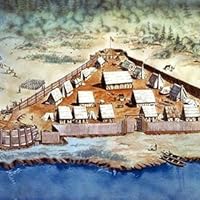
America was the place Smith had dreamed of his whole life.There, his character, determination, and ambition had propelled him to the top of society. He spent the rest of his life trying to return. Though he failed, he pointed the way for others, who were drawn by the dream that opportunity was here for anyone who dared seize it . . . Smith founded more than a colony. He gave birth to the American dream. --from Captain John Smith
Captain John Smith tells the real story behind the swashbuckling character who founded the Jamestown colony, wrote the first book in English in America, and cheated death many times by a mere hairbreadth. Based on rich primary sources, including Smith's own writings and newly discovered material, this enlightening book explores Smith's early days, his forceful leadership at Jamestown that was so critical to its survival, and his efforts upon his return to England to continue settlements in America. This unique volume also reveals the truth behind Smith's relationship with Pocahontas, a tale that history has greatly distorted. Bringing to life heroic deeds and dramatic escapes as well as moments of great suffering and hardship, Captain John Smith serves as a great testament to this important historical figure.
Thomas Hoobler has written nearly 100 books with his wife Dorothy, and some more by himself. The Hooblers are the co-authors of the Samurai Detective Series, which tells the adventures of a boy in 18th century Japan who helps his samurai father solve mysteries. The third book in the series, IN DARKNESS, DEATH, won an Edgar as the Best YA mystery of 2004. The Washington Post also chose the book as one of the Best Children's books of that year. Tom won $500,000 on the quiz show WHO WANTS TO BE A MILLIONAIRE, making it easier for the Hooblers to follow their career. They have written history for children, young adults, and adults.
It would be hard to overstate how much I enjoyed this book. The Hooblers tell the story of John Smith masterfully, with a great eye for detail and with a sense of historical balance and perspective. For anyone interested in either Captain John Smith or the Jamestown colony, I cannot recommend this book highly enough. I expect to be reading it a second time within the next year.
A well written book on the life of John Smith, the driving force for the success in the Jamestown, VA colony. The book focuses on Smith's life, but there is so much insight into the beginnings of colonial America, navigating the Americas, the challenges of survival, negotiating with native people, and the brutal treatment of native Americans. The frustrating part of reading such a history is that so much that occurred was not properly documented. We have to rely on Smith's or other's own accounts. Some of which have been influenced by ego, jealousy, power, friendship, and hatred. The author does a good job in describing what is fact and where we just have to speculate how life was. Recommended for those interested in colonial America and some of the powerful characters who started these endeavors.
Just a casual snatch off a library shelf, turned into a very pleasant surprise. I thought I knew the bare bones story of John Smith, Jamestown and Pocahontas, only to discover how little of the history of England's early explorations of this New World I understood. The authors, Dorothy and Thomas Hoobler have produced a very commendable biography of Captain John Smith, not just his involvement with Jamestown. A surprise for me was learning of his exploits fighting in the Netherlands, France and Transylvania, before his capture by Ottoman Turks and enslavement in Constantinople, and then escaping to Russia! Such is the detail of Smith's explorations in Virginia that I have accompanied the reading with my world atlas and Google Earth to follow the text. Accompanied with generous source notes and a short bibliography. A fascinating life story of another incredible Elizabethan.
I am not a great lover of history, however, I found this book to be very enjoyable and very enlightening. Family history is contained in this book as I am a direct descendant of Chief Powatan.
James Smith was much more than a cartoon husband of Pocahontas!
The truth is that he never was married to daughter of Powhatan. This book goes into his early life, his adventurous life before Jamestown, his time in the Chesapeake area and post Jamestown founding. What a life! He deceived death numerous times, escaped drownings, was captured by the Turks and held as a slave for a number of years before escaping and making his way back to England.
On the initial voyage to America and a number of times during his stay, he was arrested and sentenced to death. Each time, overruled or saved by new assignments. He was captured numerous times by the Native Americans, including the famous well known time that had his head placed on the executioners block only to be saved by the 10 year old daughter of the king.
The writer of this bio tends to doubt the entire event as his other soldiers were tied to a tree and skinned alive, so why was he not? We will never know.
What was given was that his leadership saved the colony both from his work and his PR back in London. The first few years, Jamestown was inhabited, apparently, by the laziest most spoiled sons of the ruling class and they died in droves as a result (over 500 of the the first 650 died). The settlers refused to grow their own food insisting instead on trading for food from the Native Americans. For awhile, it worked, but each village needed only so many copper pots and beads before the value dropped and the patience wore thin. This occurred and Jamestown and the second settlement, Henrico, was attacked.
We all know the first 13-15 years of the colony was tough. Captain Smith was quite involved with the first few years and then kept his eyes on the colony until he died. The book does not touch upon indentured servants or imported slaves. Smith was back in London by that time and not involved. The book does not say how he felt about it. It did go into how he approved the change in policy of who came over. A new policy went into effect to sell passages and to sell land which changed the outcome and sped the immigration rates, the success of each farmer and the alteration of the population of the region.
Five stars bc John Smith’s life was unusually fascinating. I especially love reading about that brief period when native Americans and Europeans were encountering each other for the first time. Anyway, Smith had a legendary life before he even stepped foot in America. It’s just such a fascinating, important series of historical events.
Interesting read, but quite a stretch to call John Smith the founder of the American dream. The author's take a favorable view of Smith, which isn't such a bad thing.
John Smith is an incredibly fascinating man. He fought in the crusades, was made a slave, worked his way up the British hierarchy and really kept Jamestown together. He accomplished all this by his mid-20s (I have not yet even conquered law school in my mid-twenties, *sigh*). The writing is a bit simplistic, which is why I gave this book 3 stars (also, the citations were a bit sparse). However, it is reader-friendly (which is always difficult for a work of non-fiction in my opinion) and also sheds light on some other fascinating figures including Christopher Newport, Chief Powhatan and even King James! John Smith truly was an amazing character.
I am not sure what to think of this book actually. I got this at the library while I was looking at another book and said sure let me see how it was rated. It was rate pretty high at 3.85 Stars, so I was excited to read it. It really read into 3 books, 1 of Captain John Smith and his life, the history of Jamestown and how he was there and also how Jamestown really sprung the rest of the development of America from Europe. The authors put it together for the most part, but probably should have stuck to one thing. The big plus was learning about John Smith and his life. He lived an incredible life and seemed to just go everywhere and was always in the right place at the right time.
Wow, what a nice surprise to find and read this book about the amazing John Smith. I had been to Jamestown earlier this year, which sparked my interest in its history, and you can't study that without reading about Mr. Smith.
I was really impressed with the author's writing style and how she approached her subject. It was a fair treatment of this real character. What a story, what a personality. It added so much to my understanding of what life was like for those first English colonists, standing on the edge of a "new" continent.
This was one of the best biographies and historical books I've read in a long time. Not only did this give a full life view of Captain Smith including his time *before* coming to America, but it also detailed how the colonizing of America affected England and visa versa. I didn't know the Gunpowder Plot had played a hand in Virginia, for example.
Well researched, very well written, and well rounded. I really enjoyed reading this book.
Great read- many things I thought I knew where wrong- but discovered so many more. Good history of the beginning of America. Without the influence of Smith, a Yeoman- American may have been much more elitist like England.