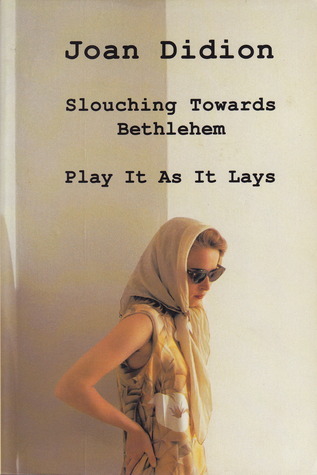
Two books under one cover. "Slouching Towards Bethlehem" and "Play it as it Lays". Both by reknowned essayist Joan Didion. Published by the Quality Paperback Book Club.
Joan Didion was an American writer and journalist. She is considered one of the pioneers of New Journalism along with Gay Talese, Hunter S. Thompson, and Tom Wolfe. Didion's career began in the 1950s after she won an essay contest sponsored by Vogue magazine. Over the course of her career, Didion wrote essays for many magazines, including The Saturday Evening Post, Life, Esquire, The New York Review of Books and The New Yorker. Her writing during the 1960s through the late 1970s engaged audiences in the realities of the counterculture of the 1960s, the Hollywood lifestyle, and the history and culture of California. Didion's political writing in the 1980s and 1990s often concentrated on the subtext of political rhetoric and the United States's foreign policy in Latin America. In 1991, she wrote the earliest mainstream media article to suggest the Central Park Five had been wrongfully convicted. In 2005, Didion won the National Book Award for Nonfiction and was a finalist for both the National Book Critics Circle Award and the Pulitzer Prize for The Year of Magical Thinking, a memoir of the year following the death of her husband, writer John Gregory Dunne. She later adapted the book into a play that premiered on Broadway in 2007. In 2013, she was awarded the National Humanities Medal by president Barack Obama. Didion was profiled in the Netflix documentary The Center Will Not Hold, directed by her nephew Griffin Dunne, in 2017.
“All I ever did to that apartment was hang fifty yards of yellow theatrical silk across the bedroom windows, because I had some idea that the gold light would make me feel better, but I did not bother to weight the curtains correctly and all that summer the long panels of transparent golden silk would blow out the windows and get tangled and drenched in afternoon thunderstorms. That was the year, my twenty-eighth, when I was discovering that not all of the promises would be kept, that some things are in fact irrevocable and that it had counted after all, every evasion and every procrastination, every word, all of it.”
Nobody wrote about California in the Sixties as well as Didion, with most of her work focusing on San Francisco and L.A. Her first novel, "Run River," was actually a fictionalized novel about her growing up in Sacramento, right after the war, with a war hero father, turned farmer, and life in the valley. I read "Run River" in college and it had a great late Fifties Faulknlker inspired feel to it and was clearly the work of a very gifted writer, but I could imagine finding it on the carousel rack of a drugstore, and buying it for 50 cents because it was on the best seller's list and it looked steamy, intelligent, and somehow forbidden, and it was a joy to read, a California central valley epic. I'm sure the bare bones of Didion's thinking on the world stem from "Run River,", not to mention it was about Sacramento, the State Capitol, little else in it could prepare the reader for what was to come from such an amazingly gifted young writer, nor did she ever write a book that long again (I don't think), or in that kind of third person voice reeking of Faulkner and Fitgerald, because the voice Didion found "Slouching Towards Bethlehem," and "Play it as it Lays," are completely her own, and something tells me without a lot of thought that she will be remembered as the great prose stylist of the Sixties, and the Queen of the New Journalism that was taking over America, because as great as Hunter S. Thompson is, or Tom Wolfe (at times), none of them had Didion's cold cool yet emotional layered prose that read like poetry more than anything, and seemed like no one else that I've ever read. Her words have a certain feeling of loneliness, alienation, observation, and romance, that just no other writer of the last fifty years really has, or at least not that comes to mind. There is Raymond Carver who also has a very distinct short sentence short story style, and I'd say Didion basically wrote novellas she passed off as novels ("Play it as it Lays"), or put together collections of essay's ("Slouching Towards Bethlehem"), but Carver sounds a little too like Hemingway, just an updated one in academia with the same drinking problems but more emotional vulnerability though hidden by layers of blank page in minimalistic prose, but.... he's not Didion, he's Carver, and I suppose he carved out the Paciifc Coast post Sixties academic teaching and living a failed life, like so many of his generation, but Didion had no academia in her except that she went to Berkeley in the Fifties and did write about it some, but Didion was a "New Journalist," and some of her most memorable work aside from "Play it as it Lays," in this critic's humble opinion, were her pieces on California in the Sixties and her place in it, a middle age favorite daugher, raised on the hopes of the Kennedy era, and looking on sort of bewildered half excited by the Sixties, and half wishing for a simpler time, before Vietnam and drugs, and she literally seems caught in the middle. In "Slouching Towards Bethlehem," Didion often sounds like she's in a mission in the Haight Ashbury interviewing the Hippies and really trying to understand them, and they take her in, kind of like how the Hell's Angels took in Hunter S. Thompson, so he could write "Hell's Angels," only to beat the shit out of him at the end for being a spy. Didion has this quality in "Slouching Towards Bethlehem," or at least the piece titled that, and she is something of a spy in that great writerly tradition, but she treats the pieces as journalism, and for all I know they came out in "Vogue" before they ever came out in a collection, because she got a job to write for them soon after college, so who knows? Didion was a journalist and a fiction writer, but more importantly a journalist, because her fiction became journalistic, and was never so hyper romantic as "Run River" ever again, whereas Carver's stories never feel journalistic, but seen through a drunk poet's lens.
"Play it as it Lay's" will always be one of my favorite books, that I go back to again and again, but it's not exactly "War and (or) Peace," and I should say reading it in a day does take an awful lot of concentration, because you won't be done in an hour, and yet the writing, structure, and story are so cinematic that it almost deserves to be read in a day, and indeed all of Didion's writing is very visual and I always feel like I'm watching a movie when I read it and that's part of the appeal. "Play it as it Lay's," is about the film industry in the late Sixties, and I'd say the structure has an almost Godard like feeling to it and was deeply influenced by the French New Wave, the scenes are short but poignant, and give you just enough to move the story on, but there is almost no hyperbole, and the sparseness makes Maria's bursts of poetic intensity all the more so because the book is so quiet that you yearn and crave for those paragrapsh that have an almost hallucinatory like feel to explain Maria's insanity, because like Plath in "The Bell Jar" she is going insane. Funnily enough, Didion seems to have lived a Plath like life, though a little younger, but they both were beautiful women living a rather archetypal life and writing about women going insane, but I'm not sure Didion relied on this theme like Plath did, nor did she make her parents her Waterloo. But Maria from "Play it as it Lays" is an unbelivably lost soul and that's how I felt in L.A. when I read it, like I just kind of wanted to drive on the freeway to nowhere in particular, just to lose myself, and never come back again, only to come back, and do it again everyday. Maria's alienation also made sense to me because it was a very Hollywood kind mistaking fantasy for reality and I think the character came to L.A. in the Sixties as a model and liked the groovy lifestyle never thinking that people could be that cruel to each other, but the sex is cold and she's falling out of love, and her career is flailing if indeed it ever started. M spends a lot of time remembering her past in this book and her humble beginnings in Nevada and wonders in the classic "Hollywood Nights" way why she had ever left home because she lost all control. I guess what's crazy about the book is that she manages to paint Maria's isolation and alienation in a very poetic way kind of like Sofia Coppola does in her movies, that are also sparse, and probably heavy influenced by Didion, because both make sadness very stunning but there aren't a lot of laughs in Didion and this also separates her from many of the New Journalists that were practically humoirsts they felt so freed up. I really think "New Journalism" just gave Didion the freedom to write about her own favorite daughter status from another era and juxtaposing it with the one she was in and able to see a great generational vision without the restraint and conceit of fiction.
I realize there is a cult of Didion out there but there wasn't when I first picked out this book from my parents library, and easily my favorite of theirs, by far, and this almost bonded us. No one read her in the universities yet (I have a feeling they do now), and whatever she did was so new that I think people were wondering if she had staying power, or would be relegated to the 'dustbin of history' in Reagan's words. I quickly saw that she was the great writer about the Sixties in California, bringing a real gravitas and seriousness to an otherwise silly era, not that it felt this way, but the art was so silly, that's how we remember it, but not through Didion's eyes. She was one of the most interesting "New Journalist" because she was a woman from a slightly older generation and came at it from a very chic cool waspy sort of nouveau riche way, not to mention she had an identity as a "Vogue" writer the whole time, and this wasn't a Hunter S. Thompson's "Hell's Angel's" perspective on the Sixties, or Tom Wolfe's sort of chameleon like prose that was pop to the core, because there's nothing 'pop' about Didion's style that's eternal, but her subject matter is pop, or scratches the surface to see what's beneath it. I always knew she was one of the best writers but I thought I had her for all my own like a unique discovery, and maybe I did in 1990, but she has been discovered and I'm just another schmuck admiring her prose, like how I used to feel listening to Joni Mitchell when I knew that every asshole was in love with her, not just me. My mother met Joan Didion once in Morton's, where you could imagine her eating, and told her that I went to U.C. Santa Cruz, and like a favorite daughter Didion knowingly wrote to me 'Have a good year up in the gloaming," and how Didion a thought that is.
The breakout work by a fantastic writer. Fifty years on we can see how prescient she was, and how timeless her talent.
Joan Didion is a pleasure to read. She is not the kind of author who appealed to me in my youth. Although I knew of her, the first book that I read was Blue Nights, which I reviewed very favorably in 2011.
An Internet article recently piqued my interest in Slouching Toward Bethlehem. It is a collection of essays written in the 1960s, all of them more than 50 years old. This is before most readers were born, talking about a time and place that they did not experience.
I am only eight years younger than Didion, and from California. I lived in the Haight-Ashbury when she reported when she wrote the most famous piece here, slouching toward Bethlehem. Reading it makes me acutely aware of how blind I was to what was going on around.
She writes also about Sacramento, Los Angeles, New York, and other places Las Vegas, and other places that have certainly changed a lot since. It's one of those "you had to be there" sensations.
One of the things that strikes me is how grounded, how sensible Didion was in seeing exactly what was going on. Her prose is exquisite. She not only comes up with the right word, the mot juste, but she often makes it up. Her writing is as fresh after 50 years, as it was back then. As it must've been back then. It is no wonder to me that she burst on the scene so explosively in the 1960s.
Hers was a generation of great writers. Tom Wolfe did the same kind of thing. Hunter S. Thompson wasn't far off. It was a generation of both readers and writers. If this kind of talent is out there today, I am not seeing it.
I include a table of contents, and offer my own comments on some of the some of the articles on some of the pieces that she's done.
===I Life Styles in the Golden Land ===== ===========Some Dreamers of the Golden Dream =====
Walmart was just a dream and Sam Walton's eyes, but the Walmart style had evolved in full glory in the deserts of California east of Los Angeles. A spectacularly trashy murder trial.
===========John Wayne: A Love Song =====
Appreciation for a real man, who knew what he was and didn't pretend to be anything more.
===========Where the Kissing Never Stops =====
A touching, affectionate portrait of Joan Baez. She is a woman from a highly intellectual background who could simply accept her gift and not be spoiled by it.
A true believer. The other Communists were all sellouts except for the Communist Party USA (Marxist-Leninist)
===========7000 Romaine, Los Angeles 38 =====
A paean to Howard Hughes, who represented America's real values and aspirations despite our pretentious claims to the contrary.
===========California Dreaming =====
A think tank on the Santa Barbara coast; the opposite of all things John Birch.
===========Marrying Absurd =====
Las Vegas, the most phony, plastic city on earth, and the home of the quickie marriage.
===========Slouching Towards Bethlehem =====
The centerpiece of the book. A extended journalistic tour through the Haight-Ashbury of 1966 – 67. The title comes from the Yeats poem.
This single essay did more than anything else to cement Didion's reputation as a journalist who could see beneath the surface and around the corners, and had a gift for portraying visual concept, a mood, or a sense of anomie so vividly that it brought the reader immediately to the scene of the action.
I was a young man living at 340 Carl St., San Francisco, five blocks from the Haight, as she wrote this. I missed 90% of it. Her powers of perception were incredible, and her sense of the terrible portent was equally prescient.
The hippie scene devastated our family. My two girl cousins, born in the 50s, disappeared into the San Francisco scene about this time. Both dead now, brain dead long before their bodies collapsed, they bore between them five children by five men.
Sex drugs and rock 'n' roll devastated my El Cerrito California high school class. The only two who became famous were Roy Jacuzzi, who coasted on a family connection, and Barr Rosenberg, whose astronomical intelligence gave him the freedom to pursue whatever lifestyle he chose. Most of my class tried drugs, and a large number lost direction. Cartoonist Joel Beck, sought by Playboy and every publisher around, drugged himself to death. Others simply wandered aimlessly through life. Didion expressed her foreboding extremely well.
=== II Personals ===== ===========On Keeping a Notebook =====
However chaotic it may have been, Didion's notebook was a useful tool in her literary success.
===========On Self-Respect =====
Self-respect is essential. It was amazingly detached from reality. Sometimes the least worthy people have the greatest sense of self respect. And it serves them well, in general.
===========I Can't Get That Monster out of My Mind =====
A musing on Hollywood, the destroyer. Didion wryly notes that Hollywood can't destroy what was not there in the first place, but it offers a very convenient excuse.
===========On Morality =====
There is real morality and sham morality, the morale the of political poseurs.
Quote: " And of course it is all right to do that; that is how, immemorially, things have gotten done. But I think it is all right only so long as we do not delude ourselves about what we are doing, and why. It is all right only so long as we remember that all the ad hoc committees, all the picket lines, all the brave signatures in The New York Times, all the tools of agitprop straight across the spectrum, do not confer upon anyone any ipso facto virtue. It is all right only so long as we recognize that the end may or may not be expedient, may or may not be a good idea, but in any case has nothing to do with “morality.” Because when we start deceiving ourselves into thinking not that we want something or need something, not that it is a pragmatic necessity for us to have it, but that it is a moral imperative that we have it, then is when we join the fashionable madmen, and then is when the thin whine of hysteria is heard in the land, and then is when we are in bad trouble. And I suspect we are already there."
===========On Going Home=====
This is a short piece about daughter Quintana Roo's first birthday. A touching story, and a lovely introduction to the much fuller picture that she offers in Blue Nights.
Quote: " Or perhaps it is not any more. Sometimes I think that those of us who are now in our thirties were born into the last generation to carry the burden of “home,” to find in family life the source of all tension and drama. I had by all objective accounts a “normal” and a “happy” family situation, and yet I was almost thirty years old before I could talk to my family on the telephone without crying after I had hung up. We did not fight. Nothing was wrong. And yet some nameless anxiety colored the emotional charges between me and the place that I came from. The question of whether or not you could go home again was a very real part of the sentimental and largely literary baggage with which we left home in the fifties; I suspect that it is irrelevant to the children born of the fragmentation after World War II."
" It is time for the baby’s birthday party: a white cake, strawberry-marshmallow ice cream, a bottle of champagne saved from another party. In the evening, after she has gone to sleep, I kneel beside the crib and touch her face, where it is pressed against the slats, with mine. She is an open and trusting child, unprepared for and unaccustomed to the ambushes of family life, and perhaps it is just as well that I can offer her little of that life. I would like to give her more. I would like to promise her that she will grow up with a sense of her cousins and of rivers and of her great-grandmother’s teacups, would like to pledge her a picnic on a river with fried chicken and her hair uncombed, would like to give her home for her birthday, but we live differently now and I can promise her nothing like that. I give her a xylophone and a sundress from Madeira, and promise to tell her a funny story."
===III Seven Places of the Mind ===== ===========Notes from a Native Daughter =====
Didion is fourth generation Californian. Her forebears came even before the gold rush. She has a marvelous sense of place, and expresses it in this piece.
===========Letter from Paradise, 21° 19’ N., 157° 52’ W =====
Notes about Hawaii, devastated in the Second World War and staging ground for the war in Vietnam as she wrote this piece. Rings true with me – I spent time there flying to and from Vietnam.
===========Rock of Ages =====
A visit to Alcatraz three years after it was decommissioned.
===========The Seacoast of Despair =====
The ghost mansions of Newport Rhode Island, and musings on the great wealth and perhaps spiritual poverty of those who built them.
===========Guaymas, Sonora =====
The Mexican high desert but
===========Los Angeles Notebook =====
A portrait in words of Los Angeles, where Didion spent most of her career.
===========Goodbye to All That =====
Reminiscences of the first years of her career in New York City. It goes from everything being fresh, wonderful and exciting to "seen that, done that" after five years, very happily moving back to the West Coast with her husband.
My first Didion books and now I see why she is talked about so often. Great writer. I must admit, it was a semi challenging read for me with all the new vocabulary I had to look up and I found it to be a not so cookie-cutter writing.
First half was stories and notes of her time in the 60s. Little snippets of life that she observed and she herself had experienced.
Play It As It Lays is a book about a used to be model and actress Maria who is married to a big time director Carter. It seems like all the fun (was there ever any?) is over for Maria, who drifts through life increasingly depressed and numb. Their daughter lives in a child care facility and they're both fucking other people. Their marriage is toxic and they end up divorcing. Maria ends up in a psych unit after her friend BZ kills himself right next to her and she doesn't do anything to stop it.
This entire review has been hidden because of spoilers.
Book Club April 2025 These are my notes for myself. Book of essays. Joan career began in 1950's when she won an essay contest sponsored by Vogue. Her writing during 1960's-70's was about the counterculture of the 60's, Hollywood lifestyle, history/culture of CA, political writing of 80's&90's. I personally thought her lifestyle was upperclassmen and it showed in her writing- like having dinner with The Duke. I did find the history behind some of the stories were interesting like the one about Alcatraz and the prison guard and family who lived there. . .the daughter had left the island but came back to hold her wedding there. Everyone says what a great writer she was. . .
Unexpectedly, not my favorite from Didion, but my favorite from Babitz. However, intertwined in one publication, this is symbolic of their tempestuous friendship.
Play it as it Lays-- Loveless sex, drugs, violence, and booze in a grim portrayal of a California world where people use each other without sympathy or conscience.
Didion’s mordant lucidity is like L.A. sunlight, a thing so bright sometimes it hurts. She’s a descendant of the old California, the great- great-granddaughter of pioneers. But she was also schooled at Berkeley and in the literary circles of Paris and New York, so she’s fully versed in the predicaments of a shaky modernity that she does not care for in the least. To drive home her belief that the world, or at least the part around L.A., is coming to a bad end, she gives us Maria Wyeth, a model turned actress turned hollowed-out woman who speaks to us from the mental institution where she has fetched up after a long slide into despair. Passing through a pointless career, a toxic marriage, an abortion, finally holding the hand of a close friend while he commits suicide; when she tells you, “I know what ‘nothing’ means,” you believe her.
This entire review has been hidden because of spoilers.
More fantastic essays from Didion. We were lucky to have her living in So Cal during the 60;s-70's to record the period in her inimitable way. "Driving is a form of secular communion" in L.A. That's what you get with Didion.