

What do you think?
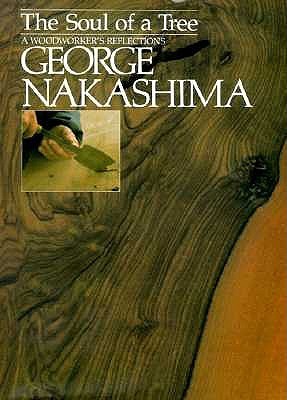
The Soul of a Tree: A Master Woodworker's Reflections
On a farmlike compound near New Hope, Pennsylvania, George Nakashima, his family, and fellow wood-workers create exquisite furniture from richly grained, rare timber. Tables, desks, chairs, and cabinets from this simple workshop grace the homes and mansions and executive boardrooms of people who prize such excellence. In this lavishly illustrated volume, George Nakashima allows us in intimate look at his artistry, his philosophy, his life. It is the portrait of an artisan who strives to find the ideal use for each plank in order to "create an object of utility to man and, if nature smiles, an object of lasting beauty."
The author's search for the meaning of life took him as a young man to Paris, Tokyo, and Pondicherry, India. In India, he found the inner peace for which he had been searching and began to find ways to work with timber. He writes movingly about the grandeur of ancient trees and stunning figured woods and explains how he selects and prepares his materials. Above all, he impresses us with his devotion to discovering the inherent beauty of wood so that noble trees might have a second life as furniture. The Soul of a Tree looks at the world through the eyes of an artist and evokes the joy of living in harmony with nature.
The author's search for the meaning of life took him as a young man to Paris, Tokyo, and Pondicherry, India. In India, he found the inner peace for which he had been searching and began to find ways to work with timber. He writes movingly about the grandeur of ancient trees and stunning figured woods and explains how he selects and prepares his materials. Above all, he impresses us with his devotion to discovering the inherent beauty of wood so that noble trees might have a second life as furniture. The Soul of a Tree looks at the world through the eyes of an artist and evokes the joy of living in harmony with nature.
224 pages, Paperback
First published October 1, 1981
Ratings & Reviews
Friends & Following
Create a free account to discover what your friends think of this book!
Community Reviews
Displaying 1 - 26 of 26 reviews

December 13, 2017
The whole book is awesome and inspiring, but one of my favorite points that helped at a tough time in my projects in work, home, etc. was a quick one-liner:
Craftsmanship is a silent skill. People who talk excessively cannot take part.

April 7, 2014
This was amazing, I'll never look at wooden furniture the same way again. Great text, photos and sketches (I am a huge fan of pencil sketches...). Informative, fascinating, masterful.

Read
March 21, 2025what a beautiful book. i can’t personally get into live edge furniture bc of the cultural associations it has taken on (craft beer etc) but wow do i GET where it came from now. and some of the other forms (eg conoid chairs, trestle tables) are jaw dropping in their simplicity, very drawn to them.
what a life Nakashima lived….from washington state to MIT to Paris to ashram in India to Japan to Seattle to an internment camp in Idaho to new hope PA where he remained till death. unreal.
what a life Nakashima lived….from washington state to MIT to Paris to ashram in India to Japan to Seattle to an internment camp in Idaho to new hope PA where he remained till death. unreal.

October 1, 2020
Despite knowing nothing about woodworking, Nakashima has managed to captivate me and completely engulf me in his world of nature and beauty. What a surprise finding out that him and I were born in the same city, and where I still reside! A beautiful read for anyone, and I mean anyone!

xx-dnf-skim-reference
February 24, 2025My dad would have loved this. I enjoyed the pictures. I don't think you need to be a woodworker to appreciate it, but if you have any interest in design, fine furniture, or even history of the Japanese-American experience, you might want to take a look.

February 4, 2025
the most elite of coffee table books, the most spiritual of textbooks. I know nothing about intricate woodworking, but if this had been my textbook growing up, I may have dreamt of life as a carpenter. the book, along with Nakashima’s own telling of his journey, is complete with sketches from his world travels and photos taken of/by him.
the crux is soft spoken, gentle, observant - and carries a quiet resilience that supersedes all boisterous ego. there was so much to learn from him and his craft, and i’ll never see handmade wooden furniture the same again. really recommend this autobiography to anyone looking for inspiration from nature/our human self/a way of life.
the crux is soft spoken, gentle, observant - and carries a quiet resilience that supersedes all boisterous ego. there was so much to learn from him and his craft, and i’ll never see handmade wooden furniture the same again. really recommend this autobiography to anyone looking for inspiration from nature/our human self/a way of life.

February 17, 2026
George acted on the post-grad urge to spend years in european/asian vegabondage and clearly we should all follow in his example
February 20, 2026
Very good! This is one I will keep to refer to again .

January 12, 2019
George Nakashima was not only a master craftsman in his field, he was a genius. He could pick up any piece of wood and at a glance know what the end product would be to its full potential...and more.He would let the wood tell him. Even his simplest of projects 'sing' beauty and finesse. I bought the book for insperation to my own woodworking skills, and learnt much more than i expected. Included in the book is a short biography telling us of his early life, his travelings and how he ended up the man he became, his family, lifestyle, work and good natured beliefs. It certainly gave me insperation towards beautiful woodwork and i like to think I learnt a few lessons in life as well. If i was to me this man and only shake his hand I would feel honoured.
August 17, 2025
Part biography, part craft manual, part coffee table book. An accidental read that I loved. Like all great makers Nakashima is a philosopher. While he proclaims that woodworking is a practice of silence, his own practice has taught him much that he needs to say. Foremost, for me, he communicated that the world is not made up of objects but of subjects, and that changes everything.
While his analysis of the world is critical, his overall message is a great hope for the future. "We are on the verge of a great and heroic revolution, a revolution of the soul."
While his analysis of the world is critical, his overall message is a great hope for the future. "We are on the verge of a great and heroic revolution, a revolution of the soul."

November 20, 2021
"I go back often to the land from which the timber has come, the woods and the forests around the world. It is like visiting relatives..."
"Craftsmanship is a silent skill. People who talk excessively cannot take part."
~George Nakashima
"Craftsmanship is a silent skill. People who talk excessively cannot take part."
~George Nakashima

September 22, 2021
Beautiful reflections from one of the most important craftsmen on earth. While his creations certainly challenged and changed the way we view design, I think his life eclipsed all of it. This is an human story we should all read and seek to follow, both practically and spiritually.

October 12, 2021
I'm not sure how a book could feel so essential and dated at the same time. Nakashima's work is beautiful and timeless. But I believe one should just ignore the rejection of veneers and straight grained wood as best one can. Everything has its place.
July 23, 2017
The highly regarded architect and woodworker speaks of his life and work; of the spirituality and endurance of the wood he has worked with. Well worth the read.

May 7, 2018
Incredible! An absolute legend!
September 29, 2020
Full of inspiration and a deep look into the philosophy behind his work. A true treasure on the shelf.
April 24, 2021
Excellent and unique. Learned a lot about older trees and traditional woodworking techniques.
January 23, 2021
George Nakashima is the greatest artist of the 20th century.

April 11, 2012
What an inspiring man! George Nakashima was a revolutionary woodworker whose passion was to be true to the purpose of the wood, to bring out the innate glory of the tree: "Each flitch, each board, each plank can have only one ideal use. The woodworker, applying a thousand skills, must find that ideal use and then shape the wood to realize its true potential."
Rather than read some analysis of Nakashima's style, here you can read his own words. Drawings by Nakashima's own hand. Chapters about species of trees, their spiritual and practical uses. Pages about where to cut, and why. Gorgeous photos of Nakashima's stunning original designs that are so lovely, you'll want to run your fingertips over the paper. Slabs of trees that make a woodworker's heart race. A genius of a man who enriched our lives, even if we never knew him.
If you want more detail, I wrote an expanded review with images at http://clearheartblog.blogspot.com/20...
Rather than read some analysis of Nakashima's style, here you can read his own words. Drawings by Nakashima's own hand. Chapters about species of trees, their spiritual and practical uses. Pages about where to cut, and why. Gorgeous photos of Nakashima's stunning original designs that are so lovely, you'll want to run your fingertips over the paper. Slabs of trees that make a woodworker's heart race. A genius of a man who enriched our lives, even if we never knew him.
If you want more detail, I wrote an expanded review with images at http://clearheartblog.blogspot.com/20...
December 15, 2009
Take all the disciplines of managing a watershed: geology, botany, hydrology, ecology... Distill them all into one and apply to the study of a single slab of walnut. And there you have the vision of George Nakashima, the venerable Owl of American furniture-making.
April 2, 2013
I actually have the hardcover book that I had George Nakashima sign when it was published in the early 80's. A great book about an interesting man. Since his death in 1990 his pieces have been sought after by collectors with good reason.

March 31, 2018
The last part (the making of an object) was the best part of the book for me.
from Epilogue:
"My life has been a long search across the tumbling screes on mountain slopes around the world to find small points of glowing truth."
from Epilogue:
"My life has been a long search across the tumbling screes on mountain slopes around the world to find small points of glowing truth."

February 16, 2008
George Nakashima articulated things I had bee thinking about for a long time.
Read
March 28, 2014749.213 N1636 2011
November 11, 2016
Beauty, art and craftsmanship. A life well lived. The book is a joy and place of reflection.

Displaying 1 - 26 of 26 reviews