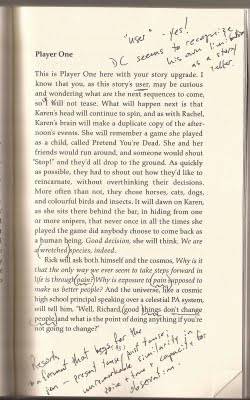
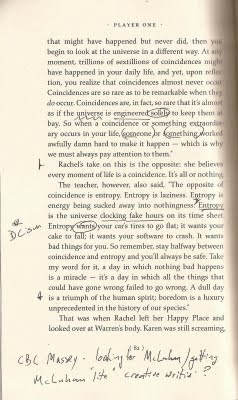
Player One is a novel that Douglas Coupland wrote as a series of one hour lectures to be given at the CBC Massey Lectures. Because of this, I believe there are probably different ways of approaching this story from a critical point of view, either as a lecture (meant to inform) or as a novel (meant to entertain). I read it as a novel, so that’s the basis of my review.
The premise of Player One is about five people who have converged in an airport hotel bar in Toronto, all for different reasons. Luke is a pastor who recently lost his faith and ran away with all the cash in the church’s bank account. Rick is a down-on-his luck sad sack who works at the bar after a series of bad choices and bad breaks. Karen is a single mom who’s flown across the country to meet an internet hookup for the first time. And Rachel is a beautiful young girl with severe autism who is trying to pick up a man to impregnate her to prove to her father that she is a human. Along with the characters are chapters from an entity only known as Player One.
A catastrophic event happens, and all the players are forced to band together to protect themselves from the events outside, not to mention a crazy sniper on the roof. In typical Coupland fashion, the characters wax poetic about everything, from the drudgery of their jobs to the confusing effects of time on our lives. While doing what they can to survive, they are also trying to figure out what the first part of 21st century life meant and what humanity will become once the dust has settled. Each character examines their life and tries to come to grips with the life decisions that landed them in their current situation and what they will become in the emerging new world.
There’s probably as much that is awkward and stilted about this story as there is touching and meaningful. The characters all have some sympathetic flaws, and these flaws influence their philosophical dialogue. As sympathetic as each character is, they strangely all seem to be worrying about the same things, namely how humans perceive time and whether a person’s life can be seen as a story. Several of the ideas seemed to be repeated in each character’s perspective, which was a little annoying. These moments felt more like Coupland stuffing his personal ponderances inside the character’s head. However, there were enough original thoughts to make each characters plight ring true. Each character seems to represent some aspect of modern humanity: apathy, loneliness, loss of faith, and objectivity. My personal favorite was Rachel, who wants to understand the aspects of humanity that she can’t understand, things like faces, humor, stories, and metaphors. Maybe it’s because her thoughts dealt more with looking at humanity from an ‘alien’ perspective more than throwaway sentiments about time.
A lot of the ideas in Player One are recycled from Coupland’s other works. I noticed a few paragraphs that had been lifted from previous novels. I’m willing to forgive this however, seeing as how this was technically a lecture about post-modern humanity. However, if Coupland publishes another book where the characters go on monologues about the effects of time, I might barf. It’s an interesting question, and it’s relevant to the story, but it seems to be repeated way too often and in the exact form as other novels. Within the context of this story, the questions of time often feel forced. Again, Rachel’s character (ironically) seems to be the most striking commentary. She is aware of her amygdala “double-recording” life-changing events, and her super-ability to sequence also provides a thought-provoking look at humanity’s perception of time. But most of the other characters’ quibbles with the passing of time felt out of place and a bit like filler material.
With all the discussions of “big questions” looming over every character’s head, we are reminded us that not all questions are “big.” As the playwright Craig Wright once said, “The real questions are simpler, but they're much scarier. The real question isn't 'Are we free?,' but 'Do you still love me?' The big question evaporates when we're face to face with the real question." Thankfully, Coupland deals with this in a subtle way that can almost go unnoticed. However, the resolution to the “little” questions are what make the conclusion to this story satisfying, and in turn it provides shines on the “big” questions. As with most other Coupland novels, the characters have been drastically changed, and now they stand on the brink of a new existence, ready to try all over again.
Despite its flaws, Player One was a great read. The plot is actually the most terrifying I’ve read from Coupland, and it gives the story an ominous tone that brings more weight to everything the characters discusss. The way each character changes in the face of a life-altering event was worth the price of admission. It’s the greatest hits of Douglas Coupland, and they’ve all come to play in one story.