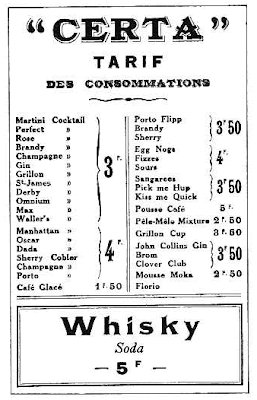
Paris Peasant (1926) is one of the central works of Surrealism, yet Exact Change's edition is the first U.S. publication of Simon Watson Taylor's authoritative translation, completed after consultations with the author. Unconventional in form--Aragon consciously avoided recognizable narration or character development--Paris Peasant is, in the author's words, -a mythology of the modern.- The book uses the city of Paris as a stage, or framework, and Aragon interweaves his text with images of related ephemera: cafe menus, maps, inscriptions on monuments and newspaper clippings. A detailed description of a Parisian arcade (nineteenth-century precursor to the mini-mall) and another of the Buttes-Chaumont park, are among the great set pieces within Aragon's swirling prose of philosophy, dream and satire. Andre Breton wrote of this work: -no one could have been a more astute detector of the unwonted in all its forms; no one else could have been carried away by such intoxicating reveries about a sort of secret life of the city. . . .-
French writer Louis Aragon founded literary surrealism.
Louis Aragon, a major figure in the avant-garde movements, shaped visual culture in the 20th century. His long career as a poet, novelist, Communist polemicist and bona fide war hero secured his place in the pantheon of greats.
With André Breton and Phillipe Soupault, Aragon launched the movement and through Paysan de Paris (Paris Peasant), his novel of 1926, produced the considered defining text of the movement.
Aragon parted company with the movement in the early 1930s, devoted his energies to the Communist party, and went to produce a vast body that combined elements of the social avant-garde.
Aragon, a leading influence on the shaping of the novel in the early to mid-20th century, gave voice and images to the art. He, also a critic, edited as a member of the Académie Goncourt. After 1959, people frequent nominated him for the Nobel Prize.
Surrealism’s pretty childish when you think about it. It’s as if, around 1924, a bunch of snotty French hipsters took a look at their society and said: ‘Oh yeah? Well, we’re going to do the opposite of everything you do, cuz yer stupid.’ So they tossed out the civilized values of reason, hard work and common sense, and set up their own private Bizarro world, a topsy-turvy kingdom ruled by dreams, play and imagination. It was a willed immaturity, a conscious regression to the infantile state, and I think the original Surrealists were deluding themselves about the extent to which their fabulous little slumber party was subsidized by the grown-up culture they’d spurned. You can, for instance, choose to view your city as a playground and trip out on its oneiric vistas, but it might be worthwhile to reflect on the poor working stiffs who built it for you. Sure, the kids can get high in their funky jam space all night, but who’s paying the bills?
As you might have gathered, I’m a little too old, and much too square, to have a whole lot of sympathy for the Surrealist project. It’s ironic, then, that one of my favourite books ever is a monument of Surrealism, written by perhaps the biggest daddy-o of all those hep cats, Louis Aragon (and doubly ironic in that the middle-aged, Communist Aragon epitomizes a type of French intellectual I absolutely loathe). But who’d want to be totally consistent in their prejudices? Why on earth can’t an anarcho-vegan punk listen to Spoon in his off-hours? (What? They’re a good band. Shut up.)
Le Paysan de Paris in not quite a novel (roman was a swear word in the Surrealist vocabulary) and it’s too documentary to be a prose poem. If you want to get hung up on genre, you could call it a travelogue, but it’s a travelogue with a bad case of agoraphobia, never venturing far from a couple of tiny patches of downtown Paris. Aragon spends the first half of the book exploring every inch of the Passage de l’Opera, one of those covered arcades dating back to the 19th century that are now recognized as forerunners of the modern shopping mall (see Walter Benjamin’s massive Arcades Project, or then again, don’t.) By the time Aragon got around to writing about it, the place had already gone to seed and was about to be demolished to make way for yet another of Haussmann’s boulevards. But for Aragon, the Passage’s weird sex appeal is bound up with its very ephemerality . The place fascinates him as a repository of memories, desires, fashions – a whole hidden history of Paris mouldering away in a sleazy arrondissement. His obsessively detailed evocations of the arcade’s cafes, hair salons and louche massage parlours are not so much surreal as hyperreal; he thinks nothing of devoting an entire delirious page to the unusual dress worn by a saleswoman in a handkerchief shop; hell, it takes him a paragraph just to figure out what colour it is:
The whole skirt has a garish half-tint (use your imagination): it’s a sort of plum-brandy red, a vinaigrette-ish tone that looks as much like a living colour as costume spangles look like diamonds. It’s reminiscent of dying gooseberry, of pecked-over cherry, it resembles those ribbons on Palmes Academiques that turn to acid in daylight…wait, I’ve got it, the dress is litmus paper tinted slightly pink by urine.
Now you might be thinking a hundred pages about some condemned shopping centre in old Paris would get to be a bit much. But the joy of reading Le Paysan is in watching a brilliantly inventive mind go to work on the faded texture of everyday life, bringing out the beauty and strangeness lying just below the dusty, fly-specked surface. This, I have to admit, is one of the nobler aspects of Surrealism: the determination to seek paradise, not in some other, ideal world, but right here, in the depths of the quotidian. A woman’s glance, a moronic ad, a row of medical supplies in a display window: all are mundane, all are sacramental. Each has its meaning and its mystery, if we’d only look.
I’m almost farcically unqualified to be dispensing wisdom in any form, but I sometimes feel that our spiritual fortitude is tested less by outright disaster than by all the drab, pointless shit we rub up against every day. It can wear you down after a while, you know? ‘Habit,’ as Beckett said, ‘is a great deadener.’ I still have no idea what literature is for, but one thing I believe it can do is to break through the crust of habit, to restore the world, if that’s not too portentous a phrase for what should be a humble task.
'I am already twenty-six years old,’ Aragon tells us in his preface. ‘Am I still privileged to take part in this miracle? How long shall I retain this sense of the marvellous suffusing everyday existence?’
The answer, it turned out, was: not long. But it was long enough to write a book as marvellous as the brief vision he was granted. I know my world would be a little poorer without it.
A paean to the chance discoveries and revealings of error, a treatise on the peculiar magic and mystery of place, a vast theoretical framework for experiencing the world.
Aragon, despite his many novels and essay, was foremost a poet, I think, and this shows in his rich and unexpected use of language. Also in the tendency of his words to sometimes lift off, unmoored from the actual narrative context that inspired them. Not that this is really a narrative in its basic sense: Aragon's odd travelogues of Paris place (an arcade (in the pre-mall, covered pedestrian commercial passage sense), a park) are just jumping-off points, brief perches from which to fire off piercing observation and musing.
And his thoughts are very worth it. Particularly in the first and longest section. At one point he chides himself after a long tirade against the hazards of eminent domain abuse, calling himself out for assuming that the reader actually shared his positions and preoccupations. Except he had been right: I did and do share his obsessions and thoughts, even all this space and time across most of a century.
And as far as novels that are part memoir and part philosophic leaping-off point, this is far far better than Nadja.
Will be reviewing this edition separately from the Taylor English translation and the original French edition.
Note that this cover is from the 1970 translation by Frederick Brown, NOT the newer translation by Simon Watson Taylor released under the title "Paris Peasant." In my opinion Taylor's translation doesn't even feel like the same book. I love the Brown translation; by comparison I didn't care as much for the Taylor edition, which seemed to be much more literal. But native French speakers have the advantage of knowing Aragon's true words.
A very accessible philosophical walk through the Paris of the early 1920s, reflecting on the city as a changing mythology, on human imagination, and on the fear of losing our youthful sense of wonder as we age. A sort of Surrealist, philosophical, modern-day Alice in Wonderland with a marvelous commentary by the translator.
Aragon's growing distaste for the automatic writing of his fellow surrealists, which largely consisted of imagery for the sake of imagery, led him on a physical and intellectual peripatetic adventure to create a surrealist text of far greater substance. Here, in a frenzied philosophical outpouring of highly imagined surrealist prose, Aragon mythologises place, blends genres (including his own autobiography), adds clippings from newspapers, posters and plaques, all while vacillating between whimsy, satire and outsider conceit.
What can I say, I'm a sucker for poetry and intellect, for language with substance, for story that defies categorisation.
Sürrealist bir roman, ya da karşı-roman, ya da yazarının tanımlamasıyla: "Roman olmayan roman". Walter Benjamin'e Pasajlar'ı yazmayı esinleyen metin. Aragon, gerçeğin üstünde gezindiği döneme ait (1926 tarihli) bu başyapıtında, hayal gücüyle metropolü bir araya getirerek, çoğu yerde olağanüstü şiirsel, bazen öfkeli, bazen esprili, bazen mistik bir gezi yazısı kıvamında, sonlara doğru ise tamamen felsefi, ele avuca sığmaz bir metin ortaya koymuş. Ancak kolay bir okuma vaadi değil bu; bu yüzden 4 yıldız verdim, ama bir kez daha okusam beşlerim diye düşünüyorum. Bu zor metni kusursuz bir şekilde Türkçe'ye kazandıran Ayberk Erkay'a teşekkürler. (Tek eleştirim, sonda açıklama notları bulunduğuna dair önsözde hiçbir ipucu olmaması; biraz geç keşfettim bu notları ve tekrar geri dönmek zorunda kaldım.)
Malgré son mépris affiché pour le genre romanesque, force est de constater que le surréalisme a toutefois laissé en héritage un nombre relativement conséquent de romans. Cette contradiction première n'est que la première trahison du goût prononcé du mouvement pour le paradoxe, art de l'insolvabilité des contraires. Le Paysan de Paris n'échappe pas à cette tradition. En effet, sa structure tout entière est construite sur des fondements mobiles, ce qui renforce son extrême labilité. À un réalisme quasi scientifique dans sa précision géographique et topographique, Aragon mêle, dans une étreinte littéraire passionnée, le surréel, le mythique, qui suintent au travers de digressions toujours plus oniriques. Ce roman est celui d'un itinéraire cahoteux, fait d'errance et de bifurcations à la fois physiques et psychiques. Refus du rectiligne, l'écriture est faite d'une suite de méandres qui contribuent au dépaysement et à la désorientation, ouverture vers un ailleurs à la fois familier et nouveau. L'heure n'est pas à l'observation : elle est tout entière à la vision, entendue au sens clinique, pratiquement hallucinatoire du terme. Et c'est précisément au sein de cet enchaînement de tableaux que se déploie la virtuosité du Aragon surréaliste, qui gagne aujourd'hui à être redécouverte. En relisant ce joyau de jeunesse, on se donne également les moyens de comprendre le virage drastique qu'a pris l'écriture d'Aragon, passé de fervent détracteur du réalisme dans ses jeunes années au créateur de son propre Monde réel...
PS : pour tous ceux qui possèdent un accès jstor, cet article sur la création d'une mythologie surréaliste est à la fois très concis et éclairant, n'hésitez pas à y jeter un oeil ! https://www.jstor.org/stable/40550988
Paris Köylüsü bir roman mıdır? Bence değildir. Bu tabii çok öznel bir kanı. Bana kalırsa Paris Köylüsü Louis Aragon'un Sürrealizm akımını düz yazı bir metinde ortaya koyuşu ve hakim felsefe literatüründeki kabaca idealimz realizm savaşında konumlandığı noktanın bir anlatısıdır. Keza kendisi şair. Metin de uzun bir şiir tadında ve üslubunda. Şiirsel üslup ile yazılmış ya da kurgusu ve olay örgüsü daha geri planda bırakılmış romanlar var elbette ama bu metin roman türünden epey uzak bir metin. Bu metni roman olarak addedersek Memleketimden İnsan Manzaraları daha romandır. Okurken saygı duyup, özellikle felsefi görüşlerini dile getirdiği ve hemen akabinde o harikulade şairane üslubu ile görüşlerini desteklediği yerlerde keyif aldım diyebilirim. Fakat kitabın geneline baktığımda birşeyler eksik kaldı bende. Bu da bir roman okumayı beklerken yer yer bir felsefi metin, yer yer şiir okurken kendimi bulduğum içindir belki. Bu yüzden naçizane görüşüm üç yıldızda kaldı.
Louis Aragon was one of the main guys behind Surrealism, till he came up against his one time friend Andre Breton, who threw him out of the group. Aragon became a hardcore Communist for the rest of his life. Meanwhile during his Surrealist years he wrote "Paris Peasant" which is a beautiful book about mad love among the 'ruins' of Paris. Not as good as Breton's Nadja, but nevertheless a must for those who collect and read French Surrealist literature.
160 sayfalık kitabın ilk 100 sayfası kitabın ilk bölümü. Hikaye ya da Aragon’un gözlem seyri Parid’te 19.yy’dan kalma Opera Pasajı’ında geçiyor. Roman diye aldığım bu kitap- ilk bölümü roman olmaya daha yakın- aslında deneme ya da gözlem kitabı; Louis Aragon başarılı bir yaşam gözlemcisi. Okuduğum bu kitabın tarifini yapmak istedim çünkü “roman okurum” niyetiyle alanlar için hayal kırıklığı olabilir. *** Opera Pasajı içinde terzi, berber, bar, otel vs. yerleri barındıran bir yapı. Louis Aragon’da hem yapının tasvirini(sayfalarca) yapıyor hem de pasajda gözlemlediği yaşamı, pasaj insanını ve dışarıdan gelen misafirlerle ilgili gözlemlerini aktarıyor. Bunu bazen olayların içindeymişiz gibi şimdiki zamanda, bazen de masasının başındayken aklına gelenleri yakın geçmiş zaman dilini kullanarak yapıyor. Sadece pasajı değil, pasajın bulunduğu sokak, oradaki dükkan ve yine burjuva gurubunun yaşantılarını da mevcut bu ilk bölümde. Müthiş, hayranlık uyandıran bir bilinç akışı tekniği hakim bölüme. Berberde bir saç örgüsünün ucundayken, bir bakmışsınız terzinin ihtiyatsız hareketleriyle oynattığı makasının ucundasınız ve hoop bir vagonda karışınızda oturan kadının parmağındaki alyansın anlamında ya da anlamsızlığındasınız. Hep bir imge peşindeyken sanki hikaye de her yeni imgeyle baştan yazılıyor gibi. Hikayenin bu parçalanmışlığını sevdim. Güç bir metin olsa da Louis Aragon’un yağ gibi akan bir anlatımı da var. Şair yönünü özellikle bu sayfalarda ama metnin tamamında da fazlasıyla hissettiriyor. Kavramlar üzerinden-ölüm, aşk, varoluş- felsefe yaptığı satırlar hatta paragraflar da çok. Bu sayfalarda Freud’a, Hegel’e göndermeleri görüyoruz. Konuşan akıl, konuşan duyarlılık, konuşan irade ve hayal gücü ile de karşılaşmanız mümkün bir kitap Paris Köylüsü. Özetle birinci bölümü yorucu bulsam da ilk bölüme bayıldımmm. *** Birinci bölümü tasvirleri ile yorucu bulurken ikinci bölümde daha güç olanla, düşüncelerin seyriyle karşılaştım. İlk bölümde yaptığı çevresel tasvirlerini burada düşüncelere uyguluyor Louis Aragon. Bana göre kitabın son 60 sayfası görüşler, simgeler ve elle tutulamaz soyut düşüncelerle ilerlediğinden daha dikkatli bir okuma gerektiren ve daha az keyif aldığım kısmı.
So Jesus, where to even start? If we’re using Breton’s definition of “pure psychic automatism,” this is a pretty pristine example. All those random thoughts, the completely observational running headlong into pure emotion, with little bits of the city flying by – banal advertisements in shop windows reproduced whole interspersed with the text.
I was reminded, more than anything, not of a piece of fiction at all, but Nas’ Illmatic. Louis Aragon’s stand-in narrator walks around the infinitely dense cityscape of Paris, letting its myriad bits and pieces fall over him, not too different from NaS’ Queensbridge lyricism. And if a 100 year old French novel is making me think of one of the most iconic rap albums of my childhood, that’s a sign that certain vein is being hit. The world is yours.
Afar áhugavert að lesa þær hugmyndaglóðir sem myndu kveikja það fræðilega bál sem myndi á endanum verða að Verslunarsalaverkefni Walter Benjamins. Hér eru verslunarsalirnir uppfullir af töfrum, kynjaverum og dulúð. Ætli það sé eitthvað svipað að finna í Mjóddinni?
"Paris Peasant is one of the central works of Surrealism, ..." and yet, it doesn't feel at all "surreal" to me. I'm well aware that "surreal" is used nowadays as a word quite detached from what the Surrealist writing groups were (and still are) doing. But still, this isn't what I was expecting.
Basically, Aragon walks around in a Paris arcade that will soon be torn down to construct Blvd. Haussmann, and records what he sees. This includes description of a bar, a cafe, a shoe shop, public baths, and even his visit to a "massage" parlor. (Nudge, nudge... Wink, wink.) I somewhat enjoyed it because I like Paris and reading about foreign places in general, but this still feels like there isn't much there.
I should deduct points because he mentions the existence of a "Dada cocktail" at the cafe "Certa", but does not provide the recipe.
je suis complètement amoureuse de lui ct trop beau j’ai failli pleurer je suis absolument choquée de ce banger et je vais l’apprendre par cœur, cela dit moins une étoile pour la mention de paul et virginie dsl fallait pas jouer avec mes nerfs
Paris Köylüsü, bir şehir ve zihin haritası. Sürrealist Manifesto'nun da yayımlandığı yıl (1924), Aragon, gerçeklikten emin olamazken daima faaliyet halinde olan hayal gücünün derinliklerine doğru yürüyor. Gördüğünü de anlatıyor, zihninde açılan pencereleri de. 'Gerçek' sandığımız dış dünyanın, nesnelerin ardındakini bulmak istiyor. Sınırları belirlenmiş olağan dünyasının içindeki insana soruyor, "Niçin yalnız benim buna şaşıran?" Bu söz beni yirmi yıl öncesine üniversiteye başladığım ilk güne götürüyor, hocamız demişti ki "Her gün önünden geçtiğiniz Kapalıçarşı ve orada gördükleriniz sıradanlaşmasın, hep merakla bakın." Aragon da katılıyor buna "Zihninizin dev fenerleri hep açık olsun" diyor.
C'est à lire seulement si on le doit parcque l'on suit un cours sur le surréalisme. Le Paysan de Paris fait un clin d'Oeil au Paysan Perverti de Restife de la Brétonne. Le roman de Restife de la Brétonne decrit une déchéance. Le roman d'Aragon décrit un trajectoire qui tourne en ronds.
Le surréalisme est un mouvement qui n'a pas produit une seule oeuvre d'intéret dans la domaine de la littérature. Les résultats ont été carrément meilleurs dans les domaines de la peinture, de la sculpture et le cinéma.
D'autre part, le surréalisme discute bien ce qui explique sans doute pourquoi on continue a le guarder au programme au premier cycle.
Had this on my list for so long and I wish I read it earlier, it's fascinating and revolutionary still. The minutiae and the incorporation of non-fiction elements into a dreamlike fiction is great.
le passage de l’opera c’est un grand oui 10/10 bravo loulou tu m’as emporté mais par contre les buttes chaumont c’etait la goutte de trop genre bb jnai rien compris ca m’a gaché tout le plaisir du début…
I usually find Surrealist writers, at least in translation, to be dreadfully boring & wooden & forced. The best "Surrealist" writing is by people who were either never Surrealists or were only peripherally associated w/ Surrrealism - like Raymond Roussel & Raymond Queneau. Of course, you have to be named Raymond to be a good Surrealist writer - except for Antonin Artaud.. However, I liked this Louis Aragon bk. On the other hand, contrary to what the back-cover blurb says, I wdn't call this bk Surrealist either, so..
Start at the last chapter, then move to the first. Camouflaged as an inch-by-inch inventory of certain favorite areas of Paris, Aragon has created a manifesto on the purpose of literature: As a means of personal and phenomenological exploration.
Je n’ai pas réussi à finir ce livre. Je ne sais pas pourquoi mais je trouve que le style des surréalistes a mal vieilli entre figures de style ampoulées et provocations faciles.
Alors à un moment donné on referme le livre et on se dit : « à quoi bon » ?