Here Comes Mrs. Kugelman is Minka Pradelski's enchanting novel of listening and telling, of the silence between Holocaust survivors and their children, and of the power of stories to mend broken bonds
When feisty young Tsippy Silberberg of the curious eating habits receives word from Tel Aviv that a distant aunt has left her a mysterious inheritance—an incomplete fish service in a battered brown suitcase—she decides to break her rigid routine and go collect it in person. But before she is even able to settle into her hotel room, an odd old woman bangs on her door and invites herself in. Her name is Bella Kugelman, and she is determined to talk.
And talk she does, with wondrous effect. Soon the room is filled with people—residents of the Polish town of Bedzin before the war, who now live on, if only in Mrs. Kugelman's stories. Flirtatious girls and sly shopkeepers, rich industrialists and a family so poor that their necks are bent over from looking for coins—in tale after tale, a town magically returns to life, even as its grim future looms darkly. And under the thrall of Mrs. Kugelman's words, Tsippy finally pieces together her aunt's strange bequest, as well as her own place in the story unfolding before her.
I find this book a bit hard to rate - I kind of want to give it a 3, as I did enjoy parts of it. But overall, my reaction was "It was okay." The stories Mrs. Kugelman told were, indeed, interesting, and sometimes moving, but the way the stories were delivered - the hotel setting, the narrator with her odd eating habits - things that seem to have been written to be entertaining were not believable to me. Nor did I find Tsippy or Mrs. Kugelman very likeable. I really wanted to like the whole book more- not just parts of it.
I am not sure that any review I write can do this book justice. I listened to the NPR review and it was explained that the author had spent decades studying the psychological effects of the Holocaust on survivors. This necessitated the interviewing of many people and one person told her not to forget the Polish town of Bedzin. She didn't and in this novel manages to bring the whole town alive.
The main character is a woman named Tsippy Silberberg and she finds out that a distant aunt has left her a strange inheritance. This starts the story in motion and when she goes to collect it in person she is confronted by a few strange occurrences, one of course being the mysterious Mrs. Kugelman. She insists on telling Tsippyr stories of the past, from her town and it is in this way that we meet the people of Bedzin.
This was a new slant on the Holocaust story, the author really brings these people alive. Of course, we know what is going to happen soon, but when these people are young they are just living their lives. Tsippy finds out things about herself and her family from Mrs. Kugelman and from this looks back at her past with her father and finally begins to understand. Tsippy herself has one strange obsession and it is managed with humor and pathos. This is a first novel and I just loved it. Loved the way the story is told and the fact that it has such a deeper meaning.
The antics and odd behavior of Tsippy Silberberg took away from the book's purported message. The story telling just didn't come across effectively. Maybe something was lost in translation. I am truly shocked at the praise from others.
When does the Holocaust pass completely into history? I suppose when the last survivor dies and the last person who has heard the last survivor tell his story dies. We're not in danger of that happening too soon, but it will happen.
In German author Minka Pradelski's first novel (translated from German by Philip Boehm), she writes about Tsippy Silberberg, who travels from Frankfurt to Tel Aviv to pick up an inheritance she has received from a dead Israeli relative. She's sort of an odd girl - Tsippy is - who has developed some very bizarre eating habits and is definitely more than a bit neurotic. Her parents are both Holocaust survivors who have moved to Germany from their native Poland. After Tsippy arrives in Tel Aviv, she is told by the front desk at the hotel she has reserved her room at that the room had just been given away to another Tsippy Silberberg. (How many can there be in the world?) She moves to a second hotel, where she encounters an old woman, Mrs Kugelman, who basically traps Tsippy in her room and tells her about her life back in a small Polish village before WW2. According to Mrs K, the village of Bedzin, located near the border of Silesia, was a wonderful place to live, filled with wonderful people. All of that came to an end, of course, when the Germans invaded Poland and most of the residents of Bedzin were either murdered or fled east into Russia. Some had left Bedzin for Palestine before the war; most did not.
Pradelski's book has more than a little "magical realism". It isn't totally "magical realism", because if it was, I wouldn't have finished it. I don't find it easy to suspend belief in the rational; I'm too much a literal reader. But Pradelski has produced two main characters - Mrs Kugelman and Tsippy Silberberg - who, along with the late residents of Bedzin and a few current residents of Tel Aviv - come together in an interesting way to produce a fascinating story of love, life, and the way the past most definitely influences the present and the future? Even though Tsippy's father back in Frankfurt had come from a different part of Poland, could he possibly have been a bit present in the events in Bedzin?
As with most book with "magical realism", this book can be read in two ways. One is the "plain", this is what happened to these people and the other is more as a fable. I think how much you enjoy the book depends on how you choose to read it. I think "Mrs Kugelman" will probably get a whole range of reviews. It's one of those books; books that make you think when you finally close it.
I wanted to like this book more than I did like it. The modern day scenes seemed contrived and disjointed and they detracted from the Holocaust story. The idea of keeping the memory of a town alive by telling and re-telling stories of the daily lives of its inhabitants who were murdered could make a powerful novel. This isn't it.
This book was just bizarre and confusing. There were so many plot points that had no reasoning or explanation. Number one being Tsippy’s “addiction” to eating ice and frozen vegetables. It served absolutely no point to the story. Her relationship with Koby was very strange and confusing. The fact that someone stole her original hotel reservation seemed pointless too. Her inheritance is only semi-explained. What about the suitcase?
I do not understand why Tsippy let Mrs. kugelman into her hotel room in the first place, let alone the next day? Who just lets a stranger barge in to their hotel room and force them to sit and listen to them talk for hours. Both Tsippy and Mrs. Kugelman are very unlikable. Mrs. K is very rude and nasty, and it’s strange how Tsippy became so frantically dependent on her.
I think the idea behind this book was great, and hearing stories from a Survivor should be very captivating. However, this book does a great disservice to whatever parts are based on true stories.
Hätte Iris Berben nicht gelesen, hätte ich e abgebrochen! Solch unsympathische Charaktere mit einer flachen, langatmigen und wenig spannenden Geschichte.
A very fast read. The parts set in modern-day Tel Aviv have a delusional, dream-like haze to them. Mrs. Kugelman's stories from pre-war Poland feel more focused and real. Charming stories, all starting with a high school classmate of Mrs. Kugelman's. They reminded me of many similar books I've read about the Jewish communities that were destroyed.
I appreciated that this book didn't dwell much on the tragic ends that all these friends and neighbors met. Not that those ends aren't important, but I just couldn't take it . . . and that reader response is, sadly, consistent with the book's main theme (who do the survivors talk to now? do we really want them to talk about everything? only some things?). However, I did find intriguing a story about the local Jewish factory owners, materials suppliers, etc. trying to organize a boycott of German business. If only such ideas had worked....
Mrs. Kugelman tells the young woman narrator all the stories that Kugelman never told her own children, and that her children, trying to spare her pain, never asked her about. The poignant part of the book is when Mrs. Kugelman suggests that every survivor should set up as a community storyteller for the other survivors' children. This is a book about when people talk too much (Kugelman invading the young woman's hotel room) and when they talk too little (the young woman growing up around her parents' absolute silence).
This is an odd little book, and I can't say it covers much new ground, but the stories (of burly porters, of secret recipes for cheesecake, of teenagers playing hooky) have a sweet, Chagall-painting-like feel.
Grab yourself a bottle of cold water, find yourself a chair, and get comfy because Mrs Kugelman is here and she has plenty of stories to share.
I found Mrs Kugelman's stories warm, endearing, and poignant. That is before they turn into a confession of how perfection was destroyed. I would have liked for that part of Mrs Kugelman's life to have been explored further. Mrs Kugelman herself is feisty and strong.
On the other hand, Tsippy Silberberg is a bit wimpy, has a strange addiction/fetish, which is lucky for us otherwise we'd have never gotten to hear Mrs Kugelman's stories.
With the rate at which we are losing both holocaust survivors and WWII veterans, I do recommend "Here Comes Mrs. Kugelman: A Novel." Something/someone needs to remind us that what happened was real and that it happened to real people.
DISCLOSURE: I did receive the book for free through Goodreads First Reads.
Just from the title, I really hoped this book would be special...but it wasn't. The story is about a young single woman, Tsippy Silberberg who travels to Israel to claim an inheritance left by an aunt. Seems straight forward, and should have been the start of an interesting tale. Unfortunately, something was lost in translation. Tsippy's hotel reservation has been take over by someone claiming to be her...and the why or how never comes up again. She finds another hotel, and a strange woman, Mrs. Kugelman, knocks on her door and starts to tell her about what it was like in Poland before WWII. The way Mrs. Kugelman tells her stories, (and there are hours, days, and weeks of stories), makes those who were lost in the Holocaust come alive. But the question remains, why? I found the book to be a very slow read, and I only kept reading to the end hoping it would get better.
I started to read this, thinking it was going to be a story about generations, a mystery, and a little bit of Israel. Instead, the actual narrator recedes into the background, and the story is Mrs. Kugelman's, about her life in Bedzin, Poland, before the Shoah. That would have been a fine story on it's own, but instead of just allowing us to immerse in that, the story jumps back and forth, but mostly back. A rather schmaltzy nostalgic tone and the mysterious ice obsession that was made to seem perverse, but never explained, put me off. I'm sorry Minka, I didn't finish!
It’s hard to blend tragedy and comedy and this book doesn’t really pull it off. I’ll say upfront that, according to GR, this is one of the lowest-rated books I’ve read (2.99).
Tsippy Silberberg, the narrator, learns that an aunt she never met died in Israel and left her a suitcase with an inheritance in it. The narrator goes to Israel to collect it. She meets Mrs. Kugelman, a non-stop talker, who encamps in Tsippy’s hotel room to tell her stories of the lost Jews of Bedzin, a city in Poland where she grew up. (Mrs. Kugelman’s parents were murdered in the holocaust; Tsippy’s survived.)
The novel becomes a collection of vignettes about the people of Bedzin interrupted by the odd behaviors of the two conversants. We hear over and over that Tsippy eats only ice cream and frozen vegetables and has to check the hotel freezer to see if they are properly stored.
Mrs. Kugelman brings the village back to life by relating tales of her childhood and stories of the residents. Indeed, it’s as if she feels that by talking of the people she knew as a child she IS bringing them back to life. Shopkeepers, bakers, doctors, pharmacists and homemakers and nasty teachers.
And then the cattle cars came for them.
What’s the problem with the book? Banal dialog at times. Why all the weirdness about the frozen food? There’s some magical realism thrown in with the stories that doesn’t seem to fit.
The German author (b. 1947) is a sociologist and a documentary filmmaker who has focused her studies on the psychological impact of the holocaust on survivors and their children.
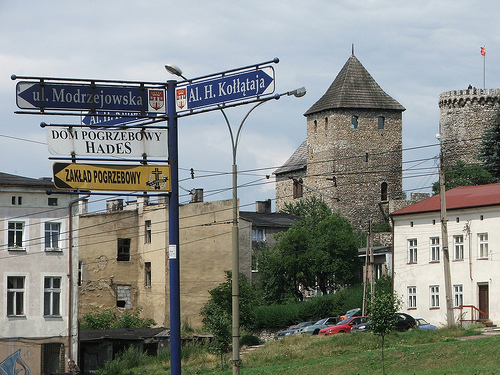
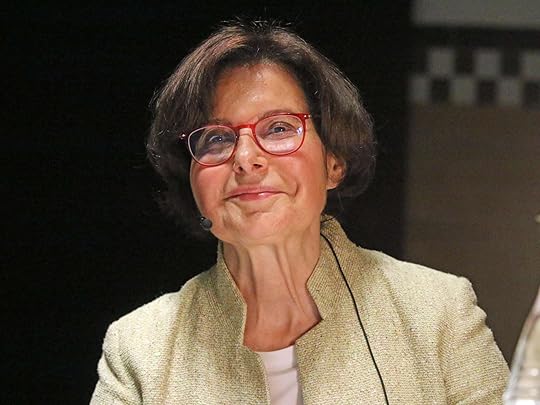
Photo of modern-day Bedzin from kpbs.org The author from wetterauer-zeitung.de
In this book, a German Jew named Tsippi Silberberg moves to Israel and then makes friends—in a pretty convoluted way—with a Holocaust survivor named Mrs. Kugelman. I was confused about the Mrs. title, since Mrs. Kugelman never admitted to marrying anybody, but that is possibly a faulty translation, since she is Frau Kugelman in the original.
However, I found this book pretty mediocre, and not because of translation issues. The relationship between the two main characters was contrived and didn’t feel satisfying to me. Tsippi was the more interesting character, even if I didn’t like her that much, which was sad because Mrs. Kugelman was telling all the stories. Some of the stories were interesting, emotionally arrested, and well-written, but those were few and far between. Too much rattling on about Mrs. Kugelman’s childhood and how she played hooky.
In Mrs. Kugelman’s stories, there are several great insights into her mind as a Holocaust survivor and good historical details. The great moments within this book do not redeem the whole enough. This book was a bit of a slog, and I had to trudge through lots of boring stuff to get to the story I expected.
I wanted to like this better than I did. There were so many good things about it: Mrs. Kugelman, her stories of the lost town of Bedzin, the writing style. The problem I had was with the disjointed portrait of Tsippy. What was really going on with her and her mental state? It's hinted at, but never expressly stated. Compared with the vivid portraits of Bedzin's inhabitants, she comes off as one dimensional; she's basically just there as an audience, not as a fully formed character. The pace was slow, slower than I would expect from a book as short as this. And the 'twist' at the end was sadly predictable. Also, some of the parts that I think were supposed to be somewhat humorous fell flat. I'm wondering if this was due to the translation rather than the story. By the time I finished the book I was a little unsatisfied and underwhelmed.
Von all den Büchern, die wir im Deutschunterricht hätten lesen können, wählte die komplett derangierte Deutschlehrerin in der 9. Klasse dieses hier. Für mich ein persönlicher Affront. Ich frage mich, wie man so einfallslos und anspruchslos sein kann, jungen, formbaren Menschen ein Buch aufzuzwingen, das in der Brigitte empfohlen wird und dazu noch schlecht geschrieben ist? Ich erinnere mich an die abstoßende Szene, in der die Protagonistin (wohl wenig überraschend Frau Kugelmann) unaufgewärmte Tiefkühlerbsen direkt aus der Tüte in sich hineinstopft. Bereits damals habe ich mich gefragt, welchen pädagogischen Wert dieses Buch haben soll.
The telling of the stories of the Jewish families was interesting, but did not capture the feeling of the times. Perhaps that is because the almost denial of what was happening was evident. But in retrospect that is exactly what was happening at the time. Oh my!
The book touches on questions that are hard to be asked and offers answers that no everybody is ready to hear. Mrs. Kugelman and all the citizens of Bedzin are very relatable and authentic. Even though the author projects them like holograms they feel very present now and here.
I thought I would enjoy this book because I wish I had talked to my ancestors about their lives and didn't. I think the idea of the book was good but the characters were not likeable. The stories were hard to follow and much of the Jewish language was confusing for me.
Had blijkbaar hele andere verwachtingen dan een verhalen vertellende mevrouw Kugelmann. Ik kon maar geen links zien tussen de vele in mijn ogen losse verhalen en kwam daardoor niet in het verhaal.
this book was really, really, really hard for me to get into. it didn't keep my attention well and it was kind of hard to follow. an absolute gorgeous cover tho!
Young Tsippy Silberberg is more than a little surprised when her aunt in Tel Aviv passes away and leaves her an inheritance. When she arrives to claim it, she's even more puzzled that it consists of an incomplete fish service in a suitcase. As she sits in her beach-side hotel room trying to puzzle out the meaning of having silverware to serve something she refuses to even eat, her journey gets even stranger with a knock on the door. Behind that knock is Mrs. Bella Kugelman, a Holocaust survivor like Tsippy's parents, who is determined to keep her hometown in Poland alive through stories that she insists on telling to Tsippy and anyone else who will listen. Much to her surprise, it's this odd and persistent woman and her stories that will help Tsippy unearth the meaning behind her aunt's bizarre bequest.
To get to the heart of things, Here Comes Mrs. Kugelman is kind of a weird book. Tsippy is a bizarre narrator prone to flights of fancy and impulsiveness that hardly make sense. Her bizarre diet centers on frozen vegetables for reasons that aren't entirely clear. The whole premise of an aged survivor materializing in her hotel room every day to tell stories of the old country regardless of whether Tsippy wants to hear them or not requires a healthy dose of suspension of disbelief. It's easy to see why Mrs. Kugelman is probably not a book that everyone is going to like. That said, I liked it quite a lot indeed.
Despite her oddities, Tsippy is an interesting character who has grown up in the shadow of her parents' silence over the terrible events of the Holocaust they survived. Her bizarre eating habits seemed to be grounded in a desperate need to get her emotionally repressed parents to say anything even if it was just to scold her for her increasingly bizarre behavior. I came to terms with odd Tsippy Silberberg as the story's primary narrator, but what I really loved were the stories Mrs. Kugelman came to tell Tsippy. Determined to keep her Polish town of Bedzin and its denizens alive long after the Holocaust destroyed it, Mrs. Kugelman is happy to tell anyone who will listen the stories of her childhood and the many characters that populated it. Her stories both satisfy Tsippy's hunger for some sense of her past and draw readers into the lives of mischievous kids, extremely religious adults, lovers, scam artists, businessmen, bakers and grocers and porters who populate an above-average small town that stood on the precipice of its own destruction and never knew.
Mrs. Kugelman's stories call to mind the sort of small-time legends that populate any town or even any one family, and Pradelski's choice to focus on the life of the town in its glory days before the horrors of the Holocaust came calling is a refreshing departure. Minka Pradelski is a sociologist who has spent considerable time exploring the psychological effects of the Holocaust on survivors, and her depiction of the very willful disconnect Tsippy's guilt-ridden father has made between the painful past and the promising future he hopes for his daughter definitely seems to spring from that knowledge. However, as Tsippy and Mrs. Kugelman's tale shows us, it might just be that the very stories survivors avoid are the ones that stand to heal a new generation. Here Comes Mrs. Kugelman is unexpectedly touching novel that shows the value of knowing our past even as we plunge into the uncertain future, and one that I would highly recommend if you don't mind reading a book that's just a bit outside the box.
I'm a big believer in the the value of stories. I treasure the ones I learned from elders in my family, true or not. For the thing about stories is that the truth can slip as time and memory blur the edges of a tale. But a gifted storyteller is a treasure for the ability to craft images, characters, and situations for their audience.
In this novel, the storyteller is Mrs. Kugelman. She enters the world of the narrator, a young woman named Tsippy Silberberg, in a rather haphazard way. Tsippy, who has some rather peculiar quirks of her own with her eating habits, is in Tel Aviv to pick up an inheritance left to her by her father's sister. Bella Kugelman enters Tsippy's life with a knock on the door, and a story to tell. Through her words, the inhabitants of Bedzin, a small, predominantly Jewish, Polish village on the border with Germany, come to life again. She tells of day to day life, before the war, before the invasion, before the Holocaust. It's a time when children played pranks in school (or were even still in school, since those were closed almost immediately when things got bad), when people went to the rebbe for blessings before new ventures, when families sent their cholent to the baker on Friday, so it could cook in the oven all day on the Sabbath, and they would not be working to do so. Mrs K's tales take the reader right up through the start of the end of a way of life, painting a vivid picture of what was lost, both in lives and lifestyle.
The stories charmed me, especially since some of my own family probably lived a similar life. The bits in between didn't carry the same type of interest for me, and oddly enough, either did the two main characters. The subplot of the relationship of Mrs Kugelman's stories to Tsippy's own life was a nice touch, but lacked the clarity of the mini-plots about the villagers of Bedzin. Indeed, just as kugel is often a side dish to a holiday table, Mrs Kugelman was more of a side character to the people she talked about.
I'm told the author is both a sociologist and documentary filmmaker and that her own parents were Holocaust survivors. Her interest in these survivors, their families, and the impact of horrors that occurred in that awful time, helped round this book out in a realistic way. This is her first novel. I look forward to reading more of her works in the future.
Thank you to LibraryThing Early Reviewers and to the publisher for sending me this copy of the book.
I want to thank Goodreads and the publisher for giving me the opportunity to read this Firstread reviewers' copy.
The book introduces us to Tsippy Silberberg, who travels to Israel to claim her inheritance after her aunt's death. Tsippy has a number of issues - she is obsessed with ice and frozen foods, and she checks out the emergency exits before settling into a hotel room. While staying in the hotel in Tel Aviv, she meets Mrs. Kugelman, a Holocaust survivor, who comes to her room every day and tells her of the life and people of the Polish town she grew up in. at first, Mrs. Kugelman is an intrusion; but her repeated visits become a gift for Tsippy. As Mrs. Kugelman relates more about the people of the town, Tsippy makes a connection between her family and the people that populate Mrs. Kugelman's story.
The story is especially good at highlighting the rich and varied lives of the Jews (and Christians) of Poland before Hitler's invasion. It also underlines the legacy of the Holocaust for those Jews that survived and for their children, who suffer a void as a result of the silence of their parents and an absence of familial relations. Unfortunately, I think the light tone of the novel and it's somewhat comic characters undermine its themes and thus its impact. So a good read but not a great one.
Lovers of historical fiction presented in an unusual way should appreciate HERE COMES MRS. KUGELMAN, Minka Pradelski’s unconventional account of the various inhabitants of the Polish town of Bedzin just prior to the start of WWII. Pradelski explores historical events and everyday happenings through the lens of Mrs. Kugelman who manages to bring life to those persons long dead through the stories she tells.
Mrs. Kugleman is a persistent historian not inclined to be dissuaded by the initially uncooperative and uninterested Tsippy Silberberg, a woman who has come Tel Aviv to collect a meager inheritance left by her distant aunt Helina. Slowly, as Mrs. Kugelman’s story unfolds, Tsippy learns of the connection between Bedzin, her aunt Helina, her inheritance and the tenacious Mrs. Kugelman.
This unusual presentation of the Holocaust puts a very personal face on those who survived as well as going a long way in explaining their reticence in sharing their experiences with their children.
This book is translated from another language and the writing does not flow as it would if written by a individual whose native language is English. When I read Mrs. Kugleman’s stories, it was akin to having an old Jewish woman sitting in my living room telling me about her life (complete with old country accent).
I found this book charming. Did you say, "How can a book about Hitler's armies invading Poland be charming?" Well, for most of the book -- although we know what is coming -- the almost idyllic childhood of Mrs. Kugelman in her small town in Poland is the subject. The town's people remind me of those in Tevye's town (from The Fiddler on the Roof) with its colorful cast of characters. Mrs. K.'s town has its share of characters in spades. I wanted to be in the Tel Aviv hotel with Mrs. K. and Tzippy so I could listen to the stories. Yes, Tzippy is odd (she eats only frozen food!), and Mrs. K. is mysterious. But who cares. Perhaps the stories, the narrators and the town are all made of fabric that is far from real. But that's ok with me. I am happy that I could read these stories and imagine myself back in Mrs. K.'s town in a happier time. And on a serious note: I found Mrs. K's explanation that she couldn't tell these stories to her own children to ring true. In my experience, with relatives and friends who experienced the Holocaust first-hand, they often won't share their experiences with their loved ones.
Think Fried Green Tomatoes at the Whistle Stop Cafe, Israeli style. Tsippy Silberberg's life is driven by her strange food compulsion/fetish. When her trip to Tel Aviv gets off to the wrong start, she encounters the elderly Mrs. Bella Kugelman, self-described as "'as [a] part of this hotel as the sofas and chairs'" (p. 9).
(The real reason isn't revealed until page 158.)
Tsippy is both enthralled by Mrs. Kugelman's stories of pre-World War II Poland while at other times not wanting to be bothered by her. Through the elderly women's stories, young Tsippy also learns more about herself, her culture, and family secrets.
PROS: Quick read.
CONS: Mrs. Kugelman doesn't like to be asked questions. Invasion/Holocaust not mentioned towards end of book. Too many characters for me to keep track of. The ending, which almost made me give this book 2 stars.
For a first novel, Minka Pradelski comes out running. This book, with a back story of some pretty funny stuff (only eating frozen food – frozen!!), takes us back to the 1940’s when Germany tried to rule the world.
Tsippy Silberberg inherits a fish service which is missing pieces. It is the perfect reason to break out of her self-imposed rut and travel a bit. After all, what could go wrong in Tel Aviv? Hah!
Barely into her hotel, Tsippy is “accosted” but a little old lady – Bella Kugelman. Bella has stories to tell and by God, Tsippy is going to listen. There isn’t a choice here. Soon Tsippy is familiar with Bedzin as it was before the war. The adults and children; the shops and schools and even the pets. Mrs. Kugelmam is a force in and of herself and she is the only person who knew Tsippy’s father as a child.
Told in first person by Tsippy you can laugh (guaranteed); cry (definitely) and think a lot but I know you will enjoy this one.