

What do you think?

The Night Shift: Real Life in the Heart of the E.R.
Dr. Brian Goldman is both an emergency room physician at Mount Sinai and a prominent medical journalist. Never one to shy away from controversy, Goldman specializes in kicking open the doors to the medical establishment, revealing what really goes on behind the scenes -- and in the minds of doctors and nurses. In The Night Shift , Goldman shares his experiences in the witching hours at Mount Sinai Hospital in downtown Toronto. We meet the kinds of patients who walk into an ER after late-night revellers injured on their way home after last call, teens assaulted in the streets by other teens and a woman who punches another woman out of jealousy over a man. But Goldman also reveals the emotional, heartbreaking side of everyday ER adult children forced to make life and death decisions about critically ill parents, victims of sexual assault, and mentally ill and homeless patients looking for understanding and a quick fix in the twenty-four-hour waiting room. Written with Goldman’s trademark honesty and with surprising humour, The Night Shift is also a frank look at many issues facing the medical profession today, and offers a highly compelling inside view into an often shrouded world.
263 pages, Hardcover
First published January 1, 2010
About the author
Brian Goldman
11 books34 followersBrian Goldman, MD, is one of those rare individuals with great success in not one but several adrenaline-pumping careers. Goldman is a highly regarded emergency physician at Mount Sinai Hospital in Toronto. He is also the host of the Canadian Broadcasting Corporation’s award-winning radio show “White Coat, Black Art”, where he takes listeners behind the scenes of hospitals and doctor’s offices. Goldman unpacks and demystifies what goes on inside medicine’s sliding doors – with edgy topics that include the whistle blowing in health care, burnout among health professionals, racism in health care and how to getting to the head of the line in health care.
Goldman is on a lifelong campaign to confront medical errors and create a culture of safety for patients. He has proven unafraid of using his own medical mistakes for examples on how doctors can improve. His TEDtalk – “Doctors Make Mistakes. Can We Talk About That?” has been watched by close to a million viewers, and has been featured in The Huffington Post and NPRs TED Radio Hour.
Dr. Goldman has worked as a health reporter for The National, CBC Television’s flagship news program, for CBC-TV’s The Health Show, and served as senior production executive during the launch year of Discovery Health Channel, Canada’s only 24-hour channel devoted to health programming.
He is the author of the bestselling book The Night Shift: Real Life in the ER, which takes readers through giddying heights and crashing lows as Goldman works through a typical night shift in one of Canada’s busiest ERs. His book The Secret Language of Doctors – published by Harper Collins in 2014 – is a biting look at medical slang. The book cracks the coded words doctors use in hospital elevators and hallways that reveal what the doctor really thinks about your mother’s obesity, your grandfather’s dementia or her colleague’s competence. Often funny and always revealing, The Secret Language of Doctors reveals deep flaws in modern medical culture, and how to fix them.
Goldman is on a lifelong campaign to confront medical errors and create a culture of safety for patients. He has proven unafraid of using his own medical mistakes for examples on how doctors can improve. His TEDtalk – “Doctors Make Mistakes. Can We Talk About That?” has been watched by close to a million viewers, and has been featured in The Huffington Post and NPRs TED Radio Hour.
Dr. Goldman has worked as a health reporter for The National, CBC Television’s flagship news program, for CBC-TV’s The Health Show, and served as senior production executive during the launch year of Discovery Health Channel, Canada’s only 24-hour channel devoted to health programming.
He is the author of the bestselling book The Night Shift: Real Life in the ER, which takes readers through giddying heights and crashing lows as Goldman works through a typical night shift in one of Canada’s busiest ERs. His book The Secret Language of Doctors – published by Harper Collins in 2014 – is a biting look at medical slang. The book cracks the coded words doctors use in hospital elevators and hallways that reveal what the doctor really thinks about your mother’s obesity, your grandfather’s dementia or her colleague’s competence. Often funny and always revealing, The Secret Language of Doctors reveals deep flaws in modern medical culture, and how to fix them.
Ratings & Reviews
Friends & Following
Create a free account to discover what your friends think of this book!
Community Reviews
Displaying 1 - 30 of 165 reviews

June 17, 2017
The motivation for being an ER doctor is the adrenaline rush of dealing with an emergency situation solving the problem of perhaps life v death, or life-changing injuries to restored to full health, extracting splinters perhaps not so much! ER doctors don't like people coming back to the ER time and again, they aren't interested in ongoing cases or even particularly patients, it's the procession of cases, all different that gets them going.
Other than that, apart from being very well-written, the book was typical of it's genre - one I enjoy - a life in the night of a doctor.
Recommended because the author has a philosophical bent and a passion for explaining to the reader, the nurse, the patient and other doctors exactly what is going on.
Other than that, apart from being very well-written, the book was typical of it's genre - one I enjoy - a life in the night of a doctor.
Recommended because the author has a philosophical bent and a passion for explaining to the reader, the nurse, the patient and other doctors exactly what is going on.

January 18, 2024
This book should be popular with many, just as shows dealing with emergency departments are popular on television. The author, an ED doctor, has chosen night shift work which adds another element of interest to his story. In addition to his primary profession he writes and has a show on the Canadian Broadcasting Corporation, demonstrating his interest in educating the public as he does in this book. The Night Shift was published in 2010 so there are surely updates in medications, laws and procedures, but it’s a very human centered story and has lots of good takeaways.
Here are some of my takeaways:
ED’s have reduced staff at night and more rookie practitioners—doctors, residents, etc. The plum daytime shifts generally go to those who have “done their time.” Goldman is a doctor who has chosen night shifts by preference.
Nurses and staff do triage (sort cases by emergency need) but doctors may and do cherry pick the cases they wish to deal with next. Passed over cases tend to be the elderly, especially those with multiple issues, dementia, chronic pain, and alcohol and drug issues. Goldman is being quite honest here. This seems like something hospitals should address, especially as the population ages.
Fatigue among doctors and staff is huge.
Factoids—in 2010 up to 65 patients died per day in Canadian hospitals because of mistakes. In Canada, about 52 people die in plane cases in an entire year. This shouldn’t stop you from going to a hospital if you need to go, but if you have any control over your emergencies, go towards the beginning of the ED shift and don’t look longingly at the bottle of hand sanitizer attached to the wall. It will get you strapped to your bed.
Here are some of my takeaways:
ED’s have reduced staff at night and more rookie practitioners—doctors, residents, etc. The plum daytime shifts generally go to those who have “done their time.” Goldman is a doctor who has chosen night shifts by preference.
Nurses and staff do triage (sort cases by emergency need) but doctors may and do cherry pick the cases they wish to deal with next. Passed over cases tend to be the elderly, especially those with multiple issues, dementia, chronic pain, and alcohol and drug issues. Goldman is being quite honest here. This seems like something hospitals should address, especially as the population ages.
Fatigue among doctors and staff is huge.
Factoids—in 2010 up to 65 patients died per day in Canadian hospitals because of mistakes. In Canada, about 52 people die in plane cases in an entire year. This shouldn’t stop you from going to a hospital if you need to go, but if you have any control over your emergencies, go towards the beginning of the ED shift and don’t look longingly at the bottle of hand sanitizer attached to the wall. It will get you strapped to your bed.

July 4, 2019
Dr. Goldman is a doctor and radio commentator on CBC (Canadian Broadcasting Corporation) who discusses various aspects of the medical profession. This book is on the wee hours of the night in the emergency room of a Toronto hospital.
He also brings up cases from his co-workers in other hospitals. I found the book became more intimate and engaging in the latter half. At times it felt kind of like an emergency room consult where you are allotted your five minutes of fame with a physician (probably a resident) and if you are lucky or severely ill more time. Dr. Goldman does explain that a conscientious emergency room doctor will prepare himself prior to meeting the patient from the nurse’s triage interview and medical records.
There is much honesty that shines through in this book. He discusses past mistakes made. And doctors will always remember the names of those who died on their watch.
I was surprised that doctors had to be aware of and evaluate the risk of suicide for their patients. In one case, after a discussion, the patient agreed to be escorted for further care under a psychiatrist.
All-and-all interesting but made me queasy at times with the medical anatomical details!
He also brings up cases from his co-workers in other hospitals. I found the book became more intimate and engaging in the latter half. At times it felt kind of like an emergency room consult where you are allotted your five minutes of fame with a physician (probably a resident) and if you are lucky or severely ill more time. Dr. Goldman does explain that a conscientious emergency room doctor will prepare himself prior to meeting the patient from the nurse’s triage interview and medical records.
There is much honesty that shines through in this book. He discusses past mistakes made. And doctors will always remember the names of those who died on their watch.
I was surprised that doctors had to be aware of and evaluate the risk of suicide for their patients. In one case, after a discussion, the patient agreed to be escorted for further care under a psychiatrist.
All-and-all interesting but made me queasy at times with the medical anatomical details!

October 10, 2017
*Edited with my review*
*The cover of my edition off Amazon:
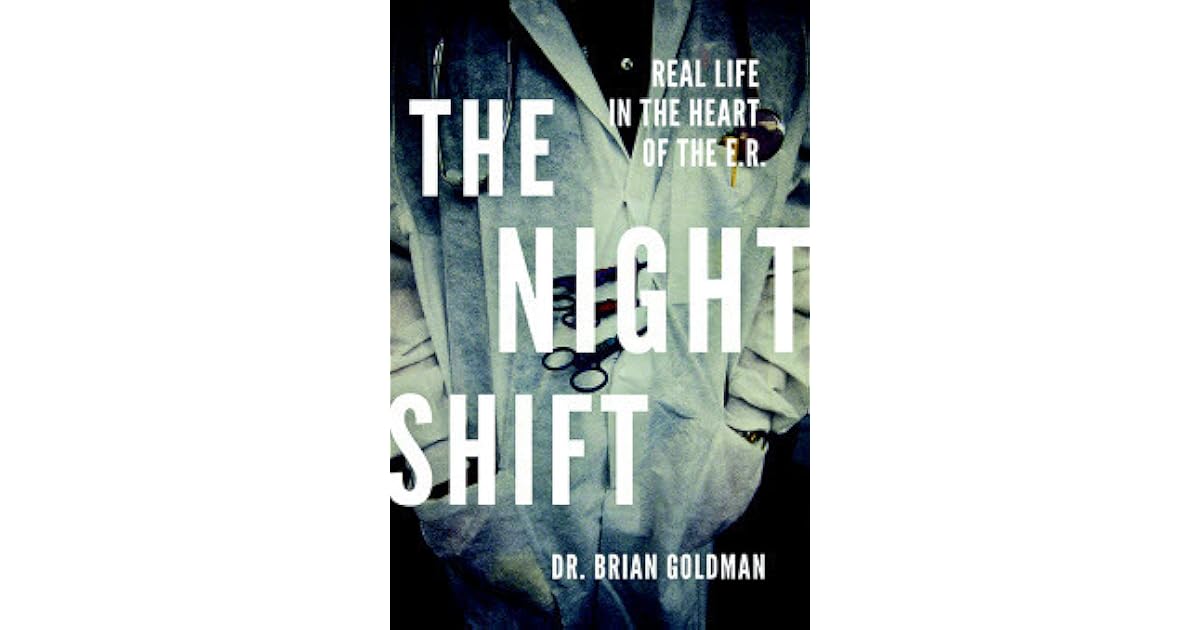 *
*
---
(Book Three in my Kindle Book Experiment, to see how I do reading full length ebooks on my phone app and/or laptop since I tried an ereader and gave me a migraine)
The writing in the beginning part was rough, but once the actual narratives got started it was pretty good.
One part where he said other things would fill out other parts of the book had me briefly worried but they fit in nicely and were just as interesting as the stories he told of his own time in the ER. Still, I would have liked to hear more from him. Gave him points for changing patient names to respect their privacy.
There were some things I didn't know about but made sense to me afterwards (the system of determining which patients to see first in the waiting room. Makes sense, and will keep that in mind if I ever end up in there again. Another, being how some Doctors get paid by patient... don't know how different these are in the USA but it would be interesting to compare).
A few things he wrote about reminded me of when I read another book about Nurses a few years ago. Guess some 'attitudes' are international *snorts* Other stories touched me and also made my heart ache while the 'not great' outcome ones... well, I probably don't have to say it.
His insights into how some behavior can be interpreted by some people as /dismissive/bored/rude/etc I thought was on point. Its hard to tell sometimes what goes on in someone's mind, and easy to misinterpret expressions/tone of voice and see it as something else. For some who are really nervous or worried at seeing the doctor, whatever they are feeling is probably heightened as well.
More people should read this, I think it would help them understand some more things about the ER and hopefully give more people some patience dealing with the medical staff. (I can understand being frustrated at a long wait but some people take it up a notch too far. The stuff he mentioned in one instance didn't surprise me).
Writing: 3 stars
Interesting factor: 4 stars
Overall rating: 3.5 stars
A fairly short read (288 pages) but worth the money in my humble opinion (if you have any other more recs like this, feel free to send em my way ).
*The cover of my edition off Amazon:
*---
(Book Three in my Kindle Book Experiment, to see how I do reading full length ebooks on my phone app and/or laptop since I tried an ereader and gave me a migraine)
The writing in the beginning part was rough, but once the actual narratives got started it was pretty good.
One part where he said other things would fill out other parts of the book had me briefly worried but they fit in nicely and were just as interesting as the stories he told of his own time in the ER. Still, I would have liked to hear more from him. Gave him points for changing patient names to respect their privacy.
There were some things I didn't know about but made sense to me afterwards (the system of determining which patients to see first in the waiting room. Makes sense, and will keep that in mind if I ever end up in there again. Another, being how some Doctors get paid by patient... don't know how different these are in the USA but it would be interesting to compare).
A few things he wrote about reminded me of when I read another book about Nurses a few years ago. Guess some 'attitudes' are international *snorts* Other stories touched me and also made my heart ache while the 'not great' outcome ones... well, I probably don't have to say it.
His insights into how some behavior can be interpreted by some people as /dismissive/bored/rude/etc I thought was on point. Its hard to tell sometimes what goes on in someone's mind, and easy to misinterpret expressions/tone of voice and see it as something else. For some who are really nervous or worried at seeing the doctor, whatever they are feeling is probably heightened as well.
More people should read this, I think it would help them understand some more things about the ER and hopefully give more people some patience dealing with the medical staff. (I can understand being frustrated at a long wait but some people take it up a notch too far. The stuff he mentioned in one instance didn't surprise me).
Writing: 3 stars
Interesting factor: 4 stars
Overall rating: 3.5 stars
A fairly short read (288 pages) but worth the money in my humble opinion (if you have any other more recs like this, feel free to send em my way ).

November 9, 2012
Story Description:
HarperCollins|September 3, 2010|Hardcover|ISBN: 978-1-55468-391-8
Dr. Brian Goldman is both an emergency room physician at Mount Sinai and a prominent medical journalist. Never one to shy away from controversy, Goldman specializes in kicking open the doors to the medical establishment revealing what really goes on behind the scenes – and in the minds of doctors and nurses.
In The Night Shift, Goldman shares his experiences in the witching hours at Mount Sinai Hospital in downtown Toronto. We meet the kinds of patients who walk into an ER after midnight: late night revellers injured on their way home after last call, teens assaulted in the streets by other teens and a woman who punches another woman out of jealousy over a man. But Goldman also reveals the emotional, heartbreaking side of everyday ER visits: adult children forced to make life and death decisions about critically ill parents, victims of sexual assault, and mentally ill and homeless patients looking for understanding and a quick fix in the twenty-four hour waiting room. Written with Goldman’s trademark honesty and with surprising humour, The Night Shift is also a frank look at many issues facing the medical profession today, and offers a highly compelling inside view into an often shrouded world.
My Review:
This was an absolutely phenomenal book! Dr. Goldman blows the lid off what really goes on inside the Emergency Room for those inquiring minds who want to know. Goldman is frank, honest and doesn’t mince words about both the good and bad sides of his profession.
The decisions, quick thinking and the speed at which these doctors and nurses often have to work is staggering. When you’re in the position of trying to save someone’s life you don’t have time to stand around and take a lot of time to think of your best options. At times, you just have to go with the flow so to speak.
I feel terribly sorry for the mentally ill who are often misunderstood and don’t always get a sympathetic or understanding ear at the emergency department and Goldman admits that. Some just don’t have the patience to administer to the needs and requirements of these people in society which is sad. It must be very frustrating for the patient.
The Night Shift was a riveting read and kept me glued from the first page to the last page and quite frankly, I didn’t want it to end. I wanted more stories. I’ll definitely be recommending this to friends and family.
HarperCollins|September 3, 2010|Hardcover|ISBN: 978-1-55468-391-8
Dr. Brian Goldman is both an emergency room physician at Mount Sinai and a prominent medical journalist. Never one to shy away from controversy, Goldman specializes in kicking open the doors to the medical establishment revealing what really goes on behind the scenes – and in the minds of doctors and nurses.
In The Night Shift, Goldman shares his experiences in the witching hours at Mount Sinai Hospital in downtown Toronto. We meet the kinds of patients who walk into an ER after midnight: late night revellers injured on their way home after last call, teens assaulted in the streets by other teens and a woman who punches another woman out of jealousy over a man. But Goldman also reveals the emotional, heartbreaking side of everyday ER visits: adult children forced to make life and death decisions about critically ill parents, victims of sexual assault, and mentally ill and homeless patients looking for understanding and a quick fix in the twenty-four hour waiting room. Written with Goldman’s trademark honesty and with surprising humour, The Night Shift is also a frank look at many issues facing the medical profession today, and offers a highly compelling inside view into an often shrouded world.
My Review:
This was an absolutely phenomenal book! Dr. Goldman blows the lid off what really goes on inside the Emergency Room for those inquiring minds who want to know. Goldman is frank, honest and doesn’t mince words about both the good and bad sides of his profession.
The decisions, quick thinking and the speed at which these doctors and nurses often have to work is staggering. When you’re in the position of trying to save someone’s life you don’t have time to stand around and take a lot of time to think of your best options. At times, you just have to go with the flow so to speak.
I feel terribly sorry for the mentally ill who are often misunderstood and don’t always get a sympathetic or understanding ear at the emergency department and Goldman admits that. Some just don’t have the patience to administer to the needs and requirements of these people in society which is sad. It must be very frustrating for the patient.
The Night Shift was a riveting read and kept me glued from the first page to the last page and quite frankly, I didn’t want it to end. I wanted more stories. I’ll definitely be recommending this to friends and family.

April 2, 2017
This book kind of reads the way the author describes a night shift in the ER: you start out with energy and vigor, excited to see what will come next, then around the halfway point, you start getting tired, you're waiting for something interesting to come along, then you get a brief second wind that takes you to the end, which you're very relieved to have made it to.
The subject matter isn't boring at all, and it's fairly well presented. I wish that the case histories the author provides had had more closure, but then I guess as an ER doctor you don't necessarily always know the outcome of the patients you see, so it makes sense. It was also interesting to get a better look at how an ER in Ontario really works, as well as to see some experiences from around the country and a few from the US. So those parts were very interesting to me.
My biggest issue with this book is the author himself. He comes across as extremely arrogant. It gets a bit better about halfway through, but that's the same point where I found the author started rambling more which lost my interest, then it was back to arrogance. I've met enough doctors in my life to know that arrogance is a fairly common trait amongst them, but reading a book written entirely in that kind of voice gets a bit grating. I'm sure Dr. Goldman is very good at his job, and I appreciated the honest insight he provides in this book, but when even your failings come across as humblebrags or teachable moments that were never repeated, it gets old.
The subject matter isn't boring at all, and it's fairly well presented. I wish that the case histories the author provides had had more closure, but then I guess as an ER doctor you don't necessarily always know the outcome of the patients you see, so it makes sense. It was also interesting to get a better look at how an ER in Ontario really works, as well as to see some experiences from around the country and a few from the US. So those parts were very interesting to me.
My biggest issue with this book is the author himself. He comes across as extremely arrogant. It gets a bit better about halfway through, but that's the same point where I found the author started rambling more which lost my interest, then it was back to arrogance. I've met enough doctors in my life to know that arrogance is a fairly common trait amongst them, but reading a book written entirely in that kind of voice gets a bit grating. I'm sure Dr. Goldman is very good at his job, and I appreciated the honest insight he provides in this book, but when even your failings come across as humblebrags or teachable moments that were never repeated, it gets old.

December 30, 2018
Really well written! Not a 'dry' medical book. Great stories, Canadian, and this one tells it like it really is with the rigorous training that doctors do on so little sleep + for such long shifts...he argues the system down as much as he can while still being IN the system and wanting to keep his job, you know? --Jen from Quebec :0)

April 28, 2022
This one is Canadian and a wonderful nonfiction that kept my attention. I learned a lot and I also really respect the doctor who wrote it. He’s a great man and it’s clear he poured his heart into both this book and his work.

February 12, 2012
I can't say that I didn't enjoy this book, because I did... a lot of what Dr. Goldman described, I have witnessed in my own short career as an RN, albeit on a med/surgical floor. Although patients are typically stable, I have been involved in a code situation (a successful one. The woman crashed twice and is still alive. That's something to be proud of), and I can attest to the fact that although you are exhausted running it, adrenaline comes over and all you can think is, "COME ON! BREATHE!"
That being said, I was looking for a medical book that was written for... well, me. Although I respect Dr. Goldman's efforts at explaining procedures so that laymen would be able to understand the procedures, I simply found this off-putting. Whenever I have read a book and didn't understand something, I looked it up to gain an understanding of it. That way, the story doesn't become compromised by repetitive explanations (did you know that Lorazepam (Ativan) is a sedative used to help with anxiety? I found that out three times in this book, although I already knew before the first time it was mentioned...) I just found it tedious, getting away from the true story by having to read explanations that almost felt... patronizing to read. Like explaining things to a child. I'm not into that.
Lastly, and it's because I'm a nurse, I found it very clear that this was written by a doctor, not a nurse. There is one instance where the nurse who got the patient into the room explained the subjective symptoms to Dr. Goldman, stated that the patient believed it to be food poisoning. When he went into the room and thoroughly assessed the man's abdomen, he found a large abdomen aneurysm, which is life threatening. When the nurse asked him if it was just food poisoning, he smugly told her that it was an aneurysm and patted himself on the back for having not listened to her. Come on, Dr. Goldman. Nurses are not allowed to diagnose, that's one. And two, the nurse had not done a completely abdominal assessment on the man, because she was awaiting your assessment. The only objective data that would have been obtained by that point was likely this patients vital signs. While I do believe that Dr. Goldman holds a fairly good relationship with his nurses (and cites a colleague who states that without his team of nurses and other professionals, he would sink), there were instances like this that bothered me. Nurses get shit on (quite literally sometimes) every day in their field. In certain settings (like my own) if a nurse isn't there watching the patient and making the call to get the doc in to assess them, they would die. We need to respect each other. That's why we're called a team.
I think that reading this book has taught me that maybe I'm best to stick with fiction, instead of reading about something so close to my reality... I like imagining things instead...
That being said, I was looking for a medical book that was written for... well, me. Although I respect Dr. Goldman's efforts at explaining procedures so that laymen would be able to understand the procedures, I simply found this off-putting. Whenever I have read a book and didn't understand something, I looked it up to gain an understanding of it. That way, the story doesn't become compromised by repetitive explanations (did you know that Lorazepam (Ativan) is a sedative used to help with anxiety? I found that out three times in this book, although I already knew before the first time it was mentioned...) I just found it tedious, getting away from the true story by having to read explanations that almost felt... patronizing to read. Like explaining things to a child. I'm not into that.
Lastly, and it's because I'm a nurse, I found it very clear that this was written by a doctor, not a nurse. There is one instance where the nurse who got the patient into the room explained the subjective symptoms to Dr. Goldman, stated that the patient believed it to be food poisoning. When he went into the room and thoroughly assessed the man's abdomen, he found a large abdomen aneurysm, which is life threatening. When the nurse asked him if it was just food poisoning, he smugly told her that it was an aneurysm and patted himself on the back for having not listened to her. Come on, Dr. Goldman. Nurses are not allowed to diagnose, that's one. And two, the nurse had not done a completely abdominal assessment on the man, because she was awaiting your assessment. The only objective data that would have been obtained by that point was likely this patients vital signs. While I do believe that Dr. Goldman holds a fairly good relationship with his nurses (and cites a colleague who states that without his team of nurses and other professionals, he would sink), there were instances like this that bothered me. Nurses get shit on (quite literally sometimes) every day in their field. In certain settings (like my own) if a nurse isn't there watching the patient and making the call to get the doc in to assess them, they would die. We need to respect each other. That's why we're called a team.
I think that reading this book has taught me that maybe I'm best to stick with fiction, instead of reading about something so close to my reality... I like imagining things instead...

July 16, 2015
Absolutely LOVED this book! I hope one day I get to meet Dr. Brian Goldman and it would be such an honour to work with him. This novel really opened up my eyes to the whole world of emergency medicine and the inner workings of a major city hospital ER.
I loved everything about this book. Especially that within the first chapter he discussed his difficulties with intubation which I had similar trouble with during my OR rotation.
A perfect read for anyone interested with limited medical knowledge or students starting in the health care field. Some of these cases will stick with me forever. Goldman is a perfect narrator; adding comedic relief when needed and intensity when discussing serious topics.
I loved the pace of this book. It follows Dr.Goldman along his 12 hour shift but along his cases he weaves in stories of several other physicians across the country and USA.
Highly recommended!!!
My favorite quote:
"If you can't be the best be different"
I loved everything about this book. Especially that within the first chapter he discussed his difficulties with intubation which I had similar trouble with during my OR rotation.
A perfect read for anyone interested with limited medical knowledge or students starting in the health care field. Some of these cases will stick with me forever. Goldman is a perfect narrator; adding comedic relief when needed and intensity when discussing serious topics.
I loved the pace of this book. It follows Dr.Goldman along his 12 hour shift but along his cases he weaves in stories of several other physicians across the country and USA.
Highly recommended!!!
My favorite quote:
"If you can't be the best be different"

July 18, 2017
I probably was expecting something different, more in the terms of dark comedy, more personal human stories, not medical history and facts. My bad.
You can tell that author is not a fiction writer, but it's not the case here.
Once again book confirmed to me that not choosing medical studies in my life was a good decision :)
You can tell that author is not a fiction writer, but it's not the case here.
Once again book confirmed to me that not choosing medical studies in my life was a good decision :)
September 26, 2024
I decided to read this book after enjoying episodes of a podcast called The Dose that is hosted by the author. A lot of what I read is very familiar and relatable from my own work as a nurse in a busy ER. It’s interesting to learn about how things have changed over time such as with the use of bedside ultrasound for central line insertion - progress is good! Dr Goldman seems to be wonderfully insightful, intelligent, and kind - the type of person you’d be fortunate to work with or hope to see on your own visit to an emergency department.

October 25, 2018
3.5 stars. A well-written memoir of life as a conscientious ER physician. I liked the framework of this book as we go through a night shift with Dr Goldman. It’s not a career I’d like to have, but I almost feel like I could work a few shifts after reading this book ;)

November 19, 2023
This book was a neat read. I think for somebody with very limited context of how a hospital works or common medical procedures, it might be a bit more interesting. I also found the back and forth between different cases a bit confusing to follow, but overall a quick and enjoyable read.

June 8, 2022
Honestly, I learned so much about the job of an ER doctor from this book. A really great read.
April 30, 2025
Loved it. Very well written and informative of how the medical system works and the challenges that doctors face. Was very easily digestible as he draws from interesting anecdotal experiences he has had in his career.
June 2, 2019
Fantastic! Well written, accurate and very honest.
A must read for anyone who ever needs an ER.
Love Brian Goldman's style.
A must read for anyone who ever needs an ER.
Love Brian Goldman's style.

June 3, 2017
As someone who has always been fascinated by the practice of medicine, I enjoyed this book and read it in one day. I liked how Goldman alternated between telling of a single night shift in the ER and his past experiences and experiences of fellow colleagues, but sometimes this structure was a little awkward. As an American, it was also interesting to read about the Canadian health system and health statistics, though the book did not get into the politics of single-payer versus our system.

September 28, 2022
So interesting to hear the human side to working as an ER doc. All the same issues as most work places but with life or death consequences.
February 11, 2021
Dr. Goldman writes like he talks on his show, with clarity, empathy and the perspective of an experienced physician. He takes the reader through a typical night in the ER ward, but broadens the scope of each case through excerpts of experts he has talked to, or residents, or nurses. He also references studies. Most of all, this is written from a Canadian perspective, which I really appreciate. For all of the negative aspects of our system, it still beats the American system by a hundred fold, and then some.

May 13, 2015
I chose this book primarily because I have extensive experience, in recent years, as a patient in an ER. (That would be A&E for those that live in Europe). I'm not the healthiest pup in the litter. But I do try. And I wanted to see life from the doctor's perspective. Emergency docs where I live are fuckbeans. Plain and simple. I wanted to see what doctors were like across the country. And I got an education. And high blood pressure lol. Fuck did this guy piss me off.
Firstly, what an arrogant asshole!! This guy seriously puts the ASS in asshole. The way he toots his own horn you would think that the medical profession would die without him. Nearly every patient he talks about was saved by him, he's kind, he lectures at the pharmaceutical companies and does videos for them, he makes contributions to textbooks that are used worldwide, he's a consultant on some clinical trials (his ego is the size of a bloody football field...). Towards the end he does start admitting he's human but not by much.
He explains the classification of emergency levels in the ER, and how long you should be waiting. In the next paragraph he acknowledges that this classification system is faulty. Gee, that makes me feel better.
The book really started bothering me when he mentioned what ER docs do after taking care of the urgent cases. They don't take you based on how long you have been waiting. They don't take you in priority sequence. They take you based on interest. If your case interests them, they'll take you next. Isn't that lovely?
Doctors on the overnight shift do whatever they can to remain awake and alert. This includes drinking copious amounts of coffee. Or using a "cognitive-enhancer". Right. A pill. Like Ritalin. Apparently it's to keep the doctors alert and enhances their concentration, memory and other cognitive abilities. The author of the book poses this question "Would you rather have me clean or knowing the difference between one medication and another?" My answer to that is BOTH. There is no OR in the question. Get the proper rest that you need. I don't want a high physician treating me, nor do I want a sleep deprived one. I have the right to demand excellent health care and a high doctor or one who is sleep deprived is impaired either way.
Something he said really bothered me. More than what I've detailed previous and what's to come after this. He speaks very derogatorily about those with mental illness, and particularly those with Borderline Personality Disorder. I've lived with Borderline Personality Disorder for 25 years and the things he was saying were vile, disgusting, and most importantly, WRONG. He called them rude. Yes some can be rude but it's not a typical behaviour. He called them violent. No Borderline that I've ever met has been violent. Borderlines don't try to harm others. We try to harm ourselves. And he went on and on. Obviously the patients he used as examples were misdiagnosed.
If you have chronic conditions and go to the hospital frequently, be prepared to wait. Doctors and nurses will think you are there seeking attention.
Did you know Doctors lie? They sometimes tell little white ones "for the sake of the patient". I call bullshit. They are lying for their own sakes because they are too lazy to tell the truth. Because it doesn't protect the patient. It harms them.
There was a lot more that came to light in that book but if I keep going I'll end up writing a book instead of a write-up. It left me with more questions than answers and feeling severely distrustful of the Canadian Emergency Health Care System. If you live in Canada I do recommend reading this. Perhaps we can start some kind of movement and fix it.
This entire review has been hidden because of spoilers.

May 10, 2013
This is another one of those books that I put on hold at the library on a whim because it looked interesting. I didn't realize that after it became available to check out from said library, I would have already have been rushed to the hospital in the middle of the night by my husband. This left me very nervous to even read the book because I was afraid of reading anything that resembled what happened to me and at the time I had NO idea why it happened. (My heart went into atrial fibrillation for the second time in 5 years and it is not to common for a young healthy person to experience that!) Of course my curiosity got the better of me and I slowly started reading it anyways. There were a few parts where I almost stopped because it was talking about a patient with heart problems. I was convinced that regardless of my age there was something wrong with my heart and reading anything to do with people in the ER with heart problems really made my anxiety fly sky high.
I however, still kept reading and found it rather interesting. I knew of course that life in the ER is nothing like the TV shows but I never realized just how hectic it could be. I did find it frustrating at times though because Dr. Goldman would start talking about one patient then leave you hanging while he told stories about similar or related topics before going back to the original story at the end of the chapter.
Although Dr. Goldman does talk in some medical terms and about certain medications that I have never heard of, he does give a good impression of what working in a ER is like. I know it's something I could never do and I commend anyone that does. I guess I can understand now sometimes when nurses or doctors come across as indifferent. It's probably either work fatigue or their only defense against getting too emotionally involved with each patience situation. I would imagine working the long hours in an ER, would be emotionally draining after awhile.
(Also in case anyone is wondering after all the tests I have had done, my heart is totally healthy and they found nothing wrong with me. The specialist determined because of what I was doing both times it happened (chugging cold water and trying to get some burbs out) that I am one of the lucky few that people in this world that could experience atrial fibrillation due to either food, liquid, or gas disturbing my esophagus. Lucky me :(. )
I however, still kept reading and found it rather interesting. I knew of course that life in the ER is nothing like the TV shows but I never realized just how hectic it could be. I did find it frustrating at times though because Dr. Goldman would start talking about one patient then leave you hanging while he told stories about similar or related topics before going back to the original story at the end of the chapter.
Although Dr. Goldman does talk in some medical terms and about certain medications that I have never heard of, he does give a good impression of what working in a ER is like. I know it's something I could never do and I commend anyone that does. I guess I can understand now sometimes when nurses or doctors come across as indifferent. It's probably either work fatigue or their only defense against getting too emotionally involved with each patience situation. I would imagine working the long hours in an ER, would be emotionally draining after awhile.
(Also in case anyone is wondering after all the tests I have had done, my heart is totally healthy and they found nothing wrong with me. The specialist determined because of what I was doing both times it happened (chugging cold water and trying to get some burbs out) that I am one of the lucky few that people in this world that could experience atrial fibrillation due to either food, liquid, or gas disturbing my esophagus. Lucky me :(. )

July 12, 2017
Honestly, I couldn't get through the first chapter. If this "doctor" wants praise for identify a dissecting AAA that is the size of a grapefruit like the diagnosis was some super power unbeknownst to the average doc, I can't take him serious. Palpation of the abdomen on a patient complaining of abdominal pain is a standard of practice and has been for hundreds of years. It never reflects well on a person when they attempt to make themselves look greater than another "class" of people. He works extra hard to paint nurses in a poor light. This guy is either an imposter of practice or an idiot that should have never made it through his residency and now in his twilight is trying to gold plate the pewter legacy he molded.
June 9, 2017
Not your typical medical bior
Dr. Goldman gives us a look into the life of an emergency department doctor in a hospital in Canada. While a few items are a bit different than in the U S, the majority are pretty much what you would see in a typical hospital of comparable size in any US setting. This is not your typical biography even though he shares many incidents he has experienced. This book goes much deeper. He speaks of worries about making medical decisions when the doctor is tired and overwhelmed by too many patients and too few staff. Surprisingly, he o shares errors he has made freely with the reader. He addresses medical practice rotations in a teaching hospital and how often fatigue and fear of making a mistake can cause exactly the outcome that is the result of that fear. He describes dealing with patients from all walks of life and the process of making a the correct diagnosis under the pressure of giving each person the attention they deserve while trying to see patients who sometimes have been waiting for hours, sometimes in a hallway or still in the waiting room after triage. I found the book incredibly interesting, particularly for anyone who has ever worked in a similar situation or is just curious about what goes on, as well as the all important why.
Dr. Goldman gives us a look into the life of an emergency department doctor in a hospital in Canada. While a few items are a bit different than in the U S, the majority are pretty much what you would see in a typical hospital of comparable size in any US setting. This is not your typical biography even though he shares many incidents he has experienced. This book goes much deeper. He speaks of worries about making medical decisions when the doctor is tired and overwhelmed by too many patients and too few staff. Surprisingly, he o shares errors he has made freely with the reader. He addresses medical practice rotations in a teaching hospital and how often fatigue and fear of making a mistake can cause exactly the outcome that is the result of that fear. He describes dealing with patients from all walks of life and the process of making a the correct diagnosis under the pressure of giving each person the attention they deserve while trying to see patients who sometimes have been waiting for hours, sometimes in a hallway or still in the waiting room after triage. I found the book incredibly interesting, particularly for anyone who has ever worked in a similar situation or is just curious about what goes on, as well as the all important why.

September 7, 2022
Very good book! Be advised it is written by an emergency room physician so the medical information is detailed and at times descriptive. The tests done on patients are detailed as is the insertion of a breathing tube and other forms of emergency methods.
I didn't find a lot of things to complain about with this book. One thing I had trouble with is how the author would go from treating a patient to an entirely different subject and though he did go back to the patient, sometimes he didn't.
Having put in 40 years working in the medical field, I was interested in the procedures used but I was more interested in the patients themselves. I realize in a big city teaching hospital, the ER doctors cannot take a lot of time with a patient. I live in a small town and my hospital is just down the road. I've had to go there more than a time or two but all the doctors take time to talk to the patients and show that they care. However, if it's something the hospital ER/physician can't handle, the patient takes a trip by helicopter to a big city hospital (Buffalo ECMC Trauma Center or the
University of Rochester Strong Memorial Hospital 40-50 miles away.).
I could not put this book down and read it all through last night. I only hope that nothing like Dr. Goldman described in this book ever happens to me!
I didn't find a lot of things to complain about with this book. One thing I had trouble with is how the author would go from treating a patient to an entirely different subject and though he did go back to the patient, sometimes he didn't.
Having put in 40 years working in the medical field, I was interested in the procedures used but I was more interested in the patients themselves. I realize in a big city teaching hospital, the ER doctors cannot take a lot of time with a patient. I live in a small town and my hospital is just down the road. I've had to go there more than a time or two but all the doctors take time to talk to the patients and show that they care. However, if it's something the hospital ER/physician can't handle, the patient takes a trip by helicopter to a big city hospital (Buffalo ECMC Trauma Center or the
University of Rochester Strong Memorial Hospital 40-50 miles away.).
I could not put this book down and read it all through last night. I only hope that nothing like Dr. Goldman described in this book ever happens to me!
June 22, 2020
Dr Brian Goldman is well-known as the host of CBC Radio’s “ White Coat, Black Art” programme. He has worked in the Emergency Room at Mount Sinai for many years. Written in 2010, “ The Night Shift” reveals to us the trials and tribulations of an ER doctor, the snap decisions that are taken that can have life-or-death consequences. This is not a true portrait of a typical night in an ER, but rather a selection of challenging and at times disappointing cases that Goldman has faced over the years. He is good at second-guessing himself, and is ever-fearful of making a mistake or providing a misdiagnosis. He also selects patients whose situations allow him to explore ethical considerations, from lectures and conferences funded by the pharmaceutical industry to intimate relations between doctors and patients. And he always tries to listen to the “ little voice” in his head when he feels he has not heard everything a patient is trying to tell him. I enjoyed this insider’s view of life in a downtown ER.

October 27, 2022
ER doctors have quiet the job of keeping people alive when they arrival at the emergency in pain, broken, screaming, bleeding, covered in filth because they couldn’t hold a bowel or vomit all over them, delusional, combative, calm, with a heart attack, stroke, you name it.. To add to this unpleasant smell, sight, noise and ambiguity of a persons condition there’s a constant beeping and buzzing of medical devices. To top the distractions and emotional toil, they are expected to make life saving decisions beginning with prioritizing whose life to save first.. after one life saved, the next one is and then another and another until the shift ends.
In between stories there’s commentary and information that the author share which felt a bit dry for my liking. Says a lot about how humans learn with stories and tune out when the story ends.
All in all, Dr. Goldman has done a terrific job detailing the work with multiple stories in the ER paining a vivid picture of a variety of cases and how he managed them.
In between stories there’s commentary and information that the author share which felt a bit dry for my liking. Says a lot about how humans learn with stories and tune out when the story ends.
All in all, Dr. Goldman has done a terrific job detailing the work with multiple stories in the ER paining a vivid picture of a variety of cases and how he managed them.
June 25, 2017
How true! Excellent read.
I loved this book. It was well-written, very interesting, and, most of all, completely accurate. Dr. Golden's description of what REALLY happens in the ER is spot-on!
Revealing his thoughts and feelings as an emergency physician, both on and off-duty, lends valuable insight. Candidly, he aptly portrays the practice of emergency medicine. The adrenalin-fueled highs, exhaustion-fed lows inherent to his profession were described well. How refreshing that he revealed his vulnerabilities!
I liked that Dr. Goldman provided the technical details of cases, procedures, and protocols. His writing proved to be informative to the layperson, accurate to medical career personnel, and intriguing to BOTH.
I enjoyed this book and highly recommend it. I just bought another book by Brian Goldman MD and will to attempt to listen to his radio show. I would be honored to work with him in MY Emergency Department.
I loved this book. It was well-written, very interesting, and, most of all, completely accurate. Dr. Golden's description of what REALLY happens in the ER is spot-on!
Revealing his thoughts and feelings as an emergency physician, both on and off-duty, lends valuable insight. Candidly, he aptly portrays the practice of emergency medicine. The adrenalin-fueled highs, exhaustion-fed lows inherent to his profession were described well. How refreshing that he revealed his vulnerabilities!
I liked that Dr. Goldman provided the technical details of cases, procedures, and protocols. His writing proved to be informative to the layperson, accurate to medical career personnel, and intriguing to BOTH.
I enjoyed this book and highly recommend it. I just bought another book by Brian Goldman MD and will to attempt to listen to his radio show. I would be honored to work with him in MY Emergency Department.

August 11, 2018
I've never been a big fan of biographies but this book was GREAT!
For starters I loved that he's from my home town. Mount Sinai is like one of our most famous hospitals. I was super invested in the patients and whether or not they'd be okay. I was super invested in what was going on and what he was talking about and I was absolutely amazed that almost all his stories were from the same night.
Yes he digressed into smaller stories that happened earlier. But I was interested in those too.
There were a lot of digressions into medical opinions of other doctors but I didn't really care for those, I just wanted to get back to the patients that mattered.
All in all this book surprised me. I enjoyed it much more than I expected too. It was a wonderful read that made me laugh, made me said, and made me happy all at once. It also made me a bit stressed but the ER is a stressful place, even if you're just reading about it.
For starters I loved that he's from my home town. Mount Sinai is like one of our most famous hospitals. I was super invested in the patients and whether or not they'd be okay. I was super invested in what was going on and what he was talking about and I was absolutely amazed that almost all his stories were from the same night.
Yes he digressed into smaller stories that happened earlier. But I was interested in those too.
There were a lot of digressions into medical opinions of other doctors but I didn't really care for those, I just wanted to get back to the patients that mattered.
All in all this book surprised me. I enjoyed it much more than I expected too. It was a wonderful read that made me laugh, made me said, and made me happy all at once. It also made me a bit stressed but the ER is a stressful place, even if you're just reading about it.

June 12, 2017
Good book but...
I enjoyed reading about an ER doctor's work during a night shift. It was doubly interesting since this is a Canadian hospital, so you get a glimpse of what Medicare for all might look like here in the States. The patients were fascinating and Brian is brutally honest about his work and his feelings. He clearly enjoys being an ER doc. What I found infuriating was his penchant for veering off topic. It's almost like a flight of ideas or loose association. It takes him pages and sometimes an entire chapter to get back to the original patient and what is happening with him or her. In one case, he never does, leaving reader to wonder if the patient has a testicle in tortion, an infection, or testicular cancer. Aside from that, it's a fast read and gives an insider look at the workings of a busy ER.
I enjoyed reading about an ER doctor's work during a night shift. It was doubly interesting since this is a Canadian hospital, so you get a glimpse of what Medicare for all might look like here in the States. The patients were fascinating and Brian is brutally honest about his work and his feelings. He clearly enjoys being an ER doc. What I found infuriating was his penchant for veering off topic. It's almost like a flight of ideas or loose association. It takes him pages and sometimes an entire chapter to get back to the original patient and what is happening with him or her. In one case, he never does, leaving reader to wonder if the patient has a testicle in tortion, an infection, or testicular cancer. Aside from that, it's a fast read and gives an insider look at the workings of a busy ER.
Displaying 1 - 30 of 165 reviews