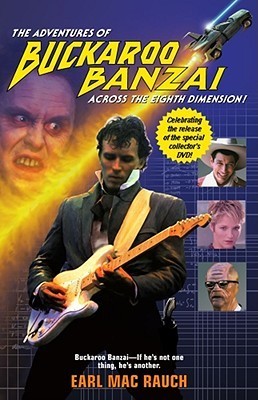
Having been slightly disappointed with my latest two philosophical reads, and looking for some respite for my overtaxed, end-of-semester brain, I decided to read this short memoir of the eventful days of 1984 that almost led to the annihilation of our planet, as the Nova Police of Alpha Centauri threatened nuclear armageddon to forestall the risk of John Whorfin wreaking vengeance on their planet by using B. Banzai's newly field-tested OSCILLATION OVERTHRUSTER.
Reno, the then saxophone player of the Hong Kong Cavaliers and chronicler of the Banzai Team, just tells it like it was, offering his eyewitness testimony and many personal musings, humanising and personalising what may seem to us, in hindsight, like just a forgotten episode of the Cold War and humanity's fraught dealings with the denizens of Planet 10.
I really enjoyed his thoughtful perspective on the events, and his narrative voice, which sounded very much like that of a XIXth century memorialist. I guess it must have been a reflection of the kind of literature he was reading at the time, for that was not the fashionable way of writing in that decade.
I didn't find the account of the raid on the Yoyodyne compound the most interesting part, but that may be because we've all heard the story, it's been plagiarised to death by countless Hollywood movies (James Cameron claiming the tunnel skirmishes as the main real-life inspiration for his movie Aliens), and maybe Reno's heart was not entirely in the retelling. In fact, he seemed to be voicing my own feelings at one point: "I have never felt the slightest desire to hear tales of men in battle. It is my conviction that readers who find entertainment in such bloody events deserve to sample the experience firstand; I daresay their taste in literature would change." My own taste was more for the portraits of those brilliant scientists of the Banzai Institute, to whom our world owes so much (down to your own or your husband's gyroscopic razor), and for the empathetic recounting of the personal tragedies that affected them.
The youth of today, to whom the Lectroid threat may seem like a grandfather's stale memory, and who will spurn as hopelessly antiquated any person not sporting the latest smartphone, might be curious to learn that back in the eighties, the whole Banzai team was already equipped with so-called Go-Phones, the description of which (on p112) will look uncannily familiar to them (and I have the 1984 edition of the book, so I can vouch this is not interpolation.)
I am now counting the days to the belated publication of Reno's memoir of the Banzai Institute's much less documented confrontation with Hanoi Xan's World Crime League.