The ineffable nature of grieving and belief inspires a tender, gritty, and breathtaking work of graphic storytelling from the creators of The Savage .
"Slogger, man," I said. "Your dad’s dead." "I know that, Davie. But it’s him. He’s come back again, like he said he would."
Do you believe in life after death? Slog does. He believes that the scruffy man on a bench outside the butcher shop is his dad, returned to visit him one last time. Slog’s friend Davie isn’t so sure. Can it be that some mysteries are never meant to be solved? And that belief, at times, is its own reward? The acclaimed creators of The Savage reunite for a feat of graphic storytelling that defies categorization. Eerie, poignant, and masterful, Slog’s Dad is a tale of astonishing power and complexity.
David Almond is a British children's writer who has penned several novels, each one to critical acclaim. He was born and raised in Felling and Newcastle in post-industrial North East England and educated at the University of East Anglia. When he was young, he found his love of writing when some short stories of his were published in a local magazine. He started out as an author of adult fiction before finding his niche writing literature for young adults.
His first children's novel, Skellig (1998), set in Newcastle, won the Whitbread Children's Novel of the Year Award and also the Carnegie Medal. His subsequent novels are: Kit's Wilderness (1999), Heaven Eyes (2000), Secret Heart (2001), The Fire Eaters (2003) and Clay (2005). His first play aimed at adolescents, Wild Girl, Wild Boy, toured in 2001 and was published in 2002.
His works are highly philosophical and thus appeal to children and adults alike. Recurring themes throughout include the complex relationships between apparent opposites (such as life and death, reality and fiction, past and future); forms of education; growing up and adapting to change; the nature of 'the self'. He has been greatly influenced by the works of the English Romantic poet William Blake.
He is an author often suggested on National Curriculum reading lists in the United Kingdom and has attracted the attention of academics who specialise in the study of children's literature.
Almond currently lives with his family in Northumberland, England.
Awards: Hans Christian Andersen Award for Writing (2010).
اسلاگ در مقابل دیو، آیا تقابل ایمان و باور در مقابل دلیل و منطق است؟ فکر میکنم کتابهایی که سوال ایجاد میکند حتی اگر مخاطب کودک و نوجوان باشند خیلی ارزشمنده. چه قدر هم تصاویر کتاب قشنگ بودند.
Slog's dad is dead. Is that homeless man him, brought back in a different form to visit his son? Slog is certain that he is. His friend, Davie (our narrator) is certain he's not. Almond leaves it an open question for the reader.
The book alternates between Almond's prose and pages of wordless Dave McKean art, both telling different parts of the same story. Both can work on their own, but make a much more beautiful whole when combined. Think The Invention of Hugo Cabret in presentation. It's very, very short, though it doesn't need to be any longer. It's a single, powerful scene, a look at faith and hope and love after death.
I came across Slog’s Dad on the recommendation of a 6 year old girl, and must confess now that without her, I never would have picked this book up off the shelf. An interesting hybrid of a graphic novel and a short story, Slog’s Dad shines as it demonstrates just how powerful illustration can be, as the punch delivered by Slog’s Dad is not only through David Almond’s words, but also the double page spread created by Dave McKean. Not wanting to give away too much about the plot in this review, I have to say that I can fully understand why this has become a favourite of the young child who advocated it to me, and I urge you to read the book and then decide what message you think is being conveyed.
Only 55 or so pages long, Slog’s Dad is an incredibly powerful short story where the narrative is interspersed with pictures that in some places relate emotions that Davie, our narrator simply cannot put into words. For such a short story, Almond and McKean pack a lot into this hybrid novel as complicated issues of loss, hope and the spirituality are approached by the two young boys. The book is aimed at children 8 and above and I think could be used in a variety of ways within the classroom, from literacy where the idea of different dialects could be approached, to understanding the beliefs of different religions or as a way of approaching the idea of loss the emotions linked to this in PSHE.
پدر اسلاگ، در ابتدا یه اثر ساده برای کودک به نظر میاد، اما وقتی می خونیش، می بینی که خیلی بیشتر از این حرف هاست. کلا به نظرم این ویژگی توی آثار دیوید آلموند هست و همینه که جذابیتشون رو بیشتر می کنه، چون چیزی رو بهت نشون می دن که ابدا انتظارش رو نداشتی. شباهت هایی بین این کتاب و کتاب "گل" از همین نویسنده بود که حس می کنم برگرفته از واقعیت هستند. مثل اسم شخصیت اصلی که در هر دو کتاب خود آلموند بود، یعنی دیوی، و کشیش که اسمش هر دو جا پدر اوماهونی بود.
You know, sometimes, how a book catches you? How it sits there very quietly until you notice it and then, just, holds you to it? This is one of those books.
I've talked about the wonder of David Almond before, and about his skill in capturing the quiet, and yet somehow immense, magic of the everyday. He makes me rampantly, vividly, awfully, jealous of his skill. If you look back at his books that I've reviewed (The Savage, My Name Is Mina, Mouse Bird Snake Wolf), they're all five stars. All of them. Joyously, incredibly so. And I love his work with Dave McKean. I love it with a passion that startles me. I love the bravery of it, the wild darkness, the just-that-little-bit-on-edge feel of a McKean line. I love that they are producing such intensely superb, challenging, heart-breaking, lovely books.
I am hugely indebted to Walker Books for giving me permission to use the following images which truly do justice to this book.
"Counterpoint : The melody added as accompaniment to a given melody or 'plain-song'"
That's how the OED defines counterpoint, and it's a framework I want to use to discuss Slog's Dad. It's a small book, of 64 pages, and it's one constructed with a lot of musicality. I know that's an odd term to apply to a book, but it's one that I feel is apt. Throughout Slog's Dad we see the left hand and the right hand working together, the text and the image, the bass and the treble, the shadow and the light. It's a book where we go forward through image and back through text and every now and then one of them soars and tells us everything whilst the other fades into content stillness. That's what I mean about musicality. It's in the way this book sings. It's singing even on the front cover (fig 1.). "I shall lift up mine eyes to the hills from whence cometh my help". The child is exultant, holding his breath and he's looking up and he's caught in such, utter, hope and awe that it is breath-taking.
This book is about grief. Slog's dad is dead but he comes back. Or does he? In a way it's never really resolved, it's left up to the reader to decide, but what is clear in this book is that we're always looking. Always. It's a book about sight, about looking, about hoping that they'll be there on the street corner as we drive by. It's a book about memory. About reaching out and just trying to touch, but never getting far enough.
And it's a book about being earth-bound, about the fact that maybe death isn't this finite thing, about how it could be this great, fluid thing that we fly up to and come back from and if we hold our breath and count to ten, the person we love will come back to us and we'll be there, right there, ready to catch them.
Perhaps nowhere is this more clearly illustrated in the silent pages at the heart of this book (fig 2/3). At this point we've become accustomed to the structure of Slog's Dad. We have the tiniest,most crystalline of chapters book-ended by images which frame, compliment and contradict each chunk of text, and now we receive something a little different.
The black and white image of fig.2 gives us the still, oppressive gloom of darkness. Sadness is always worse when it's dark. Always. Because there's nothing there to distract you, nobody there to talk to you, nothing happening to pull you away from your thoughts. And your thoughts can be the most terrifying place in the world. McKean is quite spectacular. Throughout the entire book he's maintained an aerial view. That is, to say, we've spent a vast amount of the images looking down on the events. We spend the opening pages of the book zooming in in a breathless series that bring us from some point far away, out of this world, all the way down to a man, sat on a bench, wrapped in whiteness.
In this spread, McKean engages that dramatic technique of dominance, of power, and he uses it to pull us in to what matters. The frame on the left - Slog's lost in it. There is the empty chair, the foetal curve of the boy in the bed and shadows. Losts and lots of shadows, and they're pulling at Slog, trying to keep him in the darkness. Everything is too big and yet, too empty all at once.
The top right frame starts to pull us in. It's started to focus. And it's not yet stopped because this frame, important as it is, isn't what it is all about. Not right now. And here's where this all gets even more interesting.
What is important is this tear. And it's been there all along. It was there only if we knew where to look for it. And suddenly the image on the left takes on a whole more tragic overtone; the boy crying silently in the dark that nobody notices. Not even us until we're led to it.
And have a think about the use of light in this spread too, the way the chair's illuminated and how, just out of frame, the lights in the house are clearly still on. Think about what that suggests about what's going on out of frame. Think about how that suggests that there's somebody still awake in the house, probably his mother, trying to come to terms with what's happened. Think about how that is broadening this story, making it spill out of the pages and out of the 'book' confines.
Fig 2. is immediately followed by Fig 3. Here the aerial, downward perspective changes. We are quite literally 'on Slog's level' and as such experience an immediate kinship with him. We are seeing his dream. Or his hope? His desire, maybe. Whatever it is, he's still rooted in his lonely sleep and the events are occuring inside his mind.
And oh, can I tell you how much I gasped at this the first time I read it? Because this is full of so very much.
Firstly, the colours. The charcoal greys and blacks that link this scene with the previous, to give us continuity and contrast to the magic occurring just up above. The strange, watery colours of the wings that are reminiscent of the Northern Lights, or of water caught in sunshine, or of a rainbow just after the heaviest of rains. His wings are full of this weirdly magical light; a light we first saw on the front cover. It's the strangest and best of things. The sky is caught in Slog's dads' wings.
Secondly, the boys. Davie is with Slog. And it's Davie that catches me here because we are him. We're watching what's happening, turning politely away when Slog embraces his dad, placing our hands on our hips and trying to figure out what's gone on. But in a way, whilst we are him, we're not him at the same time. Remember when I mentioned about the aerial perspective we've had a lot in this book? Consider the implications of shifting straight from that into this - we were looking from Slog's dads' perspective and now we're not. But consider the implications of that perspective. Slog's Dad saw what we saw and now he's making it all better. He has come to his boy. Whether that's wish-fulfilment or not, is open to say, but what it is is moving. Moving and intensely emotional stuff. Where Slog is right now? We've all been there. All of us.
There's such a rich, nonjudgmental joy about this book that I could go on for days. So to sum, I will say this:
Slog's Dad is a dark, challenging book. But the joy is in the non-confrontational nature of that challenge, the way that it's only there if you want to be challenged, and that that challenge does not come with already given answers.
Death is a darkness. But books like this help us to see the light.
I was really interested in this book, since it's a short story and I liked the idea of combining that with illustrations. The plot is actually great and sad at the same time - it's always an utter loss when parents die. Almond wrote the story nicely so that it's not too dark and it has that taste of life in it.
Personally I didn't like the way Slog talked or his naive optimism (read stupidity) all that much. I would've wanted to know Slog's age, since he seemed underdeveloped as opposed to Davie. In a way I can understand Slog's wishes and hopes, but at the same time they bothered a lot. Davie's character instead was really nicely written. The revived dad just seemed creepy instead of sweet, so Almond could've tried to write him less like that. What I didn't enjoy all that much were the illustrations, even though as an idea they were great. The reason is that most of the illustrations didn't have anything to do with the story and the quality of them varied too much too. Still, a nice and quick read.
A story about a child called Slog, who is convinced that a man on the street is his father, who the reader finds out tragically died months prior. Whilst Slog's friend tries to be the voice of reason, contesting that Slog's father cannot have come back to visit his son, the reader is left questioning who the man really is and the true nature of death. Though I did not realise that this story would be more suited to secondary school children, I am still glad that I picked it up. McKean and Almond make a masterful yet almost disturbing partnership- and it is the way that the two work together that helps to tell such a troubling story. McKean fuses a multitude of types of media, meaning that the reader has to regularly flip between different narratives, piecing together the ideas to build their own interpretation of the story. Some of McKean's images did not always make sense to me, but I gained a sense of Slog trying to recreate his father, instilling the overall sense of trying to hold onto memories. The abstract nature of McKean's element of the story is perhaps purposeful, it is meant to leave the reader uncertain and at a level of unease- just as the characters feel. Whilst I question whether I would be able to use this book in primary school, I still think that it is an interesting example of how different forms of narrative can be used to build a story and twist interpretations.
I know there is a lot of debate in the use of the term Graphic Novel over Comic or Long Comic, and sometimes Picture Book. Shaun Tan writes Picture Books for not just small children; he is unabashed with his use of the term. David Almond’s Slog’s Dad leans close to Tan’s work with its pages of text alternating with pages of Illustrations (framed out and sequential) by Dave McKean. The Illustrated pages (after establishing a beginning, before Almond’s beginning, seems to plumb the emotional depths of the novel as well as the more magical aspects of Slog’s and his dad’s beliefs. However Slog’s Dad might be categorized descriptively, it is a marvelous creation, an incredibly effective storytelling device.
There are no chapters, the story is fairly short, a pint’s telling if you don’t gulp. The transitions between Almond’s text and McKean’s sequences are smooth and they aid one another in the piecing out of the text’s story. You understand that Slog’s Dad is dead, then you learn who he was and what happened before returning to the park and Davies doubts. The story leaves you on a fence, able to explain away either side using both text and culture as evidence. Slog’s Dad does wonder: “Can it be that some mysteries are never meant to be solved? And that belief, at times, is its own reward?” Davie’s skepticism is as strong as Slog’s embraced belief, and the Reader is placed in the middle—simultaneously comforted and discomforted by belief.
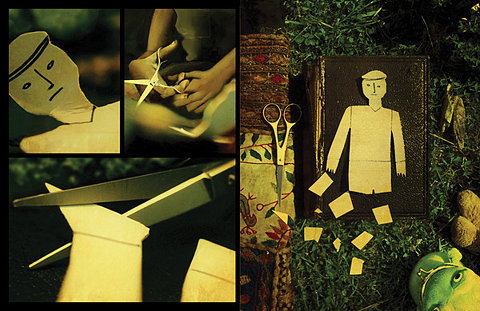
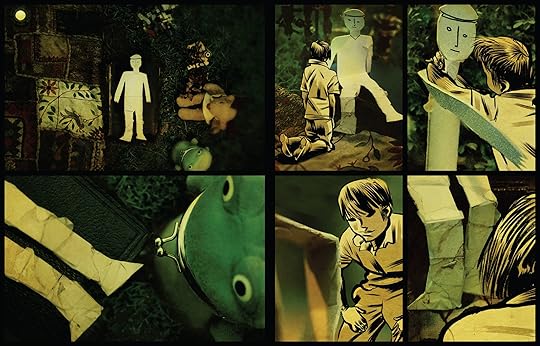
McKeans images are without narrated text (if it has text at all), but are by no means silent. And he shifts his approach with each portion as it feels necessary to depict the story’s intentions. Rough line work with watercolor, to photograph under ink and paint, to—McKean’s signature is all over this piece. I really responded to the paper-cut dad sequences and the borealis dreaming; which were no less full of portent than the superhero section; the above sequence is terribly sad (helpless). Even with the shifts, McKean provides visual cues so you know which character is which. What is nice about how Slog’s Dad works is that McKean isn’t illustrating what was already set down in text by Almond. His is another portion of the story. While Almond uses Davie as his first person narrator, McKean uses Slog as his.
The writing is so clean and perfectly played out; quietly ambiguous in such artful ways when tension is necessary.It falls into nice rhythms. And I appreciate how Almond translates dialect alongside tension and sorrow and inevitable uncertainty.
The scope of the novel physically is small. A small neighborhood, a humble worker (a binman (garbage man)), two boys who are best friends, a normal afternoon in the Spring. McKean begins the story by moving us from Universal proportions to a park bench with a stranger sitting on it. Or is he mapping Mr. Mickley’s return? Either way, the story is titled Slog’s Dad and it intimate in its portraiture. On an emotional and spiritual front, it isn’t decisive or interested in any grander supposition than this small piece of earth and these few people. As if grief is that personal. As if in the end we find our own ways of dealing with illness and death and what comes after for those living.
In the end, Slog’s Dad leaves the interpretations and their implications to the Reader. It’s just telling a story.
Slog's Dad is about Slog, a boy who recently lost his father in one of the most nightmarish ways possible; however, before his death, his father promised his son to "come back." A year or so later, as Slog is running around with his friend, he sees his father sitting on a bench in the park... Is Slog imagining this? Is the man really his father? Just what is going on?
And thus this strange setup opens a window: a look inside the life of a grieving boy and the people around him.
It's beautifully constructed, really. It's not even 60 pages long, and has large font and many illustrations, but every word and every placement of every element is used to its maximum potential, leading in a powerful emotional experience. It didn't make me cry, but it did brush against my insides and made me hope for this heartbroken boy.
And then there's the matter of illustrations, and goodness! They are gorgeous! Almond and McKean are a potent team, because McKean doesn't just draw arbitrary pictures to make eye candy that compiment the text, his illustrations actually add a new dimension to the story. He mixes all sorts of media to make these surreal, emotionaly charged, heavily symbolic pictures that are absolutely delightful to behold. I don't want to spoil them too much for you, but take a look:
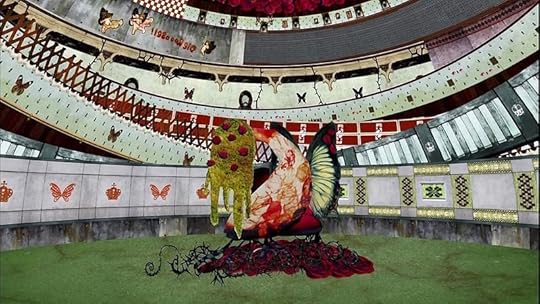
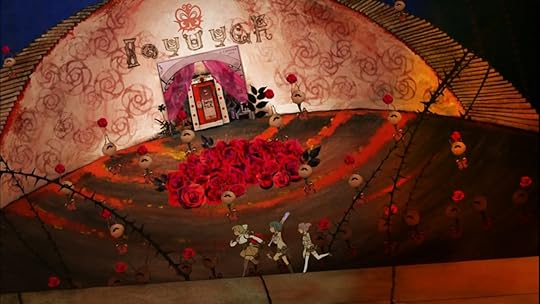
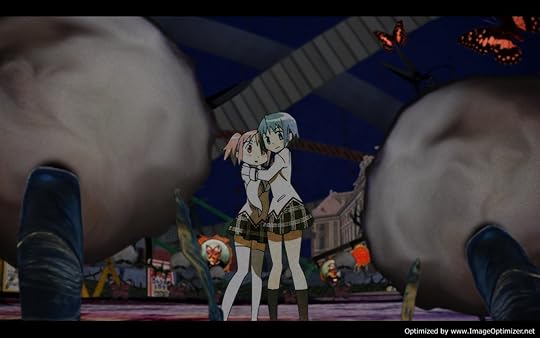
You know what it reminds me of? It reminds me of the heavily-stylized animation of the Barriers (alternate states of reality where Witches live) from the anime Puella Magi Madoka Magica.
Behold, the Witch in her Barrier:
Also, below: note how the traditional animation (bottom center) combines with the surreal background. This book is sort of like that.
The whole thing reminds me of Margo Lanagan's short stories; using magical realism or fantasy to explore human thoughts, desires, and emotions. Lanagan also happens to be one of my favorite authors of all time, so this is some serious praise I'm giving.
All in all, this was a delightful find, and if this sounds even remotely interesting to you, be sure to check it out!
Originally a short story, this small book is eerie, haunting and achingly sad. Slog’s father is dead and he knows it. But when he sees the scruffy man outside the butcher shop, he knows that it is his father who has returned to see him. But Davie, his best friend, is just as convinced that this man is a fake. The story explores the way that Slog’s father died, slowly and by tangible steps. It is a story of grief but also one of hope that asks unanswerable questions and allows readers to stay in the in-between world where hope thrives but so does doubt.
Almond and McKean paired up for The Savage, an amazing work of fiction. This story is gentler and hopeful. It quietly explores grief, allowing the poignant moments to live, hover and hope. It is a story of dreams and beauty, of the unexpected and the amazing. Almond’s writing is at times so blunt that it is traumatic and unblinking. At other times, it is eerie and bizarre. And at still others it is haunting, hopeful and trembling.
McKean’s illustrations help bring the story to a new level. From the almost photographic detail of some of them, where the warped faces are the only clue that you are not looking at a photograph to the line drawings that soar with greens and blues hovering above heads. These are illustrations that explore the emotions of the book. They are not concerned with a unified look and feel, but with the look and feel that is right for that moment in the story.
A gorgeous work of writing and art, this book is a testament to grief, hope and wonder. Appropriate for ages 9-12.
What it’s about: This story is told by a boy whose friend goes through some very difficult times, and who finds some peace through a situation that might be supernatural, or might be someone taking advantage of the situation.
What I thought: It's difficult to discuss the story itself without getting into spoiler territory because it's so short.
This is an unusual short story. It's paired with some unusual art. It's a bit of a thought-provoker, and could drive some interesting discussion about whether it's okay to trick someone if the tricked person feels like they got something important out of the trick.
Why I rated it like I did: This is not a bad short story, but it's has a very muddled message, and it's silly how short it is. I found the art to be unsettling in several spots. The more I think about the story and unravel it in my mind, the more unsure I am how I feel about it. I started out really disliking it, but now have come to think it's not terrible, just odd.
David McKean has a distinct, easily recognizable artistic style. It's a mixture of collage and illustration that evokes visceral, emotional responses. He has collaborated with Neil Gaiman but the first time I saw his art was in The Savage by David Almond. The two collaborated again in Slog's Dad.
This is a short book and like The Savage is a hybrid graphic novel. Davie isn't convinced in life after death but his friend Slog is. His dad made a death bed promise to visit him again. Slog believes the man sitting outside the chop shop is his father.
Most of the book is the story of how Slog's dad became sick and how the illness took its toll. The meeting on the bench is taken as matter of fact. Whether or not the visitor was really Slog's dad is left to reader to decided based on McKean's surreal illustrations.
It's a book that can be read in thirty minutes. It's also one to ponder over.
David Almond is one of my favorite authors, and I tend to devour his new books. (So much so, that I've been considering paying the $30.00 bucks for an import of his latest, "My Name is Mina.")
This was a bit of a disappointment, but only because of its shortness. It truly is a gorgeous book with amazing illustrations from McKean, but it's simply a short story blown up a bit. A good short story, but I'm not sure if it required an entire book.
Again, being an enourmous fan of Almond, it almost pains me to give this three stars, but I can't do more. It's just not up to pair with his other work--including his other collaboration with McKean, "The Savage."
If you like Almond, check this out. But perhaps it should simply be a library rental over the purchase.
Slog is a young boy who is still grieving the loss of his father. One day, he sees a homeless, hairy, and greasy man sitting on a bench, he insists that the man is his father, Slog says his dad told him he would be back. Slog’s friend Davie, the narrator, tries to talk to Slog and be the voice of reason. He talks about how Slog’s father died and works to help Slog cope with his father’s death. Slog is still convinced in life after death, and hold on to the fact that the man on the bench is his dad. The graphic novel leaves a lot of the story open for personal interpretation.
This graphic novel would be a different kind of a text that students could analyze. Since graphic novels are more uncommon, this could be a good opportunity for students to interact with one. Middle school is a unique point in life for many kids, it is often awkward. This story takes a different look at the grieving process and might offer some students new insight. Not only does this story cover grief, but it is open-ended and calls for some interpretation. Teachers could ask students to create their interpretation of the story after reading by using details from the text. Students could use the different elements of graphic novels (framing, narrative boxes, speech bubbles, facial expressions, etc.) to create their interpretation. They could show their ideas through both pictures and words. CCSS.ELA-LITERACY.RL.6.: Cite textual evidence to support analysis of what the text says explicitly as well as inferences drawn from the text.
I've read tales of grieving before (A Monster Calls, My Sister Lives on the Mantelpiece etc) but never one quite so colloquial as this. Almond uses 'bliddy', 'gan on' and other such phrases to firmly root his plain-speaking tale on the Tyneside.
Any homeliness this might evoke, however, is soon offset by McKean's trademark style of shifting perspectives and shadowy colours. He even employs childhood images like balloons and paper dolls to add new dimension to this already sombre meditation on mortality.
Indeed this stark contrast between Almond's storytelling and McKean's illustration was often a cause of great unease within me, especially when Slog was trying to physically prove to his narrator friend that his father had come back to life again. Also the way that Slog's father passes is cruel in its slow certainty.
Nevertheless I feel Slog's Dad would be a unique prompt for parent-child conversations about death and grieving. I recommend this book to graphic novel enthusiasts coming to terms with loss, be they young or old.
A truly heartfelt story! The power of McKean’s illustrations is such that, in a matter of a few flips, it can transform your mood and transport your soul to a new world altogether. Needless to say — Almond’s touch of magic on the most sensitive subject is something that continues to amaze me. How does he do that every single time? How does he make a deep, dark space shine in the brightest light? He sure believes in the wonder of a man with wings and now, so do I.
Although Slog’s Dad sits somewhere between a graphic novel and a short story, it very much reminds me of The Savage. The only difference is that moments of wordlessness in this book hit you quite differently. Like Almond says — hell’s teeth!
This is not what I was expecting. I didn't realise it was a children's book for a start - I just purchased it for Dave McKean's illustration. Of course the artwork is great a la McKean. Interesting use of photo-realistic style imagery combined with straight vibrant more cartoonish bits.
The story is sweet if sad. Slog's friends inner monologue of narration is kind of annoying and slightly bitter in its pessimism. Also whilst the strange man Slog meets represents a sweet moment I can't help but feel it's a little misjudged in that, outside of this story book, it is a strange man hugging and kissing a boy saying that he's his dead dad. I don't know that just felt off for me.
I love almost everything Dave McKean does. His styles range from the super-rich multi-dimensional Sandman covers to the simple lines of Cages, both of which speak to me in different ways. His work in Slog's Dad, while independently interesting, didn't work for me narratively, almost certainly due to the choppy overly simplified source material. David Almond's story just fell absolutely flat. I read through this a couple of times, really hoping to find something that resonated, but nothing ever did. Sadly, I can't recommend to anyone but a McKean completionist.
I'm going to be honest. At first, I did not get it. I really didn't understand how the written story and the pictorial story went together. It was only when I read a reviewer's quote on the back cover that mentioned different forms of expression that it clicked - its the same story told by two different people in two different ways. I reread it and truly enjoyed it, though I'm still not sure I really get it (but that's OK,)
A wonderfully illustrated short story about the power of love and promises...and grief.
This illustrator is like no other I've seen and I really love his eclectic style. Sometimes the art needs more than just ink or colour to make the 'idea' sing off the page. Having different mediums really drives home the point and makes you pay attention to the story.
This story leaves you with lots of thoughts to ponder. Loved it!
David Almond's short story is spliced together with illustrations by the amazing Dave McKean, which tell the same story from a different perspective. It didn't grab me in the same way their previous collaboration, The Savage, did, but it's a thought-provoking read, which somehow manages to be both sweet and a little creepy.