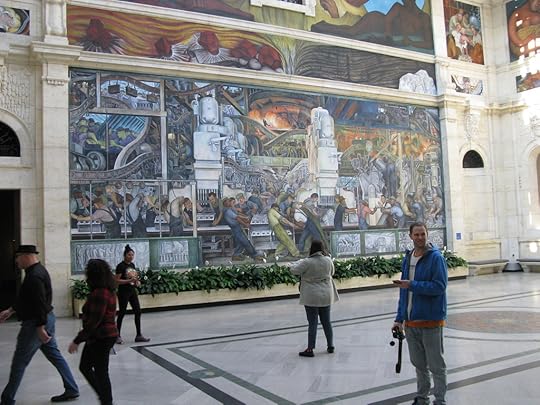
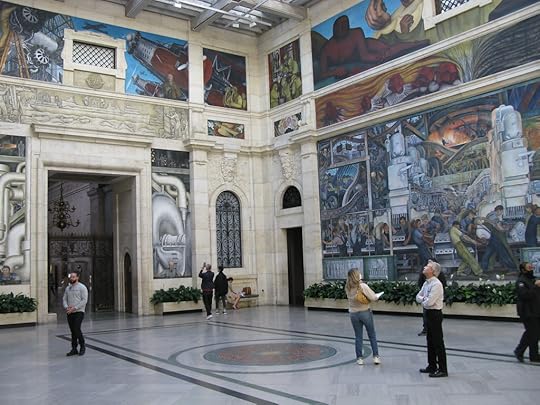
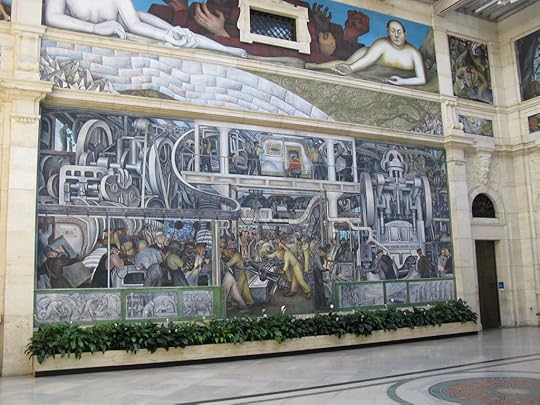
A beautifully illustrated in-depth study of the most important North American work by the best-known Mexican muralist, Diego Rivera. Early in the Depression, Diego Rivera was commissioned by Edsel Ford to create a series of murals in the gallery of the Detroit Institute of Arts, giant frescos whose theme would be America’s industrial might. This volume studies the astonishing results and gives us a remarkably close look at Diego and his wife, Frida Kahlo.
Rivera’s Detroit Industry murals are one of this country’s greatest treasures. In addition to providing full coverage and analysis of the murals, the book includes chapters on the murals’ planning and antecedents, Rivera’s working methods (which can be read as a primer on frescos), Diego and Frida’s lives for their nine months in Detroit, and the public’s dramatic response to the strong socialist/communist themes in the works.
"Rivera reached a level of understanding about himself, his work, and the world that is reflected in the Detroit murals and that does not appear in any of his work before or after. . . In its Pan-American perspective, thematic richness, complexity of design, boldness of presentation, and vibrance of color, the Detroit mural cycle has no peer in the history of modern art. _Detroit Industry_ remains today a historical record of a fictive past, a utopian vision of the industrial culture of Detroit played out on a cosmic scale, an inspiration to the entrepreneur and social reformer alike, and a monumental modern work of art to be contemplated, studied, and enjoyed."
I was down in Detroit a few months ago, and had the ability to visit the DIA in ideal conditions, when they were limiting the number of admittances (due to COVID-19), yet most of the galleries - and the Rivera courtyard - were open. I haven't seen the DIA ever look better - and I was able to spend a good half hour contemplating the _Detroit Industry_ murals without the pressure of crowds (and school groups, hahaha). I left convinced more than ever that it really is a great work of art, and Detroit is incredibly fortunate that the circumstances of its creation worked out the way they did. Linda Bank Downs does a fine job of showing how everything had to come together "just right" in order for the mural sequence to be such an ideal representation of its creator, its patrons, and its city.
A beautiful book of a breathtaking mural, one I've come to appreciate more and more over the years. The history and controversy, main characters and supporting cast, as well as detailed sections of the mural, are highlighted and explained.
Any visit to Detroit should include the DIA to see the Detroit Industry Murals!
When you enter the Detroit Institute of Arts Museum and go down the large corridor, you come to the Industrial Murals painted by Diego Rivera in 1932-33. The effect is overwhelming. One is surrounded on all sides by huge murals illustrating not only the Ford industries of Detroit, but life themes of birth, race, the benefits of technology and the death that it can give. Parts of the murals throng with workers. There is a sensory overload viewing these gigantic murals.
This book explains in very readable text the making of the murals. Craftsmen made them in several layers of plaster – and Diego had to paint on them before they dried up completely. He made huge sketches (called cartoons in the book) on which he based his murals – these were only rediscovered in the late 1970s.
Diego was a self-proclaimed communist, but at the time of the murals he had been excommunicated from the Communist Party. He was hired by Edsel Ford (son of Henry) to do the murals.
Diego was an admirer of industrial technology and at that time the Ford Motor Plants in Detroit were one of the largest in the world. He saw industrial technology, the worker, and the managers who made the automobile as representing a type of communist utopia. They all worked together as a unified team to make a modern product. Diego was not interested in the finished product, the automobile, but in the methods used to manufacture it.
The book explains the many different themes in these complex murals.
After the end of the Second World War the murals were neglected. With the advent of abstract expressionism, Diego’s art was seen as passé. The mural room became, among other things, a smoking lounge – and the murals came to covered in a layer of tar from the tobacco smoke.
In the 1990s there was a rebirth of Diego’s Industrial Murals. The room, more so the leaking roof, was repaired and the murals cleaned up. It then became, as it is now, the centerpiece of the Detroit Institute of Arts.
This book has plenty of colour photographs with details from the impressive murals. We also get a short history of how the murals were perceived through the decades. Initially there were religious groups who took offense at certain features – and they wanted the murals whitewashed completely. Fortunately, they did not succeed!
The Detroit Murals are an American Sistine Chapel. This book does an excellent job justifying that claim. The abundant details of the mural as well as photos of preliminary sketches and the production process are plentiful and high quality. Chapters cover the history of the mural’s commission, the production process, the philosophy of the painting, and its cultural impact. The book’s intention is to show why this is one of the masterpieces of 20th century art and it completely succeeds. I’ve been to the Uffizi, Sistine Chapel, and many other temples of high art and the Rivera Court deserves a place with those sacred places. Highly recommend reading and passing along to a friend - before a visit to the Detroit Institute of Arts of course!
Diego Rivera and Frida Kahlo spent nine months in Detroit during the creation of the murals commissioned by Ford. Gorgeous book with a good biographical and technical background. Splendid addition to the Art Book collection Highly recommended Not to be rushed.
Scholarly written of the art, politics and references of the murals. Painted from 1932 - 1933 during an era between wars and depression. References made to the lives of Diego and Frieda during that period. Good overview of traditional mural techniques
Bought this at the DIA after a visit to the museum. Outstanding photography! The lengthy text goes into plenty of detail concerning the selection of Rivera and the creative process and public reaction. After reading this, I want to go back to the Detroit Institute of Art for another viewing.
Another one of my favorite artists. Diego was hired by Edsel Ford to paint a mural at the Detroit Art Museum. It is still there today and it is gorgeous.