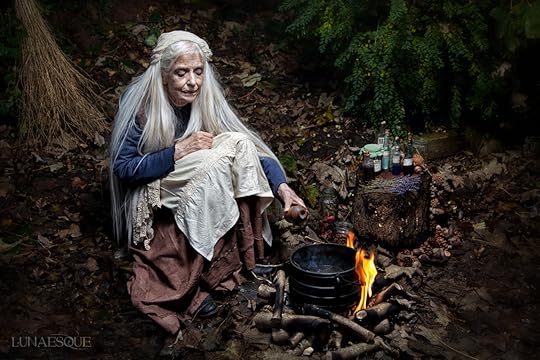
Bess Southerns, an impoverished widow living in Pendle Forest, is haunted by visions and gains a reputation as a cunning woman. Drawing on the Catholic fold magic of her youth, Bess heals the sick and foretells the future. As she ages, she instructs her granddaughter, Alizon, in her craft, as well as her best friend, who ultimately turns to dark magic.
When a peddler suffers a stroke after exchanging harsh words with Alizon, a local magistrate, eager to make his name as a witch finder, plays neighbors and family members against one another until suspicion and paranoia reach frenzied heights.
Sharratt interweaves well-researched historical details of the 1612 Pendle witch-hunt with a beautifully imagined story of strong women, family, and betrayal. "Daughters of the Witching Hill" is a powerful novel of intrigue and revelation.
Mary Sharratt is an American writer who lives with her Belgian husband in the Pendle region of Lancashire, England, the setting for her acclaimed 2010 novel, DAUGHTERS OF THE WITCHING HILL, which recasts the Pendle Witches of 1612 in their historical context as cunning folk and healers.
Previously she lived for twelve years in Germany. This, along with her interest in sacred music and herbal medicine, inspired her to write her most recent novel, ILLUMINATIONS: A NOVEL OF HILDEGARD VON BINGEN, which explores the dramatic life of the 12th century Benedictine abbess, composer, polymath, and powerfrau.
Winner of the 2005 WILLA Literary Award and a Minnesota Book Award Finalist, Mary has also written the acclaimed novels SUMMIT AVENUE (Coffee House 2000), THE REAL MINERVA (Houghton Mifflin 2004), THE VANISHING POINT (Houghton Mifflin 2006), and co-edited the subversive fiction anthology BITCH LIT (Crocus Books 2006), which celebrates female anti-heroes--strong women who break all the rules. Her short fiction has been published in TWIN CITIES NOIR (Akashic Books 2006).
Mary writes regular articles for Historical Novels Review and Solander on the theme of writing women back into history. When she isn't writing, she's usually riding her spirited Welsh mare through the Lancashire countryside.
Though other books have tackled a fictitious account of Lancashire Witchcraft Trials of 1612, Mary Sharratt is the first author among them to give Mother Demdike and her granddaughter, Alizon Device, their own say. Daughters of the Witching Hill is told in two voices. The first section being narrated by Bess Southerns (Mother Demdike) and the second by Alizon. Through this we see how both women viewed their world and their gift of cunning craft. Of course, some liberties were taken with the novel but this is what makes it historical fiction and not a boring textbook (the changes are clearly addressed in Afterword for those interested).
Mary writes with such a beautiful, yet subtle, poetic flair that I was utterly transfixed in this late sixteenth century world, and nearly read the book in one sitting. Take this line from page 126 for instance, "His was the might concealed in the tiny purple flowers of nightshade." Gorgeously vivid. On par with her prose, is her painstaking attention to historical detail. Even the most minute of particulars is included to fully immerse the reader in Mother Demdike's world and time.
Daughters of the Witching Hill is an engrossing and emotional look at a horrible period of upheaval and change in England's history, all brought to a roaring crescendo by King James I and his vendetta against the supernatural and Catholicism.
I listened to this with the group, Witches vs. Patriarchy. I LOVED, LOVED, LOVED this book! I did not expect to be so affected by it but as i was finishing it up this morning, i could've cried. My heart wept for all these people accused of dealing with the devil. I'm in the southern U.S. so I'm not (yet) familiar with the history of this witch trial. The story is that of the Pendle Witches. It is so beautifully written. The characters are flushed out people, not just names on a paper. They are good people, just trying to survive any way they can. Times are hard, there's famine, devastating rains and cold, cold winters. It was wonderful reading about Mother Demdike and her cunning. She's a blesser. By doing her blessings, she is able to feed & provide clothes for her family.
It all goes wrong one evening when granddaughter Alison speaks out of anger to a peddler. He falls down and "half his body dies." Being an outsider, he cries witch and the charges are brought against Alison and her family. This is based on an actual historical witch hunt, you know there is no happy ending. By the time you get there, you love these people so the ending really hurts. I really loved this book and I's so glad i finally listened to it. It was read by Terry Donnelly and she did such an outstanding job. I loved the 13.5 hours i spent listening to her telling me this tale.
Daughters of the Witching Hill is a beautifully crafted story of what was a horrifying moment in history.
Not knowing much about the 1612 witch trials of the Pendle witches in England, I didn't know what to expect, but I figured that it ended much like the witch trials I do know about: the Salem Witch Trials of 1692. A big difference I noticed is that in the 1612 trials, if someone admitted that they were a witch, they weren't shown leniency, while in the Salem trials, if someone admitted they were a witch, they weren't hanged.
The writing struck me. It flowed effortlessly and nothing seemed forced. We saw the points of view of two women: Bess Southerns, known as old Demdike, and great healer in the community for several decades, and her granddaughter Alizon Device. We saw the happy events in these two women's lives and their heartbreak. The descriptions of the imprisonment and trials of the Pendle witches absolutely terrified me and I'm so thankful I didn't live back then. People were quick to flip the witch switch when anyone became ill or died.
I can't stop thinking about this story. The heartbreak and unfairness really got to me.
Relying on Goodreads guidelines to interpret this 1-star—that is, “I didn’t like it.”
I don’t think it’s badly written, though it’s a bit dry & infodump-happy & I longed for an OC to give me some hope of a slightly upbeat closure. But hey, some people prefer their historicals to be firmly Historical(tm), so whatever. *shrug*
I just can’t face plodding through this depressing book to reach the even-more-depressing conclusion. That’s on me, not the subject matter. When I was young & dumb & continually searching for literary gut-punches (as many of us do in our disenchanted post-university youths 🙄), I gobbled up books about Salem & other witchhunt hysterias precisely because it was fun to be mad…but nowadays I avoid fruitless disgust & have withdrawn from the Outrage Olympics. I’m older, wiser, & prefer at least a determined Scarlett standing on the hill & staring back at Tara. Suffering & sadness & outrage for 300+ pages only to be capped by everyone’s preordained death is no longer my idea of a fun read.
I feel sadness on behalf of the Pendle victims, but I’m not continuing. DNF, circa 30%.
Before I forget, I'd like to say thank you to First Reads and the publisher Houghton Mifflin Harcourt for giving away copies of this book here on Good Reads. I'm happy to have won my copy here. What could be better than free books?!
Mary Sharratt has created a vivid story rich with period detail and social context. Her writing is polished and refined and she is able to create a picture of what life was like for the poor after the Reformation. This book would be an excellent tool for teachers who cover this period in history. The social and political context of the story is what makes it so interesting. Mary Sharratt is my favorite kind of writer, she is also a teacher.
Here is an excerpt; 'But gone were the days when Christian folk felt beholden to give alms to the poor. When I was a tiny girl, the monks of Whalley Abbey fed and clothed the needy. So did the rich folk, for their souls would languish a fair long time in purgatory if they were stingy to us. In the old days, the poor were respected - our prayers were dearer to God than those of the wealthy. Many a well-to-do man on his deathbed would give out food and alms to the lowliest of the parish if they would only pray for his immortal soul. At his funeral, the poor were given doles of bread and soulcakes, so my mam had told me. The reformers said that purgatory was heresy. It was either heaven for the Elect or hell for everyone else, so what need did the rich have to bribe the poor to pray for them? We humble folk were no longer seen as blessed of the Lord but as a right nuisance.'
She also illustrates how celebrations and building a sense of community changed after the reformation. The old ways were forbidden as were celebrations and dancing and if you didn't attend church on Sunday the Church Warden could whip you and fine you. (Had I lived during this period, I would have been in deep trouble I'm sure.)
I loved the details throughout that enabled me to imagine what life was like for these two poor women. At one point Mother Demdike and Alizon sleep in a real bed.
'The linens, soft and soothing against my skin, allowed me to forget her words. Such comfort - the likes of which I'd never known. The feather mattress cushioned my hip and shoulder where the bones stuck out. So this was what it was like to lie upon a proper feather bed. The embroidered canopy kept the spiders and beetles living in the thatch from dropping upon our faces in the night. So blessed quiet here, too.'
As a general rule I don't like fantasy/magic themes in novels but I thought Mary Sharratt did an excellent job of showing the similarity between Catholicism and the faith of these accused witches. And she made their beliefs understandable and logical in the context of this period in time.
I thought this was a very enlightening and well written historical novel. Though I did read it with a sense of dread knowing what happened to these people in the end. It's not a beach read, honestly it really bummed me out. But it made me think of something a wise woman once said to me about reading books about the Holocaust. She said "If they could live it the least I can do is read about it." And I think the same principle applies here.
Lancashire England, late 1500's, a place of old Catholic mysticism, fairies and superstition. An aging Elizabeth rules, as does the Protestant faith and Catholics must worship in secret or face imprisonment or worse. Bess Southerns is a poor widow trying to eke out an honest living for herself and her children and one day she's *adopted* by an imp in the form of a dog and like *magic* she can heal the sick (both people and animals) by performing blessings. Eventually her great friend Anne, as well as her grandson Jamie and granddaughter Alizon gain imps/familiars and begin casting *spells* of their own, although Anne and Jamie eventually turn to the dark side in their desire to cause harm to those who wish ill of them. Years pass and James I gains the throne and he’s hell-bent on destroying the Catholic faith for good, as well as persecuting witches. Of course ambitious magistrates jump at the chance to prosecute any likely suspect to gain the king’s notice.
Well that sounds for an interesting novel, especially as the book is based upon actual events and people, just Google Pendle Forest and witches and you'll find plenty of reading material and photos. My two cents? I loved the idea and at first I was gung ho getting into the book and looking up the places online and dreaming of a trip to Lancashire and seeing it for myself. Eventually though I ran into a quagmire - much of the book goes on and on and on (and on some more) detailing about Bess and Alizon's day to day life and interaction with their familiars as well as all those *clay pictures* (think voodoo dolls). I would have preferred to hear more about the arrests and trials themselves as well as Alice Nutter, the devout catholic who was caught up in the witch-hunt.
I'm not a huge fan of the first person narrative used in this book (first Bess' POV and finishing up with Alizon), and I felt it hampered the story a bit in the latter part of the book when Alizon is sitting in prison and we can't see what's happening outside of those walls. At the end, I just didn’t pick up on the terror those accused must have felt, nor much of the mass hysteria there must have been among the townspeople. A list of character names and relationships would also have been helpful, especially as some are referred to with different names - either call Anne Anne or call her Chattox, but don't go switching back and forth - very distracting. In the end, the author just took too much time on blessings, dolls and familiars and not enough time on the trials themselves. This is a good book, it just not a great one. 3/5 stars.
This novel is amazing. I felt almost as if I were bewitched as I read it, drawn into the magical, heart-rending world that Mary Sharratt has created. Using trial records from a witch hunt in Lancaster County, England in 1612, Ms. Sharratt brings the accused Bess Southerns and her granddaughter Alizon to brilliant, vibrant life. A jewel of a novel that makes me hungry for more of Ms. Sharratt's beautiful work.
I wasn't really sure how I felt when I got to the end of this book.
While Daughters of the Witching Hill does explore the interesting idea of the sometimes thin line between religion and superstition, it fails to provide a real conflict. There is the sense of dread at the possibility of the "cunning" women being discovered and charged with witchcraft, but this lingering nervousness is not really enough to keep the reader engaged through the entirety of the book. Also, the author never fully explains the "familiars." They almost felt like an unnecessary addition to the plot because they are heavily present in the beginning of the story, but by the end are merely mentioned in name alone.
I did enjoy the relational aspect of this story and the importance that is placed on friendship, family, and loyalty. Also, the author handles the arrest and trials of the suspected witches with much skill. Her descriptions and dialogue paint a terrifying (yet historically accurate) portrayal of the legal system during this time period. These chapters made indignation rise within me as I read about the injustice and cruelty these women faced. What was worse was the fact that these events were all too common throughout history!
Don't you love it when you start a book and immediately get sucked in just from the first few sentences? Well, that's what happened when I began to read Daughters of the Witching Hill. This book had me from hello!
Mary Sharratt paints a vivid and moving story of the Pendle Witches (also known as the Lancashire Witches), a true story of a group of women and men thought to be witches and hung in Lancashire, England in 1612. DOTWH is told through the eyes of Mother Demdike (Bess Southerns) and her granddaughter Alizon. Sharratt's unique dialogue style is captivating and the character development multi-dimensional.
The reader will be entranced by these fierce, strong women who will do anything to protect their own. To me, the heart of the story of Daughters of the Witching Hill is one of human compassion, or at times the lack of it. The men and women hung at Lancashire will never have justice, but their story deserves to be told and in my opinion, Mary Sharratt gave them that final justice.
Marvelous evocation of the women and men caught up in the hysteria of a real witch trial in the late 1500s; Sharratt twists the tale with the possibility that one of the women may have actually had supernatural gifts. Sharratt infuses her tale with vivid details of life in a dangerous era. A gorgeously rendered account of faith, persecution, and tragedy.
In the early 17th century, during the last years of the Elizabethan era, a witch craze hit Lancashire and a dozen men and women were brought to trial accused of black magic and Satanism. Six of the accused came from just two families who lived near to each other at Pendle Hill in Lancashire. Elizabeth Southerns (called Mother Demdike) was in her eighties, and was accused along with her daughter (also called Elizabeth) and her grand-children James and Alizon Device. A neighbour Annie Whittle (called Mother Chattox) was also in her eighties and was accused along with her daughter Anne. The other six also lived nearby, and included a mother and her son. One died in prison, and one was found not guilty, but the rest were hanged on 20 August 1612. The two women in their 80s were both acknowledged village healers and cunning-women, and their tsti9mony is a fascinating glimpse into the magical thinking of England in the 1600s.
Mary Sharratt has taken the story of the Pendle Witches – the most famous witch-trials in British history – and brought them to vivid and heart-rending life. Most of the narrative is told through the eyes of Bess Southerns, cunning-woman and widow, who ekes out a living on the edge of Pendle Forest by healing the sick, making love spells and foretelling the future. As her grand-daughter Alizon grows up, Bess begins to teach her the secret of magic but finds herself at odds with her neighbour, Mother Chattox, who turns to the dark arts in her desire for revenge and power. When a peddler suffers a stroke after an exchange of hot words with Alizon, the family finds themselves drawn into accusation and counter-accusation, which leads them inexorably towards tragedy. I knew the story of the Pendle Witches well, having read a great deal about it over the years, but it is not necessary to know the background to be drawn into this powerful and beautifully imagined novel. This is a story about love, compassion, strength and betrayal, and a must-read for anyone who loved Hannah Kent’s The Good People or Kathleen Kent’s The Heretic’s Daughter.
I really enjoyed this story of Bess Southern and her granddaughter, Alison Device in seventeenth century England. Considered cunning folk, Mother Demdike as she was commonly known, was a blesser. She healed and blessed ailing farm animals and family members. She could also see the future. Looked upon with a mixture of suspicion and reverence, she went about her daily life trying to keep her family together through mostly lean times, and staying out from under the baleful eye of the reformed church and it's warden. Considered a papist, she clung to the ways of the old catholic church, that had been filled with meaning and magic. Her granddaughter Alizon was gifted as well and she tried very hard to impart the wisdom and caution necessary to use the gift wisely. But Alizon feared the gift, and spent most of her time in denial, refusing to embrace it and learn from her adored grandmother. When one time she did inadvertently use the gift out of frustration and anger, it set in motion a deadly cascade of events. This is a very well researched fictional history of the Pendle witch trials in 1612. The story is compelling all on it's own. Add to that the fact that the events actually transpired, are as fascinating as they are chilling.The religious persecution endured throughout history spans the world. These stories while fictionalized to a degree serve as cautionary tales to never forget,for next time, they could come for you or me.
Like a lot of people I am familiar with the Salem witch trials, but I knew almost nothing about the trials of the Pendle witches in England in 1612.
This is a well written book. The ending(no surprise how it ends..hmm..one can take a guess), brought it up a bit for me. 3/4 of the book follows the characters through their lives. It's not until the final 1/4 that you get to the trials itself(which is written really well--I felt I was there).
The characters are realistically imagined and the author is good at capturing the feel of that time period. Details are done right, but not overdone. I can't imagine the hysteria and fear of that time--especially if you're the one being accused of being a witch! But the fear even of the people who believe that someone could curse them and they'd soon die: The power of belief. Or if someone fell ill, instead of looking at medical reasons they'd throw the blame on a "witch." She must've cursed me! Sadly, in some places in the world this superstition still continues.
To borrow from the book description this is "a story of strong women, family, and betrayal." That sums it up well. I enjoyed this and would recommend it for anyone interested in those themes--even if the witch trials don't interest you.
This is a very compelling story with substance, one with strong women characters that resonates intellectually and emotionally. It’s based on the true story of the infamous and well-documented Pendle witch trials of 1612. The story is filled with atmosphere and poignant relationships showing not only the very human side of these women being accused of witch craft, but also the religious zealotry that fueled the fear. There is also a timelessness to the human flaws demonstrated in this book provoking thought on two spheres; the unspeakable actions of the past and the steadfastness of human nature. The story is told from the perspective of Bess, also known as Mother Demdike and later in the book by her granddaughter Alizon . It’s interesting to see and compare how each interpreted their craft and the world they lived in. Highly recommend for historical fiction fans or anyone who has an interest in witchery. Fans of Phillipa Gregory or those who enjoyed “The Heretics Daughter “will not want to miss this one
I don't remember when I bought this book; all I know is it's been on my shelf for years. I do recall picking it up to read once, but I couldn't get into it then and passed over it for something a bit easier. Given my fascination with the Salem witch trials and otherwise nonexistent knowledge of other witch trials, this book has always held a certain allure for me. Also, the cover is pretty. Sue me.
The voices of Bess Southerns and Alizon Device are perfectly captured in these pages, and even though it took me weeks to read I was never bored by the story. All of the major characters were real people, as noted in the afterword, and I highly doubt I've read a book that was so meticulously researched. These people literally jump off the pages to populate your imagination and it is not a stretch at all, frightening as it may be, to envision these things happening in 1600s England. A fantastic and highly recommended book.
Spanning the years leading up the famous Pendle Witch Trials in 1612, Daughters of the Witching Hill centres around the women of the Southern/Device family that were involved.
Old witch Demdike or Bess comes into her powers late in life, and eventually passes her knowledge onto her daughter Lisa, best friend Anne and grandchildren Jamie and Alizon. But as the years pass on, and King James I's insistence on the persecution of witches, the family become an opportunity for a local man seeking power from the King.
This was a grand book, and the storytelling was a bit slow and steady, with nothing too strange or startling. I liked learning about the particular time in history and what it was like to live in England with changing religions, and how fear and disgust of 'Papists' gradually changed people's feelings towards each other and neighbourly friendliness all but disappeared. Bess and her family never seem to live a particularly comfortable life and forever penniless and begging for work and scraps but there are times of simple family happiness in the story too.
I wasn't too crazy between the woman-on-woman hate that occurred between Bess/Liza and Anne and Annie Redfearn but this was apparently something that truly happened in history so so be it.
This book really shows what a farce witch trials were and how unfair the trials were to the people accused of witchcraft. There was never really a chance to defend themselves and it can be infuriating to read at times, and the story feels a bit hopeless.
I recommend for people who like historical fiction and prefer slower reads with not a whole load of action but more so a story of an interesting life.
I picked this up as a book to read at work- something I wasn't that interested in, that I could pick up between busy periods and kill time. I ended up really liking it! Good writing, flawed characters, suspense, dark. Enjoyed it!
Daughters of the Witching Hill was one of the best books I read all year. I don't know how I didn't read it before now, considering that Mary Sharratt is one of my favorite authors, but I'm glad I corrected the oversight.
This novel deals with the Pendle witch trials of 1613, near Lancashire, England. It is a beautifully written portrayal of the two women at the heart of the trials, Bess Southerns (AKA Mother Demdike, or Gran to Alizon) and her granddaughter Alizon Device. Told through their points of view, we learn about their lives, the village where they grew up, and how they became cunning women and healers.
The secondary characters, the other "witches" and their accusers, and villagers alike are all nearly as well fleshed out as Gran and Alizon themselves. Alice Nutter, Nancy Holden, Roger Nowell, even the gaolers at the end all had distinct personalities and were there for a reason, not just to fill pages.
I really liked Sharratt's handling of the supernatural elements. While Gran and her family all had familiars, healing powers, etc, it all fit within the scope of what was widely believed at the time and can easily be seen as something readily explainable by logic. *I* don't think they had familiars, but *they* believed it, and those around them believed it, and so it was. Other things, such as Alizon's cursing of John Law, is easily explained as a stroke, which the fellow would have had whether he encountered her on the road or not. I thought it was brilliantly written and highlights the author's intimate knowledge of the place and time, as well as her detailed research.
Highly recommended.
Some of my favorite scenes: I love the scene when Gran advises Alice Nutter about being barren and how to fix it. Getting the girl to laugh, giving her practical advice, and giving her insight into motherhood are all things my own mother, aunts, and grannies have done for me (p 50-52).
The charme in the beginning was lovely. I kind of want to embroider it on a linen with pretty flowers or something.
I loved all the scenes with the Queen of Elfhame, and how she ended up looking just like Gran did as a young woman. That was some wonderful juxtaposing and symbolism there, Gran and the Queen of Elfhame and the Virgin Mary.
Of course, the final scenes made me all weepy, and I blubbered at the very last chapter, told again from Bess/Gran's perspective.
What I most appreciated about this book is its authenticity. Some historical novels dealing with witchcraft seemed to be drawn from Neo-Pagan sources. This book is based on a witch from historical records and her practices are taken from the trial transcript. Some trial transcripts contained wildly extravagant stories that were obviously derived from torture. This didn't happen in the case of Bess Southerns for reasons that will become clear in the course of reading the book. Daughters of the Witching Hill is very grounded in the period. The characters and relationships are very well drawn and the plot is suspenseful. It was difficult for me to put the book down, though I had to in order to complete a library school assignment. So when you read this book, you should allow time to read it cover to cover.
After People Magazine gave this book a very high-rated review, I bought it since it combined two subjects I liked - witchcraft and Tudor England. It was billed as a novel, but, unfortunately was the story of a real life event in the 1600s in Lancaster, England. Sharratt's writing style was good, but the story is so depressing, I could not wait for it to end, even though I knew the ending would be a bad, tragic one. So, unless you want to learn more about these specific witch trials, I would avoid this one and read the wonderful novel "The Physick Book of Deliverance Dance" by Katherine Howe instead.
This historical novel is an interesting account of a true witch hunt and trial in 1612 in England. Before I read this book I was not aware of the similarities between the Salem Witch hysteria and similar ones in England spurred by King James I's writings. The author described the practicing of faith of both Protestants and Catholics (who had to hide their devotion) during the Reformation period which I had never thought about before. This book is a believable and engaging retelling of the sad, hard lives of the Pendle Hill "witches." I enjoyed learning the history behind the story. Recommended!
I absolutely loved this book! I spent many a night declining sleep so that I could read. One of my definitions of an awesome book is one that when I am finished I either want to visit that place, or read and learn more about that subject, characters, etc. This book met both of those criteria! Mary Sharratt did a wonderful job of taking a piece of history and with some literary license develop a story that for all accounts follows what we know today of the witch trials/hunts. I did a little reading on-line and found that for the most part Sharratt kept true to history, but there were some differences. I'll let you read and figure out the different parts! Please read this book!!
I did find the book mildly interesting, but it drags on and on with no plot. For ages. And chapters. And forever. It hints at a plot at the beginning, and almost the entire remainder of the book is backstory. No plot. This gets dull and disappointing.
In my childhood witches were relegated to history, halloween and The Wizard of Oz.
This excellent fictionalized account of the 1612 UK witch trials is not merely history. Women today are still continually targeted for living and speaking their truth. In some parts of the world this is still called practicing witchcraft.
Last night in Canada an 11 year old girl was found murdered. Her father has been arrested. The police did not listen to the mother of this girl about the violent threats the father made. 400 years later and women are still ignored. And carnage is still the result. #femicide