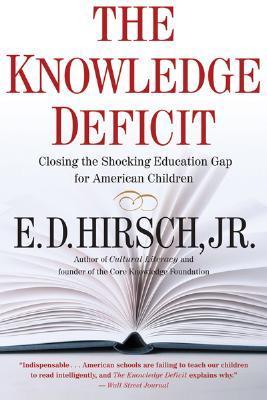
Having spent many years in the classroom as a very successful Language Arts teacher despite not having a degree in education, but one in English Literature, I agree with this author's thesis that reading cannot be taught in a vacuum, so much so that I want to hand out copies of the book to every teacher at my son's elementary school. Hirsch's book explains why it is, that despite tons of monies and decades of educational "research", that American students literacy and reading scores, no matter socioeconomic background, go DOWN as they get older when compared to children of other nations. He explains that so very much time is used teaching the basics of reading, the phonics, and most importantly the "strategies" of reading comprehension, that our children are left with a huge knowledge gap about the world they live in. That gap of general knowledge makes reading comprehension a struggle for kids who don't have a well-rounded background of knowledge that they've learned on their own from home, as all subjects other than reading and math are put on the back burner in early elementary school these days. Amen, Mr. Hirsch, A-effing-Men. Reading comprehension strategies make me want to pull my hair out. Kids comprehend well when they have appropriate background knowledge of a topic and so they GET what they're reading about, not because we drill them on their abilities to predict and infer all day, every day.
Having worked (and hated having worked) in a public school for only one year, I found that private schools are much more willing to embrace a different take on how to teach English/Language Arts, as long as the students are progressing adequately. Guess what? They progress better when teachers actually teach about the subject matter and vocabulary of the books (yes, BOOKS, not "passages", not "sample texts" written precisely for purposes of testing and/or not offending anyone, nor requiring any thought) as the class reads the books. They progress more when they learn from an integrated curriculum, and can understand the context and background of the material they're reading. They learn better when you can make reading interesting, fun, relevant, and when they are actually picking up new KNOWLEDGE about the world beyond their own lives. You can't expect a child to understand Number the Stars in fourth grade when they've never learned about World War II, know nothing about Europe, history, the Holocaust, etc. By not expecting children in kindergarten, first, second, and third grade to learn, even if they can't write about or read about at a high level, any real knowledge in social studies, science, music, art, physical education, etc, we are doing a grave disservice to our kids, who are capable of learning a TON of information between the ages of 5-9, before handing them a book and wondering why they don't "get it" automatically since they are perfectly able to decode the words. Education NEEDS to be based on not just measurable skills of reading and math, but on KNOWLEDGE as a whole.
My favorite quote: "It is true that many American teachers are ill-informed about the subjects they teach, and it is also true that this reduces their productivity in the classroom. But this is not because of their inherent laziness or native incompetence. It is because they are subjected to antifact, how-to ideas during their training. American education schools consider it their job mainly to provide teachers with naturalistic and formalist ideologies." Word, Mr. Hirsch. I took two education courses in college-- they were both huge wastes of time where I learned a lot of pedagogical terminology that had exactly zero impact on anyone being able to be a successful teacher.
So, yes, four stars, not five, because the book is dry, and if you aren't interested in education, particularly reading/literacy education, you'd hate it. That said, if you're a teacher or want to be a teacher? You should read this book-- it is important and it is RIGHT.