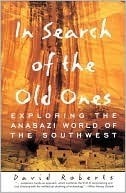
This is a good (dated?) overview of the Anasazi (1), a large grouping of Indians who are generally understood to have lived in the four corners area of the USA and who mysteriously left their cliff dwellings there in the 1300s, moving south, mainly along the Rio Grande.
The impressive cliff dwelling structures are located extensively throughout the four corners area. It’s hard not to wonder who these people were, and to speculate about the reasons for leaving. This is the focus of the book. Roberts covers the various theories as to why these Indians abandoned their cliff dwellings (e.g., raiding; environmental stresses - drought). In the end, the reader is left with the strong impression that we just don’t know.
Roberts discusses the idyllic picture of these people as portrayed by Ruth Benedict, who with other scholars viewed them “as peaceful Indians par excellence.” Roberts says this was not accurate, and there is plenty of evidence to suggest that violence and cannibalism was a significant part of Anasazi culture. He also writes that before AD 900 “the Anasazi had always been a “fiercely individualistic and egalitarian people.” He makes a few references in this regard, but these seem to fall more into the realm of assertion based on scanty evidence - the lack of symbolic valuables in graves (which struck me as not all that abundant). This, in contrast, was not the case with Chaco Canyon where “several burials” teemed “with precious grave goods” that suggested “these dead might have been powerful rulers.” It could be, though, that some groups were egalitarian whereas others may not have been. The “non-violent” (Benedict) or the “egalitarian” (Roberts) characterizations adds a certain naturalism (humans are that way by nature) that does not account for variability in human nature and differences due to environmental-cultural influences. (2)
This raises a larger question about what Roberts puts forward. Is the term “Anasazi” too confining? Does it put all of these Indians under one umbrella grouping that might mask significant differences between them. Before their move south (“abandonment”), the main thing these Indians had in common were the cliff dwellings, but maybe the building of such was dictated by what was available in this environment (overhanging cliffs and an abundance of stones). For example, the Gila Cliff Dwelling was built and occupied by the Mogollon peoples; Walnut Canyon and Montezuma Castle were built and occupied by the Sinagua people (related to the Hohokam). And, after abandonment, Indian communities grew up in the pueblos to the south, and especially along the Rio Grande. But these various settlements are, according to Dozier (3), individualistic and independent from each other. They belong to four, quite unrelated, language groups, with the language in some neighboring pueblos being unintelligible to each other.
Roberts discusses the prominence of the Kachina phenomenon, a religious movement arising around the time of abandonment and continues in some forms today. Roberts notes that this phenomenon may have arisen in the south and “pulled” the Anasazis from their cliff dwellings and that this, rather than “push” factors (drought, raids) accounts for the movement away from the four corners. Since this religious movement centered on “intercessors” dealing with good fortune (kachinas “who negotiate with the gods to bring rain, good crops and health to the people”), a question might be whether this originated from a situation of environmental stress in the north and as a reaction to it. Also, given the size and reach of the Chaco Canyon complex, and the location roughly halfway between the Four Corners and Rio Grande pueblos, it seems to me that the mystery of abandonment and Chaco have to be connected in some central way.
Roberts writes well. But there’s also something of an “attitude” - about tourists and the non-initiated who also want to know more about these Indians and see their fascinating structures - in this book that was off-putting. Not much, but some.
(1) “At the dawn of serious study of the Cliff Dwellers - the term ‘Anasazi’ did not become current until 1936 - remarkably little was known of these ancients. No one could say whether their lost cities were five hundred or three thousand years old. A prevalent assumption held that they were the work of Aztecs from Mexico: whence such place names as Montezuma Creek, Utah; Cortez, Colorado; and Aztec, New Mexico.”
(2) Roberts argues that the complexity of the Chaco Canyon complex (extending extensively northward and southward) necessitated the breakdown of egalitarianism and the creation of a hierarchical society). This is a well-repeated argument about what happens universally (world-wide), in cultural evolution, but perhaps this is a too sweeping generalization to make, which doesn’t allow for cultural variability: some non-complex groupings may be hierarchical (e.g., paternalistic - dominating head “mans”) or some complex societies (e.g., the USA generally) may be relatively democratic.
(2) Edward P. Dozier, The Pueblo Indians of North America, 1970. Roberts does not cite Dozier.