

What do you think?

Arkady Renko #1
Gorky Park
“Brilliant . . . enough enigmas within enigmas within enigmas to reel the mind.”
–The New Yorker
A triple murder in a Moscow amusement three corpses found frozen in the snow, faces and fingers missing. Chief homicide investigator Arkady Renko is brilliant, sensitive, honest, and cynical about everything except his profession. To identify the victims and uncover the truth, he must battle the KGB, FBI, and the New York City police as he pursues a rich, ruthless, and well-connected American fur dealer. Meanwhile, Renko is falling in love with a beautiful, headstrong dissident for whom he may risk everything.
“Once one gets going, one doesn’t want to stop. . . . The action is gritty, the plot complicated, [and] the overriding quality is intelligence.”
–The Washington Post
“Reminds you just how satisfying a smoothly turned thriller can be.” – The New York Times Book Review
“An unbelievable achievement . . . vivid, witty . . . completely fascinating.”
– Boston Herald American
“Gripping, romantic, and dazzlingly original.”
– Cosmopolitan
–The New Yorker
A triple murder in a Moscow amusement three corpses found frozen in the snow, faces and fingers missing. Chief homicide investigator Arkady Renko is brilliant, sensitive, honest, and cynical about everything except his profession. To identify the victims and uncover the truth, he must battle the KGB, FBI, and the New York City police as he pursues a rich, ruthless, and well-connected American fur dealer. Meanwhile, Renko is falling in love with a beautiful, headstrong dissident for whom he may risk everything.
“Once one gets going, one doesn’t want to stop. . . . The action is gritty, the plot complicated, [and] the overriding quality is intelligence.”
–The Washington Post
“Reminds you just how satisfying a smoothly turned thriller can be.” – The New York Times Book Review
“An unbelievable achievement . . . vivid, witty . . . completely fascinating.”
– Boston Herald American
“Gripping, romantic, and dazzlingly original.”
– Cosmopolitan
373 pages, Paperback
First published March 1, 1981
About the author
Martin Cruz Smith
56 books1,298 followersMartin Cruz Smith (AKA Simon Quinn, Nick Carter, Jake Logan, and Martin Quinn) was an American writer of mystery and suspense fiction, mostly in an international or historical setting. He was best known for his 11-book series featuring Russian investigator Arkady Renko, who was introduced in 1981 with Gorky Park and appeared in Independence Square (2023) and Hotel Ukraine (2025). [Wikipedia]
Ratings & Reviews
Friends & Following
Create a free account to discover what your friends think of this book!
Community Reviews
Displaying 1 - 30 of 1,708 reviews
September 8, 2020
There seemed a kind of a hush all over our fifth-floor coffee and smoking lounge as I cracked open this then-new release on my lunch break, back in the early eighties.
And as I entered the crime scene with our dishevelled and grumpy Arcady Renko, deep within the famed Moscow park - in a fairytale midwinter scene of icily glittering snow - I saw how expertly the scene had been set for “doom, deep and darker than any sea-dingle!”
For the doom of widespread corruption is apocalyptic in its scope.
It was an electrifying experience, and if you haven’t already done so, I suggest you read it.
But, you know - reading it in the eighties, I was concurrently witnessing colossal transformations in the same office which was the milieu for my reading - strikingly similar to changes occurring now.
Our button-down management was then, as now, infiltrated by Me-Gen Bright Young Things, though I guess the bright kids now are products of a sleek, Can-Do Millennial education, beavering away at purging dark information.
You see, managers and politicos both had learned from the much-ballyhooed corruption of the seventies.
Time to tighten the rules -
And the apron strings.
Get an iron grip, guys!
The Communist Empire was teetering.
The posthorns were announcing the imminent collapse of the fagged fox.
And the hounds were closing in close behind.
***
And we aging Boomers, fagged like the flagging fox at the snarls and yelps of an inhuman onrush of an exponentially new set of rules in the name of Blind Progress, now have to admit we’re flummoxed and finished.
Do you see my point?
The real rush to the kill came at the time Gorky Park was published.
This novel showed us deep corruption at all levels, like that of the eighties, and it told us: the Powers that Be would soon discretely fold it all up and put it out of harm’s way.
And that was prescient - for we are now at the penultimate point -
Standing in the Lengthening Dark Sunset Shadow of the Deep State which will now - in November 2024:- cast its shadow over the Entire Globe.
Goodbye; Pax Americana.
And as I entered the crime scene with our dishevelled and grumpy Arcady Renko, deep within the famed Moscow park - in a fairytale midwinter scene of icily glittering snow - I saw how expertly the scene had been set for “doom, deep and darker than any sea-dingle!”
For the doom of widespread corruption is apocalyptic in its scope.
It was an electrifying experience, and if you haven’t already done so, I suggest you read it.
But, you know - reading it in the eighties, I was concurrently witnessing colossal transformations in the same office which was the milieu for my reading - strikingly similar to changes occurring now.
Our button-down management was then, as now, infiltrated by Me-Gen Bright Young Things, though I guess the bright kids now are products of a sleek, Can-Do Millennial education, beavering away at purging dark information.
You see, managers and politicos both had learned from the much-ballyhooed corruption of the seventies.
Time to tighten the rules -
And the apron strings.
Get an iron grip, guys!
The Communist Empire was teetering.
The posthorns were announcing the imminent collapse of the fagged fox.
And the hounds were closing in close behind.
***
And we aging Boomers, fagged like the flagging fox at the snarls and yelps of an inhuman onrush of an exponentially new set of rules in the name of Blind Progress, now have to admit we’re flummoxed and finished.
Do you see my point?
The real rush to the kill came at the time Gorky Park was published.
This novel showed us deep corruption at all levels, like that of the eighties, and it told us: the Powers that Be would soon discretely fold it all up and put it out of harm’s way.
And that was prescient - for we are now at the penultimate point -
Standing in the Lengthening Dark Sunset Shadow of the Deep State which will now - in November 2024:- cast its shadow over the Entire Globe.
Goodbye; Pax Americana.

July 2, 2008
Between watching the ‘80s era Soviet spies in FX’s The Americans, and tensions running high over Russian activity in the Ukraine, it almost seems like Cold War never ended. In fact, because of a European consulting firm being brought into my workplace, I’m seeing Russians all over my building. Hopefully things don’t hit the point where I have to take to the hills and go all Red Dawn. Wolverines!!
With all this red scare stuff going on, it seemed like a great to time revisit this old favorite. It’s the early ‘80s and three bodies have been found under the snow in Moscow’s Gorky Park with their fingertips removed and their faces peeled off to prevent identification. Militia chief homicide investigator Arkady Renko finds an enemy of his from the KGB on the scene showing an interest in the bodies, and that can mean nothing but trouble. As he reluctantly begins to investigate the murders and discovers that one of the bodies was an American, Renko wants nothing more than to dump the case on the KGB since he’s pretty sure they killed those people anyhow. However, Renko soon finds himself embroiled in schemes that may mean that he’s the only who gets punished for trying to be a detective in a society that doesn’t want to admit that crime exists at all.
So the hook here is that it’s a mystery set in the Soviet Union, and even though that era has come and gone, it’s still incredibly interesting to get this peek behind the old Iron Curtain. Martin Cruz Smith didn’t just give us a procedural of how Soviet cops worked, he also provided a view of an entire country living under a system where covering your own ass had become an art form and logic rarely entered in to it. It’s kind of like working for a corporation only a corporation can’t ship you off to Siberia if you rock the boat too much. (Or at least they can’t yet. I probably shouldn’t give them any ideas….)
Even though this has plenty of Soviet political intrigue and an international aspect to it this doesn’t feel like a spy story, and that’s mainly because of Arkady Renko. During this reread I found myself comparing Renko to one of my favorite fictional detectives, Matt Scudder, because they’re both pragmatic men who don’t see the point in fighting a system that’s inherently corrupt, but there’s a quiet streak of idealism in both that believes that some crimes have to be answered for. Renko is stubborn with a sly talent for screwing up the plans of powerful people, and there’s a great worn down but not beaten element to the character.
Smith also had excellent timing when he created Renko because through the next several decades he could use his detective to give us mysteries that are also glimpses of what it’s been like for Russians through the fall of the Soviet Union and the aftermath today.
With all this red scare stuff going on, it seemed like a great to time revisit this old favorite. It’s the early ‘80s and three bodies have been found under the snow in Moscow’s Gorky Park with their fingertips removed and their faces peeled off to prevent identification. Militia chief homicide investigator Arkady Renko finds an enemy of his from the KGB on the scene showing an interest in the bodies, and that can mean nothing but trouble. As he reluctantly begins to investigate the murders and discovers that one of the bodies was an American, Renko wants nothing more than to dump the case on the KGB since he’s pretty sure they killed those people anyhow. However, Renko soon finds himself embroiled in schemes that may mean that he’s the only who gets punished for trying to be a detective in a society that doesn’t want to admit that crime exists at all.
So the hook here is that it’s a mystery set in the Soviet Union, and even though that era has come and gone, it’s still incredibly interesting to get this peek behind the old Iron Curtain. Martin Cruz Smith didn’t just give us a procedural of how Soviet cops worked, he also provided a view of an entire country living under a system where covering your own ass had become an art form and logic rarely entered in to it. It’s kind of like working for a corporation only a corporation can’t ship you off to Siberia if you rock the boat too much. (Or at least they can’t yet. I probably shouldn’t give them any ideas….)
Even though this has plenty of Soviet political intrigue and an international aspect to it this doesn’t feel like a spy story, and that’s mainly because of Arkady Renko. During this reread I found myself comparing Renko to one of my favorite fictional detectives, Matt Scudder, because they’re both pragmatic men who don’t see the point in fighting a system that’s inherently corrupt, but there’s a quiet streak of idealism in both that believes that some crimes have to be answered for. Renko is stubborn with a sly talent for screwing up the plans of powerful people, and there’s a great worn down but not beaten element to the character.
Smith also had excellent timing when he created Renko because through the next several decades he could use his detective to give us mysteries that are also glimpses of what it’s been like for Russians through the fall of the Soviet Union and the aftermath today.

May 23, 2016
“‘There are not many road signs in Russia, you know.’ He laughed. ‘If you don’t know where the road goes, you shouldn’t be on it.'” — Arkady Renko
When Gorky Park was first published in 1981, it was immediately banned in the then Soviet Union because of its apt depiction of everyday Soviet life. Though I’ve never been to Russia (my only immersion into the culture was the year I spent trying unsuccessfully to learn the language), its image is intricately linked with the glamorous Moscow of the film, The Saint, in my mind’s eye. Smith’s depiction is the polar opposite! It’s gritty, dark and dangerous. Everyone fears being sent to political prison, or worse—Siberia. And they would be right to be afraid; the murky past of a close relative, one whisper from a vengeful neighbor, or even owning a Bible would be enough to get one into trouble with the KGB.
Detective Arkady Renko lives a simple life. Though the son of a decorated war general, and a member of the communist party, he prefers not to make waves or get any marks on his party card. Murder is his specialty, which is fine by him, as all the ones he has come across are the direct results of drunkenness, jealousy or accident. Open. Shut. What he isn’t prepared for are the three frozen bodies found in Gorky Park, with their faces skinned and fingertips cut off. Clearly, this is not your average Soviet murder.
I enjoyed this book for the same reasons I was enamored of Smilla’s Sense of Snow. It was simultaneously a page turner and social commentary. Though things have changed globally since 1981, many things are still the same. Greed, money and corruption make the world go round, and you’d be a fool to think otherwise. Everyone seemingly has a price that they can be bought at, and those that are faithful to their beliefs and standards often suffer. I’ve already purchased the next book in the series, grateful that unlike Peter Hoeg’s book, Renko lives on for another seven books.
When Gorky Park was first published in 1981, it was immediately banned in the then Soviet Union because of its apt depiction of everyday Soviet life. Though I’ve never been to Russia (my only immersion into the culture was the year I spent trying unsuccessfully to learn the language), its image is intricately linked with the glamorous Moscow of the film, The Saint, in my mind’s eye. Smith’s depiction is the polar opposite! It’s gritty, dark and dangerous. Everyone fears being sent to political prison, or worse—Siberia. And they would be right to be afraid; the murky past of a close relative, one whisper from a vengeful neighbor, or even owning a Bible would be enough to get one into trouble with the KGB.
Detective Arkady Renko lives a simple life. Though the son of a decorated war general, and a member of the communist party, he prefers not to make waves or get any marks on his party card. Murder is his specialty, which is fine by him, as all the ones he has come across are the direct results of drunkenness, jealousy or accident. Open. Shut. What he isn’t prepared for are the three frozen bodies found in Gorky Park, with their faces skinned and fingertips cut off. Clearly, this is not your average Soviet murder.
I enjoyed this book for the same reasons I was enamored of Smilla’s Sense of Snow. It was simultaneously a page turner and social commentary. Though things have changed globally since 1981, many things are still the same. Greed, money and corruption make the world go round, and you’d be a fool to think otherwise. Everyone seemingly has a price that they can be bought at, and those that are faithful to their beliefs and standards often suffer. I’ve already purchased the next book in the series, grateful that unlike Peter Hoeg’s book, Renko lives on for another seven books.

September 29, 2018
Martin Cruz Smith’s Gorky Park (1981) is the first book in series set in the Soviet Union and featuring Arkady Renko, a homicide investigator for the Moscow city police. It is an unusual work, for it gives the reader a unique glimpse into the difficulties facing a detective who is forced to operate in a police state.
For example—and this makes for a noteworthy variation on the typical policier—Renko at first tries not to solve his case, but instead to find some piece of evidence—of foreign involvement or some form of conspiracy—that will allow him to dump the whole vexing affair in the lap of the KGB. The vodka-fueled bludgeonings he usually investigates are easy to handle, but these three frozen corpses in Gorky Park—two men and one woman shot to death, their faces and fingertips removed to prevent identification—are another matter entirely. This is definitely something that might attract the attention of his superiors. And that kind of attention is something Arkady Renko does not desire.
One of the best things about Smith’s book is his portrait of the Soviet bureaucracy: suspicious and hypocritical, deceptive and self-deceptive, filled with outmoded beliefs and threadbare traditions, always ready to betray the loyal and the naive for the good of “the institution.” Now what exactly did Smith’s description of this society remind me of? The Republican Party? The Roman Catholic Church? Yes, of course, those too, but they weren’t exactly the institutions I was thinking of. And then it hit me: Smith’s Soviet Union reminded me of John le Carre’s “The Circus,” his fictionalized portrait of British Intelligence in the post WW II world.
In 1979, John Le Carre completed the last volume of his highly esteemed “Karla Trilogy” (Tinker, Tailor, Soldier, Spy; The Honourable Schoolboy; and Smiley’s People), in which he depicts in detail the culture of the British Spy Network. (And more than a little about the Soviet Union too) Two years later, Gorky Park was published.
Le Carre, a writer of genius, transforms his jaundiced view of the “circus” of spies into a metaphor for an even greater fraud: humanity itself. Martin Cruz Smith, although no genius, is an accomplished writer of thrillers who knows how to learn from a master. In Gorky Park he has given us an excellent mystery that—although no indictment of humanity--is also a memorable portrait of the Soviet Union in decline.
July 14, 2013
A little bit of actual research would've been nice. I am very forgiving when it comes to getting things wrong about USSR; after all, not everyone lived there and not everyone knows the culture. I was able to forgive the misuse of names and the word comrade. I was able to forgive the fact the the author seems to think that Moscow is located at the north pole. Factories suing each other though.... come on. Who doesn't know that in communism all factories belong to the state? That would mean that the government was suing itself. Also couldn't forgive the idea that kgb would have to cover up killing people accused in treason. I had a family member die because he was a suspect. I knew many others who's family members die the same way. Trust me, kgb didn't have to cover up for any of it. Killing "traitors" and "enemies of the people" was a part of their job. The article in the teacher's newspaper in the begining of chapter 2 was also a load of cat poo. Why would a government put Stalin, who was Georgian, and Khrushchev, who was Ukrainian, in power if the policies were so racist against non-Russians? Of all the problems USSR had, racism was not one of them. In fact, racism is something USSR used in their propoganda against the US. There were movies made where they were specifically criticizing US for segregation. The "pop babies" propaganda did exist in USSR, but it wasn't to have Russians as the dominant race, it was because during WWII almost an entire generation got killed They needed to repopulate the country.

January 24, 2023
Three bodies are found close to the busy ice skating rink in central Moscow’s Gorky park. They have been buried in the snow. They have been shot, their fingers removed and their faces skinned to make them practically unidentifiable. Arkady Renko of the military police leads the investigation. It’s a fairly improbable premise that begins this farfetched soviet era thriller that finishes with a totally implausible ending. Suspend your disbelief and you have a fairly engaging read. Why not?

December 20, 2017
Martin Cruz Smith's novels featuring Chief Investigator Arkady Renko have long been favourites of mine. After the sad news of author Martin Cruz Smith's death last year, and the publication of his final Renko novel, I thought I would return to where this superb series of thrillers began.
Yet again I'm still thrilled by the excellent plotting, the well drawn characters & the author's ability to create a fascinating portrait of Russia.
Gorky Park is not only one of my favourite novels it is also one of my all time favourite films. Although some of the film version differs from the novel it's great to see that they used a lot of dialogue straight from the book.
When I was young I had the film poster on my bedroom wall & I still listen to James Horner's excellent soundtrack today.
So if you want to read a great thriller just remember (as the film's tagline goes)......It all began with three faceless bodies in the snow.
Yet again I'm still thrilled by the excellent plotting, the well drawn characters & the author's ability to create a fascinating portrait of Russia.
Gorky Park is not only one of my favourite novels it is also one of my all time favourite films. Although some of the film version differs from the novel it's great to see that they used a lot of dialogue straight from the book.
When I was young I had the film poster on my bedroom wall & I still listen to James Horner's excellent soundtrack today.
So if you want to read a great thriller just remember (as the film's tagline goes)......It all began with three faceless bodies in the snow.

March 27, 2019
A mesmerizing police procedural / murder mystery that also explores Soviet Russia and the dichotomy between east and west.
Set in the late 70s (the book was first published in 1981) this is the SOVIET UNION, Leonid freaking Brezhnev, and still some old pre-revolution folks running around Moscow.
Chief Inspector Arkady Renko is tasked with solving the murders of three people found in Gorky Park, their bodies frozen and killed weeks earlier, hidden by the snow. Their faces have been mutilated and fingertips removed to hinder identification.
What follows is not just damn fine crime fiction, but an examination of the communist revolution, the good, the bad and the ugly of human nature regardless of ideology and finally a study of the juxtaposition of us and them.
Writer Martin Cruz Smith’s greatest achievement, in my humble opinion, is his superb characterization. While Renko is complicated and tormented by social and moral angst, Smith populates his story with a Dickensian cast of fascinating players. Irena and Kirwill are well drawn but as in many novels, the chief antagonist is the most compelling character. John Osborne is an American capitalist who personifies wealth and corruption. The dialogue between he and Renko at the end is reminiscent of the scene between Rakolnikov and Porfiry in Dostoyevsky’s Crime and Punishment.
Highly entertaining and highly recommended.

Set in the late 70s (the book was first published in 1981) this is the SOVIET UNION, Leonid freaking Brezhnev, and still some old pre-revolution folks running around Moscow.
Chief Inspector Arkady Renko is tasked with solving the murders of three people found in Gorky Park, their bodies frozen and killed weeks earlier, hidden by the snow. Their faces have been mutilated and fingertips removed to hinder identification.
What follows is not just damn fine crime fiction, but an examination of the communist revolution, the good, the bad and the ugly of human nature regardless of ideology and finally a study of the juxtaposition of us and them.
Writer Martin Cruz Smith’s greatest achievement, in my humble opinion, is his superb characterization. While Renko is complicated and tormented by social and moral angst, Smith populates his story with a Dickensian cast of fascinating players. Irena and Kirwill are well drawn but as in many novels, the chief antagonist is the most compelling character. John Osborne is an American capitalist who personifies wealth and corruption. The dialogue between he and Renko at the end is reminiscent of the scene between Rakolnikov and Porfiry in Dostoyevsky’s Crime and Punishment.
Highly entertaining and highly recommended.

May 1, 2020
Gorky Park – officially, the Gorky Central Park of Culture and Leisure (Центральный парк культуры и отдыха имени Горького)– plays a role in Moscow life similar to that of Central Park in New York City. In both cases, the park offers green space for rest and renewal in the middle of a major city, along with recreational opportunities. Yet while Gorky Park was named for the Soviet writer Maxim Gorky, it is today best known for its associations with an American writer – Martin Cruz Smith, who made Gorky Park the thematic epicenter, and the title, of one of the best police-procedural novels ever written.
At first glance, there doesn’t seem to be much in Smith’s background that would point ahead toward his writing a series of detective novels set in the Soviet Union and later the Russian Federation. Born in Pennsylvania, Smith is not of Russian or Eastern European heritage; rather, his mother is of Pueblo ancestry and was active in Indigenous Rights movements. Smith’s Native American heritage no doubt influenced the composition of books like Nightwing (1977), a supernatural thriller set on the Hopi Nation, and Stallion Gate (1986), a political suspense novel whose Pueblo protagonist finds himself involved in espionage intrigue in New Mexico at the time of the development of the atomic bomb.
But Smith has always had a strong interest in writing fiction that crosses cultural boundaries – his early writings included a series of mystery novels that featured a Romani or “gypsy” art dealer turned detective – and Gorky Park certainly follows in that tradition.
Published in 1981, in one of the chilliest periods of the Cold War, Gorky Park begins with the discovery of three bodies in the Moscow park that gives the novel its title. What makes this murder different is that the killer sliced off the faces and fingertips of all three victims – a gruesome extra touch that might make it seem, at first, as though the identities of the murder victims could never be discovered.
It is a standard trope of the police procedural to begin with the discovery of the victim(s), and then to move on to the introduction of the detective whose job it will be to solve the murder(s). In the case of Gorky Park, the protagonist is Arkady Renko, a chief investigator for the militsiya, the regular Moscow police. Even before the finding of the Gorky Park corpses, Renko has been having plenty of troubles of his own. His life and work are always placed in the shadow of his father, a notoriously bloodthirsty World War II general who despises his son as “weak.” He has powerful enemies among the KGB. And as if all that weren’t enough, his wife is openly having an affair.
What protects Renko is his excellent work as an investigator, his known loyalty to Russia (though not the Soviet Union), his ability to think on his feet, a Stoic approach to life, and an ironic sense of humour. All of these character traits make him an interesting and sympathetic protagonist – a hero who does not want to be one; a true hero in a society full of false ones.
Renko, through diligent police work, uncovers evidence that one of the Gorky Park victims was an American – a development that would transfer the case from militsiya to KGB jurisdiction, and move him safely off of a politically explosive and dangerous case. And yet, there is a part of him that wants to stay on, to solve the case, even if he sometimes wonders whether he is overthinking the case, making it more complex than it truly is:
Was he a chief investigator or a processor of the dead, an adjunct of the morgue, his paperwork the bureaucratic substitute for last rites? A small point, that, and merely indicative of socialist reality (after all, only Lenin Lives!). More important, career-wise, everyone was right. Unless he became a party apparatchik, he’d gone as far as he ever would. Here and no further. Was it possible – did he have the imagination – to create some elaborate case full of mysterious foreigners, black marketeers and informers, a whole population of fictitious vapors rising off three corpses? All of it a game of the investigator against himself? There was a certain plausibility to that. (p. 102)
As he continues with his investigation, Renko meets a range of vividly rendered supporting characters, all of whom seem to be somehow connected to the Gorky Park murders. Those characters include John Osborne, a wealthy and well-connected American businessman who regularly travels to the U.S.S.R. to purchase Barguzin sables for the fur trade, since the Soviet Union has a monopoly on those sables. William Kirwill, a tough New York City police detective, has come to Moscow in search of his missing brother Jimmy, who may be one of the Gorky Park victims. Irina Asanova, a beautiful young Siberian dissident, also seems to have connections to the victims; and from the disdain with which Renko and Irina invariably speak to each other, it is clear that the two are falling deeply in love.
As mentioned above, the fact of the murder victims lacking faces and fingertips might seem to make positive identification of the victims impossible. Yet – and this is no doubt one of the factors that influenced novelist Smith in composing this novel – the U.S.S.R. was home to a brilliant real-life scientist, an archaeologist and anthropologist named Mikhail M. Gerasimov, who could reconstruct a human face from the bones and tissue left behind after the flesh decayed, and had done so in the case of historical figures like Ivan the Terrible.
In Smith’s Gorky Park, the scientist is one Professor Andreev from the University of Moscow; and while the professor normally (and wisely) stays away from anything that could be considered political, he is intrigued enough in this instance to take on the professional challenge of reconstructing the faces of the Gorky Park victims. Kirwill is singularly dubious regarding this bit of investigative initiative on Renko’s part – “A face from a skull?...Well, this is fascinating, like seeing police procedure in ancient Rome. What’s next, entrails from birds, or do you throw bones?” (p. 204) – but this line of inquiry does produce important results for Renko’s investigation.
Indeed, Renko’s diligent detective work leads him to the killer – and to a stark scene of confrontation when Renko confronts the killer, just as the killer is about to go into a party through the Kremlin’s Trinity Gate. The killer, untouchable at the moment because of his connections among the Soviet nomenklatura, asks whether Renko is really willing to run the risk of making a politically inadvisable arrest, given the depth of corruption throughout Soviet society: “You can’t be willing to die simply to make an arrest to please Soviet justice. Everyone is bought, from the top to the bottom. The whole country’s bought – bought cheap, cheapest in the world. You don’t care about breaking laws, you’re not that stupid anymore. So what is there to die for?” (p. 306)
The killer is right about the endemic corruption of the Soviet Union, as an act of betrayal by a long-time friend and mentor very nearly costs Renko his life, and drops him into the clutches of the KGB into the bargain. Yet even the fanatically politicized agents of the Soviet secret police must acknowledge Renko’s incorruptible honesty; and the dedicated militsiya investigator continues to move closer to final resolution of the Gorky Park case.
And resolving the case, in a nice twist, takes Renko to the other side of the Iron Curtain – to New York City – where the prospect of an exchange involving smuggled goods also holds forth the possibility of freedom in the West for Arkady Renko and Irina Asanova. Yet Renko sees that the prospects for a happy resolution of their dangerous situation are remote at best:
Then he and Irina might not get away. Perhaps the FBI watched the windows of their room all the time. Arkady had never driven an American car; who knew how it worked? They could get lost. Maps, at least in the Soviet Union, were deliberately inaccurate. Perhaps he and Irina were so plainly Russian that everyone would recognize them as fugitives. Besides, he was an ignorant man in a foreign country. (p. 410)
And thus Gorky Park moves toward its suspenseful conclusion, thousands of miles from the park that gave the novel its name.
Smith sets forth the people and events of Gorky Park in what I would call a sort of tough-minded prose poetry. He sketches his characters economically and effectively, and weaves an intricate plot with plenty of authentic surprises. While I quite like the stylish 1983 film adaptation by British director Michael Apted (with Helsinki standing in for Moscow, as Western film crews could not film in Russia in those days), the novel is an ever deeper and richer fictive experience – a marvelous way for post-Cold War readers to be, for a time, back in the U.S.S.R.
At first glance, there doesn’t seem to be much in Smith’s background that would point ahead toward his writing a series of detective novels set in the Soviet Union and later the Russian Federation. Born in Pennsylvania, Smith is not of Russian or Eastern European heritage; rather, his mother is of Pueblo ancestry and was active in Indigenous Rights movements. Smith’s Native American heritage no doubt influenced the composition of books like Nightwing (1977), a supernatural thriller set on the Hopi Nation, and Stallion Gate (1986), a political suspense novel whose Pueblo protagonist finds himself involved in espionage intrigue in New Mexico at the time of the development of the atomic bomb.
But Smith has always had a strong interest in writing fiction that crosses cultural boundaries – his early writings included a series of mystery novels that featured a Romani or “gypsy” art dealer turned detective – and Gorky Park certainly follows in that tradition.
Published in 1981, in one of the chilliest periods of the Cold War, Gorky Park begins with the discovery of three bodies in the Moscow park that gives the novel its title. What makes this murder different is that the killer sliced off the faces and fingertips of all three victims – a gruesome extra touch that might make it seem, at first, as though the identities of the murder victims could never be discovered.
It is a standard trope of the police procedural to begin with the discovery of the victim(s), and then to move on to the introduction of the detective whose job it will be to solve the murder(s). In the case of Gorky Park, the protagonist is Arkady Renko, a chief investigator for the militsiya, the regular Moscow police. Even before the finding of the Gorky Park corpses, Renko has been having plenty of troubles of his own. His life and work are always placed in the shadow of his father, a notoriously bloodthirsty World War II general who despises his son as “weak.” He has powerful enemies among the KGB. And as if all that weren’t enough, his wife is openly having an affair.
What protects Renko is his excellent work as an investigator, his known loyalty to Russia (though not the Soviet Union), his ability to think on his feet, a Stoic approach to life, and an ironic sense of humour. All of these character traits make him an interesting and sympathetic protagonist – a hero who does not want to be one; a true hero in a society full of false ones.
Renko, through diligent police work, uncovers evidence that one of the Gorky Park victims was an American – a development that would transfer the case from militsiya to KGB jurisdiction, and move him safely off of a politically explosive and dangerous case. And yet, there is a part of him that wants to stay on, to solve the case, even if he sometimes wonders whether he is overthinking the case, making it more complex than it truly is:
Was he a chief investigator or a processor of the dead, an adjunct of the morgue, his paperwork the bureaucratic substitute for last rites? A small point, that, and merely indicative of socialist reality (after all, only Lenin Lives!). More important, career-wise, everyone was right. Unless he became a party apparatchik, he’d gone as far as he ever would. Here and no further. Was it possible – did he have the imagination – to create some elaborate case full of mysterious foreigners, black marketeers and informers, a whole population of fictitious vapors rising off three corpses? All of it a game of the investigator against himself? There was a certain plausibility to that. (p. 102)
As he continues with his investigation, Renko meets a range of vividly rendered supporting characters, all of whom seem to be somehow connected to the Gorky Park murders. Those characters include John Osborne, a wealthy and well-connected American businessman who regularly travels to the U.S.S.R. to purchase Barguzin sables for the fur trade, since the Soviet Union has a monopoly on those sables. William Kirwill, a tough New York City police detective, has come to Moscow in search of his missing brother Jimmy, who may be one of the Gorky Park victims. Irina Asanova, a beautiful young Siberian dissident, also seems to have connections to the victims; and from the disdain with which Renko and Irina invariably speak to each other, it is clear that the two are falling deeply in love.
As mentioned above, the fact of the murder victims lacking faces and fingertips might seem to make positive identification of the victims impossible. Yet – and this is no doubt one of the factors that influenced novelist Smith in composing this novel – the U.S.S.R. was home to a brilliant real-life scientist, an archaeologist and anthropologist named Mikhail M. Gerasimov, who could reconstruct a human face from the bones and tissue left behind after the flesh decayed, and had done so in the case of historical figures like Ivan the Terrible.
In Smith’s Gorky Park, the scientist is one Professor Andreev from the University of Moscow; and while the professor normally (and wisely) stays away from anything that could be considered political, he is intrigued enough in this instance to take on the professional challenge of reconstructing the faces of the Gorky Park victims. Kirwill is singularly dubious regarding this bit of investigative initiative on Renko’s part – “A face from a skull?...Well, this is fascinating, like seeing police procedure in ancient Rome. What’s next, entrails from birds, or do you throw bones?” (p. 204) – but this line of inquiry does produce important results for Renko’s investigation.
Indeed, Renko’s diligent detective work leads him to the killer – and to a stark scene of confrontation when Renko confronts the killer, just as the killer is about to go into a party through the Kremlin’s Trinity Gate. The killer, untouchable at the moment because of his connections among the Soviet nomenklatura, asks whether Renko is really willing to run the risk of making a politically inadvisable arrest, given the depth of corruption throughout Soviet society: “You can’t be willing to die simply to make an arrest to please Soviet justice. Everyone is bought, from the top to the bottom. The whole country’s bought – bought cheap, cheapest in the world. You don’t care about breaking laws, you’re not that stupid anymore. So what is there to die for?” (p. 306)
The killer is right about the endemic corruption of the Soviet Union, as an act of betrayal by a long-time friend and mentor very nearly costs Renko his life, and drops him into the clutches of the KGB into the bargain. Yet even the fanatically politicized agents of the Soviet secret police must acknowledge Renko’s incorruptible honesty; and the dedicated militsiya investigator continues to move closer to final resolution of the Gorky Park case.
And resolving the case, in a nice twist, takes Renko to the other side of the Iron Curtain – to New York City – where the prospect of an exchange involving smuggled goods also holds forth the possibility of freedom in the West for Arkady Renko and Irina Asanova. Yet Renko sees that the prospects for a happy resolution of their dangerous situation are remote at best:
Then he and Irina might not get away. Perhaps the FBI watched the windows of their room all the time. Arkady had never driven an American car; who knew how it worked? They could get lost. Maps, at least in the Soviet Union, were deliberately inaccurate. Perhaps he and Irina were so plainly Russian that everyone would recognize them as fugitives. Besides, he was an ignorant man in a foreign country. (p. 410)
And thus Gorky Park moves toward its suspenseful conclusion, thousands of miles from the park that gave the novel its name.
Smith sets forth the people and events of Gorky Park in what I would call a sort of tough-minded prose poetry. He sketches his characters economically and effectively, and weaves an intricate plot with plenty of authentic surprises. While I quite like the stylish 1983 film adaptation by British director Michael Apted (with Helsinki standing in for Moscow, as Western film crews could not film in Russia in those days), the novel is an ever deeper and richer fictive experience – a marvelous way for post-Cold War readers to be, for a time, back in the U.S.S.R.

February 12, 2017
Well. Sigh. I'm deciding what to write. Ok. Truth.
I'm disappointed with 'Gorky Park', book one in the Soviet Union's Inspector Arkady Renko series. Oh, it's a fine inventive entertainment for a mystery, with a lot of twists and near death escapes, tons of corrupt cops and officials, and so many betrayals and hidden motives I am amazed the body count wasn't higher considering the undrained swamps that Renko wades through in not just Russia, but also in New York City. But.
In Russia, many different official police, prosecutor and spy departments want Renko to not really solve the murders of the three bodies found in Moscow's Gorky Park. Instead, they each want him to say he solved the crimes with a falsified story pointing fingers in a direction each department head wants. Each has a devious plan to force or trick Renko into lying about the murders. After Renko ‘solves’ the murders the way each department wants him to, they each plan to file a report of Renko’s sudden death. They hope to say Renko committed suicide, or was killed by an enemy of the state, or he himself confessed to the murders or he confessed to working as a corrupt double agent.
There are scenes of meetings between nefarious officials and underworld characters which made no more sense to me than they did to Renko, other than establishing confusing relationships or misdirections as to with whom Renko is friendly. Later, in America, Renko is manhandled and passed around in the custody of the FBI, the New York City police, the KGB, and a rogue triple agent. I am still scratching my head over the supposed reason for the Soviets to allow Renko to travel to America and the Big Finish reveal. It did not ring true at all.
But the biggest complaint I have is the story has too much squirrelly plotting! I could not suspend disbelief after I was 60% into the story. Instead I began to feel I was reading a sneaky tongue-in-cheek joke mystery or an overcooked Dashiell Hammett The Maltese Falcon! ‘Gorky Park’ is a great summer blockbuster script, one which might have been ordered on spec by a Hollywood producer.
So. Other than the fact I was snorting and guffawing when I wasn't supposed to, it IS a well-written mystery. Three stars for the good writing and wily twists. Maybe you won't guffaw, gentle reader. I am going to read the next one, 'Polar Star' because I am wondering what new mystery/spy plot inventions the author can possibly have left after tossing in every mystery genre plot mechanism that has ever been created into this book.
I'm disappointed with 'Gorky Park', book one in the Soviet Union's Inspector Arkady Renko series. Oh, it's a fine inventive entertainment for a mystery, with a lot of twists and near death escapes, tons of corrupt cops and officials, and so many betrayals and hidden motives I am amazed the body count wasn't higher considering the undrained swamps that Renko wades through in not just Russia, but also in New York City. But.
In Russia, many different official police, prosecutor and spy departments want Renko to not really solve the murders of the three bodies found in Moscow's Gorky Park. Instead, they each want him to say he solved the crimes with a falsified story pointing fingers in a direction each department head wants. Each has a devious plan to force or trick Renko into lying about the murders. After Renko ‘solves’ the murders the way each department wants him to, they each plan to file a report of Renko’s sudden death. They hope to say Renko committed suicide, or was killed by an enemy of the state, or he himself confessed to the murders or he confessed to working as a corrupt double agent.
There are scenes of meetings between nefarious officials and underworld characters which made no more sense to me than they did to Renko, other than establishing confusing relationships or misdirections as to with whom Renko is friendly. Later, in America, Renko is manhandled and passed around in the custody of the FBI, the New York City police, the KGB, and a rogue triple agent. I am still scratching my head over the supposed reason for the Soviets to allow Renko to travel to America and the Big Finish reveal. It did not ring true at all.
But the biggest complaint I have is the story has too much squirrelly plotting! I could not suspend disbelief after I was 60% into the story. Instead I began to feel I was reading a sneaky tongue-in-cheek joke mystery or an overcooked Dashiell Hammett The Maltese Falcon! ‘Gorky Park’ is a great summer blockbuster script, one which might have been ordered on spec by a Hollywood producer.
So. Other than the fact I was snorting and guffawing when I wasn't supposed to, it IS a well-written mystery. Three stars for the good writing and wily twists. Maybe you won't guffaw, gentle reader. I am going to read the next one, 'Polar Star' because I am wondering what new mystery/spy plot inventions the author can possibly have left after tossing in every mystery genre plot mechanism that has ever been created into this book.

August 16, 2010
There's this concept in fantasy writing, world-building? Sci-fi too. It's pretty self-explanatory: because these books are not taking place in our universe, it's up to the author to give us all the details -- to paint the picture, provide shading in just the right places, ensure we can tell what we are supposed to be looking at. Economics, politics, interpersonal relations, language, gender roles, humor... This can be done well, emphasizing just here and embellishing just there, so the empty spaces also fill in the canvas. Or it can be done poorly, cramming in everything, and we wind up with Where's Waldo, and no one can figure out what the hell is happening. Martin Cruz Smith is a really good world-builder. I mean, he's writing about a real place, but it doesn't exist anymore, as such, so I don't think that makes his job any easier.
Granted, I have no idea what life was like in the Soviet Union in the early '80s, and maybe the author didn't either. But this is a fully realized world, a backdrop that adds a great deal of freshness to yet another twisty detective thriller. Part of the reason Stieg Larsson books created a new genre in the U.S. (well, sort of -- the Swedish location-specific murder genre) are his weirdly obsessive descriptions of the Swedish landscape, which gave readers something to focus on while Lisbeth was shopping at Ikea. Here, the sense of place is as compelling (with weather as miserable); the plot and writing, a lot better.
Arkady Renko is a great character. He knows how the system works, sees no problem in "losing" the files on a few murder cases to keep the crime rate low and the politicians happy. Yet he refuses to follow the party line, pisses off the wrong people, follows leads when he has no vested interest, not even a strong desire for justice. He just wants to be right. He is assigned to the case of three corpses found shot and mutilated in a famous park, and it seems like he keeps working on it for no reason other than the fact that it violated his personal sensibility that it's uncouth to murder people in a place where people come to relax, commiserate with friends, maybe do some ice skating.
The plot is pretty complicated, as you'd expect, but the trappings (you'll see what I did there in a second) are pretty fun. Without giving too much away, everything ties into the international fur trade, and if Martin Cruz Smith is right, it's a bloody business.
This is a Russian sable:

This is a Russian sable fur coat:
[image error]
It costs about $150,000, and requires dozens of pelts. If you would wear this coat, you are an asshole. Same for a hat. Case in point:

The tail-end gets a bit droopy -- Renko loses his shit and goes into a pity spiral, and there's all this mirroring of the ways the U.S. and Communist Russia are totally opposite but equally rotten, but then there's an intense final chase sequence that got me muttering at my iPod to hurry up and get it over with, so I guess that worked out. Otherwise, the female characters are no great shakes, but I've read a lot worse on that count.
Some enterprising bookstore clerk needs to put this series on an endcap when the Dragon Tattoo movie comes out in December, because it is aching to be rediscovered.
Granted, I have no idea what life was like in the Soviet Union in the early '80s, and maybe the author didn't either. But this is a fully realized world, a backdrop that adds a great deal of freshness to yet another twisty detective thriller. Part of the reason Stieg Larsson books created a new genre in the U.S. (well, sort of -- the Swedish location-specific murder genre) are his weirdly obsessive descriptions of the Swedish landscape, which gave readers something to focus on while Lisbeth was shopping at Ikea. Here, the sense of place is as compelling (with weather as miserable); the plot and writing, a lot better.
Arkady Renko is a great character. He knows how the system works, sees no problem in "losing" the files on a few murder cases to keep the crime rate low and the politicians happy. Yet he refuses to follow the party line, pisses off the wrong people, follows leads when he has no vested interest, not even a strong desire for justice. He just wants to be right. He is assigned to the case of three corpses found shot and mutilated in a famous park, and it seems like he keeps working on it for no reason other than the fact that it violated his personal sensibility that it's uncouth to murder people in a place where people come to relax, commiserate with friends, maybe do some ice skating.
The plot is pretty complicated, as you'd expect, but the trappings (you'll see what I did there in a second) are pretty fun. Without giving too much away, everything ties into the international fur trade, and if Martin Cruz Smith is right, it's a bloody business.
This is a Russian sable:
This is a Russian sable fur coat:
[image error]
It costs about $150,000, and requires dozens of pelts. If you would wear this coat, you are an asshole. Same for a hat. Case in point:
The tail-end gets a bit droopy -- Renko loses his shit and goes into a pity spiral, and there's all this mirroring of the ways the U.S. and Communist Russia are totally opposite but equally rotten, but then there's an intense final chase sequence that got me muttering at my iPod to hurry up and get it over with, so I guess that worked out. Otherwise, the female characters are no great shakes, but I've read a lot worse on that count.
Some enterprising bookstore clerk needs to put this series on an endcap when the Dragon Tattoo movie comes out in December, because it is aching to be rediscovered.

November 15, 2020
The thing is, despite some flaws (the book goes on too long, there's a vast coincidence that Arkady's father holds one of the clues, we have yet another beat-up middle-aged loner with whom a young beauty falls in love...) this is still easily a 4-star book. MCS nails the atmosphere of snowy, repressive Moscow in the 1980s when history still looks back to Stalin, WW2 and the siege of Leningrad. In the present, corruption is rife, dissidents are persecuted and the Cold War may still be on, but greed makes surprising allies... and the discovery of three bodies in Gorky Park is just the start of a conspiracy that will take Renko all the way to New York.
MCS writes beautifully with a confidence and style that makes this stand well above the genre, and has created a character in Arkady Renko who seems to personify the struggles of Russia. Melancholy, exciting, and with a tremendous sense of time and place... bring on volume 2!
MCS writes beautifully with a confidence and style that makes this stand well above the genre, and has created a character in Arkady Renko who seems to personify the struggles of Russia. Melancholy, exciting, and with a tremendous sense of time and place... bring on volume 2!

October 22, 2014
This novel was originally published in 1981. Almost 36 years ago. I believe that I attempted to read the book once before, perhaps shortly after it's publication, but did not finish. I wish I had read it then. Reading it today I find it is dated. The author demonstrated talent in describing scenes in the story whether it is in Moscow, a Russian dacha, or a dingy New York hotel room you could visualize it and feel as though you were right there. What I found difficult to believe was the level of corruption and conspiracy. Basically everyone.
Arkady Renko, a chief homicide investigator, is assigned to a case involving three corpses found in Gorky Park, an amusement park in Moscow, who have had their faces and fingertips cut off. It is a cold case ... no pun intended. The victims had been buried in the snow and only revealed when the snow started to melt. Renko is smart and sensitive. He is also a victim. His wife doesn't love him and is having an affair. His superiors use him. Life in the Soviet Union is like an insane asylum. In the Soviet Union dissidents are labeled as mentally ill and forcibly treated with psychotropic drugs. Renko exposes corruption and dishonesty wherever he finds it, including on the part of influential and well-protected members of the elite, regardless of the consequences. The consequence being that he finds himself described by a KGB agent as mentally ill ...
"You have unreal expectations… You overestimate your personal powers. You feel isolated from society. You swing from excitement to sadness. You mistrust the people who most want to help you. You resent authority even when you represent it. You think you are the exception to every rule. You underestimate the collective intelligence. What is right is wrong and what is wrong is right."
I had a difficult time deciding on how many stars to give this book. At times I found myself into it and the story. Other times though it seemed to drag and I just wanted it to end so I could move on to the next book. Maybe in 1981 before the collapse of the Soviet Union I would have been more deeply into the book. Today though it just felt outdated. IMHO.
Arkady Renko, a chief homicide investigator, is assigned to a case involving three corpses found in Gorky Park, an amusement park in Moscow, who have had their faces and fingertips cut off. It is a cold case ... no pun intended. The victims had been buried in the snow and only revealed when the snow started to melt. Renko is smart and sensitive. He is also a victim. His wife doesn't love him and is having an affair. His superiors use him. Life in the Soviet Union is like an insane asylum. In the Soviet Union dissidents are labeled as mentally ill and forcibly treated with psychotropic drugs. Renko exposes corruption and dishonesty wherever he finds it, including on the part of influential and well-protected members of the elite, regardless of the consequences. The consequence being that he finds himself described by a KGB agent as mentally ill ...
"You have unreal expectations… You overestimate your personal powers. You feel isolated from society. You swing from excitement to sadness. You mistrust the people who most want to help you. You resent authority even when you represent it. You think you are the exception to every rule. You underestimate the collective intelligence. What is right is wrong and what is wrong is right."
I had a difficult time deciding on how many stars to give this book. At times I found myself into it and the story. Other times though it seemed to drag and I just wanted it to end so I could move on to the next book. Maybe in 1981 before the collapse of the Soviet Union I would have been more deeply into the book. Today though it just felt outdated. IMHO.

February 4, 2017
I've been wanting to read this book for a very long time so it was disappointing t0 find that it wasn't quite as enjoyable as I'd hoped. Some characters were well fleshed out and Smith was great at describing the locale, making it easy for readers to visualize their surroundings, be they a Russian General's dacha or a dingy New York hotel room. What did bother me was its pacing and it's labyrinthine conspiracy where it seems that almost everybody was colluding with everyone else. For a book with only 365 pages it seemed to go on forever. I will probably read more Arcady Renko books but it may be a while. ✭✭✭½

April 24, 2017
First read more than thirty years ago, this novel held up well on a recent second reading. It's an excellent police procedural/thriller with a compelling narrative, strong characterizations and fine descriptive detail of crime, forensics and detection in Moscow toward the end of the Soviet Era.

April 10, 2024
A signed copy of Gorky Park: A Novel by Martin Cruz Smith has been sitting in my library for too long. This police procedural is a smoothly turned thriller as it transcends the genre. It also gives a lot of insight into life in Cold War Russia. Arkady Renko, Chief Police Inspector for the People’s Militia is brought in to investigate the deaths of three people lying next to each other in the snow in Gorky Park. They have been shot at close range, the tips of their fingers cut off and their faces mutilated. As Renko becomes more involved in the investigation, he will chase a psychopathic killer across Russia and into New York City, all the while being trailed by the KGB, CIA, FBI as well as the New York Police Department. Chief Inspector Renko quickly realizes that the crimes committed in Gorky Park are “a crime of wit,” that will test and challenge his investigative skills. But once he is on the trail of the killer, he will not let go until justice has been done. But there is no simple justice for in the case of the three murdered people in Gorky Park, as more of their past comes to light. Gorky Park has a lot to say about the police-state mentality in the comparison of Russian and American police and security work. Martin Cruz Smith is a talented writer as he handles the devious twists and turns of a complicated plot with consummate skill. I will look forward to reading the subsequent books in Arkady Renko series, many of them in my library!

November 19, 2011
In 1981, when Smith published Gorky Park, the Berlin Wall had yet to fall, and Glasnost wasn't yet a twinkle in Gorbachev's eye. Perhaps in that climate, nearly 40 years into the Cold War, a thriller set largely behind the Curtain, exploring how the Red half lived, was enough to titilate an audience. Because the effusive praise heaped on this one surely isn't due to the writing. Gorky Park is a messy narrative at best, a willy-nilly hodgepodge of Soviet cliches at worst. Most disappointing is the lack of mystery in this thriller, as the bad guy (who, incidentally, wears a black hat) gets identitified early on, and thereafter simply pops up with all the convenience of a jack-in-the-box bogeyman. Wildly overrated.

April 30, 2019
My second Goodreads recommendation, this one from KATHRYN IN FL, and I'm in her debt for putting this book back on my radar. Beautifully written and perfectly paced, Gorky Park deserves all the praise it's gotten over the years, and it holds up like a bona fide classic.

March 28, 2022
An excellent book with above-average writing that actually kind of caught me off guard! Not always an easy read, this book always shows rather than tells, and requires some extra effort by the reader sometimes (in a good way); seems like a good warm-up for the John le Carre buddy read I’m doing in a few days. Took turns and went directions that I never saw coming, and I definitely understand Stephen King’s reference to this book in The Institute now. Will definitely be checking out Polar Star. 4.25/5, full review coming

December 20, 2012
After an intriguing start the novel drifted and became very drawn out. At one point I found that I didn't really care what was happening and very nearly gave up. It did get better and I appreciate that my point of view is different to many others but the end of the book was very welcome.

July 24, 2018
(Arkady) had a sense that something was happening, but he didn’t know what or where. In the halls his footsteps sounded ahead of him like another man’s. Most of the officers on night duty were out on the annual push to clear the central city of drunks before May Day; conversely, on May Day it would be patriotic to be drunk. Timing was everything...
Gorky Park introduces Arkady Renko, Chief Investigator with the Moscow militia, set during the former Soviet Union under Secretary Brezhnev. His father, a general in the Great Patriotic War, complains that his son only visits when he wants information. His marriage of 10 years to Zoya is on the rocks; she rails against his lack of ambition, that he is not an active member of the Party, giving them access to stores to buy consumer goods. His friends and colleagues have troubles of their own, especially as one of his officers is a KGB informant.
There were few more dangerous positions, (Arkady) had distilled from experience, than to be the best friend of or married to a drunk, and the entire country was drunk half the time.
He is called to Gorky park, a popular spot, where an unusually mild April has brought on an early thaw in the snow, revealing of the bodies of two men and a woman, all shot through the chest at close range and the two men in the head. Their faces had been erased and fingertips chopped off to hamper identification. Arkady is used to handling homicides resulting from drunkenness, and these murders have the hallmarks of a state-sanctioned assassination. But before he can secure the area Major Pribluda of the KGB arrives, contaminating the crime scene. The two men have crossed before.
The female victim is wearing ice skates, reported missing in February by a former student dissident Irina Asanova, a girl from Siberia, working as a prop manager for Mosfilm. She is naturally suspicious of authority and uncooperative. Amongst his findings the pathologist Lyudin states that one of the men had a form of root canal treatment not available in the USSR, suggesting he was a foreigner, and that the case should be handed over to the KGB. The suggestion is dismissed by Prosecutor Iamskey, who says all foreign subjects have been accounted for and insists that Arkady continue the investigation. Arkady says he will do so only if Major Pribluda of the KGB hands over all of the taped conversations of foreigners for January and February that year. The Major agrees and the team is given space in the Hotel Ukraina. Meanwhile, while checking the crime scene again at night Arkady disturbs a man with an American accent who attacks him.
When listening to the tapes at the Ukraina of a party held by the Americans, Arkady recognises the angry voice of Irina Asanova discussing Chekhov. But the main person of interest is a businessman who imports Russian furs into the USA.
The American’s name was John Osborne. His room at the Rossiya was just off Red Square, most likely a real suite with cut flowers. The Ukraina was a railway station in comparison to the Rossiya. Osborne’s Russian was good and strangely suave. But Arkady wanted to hear the girl’s voice again.
Reluctantly Arkady is drawn into a web of deceit and corruption at the highest level, with the intention that he fail. When a key witness and a colleague are gunned down Arkady tries to save Irina from the same fate, only to learn that he is being framed for a murder of a friend. In one scene Arkady skilfully evades the police by hiding in plain view with criminals. Not knowing who to trust he finds an unlikely ally in Major Pribluda...
Martin Cruz Smith has produced an intense yet finely-balanced murder mystery, one that keeps a reader guessing and on his toes. Though I found the shootout at the end a bit contrived this does not detract from the flavour of the novel. I particularly like the way he captures the psyche of the Russian people, drawing a picture of the food, transport limitations, restrictions on movement and association.
The Russian murderer had great faith in the inevitability of his capture, all he wanted was his moment onstage. Russians won wars because they threw themselves before tanks, which was not the right mentality for a master criminal.
This is the third of the Arkady Renko novels I have read, and I look forward to tracking down the others in the series.
Gorky Park introduces Arkady Renko, Chief Investigator with the Moscow militia, set during the former Soviet Union under Secretary Brezhnev. His father, a general in the Great Patriotic War, complains that his son only visits when he wants information. His marriage of 10 years to Zoya is on the rocks; she rails against his lack of ambition, that he is not an active member of the Party, giving them access to stores to buy consumer goods. His friends and colleagues have troubles of their own, especially as one of his officers is a KGB informant.
There were few more dangerous positions, (Arkady) had distilled from experience, than to be the best friend of or married to a drunk, and the entire country was drunk half the time.
He is called to Gorky park, a popular spot, where an unusually mild April has brought on an early thaw in the snow, revealing of the bodies of two men and a woman, all shot through the chest at close range and the two men in the head. Their faces had been erased and fingertips chopped off to hamper identification. Arkady is used to handling homicides resulting from drunkenness, and these murders have the hallmarks of a state-sanctioned assassination. But before he can secure the area Major Pribluda of the KGB arrives, contaminating the crime scene. The two men have crossed before.
The female victim is wearing ice skates, reported missing in February by a former student dissident Irina Asanova, a girl from Siberia, working as a prop manager for Mosfilm. She is naturally suspicious of authority and uncooperative. Amongst his findings the pathologist Lyudin states that one of the men had a form of root canal treatment not available in the USSR, suggesting he was a foreigner, and that the case should be handed over to the KGB. The suggestion is dismissed by Prosecutor Iamskey, who says all foreign subjects have been accounted for and insists that Arkady continue the investigation. Arkady says he will do so only if Major Pribluda of the KGB hands over all of the taped conversations of foreigners for January and February that year. The Major agrees and the team is given space in the Hotel Ukraina. Meanwhile, while checking the crime scene again at night Arkady disturbs a man with an American accent who attacks him.
When listening to the tapes at the Ukraina of a party held by the Americans, Arkady recognises the angry voice of Irina Asanova discussing Chekhov. But the main person of interest is a businessman who imports Russian furs into the USA.
The American’s name was John Osborne. His room at the Rossiya was just off Red Square, most likely a real suite with cut flowers. The Ukraina was a railway station in comparison to the Rossiya. Osborne’s Russian was good and strangely suave. But Arkady wanted to hear the girl’s voice again.
Reluctantly Arkady is drawn into a web of deceit and corruption at the highest level, with the intention that he fail. When a key witness and a colleague are gunned down Arkady tries to save Irina from the same fate, only to learn that he is being framed for a murder of a friend. In one scene Arkady skilfully evades the police by hiding in plain view with criminals. Not knowing who to trust he finds an unlikely ally in Major Pribluda...
Martin Cruz Smith has produced an intense yet finely-balanced murder mystery, one that keeps a reader guessing and on his toes. Though I found the shootout at the end a bit contrived this does not detract from the flavour of the novel. I particularly like the way he captures the psyche of the Russian people, drawing a picture of the food, transport limitations, restrictions on movement and association.
The Russian murderer had great faith in the inevitability of his capture, all he wanted was his moment onstage. Russians won wars because they threw themselves before tanks, which was not the right mentality for a master criminal.
This is the third of the Arkady Renko novels I have read, and I look forward to tracking down the others in the series.

February 17, 2014
This is probably my most favorite "detective" novel read to date, because it is so much more than a mystery--it is really a masterfully written, poignant, cynical, realistic, and all-too-palpable portrayal of life behind the Iron Curtain. Having been born and raised in this part of the world before 1989, I almost cannot believe how well an American author was able to capture the dreary, corrupt, existentially-dispiriting and hopeless atmosphere of the era, without moralizing and without futile and inapt comparisons to a cheery, hopeful, democratic "west". In fact, Cruz Smith manages to draw parallels between the two as equally corrupt, and oppressive - in their own ways.
The story, to me, was besides the point (perhaps its main point, though, was illustrating the futility of seeking "justice" when immense power is at stake-on both sides of the Curtain). There is no "happy ending" here, no neat story arc tied with a bow and concluded in a satisfactory way.
My favorite part of this novel was Cruz Smith's ability to portray the Russian psyche, and there is nothing that does this better than humor and insinuations (that may be lost on those who are not familiar with the Eastern Block machinery-and Cruz Smith, bless his soul, is not explicit-explicating to a "western" audience the intangibles of life beyond the Iron Curtain would only destroy the novel's realism). Other reviewers have written that they gained a new appreciation for Cruz Smith only after traveling to this region of the world--this makes a lot of sense, as one can still sense the desperation and dreariness of the "eastern-block" soul of the era, even today, when traveling to former Communist countries.
In many ways, 99% of conversations of the time either consisted of (1) backhanded humor or (2) dark innuendo. Martin Cruz Smith does this brilliantly. Some examples:
* In explaining how he came up with smuggled icons for the motivation to murder, Arkady says that it's about Marxist dialectic: "We are now in an intermediate stage of communism where there are still criminal tendencies resulting from relics of capitalism in the minds of some individuals. What more obvious relic than an ikon?" (then he goes on to point out that material evidence also points to ikon smuggling).
* "Stalin gothic was not so much an architectural style as a form of worship. Elements of Greek, French, Chinese, and Italian masterpieces had been thrown into the barbarian wagon and carted to Moscow and the Master Builder Himself..."
* In describing wiretapping by the KGB of foreign hotels: "The French all complained about the food, and the Americans and English all complained about the waiters. Travel was so irritating."
* In describing Arkady's meeting with an agent of the KGB: "[the KGB agent] might even start with a joke, establishing a fresh, more amiable relationship, perhaps describing their current misunderstanding as purely institutional. After all, the KGB was maintained out of fear. Without enemies, real or imagined, outside or within, the whole KGB apparatus was pointless. The roles of the prosecutor's office, on the other hand, were to demonstrate that all was well..."
* In discussing theater: "But you can't do Camus' The Stranger for a Soviet audience. A man takes the life of a total stranger for no reason but ennui? It's purely Western excess. Middle-class comfort leads inevitably to ennui and unmotivated murder. The police are used to it, but here in a progressive socialist society no one is tainted by ennui"
* A subordinate of Arkady: "I'm no theoritician like you. It takes a genius to know what's against the law" (My personal favorite).
* In describing trying to process a body, there are pages about "the right forms": "Nobody would touch the body without the right forms. Still no one could find the right forms. Someone suggested there were no such forms, and that set off a panic..."
* "It doesn't matter how ridiculous a lie is if it's your only chance of escape. It doesn't matter how obvious the truth is if the truth is you'll never escape."
* Arkady, observing American clerks using telephones in NY: "The clerks would pick up a phone, say no more than a word or two and set it down. In Moscow an office telephone was an instrument of gossip considerately provided by the state; it was hardly ever used for work, but it was always busy"
* "Interrogation is largely a process of rebirth done in the clumsiest fashion possible, a system in which the midwife attempts to deliver the same baby a dozen times in a dozen different ways."
and on and on. I LOVE this book!
The story, to me, was besides the point (perhaps its main point, though, was illustrating the futility of seeking "justice" when immense power is at stake-on both sides of the Curtain). There is no "happy ending" here, no neat story arc tied with a bow and concluded in a satisfactory way.
My favorite part of this novel was Cruz Smith's ability to portray the Russian psyche, and there is nothing that does this better than humor and insinuations (that may be lost on those who are not familiar with the Eastern Block machinery-and Cruz Smith, bless his soul, is not explicit-explicating to a "western" audience the intangibles of life beyond the Iron Curtain would only destroy the novel's realism). Other reviewers have written that they gained a new appreciation for Cruz Smith only after traveling to this region of the world--this makes a lot of sense, as one can still sense the desperation and dreariness of the "eastern-block" soul of the era, even today, when traveling to former Communist countries.
In many ways, 99% of conversations of the time either consisted of (1) backhanded humor or (2) dark innuendo. Martin Cruz Smith does this brilliantly. Some examples:
* In explaining how he came up with smuggled icons for the motivation to murder, Arkady says that it's about Marxist dialectic: "We are now in an intermediate stage of communism where there are still criminal tendencies resulting from relics of capitalism in the minds of some individuals. What more obvious relic than an ikon?" (then he goes on to point out that material evidence also points to ikon smuggling).
* "Stalin gothic was not so much an architectural style as a form of worship. Elements of Greek, French, Chinese, and Italian masterpieces had been thrown into the barbarian wagon and carted to Moscow and the Master Builder Himself..."
* In describing wiretapping by the KGB of foreign hotels: "The French all complained about the food, and the Americans and English all complained about the waiters. Travel was so irritating."
* In describing Arkady's meeting with an agent of the KGB: "[the KGB agent] might even start with a joke, establishing a fresh, more amiable relationship, perhaps describing their current misunderstanding as purely institutional. After all, the KGB was maintained out of fear. Without enemies, real or imagined, outside or within, the whole KGB apparatus was pointless. The roles of the prosecutor's office, on the other hand, were to demonstrate that all was well..."
* In discussing theater: "But you can't do Camus' The Stranger for a Soviet audience. A man takes the life of a total stranger for no reason but ennui? It's purely Western excess. Middle-class comfort leads inevitably to ennui and unmotivated murder. The police are used to it, but here in a progressive socialist society no one is tainted by ennui"
* A subordinate of Arkady: "I'm no theoritician like you. It takes a genius to know what's against the law" (My personal favorite).
* In describing trying to process a body, there are pages about "the right forms": "Nobody would touch the body without the right forms. Still no one could find the right forms. Someone suggested there were no such forms, and that set off a panic..."
* "It doesn't matter how ridiculous a lie is if it's your only chance of escape. It doesn't matter how obvious the truth is if the truth is you'll never escape."
* Arkady, observing American clerks using telephones in NY: "The clerks would pick up a phone, say no more than a word or two and set it down. In Moscow an office telephone was an instrument of gossip considerately provided by the state; it was hardly ever used for work, but it was always busy"
* "Interrogation is largely a process of rebirth done in the clumsiest fashion possible, a system in which the midwife attempts to deliver the same baby a dozen times in a dozen different ways."
and on and on. I LOVE this book!
May 9, 2011
Anyone not giving this the highest rating should perhaps read it again.
Back when I was an undergrad student of economics at Indiana University in Bloomington (1979), one of my professors had just returned from a trip to the USSR. He couldn't shut the fuck up about how the USA had nothing to fear from this third world shit hole where people waited in line for toilet paper. I blame the American military industrial complex for leaning on this lie of the Soviet threat.
I read Gorky Park by Martin Cruz Smith back when it first came out and loved it. As part of my new fitness program I’m doing a lot of brisk walking as my doctor says this will balance out the crazy amount of cycling that I do. I hate walking and running but if I have to do it I want to kill two birds. On my walks I have been listening to recorded books. Unfortunately, I haven’t found much in French and Spanish to improve my language skills. English books I got, and lots of them. I have been listening to Gorky Park on my recent walks and I have to say that I underappreciated this book the first time around. His skill as a writer is apparent in every paragraph.
I don’t think the author had visited the Soviet Union before writing the novel yet he seems to totally nail the communist mentality. Maybe he served in the American military where this extreme version of kiss-ass careerism is de rigueur. The Soviet anti-hero in the book, Arkady Renko is a police investigator who almost completely against his will is forced into a murder investigation. He has no use for the communist party or its trappings of benefits and promotions for the elite. Arkady hates the system yet he is ironically the best communist in the story, right down to the shitty soviet cigarettes he smokes. The story in Gorky Park takes a backseat to the descriptions of Soviet life and the characters. But it’s not like the story is lacking at all, it’s just that the protagonist steals the show in almost every passage.
There are almost countless memorable scenes in the book and one of my favorites is when Arkady visits a friend who has just purchased a new Soviet-made washing machine that he waited ten months to get. “Very highly rated,” his friend tells him to which Arkady replies, “And not in the least bourgeois.” Arkady is definitely not bourgeois, not in the least and he continues to be underwhelmed by the washer.
The machine is a total piece of crap and as he is showing Arkady how it works it goes haywire and is on the verge of exploding before Arkady has the sense to pull the plug.
Don’t ask me why—it’s a long story—but I speed-read a chic lit novel on Sunday morning called Something Borrowed that was evidently some sort of best seller and is now a movie. This book is absolutely one of the biggest pieces of shit I have ever read. I defy anyone to point out one paragraph that has any sort of craft in the writing, and forget about the plot. The entire book reads like a run-on sentence written by a spoiled suburbanite teen, which probably isn’t far from the truth. Gorky Park is probably filed under thrillers by librarians, yet it completely transcends the genre. It was popular and, like the ridiculous chic lit novel, was made into a film, but what a difference in artistic merit between these two books.
https://www.theguardian.com/books/200...
Back when I was an undergrad student of economics at Indiana University in Bloomington (1979), one of my professors had just returned from a trip to the USSR. He couldn't shut the fuck up about how the USA had nothing to fear from this third world shit hole where people waited in line for toilet paper. I blame the American military industrial complex for leaning on this lie of the Soviet threat.
I read Gorky Park by Martin Cruz Smith back when it first came out and loved it. As part of my new fitness program I’m doing a lot of brisk walking as my doctor says this will balance out the crazy amount of cycling that I do. I hate walking and running but if I have to do it I want to kill two birds. On my walks I have been listening to recorded books. Unfortunately, I haven’t found much in French and Spanish to improve my language skills. English books I got, and lots of them. I have been listening to Gorky Park on my recent walks and I have to say that I underappreciated this book the first time around. His skill as a writer is apparent in every paragraph.
I don’t think the author had visited the Soviet Union before writing the novel yet he seems to totally nail the communist mentality. Maybe he served in the American military where this extreme version of kiss-ass careerism is de rigueur. The Soviet anti-hero in the book, Arkady Renko is a police investigator who almost completely against his will is forced into a murder investigation. He has no use for the communist party or its trappings of benefits and promotions for the elite. Arkady hates the system yet he is ironically the best communist in the story, right down to the shitty soviet cigarettes he smokes. The story in Gorky Park takes a backseat to the descriptions of Soviet life and the characters. But it’s not like the story is lacking at all, it’s just that the protagonist steals the show in almost every passage.
There are almost countless memorable scenes in the book and one of my favorites is when Arkady visits a friend who has just purchased a new Soviet-made washing machine that he waited ten months to get. “Very highly rated,” his friend tells him to which Arkady replies, “And not in the least bourgeois.” Arkady is definitely not bourgeois, not in the least and he continues to be underwhelmed by the washer.
Misha had crammed four underpants into the spin dryer. At that rate,
Arkady estimated, moving laundry from the agitator tub to the spin dryer and on to the
communal clothesline, a week's wash could be done in . . . a week.
The machine is a total piece of crap and as he is showing Arkady how it works it goes haywire and is on the verge of exploding before Arkady has the sense to pull the plug.
'A little problem, love,' Misha said. 'The washer isn't quite working.'
'That's all right. We can still show it to people.'
She seemed genuinely content.
Don’t ask me why—it’s a long story—but I speed-read a chic lit novel on Sunday morning called Something Borrowed that was evidently some sort of best seller and is now a movie. This book is absolutely one of the biggest pieces of shit I have ever read. I defy anyone to point out one paragraph that has any sort of craft in the writing, and forget about the plot. The entire book reads like a run-on sentence written by a spoiled suburbanite teen, which probably isn’t far from the truth. Gorky Park is probably filed under thrillers by librarians, yet it completely transcends the genre. It was popular and, like the ridiculous chic lit novel, was made into a film, but what a difference in artistic merit between these two books.
https://www.theguardian.com/books/200...

February 10, 2012
A triple murder and Arkady Renko son of a Soviet Hero is put on the case and he really tries to put the case into the hands of his KGB colleagues but they seem not to interested. He has to solve this case even if one of the victims is an American which normally is enough ground for the KGB to interfere. So Renko has to solve a case, save his marriage, save his own life from the Soviet State wrath.
This is an old thriller from the dark days of the Iron Curtain and the great Soviet Union, our hero is a Russian but certainly not a faithful member of the party. Which matters not if he solves the case only he gradually finds out that he was never meant to solve the case because some Party members have other ideas.
Arkady Renko, a chief investigator for the Moscow militia, is a one man Don Quichote who wants justice for the three dead people in Gorky Park, an amusement park in Moscow. The victims - two men and a woman - were shot, and have had their faces and fingertips cut off by the murderer to prevent identification. His story takes place in a Russia that is at least as corrupt as anything the West has too offer. This is a beautiful written tale in the Communist Russia and show how the wheels of justice slowly grinds it citizen into the ground. Arkady Renko is a wonderful man that feels like a real person in pages of Cruz Smiths novel. At the original release I did read the book as it gave a face to the world behind the Iron curtain. Now many years later the thriller stands out as an original and very good thriller.
Foe the reader who like an adult thriller in a world from darker times, but you'll find yourself wondering what has changed from the Soviet Union towards Putins' Russia.
This is an old thriller from the dark days of the Iron Curtain and the great Soviet Union, our hero is a Russian but certainly not a faithful member of the party. Which matters not if he solves the case only he gradually finds out that he was never meant to solve the case because some Party members have other ideas.
Arkady Renko, a chief investigator for the Moscow militia, is a one man Don Quichote who wants justice for the three dead people in Gorky Park, an amusement park in Moscow. The victims - two men and a woman - were shot, and have had their faces and fingertips cut off by the murderer to prevent identification. His story takes place in a Russia that is at least as corrupt as anything the West has too offer. This is a beautiful written tale in the Communist Russia and show how the wheels of justice slowly grinds it citizen into the ground. Arkady Renko is a wonderful man that feels like a real person in pages of Cruz Smiths novel. At the original release I did read the book as it gave a face to the world behind the Iron curtain. Now many years later the thriller stands out as an original and very good thriller.
Foe the reader who like an adult thriller in a world from darker times, but you'll find yourself wondering what has changed from the Soviet Union towards Putins' Russia.

October 21, 2020
I have meant to read this novel forever and I am astonished that I only just got around to it now, but I am glad that I did – even if it was not quite what I had expected.
It begins with three bodies in the park and Arkady Renko, our main character, and senior homicide investigator, sent to the crime scene. However, KGB Major Pribluda is there before and damages the crime scene. Now we have our main characters and the scene – the Soviet Union of the Cold War, with all of the secrecy, informers and intrigue that we expect. Also, Renko is, despite the setting, a typical anti-hero; a wife who is having an affair and cleans out his bank account and apartment, down to the light bulbs, a war hero father who calls him a coward, but a tenacious nature and lack of respect for authority.
Of course, Renko’s investigation into the three bodies discovered in the park lead to a complicated unravelling of events, involving the FBI, KGB and people much closer to home than Renko may have bargained for. We move across Russia and even to New York, before the end of this novel which, in my mind, worked better when set in Moscow than outside it, but is an interesting crime novel. I would certainly like to read more of the series featuring Arkady Renko and am glad I finally got around to reading this.
It begins with three bodies in the park and Arkady Renko, our main character, and senior homicide investigator, sent to the crime scene. However, KGB Major Pribluda is there before and damages the crime scene. Now we have our main characters and the scene – the Soviet Union of the Cold War, with all of the secrecy, informers and intrigue that we expect. Also, Renko is, despite the setting, a typical anti-hero; a wife who is having an affair and cleans out his bank account and apartment, down to the light bulbs, a war hero father who calls him a coward, but a tenacious nature and lack of respect for authority.
Of course, Renko’s investigation into the three bodies discovered in the park lead to a complicated unravelling of events, involving the FBI, KGB and people much closer to home than Renko may have bargained for. We move across Russia and even to New York, before the end of this novel which, in my mind, worked better when set in Moscow than outside it, but is an interesting crime novel. I would certainly like to read more of the series featuring Arkady Renko and am glad I finally got around to reading this.
November 21, 2021
40th Anniversary Re-Read
Review of the Simon & Schuster UK paperback edition (October 2021) of the original Random House hardcover Gorky Park (February 1981)
[4.5 rounded up]
Gorky Park is one of the first novels that I remember actually buying in hardcover when it was first released in 1981, a relative luxury purchase at the time. Another such purchase was Smiley's People (1979) by John le Carré (1931-2020). Both had a strong Soviet Union component and both made a nod to my heritage country of Estonia: more significantly in Smiley's People with General Vladimir's Estonian spy network, less so in Gorky Park with only a brief reference to "traitorous Estonians".
Seeing that a 40th Anniversary edition was now available with an Introduction by Lee Child (author of the Jack Reacher series) and a Q&A Afterword interview with author Martin Cruz Smith (1942-) made me eager to read it again to see how it held up over time. It mostly did so very well.
The paranoid and cynical view of a detective operating under a totalitarian state was especially well handled. The atmosphere of the Soviet Union was well constructed. From the Afterword we learn that this came through Smith's own location spotting from an initial tourist trip to Moscow in 1972 and his contacts with émigrés from the Soviet Union in the U.S. Smith was thus writing the book for almost a decade while still making a career in writing by publishing many books under various pseudonyms such as Nick Carter, or as the more anonymous "Martin Smith." He added the middle name of Cruz from a grandparent in order to create a more individual looking and sounding author name.
The weakest part of the book is probably its ending, which feels artificial and forced in retrospect. Without discussing spoiler-like details, it just seems unlikely that such a situation would occur, and with the FBI and KGB acting in cooperation. One wonders whether editors at the time insisted that the final locale placement was required in order to create a mixed "happy ending." Smith's Afterword doesn't reveal anything about him being manipulated like that though.
Still it was a strong suspense thriller overall and a worthy re-read. It certainly ignited Cruz Smith's own career with the now 9 Arkady Renko novels to date. It spawned various other "lone competent detective working within an authoritarian state" sub-genre series such as Philip Kerr's Bernie Gunther (1989-2019) in Nazi Germany, and Tom Rob Smith's Leo Demidov (2008-2011), also in the Soviet Union. Lee Child's Foreword praise was justifiably earned.
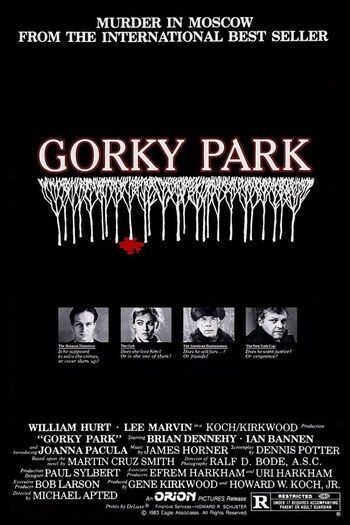
Movie poster for the 1983 film adaptation of "Gorky Park" directed by Michael Apted
Trivia and Link
Gorky Park was adapted by screenwriter Dennis Potter for its film version Gorky Park (1983) directed by Michael Apted, starring William Hurt as Arkady Renko and Lee Marvin as John Osborne. Filming locations in Helsinki and Stockholm stood in for those of Moscow. A trailer for the film can be viewed on YouTube here.
Review of the Simon & Schuster UK paperback edition (October 2021) of the original Random House hardcover Gorky Park (February 1981)
[4.5 rounded up]
Gorky Park is one of the first novels that I remember actually buying in hardcover when it was first released in 1981, a relative luxury purchase at the time. Another such purchase was Smiley's People (1979) by John le Carré (1931-2020). Both had a strong Soviet Union component and both made a nod to my heritage country of Estonia: more significantly in Smiley's People with General Vladimir's Estonian spy network, less so in Gorky Park with only a brief reference to "traitorous Estonians".
Seeing that a 40th Anniversary edition was now available with an Introduction by Lee Child (author of the Jack Reacher series) and a Q&A Afterword interview with author Martin Cruz Smith (1942-) made me eager to read it again to see how it held up over time. It mostly did so very well.
The paranoid and cynical view of a detective operating under a totalitarian state was especially well handled. The atmosphere of the Soviet Union was well constructed. From the Afterword we learn that this came through Smith's own location spotting from an initial tourist trip to Moscow in 1972 and his contacts with émigrés from the Soviet Union in the U.S. Smith was thus writing the book for almost a decade while still making a career in writing by publishing many books under various pseudonyms such as Nick Carter, or as the more anonymous "Martin Smith." He added the middle name of Cruz from a grandparent in order to create a more individual looking and sounding author name.
The weakest part of the book is probably its ending, which feels artificial and forced in retrospect. Without discussing spoiler-like details, it just seems unlikely that such a situation would occur, and with the FBI and KGB acting in cooperation. One wonders whether editors at the time insisted that the final locale placement was required in order to create a mixed "happy ending." Smith's Afterword doesn't reveal anything about him being manipulated like that though.
Still it was a strong suspense thriller overall and a worthy re-read. It certainly ignited Cruz Smith's own career with the now 9 Arkady Renko novels to date. It spawned various other "lone competent detective working within an authoritarian state" sub-genre series such as Philip Kerr's Bernie Gunther (1989-2019) in Nazi Germany, and Tom Rob Smith's Leo Demidov (2008-2011), also in the Soviet Union. Lee Child's Foreword praise was justifiably earned.
Movie poster for the 1983 film adaptation of "Gorky Park" directed by Michael Apted
Trivia and Link
Gorky Park was adapted by screenwriter Dennis Potter for its film version Gorky Park (1983) directed by Michael Apted, starring William Hurt as Arkady Renko and Lee Marvin as John Osborne. Filming locations in Helsinki and Stockholm stood in for those of Moscow. A trailer for the film can be viewed on YouTube here.

April 17, 2017
A very absorbing and entertaining Russian/American crime/spy thriller. I read this as a teenager and have a distinct memory of loving it, but couldn't remember a single solitary thing about the plot. So basically a from-scratch reread. Had I known there were more books in the series I'm sure my teenage self would have inhaled them. But I didn't so I guess I'll have to do it now.
It's pretty obviously written by an American. This made the descriptions of Russia like images filtered through an American lense. It didn't feel ludicrous but neither did it feel fully authentic. And the American cop being bigger, tougher, smarter and more badass than our Russian MC cop was disappointing. But I enjoyed Arkady and look forward to what's at the bottom of the cliff he just left us hanging from.
It's pretty obviously written by an American. This made the descriptions of Russia like images filtered through an American lense. It didn't feel ludicrous but neither did it feel fully authentic. And the American cop being bigger, tougher, smarter and more badass than our Russian MC cop was disappointing. But I enjoyed Arkady and look forward to what's at the bottom of the cliff he just left us hanging from.

March 16, 2008
If only there were Russian men like Arkady Renko! What a hero. Martin Cruz Smith, despite making up an implausibly wonderful Russian man in Arkady Renko, just totally nails some things about Soviet Russia. I get nostalgic even thinking about it.
Got a plane ride coming up? If you haven't read this - GO NOW! BUY IT! I promise you won't regret it.
Got a plane ride coming up? If you haven't read this - GO NOW! BUY IT! I promise you won't regret it.

September 13, 2015
Gorky Park
Me ha recordado mucho a “Child 44”, de Tom Rob Smith, pero “Gorky Park” es bastante anterior, así que el mérito se lo atribuyo a Martin Cruz. Es el primer libro de la serie de Arkady Renko, y de momento, el único que he leído.
A pesar de los muchos años que lleva publicada, la novela aún puede leerse con interés, aunque tampoco lo considero un clásico del género (Sigo prefiriendo a John LeCarré). El autor parece conocer bastante bien el terreno que pisa, y la descripción de la Unión Soviética de aquellos años me ha resultado muy creíble. Quizás le sobre algún que otro cliché, y el ritmo narrativo no siempre se mantiene atractivo, pero, en su conjunto, me ha parecido una obra más que decente, con un protagonista que llega a hacerse entrañable.
No la veo como un panfleto propagandístico, como algunos lectores opinan, pues Renko constata sin ambages que no sólo en su país “cuecen habas”, aunque también asume que con un sistema capitalista podría vivir mejor.
En su contra, que sabemos quién cometió los crímenes demasiado pronto, y eso hace que la novela pueda parecer un poco larga.
Me ha recordado mucho a “Child 44”, de Tom Rob Smith, pero “Gorky Park” es bastante anterior, así que el mérito se lo atribuyo a Martin Cruz. Es el primer libro de la serie de Arkady Renko, y de momento, el único que he leído.
A pesar de los muchos años que lleva publicada, la novela aún puede leerse con interés, aunque tampoco lo considero un clásico del género (Sigo prefiriendo a John LeCarré). El autor parece conocer bastante bien el terreno que pisa, y la descripción de la Unión Soviética de aquellos años me ha resultado muy creíble. Quizás le sobre algún que otro cliché, y el ritmo narrativo no siempre se mantiene atractivo, pero, en su conjunto, me ha parecido una obra más que decente, con un protagonista que llega a hacerse entrañable.
No la veo como un panfleto propagandístico, como algunos lectores opinan, pues Renko constata sin ambages que no sólo en su país “cuecen habas”, aunque también asume que con un sistema capitalista podría vivir mejor.
En su contra, que sabemos quién cometió los crímenes demasiado pronto, y eso hace que la novela pueda parecer un poco larga.
September 20, 2011
Stealthy Police Procedural set in Moscow prior to Perestroika and Dissolution of U.S.S.R.
Back in the U.S.S.R.:
****
Arkady Renko is chief homicide investigator for Moscow's Soviet militsiya (the city's civilian police force). When investigating the murder of three American college students found frozen in the snow of Gorky Park, faces and fingers removed, Renko faces resistance from the KGB, FBI and NYC police.
Renko is intelligent, moody, cynical and at times defiant in his dogged pursuit of the killer's identity, which puts him at odds with a brash, wealthy American fur trader. The detective's weakness is his love, of course, for a beautiful Soviet dissident who'll do nearly anything to get out of the USSR.
What sets this suspenseful 1981 novel apart is Martin Cruz Smith's meticulous portrayal, in vivid and stunning detail, of day-to-day life in the Soviet Union prior to perestroika and the Soviet Union's dissolution.
Back in the U.S.S.R.:
Well the Ukraine girls really knock me outLennon-McCartney, 1968
They leave the West behind
And Moscow girls make me sing and shout
That Georgia's always on my mind
****
Arkady Renko is chief homicide investigator for Moscow's Soviet militsiya (the city's civilian police force). When investigating the murder of three American college students found frozen in the snow of Gorky Park, faces and fingers removed, Renko faces resistance from the KGB, FBI and NYC police.
Renko is intelligent, moody, cynical and at times defiant in his dogged pursuit of the killer's identity, which puts him at odds with a brash, wealthy American fur trader. The detective's weakness is his love, of course, for a beautiful Soviet dissident who'll do nearly anything to get out of the USSR.
What sets this suspenseful 1981 novel apart is Martin Cruz Smith's meticulous portrayal, in vivid and stunning detail, of day-to-day life in the Soviet Union prior to perestroika and the Soviet Union's dissolution.
Displaying 1 - 30 of 1,708 reviews