

What do you think?

Memoirs of a Midget
Miss M., the narrator of these fictional memoirs, is a diminutive young woman (though just how diminutive, the author never says) with a “passion for shells, fossils, flints, butterflies, and stuffed animals.” Miss M. tells of her early life as a dreamy orphan and, in particular, of her tempestuous twentieth year—in which she falls in love with a beautiful and ambitious full-sized woman and is courted by a male dwarf. Concluding that she must choose either to simply tolerate her difference or grow callous to it, Miss M. resolves to become independent by offering herself up as a spectacle in a circus.
[Walter de la Mare (1873–1956) wrote numerous novels, short stories, essays, and poems. He was awarded the James Tait Black Memorial Prize for Memoirs of a Midget. Other major works include the children’s novel, The Three Royal Monkeys, Henry Brocken, The Return, and Desert Islands.]
[Alison Lurie is the author of many highly praised novels as well as two collections of essays on children’s literature, Don’t Tell the Grown-Ups and Boys and Girls Forever. She has taught children’s literature and folklore at Cornell University.]
[Walter de la Mare (1873–1956) wrote numerous novels, short stories, essays, and poems. He was awarded the James Tait Black Memorial Prize for Memoirs of a Midget. Other major works include the children’s novel, The Three Royal Monkeys, Henry Brocken, The Return, and Desert Islands.]
[Alison Lurie is the author of many highly praised novels as well as two collections of essays on children’s literature, Don’t Tell the Grown-Ups and Boys and Girls Forever. She has taught children’s literature and folklore at Cornell University.]
392 pages, Paperback
First published January 1, 1921
About the author
Walter de la Mare
510 books181 followersWalter John de la Mare was an English poet, short story writer and novelist. He is probably best remembered for his works for children, for his poem "The Listeners", and for his psychological horror short fiction, including "Seaton's Aunt" and "All Hallows". In 1921, his novel Memoirs of a Midget won the James Tait Black Memorial Prize for fiction, and his post-war Collected Stories for Children won the 1947 Carnegie Medal for British children's books.
Ratings & Reviews
Friends & Following
Create a free account to discover what your friends think of this book!
Community Reviews
Displaying 1 - 30 of 48 reviews

May 17, 2021
A miniature maiden of Memoirs of a Midget isn’t a dwarf… She is more similar to Thumbelina… She is an elflike being…
The story is a delicious blend of Victorian novel and surrealism… The book is full of Dickensian intrigues and fine surreal imagery…
Memoirs of a Midget is a tale of solitude and isolation, of envy and malice, of compassion and kindness… Taken to London by the rich whimsical woman Miss M. was considered by gentry just a curious doll serving to entertain high society and aristocracy… No better than an animated gewgaw…
Life of a loner is like a jewel box inside which one’s inner world is locked.
But every family, I suppose, has its little pet traditions; and one of ours, relating to those early years, is connected with our kitchen cat, Miaou. She had come by a family of kittens, and I had crept, so it was said, into her shallow basket with them. Having, I suppose, been too frequently meddled with, this old mother cat lugged off her kittens one by one to a dark cupboard. The last one thus secured, she was discovered in rapt contemplation of myself, as if in debate whether or not it was her maternal duty to carry me off too.
The story is a delicious blend of Victorian novel and surrealism… The book is full of Dickensian intrigues and fine surreal imagery…
What may wholly have been another childish fancy was that apart from the silvery darting flies and the rainbow-coloured motes in the sunbeams, fine and airy invisible shapes seemed to haunt and hover around me when all was still. Most of my fellow creatures to my young nose had an odour a good deal denser than the fainter scented flowers, and I can fancy such a fog, if intensified, would be distressing to beings so bodiless and rare. Whereas the air I disturbed and infected with my presence can have been of but shallow volume.
Memoirs of a Midget is a tale of solitude and isolation, of envy and malice, of compassion and kindness… Taken to London by the rich whimsical woman Miss M. was considered by gentry just a curious doll serving to entertain high society and aristocracy… No better than an animated gewgaw…
Life became a continuous game of chess, the moves of which at times kept me awake and brooding in a far from wholesome fashion in my bed. Pawn of pawns, and one at the point of being sacrificed, I could only squint at the board. Indeed, I deliberately shut my eyes to my own insignificance, strutted about, sulked, sharpened my tongue like a serpent, and became a perfect pest to myself when alone. Yet I knew in my heart that those whom I hoped to wound merely laughed at me behind my back, that I was once more proving to the world that the smaller one is, the greater is one’s vanity.
Life of a loner is like a jewel box inside which one’s inner world is locked.

January 24, 2009
Probably the strangest novel I've read - and I mean that as a compliment. It's weird without even trying. To compare it to another book narrated by a dwarf I've read recently, unlike Geek Love, there's nothing extreme, no grotesque characters, never a sense of the author trying a little too hard. Reading Miss M's thoughts on the world, one gets the impression that Walter de la Mare had a similarly idiosyncratic way of thinking, and was blissfully unaware of it. Consequently, reading Memoirs of a Midget is rather like being in a dream, where everything seems perfectly normal, until someone says something odd, or behaves in a slightly unconventional way, and you're reminded that it's not real. For all its strangeness, though, Memoirs of a Midget is still convincing as a novel, and while the prose is so beautiful that at times it's almost like a poem, the plot's still very gripping. The characters are fascinating - Miss M and Mr Anon remain somewhat enigmatic until the very end, and Fanny...well, I still don't know what to make of Fanny. Miss M's feelings for Fanny are unusual, considering that the book was published in 1921, and as for Fanny's attitude to Miss M, try to read her final tirade without feeling shocked.
It's a book that constantly surprises you, and whether you try to follow the clues (Miss M, rather like Satan in Paradise Lost, seems to keep changing size - how tall is she really?) or simply accept it for what it is, it never fails to engage. I'd also recommend it to anyone who's ever felt like an outsider. It certainly is "an elegiac, misanthropic, sometimes perverse study of isolation", and it conveys a sense of loneliness with more subtlety than any other book I've read.
Finally, as there's so little information about Memoirs of a Midget, I thought I might as well post a short extract:
I held out my hand. His sent a shiver down my spine. It was clammy cold, as if he had just come out of the sea. Thrusting our way between the denser clumps of weeds, we pushed on cautiously until we actually stood under the creature's enormous oak. So elusive and deceitful was the throbbing croon of sound that it was impossible to detect on which naked branch in the black leafiness the bird sat churring. The wafted fragrances, the placid dusky air, and, far, far above, the delicate, shallowing deepening of the faint-starred blue - how I longed to sip but one drop of drowsy mandragora and forget this fretting, inconstant self.
We stood, listening; and an old story I had read somewhere floated back into memory. 'Once, did you ever hear it?' I whispered back to him, 'there was a ghost came to a house near Cirencester. I read of it in a book. And when it was asked: "Are you a good spirit or a bad?", it made no answer, but vanished, the book said - I remember the very words - "with a curious perfume and most melodious twang." With a curious perfume', I repeated, 'and most melodious twang. There now, would you like me to go like that? Oh, if I were a moth, I would flit in there and ask that old Death-thing to catch me. Even if I cannot love you, you are part of all this. You feed my very self. Mayn't that be enough?'
His grip tightened round my fingers; the entrancing, toneless dulcimer thrummed on.
I leaned nearer, as if to raise the shadowed lids above the brooding eyes. 'What can I give you - only to be your peace? I do assure you it is yours. But I haven't the secret of knowing what half the world means. Look at me. Is it not all a mystery? Oh, I know it, even though they jeer and laugh at me. I beseech you to be merciful, and keep me what I am.'
It's a book that constantly surprises you, and whether you try to follow the clues (Miss M, rather like Satan in Paradise Lost, seems to keep changing size - how tall is she really?) or simply accept it for what it is, it never fails to engage. I'd also recommend it to anyone who's ever felt like an outsider. It certainly is "an elegiac, misanthropic, sometimes perverse study of isolation", and it conveys a sense of loneliness with more subtlety than any other book I've read.
Finally, as there's so little information about Memoirs of a Midget, I thought I might as well post a short extract:
I held out my hand. His sent a shiver down my spine. It was clammy cold, as if he had just come out of the sea. Thrusting our way between the denser clumps of weeds, we pushed on cautiously until we actually stood under the creature's enormous oak. So elusive and deceitful was the throbbing croon of sound that it was impossible to detect on which naked branch in the black leafiness the bird sat churring. The wafted fragrances, the placid dusky air, and, far, far above, the delicate, shallowing deepening of the faint-starred blue - how I longed to sip but one drop of drowsy mandragora and forget this fretting, inconstant self.
We stood, listening; and an old story I had read somewhere floated back into memory. 'Once, did you ever hear it?' I whispered back to him, 'there was a ghost came to a house near Cirencester. I read of it in a book. And when it was asked: "Are you a good spirit or a bad?", it made no answer, but vanished, the book said - I remember the very words - "with a curious perfume and most melodious twang." With a curious perfume', I repeated, 'and most melodious twang. There now, would you like me to go like that? Oh, if I were a moth, I would flit in there and ask that old Death-thing to catch me. Even if I cannot love you, you are part of all this. You feed my very self. Mayn't that be enough?'
His grip tightened round my fingers; the entrancing, toneless dulcimer thrummed on.
I leaned nearer, as if to raise the shadowed lids above the brooding eyes. 'What can I give you - only to be your peace? I do assure you it is yours. But I haven't the secret of knowing what half the world means. Look at me. Is it not all a mystery? Oh, I know it, even though they jeer and laugh at me. I beseech you to be merciful, and keep me what I am.'

May 14, 2008
"When one speaks of de la Mare one must go heavy on the cream..."
I miss this book. But I don’t miss it like I missed Don Quixote or The Book of Ebenezer Le Page when I finished them. Those two books for me were the embodiments of two people; two people I dearly missed as soon as I finished reading the final page. I missed their presence as people in my life. I still miss them! even though they’re ever within arm’s reach right there on my shelf… The way I miss Memoirs of a Midget is different. I miss the book itself. I miss being in, being rooted within, the book itself. The book was a world I entered as I stepped through my reading into it. It enveloped me, or rather it enveloped my imagination, but then that’s not quite right either, since in a way it was my own imagination that I entered while reading it. Walter de la Mare provided the portal with his own imagination, but it was the congruence of my own imagination with his that allowed his world to accept my imagination into it, where it (my imagination) then ballooned, filling the space I lived within while reading the book. I am not ashamed to admit that this kind of experience is my ideal reading experience. I want an escape. I want to live in an alternate world for a spell, for as I well know living in an alternate world for a spell permanently alters one’s brain, sending ripples of resonance and significance and splendid otherness throughout one’s consciousness forever, or at least as long as that consciousness is conscious, and so becomes not so much an escape as a subtle transformation into a permanently freer being. All I want is this kind of experience, but I rarely get it, even though I seem to fill all my spare moments with reading. This isn’t to say that all the other books I read come up short. No, I read for a multitude of reasons and almost always satisfy at least one of those reasons with every book I read. So it’s not like I’m perpetually pining for this experience, letting languidly fall book after book as I fail to achieve it, withering and growing paler and paler in my chair, cast-off dusty tomes piling around me. No, I follow the old precept of “one book opens another”, and zigzag through literary daisy-chains of verbal stimulation. I want to be stimulated! At all times! And that’s what books help me almost achieve, abetted by my too-numerous-to-count reasons for reading. But certain books are rare and different, and so by definition should be few in number, which anyway helps heighten their significance, their strange profundity. They somehow insinuate themselves into the daily, non-literary, fabric of my life, and slightly elevate the entirety of my existence, from stirring things with spoons to contemplating self in a sea of stars. Really, how many books capable of doing that do you need in your life? Their numbers should be few, and I’ve just added one more, doubling the number in my life. The other? Little, Big by John Crowley.
"...the spermatozoa of adoration."

July 8, 2009
On the bottom shelf of the back room in the cluttered East Village bookstore I stumbled on Miss M. Tattered, in hardcover, in the dark, and with the kind of title that begs to be examined. I read three pages and was enamored, and bought the book without question. Looking back, I now realize this was unusual behavior. I only buy books I've been meaning to read, and have read about, or did read, and have been meaning to find. So Miss M. became very dear to me because I discovered her for myself, without newspaper, book review, website, or recommendation, under the fingerprints of someone who bought her first, new, in 1922. I had never heard of Walter de la Mare, and neither has anyone I've spoken to since meeting him. He is, like Miss M, his own kind of curio, which I hope does not mean that I learned nothing from his work.
This beautiful, sad, twisted novel resonated with me to a frightening degree. Miss M. speaks for young women finding their way in this world of vanities, curiosities, magic, and nature. At once her universe is too large for her to wade in and too small for her to breathe in. And when do we ever come upon obscure novels in original print these days? So Miss M. was like a treasure to me, though only the kind of treasure I am sure that she herself would gladly be. That which is a good friend.
This beautiful, sad, twisted novel resonated with me to a frightening degree. Miss M. speaks for young women finding their way in this world of vanities, curiosities, magic, and nature. At once her universe is too large for her to wade in and too small for her to breathe in. And when do we ever come upon obscure novels in original print these days? So Miss M. was like a treasure to me, though only the kind of treasure I am sure that she herself would gladly be. That which is a good friend.
June 5, 2012
I love the writing style; it somehow reminds me of intricate pretty old-fashioned things. It's very introspective and the book's real strength is that it's one of those that really get across an individual's experience; the particular way they think and interpret the world. The descriptions felt very vivid to me. There's a heavily hinted romantic fascination with another woman, and that's quite good if you like beautiful, enigmatic, existentially angsty and spiteful characters. What I didn't like -- Mr Anon. Really annoying character bringing the melodrama. The novel could easily have had him cut out. And also the title makes you think the book will cover more of the character's life and basically involve more things happening than it does. It really only covers a year of Miss M's life when she is 20 during which nothing much happens except what I guess is actually quite realistic, ie she angsts about people she knows and how to deal with her crush on Fanny and Mr Anon's crush on her.

June 20, 2018
Uniquely strange, haunting, dizzying, funny and moving piece of uncanny fiction. I remember finishing Walter de la Mare's The Return and feeling that, while quietly devastating and profoundly moving, the form of the thing lacked polish. No such qualms here.
As usual Walter de la Mare's writing is among the closest you'll find to a waking, shifting dream, but here, despite the often quiet restraint of the narrative, the prose was so subtly coruscating in its suggestion that I had to reread some paragraphs over and over to soak in the beauty and strangeness of it all. This novel and the finest twenty or so of his short stories showed that de la Mare was not only a great poet, but also a titan of prose fiction worthy of the utmost respect.
As usual Walter de la Mare's writing is among the closest you'll find to a waking, shifting dream, but here, despite the often quiet restraint of the narrative, the prose was so subtly coruscating in its suggestion that I had to reread some paragraphs over and over to soak in the beauty and strangeness of it all. This novel and the finest twenty or so of his short stories showed that de la Mare was not only a great poet, but also a titan of prose fiction worthy of the utmost respect.
October 18, 2013
A forgotten gem, poetic and strange -- if not as successful as his short fiction, still very beautiful.
July 23, 2022
“Memoirs of a Midget” by De La Mare captures the limbic-strange-oosphere that individuals who have some isolated physical problem inhabit. His prose is sympathetic and does what many writers on physical disabilities do not: it uses an uncanny brushstroke and paints the portrait of a person who possesses a vivid imagination which is limited to a small set of delights. Hilarious, also.

November 4, 2010
Someone recommended de la Mare and when I saw the title Memoirs of a Midget, I just couldn't pass it up. The idea is intriguing. The memoirs of a little person before technology could overcome most of their obstacles and further, written by a man! How intriguing!
I finished this book and the first words out of my mouth, "this is stupid". Is it really stupid? No, of course not. First off, de la Mare showed some amazing insight when imagining Miss M's world and he perfectly captured the torturous thought circles to which most women are prone. Additionally he managed to capture the loneliness that is a staple of Miss M's life and to perfectly capture in her thoughts her changes in attitude towards the different individuals she encounters.
I expected this book to be a little less memoir and a little more thriller - in the spirit of Wilkie Collins' Woman in White perhaps, and honestly I might have enjoyed this book more had I not expected more mystery. The novel does have a pall, but it wasn't particularly dark - excepting Crimble's suicide and Mr. Anon's tragic demise. Other than that, we spend a lot of time exploring Miss M's thoughts and feelings, which at times grew a bit boring, was often chaotic, and a little frustrating, particularly in regard to her hot and cold relationship with Franny - who I loathed.
The language is beautiful, but the novel was just too odd for me. The scenes and language between Miss M and Franny are perhaps the greatest testament to the surreality that often suffuses the novel. It is often vague to the point of incomprehension.
I finished this book and the first words out of my mouth, "this is stupid". Is it really stupid? No, of course not. First off, de la Mare showed some amazing insight when imagining Miss M's world and he perfectly captured the torturous thought circles to which most women are prone. Additionally he managed to capture the loneliness that is a staple of Miss M's life and to perfectly capture in her thoughts her changes in attitude towards the different individuals she encounters.
I expected this book to be a little less memoir and a little more thriller - in the spirit of Wilkie Collins' Woman in White perhaps, and honestly I might have enjoyed this book more had I not expected more mystery. The novel does have a pall, but it wasn't particularly dark - excepting Crimble's suicide and Mr. Anon's tragic demise. Other than that, we spend a lot of time exploring Miss M's thoughts and feelings, which at times grew a bit boring, was often chaotic, and a little frustrating, particularly in regard to her hot and cold relationship with Franny - who I loathed.
The language is beautiful, but the novel was just too odd for me. The scenes and language between Miss M and Franny are perhaps the greatest testament to the surreality that often suffuses the novel. It is often vague to the point of incomprehension.
This entire review has been hidden because of spoilers.

June 25, 2012
Not what I anticipated when I picked it up, but very good nonetheless. I had expected it to be much more based on the physical circumstances of being of very small stature in Victorian times - and to some degree it was - but the focus was really more psychological/social, exploring the inward struggles of an individual who is cut off from nearly all of humanity because of its perception of her as somehow less, and therefore not to be taken seriously. de la Mare creates a beautifully complex character in Miss M, sometimes lovable, sometimes ugly with jealousy and the desire for revenge. She is really just a young girl who has been isolated because her physical proportions excite alarm and sensation whenever she goes out, and who is emotionally hungry for friendship or kinship of any kind. Strangely, I thought there was a lot about growing up that I could personally relate to - I have to give de la Mare credit for making the theme universal in that respect. I didn't particularly enjoy his almost Henry James-ish style of saying everything but what is really going on - but I do see the purpose in it, as that is what life is really like, and it's only later, if at all, that we figure out what happened to us as we were growing up. Anyway, loved Miss M's struggle out of being forced to be a pet, a curiosity, and somehow not fully human, to taking action for herself and taking control of her own identity regardless of outside perceptions.

March 9, 2010
I have to say I didn't *get* this book. From all the positive reviews, I was expecting to be lured into an existence not quite real and regaled with visions of a slightly altered world. I suppose I thought it would be like watching Nicole Kidman in Moulin Rouge, but for me, this book was so vague I had a hard time following exactly what was happening. It didn't help that the most crucial exchanges all seemed to be written in French, a language of which I am completely ignorant. I felt this novel to be lacking in plot as well; I couldn't see a true resolution at the end. The book just sort of... stopped. I have to admit I am really very disappointed.
(Note: I read a rather early version of this book, dating to probably the late 1930s.)
(Note: I read a rather early version of this book, dating to probably the late 1930s.)

August 29, 2009
The 4 star title lured me in, but the story disappointed. And the writing style is often confusing...or maybe I just didn't care enough to give it my full attention.
December 19, 2009
A perfectly uncanny novel. Subtle, too, as evidenced by the sheer number of complete misreadings it's accumulated over the years (see, for instance, the laughably crap review in Rain Taxi from a couple years back).

October 2, 2011
Read here for free
First line - Some years ago a brief account of me found its way into one or two country newspapers
Cannot work out if this is 1921 or 1922 first publication year as there is conflicting information on the net.
quin·sy (kw n z ). n. Acute inflammation of the tonsils and the surrounding tissue, often leading to the formation of an abscess. ...
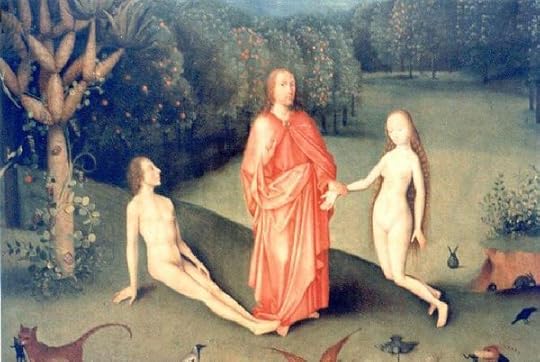
Adam and Eve by Bosch
from the Guardian - De la Mare's preoccupation with the Brontës is unsubtle (Wuthering Heights and Jane Eyre get several direct references) and, on occasion, the first-person narrative slips into the parodic. But Memoirs of a Midget is a triumphant work of fiction: a portrait of a complex heroine who the reader will ultimately find quite as compelling as Jane or Cathy.
First line - Some years ago a brief account of me found its way into one or two country newspapers
Cannot work out if this is 1921 or 1922 first publication year as there is conflicting information on the net.
quin·sy (kw n z ). n. Acute inflammation of the tonsils and the surrounding tissue, often leading to the formation of an abscess. ...
Adam and Eve by Bosch
from the Guardian - De la Mare's preoccupation with the Brontës is unsubtle (Wuthering Heights and Jane Eyre get several direct references) and, on occasion, the first-person narrative slips into the parodic. But Memoirs of a Midget is a triumphant work of fiction: a portrait of a complex heroine who the reader will ultimately find quite as compelling as Jane or Cathy.
This entire review has been hidden because of spoilers.
May 25, 2017
This is a wonderful book. I didn't want it to end. Completely unique. I have made progress in conquering my addiction to reading novels. I don't read nearly so many of them anymore, for which I thank God. But I bought this about twenty years ago. Recently I turned it up and decided to have a look. It is beautiful and truly original. It's so strange that I can't describe it in a way that would do it justice. I originally bought it because of his poem The Listeners, which I also love, and the title. The poem and novel both capture the eerie strangeness of life, a feeling that this world is a surface which connects with another world, that "reality" is not as straightforward as some may think. A contemporary, reductionist technology addict wouldn't get it at all, but there are a still a few other types of people left in the world. They might like it.
Read
September 19, 2016I couldn't review this quickly, I'll have to think about it. I look forward to re-reading this book and also looking at White's Natural History of Selborne.
Now I will read Best stories of Walter De La Mare.
Now I will read Best stories of Walter De La Mare.

July 24, 2007
phenomenally well written. an instant favorite. more to come...

December 7, 2009
I tried very hard to read this book, but just could not complete it. I found it too dragging and uninteresting.

May 30, 2025
Sorry, this is a DNF for me cause, honestly, I was bored! I know there seems to be a real fondness for this book from the reviews, but I just couldn't get into it. It just seemed to drag tbh!

November 19, 2023
Ciò che sapeva Miss M. (cit.)
Ritengo che gli anni ‘20 del novecento rappresentino uno dei periodi letterariamente più importanti e fecondi di sempre. È in tale decennio che vengono pubblicati la gran parte della Recherche, i tre romanzi di Kafka, l’Ulisse, le opere maggiori di Virginia Woolf, La coscienza di Zeno, La paga del soldato, le Elegie duinesi, L’opera da tre soldi, il Manifesto del surrealismo, e che tantissimi altri scrittori producono opere che leggiamo ancora oggi. Le motivazioni di tanta vivacità artistica sono ovviamente storiche: l’immane carneficina della guerra mondiale è terminata da poco, lasciando interi paesi in miseria mentre altri vivono una illusoria frenesia economica; il mondo, e in particolare l’Europa, è attraversato da fermenti sociali cui la Rivoluzione d’Ottobre ha dato nuova linfa, ed ai quali la borghesia dominate si prepara a dare risposte di stampo repressivo quando non apertamente autoritario, allestendo i prodromi della seconda, più grande, tragedia del secolo.
Questo decennio d’oro e di piombo non smette mai di riservare al lettore curioso piacevolissime sorprese; ad esempio è al suo inizio, nel 1921, che in Gran Bretagna uno scrittore conosciuto soprattutto come autore di racconti per bambini e poesie in stile georgiano pubblica il suo più significativo romanzo, Memoirs of a midget - titolo tradotto in italiano, a mio avviso malamente, con La donna in miniatura - il quale, pur non potendo certo essere accostato ai capolavori sopra citati è senza dubbio un piccolo gioiello letterario che merita ampiamente l’appellativo di classico.
Walter John de la Mare nacque nel 1873 a Charlton, cittadina ormai da tempo inglobata nel Greater London, in una famiglia della media borghesia, di discendenza ugonotta da parte di padre. Iniziò a scrivere all’inizio del XX secolo, mentre lavorava negli uffici londinesi della Standard Oil per mantenere la numerosa famiglia: ebbe infatti quattro figli dalla moglie, l’attrice Elfie Ingpen, sposata nel 1899. Nel 1908 ottenne un vitalizio statale, che gli permise di dedicarsi esclusivamente alla scrittura. La sua produzione letteraria comprende cinque romanzi, decine di racconti, poemi, raccolte di poesie e qualche saggio di tema letterario. Morirà nel 1956. Di lui in Italia è stato pubblicato poco: alcuni volumi di racconti e questo romanzo - la cui traduzione risale al 1947 e che, dopo questa edizione risalente al 2008, è scomparso dagli scaffali.
Analizzando la produzione in prosa di questo autore emerge il suo dualismo tematico: da un lato la letteratura per ragazzi, fra la quale spicca il romanzo The Three Mulla Mulgars, dall’altro il gusto per il mistero e il soprannaturale, che si esprime soprattutto in molti racconti e nel romanzo The Return, apprezzati tra gli altri da H. P. Lovecraft, che lo definì un raro maestro di acuta potenza narrativa. De la Mare era anche scrittore molto colto e raffinato, e nelle sue opere si ritrovano spesso citazioni, richiami e rimandi alla grande letteratura, soprattutto anglosassone, da Shakespeare a Blake, da Jane Austen alle Brontë, da Dickens a James.
La donna in miniatura, romanzo fiabesco, evocativo e misterioso, raffinato e crudele, riassume le varie sfaccettature della personalità artistica dell’autore, con un risultato a mio avviso di grande spessore letterario, sia formale sia sostanziale.
Come si intuisce dal titolo originale, il romanzo è scritto sotto forma di memorie della protagonista, Miss M., donna di dimensioni minuscole: quali esse siano effettivamente il romanzo non lo specifica, e nel corso del racconto queste sembrano mutare considerevolmente: all’età di cinque o sei anni se ne sta seduta su un vasetto di pomata e legge libri standoci sdraiata sopra; più tardi si maschera per sembrare un bambino di dieci anni, ma pochi mesi dopo viene trasportata in una gabbia per uccelli. Data la precisione e la minuzia della prosa di de la Mare, mi sento di escludere che tale indeterminatezza dimensionale sia dovuta a sviste narrative: le ridotte dimensioni della protagonista sono soprattutto una condizione spirituale, e rispetto a ciò le sue vere dimensioni fisiche sono scarsamente significative. Le memorie di Miss M. (che nella datata traduzione di Margherita Santi Farina, ripresa anche in questa edizione moderna, diviene la signorina M.) riguardano soprattutto avvenimenti accaduti tra i suoi venti e ventuno anni, che costituiscono il cuore del romanzo. Secondo un artificio classico della letteratura sette-ottocentesca, le memorie vengono ritrovate tra le carte di Miss M. dal suo amico ed esecutore testamentario Sir Walter Dadus Pollacke, che, ”sebbene non [gli] incombesse nessun obbligo di pubblicar[le]”, decide di farlo, interpretando in ciò il desiderio dell’autrice, ormai scomparsa dopo una vita appartata nella sua casa a Lyndsey, nel Kent, che ha fatto seguito agli avvenimenti narrati nelle memorie: egli dispone che le memorie vengano date alle stampe dopo la sua (di lui) morte. Tutto ciò il lettore lo viene a sapere nella breve introduzione alle memorie scritta dallo stesso Sir Walter, nella quale descrive anche come Miss M. se ne sia andata: una mattina è accorso da Mrs. Bowater, la governante di Miss M., disperata per la scomparsa di quest’ultima; la sera prima Mrs. Bowater ha sentito delle voci provenire dalla camera di Miss M., anche se nessuno era entrato in casa; bussando poco dopo alla sua porta e non ricevendo risposta, è entrata: la stanza era vuota e tutto era in ordine; appuntato ad una parete un bigliettino con scritto ”Sono stata chiamata. M.” Nulla si sa e si saprà mai su tale chiamata: è uno dei tanti non detti, forse il più importante, di cui è costellato il romanzo, che stimolano il lettore a costruire la propria interpretazione dei fatti.
Una conseguenza pratica dell’introduzione è la retrodatazione dei fatti che saranno narrati nelle pagine successive. Come detto, le memorie vengono pubblicate dopo la morte di Sir Walter, che si presume sia vissuto a lungo, appartenendo alla high class britannica. A sua volta Miss M. ha vissuto anni a Lyndsey, prima di essere chiamata. Il periodo cui le memorie si riferiscono può essere quindi verosimilmente situato nell’800, e ciò emerge effettivamente in un paio di accenni alla regina contenuti nel romanzo. Siamo quindi in piena Età Vittoriana, e ciò, lungi dall’essere una mera constatazione temporale, assume un preciso significato in un autore che, pur vivendo ed operando in pieno novecento, a quel mondo si rifaceva idealmente, rifiutando ogni modernismo, espungendo dal testo qualsiasi riferimento di carattere anche velatamente sessuale o comunque corporale ed avvalendosi di una prosa antica, minuziosa, ricercata ed affabulatoria che, salvo alcuni anacronismi linguistici, è resa molto bene dalla classica traduzione di Santi Farina.
Miss M. nasce a Lyndsey, in una casa di campagna con un grande giardino, circondata dal dolce paesaggio del Kent. Trascorre un’infanzia tutto sommato felice anche se solitaria: la madre, di origini francesi, la tiene lontana dal mondo a causa delle sue dimensioni, mentre il bizzarro padre è intento a redigere una monumentale Storia della fabbricazione della carta e a dilapidare il patrimonio di famiglia inseguendo altri improbabili progetti. M. è una bambina vivace e curiosa, che nonostante non vada a scuola e non abbia un’istitutrice legge i libri della biblioteca domestica, si interessa di astronomia, scienze naturali e pittura. Vuole molto bene al nonno materno, che dalla Francia le manda spesso regali su misura, e alla giovane domestica Polly. Un giorno, passeggiando in giardino, scopre la morte osservando il corpo di una talpa roso dai vermi. Qualche anno dopo la morte irrompe nella sua vita: in poco tempo perde i genitori, e il dissesto finanziario causato dal padre la costringe a lasciare, nell’estate in cui compie vent’anni, la casa natale, i suoi mezzi di sostentamento essendo limitati ad una modesta rendita annua. Dopo aver rifiutato di andare a vivere con l’assillante e bigotta madrina, trova vitto e alloggio a Beechwood, vicino a Londra, presso Mrs. Bowater, moglie di un nostromo da tempo in giro per il mondo. Con la rude padrona di casa instaura un rapporto dialettico ma sincero, che sfocerà in affetto reciproco. Grazie a una porticina e a scale costruite appositamente per lei può uscire di casa, e ne approfitta per recarsi, nei mesi seguenti, ad osservare le stelle nei pressi di una vicina casa abbandonata. Presto scopre che Mrs. Bowater ha una figlia più o meno della sua età, Fanny, insegnante di letteratura in un’altra città, che tornerà a casa per le vacanze di natale. Da una vecchia fotografia intuisce anche che Fanny non è in realtà figlia di Mrs. Bowater. Miss M. è molto eccitata all’idea di divenire amica di Fanny, e quando torna la coinvolge nelle sue uscite notturne e nella lettura comune di Cime tempestose. Fanny è molto bella, volitiva e volubile, e Miss M. rimane soggiogata dalla sua personalità, sino di fatto ad innamorarsene. Fanny però di fatto la disprezza per le sue dimensioni e per la sua sottomissione, chiamandola Midgetina (tradotto Minuzzolina) e giungerà a farsi dare tutti i suoi risparmi per sistemare un misterioso problema che la assilla. Di lei, che si vanta di essere molto amata, è innamorato un vicario del posto, il noioso e depresso reverendo Crimble, che Fanny illude usando Miss M. come messaggera d’amore. La scoperta da parte del reverendo che il suo amore non è corrisposto porterà alla tragedia.
Nel frattempo a Miss M., che si sta rendendo sempre più conto di come la sua diversità costituisca una barriera tra lei e quasi tutte le altre persone, accadono due fatti molto importanti. Viene invitata a bere il tè da una eccentrica signora amica del reverendo Crimble e – mentre una mattina sta leggendo Jane Austen nel luogo dove è solita recarsi ad osservare le stelle incontra un misterioso ragazzo, gobbo e poco più alto di lei, che chiamerà Mr. Anon, Signor Ignoto.
Entrambi questi avvenimenti avranno conseguenze decisive sulla vita di Miss M., che nei mesi seguenti cambierà completamente, secondo modalità che lascio alla piacevole scoperta di chi avrà la perseveranza necessaria a trovare questo romanzo tra gli scaffali dell’usato.
L’edizione da me letta è corredata da una lunga prefazione di Angela Carter - autrice inglese morta da tempo – redatta nel 1982. È una bella prefazione, pervasa della sottile - anche se a tratti gratuita - ironia di una scrittrice che in pieno XX secolo frequentava nei suoi romanzi i territori dell’horror, della distopia e dell’erotismo, nei confronti delle reticenze e delle ambientazioni vittoriane di de la Mare. Carter la chiude così: ”Tutta la narrativa, diceva Balzac, è autobiografia simbolica. La M. di signorina M. potrebbe significare semplicemente miniatura o Midgetina; oppure Metafora. O Me stesso”. Ed è proprio questo lo snodo che, a mio avviso, conferisce al romanzo un peculiare valore, che ne fa un piccolo capolavoro: il fatto che ciascuno possa leggere la storia così com’è o ricercarvi significati più o meno reconditi, tali sono la sua stratificazione, le sue svariate sfaccettature e il suo potere evocativo.
Innanzitutto è da notare come l’autore utilizzi magnificamente, in un romanzo indubbiamente per adulti ed ambientato in un mondo reale, geograficamente localizzato con precisione, in cui ci sono treni, strade trafficate, insegnanti, preti etc., alcuni dei τὸποι più genuini della fiaba, a cominciare dalle dimensioni della protagonista, che resta precocemente orfana, per continuare con l’opposizione tra il giardino – spazio chiuso e familiare che nel romanzo assume particolare importanza, anche laddove manca – e luoghi selvaggi come la casa abbandonata oggetto di visite notturne, dove incontrerà il più fiabesco dei personaggi del romanzo, il povero Mr. Anon, per finire con l’irruzione del circo nella sua vita. Non si tratta a mio parere di elementi volti a far scivolare la vicenda in una sorta di irrealtà, ma – all’opposto – sono lì per sottolineare che la fiaba, come del resto il mistero di cui pure l’autore era maestro, altro non sono che realtà espressa in altra forma, spesso per esorcizzarne gli aspetti più crudeli, come dimostrano il ruolo che la morte, anche violenta assume nel romanzo e la splendida, inesplicata e solo apparentemente inesplicabile chiamata finale della protagonista.
Traguardando il romanzo da un versante sociale si potrebbe supporre che Miss M. sia una diversa che lotta con il conformismo sociale – per il quale è un ninnolo da esposizione - per affermare la sua personalità, riuscendovi solo al prezzo di sacrificare di fatto sé stessa e chi la ama esponendosi a pagamento al pubblico nel circo. Si può pensare anche alla diversità dell’artista rispetto alla società in cui vive; in questo caso prevarrebbe la lettura autobiografica suggerita da Angela Carter, corroborata dalle ascendenze francesi della protagonista, analoghe a quelle dell’autore. Per affermarsi l’artista di oggi non può che vendersi al gran circo dell’industria culturale.
Molto intriganti sono poi i sottili fili che intercorrono tra il romanzo e la grande letteratura anglosassone. Alcuni personaggi, fra tutti Mrs. Bowater ma anche la madrina Miss Fenne e gli avvocati Harris, Harris & Harris sono dichiaratamente dickensiani. Fanny Bowater, senza dubbio il personaggio più complesso del romanzo, è una spregiudicata arrivista che non esita ad usare i sentimenti altrui per raggiungere i suoi obiettivi, e trova i suoi modelli in tante eroine negative della letteratura ottocentesca britannica e non solo. Dell’importanza di Cime tempestose nel rapporto tra Miss M. e Fanny si è già detto, mentre in Mr. Anon si possono intravedere alcuni tratti di Heatcliff, innamorato però di una piccola Jane Eyre. In generale, poi, lungo tutto il romanzo si possono trovare tracce che rimandano ad Austen, a Blake, all’immancabile Shakespeare e ad altri.
Forse però l’autore di cui maggiormente si sente l’aroma in questo romanzo fintamente vittoriano è Henry James, per il livello di ambiguità narrativa e la mole di non detto con i quali il lettore si deve confrontare. Ciò del resto, molto prima e più autorevolmente di me, l’ha intuito Michael Dirda, storico critico letterario del Washington Post, che in una sua recensione del 2004 scrisse: ”Memoirs of a Midget può essere visto come uno dei migliori romanzi che Henry James non ha scritto. La sua voce narrante è spesso severa, formale, ellittica (e prolissa), tanto che il libro avrebbe potuto intitolarsi ‘What Miss M. Knew’”. Tra l’altro, aggiungo io, la voce narrante è anche parziale, in quanto della protagonista, e ciò aggiunge un ulteriore livello di ambiguità e soggettività ad un testo che, proprio per tutti gli elementi di complessità che ho citato, finisce per essere, inevitabilmente, pienamente novecentesco, a dispetto dell’ambientazione vittoriana.
Ritengo che gli anni ‘20 del novecento rappresentino uno dei periodi letterariamente più importanti e fecondi di sempre. È in tale decennio che vengono pubblicati la gran parte della Recherche, i tre romanzi di Kafka, l’Ulisse, le opere maggiori di Virginia Woolf, La coscienza di Zeno, La paga del soldato, le Elegie duinesi, L’opera da tre soldi, il Manifesto del surrealismo, e che tantissimi altri scrittori producono opere che leggiamo ancora oggi. Le motivazioni di tanta vivacità artistica sono ovviamente storiche: l’immane carneficina della guerra mondiale è terminata da poco, lasciando interi paesi in miseria mentre altri vivono una illusoria frenesia economica; il mondo, e in particolare l’Europa, è attraversato da fermenti sociali cui la Rivoluzione d’Ottobre ha dato nuova linfa, ed ai quali la borghesia dominate si prepara a dare risposte di stampo repressivo quando non apertamente autoritario, allestendo i prodromi della seconda, più grande, tragedia del secolo.
Questo decennio d’oro e di piombo non smette mai di riservare al lettore curioso piacevolissime sorprese; ad esempio è al suo inizio, nel 1921, che in Gran Bretagna uno scrittore conosciuto soprattutto come autore di racconti per bambini e poesie in stile georgiano pubblica il suo più significativo romanzo, Memoirs of a midget - titolo tradotto in italiano, a mio avviso malamente, con La donna in miniatura - il quale, pur non potendo certo essere accostato ai capolavori sopra citati è senza dubbio un piccolo gioiello letterario che merita ampiamente l’appellativo di classico.
Walter John de la Mare nacque nel 1873 a Charlton, cittadina ormai da tempo inglobata nel Greater London, in una famiglia della media borghesia, di discendenza ugonotta da parte di padre. Iniziò a scrivere all’inizio del XX secolo, mentre lavorava negli uffici londinesi della Standard Oil per mantenere la numerosa famiglia: ebbe infatti quattro figli dalla moglie, l’attrice Elfie Ingpen, sposata nel 1899. Nel 1908 ottenne un vitalizio statale, che gli permise di dedicarsi esclusivamente alla scrittura. La sua produzione letteraria comprende cinque romanzi, decine di racconti, poemi, raccolte di poesie e qualche saggio di tema letterario. Morirà nel 1956. Di lui in Italia è stato pubblicato poco: alcuni volumi di racconti e questo romanzo - la cui traduzione risale al 1947 e che, dopo questa edizione risalente al 2008, è scomparso dagli scaffali.
Analizzando la produzione in prosa di questo autore emerge il suo dualismo tematico: da un lato la letteratura per ragazzi, fra la quale spicca il romanzo The Three Mulla Mulgars, dall’altro il gusto per il mistero e il soprannaturale, che si esprime soprattutto in molti racconti e nel romanzo The Return, apprezzati tra gli altri da H. P. Lovecraft, che lo definì un raro maestro di acuta potenza narrativa. De la Mare era anche scrittore molto colto e raffinato, e nelle sue opere si ritrovano spesso citazioni, richiami e rimandi alla grande letteratura, soprattutto anglosassone, da Shakespeare a Blake, da Jane Austen alle Brontë, da Dickens a James.
La donna in miniatura, romanzo fiabesco, evocativo e misterioso, raffinato e crudele, riassume le varie sfaccettature della personalità artistica dell’autore, con un risultato a mio avviso di grande spessore letterario, sia formale sia sostanziale.
Come si intuisce dal titolo originale, il romanzo è scritto sotto forma di memorie della protagonista, Miss M., donna di dimensioni minuscole: quali esse siano effettivamente il romanzo non lo specifica, e nel corso del racconto queste sembrano mutare considerevolmente: all’età di cinque o sei anni se ne sta seduta su un vasetto di pomata e legge libri standoci sdraiata sopra; più tardi si maschera per sembrare un bambino di dieci anni, ma pochi mesi dopo viene trasportata in una gabbia per uccelli. Data la precisione e la minuzia della prosa di de la Mare, mi sento di escludere che tale indeterminatezza dimensionale sia dovuta a sviste narrative: le ridotte dimensioni della protagonista sono soprattutto una condizione spirituale, e rispetto a ciò le sue vere dimensioni fisiche sono scarsamente significative. Le memorie di Miss M. (che nella datata traduzione di Margherita Santi Farina, ripresa anche in questa edizione moderna, diviene la signorina M.) riguardano soprattutto avvenimenti accaduti tra i suoi venti e ventuno anni, che costituiscono il cuore del romanzo. Secondo un artificio classico della letteratura sette-ottocentesca, le memorie vengono ritrovate tra le carte di Miss M. dal suo amico ed esecutore testamentario Sir Walter Dadus Pollacke, che, ”sebbene non [gli] incombesse nessun obbligo di pubblicar[le]”, decide di farlo, interpretando in ciò il desiderio dell’autrice, ormai scomparsa dopo una vita appartata nella sua casa a Lyndsey, nel Kent, che ha fatto seguito agli avvenimenti narrati nelle memorie: egli dispone che le memorie vengano date alle stampe dopo la sua (di lui) morte. Tutto ciò il lettore lo viene a sapere nella breve introduzione alle memorie scritta dallo stesso Sir Walter, nella quale descrive anche come Miss M. se ne sia andata: una mattina è accorso da Mrs. Bowater, la governante di Miss M., disperata per la scomparsa di quest’ultima; la sera prima Mrs. Bowater ha sentito delle voci provenire dalla camera di Miss M., anche se nessuno era entrato in casa; bussando poco dopo alla sua porta e non ricevendo risposta, è entrata: la stanza era vuota e tutto era in ordine; appuntato ad una parete un bigliettino con scritto ”Sono stata chiamata. M.” Nulla si sa e si saprà mai su tale chiamata: è uno dei tanti non detti, forse il più importante, di cui è costellato il romanzo, che stimolano il lettore a costruire la propria interpretazione dei fatti.
Una conseguenza pratica dell’introduzione è la retrodatazione dei fatti che saranno narrati nelle pagine successive. Come detto, le memorie vengono pubblicate dopo la morte di Sir Walter, che si presume sia vissuto a lungo, appartenendo alla high class britannica. A sua volta Miss M. ha vissuto anni a Lyndsey, prima di essere chiamata. Il periodo cui le memorie si riferiscono può essere quindi verosimilmente situato nell’800, e ciò emerge effettivamente in un paio di accenni alla regina contenuti nel romanzo. Siamo quindi in piena Età Vittoriana, e ciò, lungi dall’essere una mera constatazione temporale, assume un preciso significato in un autore che, pur vivendo ed operando in pieno novecento, a quel mondo si rifaceva idealmente, rifiutando ogni modernismo, espungendo dal testo qualsiasi riferimento di carattere anche velatamente sessuale o comunque corporale ed avvalendosi di una prosa antica, minuziosa, ricercata ed affabulatoria che, salvo alcuni anacronismi linguistici, è resa molto bene dalla classica traduzione di Santi Farina.
Miss M. nasce a Lyndsey, in una casa di campagna con un grande giardino, circondata dal dolce paesaggio del Kent. Trascorre un’infanzia tutto sommato felice anche se solitaria: la madre, di origini francesi, la tiene lontana dal mondo a causa delle sue dimensioni, mentre il bizzarro padre è intento a redigere una monumentale Storia della fabbricazione della carta e a dilapidare il patrimonio di famiglia inseguendo altri improbabili progetti. M. è una bambina vivace e curiosa, che nonostante non vada a scuola e non abbia un’istitutrice legge i libri della biblioteca domestica, si interessa di astronomia, scienze naturali e pittura. Vuole molto bene al nonno materno, che dalla Francia le manda spesso regali su misura, e alla giovane domestica Polly. Un giorno, passeggiando in giardino, scopre la morte osservando il corpo di una talpa roso dai vermi. Qualche anno dopo la morte irrompe nella sua vita: in poco tempo perde i genitori, e il dissesto finanziario causato dal padre la costringe a lasciare, nell’estate in cui compie vent’anni, la casa natale, i suoi mezzi di sostentamento essendo limitati ad una modesta rendita annua. Dopo aver rifiutato di andare a vivere con l’assillante e bigotta madrina, trova vitto e alloggio a Beechwood, vicino a Londra, presso Mrs. Bowater, moglie di un nostromo da tempo in giro per il mondo. Con la rude padrona di casa instaura un rapporto dialettico ma sincero, che sfocerà in affetto reciproco. Grazie a una porticina e a scale costruite appositamente per lei può uscire di casa, e ne approfitta per recarsi, nei mesi seguenti, ad osservare le stelle nei pressi di una vicina casa abbandonata. Presto scopre che Mrs. Bowater ha una figlia più o meno della sua età, Fanny, insegnante di letteratura in un’altra città, che tornerà a casa per le vacanze di natale. Da una vecchia fotografia intuisce anche che Fanny non è in realtà figlia di Mrs. Bowater. Miss M. è molto eccitata all’idea di divenire amica di Fanny, e quando torna la coinvolge nelle sue uscite notturne e nella lettura comune di Cime tempestose. Fanny è molto bella, volitiva e volubile, e Miss M. rimane soggiogata dalla sua personalità, sino di fatto ad innamorarsene. Fanny però di fatto la disprezza per le sue dimensioni e per la sua sottomissione, chiamandola Midgetina (tradotto Minuzzolina) e giungerà a farsi dare tutti i suoi risparmi per sistemare un misterioso problema che la assilla. Di lei, che si vanta di essere molto amata, è innamorato un vicario del posto, il noioso e depresso reverendo Crimble, che Fanny illude usando Miss M. come messaggera d’amore. La scoperta da parte del reverendo che il suo amore non è corrisposto porterà alla tragedia.
Nel frattempo a Miss M., che si sta rendendo sempre più conto di come la sua diversità costituisca una barriera tra lei e quasi tutte le altre persone, accadono due fatti molto importanti. Viene invitata a bere il tè da una eccentrica signora amica del reverendo Crimble e – mentre una mattina sta leggendo Jane Austen nel luogo dove è solita recarsi ad osservare le stelle incontra un misterioso ragazzo, gobbo e poco più alto di lei, che chiamerà Mr. Anon, Signor Ignoto.
Entrambi questi avvenimenti avranno conseguenze decisive sulla vita di Miss M., che nei mesi seguenti cambierà completamente, secondo modalità che lascio alla piacevole scoperta di chi avrà la perseveranza necessaria a trovare questo romanzo tra gli scaffali dell’usato.
L’edizione da me letta è corredata da una lunga prefazione di Angela Carter - autrice inglese morta da tempo – redatta nel 1982. È una bella prefazione, pervasa della sottile - anche se a tratti gratuita - ironia di una scrittrice che in pieno XX secolo frequentava nei suoi romanzi i territori dell’horror, della distopia e dell’erotismo, nei confronti delle reticenze e delle ambientazioni vittoriane di de la Mare. Carter la chiude così: ”Tutta la narrativa, diceva Balzac, è autobiografia simbolica. La M. di signorina M. potrebbe significare semplicemente miniatura o Midgetina; oppure Metafora. O Me stesso”. Ed è proprio questo lo snodo che, a mio avviso, conferisce al romanzo un peculiare valore, che ne fa un piccolo capolavoro: il fatto che ciascuno possa leggere la storia così com’è o ricercarvi significati più o meno reconditi, tali sono la sua stratificazione, le sue svariate sfaccettature e il suo potere evocativo.
Innanzitutto è da notare come l’autore utilizzi magnificamente, in un romanzo indubbiamente per adulti ed ambientato in un mondo reale, geograficamente localizzato con precisione, in cui ci sono treni, strade trafficate, insegnanti, preti etc., alcuni dei τὸποι più genuini della fiaba, a cominciare dalle dimensioni della protagonista, che resta precocemente orfana, per continuare con l’opposizione tra il giardino – spazio chiuso e familiare che nel romanzo assume particolare importanza, anche laddove manca – e luoghi selvaggi come la casa abbandonata oggetto di visite notturne, dove incontrerà il più fiabesco dei personaggi del romanzo, il povero Mr. Anon, per finire con l’irruzione del circo nella sua vita. Non si tratta a mio parere di elementi volti a far scivolare la vicenda in una sorta di irrealtà, ma – all’opposto – sono lì per sottolineare che la fiaba, come del resto il mistero di cui pure l’autore era maestro, altro non sono che realtà espressa in altra forma, spesso per esorcizzarne gli aspetti più crudeli, come dimostrano il ruolo che la morte, anche violenta assume nel romanzo e la splendida, inesplicata e solo apparentemente inesplicabile chiamata finale della protagonista.
Traguardando il romanzo da un versante sociale si potrebbe supporre che Miss M. sia una diversa che lotta con il conformismo sociale – per il quale è un ninnolo da esposizione - per affermare la sua personalità, riuscendovi solo al prezzo di sacrificare di fatto sé stessa e chi la ama esponendosi a pagamento al pubblico nel circo. Si può pensare anche alla diversità dell’artista rispetto alla società in cui vive; in questo caso prevarrebbe la lettura autobiografica suggerita da Angela Carter, corroborata dalle ascendenze francesi della protagonista, analoghe a quelle dell’autore. Per affermarsi l’artista di oggi non può che vendersi al gran circo dell’industria culturale.
Molto intriganti sono poi i sottili fili che intercorrono tra il romanzo e la grande letteratura anglosassone. Alcuni personaggi, fra tutti Mrs. Bowater ma anche la madrina Miss Fenne e gli avvocati Harris, Harris & Harris sono dichiaratamente dickensiani. Fanny Bowater, senza dubbio il personaggio più complesso del romanzo, è una spregiudicata arrivista che non esita ad usare i sentimenti altrui per raggiungere i suoi obiettivi, e trova i suoi modelli in tante eroine negative della letteratura ottocentesca britannica e non solo. Dell’importanza di Cime tempestose nel rapporto tra Miss M. e Fanny si è già detto, mentre in Mr. Anon si possono intravedere alcuni tratti di Heatcliff, innamorato però di una piccola Jane Eyre. In generale, poi, lungo tutto il romanzo si possono trovare tracce che rimandano ad Austen, a Blake, all’immancabile Shakespeare e ad altri.
Forse però l’autore di cui maggiormente si sente l’aroma in questo romanzo fintamente vittoriano è Henry James, per il livello di ambiguità narrativa e la mole di non detto con i quali il lettore si deve confrontare. Ciò del resto, molto prima e più autorevolmente di me, l’ha intuito Michael Dirda, storico critico letterario del Washington Post, che in una sua recensione del 2004 scrisse: ”Memoirs of a Midget può essere visto come uno dei migliori romanzi che Henry James non ha scritto. La sua voce narrante è spesso severa, formale, ellittica (e prolissa), tanto che il libro avrebbe potuto intitolarsi ‘What Miss M. Knew’”. Tra l’altro, aggiungo io, la voce narrante è anche parziale, in quanto della protagonista, e ciò aggiunge un ulteriore livello di ambiguità e soggettività ad un testo che, proprio per tutti gli elementi di complessità che ho citato, finisce per essere, inevitabilmente, pienamente novecentesco, a dispetto dell’ambientazione vittoriana.

December 30, 2016
Cast off into the world with a modest income following the deaths of her parents, the narrator finds a kindly landlady/caretaker. Major adventures at this location were sneaking out at night to view the night sky and forming an emotional attachment to the beautiful daughter. I initially did not realize that the mysterious male suitor there was a dwarf until Miss M refers to him as "the hunchback." Not surprisingly when she is swept up into London aristocracy (by a daughter of "Lord B."), she wearies of being a trinket on display. I got involved with the characters and actually cared about what happened.

October 21, 2016
Do all things miniature fascinate you? I confess I have a weakness for small objects, so the autobiography of Miss M., a very small person indeed, was an enchanting read. De La Mare
weaves a deft story of Miss Midgetina's struggles in the enormous and complex world she
ventures into. Themes of love, loss, death and fidelity make this a big novel about a small heroine.
weaves a deft story of Miss Midgetina's struggles in the enormous and complex world she
ventures into. Themes of love, loss, death and fidelity make this a big novel about a small heroine.

July 3, 2012
It's the kind of book I love-- classically constructed, beautiful sentences, highly imaginative. But the metaphor becomes very tired-- the protagonist is a midget who, like all of us, feels overwhelmed by the world. And the protagonist is not herself very engaging, or anyway I didn't find her so.

Read
July 2, 2007an eighteenth century midget in LONDON no less. yeah, probably won't get around to this anytime soon.
January 22, 2009
the enchanting story of a short woman: her perspective lovingly caught by De La Mare's detailed prose, particularly her isolation.

Want to Read
May 11, 2009I shall read this just for Nicole.
November 15, 2010
English lit...1890s? England...solitude and society from Miss M pov. More like 2.5 stars - heavy on the ruminations, short on activity.
May 31, 2011
Very strange and exquisite. A story that stays with you for a long time.

Want to Read
October 26, 2011P.9
July 2, 2023
When the sun's rays beat down too fiercely on my head I would make myself an umbrella of wild angelica or water parsnip.
Caring little for playthings, and having my smallest books with me chiefly for silent company, I would fall into a daydream in a world that in my solitude became my own. In this fantastic and still world I forgot the misadventure of my birth, which had now really begun to burden me, forgot pride, vanity, and chagrin; and was at peace. There I had many proportionate friends, few enemies. An old carrion crow, that sulked out a black existence in this beauty, now and then alarmed me with his attentions; but he was easily scared off. The lesser and least of living things seemed to accept me as one of themselves. Nor (perhaps because I never killed them) had I any silly distaste for the caterpillars, centipedes, and satiny black slugs. Mistress Snail would stoop out at me like a foster-mother. Even the midges, which to his frenzy would swarm round my father's head like swifts round a steeple, left me entirely unmolested. Either I was too dry a prey, or they misliked the flavour of my blood.
My eyes dazzled in colours. The smallest of the marvels of flowers and flies and beetles and pebbles, and the radiance that washed over them, would fill me with a mute, pent-up rapture almost unendurable. Butterflies would settle quietly on the hot stones beside me as if to match their raiment against mine. If I proffered my hand, with quivering wings and horns they would uncoil their delicate tongues and quaff from it drops of dew or water. A solemn grasshopper would occasionally straddle across my palm, and with patience I made quite an old friend of a harvest mouse. They weigh only two to the half-penny. This sharp-nosed furry morsel would creep swiftly along to share my crumbs and snuggle itself to sleep in my lap. By-and-by, I suppose, it took to itself a wife; I saw it no more. Bees would rest there, the panniers of their thighs laden with pollen: and now and then a wasp, his jaws full of wood or meat. When sunbeetles or ants drew near, they would seem to pause at my whisper, as if hearkening. As if in their remote silence pondering and sharing the world with me. All childish fancy, no doubt; for I proved far less successful with the humans.
*
Caring little for playthings, and having my smallest books with me chiefly for silent company, I would fall into a daydream in a world that in my solitude became my own. In this fantastic and still world I forgot the misadventure of my birth, which had now really begun to burden me, forgot pride, vanity, and chagrin; and was at peace. There I had many proportionate friends, few enemies. An old carrion crow, that sulked out a black existence in this beauty, now and then alarmed me with his attentions; but he was easily scared off. The lesser and least of living things seemed to accept me as one of themselves. Nor (perhaps because I never killed them) had I any silly distaste for the caterpillars, centipedes, and satiny black slugs. Mistress Snail would stoop out at me like a foster-mother. Even the midges, which to his frenzy would swarm round my father's head like swifts round a steeple, left me entirely unmolested. Either I was too dry a prey, or they misliked the flavour of my blood.
My eyes dazzled in colours. The smallest of the marvels of flowers and flies and beetles and pebbles, and the radiance that washed over them, would fill me with a mute, pent-up rapture almost unendurable. Butterflies would settle quietly on the hot stones beside me as if to match their raiment against mine. If I proffered my hand, with quivering wings and horns they would uncoil their delicate tongues and quaff from it drops of dew or water. A solemn grasshopper would occasionally straddle across my palm, and with patience I made quite an old friend of a harvest mouse. They weigh only two to the half-penny. This sharp-nosed furry morsel would creep swiftly along to share my crumbs and snuggle itself to sleep in my lap. By-and-by, I suppose, it took to itself a wife; I saw it no more. Bees would rest there, the panniers of their thighs laden with pollen: and now and then a wasp, his jaws full of wood or meat. When sunbeetles or ants drew near, they would seem to pause at my whisper, as if hearkening. As if in their remote silence pondering and sharing the world with me. All childish fancy, no doubt; for I proved far less successful with the humans.
*
Displaying 1 - 30 of 48 reviews