

What do you think?
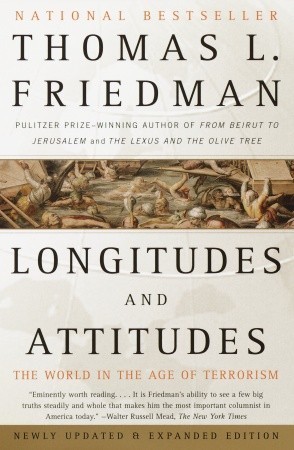
Longitudes and Attitudes: The World in the Age of Terrorism
From the Pulitzer Prize–winning New York Times columnist and bestselling author of From Beirut to Jerusalem and The Lexus and the Olive Tree comes this smart, penetrating, brilliantly informed book that is indispensable for understanding today’s radically new world and America’s complex place in it.
Thomas L. Freidman received his third Pulitzer Prize in 2002 “for his clarity of vision, based on extensive reporting, in commenting on the worldwide impact of the terrorist threat.” In Longitudes and Attitudes he gives us all of the columns he has published about the most momentous news story of our time, as well as a diary of his private experiences and reflections during his post–September 11 travels. Updated for this new paperback edition, with over two years’ worth of Friedman’s columns and an expanded version of his diary, Longitudes and Attitudes is a broadly influential work from our most trusted observer of the international scene.
Thomas L. Freidman received his third Pulitzer Prize in 2002 “for his clarity of vision, based on extensive reporting, in commenting on the worldwide impact of the terrorist threat.” In Longitudes and Attitudes he gives us all of the columns he has published about the most momentous news story of our time, as well as a diary of his private experiences and reflections during his post–September 11 travels. Updated for this new paperback edition, with over two years’ worth of Friedman’s columns and an expanded version of his diary, Longitudes and Attitudes is a broadly influential work from our most trusted observer of the international scene.
399 pages, Paperback
First published September 11, 2002
About the author
Thomas L. Friedman
45 books1,861 followersThomas L. Friedman is an internationally renowned author, reporter, and, columnist—the recipient of three Pulitzer Prizes and the author of six bestselling books, among them From Beirut to Jerusalem and The World Is Flat. In a book review for The Village Voice, Edward Said criticized what he saw as a naive, arrogant, and orientalist account of the Israel–Palestine conflict in Friedman's From Beirut to Jerusalem.
In January 1995, Friedman took over the New York Times Foreign Affairs column. “It was the job I had always aspired to,” he recalled. “I had loved reading columns and op-ed articles ever since I was in high school, when I used to wait around for the afternoon paper, the Minneapolis Star, to be delivered. It carried Peter Lisagor. He was a favorite columnist of mine. I used to grab the paper from the front step and read it on the living room floor.”
Friedman has been the Times‘s Foreign Affairs columnist since 1995, traveling extensively in an effort to anchor his opinions in reporting on the ground. “I am a big believer in the saying ‘If you don’t go, you don’t know.’ I tried to do two things with the column when I took it over. First was to broaden the definition of foreign affairs and explore the impacts on international relations of finance, globalization, environmentalism, biodiversity, and technology, as well as covering conventional issues like conflict, traditional diplomacy, and arms control. Second, I tried to write in a way that would be accessible to the general reader and bring a broader audience into the foreign policy conversation—beyond the usual State Department policy wonks. It was somewhat controversial at the time. So, I eventually decided to write a book that would explain the framework through which I was looking at the world. It was a framework that basically said if you want to understand the world today, you have to see it as a constant tension between what was very old in shaping international relations (the passions of nationalism, ethnicity, religion, geography, and culture) and what was very new (technology, the Internet, and the globalization of markets and finance). If you try to see the world from just one of those angles, it won’t make sense. It is all about the intersection of the two.”
In January 1995, Friedman took over the New York Times Foreign Affairs column. “It was the job I had always aspired to,” he recalled. “I had loved reading columns and op-ed articles ever since I was in high school, when I used to wait around for the afternoon paper, the Minneapolis Star, to be delivered. It carried Peter Lisagor. He was a favorite columnist of mine. I used to grab the paper from the front step and read it on the living room floor.”
Friedman has been the Times‘s Foreign Affairs columnist since 1995, traveling extensively in an effort to anchor his opinions in reporting on the ground. “I am a big believer in the saying ‘If you don’t go, you don’t know.’ I tried to do two things with the column when I took it over. First was to broaden the definition of foreign affairs and explore the impacts on international relations of finance, globalization, environmentalism, biodiversity, and technology, as well as covering conventional issues like conflict, traditional diplomacy, and arms control. Second, I tried to write in a way that would be accessible to the general reader and bring a broader audience into the foreign policy conversation—beyond the usual State Department policy wonks. It was somewhat controversial at the time. So, I eventually decided to write a book that would explain the framework through which I was looking at the world. It was a framework that basically said if you want to understand the world today, you have to see it as a constant tension between what was very old in shaping international relations (the passions of nationalism, ethnicity, religion, geography, and culture) and what was very new (technology, the Internet, and the globalization of markets and finance). If you try to see the world from just one of those angles, it won’t make sense. It is all about the intersection of the two.”
Ratings & Reviews
Friends & Following
Create a free account to discover what your friends think of this book!
Community Reviews
Displaying 1 - 30 of 183 reviews

November 14, 2011
This book won Thomas L. Friedman (born 1953) his third Pulitzer Award for Commentary in 2002 “for his clarity of vision, based on extensive reporting, in commenting on the worldwide impact of the terrorist threat.” That was his 3rd Pulitzer. Three years later he was elected to be a member of the Pulitzer Prize Board.
This is the third book (first was The Lexus and the Olive Tree in 1991 and The World is Flat in 2005) by Friedman that I bought. But this is the first time that I finished reading his work. I thought the two books, “Lexus and Olive” and “World is Flat” are not for me because they both from the standpoint of America as if the world revolves around America and every other country in the world is, in one way or another, under its power. I still felt that arrogance while reading this book. However, I was still not a voracious reader during that time. Now, I know better. Friedman wrote his books with Americans in mind. For one, this Longitudes and Attitudes is a compilation of his articles about 9/11 that came out in The New York Times where he is a foreign news correspondent. The NY Times is a newspaper in America and its readers are majority Americans. So, when I picked his book, I told myself to be open to know how a popular American writer felt about an American issue.
Wait, but 9/11 is not just an American issue.
In the morning of Sept 12, 2001, I was on-leave. Whenever I am at home in the morning, I always watch CNN. So, I was staring at the TV screen and I saw a plane crashed on the first tower. I watched with interest because I thought it was another big time freaking accident. Then I saw another plane crashed on the other tower. I then shouted to my wife who was upstairs to come down immediately and see what’s happening live on TV. “America is Under Attack”, says the caption. I thought it was live until later I realized that I was 12 hour ahead so it was nighttime already in New York when I was watching the CNN coverage.
The first question I asked my wife was that if she knew of anybody working in those two towers. None, she said. Good, I said. It was a horrible moment and the dastardly act of the 19 hijackers was unpardonable. However, that was from the American standpoint. I mean, for the 19 hijackers and the people who share their belief with, the act was a success and I share Friedman’s hypothesis that he was sure that some people on the other side of the globe were sipping coffee and having a celebration while watching CNN’s live coverage of the incident.
As for me, I was not celebrating. However, when I learned that my loved ones in America were unharmed and without knowing the extent and the underlying implications of 9/11, I took it as another terrorist attack just like the many other bombings around the world. Here in the Philippines, the most horrible one was the 12/30 MRT bombing, called Rizal Day Bombing, in 2000. When I saw the footages of the shattered train with scattered bits and pieces of the bodies of the 22 fatalities, I felt sadness and grief. When I saw a burned small doll’s head detached from its body, I, literally, cried. The MRT station was only few kilometers away from my home. New York seems so far away from me to feel the same way. I know this was a bit insensitive but this was how I reacted towards the two terrorist attacks.
Friedman’s articles on 9/11 compiled in this book Longitudes and Attitudes were written on days and months after the attack. So, his emotion was high and there was an article calling the whole incident as the World War III and this was consistent with his support later to President Bush’s war on Iraq. Although Bush was the President and Friedman was this popular writer whose views on foreign matters are respected by many people, that pronouncement and President Bush calling on countries to support him in America’s war against global terrorist were scary. I agree with what Friedman said that the US is now the only surviving global superpower (upon the collapse of the Soviet Union symbolized by the Berlin Wall in 1989) but calling for a world war was, in my opinion, too much too soon, if not too much to ask. I could not blame President Bush, however, because emotion can be blinding. 9/11 happened during his tenure. Grieving Americans looked up to him and waited for his pronouncements and, at that moment, I guess, indecision or forgiveness was not what they were expecting.
Overall, the book achieved its purpose of providing Friedman’s views on 9/11. He said that his objective was not to document the event but only to provide raw materials for the historians. I learned a lot from him especially the century-old conflict in the Middle East. He is very knowledgeable on the Israel-Palestine conflict as his college degree was on Mediterranean studies and he actually started his family by living in Israel for so many years.
I am glad I actually finished a book by him. I will have to go back, attempt again and try to finish his two other books. And probably buy and read the three others. He seems to be arrogant (some people’s favorite adjective for Americans) but with his credentials as an award-winning foreign affairs correspondent of The New York Times, I, now, really don’t mind.
This is the third book (first was The Lexus and the Olive Tree in 1991 and The World is Flat in 2005) by Friedman that I bought. But this is the first time that I finished reading his work. I thought the two books, “Lexus and Olive” and “World is Flat” are not for me because they both from the standpoint of America as if the world revolves around America and every other country in the world is, in one way or another, under its power. I still felt that arrogance while reading this book. However, I was still not a voracious reader during that time. Now, I know better. Friedman wrote his books with Americans in mind. For one, this Longitudes and Attitudes is a compilation of his articles about 9/11 that came out in The New York Times where he is a foreign news correspondent. The NY Times is a newspaper in America and its readers are majority Americans. So, when I picked his book, I told myself to be open to know how a popular American writer felt about an American issue.
Wait, but 9/11 is not just an American issue.
In the morning of Sept 12, 2001, I was on-leave. Whenever I am at home in the morning, I always watch CNN. So, I was staring at the TV screen and I saw a plane crashed on the first tower. I watched with interest because I thought it was another big time freaking accident. Then I saw another plane crashed on the other tower. I then shouted to my wife who was upstairs to come down immediately and see what’s happening live on TV. “America is Under Attack”, says the caption. I thought it was live until later I realized that I was 12 hour ahead so it was nighttime already in New York when I was watching the CNN coverage.
The first question I asked my wife was that if she knew of anybody working in those two towers. None, she said. Good, I said. It was a horrible moment and the dastardly act of the 19 hijackers was unpardonable. However, that was from the American standpoint. I mean, for the 19 hijackers and the people who share their belief with, the act was a success and I share Friedman’s hypothesis that he was sure that some people on the other side of the globe were sipping coffee and having a celebration while watching CNN’s live coverage of the incident.
As for me, I was not celebrating. However, when I learned that my loved ones in America were unharmed and without knowing the extent and the underlying implications of 9/11, I took it as another terrorist attack just like the many other bombings around the world. Here in the Philippines, the most horrible one was the 12/30 MRT bombing, called Rizal Day Bombing, in 2000. When I saw the footages of the shattered train with scattered bits and pieces of the bodies of the 22 fatalities, I felt sadness and grief. When I saw a burned small doll’s head detached from its body, I, literally, cried. The MRT station was only few kilometers away from my home. New York seems so far away from me to feel the same way. I know this was a bit insensitive but this was how I reacted towards the two terrorist attacks.
Friedman’s articles on 9/11 compiled in this book Longitudes and Attitudes were written on days and months after the attack. So, his emotion was high and there was an article calling the whole incident as the World War III and this was consistent with his support later to President Bush’s war on Iraq. Although Bush was the President and Friedman was this popular writer whose views on foreign matters are respected by many people, that pronouncement and President Bush calling on countries to support him in America’s war against global terrorist were scary. I agree with what Friedman said that the US is now the only surviving global superpower (upon the collapse of the Soviet Union symbolized by the Berlin Wall in 1989) but calling for a world war was, in my opinion, too much too soon, if not too much to ask. I could not blame President Bush, however, because emotion can be blinding. 9/11 happened during his tenure. Grieving Americans looked up to him and waited for his pronouncements and, at that moment, I guess, indecision or forgiveness was not what they were expecting.
Overall, the book achieved its purpose of providing Friedman’s views on 9/11. He said that his objective was not to document the event but only to provide raw materials for the historians. I learned a lot from him especially the century-old conflict in the Middle East. He is very knowledgeable on the Israel-Palestine conflict as his college degree was on Mediterranean studies and he actually started his family by living in Israel for so many years.
I am glad I actually finished a book by him. I will have to go back, attempt again and try to finish his two other books. And probably buy and read the three others. He seems to be arrogant (some people’s favorite adjective for Americans) but with his credentials as an award-winning foreign affairs correspondent of The New York Times, I, now, really don’t mind.

August 30, 2021
Long years after the 9/11 attacks occurred, the legacy of the attacks is still very much with us. And for that reason, with the 20th anniversary of 9/11 approaching, I found myself turning to Thomas L. Friedman’s Longitudes and Attitudes – a collection of the eminent New York Times columnist’s opinion articles from the time immediately before and after the attacks of September 11, 2001, and a book that was originally published on the first anniversary of the attacks.
Friedman’s opinion columns have been a fixture of the New York Times editorial page since the early 1990’s, and he has won multiple Pulitzer Prizes for his commentary on international politics. It makes sense, therefore, that many readers would turn with interest to the columns in which Friedman, back in 2001 and 2002, was Exploring the World Before and After September 11 (the book’s subtitle). Anyone who was alive at the time of the attacks can agree that going through those times changed one’s life as well as one’s perspectives.
Friedman’s columns from immediately after 9/11 show how, along with the shock, anger, and grief that he felt upon learning of the attacks – emotions that will be familiar to anyone who lived through that day and is old enough to remember it – he also felt curiosity: Who would want to carry out attacks like those of 9/11, and who could possibly support, or sympathize with, those who had done so? Therefore, he began traveling about, seeking to understand the mood in those parts of the world where there seemed to be some degree of appreciation for bin Laden’s defiance of the West.
This pursuit of answers to 9/11-related questions took Friedman to places like Peshawar, Pakistan, where Friedman offered some grim reflections on those parts of the world where support for bin Laden and al-Qaeda might be strongest:
This is not a neighborhood where we should linger. This is not Mister Rogers’ neighborhood. What makes me say that? I don’t know. Maybe it was the street vendor who asked me exactly what color Osama bin Laden T-shirt I wanted – the yellow one with his picture on it or the white one simply extolling him as the hero of the Muslim nation and vowing JIHAD IS OUR MISSION. (He was doing a brisk business among the locals.) Or maybe it was the wall poster announcing CALL THIS PHONE NUMBER IF YOU WANT TO JOIN THE ‘JIHAD AGAINST AMERICA.’…Or maybe it was the cold stares and steely eyes that greeted the obvious foreigner. Those eyes did not say “American Express accepted here.” They said, “Get lost.” (p. 100)
Friedman’s observations here lead up to his visit to the largest madrassa (Islamic religious school) in Pakistan – one that is well-known because its alumni include Mullah Muhammad Omar, who at the time of the 9/11 attacks was the leader of the Taliban. In that school, Friedman saw a telling indicator of the challenges that the United States would face in assuring the people of that part of the world that the U.S.A. is not an enemy: in that school, “[T]heir almost entirely religious curriculum was designed by the Mogul emperor Aurangzeb Alamgir, who died in 1707. There was one shelf of science books in the library – largely from the 1920’s” (p. 101).
At this time of the final U.S. withdrawal from Afghanistan, after a 20-year war, it is most interesting to contemplate Friedman’s words from the time of the early days of that war. In a column from March of 2002 – after Osama bin Laden had been chased out of Afghanistan and the Taliban removed from power, but before the invasion of Iraq took much U.S. focus off Afghanistan – Friedman wrote that “We don’t need to make Afghanistan into Switzerland. We just need to make the new Afghanistan into something slightly more stable, slightly more decent, and slightly more prosperous than it was under the Taliban.” He added that “If we shrink from this task, Afghanistan will revert right back to what it was before September 11, only worse. And this open sore of Afghanistan will dog us, and the U.S. anti-terror campaign, forever” (p. 208).
Two decades after Friedman wrote those words, U.S. forces have finally left Afghanistan; the Taliban are back in charge. Stability, decency, and prosperity are nowhere to be found, and Afghanistan is well-along in the process of reverting to who-knows-what. To call the current situation there “troubling” would be an understatement.
The Friedman columns from those times are interesting – though not all of them relate to 9/11, or even to U.S. relations with Arab and Muslim nations, and therefore I’m not sure it was necessary to include all of those columns in the book. But what I found to be most informative and helpful in Longitudes and Attitudes was Friedman’s further reflections, in retrospect, on what he was writing in those columns at the time. Freed from the length restrictions of a 740-word newspaper column, Friedman can and does hold forth at greater length regarding a variety of issues relating to 9/11 and its legacy.
For instance, Friedman looks back at September 11, 2001, when he was in Israel, away from his family back in the States. Unable to return to them, during the period when the airspace over the United States was closed, he traveled to Jordan, taking comfort from the messages of consolation that he received from Arab and Muslim friends all over the world. But then he received a profoundly disturbing e-mail, from a friend of his – a fellow American, who was living in the United Arab Emirates. The friend had heard, on the streets of Dubai, rumors that 4000 Jewish people had been warned by Israeli intelligence not to go to the World Trade Center, and – shockingly enough – he wanted Friedman to tell him whether the rumors were true! Friedman writes that
His message rattled me because, I thought, if such an intelligent person could even wonder aloud whether that were true, the rumor must be pervasive, and it must mean that the masses, who would never check, were thoroughly predisposed to believe such a thing. This was the first time I would meet this outrageous fabrication, but unfortunately not the last. I would meet it over and over again in every Arab or Muslim country I visited after September 11; and if you took a poll – a real poll – today, you would find that the vast majority of Arabs and Muslims still believe this terrible lie. It was the beginning of an epidemic of denial that spread throughout the Arab-Muslim world, which refused to really face how this outrage could have come from its bosom. (p. 301)
Contemporary readers may find much to take issue with, in these newspaper columns from 20 years ago. I would question, for example, whether any majority of Arabs or Muslims really believed stories, of whatever kind, claiming that al-Qaeda planners and agents were not responsible for the 9/11 attacks. And Friedman's perspectives regarding Vladimir Putin now seem absurdly over-optimistic, considering Putin’s subsequent aggression toward neighboring countries that were once part of the Soviet Union. But Friedman is certainly a well-informed observer, with many fascinating stories to tell; and Longitudes and Attitudes unquestionably puts one back in those grim, frightening days of 9/11 and its aftermath.
Friedman’s opinion columns have been a fixture of the New York Times editorial page since the early 1990’s, and he has won multiple Pulitzer Prizes for his commentary on international politics. It makes sense, therefore, that many readers would turn with interest to the columns in which Friedman, back in 2001 and 2002, was Exploring the World Before and After September 11 (the book’s subtitle). Anyone who was alive at the time of the attacks can agree that going through those times changed one’s life as well as one’s perspectives.
Friedman’s columns from immediately after 9/11 show how, along with the shock, anger, and grief that he felt upon learning of the attacks – emotions that will be familiar to anyone who lived through that day and is old enough to remember it – he also felt curiosity: Who would want to carry out attacks like those of 9/11, and who could possibly support, or sympathize with, those who had done so? Therefore, he began traveling about, seeking to understand the mood in those parts of the world where there seemed to be some degree of appreciation for bin Laden’s defiance of the West.
This pursuit of answers to 9/11-related questions took Friedman to places like Peshawar, Pakistan, where Friedman offered some grim reflections on those parts of the world where support for bin Laden and al-Qaeda might be strongest:
This is not a neighborhood where we should linger. This is not Mister Rogers’ neighborhood. What makes me say that? I don’t know. Maybe it was the street vendor who asked me exactly what color Osama bin Laden T-shirt I wanted – the yellow one with his picture on it or the white one simply extolling him as the hero of the Muslim nation and vowing JIHAD IS OUR MISSION. (He was doing a brisk business among the locals.) Or maybe it was the wall poster announcing CALL THIS PHONE NUMBER IF YOU WANT TO JOIN THE ‘JIHAD AGAINST AMERICA.’…Or maybe it was the cold stares and steely eyes that greeted the obvious foreigner. Those eyes did not say “American Express accepted here.” They said, “Get lost.” (p. 100)
Friedman’s observations here lead up to his visit to the largest madrassa (Islamic religious school) in Pakistan – one that is well-known because its alumni include Mullah Muhammad Omar, who at the time of the 9/11 attacks was the leader of the Taliban. In that school, Friedman saw a telling indicator of the challenges that the United States would face in assuring the people of that part of the world that the U.S.A. is not an enemy: in that school, “[T]heir almost entirely religious curriculum was designed by the Mogul emperor Aurangzeb Alamgir, who died in 1707. There was one shelf of science books in the library – largely from the 1920’s” (p. 101).
At this time of the final U.S. withdrawal from Afghanistan, after a 20-year war, it is most interesting to contemplate Friedman’s words from the time of the early days of that war. In a column from March of 2002 – after Osama bin Laden had been chased out of Afghanistan and the Taliban removed from power, but before the invasion of Iraq took much U.S. focus off Afghanistan – Friedman wrote that “We don’t need to make Afghanistan into Switzerland. We just need to make the new Afghanistan into something slightly more stable, slightly more decent, and slightly more prosperous than it was under the Taliban.” He added that “If we shrink from this task, Afghanistan will revert right back to what it was before September 11, only worse. And this open sore of Afghanistan will dog us, and the U.S. anti-terror campaign, forever” (p. 208).
Two decades after Friedman wrote those words, U.S. forces have finally left Afghanistan; the Taliban are back in charge. Stability, decency, and prosperity are nowhere to be found, and Afghanistan is well-along in the process of reverting to who-knows-what. To call the current situation there “troubling” would be an understatement.
The Friedman columns from those times are interesting – though not all of them relate to 9/11, or even to U.S. relations with Arab and Muslim nations, and therefore I’m not sure it was necessary to include all of those columns in the book. But what I found to be most informative and helpful in Longitudes and Attitudes was Friedman’s further reflections, in retrospect, on what he was writing in those columns at the time. Freed from the length restrictions of a 740-word newspaper column, Friedman can and does hold forth at greater length regarding a variety of issues relating to 9/11 and its legacy.
For instance, Friedman looks back at September 11, 2001, when he was in Israel, away from his family back in the States. Unable to return to them, during the period when the airspace over the United States was closed, he traveled to Jordan, taking comfort from the messages of consolation that he received from Arab and Muslim friends all over the world. But then he received a profoundly disturbing e-mail, from a friend of his – a fellow American, who was living in the United Arab Emirates. The friend had heard, on the streets of Dubai, rumors that 4000 Jewish people had been warned by Israeli intelligence not to go to the World Trade Center, and – shockingly enough – he wanted Friedman to tell him whether the rumors were true! Friedman writes that
His message rattled me because, I thought, if such an intelligent person could even wonder aloud whether that were true, the rumor must be pervasive, and it must mean that the masses, who would never check, were thoroughly predisposed to believe such a thing. This was the first time I would meet this outrageous fabrication, but unfortunately not the last. I would meet it over and over again in every Arab or Muslim country I visited after September 11; and if you took a poll – a real poll – today, you would find that the vast majority of Arabs and Muslims still believe this terrible lie. It was the beginning of an epidemic of denial that spread throughout the Arab-Muslim world, which refused to really face how this outrage could have come from its bosom. (p. 301)
Contemporary readers may find much to take issue with, in these newspaper columns from 20 years ago. I would question, for example, whether any majority of Arabs or Muslims really believed stories, of whatever kind, claiming that al-Qaeda planners and agents were not responsible for the 9/11 attacks. And Friedman's perspectives regarding Vladimir Putin now seem absurdly over-optimistic, considering Putin’s subsequent aggression toward neighboring countries that were once part of the Soviet Union. But Friedman is certainly a well-informed observer, with many fascinating stories to tell; and Longitudes and Attitudes unquestionably puts one back in those grim, frightening days of 9/11 and its aftermath.

March 25, 2018
3.5/5 This book consists of the author’s columns written from around 9/11 (11 sep 2001) to 3 July 2002. The author is a centrist who gave me the impression of being sympathetic towards the Arabs and apologetic for Islam/Muslims earlier. But in this book he has really called a spade a spade. Am listing d main arguments :-
1) 9/11 has nothing to do with America’s actions but is fueled by a jealousy and hatred fueled by perversion of religion. And the complete lack of maturity and basic empathy by even educated Arabs was an eye-opener to him.
2) 9/11 has nothing to do with Israel’s actions. The author is deeply anguished by how all offers of peace and 95% of the land and compensation made by Israel were repeatedly rejected by Palestine and Arab nations.
3) 9/11 has a lot to do with the inability of the Arabs to self-criticise and to cook up excuses and blame others for everything. Not me, not my family, not my tribe, not my country, not my religion- none are to blame. To me this is the clinching argument that I have made earlier myself too.
4) He argues citing the example of Iran (relatively) that democracy will ease the hatred and is the solution. Unfortunately, as the Pew research (2014) shows, and time has unraveled the Arab Spring, liberal democracy is out of their imagination.
1) 9/11 has nothing to do with America’s actions but is fueled by a jealousy and hatred fueled by perversion of religion. And the complete lack of maturity and basic empathy by even educated Arabs was an eye-opener to him.
2) 9/11 has nothing to do with Israel’s actions. The author is deeply anguished by how all offers of peace and 95% of the land and compensation made by Israel were repeatedly rejected by Palestine and Arab nations.
3) 9/11 has a lot to do with the inability of the Arabs to self-criticise and to cook up excuses and blame others for everything. Not me, not my family, not my tribe, not my country, not my religion- none are to blame. To me this is the clinching argument that I have made earlier myself too.
4) He argues citing the example of Iran (relatively) that democracy will ease the hatred and is the solution. Unfortunately, as the Pew research (2014) shows, and time has unraveled the Arab Spring, liberal democracy is out of their imagination.

December 12, 2020
Always genial, upbeat, and optimistic, Thomas Friedman is a national treasure. Whether he's jet-setting around the Arab world or playing golf with baseball great Jim Bouton, this is one genial guy who just won't let the terrorists get him down. The day after 9/11 he went out and bought some stock, just to show Osama Bin Laden who was boss. You have to give him credit for his vision, though. Friedman predicted America would triumph *in the end.* And to think the Afghan War only lasted twenty years, cost billions of dollars, and ruined countless lives!

September 25, 2011
I tried really hard to finish this and just couldn't. Friedman's world "philosophy" is restricting and reductionist. He's a convincing writer, but doesn't make the effort to address fault-lines in his perfectly square little analogies and anecdotes. Like this gem that goes something along the lines of "India is a democratic country despite a large Muslim population, therefore traditional Middle Eastern countries must adapt NOW." He's also really adroit at setting up a pretty clear West vs the Rest argument that just isn't very accurate anymore. I'd give the book a few stars for his easy-to-read and accessible discussions of a pretty dense subject matter. 1 star for actually attacking the material in a cogent way.

October 6, 2018
If I were as impressed by Thomas Friedman as he seems to be by himself, I expect I would have enjoyed this book quite a lot more.

January 10, 2008
Friedman is a talented writer, but extremely one sided. He does a good job trying to convince us that we, as readers, can fully understand difficult issues such as the causes of terrorism, the roles of madrassahs in the Afghan region, and the over-blown burqa... while ignoring the fact that all these issues cannot possibly be understood without considering the many different cultural and religious contexts surrounding them! There were some good articles, but literally SOME. As in maybe one or two. His reporting was one sided; the people he interviewed were almost always those with the same views as him, and if, on the off chance, he did intereview someone with an opposing viewpoint, it was put in a very bad light. As one who grew up in a region where these were real issues affecting social control and structure, I can honestly say that Friedman must be getting payed big bucks to spew out stuff this ridicilous.
... Never picked up a Friedman book since.
... Never picked up a Friedman book since.

March 5, 2008
This book follows Friedman's editorials from 2001-2003ish. It is interesting to watch a juggernaut of mideast intelligencia navigate the turmoil of sept 11, invasion of Iraq and violence in Isreal. From meetings with Saudi princes to sharing flights with powerful senators, Friedman weaves a cohesive story from our most confusing times.

January 22, 2009
I agree with 95% of what is written here. In fact a lot of what he has written, I intuitively thought about when I was daydreaming during medical school about the same time he wrote it.
This is a collection of Friedman's articles from September 11 era. What strikes about the articles is Friedman places September 11 in context with supports and strengthen terrorism, namely the effects of globalization instead of the tunnel vision us vs. them mentality. I agree with his assessment that in order to combat terrorism we need to change the terrorist environment to make them obsolete as what happened in Egypt. By supporting Egyptian democracy movement in a largely secularly minded population, we have empowered Islamist a say in creating their own government; thereby diffusing their targeted anger at Western democracies. An important collorary is the surgical precision strikes by Special Ops forces with minimal civilian casualties as what happen with Bin Laden. One without the other would have been meaningless but both in concert with the other provides the knock-out blow to Al-Quaeda operations world wide.
The key to dismantling terrorism in the world aside from targeted special ops against terrorists is 1) promoting democracy in the middle east by getting rid of authoritarian regimes. Hopefully, Iraqi operation combined with the democratic movements in Egypt and Tunisia can finally convince Arabs that Arab Muslims that they do not have to resort to violence against the West to have their voices heard. I disagree with the pundits that say that democracy will some how an Islamic Armageddon. Let say that they are right and Iraq, Egypt and Tunisia become Islamist states. So what, at least then we will know who the enemy is instead of what is happening now that it is largely amorphous in character. The best case scenario is of course this Arab states become just like Turkey, namely productive members of the world that although Islamist in character are also pluralistic democracies with thriving economy.
2) Secondly, and that goes with promoting unconditional democracies with the middle east is the need for energy independence from the middle east with the focus on renewable sources of technology as well as energy efficiency. I am against drilling for oil in the US right now because if WWIII breaks out and the international order falls down then we will need all the resources we have that is currently untapped to fuel the NWO. If we tap that now because we want to keep current prices low, then what will happen when we actually need the oil in the future. I think tapping oil now because we cannot control our appetite for oil is incredibly short sighted in terms of national security interests. The only time I would be for tapping US resources is if it is clear that not doing so will lead to a depression or international trade ceases to exist thus necessitating us to tap our resources.
3) Thirdly, globalization as a driver for not only US multinational profits but also for world peace. It is clear the countries that participate competitively in the global supply chain want stability and world peace in order to become increasingly prosperous. It is the failed states that do not participate in the global supply chain that harbors terrorist and perhaps even actively promote terrorism. This is the reason, we need to encourage countries that do participate in the global supply chain.
4)It continues to surprise me how much the Israeli-Palestinian peace process drives Islamic anger toward America and Israel and thus stability toward the middle east, probably due to Arab undemocratic governments channeling Arab street anger toward forces outside their control to distract them from their own governments performance. This much is clear, there needs to be a two state solution with Palestinians relinquishing their right of return and the Islamic world recognizing Israel's right to exist, Islamic world condemning all in terrorist action exchange for Israeli unilaterally pulling their settlement out of the West Bank, Gaza, and perhaps East Jerusalem (pre-1967 war borders). What is clear is all Israeli settlements in the West Bank and Gaza need to be destroyed so Palestine can have a functioning country or else they will forever blame Israel and America for their lack of progress.
Friedman is right in saying the inability of Israel to compromise now will jeopardize the Israel as democratically elected Jewish state due to the Palestinians increase in birth rate combined with the growing unemployment of Palestinian men make for an explosive future if Israel continues to simply "crack down".
5)An interesting fact that he cites is how much Iranians are ripe for a revolution that is like much of the middle east, Iran has a young unemployed workforce but because their regime is anti-American, the people who are frustrated with the stagnation of their economies are decidedly pro-Western in that they want a taste of democracy in Iran. Friedman blames oil money that the regime receives as the reason it has been able to hold onto power. If that is the case, then how was the Shah of Iran unable to hold onto power while the Ayatollahs hold on to power? The answer of course is that the Ayatollah nationalize the oil fields so all the oil revenue that Iran receives are totally controlled by the Ayatollah whereas the Shah only received a cut from the western oil companies who owned those wells.
6)Bush mistake in post-9/11 leadership is he did not galvanize public support to do something useful with our shared sense of loss. That is, when war was eminent, Bush did not ask everyone to share in the sacrifice of war that is the reason why for half the American population the war was largely an over there phenomenon rather than a close and personal one like WWII. Although Iraq was legitimate war of choice in bringing democracy to the middle east, Bush muddied the effect by falsely tying Saddam Hussein with Al-Quaeda and weapons for mass destruction as well as poorly planning and executing its peace. I for one only opposed the war because of Bush's reasoning for it because I believed that Saddam Hussein could be contained and thus was not a threat to the US. On the other hand if Bush actually said we are going to the middle east to try to bring democracy to that area while kicking out a cruel dictator then I would have been for it. The troubling thing is I do not know if Congress, the world, and the American people would have been with him if he told the truth. But equally troubling is if Bush knowingly misled the American people in order to establish democracy in the middle east.
7) I agree with Friedman that in order for a democratic movement to be legitimate it needs to be indigenous. This is the reason it must be an national priority to help the Egyptians and Tunisians establish liberal democracies that is also Islam friendly so the myth that Arab Islam and democracies are mutually exclusive can finally come to rest. While war should always be an option, it is really American soft power that ensures a peaceful, democratic, and stable world. Also to destroy the root cause of terrorism, it is necessary that democracy thrives because it is only through democracy that there is safety valve that lets out the anger of the population through elections. That is, only through elections do the Arab populations have the necessary control that they yearn for in their lives.
8) While doing some investigations Friedman realizes that there are two types of fundamentalist who were behind September 11. The first type of terrorist which is the leader is the type are Islamist who are educated middle class people who emigrate to the West especially Europe and feel disenfranchised. That is, even though they are educated in the West, people in those countries still treat them as the other. Because of this other status, they turn toward Islam for comfort an as away to feel part of a community and thus are susceptible to teachings of hate toward the West. Although there are problems in the US, I think the issue of immigrant disenfranchisement of Muslims is more a problem of European countries where they use Muslims as a source of cheap labor but refuse to integrate them into their society thus forcing them to seek comfort in Islamic radicalism.
I believe this is where the US strength lies in rooting out home-grown terrorism. I believe that the US integrative approach to immigrants (we want immigrants to integrate into American society) is a strength in deterring the feelings of alienation that would be middle class Islamist feel. That is, it is harder to create a heinous crime in terrorism if one actually likes and respects ones neighbors.
The other source of Islamist are the countless unemployed foot-soldiers in Middle Eastern countries who are unemployed because of the sclerotic regimes and economies due to the lack of private initiative. These people become radicalized because the Arab regime and Islamic religious leaders deflect the problems in their societies and constantly blame the West for their troubles.
9) The rise of Saudi fundamentalism lies in the successful start of Iranian Islamic revolution. Since Saudi vies against Iran for Islamic supremacy, Saudi made an unholy pact with the virulent Wahabi Islamist to export Islamist doctrine abroad in order to legitimize the Saudi regime as the most Islamic in the region. This in turn created the Taliban and Al-Quaeda in Pakistan and Afghanistan.
10) Friedman states that enhancement of telecommunications exacerbated the insular nature of fundamentalist Islam in that the internet gives Islamist post a veneer of truth while allowing like-minded individuals to accentuate their power and message that is highly disportionate to their actual numbers. That is, the message of hate can be made faster and farther than ever before linking isolated crazies to other crazies in the world that can now topple regimes (North African regimes).
This is a collection of Friedman's articles from September 11 era. What strikes about the articles is Friedman places September 11 in context with supports and strengthen terrorism, namely the effects of globalization instead of the tunnel vision us vs. them mentality. I agree with his assessment that in order to combat terrorism we need to change the terrorist environment to make them obsolete as what happened in Egypt. By supporting Egyptian democracy movement in a largely secularly minded population, we have empowered Islamist a say in creating their own government; thereby diffusing their targeted anger at Western democracies. An important collorary is the surgical precision strikes by Special Ops forces with minimal civilian casualties as what happen with Bin Laden. One without the other would have been meaningless but both in concert with the other provides the knock-out blow to Al-Quaeda operations world wide.
The key to dismantling terrorism in the world aside from targeted special ops against terrorists is 1) promoting democracy in the middle east by getting rid of authoritarian regimes. Hopefully, Iraqi operation combined with the democratic movements in Egypt and Tunisia can finally convince Arabs that Arab Muslims that they do not have to resort to violence against the West to have their voices heard. I disagree with the pundits that say that democracy will some how an Islamic Armageddon. Let say that they are right and Iraq, Egypt and Tunisia become Islamist states. So what, at least then we will know who the enemy is instead of what is happening now that it is largely amorphous in character. The best case scenario is of course this Arab states become just like Turkey, namely productive members of the world that although Islamist in character are also pluralistic democracies with thriving economy.
2) Secondly, and that goes with promoting unconditional democracies with the middle east is the need for energy independence from the middle east with the focus on renewable sources of technology as well as energy efficiency. I am against drilling for oil in the US right now because if WWIII breaks out and the international order falls down then we will need all the resources we have that is currently untapped to fuel the NWO. If we tap that now because we want to keep current prices low, then what will happen when we actually need the oil in the future. I think tapping oil now because we cannot control our appetite for oil is incredibly short sighted in terms of national security interests. The only time I would be for tapping US resources is if it is clear that not doing so will lead to a depression or international trade ceases to exist thus necessitating us to tap our resources.
3) Thirdly, globalization as a driver for not only US multinational profits but also for world peace. It is clear the countries that participate competitively in the global supply chain want stability and world peace in order to become increasingly prosperous. It is the failed states that do not participate in the global supply chain that harbors terrorist and perhaps even actively promote terrorism. This is the reason, we need to encourage countries that do participate in the global supply chain.
4)It continues to surprise me how much the Israeli-Palestinian peace process drives Islamic anger toward America and Israel and thus stability toward the middle east, probably due to Arab undemocratic governments channeling Arab street anger toward forces outside their control to distract them from their own governments performance. This much is clear, there needs to be a two state solution with Palestinians relinquishing their right of return and the Islamic world recognizing Israel's right to exist, Islamic world condemning all in terrorist action exchange for Israeli unilaterally pulling their settlement out of the West Bank, Gaza, and perhaps East Jerusalem (pre-1967 war borders). What is clear is all Israeli settlements in the West Bank and Gaza need to be destroyed so Palestine can have a functioning country or else they will forever blame Israel and America for their lack of progress.
Friedman is right in saying the inability of Israel to compromise now will jeopardize the Israel as democratically elected Jewish state due to the Palestinians increase in birth rate combined with the growing unemployment of Palestinian men make for an explosive future if Israel continues to simply "crack down".
5)An interesting fact that he cites is how much Iranians are ripe for a revolution that is like much of the middle east, Iran has a young unemployed workforce but because their regime is anti-American, the people who are frustrated with the stagnation of their economies are decidedly pro-Western in that they want a taste of democracy in Iran. Friedman blames oil money that the regime receives as the reason it has been able to hold onto power. If that is the case, then how was the Shah of Iran unable to hold onto power while the Ayatollahs hold on to power? The answer of course is that the Ayatollah nationalize the oil fields so all the oil revenue that Iran receives are totally controlled by the Ayatollah whereas the Shah only received a cut from the western oil companies who owned those wells.
6)Bush mistake in post-9/11 leadership is he did not galvanize public support to do something useful with our shared sense of loss. That is, when war was eminent, Bush did not ask everyone to share in the sacrifice of war that is the reason why for half the American population the war was largely an over there phenomenon rather than a close and personal one like WWII. Although Iraq was legitimate war of choice in bringing democracy to the middle east, Bush muddied the effect by falsely tying Saddam Hussein with Al-Quaeda and weapons for mass destruction as well as poorly planning and executing its peace. I for one only opposed the war because of Bush's reasoning for it because I believed that Saddam Hussein could be contained and thus was not a threat to the US. On the other hand if Bush actually said we are going to the middle east to try to bring democracy to that area while kicking out a cruel dictator then I would have been for it. The troubling thing is I do not know if Congress, the world, and the American people would have been with him if he told the truth. But equally troubling is if Bush knowingly misled the American people in order to establish democracy in the middle east.
7) I agree with Friedman that in order for a democratic movement to be legitimate it needs to be indigenous. This is the reason it must be an national priority to help the Egyptians and Tunisians establish liberal democracies that is also Islam friendly so the myth that Arab Islam and democracies are mutually exclusive can finally come to rest. While war should always be an option, it is really American soft power that ensures a peaceful, democratic, and stable world. Also to destroy the root cause of terrorism, it is necessary that democracy thrives because it is only through democracy that there is safety valve that lets out the anger of the population through elections. That is, only through elections do the Arab populations have the necessary control that they yearn for in their lives.
8) While doing some investigations Friedman realizes that there are two types of fundamentalist who were behind September 11. The first type of terrorist which is the leader is the type are Islamist who are educated middle class people who emigrate to the West especially Europe and feel disenfranchised. That is, even though they are educated in the West, people in those countries still treat them as the other. Because of this other status, they turn toward Islam for comfort an as away to feel part of a community and thus are susceptible to teachings of hate toward the West. Although there are problems in the US, I think the issue of immigrant disenfranchisement of Muslims is more a problem of European countries where they use Muslims as a source of cheap labor but refuse to integrate them into their society thus forcing them to seek comfort in Islamic radicalism.
I believe this is where the US strength lies in rooting out home-grown terrorism. I believe that the US integrative approach to immigrants (we want immigrants to integrate into American society) is a strength in deterring the feelings of alienation that would be middle class Islamist feel. That is, it is harder to create a heinous crime in terrorism if one actually likes and respects ones neighbors.
The other source of Islamist are the countless unemployed foot-soldiers in Middle Eastern countries who are unemployed because of the sclerotic regimes and economies due to the lack of private initiative. These people become radicalized because the Arab regime and Islamic religious leaders deflect the problems in their societies and constantly blame the West for their troubles.
9) The rise of Saudi fundamentalism lies in the successful start of Iranian Islamic revolution. Since Saudi vies against Iran for Islamic supremacy, Saudi made an unholy pact with the virulent Wahabi Islamist to export Islamist doctrine abroad in order to legitimize the Saudi regime as the most Islamic in the region. This in turn created the Taliban and Al-Quaeda in Pakistan and Afghanistan.
10) Friedman states that enhancement of telecommunications exacerbated the insular nature of fundamentalist Islam in that the internet gives Islamist post a veneer of truth while allowing like-minded individuals to accentuate their power and message that is highly disportionate to their actual numbers. That is, the message of hate can be made faster and farther than ever before linking isolated crazies to other crazies in the world that can now topple regimes (North African regimes).

July 7, 2022
As the foreign affairs columnist for the New York Times, Friedman traveled the world, to locations of his choosing, and writing columns for the op-ed page without direction or restriction from editors or the publisher. In this book, Friedman lays out great background on the causes of 9/11 and the various players in the Middle East. He provides insight into the thinking and positions (public and private) of the leaders and citizens of the various Middle East countries and of the coalition partners in the 'war on terror.' Once rather ironic part is Friedman's take on Putin, who had just come to power in Russia through a democratic election. His take on Putin is far, far from what Putin as become.

December 22, 2023
Longitudes and Attitudes (o Latitudes, com li deia jo mentalment) és un extens recull d'articles del periodista Thomas Friedman sobre política internacional, centrats especialment en el món àrab. És un llibre ideal per llegir al tren anant cap a la feina i m'hi ha acompanyat durant molt de temps. (9/10)
March 14, 2019
This book offers an extremely deep dive into the history, events, and geopolitics surrounding 9/11. It compiles the editorials written by Thomas Friedman, a writer for the New York Times, surrounding 9/11. Many of the stances taken by the author become more interesting in retrospect, as it becomes clear that even what seemed like the best options had unseen consequences or variables. All in all, this is a great read, but only if you are devoted enough to the subject matter to stick around to the end, as it is a very weighty book that will take some time.

December 11, 2008
This is a collection of the Pulitzer Prize winning columns that Friedman wrote for the New York Times reflecting both on the factors that went into the events of September 11 and the world that it created. Like all of his work, these essays are marked by phenomenal insight and enormous intelligence. Most of these are available on Friedman's own website, but they are definitely worth owning in a bound volume. Over the years, I have found myself going back to his FROM BEIRUT TO JERUSALEM over and over to understand the situation in the Middle East, and many will find the same kind of insight and understanding in this volume.
The way that the essays in this book differ from his other work in FROM BEIRUT TO JERUSALEM and THE LEXUS AND THE OLIVE TREE is the intensely personal tone of many of the essays. Friedman often writes not from an objective point of view, but of how he is feeling, what he is thinking as he reflects on the fallen Towers, and of his own very specific reactions. In this way, these essays contain strong elements of memoir. A hundred years from now, they will be read as one very intelligent and perceptive journalist's reactions to one of the most traumatic disasters in American history. They are valuable as much for emotional reflections as for his objective analyses. The genius of these essays derives from the fact that he in no way attempts to minimize the tragedy and horror of 9/11, while in no way ignoring his own grief and perplexity or, and this is the tough part, losing his remarkable perspective as a journalist or resorting to trite generalizations to explain and analyze the greater global situation.
For fans of Friedman's columns and previous books, this will be an immensely satisfying book. For those unfamiliar with his other work, they will find here a work of great insight and emotional honesty on perhaps the great horror in American history since Vietnam and perhaps Pearl Harbor. I recommend this book in the strongest possible terms.
The way that the essays in this book differ from his other work in FROM BEIRUT TO JERUSALEM and THE LEXUS AND THE OLIVE TREE is the intensely personal tone of many of the essays. Friedman often writes not from an objective point of view, but of how he is feeling, what he is thinking as he reflects on the fallen Towers, and of his own very specific reactions. In this way, these essays contain strong elements of memoir. A hundred years from now, they will be read as one very intelligent and perceptive journalist's reactions to one of the most traumatic disasters in American history. They are valuable as much for emotional reflections as for his objective analyses. The genius of these essays derives from the fact that he in no way attempts to minimize the tragedy and horror of 9/11, while in no way ignoring his own grief and perplexity or, and this is the tough part, losing his remarkable perspective as a journalist or resorting to trite generalizations to explain and analyze the greater global situation.
For fans of Friedman's columns and previous books, this will be an immensely satisfying book. For those unfamiliar with his other work, they will find here a work of great insight and emotional honesty on perhaps the great horror in American history since Vietnam and perhaps Pearl Harbor. I recommend this book in the strongest possible terms.

August 16, 2012
One only has to look at the current crop of thugs occupying the White House to know that being the brightest and the best is not a criteria for holding office in the Bush administration. Nor, in this election year, does it appear to be a criteria for running for the highest office in the United States. I am old enough, however, to remember when administrations sought out those who were experts in their field and brought them into positions to formulate public policy or, at the least, sought their opinions. These days it all too often seems that the only criteria required is partisan party loyalty and an IQ of a turnip. (NOTE TO PRESIDENT BUSH: A village in Texas in missing their idiot. Please return home.)
Thomas Friedman is, arguably, the world's formost expert on middle eastern affairs. His book "From Beruit to Jerusalem" is still considered a classic and one only has to give that a casual read to see that the exact same mistakes that Israel made in Lebanon are being repeated to a Tee in Iraq and thoughout the Arab world by an administration who shows absolutely no understanding of the Arab mindset and the historical events that have driven us to where we are now.
"Longitudes and Attitudes" is a compilation of Thomas Friedman's columns written for the New York Times from slightly before 9/11 until late 2002. He shows a clear understanding of the problems and dangers facing us in a post 9/11 world and he offers thoughtful and detailed positions to get us out of this mess. These are scattered across many articles and one needs to read all of them to gain an appreciation for what Friedman is saying but the journey is worth it.
One could could wish that someone in power would hire Mr. Friedman into the State Department and listen to him because his is one of the few clear analysis I have heard.
Thomas Friedman is, arguably, the world's formost expert on middle eastern affairs. His book "From Beruit to Jerusalem" is still considered a classic and one only has to give that a casual read to see that the exact same mistakes that Israel made in Lebanon are being repeated to a Tee in Iraq and thoughout the Arab world by an administration who shows absolutely no understanding of the Arab mindset and the historical events that have driven us to where we are now.
"Longitudes and Attitudes" is a compilation of Thomas Friedman's columns written for the New York Times from slightly before 9/11 until late 2002. He shows a clear understanding of the problems and dangers facing us in a post 9/11 world and he offers thoughtful and detailed positions to get us out of this mess. These are scattered across many articles and one needs to read all of them to gain an appreciation for what Friedman is saying but the journey is worth it.
One could could wish that someone in power would hire Mr. Friedman into the State Department and listen to him because his is one of the few clear analysis I have heard.

April 2, 2026
Review title: Old news, analysis appended
Friedman is famous for his statement in a later book that The World is Flat . In this globalized connected world, “not everyone benefits from it . . . which is why the more it becomes diffused, the more it also produces a backlash by people who feel overwhelmed by it, homogenized by it, or unable to keep pace with its demands “ (p. 4).
This book is his three-part account of 9/11. Part one is a selection of his New York Times foreign-affairs opinion columns in the year before that disastrous day. Part two, by far the bulk of the pages, is a selection of columns in the two years after. And Part three is a journal of his travels in the months after, where he gathered material for his columns, included here to provide more background on the people, places, and events of those momentous months. So reading the center section now in 2026 is like reading old news. There is no analysis or long-term development, until you get to Part three; the rest is literally just op-ed journalism, so one valid approach to reading would be to start with a close reading of Part three then selective reading of the columns from the first and second sections.
Not that the columns aren't accurate, useful and sometimes predictively relevant. In June 2001, before 9/11, Friedman wrote that
With Donald Trump's isolationist refusal to foot the United States' admittedly disproportionate share (after all we benefit the most from these systems, as Friedman notes) of maintaining international systems of trade and security, he has seriously weakened not only American security and economy, but global security and economic growth. How much closer are we to another 9/11 because of this abdication of leadership?
And sure enough, a month after the 9/11 attack in a column entitled "We Are All Alone" (p. 60-61), Friedman writes, about an earlier Republican president taking the same approach: "The unilateralist message the Bush team sent from its first day in office--get rid of the Kyoto climate treaty, forget the biological treaty, forget arms control, and if the world doesn't like it that's tough--has now come back to haunt us."
Friedman frequently identifies the source of 9/11 as the "anger and problems with their [Muslim] societies, not ours" (p. 76)--stagnant economies, failed educational opportunities, high unemployment, stifling governments that allow no freedom to of expression or participation, what Friedman calls the "software" of terrorism. He also often references "deterrables" (corrupt, failed, or dictatorial governments that are nonetheless afraid of and containable by American military and political strength) and "undeterrables", who are individuals or NGOs like Al Qaeda who are afraid of nothing and willing to die for their cause, like the 9/11 terrorists. These undeterrables, "these suicide bombers were a very different kind of enemy--they hated us more than they hated life" (p. 325).
Writing 20 years ago, Friedman concluded: "Israel is doomed to permanent occupation of the West Bank and Gaza. And if that is the case, it means Israel will have to rule the West Bank and Gaza permanently, the way South African whites ruled blacks under apartheid." (p. 194). Now that may sound like 20-year-old news, but as we've watched Israel attacking the Palestinians in Gaza over the last couple years he was proven right.
Even though I said earlier that this is op-ed journalism without analysis, Friedman does on occasion include thought that he would develop later in his flat-world books. For example
reads like a first draft of his Green New Deal.
And in the short final section from his post-9/11 journal Friedman includes his most intriguing and most inspiring analysis. Intriguing: if Judaism is God 1.0--the first of the three monotheistic religions that dominate the world--and Christianity is God 2.0 and Islam is God 3.0, young Arab Muslims like the 9/11 hijackers who had learned their version was the newest and purest could not understand why countries dominated by those other, older, versions were "much better--politically, economically, and educationally" (p. 355). But Friedman posits that Christianity and Judaism are now actually 2.0.1 and 1.0.1 because they have gone through the Reformation and experience of living in multi-faith countries and cultures where their personal beliefs must compete and live. Arabic Islam has not had that "reformation" experience.
His inspiring analysis is this strong defense of America:
To prove the truth of this belief, Friedman quotes a contemporary writer: "open all the borders on Earth and see what happens. In about half a day, the entire world would be a ghost town, and the United States would look like one giant line to see The Producers" (p. 338).
In 2026 we need to act and vote as Americans to ensure we remain that world of freedom, pluralism, equality, and faith.
Friedman is famous for his statement in a later book that The World is Flat . In this globalized connected world, “not everyone benefits from it . . . which is why the more it becomes diffused, the more it also produces a backlash by people who feel overwhelmed by it, homogenized by it, or unable to keep pace with its demands “ (p. 4).
This book is his three-part account of 9/11. Part one is a selection of his New York Times foreign-affairs opinion columns in the year before that disastrous day. Part two, by far the bulk of the pages, is a selection of columns in the two years after. And Part three is a journal of his travels in the months after, where he gathered material for his columns, included here to provide more background on the people, places, and events of those momentous months. So reading the center section now in 2026 is like reading old news. There is no analysis or long-term development, until you get to Part three; the rest is literally just op-ed journalism, so one valid approach to reading would be to start with a close reading of Part three then selective reading of the columns from the first and second sections.
Not that the columns aren't accurate, useful and sometimes predictively relevant. In June 2001, before 9/11, Friedman wrote that
America continues to be willing to provide "public goods" to the global system . . . . Public goods are things that everyone can benefit from —keeping the sea-lanes open, stabilizing the free-trade system . . . . This gives lesser powers an incentive to cooperate with us even as they criticize us; otherwise who else would uphold global security and financial stability? This is hugely important. History teaches that periods of relative peace occur when you have a benign power that is ready to provide public services to maintain an orderly global system —even if it means paying a disproportionate share of the costs. That's why the greatest danger today is . . . if America is no longer ready to play America-the benign superpower that pays a disproportionate price to maintain the system of which it's the biggest beneficiary. (p. 26)
With Donald Trump's isolationist refusal to foot the United States' admittedly disproportionate share (after all we benefit the most from these systems, as Friedman notes) of maintaining international systems of trade and security, he has seriously weakened not only American security and economy, but global security and economic growth. How much closer are we to another 9/11 because of this abdication of leadership?
And sure enough, a month after the 9/11 attack in a column entitled "We Are All Alone" (p. 60-61), Friedman writes, about an earlier Republican president taking the same approach: "The unilateralist message the Bush team sent from its first day in office--get rid of the Kyoto climate treaty, forget the biological treaty, forget arms control, and if the world doesn't like it that's tough--has now come back to haunt us."
Friedman frequently identifies the source of 9/11 as the "anger and problems with their [Muslim] societies, not ours" (p. 76)--stagnant economies, failed educational opportunities, high unemployment, stifling governments that allow no freedom to of expression or participation, what Friedman calls the "software" of terrorism. He also often references "deterrables" (corrupt, failed, or dictatorial governments that are nonetheless afraid of and containable by American military and political strength) and "undeterrables", who are individuals or NGOs like Al Qaeda who are afraid of nothing and willing to die for their cause, like the 9/11 terrorists. These undeterrables, "these suicide bombers were a very different kind of enemy--they hated us more than they hated life" (p. 325).
Writing 20 years ago, Friedman concluded: "Israel is doomed to permanent occupation of the West Bank and Gaza. And if that is the case, it means Israel will have to rule the West Bank and Gaza permanently, the way South African whites ruled blacks under apartheid." (p. 194). Now that may sound like 20-year-old news, but as we've watched Israel attacking the Palestinians in Gaza over the last couple years he was proven right.
Even though I said earlier that this is op-ed journalism without analysis, Friedman does on occasion include thought that he would develop later in his flat-world books. For example
There are two ways for a government to get rich in the Middle East. One is by drilling a sand dune and the other is by drilling the talents, intelligence, creativity, and energy of its men and women. (p. 237)
reads like a first draft of his Green New Deal.
And in the short final section from his post-9/11 journal Friedman includes his most intriguing and most inspiring analysis. Intriguing: if Judaism is God 1.0--the first of the three monotheistic religions that dominate the world--and Christianity is God 2.0 and Islam is God 3.0, young Arab Muslims like the 9/11 hijackers who had learned their version was the newest and purest could not understand why countries dominated by those other, older, versions were "much better--politically, economically, and educationally" (p. 355). But Friedman posits that Christianity and Judaism are now actually 2.0.1 and 1.0.1 because they have gone through the Reformation and experience of living in multi-faith countries and cultures where their personal beliefs must compete and live. Arabic Islam has not had that "reformation" experience.
His inspiring analysis is this strong defense of America:
In more places on more days in more years, America has done more to make this world a better, more livable place for more people than any other country in history. Some people don't like that. They detest the freedom, the pluralism, the religious toleration, the secularism, the gender equality, the democracy, the faith, the free markets, and the multiethnicity with which we have built our society, and which we urge others to emulate. There really are people who hate us for who we are, not just for what we do, because who we are is the refutation of all that they believe in. It is the opposite of the world they want to construct. (p. 334)
To prove the truth of this belief, Friedman quotes a contemporary writer: "open all the borders on Earth and see what happens. In about half a day, the entire world would be a ghost town, and the United States would look like one giant line to see The Producers" (p. 338).
In 2026 we need to act and vote as Americans to ensure we remain that world of freedom, pluralism, equality, and faith.
June 17, 2015
Published in 2002, this volume of columns by Thomas Friedman from before and after the September 11th attacks might be no more than an exercise in the unnerving clarity of hindsight appended by some excellent foreign policy advice and observations. In this regard alone, Longitudes and Attitudes is a captivating piece; Friedman, of course, is an exceptional writer, and his experience with Middle Eastern affairs is unmatched.
Now, more than ten years after the publishing of this book, readers of Longitudes and Attitudes may enjoy the work with enough detachment to understand it as a historical and anthropological study. When it came out, Longitudes and Attitudes shocked readers by demonstrating the the signs the September 11th attacks were in plain sight through columns published by Friedman before the attacks, and, in the columns included written after the attacks, provided expert commentary on what the U.S. should do next. The columns included in this work are now firmly in the past, but the Middle East continues its slide into instability. Thus, Friedman's remarkable prescience in the columns written after 9/11 make this a book of not one "I told you so," but two.
In short, Longitudes and Attitudes is, more than anything else, a story of the road not taken.
January 22, 2009
So far - loved the format of this book, a collection of articles that all link together - now I want to read From Beirut to Jerusalem...and his newest book. Friedman, I'm coming for you!
Most memorable part of the book - just imagining how Muslims treat women. One view would be "omg, how horrible, how could you do that, I am going to come change your culture"
But on the other hand, isn't that kind of ridiculous? A culture may seem nonsensical to some, but sometimes people love their culture. "Dads would love their daughter so much, would educating them, send them overseas, but would want them to come back home afterwards, wear veils, and live a housewife life and/or be in a place where no good opportunities that would use their intellect exist."
This attitude does not only exist in Muslim cultures....Asian culture is full of this too. Do the women like it? Or they say they don't but they want it?
Continues to mystify me....
The question really is, is ignorance bliss? or not?
Most memorable part of the book - just imagining how Muslims treat women. One view would be "omg, how horrible, how could you do that, I am going to come change your culture"
But on the other hand, isn't that kind of ridiculous? A culture may seem nonsensical to some, but sometimes people love their culture. "Dads would love their daughter so much, would educating them, send them overseas, but would want them to come back home afterwards, wear veils, and live a housewife life and/or be in a place where no good opportunities that would use their intellect exist."
This attitude does not only exist in Muslim cultures....Asian culture is full of this too. Do the women like it? Or they say they don't but they want it?
Continues to mystify me....
The question really is, is ignorance bliss? or not?

June 20, 2011
This book is a collection of Friedman's columns from the NY Times that were published several months before and after 11 Sept 2001 as well as a collection of diary and essays written around the same time. Mr. Friedman's long history of covering the Middle East, his remarkable access to leaders and commoners throughout the region as well as his interest in what they all have to say makes this a remarkable book. As I was listening to the book, I was reminded again of a book by Sandra Day O'Connor where she stressed the importance of a free and critical press to good government and ultimately a free and productive society. I found the book really helpful in understanding various Muslim reactions to 11 Sept events.
The author describes golf as being necessary to keep his perspective among the travels and interviews of his job. I found that I too had to take breaks between discs. If I listened during part of my commute, I found that I needed to take a 'music break' with some up-beat tunes to be able to continue without becoming totally cynical and depressed.
The author describes golf as being necessary to keep his perspective among the travels and interviews of his job. I found that I too had to take breaks between discs. If I listened during part of my commute, I found that I needed to take a 'music break' with some up-beat tunes to be able to continue without becoming totally cynical and depressed.
December 25, 2024
Classic left winged Thomas Friedman book. He comes across arrogant like he knows what is best for America and what is best for the rest of the world. Typical American point of view where they are the center of the world and everyone needs to like them. No need to read this book unless you are looking for more reasons to hate America. Left this book in Port Barton, Philippines. Probably wont be picked up.
"The new international system is called globalization. It came together in the late 1980s and replaced the previous international system, the cold ware system, which had reigned since the end of World War II. This new system is the lens, the super-story, through which I viewed the events of 9/11.”
“Still another way is by putting a higher priority on working with Russia to solve web problems that endanger us both – such as nuclear or missile proliferation that than by expanding NATO’s wall to Russia’s border, thus making cooperation with Moscow impossible.”
“Hype cycle. As a new technology – like the internet – is triggered, the hype curve soars upward until it reaches a peak of inflated expectations. Then it sinks almost straight down into a trough of disillusionment as the less successful players drop out. And finally, it climbs steadily upward again to a new stable plateau as clear winner emerges and the new technology is absorbed, integrated, and made profitable by people and industries that understand it.”
“The greatest danger is if America is no longer ready to play America – the benign superpower that plays a disproportionate price to maintain the system of which it is the biggest beneficiary.”
“How come Americans are so good at selling Coke and McDonalds to people all over the world, but can’t sell their policies? Because their policies are poisonous ad their Coke is sweet. Said Moulana Samiul Haq.”
“If we are going to be stomping around the world wiping out terrorist cells from Kabul to Mania, we’d better make sure that we are the nest country, ad the best global citizens, we can be. Otherwise, we are going to lose the rest of the world.”
“The United States has become so much more technologically advanced than any of its NSATO allies that America increasingly doesn’t need them to fight a distant war, as it demonstrated in Afghanistan, where it basically won alone, except for a small but important contribution from Britain, Canada and Australia.”
“Since 1980 Saudi Arabia’s population has exploded from 7 million to 19 million, thanks to one of the highest birth rates in the world and zero family planning. Meanwhile, per capita oil income has fallen from $19,000, at the height of the oil boom in 1981, to about $7,300 today.”
“US officials rightly say that Israel is our friend because it is a democracy. But for thirty years, the same officials have failed to speak out against Israeli settlement in the occupied territories, even though they know these settlements, if unrestrained, are going to destroy Israel as a Jewish democratic state and deprive Palestinians of any potential homeland.”
“The attitude that we are entitled to consume 25 percent of the world’s energy, while we’re only 4 percent of the world’s population, is obnoxious. My. Bush has repeatedly told the world; If you are not with us, you are against us. He needs to remember this; The rest of the world is saying the same thing to us.”
“Israel can kill Palestinians till the cows come home and that will not alter its central dilemma – it can’t stay in the territories and remain a Jewish democracy, and it can’t just leave and stay alive as a Jewish democracy.”
“Jews, he said love life more than any other people, and they prefer not to die. So Palestinian suicide bombers are ideal for dealing with them. That is really sick.”
“A terrible disaster is in the making in the Middle East. What Osama bin laden failed to achieve on September 11 is now being unleashed by the Israeli -Palestine war in the West Bank; a clash of civilizations.”
“Jordan like all other Arab countries, has been bombarded by independent Arab satellite TV stations, which complete for audiences by showing the most gruesome, one-sided images of Israeli brutalizing Palestinians.”
“You go to bed seeing Palestinians killed ad you wake up seeing them killed…If you put anything else on the front page other than this, people will laugh at you.”
“Thanks to the internet and satellite TV, the world is being wired together technologically, but not socially, politically, or culturally. We are now seeing ad hearing one another faster and better, buy with no corresponding improvement in our ability to learn from, or understand, one another.”
“Costa Rica, with 4 million people, exports more than Egypt, with 68 million people; and Thailand with the same population as Egypt, exports ten times as much.”
“The GDP of Spain is greater than that of all twenty-two Arab states combined”
“On education, the report reveals that the whole Arab world translates about three hundred books annually – One fifth the number that Greece alone translates.”
“India’s huge software and information technology industry, which has emerged over the last decade and made India the back room and research hub of many of the world’s largest corporations, essentially told the nationalist Indian government to cool it.”
“People say Islam is an angry religion. I disagree. It is just that a lot of Muslims are angry, because they live under repressive regimes, with no rule of law, where women are not empowered, and youth have no voice in their future. What is a religion but a mirror on your life?”
“Nothing has subverted Middle East democracy more than the Arab worlds and Iran’s dependence on oil, and mothering will restrict America’s ability to tell the truth in the Middle East and promote democracy there more than our continued dependence on oil.”
“The best way to understand the North Korea problem is to imagine a small neighborhood in which one of the neighbors, and unemployed loser, has placed dynamite around his house and told all the others than unless they bring him Chinese take-out food every day – and pay his heating bills – he will blow up his house and then neighborhood with it.”
In the last three weeks I’ve visited two of modern history’s great walls – the Berlin Wall in Germany and the “Green Wall” in Korea, also known as the demilitarized zone separating North and South Korea. It is called the Green Wall here because so little human activity has happened in the 155-mile-long DMZ for the past fifty years that its forests and rivers have become on the world’s richest nature preserves, full of deer, bald eagles, and butterflies.”
“While the South Koreans have not let war of the DMZ define them, that is exactly what the Arabs and Palestinians have done for so long. Today, Israel-Palestinians relations have turned into a killing field- with no DMZ. Israelis are now trying to protect themselves by building a real wall of concrete – but a wall without a boarder, accepted by both sides, will never protect.”
“With every great world war has come a new security system. World War I gave birth to the League of Nations and a attempt to recreate a balance of power in Europe, which proved unstable. World War II gave birth to the UN, NATO, and the IMF, and the bipolar American-Soviet power structure, which proved to be quite stable until the end of the cold war. Now 9/11 has set off World War III, and it, too, is defining a new international order.”
“A US invasion to disarm Iraq, oust Saddam Hussein, and rebuild a decent state would be the mother of all presidential gambles. Anyone who things President Bush is doing this for political reasons is nuts. You could do this only if you really believed in it, because Mr Bush is betting his whole presidency on this war of choice.”
“The 9/11 hijackers basically came from Egypt and Saudi Arabia – the two most pro-American regimes in the region, who happen to have the most anti-American populations.”
“Since unemployment is Audi Arabia is roughly 30 percent of the available workforce (largely because most Saudis still refuse to do menial labour, so they have a huge, imported labour force and Saudi unemployment).”
“How we learn to live in a world where technology everyday is erasing more and more walls – making it so much easier to communicate, trade, and integrate, but also so much easier for small groups to reach around the world and wreak great havoc thousands of miles away – is the great challenge of the new century.”
"The new international system is called globalization. It came together in the late 1980s and replaced the previous international system, the cold ware system, which had reigned since the end of World War II. This new system is the lens, the super-story, through which I viewed the events of 9/11.”
“Still another way is by putting a higher priority on working with Russia to solve web problems that endanger us both – such as nuclear or missile proliferation that than by expanding NATO’s wall to Russia’s border, thus making cooperation with Moscow impossible.”
“Hype cycle. As a new technology – like the internet – is triggered, the hype curve soars upward until it reaches a peak of inflated expectations. Then it sinks almost straight down into a trough of disillusionment as the less successful players drop out. And finally, it climbs steadily upward again to a new stable plateau as clear winner emerges and the new technology is absorbed, integrated, and made profitable by people and industries that understand it.”
“The greatest danger is if America is no longer ready to play America – the benign superpower that plays a disproportionate price to maintain the system of which it is the biggest beneficiary.”
“How come Americans are so good at selling Coke and McDonalds to people all over the world, but can’t sell their policies? Because their policies are poisonous ad their Coke is sweet. Said Moulana Samiul Haq.”
“If we are going to be stomping around the world wiping out terrorist cells from Kabul to Mania, we’d better make sure that we are the nest country, ad the best global citizens, we can be. Otherwise, we are going to lose the rest of the world.”
“The United States has become so much more technologically advanced than any of its NSATO allies that America increasingly doesn’t need them to fight a distant war, as it demonstrated in Afghanistan, where it basically won alone, except for a small but important contribution from Britain, Canada and Australia.”
“Since 1980 Saudi Arabia’s population has exploded from 7 million to 19 million, thanks to one of the highest birth rates in the world and zero family planning. Meanwhile, per capita oil income has fallen from $19,000, at the height of the oil boom in 1981, to about $7,300 today.”
“US officials rightly say that Israel is our friend because it is a democracy. But for thirty years, the same officials have failed to speak out against Israeli settlement in the occupied territories, even though they know these settlements, if unrestrained, are going to destroy Israel as a Jewish democratic state and deprive Palestinians of any potential homeland.”
“The attitude that we are entitled to consume 25 percent of the world’s energy, while we’re only 4 percent of the world’s population, is obnoxious. My. Bush has repeatedly told the world; If you are not with us, you are against us. He needs to remember this; The rest of the world is saying the same thing to us.”
“Israel can kill Palestinians till the cows come home and that will not alter its central dilemma – it can’t stay in the territories and remain a Jewish democracy, and it can’t just leave and stay alive as a Jewish democracy.”
“Jews, he said love life more than any other people, and they prefer not to die. So Palestinian suicide bombers are ideal for dealing with them. That is really sick.”
“A terrible disaster is in the making in the Middle East. What Osama bin laden failed to achieve on September 11 is now being unleashed by the Israeli -Palestine war in the West Bank; a clash of civilizations.”
“Jordan like all other Arab countries, has been bombarded by independent Arab satellite TV stations, which complete for audiences by showing the most gruesome, one-sided images of Israeli brutalizing Palestinians.”
“You go to bed seeing Palestinians killed ad you wake up seeing them killed…If you put anything else on the front page other than this, people will laugh at you.”
“Thanks to the internet and satellite TV, the world is being wired together technologically, but not socially, politically, or culturally. We are now seeing ad hearing one another faster and better, buy with no corresponding improvement in our ability to learn from, or understand, one another.”
“Costa Rica, with 4 million people, exports more than Egypt, with 68 million people; and Thailand with the same population as Egypt, exports ten times as much.”
“The GDP of Spain is greater than that of all twenty-two Arab states combined”
“On education, the report reveals that the whole Arab world translates about three hundred books annually – One fifth the number that Greece alone translates.”
“India’s huge software and information technology industry, which has emerged over the last decade and made India the back room and research hub of many of the world’s largest corporations, essentially told the nationalist Indian government to cool it.”
“People say Islam is an angry religion. I disagree. It is just that a lot of Muslims are angry, because they live under repressive regimes, with no rule of law, where women are not empowered, and youth have no voice in their future. What is a religion but a mirror on your life?”
“Nothing has subverted Middle East democracy more than the Arab worlds and Iran’s dependence on oil, and mothering will restrict America’s ability to tell the truth in the Middle East and promote democracy there more than our continued dependence on oil.”
“The best way to understand the North Korea problem is to imagine a small neighborhood in which one of the neighbors, and unemployed loser, has placed dynamite around his house and told all the others than unless they bring him Chinese take-out food every day – and pay his heating bills – he will blow up his house and then neighborhood with it.”
In the last three weeks I’ve visited two of modern history’s great walls – the Berlin Wall in Germany and the “Green Wall” in Korea, also known as the demilitarized zone separating North and South Korea. It is called the Green Wall here because so little human activity has happened in the 155-mile-long DMZ for the past fifty years that its forests and rivers have become on the world’s richest nature preserves, full of deer, bald eagles, and butterflies.”
“While the South Koreans have not let war of the DMZ define them, that is exactly what the Arabs and Palestinians have done for so long. Today, Israel-Palestinians relations have turned into a killing field- with no DMZ. Israelis are now trying to protect themselves by building a real wall of concrete – but a wall without a boarder, accepted by both sides, will never protect.”
“With every great world war has come a new security system. World War I gave birth to the League of Nations and a attempt to recreate a balance of power in Europe, which proved unstable. World War II gave birth to the UN, NATO, and the IMF, and the bipolar American-Soviet power structure, which proved to be quite stable until the end of the cold war. Now 9/11 has set off World War III, and it, too, is defining a new international order.”
“A US invasion to disarm Iraq, oust Saddam Hussein, and rebuild a decent state would be the mother of all presidential gambles. Anyone who things President Bush is doing this for political reasons is nuts. You could do this only if you really believed in it, because Mr Bush is betting his whole presidency on this war of choice.”
“The 9/11 hijackers basically came from Egypt and Saudi Arabia – the two most pro-American regimes in the region, who happen to have the most anti-American populations.”
“Since unemployment is Audi Arabia is roughly 30 percent of the available workforce (largely because most Saudis still refuse to do menial labour, so they have a huge, imported labour force and Saudi unemployment).”
“How we learn to live in a world where technology everyday is erasing more and more walls – making it so much easier to communicate, trade, and integrate, but also so much easier for small groups to reach around the world and wreak great havoc thousands of miles away – is the great challenge of the new century.”

May 29, 2017
Very interesting to read this book, which is a collection of Op-Eds written within a 9 month span after the 9/11 attacks, in the context we have now 16 years later. It is also sad to think that we still have troops fighting overseas so long after these columns appeared. Friedman's insights are always well thought out and written in a way that is engaging to read, but it is unfortunate that many of the recommendations and predictions have not come to bear in the time since they were written.

September 15, 2009
I thought this book had some good points, and some terrible ones as well. Overall, the writing was intriguing, and to watch the perspective shift over time was priceless. At times I enjoyed what Friedman had to say, and at other times was bothered at what seemed to be oversimplification of some very deep-seeded issues.
August 16, 2017
The more I read Thomas Friedman the more I like him. He is intelligent, insightful, informed, and not afraid to tell it like it is. His agenda in this book is simple, if America wants to understand 9/11 and insure we never have another then we best learn whom we are fighting in this war and understand the divide between the Muslim and Western worlds.

February 19, 2018
a favorite author of mine but this topic was extremely interesting. Always impressed of his research, but the places he traveled for this book was amazing as well as the people he spoke with . Exposing the reasons for the Saudi denial was not a surprise but the response from The saudi prince was .

May 20, 2017
This book turned me on to Thomas Friedman. It is a collection of his Foreign Affairs Columns from the new York Times.
I cannot recommend it highly enough if you are interested in gaining a solid (albeit preliminary and western slanted) understanding of the middle east.
I cannot recommend it highly enough if you are interested in gaining a solid (albeit preliminary and western slanted) understanding of the middle east.

March 1, 2017
Instructive and inspiring to read Friedman's book which is relevant still even 15 years after 9/11.
June 29, 2017
He is an excellent writer and I find this book interesting now to consider what has changed over the past 15 years.
October 15, 2025
Predicting is a risky business
The subtitle of this book is “Exploring the world after September 11” and it was published in 2002. For a book that was obviously rushed out, it has a few very worthy observations and also some that fall flat with our hindsight 24 years after the disaster in New York. The book consists of columns that he wrote for the New York Times between January 2001 and July 2002 plus excerpts from his diary that deal with his personal experiences over some years that relate to the Middle East situation. I found him more optimistic than I am, but of course more in touch with the events of our times.
In the beginning, before 9/11, he warns very presciently that America may not, in future, want to play the relatively benign superpower. “This could happen because Congress becomes too cheap or stupid, or because our economy becomes too enfeebled, or because we have an administration dominated by people unwilling to put any limits on U.S. behavior from energy consumption to missile defense. That sort of America, if taken to extremes, could nullify our attractiveness and generate an alliance against us.” (p.35) Well, 24 years later, here we are, folks.
A week after 9/11, he interviewed King Abdullah of Jordan who warned against going for revenge, to proceed carefully and surgically, seeking to punish the perpetrators not striking out blindly. And despite the king’s warning, we didn’t listen, went off the deep end and destroyed another country and ultimately abandoned it to the very people who wanted to see the end of America.
Because Friedman believes in democracy and the positive side of America, he wound up supporting the war in Afghanistan that ensued when they did not deliver up Osama bin Laden, the war that he did not see would wind up that vast failure owing to American inability to understand local politics and mindsets. Did anyone pay attention to history?
Weapons and money lost out to religion and traditional culture plus a tradition of repelling invaders, no matter how big. The author thinks that the US could have built a different society in Afghanistan and the Taliban would not have been able to come back. How would this have been possible? He was obviously wrong, but he also said that if we didn’t build such a society the country would become a big cockfight again. This time he was right.
Friedman didn’t see what would happen in the US, that we would take a big swing to the right, heading for an autocratic system to benefit the rich. OK, neither did I. But as he wrote a lot about Israel in this volume, I note that he did warn that if they didn’t rein in the settlements (and the settler mentality), Israel would become an apartheid state. It might not be that today, but it has certainly moved in that direction. On page 201 he berates the American Jewish and Israeli right for saying we are in “a war of civilizations” and what they have to do is kill Palestinians until they [surrender]”. He says that that is the sure way to doom Israel. Well, 24 years later, I would say that doom has moved closer. There are so many more Arabs, Muslims, and people who think killing 65,000 people non-stop, people who have nowhere to flee, is a bit over the top. Israel has lost its reputation and many friends.
I think the times blinded him to seeing Russia for what it is. He was, as usual, way too optimistic. He thought walls were coming down, but even if 9/11 was not as earth-changing as he thought then, it began two wars, both of which had quite disastrous endings and Russia became increasingly totalitarian.
If this material, concentrating on that time and those events, interests you, for sure you ought to read this book. Maybe it’s passé now, a lot more has happened in the world. Friedman’s view of America—the view of a man who has travelled widely and talked with most of the famous people of our age—is almost exactly opposite to Trump’s on any subject. Maybe he was too optimistic, but in these two dozen years we have fallen so far. I think he, and most of us, should stop believing in American exceptionalism. It CAN happen here.
The subtitle of this book is “Exploring the world after September 11” and it was published in 2002. For a book that was obviously rushed out, it has a few very worthy observations and also some that fall flat with our hindsight 24 years after the disaster in New York. The book consists of columns that he wrote for the New York Times between January 2001 and July 2002 plus excerpts from his diary that deal with his personal experiences over some years that relate to the Middle East situation. I found him more optimistic than I am, but of course more in touch with the events of our times.
In the beginning, before 9/11, he warns very presciently that America may not, in future, want to play the relatively benign superpower. “This could happen because Congress becomes too cheap or stupid, or because our economy becomes too enfeebled, or because we have an administration dominated by people unwilling to put any limits on U.S. behavior from energy consumption to missile defense. That sort of America, if taken to extremes, could nullify our attractiveness and generate an alliance against us.” (p.35) Well, 24 years later, here we are, folks.
A week after 9/11, he interviewed King Abdullah of Jordan who warned against going for revenge, to proceed carefully and surgically, seeking to punish the perpetrators not striking out blindly. And despite the king’s warning, we didn’t listen, went off the deep end and destroyed another country and ultimately abandoned it to the very people who wanted to see the end of America.
Because Friedman believes in democracy and the positive side of America, he wound up supporting the war in Afghanistan that ensued when they did not deliver up Osama bin Laden, the war that he did not see would wind up that vast failure owing to American inability to understand local politics and mindsets. Did anyone pay attention to history?
Weapons and money lost out to religion and traditional culture plus a tradition of repelling invaders, no matter how big. The author thinks that the US could have built a different society in Afghanistan and the Taliban would not have been able to come back. How would this have been possible? He was obviously wrong, but he also said that if we didn’t build such a society the country would become a big cockfight again. This time he was right.
Friedman didn’t see what would happen in the US, that we would take a big swing to the right, heading for an autocratic system to benefit the rich. OK, neither did I. But as he wrote a lot about Israel in this volume, I note that he did warn that if they didn’t rein in the settlements (and the settler mentality), Israel would become an apartheid state. It might not be that today, but it has certainly moved in that direction. On page 201 he berates the American Jewish and Israeli right for saying we are in “a war of civilizations” and what they have to do is kill Palestinians until they [surrender]”. He says that that is the sure way to doom Israel. Well, 24 years later, I would say that doom has moved closer. There are so many more Arabs, Muslims, and people who think killing 65,000 people non-stop, people who have nowhere to flee, is a bit over the top. Israel has lost its reputation and many friends.
I think the times blinded him to seeing Russia for what it is. He was, as usual, way too optimistic. He thought walls were coming down, but even if 9/11 was not as earth-changing as he thought then, it began two wars, both of which had quite disastrous endings and Russia became increasingly totalitarian.
If this material, concentrating on that time and those events, interests you, for sure you ought to read this book. Maybe it’s passé now, a lot more has happened in the world. Friedman’s view of America—the view of a man who has travelled widely and talked with most of the famous people of our age—is almost exactly opposite to Trump’s on any subject. Maybe he was too optimistic, but in these two dozen years we have fallen so far. I think he, and most of us, should stop believing in American exceptionalism. It CAN happen here.
June 18, 2018
Insightful, thought-provoking but occasionally shallow commentary about the post-9/11 world
Thomas L. Friedman is an American journalist and book author most famous for his weekly political column New York Times. This book is mostly a collection of his NYT columns published in the aftermath of the terrorist attacks on the World Trade Center, and most of them deal with one question: how should the US and its allies proceed in an increasingly small, interconnected and unsafe world? Thankfully Friedman presents reasonable, insightful and empathetic views, eschewing both hawkishness and bleeding-heart liberalism. I particularly enjoyed his explanations of the Israeli-Palestinian conflict, the love/hate relationship between Saudi Arabia and the US, the political and religious tensions in the Middle East. It should also be noted that Friedman is no armchair analyst: in search of the material for his columns he travels to Saudi Arabia, Israel, Russia and Afghanistan among other places, and he's not afraid to talk both with the privileged and the poor, the religious and the secular, the moderates and the radicals.
That said, sometimes Friedman's analysis turns out to be too simplistic and shallow for my liking. "We should persuade the Arab world that the US has no problem with Islam because it was such a staunch defender of Muslims in the Yugoslav Wars." Umm okay, but are you aware that there are different Muslim denominations and sects that don't exactly see eye-to-eye? Imagine if you could eliminate all the tensions between Catholics, Protestants and Orthodox Christians by pointing out that they are essentially the same religion!
Even worse, Friedman occasionally slides into unadulterated America-first jingoism. He often makes the argument that America's core strength lies in its values, not its power or wealth. There's nothing wrong with that statement, but he backs it up with the assertion that most people in the world would immigrate to the US if given the opportunity. Many of them would, and I suppose you could attribute that to their love of American values, principles and freedoms. But consider this: in 2014, after Putin had annexed Crimea and mounted a not-so-secret insurgency into Donetsk and Lugansk regions of Ukraine, there was a sharp influx in the number of Ukrainians immigrating to Russia. Was that because they were suddenly enamored by Russian values and Putinism? Or is there another, much simpler explanation?
Oh, and for some reason, the book also has a second part –a sort of travel diary that, according to the author, contains extras and outtakes that did not make it into printed columns, but turns out to be an excuse to make the same points (phrased a bit differently) and retell the same anecdotes that you've already read in the first part. I don't think you'd lose anything but not reading it, but it's there. Just so you know.
Thomas L. Friedman is an American journalist and book author most famous for his weekly political column New York Times. This book is mostly a collection of his NYT columns published in the aftermath of the terrorist attacks on the World Trade Center, and most of them deal with one question: how should the US and its allies proceed in an increasingly small, interconnected and unsafe world? Thankfully Friedman presents reasonable, insightful and empathetic views, eschewing both hawkishness and bleeding-heart liberalism. I particularly enjoyed his explanations of the Israeli-Palestinian conflict, the love/hate relationship between Saudi Arabia and the US, the political and religious tensions in the Middle East. It should also be noted that Friedman is no armchair analyst: in search of the material for his columns he travels to Saudi Arabia, Israel, Russia and Afghanistan among other places, and he's not afraid to talk both with the privileged and the poor, the religious and the secular, the moderates and the radicals.
That said, sometimes Friedman's analysis turns out to be too simplistic and shallow for my liking. "We should persuade the Arab world that the US has no problem with Islam because it was such a staunch defender of Muslims in the Yugoslav Wars." Umm okay, but are you aware that there are different Muslim denominations and sects that don't exactly see eye-to-eye? Imagine if you could eliminate all the tensions between Catholics, Protestants and Orthodox Christians by pointing out that they are essentially the same religion!
Even worse, Friedman occasionally slides into unadulterated America-first jingoism. He often makes the argument that America's core strength lies in its values, not its power or wealth. There's nothing wrong with that statement, but he backs it up with the assertion that most people in the world would immigrate to the US if given the opportunity. Many of them would, and I suppose you could attribute that to their love of American values, principles and freedoms. But consider this: in 2014, after Putin had annexed Crimea and mounted a not-so-secret insurgency into Donetsk and Lugansk regions of Ukraine, there was a sharp influx in the number of Ukrainians immigrating to Russia. Was that because they were suddenly enamored by Russian values and Putinism? Or is there another, much simpler explanation?
Oh, and for some reason, the book also has a second part –a sort of travel diary that, according to the author, contains extras and outtakes that did not make it into printed columns, but turns out to be an excuse to make the same points (phrased a bit differently) and retell the same anecdotes that you've already read in the first part. I don't think you'd lose anything but not reading it, but it's there. Just so you know.

November 20, 2021
"In the spring of 2002, Thomas L. Friedman won his third Pulitzer Prize 'for his clarity of vision, based on extensive reporting, in commenting on the worldwide impact of the terrorist threat' after the attacks of September 11, 2001. This virtually unprecedented recognition by the fraternity of journalists underlines Friedman's unique ability to interpret the world for American readers clearly, insightfully, and memorably. Twice a week, his celebrated commentary provides the most trenchant, pithy, and illuminating perspective on world affairs we have, setting the terms of debate for the thorniest, most hotly contested issues, not only on the United States, but abroad as well.
"Longitudes and Attitudes is made up of the columns Friedman has published about September 11, the most momentous news story of our time, as well as a diary of his private experiences and reflections during his reporting on the post-September 11 world, as the author travels from Afghanistan to Israel to Europe to Indonesia to Saudi Arabia. He talks with the major players in the story and to men and women in bazaars, schools. and alleyways, developing and refining his unique perspective on the new kind of America finds itself fighting. As Friedman puts it, the book is 'not meant to be a comprehensive study of September 11 and all the factors that went into it. Rather, my hope is that it will constitute a 'word album' that captures and preserves the raw, unpolished emotional and analytical responses that illustrate how I, and others, felt as we tried to grapple with September 11 and its aftermath.'
"Readers have repeatedly said that Friedman has expressed the essence of their own feelings, helping them not only by explaining who 'they' are, but also by reassuring us about 'who' we are. More than any other journalist writing, Friedman gives voice to America's awakening sense of a radically new world and our own complex place in it."
~~front flap
I didn't finish this book for a couple of reasons: first of all, it seemed very outdated, which of course isn't surprising given that it's twenty years old now. And secondly, it seemed very repetitious, and at 379 pages, that's a lot of repetition. So I moved on. I've read other books by this author and enjoyed them, but I just didn't care for the format or subject matter of this one.
"Longitudes and Attitudes is made up of the columns Friedman has published about September 11, the most momentous news story of our time, as well as a diary of his private experiences and reflections during his reporting on the post-September 11 world, as the author travels from Afghanistan to Israel to Europe to Indonesia to Saudi Arabia. He talks with the major players in the story and to men and women in bazaars, schools. and alleyways, developing and refining his unique perspective on the new kind of America finds itself fighting. As Friedman puts it, the book is 'not meant to be a comprehensive study of September 11 and all the factors that went into it. Rather, my hope is that it will constitute a 'word album' that captures and preserves the raw, unpolished emotional and analytical responses that illustrate how I, and others, felt as we tried to grapple with September 11 and its aftermath.'
"Readers have repeatedly said that Friedman has expressed the essence of their own feelings, helping them not only by explaining who 'they' are, but also by reassuring us about 'who' we are. More than any other journalist writing, Friedman gives voice to America's awakening sense of a radically new world and our own complex place in it."
~~front flap
I didn't finish this book for a couple of reasons: first of all, it seemed very outdated, which of course isn't surprising given that it's twenty years old now. And secondly, it seemed very repetitious, and at 379 pages, that's a lot of repetition. So I moved on. I've read other books by this author and enjoyed them, but I just didn't care for the format or subject matter of this one.
December 20, 2020
This book was a struggle to get through. I found myself considering dropping it and moving on to something else several times. It is also 20 years since 9/11 so remembering the feelings and emotions the U.S. citizens (and citizens from other countries) experienced during that time was enjoyable. However, I couldn't help but think the author was just trying to "cash in" by republishing something he had already written. In addition, I disagreed with many of his conclusions which seem overly simplistic to me. The Middle East is very complex (and has been for centuries) and the troubles there cannot be simply solved by more liberal policies and democracy. The Arab Spring taught us that.
Displaying 1 - 30 of 183 reviews