Gordon Rupert Dickson was an American science fiction author. He was born in Canada, then moved to Minneapolis, Minnesota as a teenager. He is probably most famous for his Childe Cycle and the Dragon Knight series. He won three Hugo awards and one Nebula award.
I have to warn you, this is not perfect. Some serious suspension of disbelief, on several aspects, is required. And some patience with slightly dated attitudes, and with long-windedness, is also required. However, the core ideas and world-building are absolutely superb and I highly recommend the book to all thoughtful SF fans.
Btw, the blurb gives a slightly false impression, and most of the covers are awful. The one I read, and the other with more-gorilla-than-bear and the blond man, aren't so bad.
I absolutely *love* that humans are called, by the aliens, 'Muffled People,' because of the clothes we wear that hamper our movements and senses. These are realio-trulio aliens and they're awesome.
ETA: My husband, who usually reads thrillers and adventures, did read this, and loved it.
It sometimes surprises me which science fiction classics are well remembered, and which fall into obscurity.
This one is definately obscure, even perhaps to fans of Gordon R. Dickinson, but it definately deserves to be better remembered.
To begin with, this is a first contact story. But not only is it well told as a first contact story, but it is almost singular among first contact stories in that neither the people of Earth nor the the alien Ruml which they contact are simple primitives. Instead, at they both mature sophisticated star faring peoples at the time of the story. This I think right from the start sets the story on a more mature footing, and neatly avoids portraying the aliens as deus-ex-machina saviors, noble savages, mindless terrors or any of the other too easy tropes that populate the genera.
The best first contact stories postulate a species that is truly alien and not merely anthromorphic animals or humans with bumps on thier forehead. The Ruml of 'The Alien Way' are extremely well concieved in this regard, perhaps as well as any alien species has ever been realized in science fiction.
I have often thought that the central question of science fiction is the question, "What does it mean to be human?" and that science fiction was uniquely suited to answering this question because it could compare and contrast humanity to things which are not human thereby giving us a mirror which - in our current solitude - we might otherwise lack. When it comes to answering this question through this means, few books have ever done so well as 'The Alien Way'.
This book is essentially a “what if?” reflection on the possibilities of the development of alien civilizations. It tells you fairly explicitly that it is a thought-experiment derived from an article in “Natural History” magazine which the author read in 1960 – in fact, Dickson tells you this more than once. And that is largely the problem as well; Dickson’s repetitions of his basic premises get in the way of good storytelling more than once.
First, though, the strengths. Having read “Spatial Delivery,” I was concerned that this was just another variation on space-teddy-bears with no hard s-f basis. And, while the Ruml of this book do in fact resemble bears in certain respects, Dickson respects the evolutionary differences that would occur on alien worlds and makes them noticeably different from Earth-bears, not least in the fact that they carry their young in pouches like kangaroos, and he’s interested in the ways this solitary childhood informs their culture. While he’s never specific about how far in the future his story is set, we get some clues: people express shock at the age of a 1960 scientific article, and the Earth has the technological capacity to construct an interstellar space fleet.
Most of the story is told from the point of view of a main character (“Jase”) with a background in naturalism who has been granted the power to link telepathically with a member of the Ruml race and share his experiences across space. This is very fortunate, because the encounter also triggers a larger-scale colonization effort on the part of the Ruml, and Jase is the only one who has insight into how to convince them not to start a war with Earth. One criticism I have of the writing is that when Jase is seeing through the eyes of the Ruml (named “Kator”), the narrative uses Jase’s name, where it would have been clearer to the audience if Kator’s experiences om his world used “Kator” and Jase’s experiences on Earth were described as seen by “Jase.” It’s not like we’d forget that Jase was also seeing through Kator’s eyes.
The female character is another weakness. Although she is a librarian and archivist, we don’t get any sense of her intelligence or capacity for intelligent work; she’s mostly a cipher, except when she is mobilized to demonstrate the emotional instinct of human beings as differentiated from Ruml. In other words, she is a love-object (if not a sex-object) and little else. There’s also an underlying, though common enough in s-f of the time, theme of anti-government libertarianism running through the narrative.
An OK book; it would have worn out its welcome had it been much longer. I doubt we’ll ever be seeing the movie version.
One of the pleasures of revisiting the science fiction of my youth (apart from excellent stories) is seeing the failures of vision. This is a future with interstellar travel, miniaturised electronics, etc... but it reads now like life in the dark ages. Phones are all fixed line, and people deal with the complications. Library search is physical, hard copy, _dusty_ search. And smoking is accepted.
None of that detracts from the story, but it makes me remember I'm an immigrant from the 20th Century, and appreciate the science fiction quality of my life.
I usually enjoy Dickson and this was no exception. I found it a very interesting take on first contact that was more psychological in nature with one man striving to understand the "alien way" to disrupt a fatal encounter.
A frustratingly unmemorable book by one of my otherwise favorite authors. Part of the difficulty is that the reader is inside the head of one character who is inside the head of another character, for much of the book. This conveys how confusing the situation is, but not in a good way. The only thing which kept me from dropping this to two stars is the remarkably strange alien culture that Dickson created...a humanity so paranoid that the actions taken are mind-boggling, with layers upon layers of deceptions and weirdness. By comparison, the alien aliens are weird, but less creepy, a less developed version of what C. J. Cherryh created in her Foreigner series.
Unable to access my local library thanks to Covid-19, I have been raiding my own bookshelves for reading material. I think this is a book I bought from the library at one of their book sales.
It's about a man who becomes linked to an alien via a creature they leave for aliens to find out in space, and this allows him to see what the alien's doing, and to learn about the alien's culture.
It's more of an intellectual read than, say, an action adventure story, which is what many science fiction stories tend to be these days.
What's most interesting about it is that it compares our human culture and upbringing with that of the aliens, who call themselves The Ruml. Also, the man mind-linked to the alien, an ordinary man called Jason Barchar, is a student interested in how animals behave, he's an anthropologist, if I remember correctly, and the entire story is based around his research that he does in an effort to understand the Ruml, and explain the differences between them and us, so that a coming invasion of the Ruml does not lead to war between the two races, solely because of a misunderstanding of cultures. That's it in a nutshell, anyway.
I enjoyed it because it emphasized understanding aliens - strangers, in other words - in an effort to prevent a possible war, and takeover of Earth.
You might almost say it's a metaphor for we humans to use when trying to understand other humans on this Earth who are different from us, whatever their differences may be.
If we understand what makes someone else tick, we can come to agreement with them, or make peace with them, whatever it is that we feel we need to do that involves both them and us.
Yes, as others say, some of the information in this book is a little old - the copy I read was printed in 1956, so that's to be expected - but, even so, we can still learn something from it.
I highly recommend this book to those who enjoy reading subjects such as psychology, or reading about totally different alien cultures, that are more or less on the same level as we are, and who are interested in the dynamics between different peoples, be they human or alien characters.
the exploration of consciousness is really interesting, as is the double narrative that comes with it and ultimately intersects in the end. it was good, but i just don’t like when female characters are benched or ill-represented or “hysterical” etc. i know it’s normal for this era of scifi, but bleh. whatever
A very engaging read. The story holds it age pretty well. The author illustrates the very difficult task of seeing the actions of another developmentally equivalent but socially opposite species. The story does have a couple pieces that require you the set aside disbelief but they are required to further the plot.
The Alien Way is what you’d get if Dan Brown wrote a 1960s toss-off sci fi. There is an interesting underlying premise (or maybe two), but the execution works really hard to bury it.
First off, the book isn’t edited. There are commas where they don’t belong, commas missing, and words misused. I get that when we’re following the aliens this might be an attempt to create strangeness, but the human world suffers from it too. Words mean things, Mr. Brown… I mean Dickson.
Editorial failings don’t have to destroy a good story (even with lines like: “When he emerged on the dark green carpet of the ground floor carpeting…” left in there.) No, what destroys a good story is not knowing what you are writing about. This is where the Spirit of Dan Brown wholeheartedly rears up as a timeless spectre. The organizing principle of the human world of this book is…. a Committee! Wooo, let’s get excited for Committee stuff! Oh, but it’s a sort of secret committee… I think? It’s explained at one point that it’s not so much secret as “ignored” or something. Shades of old The Explorer’s Clubs filled with Very Important Thinking People, but then not taken farther than just being a paper tiger for the Hero to fight against/having the author be faced with and fail to believably write an even larger bureaucratic structure. The pale excuses for this situation not changing to a rational one are an increasingly cringeworthy repeated beat.
Dickson tries to give life to the functioning of the committee in staid Board of Directors type language but struggles with that, using nouns as modifiers that by themselves are the exact meaning he needs, making me strongly suspect he’s just plucking from a sea of buzzwords. So on top of the dreadfully dead-bedroom environment of this story, he falls down on making it a realistic setting…apparently having placed a propped open Robert’s Rules of Order beside his typewriter hoping that would cover it.
Only the main character(s) are reasonable beings. The rest are hur dur paper cutouts that necessitate those hundred or so loooong diatribes and awkward explanations of concepts that are oh so clear to the hero, but everyone else is just too baseline human to grasp. This comprises about half the word count of the book. Long sections that have some interesting basis but the way they are left untrimmed and made realistic as real conversation, makes one long for more committee meetings with 3-3 tie votes to be broken (by someone who isn’t even ON the committee…).
The one and only female character has two moments: one as a placating, patronizing mother figure. The other as a “oh, I totally believe in you” helper. The empty space around her ends up weirder than it would be to just have left her out. Or just had some hero’s friend help him out. Except for that moment when the hero gets to push back against the world… and mom. I mean, so important for that to happen.
If this book was left abandoned in Dickson’s draft pile until he needed to deliver something to meet a contract and in a haze he gave it a quick revision… that would explain things.
Book’s best line: “The thinking process of his brain insisted…”
Dickson, Gordon R. The Alien Way. Bantam, 1965. Gordon R. Dickson was a Hugo and Nebula award wining author who never got as much public attention as some of his contemporaries. He wrote a lot of novellas and short stories and several long-running novel series. He was one of those writers whose name I always looked for on the covers of magazines and racks of paperbacks in the 1960s and ‘70s. The Alien Way is a typical example of his work. A man links his mind to an alien who sees himself as spearheading an invasion of earth. So far it is typical of a story that might have appeared in a Twilight Zone episode. But it is not the mental link that saves the day for humanity, but research in popular magazines. Our hero actually combs his way through the Reader’s Guide to Periodical Literature, now online if you want to try your hand at it. Thus, we feel that we too could find the key to defeating the alien hordes. No wonder he was a comfort to me when I was a student.
I read this in my early 20's, and have not had a chance to reread it, so I can't speak to its modern relevance or rereadability.
However, it was a really good story and an excellent exploration of the themes "what does it mean to be human?" and "what does 'alien' really look like?"
Dickson realized that many SF stories portrayed aliens as humans wearing a different sort of meat suit, but that there was probably much more to being an alien than just biology. And maybe there are other stories that do a better job of this nowadays, but for 1969 (or even the early 1980's, when I read it) it was definitely original enough to stand out.
I found the book very mysogynistic. All characters in the book were male except one who surprise, surprise she is in love with the main hero. She has no say or right to vote in the board meeting 🤣 because the book was written in the sixties. Also the year given for the unfolding of the events is 2007. Author didn't predict the future properly, where are all the mobile phone or computer. Jase was still searching through tones of library books to find the info he needed instead of just 'google it' . It is a book of the sixties and definitely reflects those times.
I have liked a number of Dickson's stories, the Dorsai series the best. This falls into the first contact genre and highlights the fear of alien contact. Here he paints a picture where we want to pick up a rock and destroy or be destroyed. And read the book to see the outcome. The Kindle edition seems to have bee OCR'd with 1960s technology. I would have read Dickson's own words.
"I was pleasantly surprised by Gordon R. Dickson’s intelligent and occasionally thought-provoking The Alien Way (1965). Considering he’s famous for his military sf Dorsai! saga, the lack of epic space battles — i.e. inter-species conflict [...]"
As the saying goes, do yourself a favour and read this book. It's the old nature verses nurture argument with a dash of the ends justify the means thrown in. Written in 1965 this book has stood the test of time and is still enjoyable today. The only reason I'm not giving it 5 stars, is the protagonist is an insufferable arrogant twat I kept wanting too slap.
This is a story about the psychological interaction between two totally different types of people
who have different life cycles. It's different from Gordon Dickson's other books except for the interaction between different groups of characters. This book is well worth reading.
A really different science fiction story. The fiction in space science leaves the honor to the fiction in life sciences. It is fiction. Go ahead and try to figure that out yourself.
Although Dickson is more well known for his series, when I think of him, I think of this book the most. Not even saying it's his best; but his best talent as a writer was portraying aliens, and that also allowed him to showcase things about humanity that few others have done as well.
Detecting some similarities to Dickson's Dilbia books. A race of hyper-masculine furred aliens, with a culture seemingly, but not actually, comprehensible to humanity, and a male hero who, though masculine, triumphs through trickery. Despite that, this book is substantially different from those two. The Alien Way takes itself far more seriously than those books, and the puzzle of the Ruml has a different answer than the Dilbians. The human protagonist Jase, despite being a mere observer, via the device of a mindlink between him and a Ruml, he is far more knowledgeable about their dynamics than the protagonists of the Dilbia books. Further, his problem is not to figure out what makes the Ruml tick, but to find a way to explain it to other humans who don't possess innate knowledge of the Ruml.
The Ruml chapters are the star of the story. Seeing the weirdly restrained yet sociopathic culture of the Ruml play out is engaging enough to carry the story, even considering how repetitive the human side of it is. Jase's segments outside of the mindlink mostly consist of him attempting and failing to explain something that he already understands to the other characters (and by extension the reader). It's a decent enough reveal by the end, but dragged down by the journey to get to it. Worse, while the book seems like an excellent set up for seeing the cultures clash, it ends right before that would actually happen. Aside from I don't think much of the Earth side of this book will stick with me.
Another entry in Barlowe's Guide down...
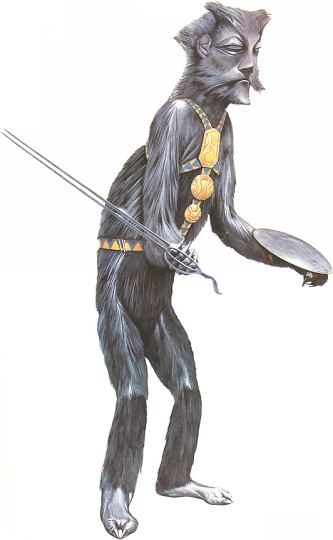
Barlowe had a bit of an odd job here. The description of the Ruml is vague in a lot of cases (the appearance of the face, hands, and feet), but specifies that they cannot stand completely erect, and that their limbs are more inwardly oriented than a human's. I think Barlowe did about as good of a job as I could imagine, but the drawing produced does have a rather stiff look to it. The very human look of the face is a good case of attention to detail, as Kator was able to disguise himself as human merely by shaving his face and wearing thick clothing. I (and the cover artist of this edition) imagined him looking significantly more catlike (the clipping of the whiskers is noted as being particularly disturbing to Kator), but I can't seriously fault Barlowe's choices here.
This book explores the psychology and sociology of an alien group (race?). It was interesting to see the unavoidable and potentially devastating results of miss-understandings. This is a great book if you are interested in cultural anthropology of aliens.
Interesting concept. I liked the 2 main characters. I thought the female character was somewhat of a cardboard cutout,but for it's time,and the fact that it takes 1-2 days to read,it was worthwhile.
ne infamia ne lode, troppe ripetizioni, alla fine il libro poteva esser la meta senza che la trama ne venisse influenzata. Bello il lato psicologico dietro una mente aliena, ma nulla di più.