

What do you think?

Silver John #1
The Old Gods Waken
In the wilds of Southern Appalachia, lies Wolter Mountain—a sacred place for the Indians and for their predecessors. But the land atop the mountaintop, taken over by two Englishmen, Brummitt and Hooper Voth, is undergoing frightening changes.
Strange and evil rumblings begin to happen around the mountain—man-like creatures prowling around, mysterious voices reciting evil incantations that terrorize Luke and Creed Forshay who live at the foot of the mountain. Then a wandering minstrel, known only as John, learns that the Yoths are Old World druids who are hell-bent on reawakening the pre-Indian spirits that sleep at the summit of Wolter Mountain. Armed with his own arsenal of personal powers, John and an Indian medicine man must fight their way through the druids' sorcerous defenses to rescue their friends from certain death at the hands of the blood sacrificing priests.
A tale of mysticism and terror featuring Wellman's famous wandering hero.
Strange and evil rumblings begin to happen around the mountain—man-like creatures prowling around, mysterious voices reciting evil incantations that terrorize Luke and Creed Forshay who live at the foot of the mountain. Then a wandering minstrel, known only as John, learns that the Yoths are Old World druids who are hell-bent on reawakening the pre-Indian spirits that sleep at the summit of Wolter Mountain. Armed with his own arsenal of personal powers, John and an Indian medicine man must fight their way through the druids' sorcerous defenses to rescue their friends from certain death at the hands of the blood sacrificing priests.
A tale of mysticism and terror featuring Wellman's famous wandering hero.
186 pages, Hardcover
First published January 1, 1979
Ratings & Reviews
Friends & Following
Create a free account to discover what your friends think of this book!
Community Reviews
Displaying 1 - 30 of 123 reviews

February 11, 2013
I enjoyed this "Silver John novel," but it is not nearly as good as Wellman's Silver John short stories. The narrative voice of John is purer in the short pieces--both in Appalachian dialect and cultural attitudes--than it is here, and this, plus the brevity and conciseness of the tales themselves, allow the stories to achieve a more powerful mythic feel. Even in the his shorter efforts, however, Wellman sometimes strives to include more "college learrning" than John's world can comfortably hold, and when he forces it--as he does with greater frequency in this longer work--we glimpse the college professor beneath the folksy mask, and the illusion that gives John's voice its uniqueness is dispelled.
Another problem with the book is the uninspired nature of the plot. John and his faithful Indian medicine man companion ascend the hill to save the lives of a handsome young couple (in the first stages of love, of course) who are about to be sacrificed to Druid gods, and the Druid baddies who oppose them have placed seven magical ordeals in their way: falling rocks, fire, mist, scary animals, etc., etc. The story is told in effective, evocative prose, and the characters are admirable and likable (although not all that vivid), but the story itself lacks both originality and power.

September 18, 2010
While Silver John is staying with his friend Creed Forshay and Creed's son Luke, odd things start happening, odd things that seem to center on Forshay's new neighbors, two Englishmen named Brummitt and Hooper Voth. Can Silver John stop the Voth's from using Druidic magic to release an ancient evil?
Silver John is back in a full length novel. If you've read Who Fears The Devil, you know what to expect. The Old Gods Waken reads like an expanded version of a Silver John short story. All the things I liked about the Silver John short stories were here: Silver John himself, his bits of lore, and ancient evils lurking just around the corners of the Appalachian mountains.
The supporting cast was a little ahead of its time. Reuben Manco could have easily been a stereotypical Indian character and it was nice to see him mocking such stereotypes. Holly was a much stronger character than most female characters of the period, back when women in pulp stories were either victims or bait. The Voth brothers were suitably creepy and I loved how Wellman wove the Raven Mockers of Indian mythology into a story about druids.
It wasn't all roses and sunshine, though. I felt like parts of the story were a little on the convenient side and I didn't think the writing was as good as it was in the short stories in Who Fears the Devil.
Really, no big complaints. It was nice to read about Silver John again. I'd give it a 3.5 if I could.
Silver John is back in a full length novel. If you've read Who Fears The Devil, you know what to expect. The Old Gods Waken reads like an expanded version of a Silver John short story. All the things I liked about the Silver John short stories were here: Silver John himself, his bits of lore, and ancient evils lurking just around the corners of the Appalachian mountains.
The supporting cast was a little ahead of its time. Reuben Manco could have easily been a stereotypical Indian character and it was nice to see him mocking such stereotypes. Holly was a much stronger character than most female characters of the period, back when women in pulp stories were either victims or bait. The Voth brothers were suitably creepy and I loved how Wellman wove the Raven Mockers of Indian mythology into a story about druids.
It wasn't all roses and sunshine, though. I felt like parts of the story were a little on the convenient side and I didn't think the writing was as good as it was in the short stories in Who Fears the Devil.
Really, no big complaints. It was nice to read about Silver John again. I'd give it a 3.5 if I could.

September 8, 2024
I don’t write reviews.
“I wished I didn’t keep afeeling something was there in the loft with me. Maybe humped over at the foot of the cot or hanging in the rafters like a big bat. I told myself, that it was just only my fancy, but that made it worse. No luck gentlemen, being bothered with what’s not there. Better maybe, for it to be there so you can do something about it. I hated that kind of sneaky company in the dark.”
Wellman’s Silver John is such a loyal, enduring and truly good character. He opposes ancient evil and never gives up. The optimism of these stories really warms my heart. I love the inclusion of Americana and folk lore. The perfect Saturday afternoon read.
“I wished I didn’t keep afeeling something was there in the loft with me. Maybe humped over at the foot of the cot or hanging in the rafters like a big bat. I told myself, that it was just only my fancy, but that made it worse. No luck gentlemen, being bothered with what’s not there. Better maybe, for it to be there so you can do something about it. I hated that kind of sneaky company in the dark.”
Wellman’s Silver John is such a loyal, enduring and truly good character. He opposes ancient evil and never gives up. The optimism of these stories really warms my heart. I love the inclusion of Americana and folk lore. The perfect Saturday afternoon read.
![Profile Image for [Name Redacted].](https://i.gr-assets.com/images/S/compressed.photo.goodreads.com/users/1347082397i/287915._UY200_CR0,0,200,200_.jpg)
July 26, 2011
Why are these books out of print? What is wrong with our society? What madman (or madwoman!) decided contemporary readers would be disinterested in what is essentially a series of books about a young Johnny Cash fighting supernatural evil (often of the Lovecraftian persuasion) in mid-20th century Appalachia?!? This stuff is GOLD!
The protagonist-narrator is known only as John, but he is known by fans of the series as "John the Balladeer" and "Silver John". He is a wandering minstrel of sorts with a silver-stringed guitar and a cheerful disposition. He doesn't seem to have any special powers or knowledge, other than musical talent, some folklore, and an amazing knack for making friends -- he doesn't even know how to drive a car! But both his musical ability and his affability are key to his evil-fighting, because he is able to befriend and enlist to his cause people who ARE powerful and knowledgeable. Plot developments which might seem contrived or excessively convenient in another book make sense here because of who John is, what he does, and what he's like -- a nice guy who likes people and travels a lot.
The author also seems to love playing with mid-20th century American stereotypes. The farmers, through whom we are introduced to John, love their land but they also value higher education and spending time outside of their small communities. The Appalachian mountain man protagonist is repeatedly baffled by the erudition of the scholars he encounters, but responds with more of a "Huh-that's-over-my-head-but-it-sounds-interesting" attitude than any of the stereotypical responses one would expect ("I-don't-cotton-to-no-book-larnin'" and "Well-Golllleeeeee-you-sure-is-smarter-than-me-oh-mighty-city-person" being the two obvious examples). The female lead is brave, educated and competent, and remains calm even while the men around her are giving in to their emotions. The Cherokee chief is also a brilliant Dartmouth-educated scholar and contributor to academic journals who uses white folks' low expectations and racism to his advantage. The two Druids are bloodthirsty and evil, more akin in their praxis and credo to actual ancient druids than the New Age revisionist nonsense passed of as "ancient" paganism. There's even a scene in which some of the characters argue that even though they have to stop the old gods, you can't really blame a god who's been marginalized/supplanted/forgotten for turning evil.
Overall a fun, intelligent book by an author who gives his subjects (mountain men, Appalachian farmers, women, Native Americans, druidism, music, etc.) more credit than almost any other author I've ever before encountered.
The protagonist-narrator is known only as John, but he is known by fans of the series as "John the Balladeer" and "Silver John". He is a wandering minstrel of sorts with a silver-stringed guitar and a cheerful disposition. He doesn't seem to have any special powers or knowledge, other than musical talent, some folklore, and an amazing knack for making friends -- he doesn't even know how to drive a car! But both his musical ability and his affability are key to his evil-fighting, because he is able to befriend and enlist to his cause people who ARE powerful and knowledgeable. Plot developments which might seem contrived or excessively convenient in another book make sense here because of who John is, what he does, and what he's like -- a nice guy who likes people and travels a lot.
The author also seems to love playing with mid-20th century American stereotypes. The farmers, through whom we are introduced to John, love their land but they also value higher education and spending time outside of their small communities. The Appalachian mountain man protagonist is repeatedly baffled by the erudition of the scholars he encounters, but responds with more of a "Huh-that's-over-my-head-but-it-sounds-interesting" attitude than any of the stereotypical responses one would expect ("I-don't-cotton-to-no-book-larnin'" and "Well-Golllleeeeee-you-sure-is-smarter-than-me-oh-mighty-city-person" being the two obvious examples). The female lead is brave, educated and competent, and remains calm even while the men around her are giving in to their emotions. The Cherokee chief is also a brilliant Dartmouth-educated scholar and contributor to academic journals who uses white folks' low expectations and racism to his advantage. The two Druids are bloodthirsty and evil, more akin in their praxis and credo to actual ancient druids than the New Age revisionist nonsense passed of as "ancient" paganism. There's even a scene in which some of the characters argue that even though they have to stop the old gods, you can't really blame a god who's been marginalized/supplanted/forgotten for turning evil.
Overall a fun, intelligent book by an author who gives his subjects (mountain men, Appalachian farmers, women, Native Americans, druidism, music, etc.) more credit than almost any other author I've ever before encountered.

October 3, 2020
This is my first adventure with Silver John and I loved it! My friend Ronald recommended this author to me a while ago. I saw this title as one i could listen to for free with my audible membership and I added it to my list. I'm so glad I spent the day with Silver John up on Wolter Mountain. I love, love the dialect. I'm from north east Tennessee and I can vouch for it accuracy. The story was engaging and very entertaining. Stefan Rudnicki reads this. He does a very good job. His voice is very deep and I loved it. He was a perfect match to read this southern tale of horror.
I tried to look up the songs mentioned in the book and these are the ones I found- https://www.youtube.com/playlist?list...
June 16, 2023
“I try to pick the oldest songs in the mountains.” I smiled my friendliest. “A-going here and there in these mountains, a-carrying my guitar with the silver strings.”
Silver John, or John the Balladeer, is a roving musician who travels extremely light all through the Appalachian Mountains, welcomed everywhere he goes for his amiable nature and for his treasure trove of old songs and even older folk tales. A modern minstrel that might seem out of place anywhere else but in this remote and fiercely traditional region of North Carolina.
“John’s a man of ripe sense and high native wit.”
This is my first book by Manly Wade Wellman, picked mostly because it comes recommended by one of my favourite pulp writers and editors: Karl Edward Wagner, who wrote this about his friend:
"These stories are chilling and enchanting, magical and down-to-earth, full of wonder and humanity. They are fun. They are like nothing else you’ve read before."
Wagner is right, this novel is unlike any other pulp or horror novel I’ve read before, simple and straightforward if I consider only its plot, yet rich beyond expectations in local colour [Wellman’s use of mountain archaic idiom is particularly pleasing], in creating a sense of wonder and adventure, and in actually making me believe a bunch of rednecks from the backwoods can engage in academic level conversations about myths and legends.
Wellman wrote not only horror pulps, but also history and ethnography for the region he evokes so well in this novel.
“Sith Bruaith,” Brummit Voth said after her. “You know about that. So do we.”
“Oh, in England, the Goodman Croft,” said Holly.
“I’ve heard tell about places called that in these mountains,” I felt like putting in. “A piece of land let go to trees and brush and so on, for the spirits. They say you call Satan the Goodman, so as not to rile him. But I’ve had it in mind that maybe old, old gods were thought to be good in their day.”
Something, maybe one of these old gods, stirs up in the mountain behind the farm of one Mr. Creed Forshay, as a couple of new neighbours try to fence in a meadow that has been in his family for generations. John the Balladeer, who is passing through, offers his services as a mediator with the two brothers who bought another old farm up the mountain, but he is warned off by them.
After several supernatural manifestations and a kidnapping of a young friend of John who is a university researcher, it becomes clear that something must be done about those two dangerous Voth brothers. Who apparently practice a forgotten type of religion, as did the original owner of their farm, who came over from England more that two hundreds years before.
“A lot of half-romantic foolishness has been said and written about Druids. They’ve been described as noble savages. But they weren’t savages – not when they had metalwork and grew crops and built stone temples. And they weren’t particularly noble either, not with bloody human sacrifices to their gods of nature.”
There aren’t many druid fantasy novels, and the ones I’ve read do tend to paint a weirdly New Age pastel image of a savage cult, just like John observes in the novel [Jennifer Roberson, for example]. Wellman sets the record straight here with a fine example of how such malefic practitioners can use natural phenomena to destroy their enemies.
Most of the novel subscribes to a classic hero on a quest plot, as John and his friend Reuben Manco, a Cherokee shaman, try to climb the mountain at night and have to face seven deadly perils, each one more elaborate than the previous.
The conversations between the two friends as they climb may seem contrived and designed to explain the plot, but the friendship in adversity feels real and the subject extremely interesting to me.
A bonus to those like me who enjoy old pulps, writers of that era rarely needed more than a couple of hundred pages to make their point, so this story doesn’t feel bloated with unnecessary scenes or descriptions.
“Very well, young friends, can you truly blame a broken, beaten god for becoming an outlaw, with an outlaw’s motives and behaviour? For making a virtue of necessity and trying to fight back?”
Without giving out any more spoilers about the intense action, my favourite aspect of this story is the blending of the old Celtic myths with Native American legends and even with speculations about the religion of the oldest prehistoric inhabitants of the continent.
I hope I will manage to continue to read Wellman’s stories about Appalachian legends and songs.
November 7, 2018
If you tend to read fantasy with historical, or cultural themes, you might like The Old Gods Waken. The reader is lulled in the beginning with a peaceful setting, but an unexplainable happening intrudes, followed by others, and soon the plot is deep in demonology. Amid the horror, Silver John has opportunities to prove his self-sufficiency, and soon it follows, that the underdog wins out. This certainly contributes to the humorous elements, that do become philosophical at the same time.
Notably though, the protagonist, John, is quite the timeless mythic American hero. Silver John is a balladeer who wanders the mountains collecting folk songs and battling evil. He might be compared to the legends we recognize readily like: Robin Hood, Knight Errant, or even Aragorn. These comparisons seem relateable and the reader is left in closing to hope that he is still wandering alone through the mountains of magic, forever young, true and brave of heart, and forever simple in the mysterious world. Silver John, captures the heart of Appalachia and hearkens back the time when mountain-folk were idealized until industrialization threatened their glory.
We also learn about the effable, Evadare, who is John’s fiancée. Also, the inclusion of Holly Christopher, is enjoyable. Holly, we learn, is a friend of John’s and a scholar of folklore and perhaps is quite interested in John for that reason. Yet, aside from this, despite myself, I kept wondering whatever had happened to Evadare, John's 'true love' by the end of the story. I believed that she was one who was ready to go anywhere with him when they left Hosea's Hollow. She is mentioned, but does not appear again? Why? Is this a part of the darkness entering the mountain?
This is how Wellman does succeed in his pacing of the plot and selective character development, and point-of-view. In sum, while it may be a predictable work, it is well-written and makes for an entertaining (abet generational) read. It's obvious that Wellman spent time in the mountains of Appalachia, and knows the people there. One must be sensitive to the dialectical approaches he used as used as oftentimes "air," meaning "every," or "any," might be confused without close attention. Wellman's use of the words/phrases like "youins," and "might could" was perhaps more understandable. While this seems to be true to the Appalachian dialect, at closer inspection, it is difficult to say whether this sort of dialogue was prevalent in the short stories written in the time period of the 1950's. Strangely, his dialect usage seems perhaps forced at times, or at least difficult to determine.
Apart from these aspects, this is well worth reading over and over for its nostalgic qualities and yore.
Notably though, the protagonist, John, is quite the timeless mythic American hero. Silver John is a balladeer who wanders the mountains collecting folk songs and battling evil. He might be compared to the legends we recognize readily like: Robin Hood, Knight Errant, or even Aragorn. These comparisons seem relateable and the reader is left in closing to hope that he is still wandering alone through the mountains of magic, forever young, true and brave of heart, and forever simple in the mysterious world. Silver John, captures the heart of Appalachia and hearkens back the time when mountain-folk were idealized until industrialization threatened their glory.
We also learn about the effable, Evadare, who is John’s fiancée. Also, the inclusion of Holly Christopher, is enjoyable. Holly, we learn, is a friend of John’s and a scholar of folklore and perhaps is quite interested in John for that reason. Yet, aside from this, despite myself, I kept wondering whatever had happened to Evadare, John's 'true love' by the end of the story. I believed that she was one who was ready to go anywhere with him when they left Hosea's Hollow. She is mentioned, but does not appear again? Why? Is this a part of the darkness entering the mountain?
This is how Wellman does succeed in his pacing of the plot and selective character development, and point-of-view. In sum, while it may be a predictable work, it is well-written and makes for an entertaining (abet generational) read. It's obvious that Wellman spent time in the mountains of Appalachia, and knows the people there. One must be sensitive to the dialectical approaches he used as used as oftentimes "air," meaning "every," or "any," might be confused without close attention. Wellman's use of the words/phrases like "youins," and "might could" was perhaps more understandable. While this seems to be true to the Appalachian dialect, at closer inspection, it is difficult to say whether this sort of dialogue was prevalent in the short stories written in the time period of the 1950's. Strangely, his dialect usage seems perhaps forced at times, or at least difficult to determine.
Apart from these aspects, this is well worth reading over and over for its nostalgic qualities and yore.

May 31, 2015
Manly Wade Wellman was born in 1903, in what is now Angola. His father was a physician at the English station there. Wellman was educated in the United States after his parents settled here when he was seven. But his real education began as a small child when he was adopted by a local chief who taught him the native dialect and about the pantheon of African gods. When Wellman began writing, he used that knowledge for his first sale in 1927 to Weird Tales, beginning a prolific career as a contributor to that and other fantasy and science fiction magazines.
At the height of his career, Wellman was referred to as “the dean of fantasy writers.” He developed series based on several characters of the psychic detective variety, and later in life became known for horror and fantasy stories set in the Appalachian south. Today he is largely forgotten and almost completely out of print. A few titles are available as e-books, and used copies of titles sell anywhere from a couple of bucks to hundreds of dollars. If you get interested, check your local library.
Wellman’s most popular character was John the Balladeer, also known as Silver John. John wanders the Ozarks with his guitar and has a knack for stumbling onto ancient evils and satanic rites. John narrates the stories in dialect, which can make you feel like you are reading an episode of The Waltons. (’Night, John Boy.) But Wellman had settled in South Carolina, and he has the dialect and colloquialisms down pat. I fell right in the rambling style.
The Old Gods Waken has John, with the help of an elderly Cherokee chieftain who happened to major in folklore and world religions at Dartmouth, defeating a pair of Druids intent on opening the gates that will let the Old Gods back onto earth via a portal on a mountain in the Appalachias. As Lovecraftian as that sounds, the book is more concerned with Druidism and Native American traditions, with just about every other religion and occult tradition you can thank of given at least a passing reference. One failing of Wellman’s style is his tendency to lecture on these topics as though he is determined to have his hours spent in libraries pay off.
John and his Indian companion must face seven perils before the human sacrifices begin at midnight on Midsummer’s Eve. Wellman knows how to plot a story. Three fourths of the action takes place between dawn and midnight on a single day. But the dialog can be creaky and the cornball factor might defeat some readers. Wellman is recommended only to those who aspire to be Weird Fiction Completists.
At the height of his career, Wellman was referred to as “the dean of fantasy writers.” He developed series based on several characters of the psychic detective variety, and later in life became known for horror and fantasy stories set in the Appalachian south. Today he is largely forgotten and almost completely out of print. A few titles are available as e-books, and used copies of titles sell anywhere from a couple of bucks to hundreds of dollars. If you get interested, check your local library.
Wellman’s most popular character was John the Balladeer, also known as Silver John. John wanders the Ozarks with his guitar and has a knack for stumbling onto ancient evils and satanic rites. John narrates the stories in dialect, which can make you feel like you are reading an episode of The Waltons. (’Night, John Boy.) But Wellman had settled in South Carolina, and he has the dialect and colloquialisms down pat. I fell right in the rambling style.
The Old Gods Waken has John, with the help of an elderly Cherokee chieftain who happened to major in folklore and world religions at Dartmouth, defeating a pair of Druids intent on opening the gates that will let the Old Gods back onto earth via a portal on a mountain in the Appalachias. As Lovecraftian as that sounds, the book is more concerned with Druidism and Native American traditions, with just about every other religion and occult tradition you can thank of given at least a passing reference. One failing of Wellman’s style is his tendency to lecture on these topics as though he is determined to have his hours spent in libraries pay off.
John and his Indian companion must face seven perils before the human sacrifices begin at midnight on Midsummer’s Eve. Wellman knows how to plot a story. Three fourths of the action takes place between dawn and midnight on a single day. But the dialog can be creaky and the cornball factor might defeat some readers. Wellman is recommended only to those who aspire to be Weird Fiction Completists.

May 7, 2014
I can't say if Wellman wrote with this in mind, but the story is a rebuttal to so much of H P Lovecraft, both in terms of theme and writing.
The Appalachian setting, for Lovecraft, would conceal a layer of dark rot, of degenerate and inbred and crossbred--okay, maybe not at the same time--inhabitants and a miasma of invasion and corruption and seafoodish textures and smells. And a strangely bookish and rational narrator, faceless and maladjusted, in total denial of mounting evidence until someone lobs a hoary, secrets-containing volume at his head.
John (Silver John? John the Balladeer?) narrates with an easy calmness and utter decency in a musical patois lightly hinted at, and these backwoods come with a natural beauty and people of a solid humanity, and if some ancient horror lurks here then there are many willing to believe and fight.
I don't think the novel format suits the character or the story: after the mystery is cleared it becomes a series of set challenges to overcome, and then the story loses its unique character.
The Appalachian setting, for Lovecraft, would conceal a layer of dark rot, of degenerate and inbred and crossbred--okay, maybe not at the same time--inhabitants and a miasma of invasion and corruption and seafoodish textures and smells. And a strangely bookish and rational narrator, faceless and maladjusted, in total denial of mounting evidence until someone lobs a hoary, secrets-containing volume at his head.
John (Silver John? John the Balladeer?) narrates with an easy calmness and utter decency in a musical patois lightly hinted at, and these backwoods come with a natural beauty and people of a solid humanity, and if some ancient horror lurks here then there are many willing to believe and fight.
I don't think the novel format suits the character or the story: after the mystery is cleared it becomes a series of set challenges to overcome, and then the story loses its unique character.

January 28, 2022
The Old Gods Waken was only a 5 hour audio, but it felt longer than that.
I'm glad that I read it, (because I've heard so much about Silver John and Manly Wade Wellman), but I'm also glad I'm done with it. I will try to search out some Silver John short stories, because I've heard they're great.
This came free as part of my Audible membership, it was in the Plus catalog, but will be expiring soon, so get it quick if you're interested!
I'm glad that I read it, (because I've heard so much about Silver John and Manly Wade Wellman), but I'm also glad I'm done with it. I will try to search out some Silver John short stories, because I've heard they're great.
This came free as part of my Audible membership, it was in the Plus catalog, but will be expiring soon, so get it quick if you're interested!

April 26, 2024
Silver John has to be one of the most down to earth protagonists I've come across in a long time. His whole demeanor is exactly what I'm looking for in a hero. Nothing flashy, just a guy with a guitar and a whole lot of know-how when it comes to navigating social encounters.
I was also a fan of how the native American chief was portrayed. Although it is an older book, and uses the dated term Indian, it does not play into the stereotypes and even points them out.
I was also a fan of how the native American chief was portrayed. Although it is an older book, and uses the dated term Indian, it does not play into the stereotypes and even points them out.

February 28, 2014
beverly hillbillies meets d&d. amazing.
June 3, 2012
Recently, I had the good fortune of coming across several short stories by Weird Tales alumnus Manly Wade Wellman. Now, I had been aware of him for decades, because of his association with Weird Tales magazine, which was the alma mater of many of the 20th century’s biggest names in the Science Fiction, Fantasy, and Horror genres, many of whom were part of the “Lovecraft Circle” of writers that under the guidance of H.P. Lovecraft, helped create and expand upon the original Cthulhu Mythos. This elite group consisted of many Weird Tale luminaries such as Clark Ashton Smith, August Derleth, Robert E Howard, and Robert Bloch, to name a few. Wellman, however, was not part of this circle (although he later apparently wrote some covert Mythos tales in his later years and even made reference to his WT colleagues within these tales), and so I ignored him for years, and only now do I see the error of my slight.
Manly Wade Wellman delved into several different Fantasy subgenres creating characters that he would return to in various short stories and novels over the span of his decades-long career, including Hok the Mighty (Swords & Sorcery), Detective John Thunstone (Occult Mystery), and most famously, John the Balladeer.
John a/k/a “Silver John” is a traveling minstrel who lives in mid-20th Century Appalachia. He is a veteran of the Korean War and a home-grown scholar of local folklore and occult knowledge. In Wellman’s stories John roams from town to town singing old-timey folk tunes (some genuinely traditional and some original to the tales) on his silver-strung guitar, which he also uses to ward off local haints (i.e. ghosts) and a host of supernatural creatures which hail from Native American and European folklore, as well as the odd Weird Tales indigene. The stories, though never preachy, do have some Christian overtones, but it all seems to fit within the contextual framework of the stories, which are also full of genuine Appalachian folk beliefs, customs and patois, that all serve to enrich the stories and give them an air of authenticity.
Silver John appears in 30 some-odd tales as well as 5 novels; one of which I read recently called “The Old Gods Waken”. In this slim novel, Silver John agrees to help a couple of friends (Luke and Creed Forshay) settle a land dispute with a couple of recently transplanted Englishmen who are trying to set up a fence just beyond the legal border of their land, and in the process encroaching upon the Forshay’s territory. During a meeting with the Brits, Brummit and Hooper Voth, a couple of eccentric brothers with a keen interest in Druidism and the indigenous folklore, Silver John notices some odd things on their land that make him uneasy so he enlists the help of a couple of knowledgeable friends, the lovely Miss Holly Christopher, who is part Cheyenne and well read in many anthropological subjects and an older Cherokee man named Ruben Manco, who is equally acquainted with many local folk beliefs and traditions. Holly and Luke hit it off right from the start but end up getting kidnapped by the Voth brothers, whom it seems intend to use them for some nefarious Druidic rituals. Creed who is injured in the kidnapping, is told to rest up while John and Ruben agree to go retrieve their friends and end up embarking on a quest, bonding with one another while facing 7 specific perils on their way through the forest and up the mountain to the Voth estate where their friends are being held. The individual challenges feel almost like the hillbilly versions of the sort of tests a Homerian hero would have endured in an odyssey of yore. I won’t say anything more so as not to ruin the fun of reading them as they appear in the tale, but I do recommend you check it out if you can ever find a copy of this book in a library or second hand store.
Manly Wade Wellman delved into several different Fantasy subgenres creating characters that he would return to in various short stories and novels over the span of his decades-long career, including Hok the Mighty (Swords & Sorcery), Detective John Thunstone (Occult Mystery), and most famously, John the Balladeer.
John a/k/a “Silver John” is a traveling minstrel who lives in mid-20th Century Appalachia. He is a veteran of the Korean War and a home-grown scholar of local folklore and occult knowledge. In Wellman’s stories John roams from town to town singing old-timey folk tunes (some genuinely traditional and some original to the tales) on his silver-strung guitar, which he also uses to ward off local haints (i.e. ghosts) and a host of supernatural creatures which hail from Native American and European folklore, as well as the odd Weird Tales indigene. The stories, though never preachy, do have some Christian overtones, but it all seems to fit within the contextual framework of the stories, which are also full of genuine Appalachian folk beliefs, customs and patois, that all serve to enrich the stories and give them an air of authenticity.
Silver John appears in 30 some-odd tales as well as 5 novels; one of which I read recently called “The Old Gods Waken”. In this slim novel, Silver John agrees to help a couple of friends (Luke and Creed Forshay) settle a land dispute with a couple of recently transplanted Englishmen who are trying to set up a fence just beyond the legal border of their land, and in the process encroaching upon the Forshay’s territory. During a meeting with the Brits, Brummit and Hooper Voth, a couple of eccentric brothers with a keen interest in Druidism and the indigenous folklore, Silver John notices some odd things on their land that make him uneasy so he enlists the help of a couple of knowledgeable friends, the lovely Miss Holly Christopher, who is part Cheyenne and well read in many anthropological subjects and an older Cherokee man named Ruben Manco, who is equally acquainted with many local folk beliefs and traditions. Holly and Luke hit it off right from the start but end up getting kidnapped by the Voth brothers, whom it seems intend to use them for some nefarious Druidic rituals. Creed who is injured in the kidnapping, is told to rest up while John and Ruben agree to go retrieve their friends and end up embarking on a quest, bonding with one another while facing 7 specific perils on their way through the forest and up the mountain to the Voth estate where their friends are being held. The individual challenges feel almost like the hillbilly versions of the sort of tests a Homerian hero would have endured in an odyssey of yore. I won’t say anything more so as not to ruin the fun of reading them as they appear in the tale, but I do recommend you check it out if you can ever find a copy of this book in a library or second hand store.

August 3, 2019
На книгата попаднах по препоръка от Брайън Кийн, който твърди, че историите за Силвър Джон са му помогнали при изграждането на неговия окултен детектив Леви Щолцфуз. Естествено, нямаше как да не последвам съвета на един от любимите си писатели и да не надникна за какво става въпрос.
Историите за Силвър Джон са градско фентъзи, писано доста преди да стане популярно, да не говоря колко преди Бътчър и неговият Хари Дрезден да започнат да касират тази популярност. Цикълът съдържа 28 разказа и 5 романа, които се разказват от Силвър Джон – фолклорист, който обикаля из южната част на Апалачите с китарата си и събира стари песни и който постоянно се натъква на свързани със старите индиански и заселнически легенди явления, събития и ужасии.
Това е първият роман за Джон и май преди това трябваше да отхвърля няколко разказа, защото както при Сапковски и тук цялостната картина свързва историите.
Въпреки това книгата ми се вслади много. Педи да нахвърлям съдържанието накратко, искам неща, които ме впечатлиха много.
- Едно от най-добрите вкарвания на диалект в повествованието – Джон, като разказвач на историите, говори като жител на Южна Каролина, но това е направено страшно ненатрапчива. Уелмън е използвал само няколко архаични думи, изрази и представки, но се е постарал да го прави достатъчно често, та читателя да хване „мелодията“ на речта, без да натежи.
- Едни от най-добре вкараните обяснения в диалог – без да се усещат като лекция, защото използва няколко героя с различна степен на познание, читателят научава легенди на сиуксите, шайените, чероките и келтските друиди. Всички се преплитат чудесно в една цялостна история.
- Много силен женски образ и макар да изпада в неприятности, Холи е силна личност, много далеч от девицата в беда.
- Много силен образ на индиански лечител. Рубен Манко сам се ебава със стереотипите, но запазва чара на коренното население на континента, въпреки дипломата си по фолклористика. Изключително добро сливане на традиции и съвремие.
Ама за сюжета:
Силвър Джон случайно гостува на баща и син Крийд, които имат конфликт за земя със съседите си – братята Вот. Разглеждайки въпросния парцел, Джон осъзнава, че има нещо дълбоко смущаващо в него. В последствие разбира, че за земята има двестагодишна легенда, а омиротворяващото посещение при братята му показва, че не са простите фемери на които се правят. Джон решава да потърси помощ от Холи Кристофър – негова приятелка, изучаваща фолклористика, и Рубен Манко – лечител от племето Чероки.
Скоро се оказва, че проблемите са много по-големи и Джон и Рубен трябва да преминат серия свръхестествени препятствия, за да спрат кърваво жертвоприношение, целящо да събуди един от старите келтски/шумерски/филистимянски богове.
Звезда назад, защото като първи роман от серията все още носи белезите на разказите и на места провлачва. Иначе е доста добре балансирана книжка с количества история, митология, страх от неизвестното (почти ала Лъвкрафт) и здрав екшън. А и през цялото време запазва напевния стил на история разказвана покрай огъня късно вечер.
Историите за Силвър Джон са градско фентъзи, писано доста преди да стане популярно, да не говоря колко преди Бътчър и неговият Хари Дрезден да започнат да касират тази популярност. Цикълът съдържа 28 разказа и 5 романа, които се разказват от Силвър Джон – фолклорист, който обикаля из южната част на Апалачите с китарата си и събира стари песни и който постоянно се натъква на свързани със старите индиански и заселнически легенди явления, събития и ужасии.
Това е първият роман за Джон и май преди това трябваше да отхвърля няколко разказа, защото както при Сапковски и тук цялостната картина свързва историите.
Въпреки това книгата ми се вслади много. Педи да нахвърлям съдържанието накратко, искам неща, които ме впечатлиха много.
- Едно от най-добрите вкарвания на диалект в повествованието – Джон, като разказвач на историите, говори като жител на Южна Каролина, но това е направено страшно ненатрапчива. Уелмън е използвал само няколко архаични думи, изрази и представки, но се е постарал да го прави достатъчно често, та читателя да хване „мелодията“ на речта, без да натежи.
- Едни от най-добре вкараните обяснения в диалог – без да се усещат като лекция, защото използва няколко героя с различна степен на познание, читателят научава легенди на сиуксите, шайените, чероките и келтските друиди. Всички се преплитат чудесно в една цялостна история.
- Много силен женски образ и макар да изпада в неприятности, Холи е силна личност, много далеч от девицата в беда.
- Много силен образ на индиански лечител. Рубен Манко сам се ебава със стереотипите, но запазва чара на коренното население на континента, въпреки дипломата си по фолклористика. Изключително добро сливане на традиции и съвремие.
Ама за сюжета:
Силвър Джон случайно гостува на баща и син Крийд, които имат конфликт за земя със съседите си – братята Вот. Разглеждайки въпросния парцел, Джон осъзнава, че има нещо дълбоко смущаващо в него. В последствие разбира, че за земята има двестагодишна легенда, а омиротворяващото посещение при братята му показва, че не са простите фемери на които се правят. Джон решава да потърси помощ от Холи Кристофър – негова приятелка, изучаваща фолклористика, и Рубен Манко – лечител от племето Чероки.
Скоро се оказва, че проблемите са много по-големи и Джон и Рубен трябва да преминат серия свръхестествени препятствия, за да спрат кърваво жертвоприношение, целящо да събуди един от старите келтски/шумерски/филистимянски богове.
Звезда назад, защото като първи роман от серията все още носи белезите на разказите и на места провлачва. Иначе е доста добре балансирана книжка с количества история, митология, страх от неизвестното (почти ала Лъвкрафт) и здрав екшън. А и през цялото време запазва напевния стил на история разказвана покрай огъня късно вечер.

July 21, 2021
Notes:
Currently on Audible +
Interesting setup for old deities walking in present day. Great narration by Stefan Rudnicki.
Currently on Audible +
Interesting setup for old deities walking in present day. Great narration by Stefan Rudnicki.

April 21, 2015
In the middle of reading this, I tweeted out that If you wanted to know what The Devil Rides Out would have been like in Appalachia, The Old Gods Waken is pretty much it. And that's pretty much true, but not exactly. Old Gods—Many Wade Wellman's tale of John [no last name] helping the Forshays [Creed and Luke, father/son farmers] against the Voths [Brummitt and Hooper, strange brothers who are up to something] in what starts out as a property dispute and then grows worse—actually engages in two story modes; and though the demarcation between them is unmarked, it is obvious upon reading.
The first, which is closer in tone to the Dennis Wheatley novel, involves John and the Forshays and a pair of allies [Holly Christoper and Reuben Manco, the latter a Native American played both in and out of stereotype in a way that is intriguing] gathering because the Voth brothers have tried to fence off part of Creed Forshays' land, a plot of land that contains some old stones that look something like a large humanoid figure. John's investigation finds the Voths up to something dark, so he calls in the aforementioned allies. Information about the land, about different types of magic, about different cultures and history, about the distant past, and ways to protect yourself is shared. While there is no clear Duke De Richleau character, the ambiance is still the same: learned friends help younger friends to plot against evil.
However, around the 2/5 mark, the book shifts from a discourse on good/evil and engages in the monomyth structure of a series of trials. The focus dials down to John and Reuben [the old Cherokee becomes the wise-man to John's squire, while also something like the side-kick to John's hero, in a bit of purposeful double-vision], and the bulk of the book is them surviving the tribulations set before them, with the information given in the beginning being cited where needed (though largely ignored except in passing).
It is interesting when a book undergoes a speed shift, as it does here, with the first part happening over 24-hours, and the last part, the larger part, happening in only something like 4 or 5 hours. Admittedly, a mad dash across Europe was a major portion of Devil Rides Out, but Wheatley felt as though he was adding in travel to invoke a sense of richness and decadent adventure, while Wellman is full on engaging in hero-myth. The flavors are different.
With the exception of the clunky device to help set up the trials—"No sense in trying the regular trail up."—and a mild disjoint that occurs across the first 20 pages into the trials when you find yourself adjusting the change in tempo, it makes for a fun read, a mish-mash (with no terrible mismatch) of European lore and Native American lore and Appalachian folklore. Wellman dives into the similarities of man's myth structures without being too academic, and dives into folksiness without being too country-bumpkin, a blend that could have been better honed in places [especially in the case of the tacked-on love story which is cute and nearly believable but never quite useful] but one which is still plenty sharp.
The first, which is closer in tone to the Dennis Wheatley novel, involves John and the Forshays and a pair of allies [Holly Christoper and Reuben Manco, the latter a Native American played both in and out of stereotype in a way that is intriguing] gathering because the Voth brothers have tried to fence off part of Creed Forshays' land, a plot of land that contains some old stones that look something like a large humanoid figure. John's investigation finds the Voths up to something dark, so he calls in the aforementioned allies. Information about the land, about different types of magic, about different cultures and history, about the distant past, and ways to protect yourself is shared. While there is no clear Duke De Richleau character, the ambiance is still the same: learned friends help younger friends to plot against evil.
However, around the 2/5 mark, the book shifts from a discourse on good/evil and engages in the monomyth structure of a series of trials. The focus dials down to John and Reuben [the old Cherokee becomes the wise-man to John's squire, while also something like the side-kick to John's hero, in a bit of purposeful double-vision], and the bulk of the book is them surviving the tribulations set before them, with the information given in the beginning being cited where needed (though largely ignored except in passing).
It is interesting when a book undergoes a speed shift, as it does here, with the first part happening over 24-hours, and the last part, the larger part, happening in only something like 4 or 5 hours. Admittedly, a mad dash across Europe was a major portion of Devil Rides Out, but Wheatley felt as though he was adding in travel to invoke a sense of richness and decadent adventure, while Wellman is full on engaging in hero-myth. The flavors are different.
With the exception of the clunky device to help set up the trials—"No sense in trying the regular trail up."—and a mild disjoint that occurs across the first 20 pages into the trials when you find yourself adjusting the change in tempo, it makes for a fun read, a mish-mash (with no terrible mismatch) of European lore and Native American lore and Appalachian folklore. Wellman dives into the similarities of man's myth structures without being too academic, and dives into folksiness without being too country-bumpkin, a blend that could have been better honed in places [especially in the case of the tacked-on love story which is cute and nearly believable but never quite useful] but one which is still plenty sharp.

June 26, 2014
First in the Silver John science fiction fantasy series revolving around a folksinging guitar player and his friends. This story takes place on Wolter Mountain in the Appalachians.
My Take
I love Wellman’s use of language and his folksy approach . . . and I’m at a loss to explain how varied this is. It’s the people and their inner goodness. John’s warm and comforting reassurances. The Chief’s snarky sense of humor about “white man” expectations, lol, even as he steps up when it’s evil come a’calllin’. There’s also Holly’s blend of college education and warm-hearted acceptance of a less scholarly angle.
For such a short story, 186 pages, you can’t help but be impressed with the level of background detail and the wealth of Wellman’s imagery. Wellman shows you how it’s done *grin*.
If you love history, culture, self-sufficiency, and the underdog winning out, you can’t help but love Wellman’s The Old Gods Waken.
The Story
It’s lucky for the Forshays that Luke befriended Silver John at that festival, for he knows how to deal with the deadly magic that flows down the mountain.
Even luckier that Rueben Manco is willing to root out that evil and endure the seven tests.
The Characters
Silver John is a balladeer who wanders the mountains collecting folk songs and battling evil. Evadare is John’s fiancée. Holly Christopher is a friend of John’s and a scholar of folklore with university learning and an appreciation for what she can discover outside a university.
Creed Forshay owns a farm up in the Appalachian mountains. Luke is his son, who helps him work the land and has degrees in English and history.
Rueben Manco is Cherokee, a medicine man, and a graduate of Dartmouth, for all that he likes to fool around with people’s expectations.
Brummitt and Hooper Voth are brothers who inherited the old Gibb place up on the mountain top. Jonathan Gibb was the last of his line and a complete loner. John Gibb was the ancestor who first settled this homestead.
The Cover & Title
The cover is fantastical with a an old hermit carrying a long-handled sickle as he wanders an alien landscape with mountains in the background and a full moon hovering while lightning crackles in the sky above.
The title is the aim of the Voth brothers, to see to it that The Old Gods Waken.

October 19, 2017
Folk horror is extremely underrated.
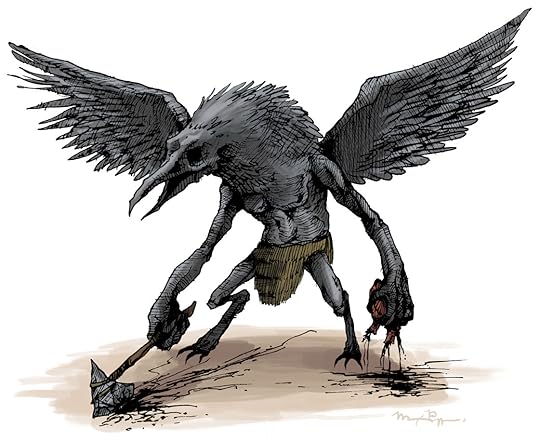
This story takes place in the Appalachia region. Many of the characters have knowledge in the old folk tales or pagan traditions. They cover many stories and references in a short period of time. There are druids and trials, but the main folk element is the Raven Mockers. Raven Mockers are from the Cherokee legends. According to the legends, Raven mockers are mostly invisible, except when they're about to feast on a new victim. They will devour the heart of the victim and will absorb the extra years of their life. It's truly a terrifying folk creature.
Now onto the book itself. This was my first forage into the Silver John stories. It was a tough start. There was little character development to grow attached to any character and there were so many characters introduced that it was hard to keep them straight. The real strength lies in the journey and Silver John's survival through the trials. It mirrors the trials and tests that characters would go through in traditional folk/fairy tales. If you can get through the first 60 pages, it's a nice book for an afternoon read.
This story takes place in the Appalachia region. Many of the characters have knowledge in the old folk tales or pagan traditions. They cover many stories and references in a short period of time. There are druids and trials, but the main folk element is the Raven Mockers. Raven Mockers are from the Cherokee legends. According to the legends, Raven mockers are mostly invisible, except when they're about to feast on a new victim. They will devour the heart of the victim and will absorb the extra years of their life. It's truly a terrifying folk creature.
Now onto the book itself. This was my first forage into the Silver John stories. It was a tough start. There was little character development to grow attached to any character and there were so many characters introduced that it was hard to keep them straight. The real strength lies in the journey and Silver John's survival through the trials. It mirrors the trials and tests that characters would go through in traditional folk/fairy tales. If you can get through the first 60 pages, it's a nice book for an afternoon read.

July 16, 2011
Stephen King recommended author. In 1981's Danse Macabre, King dedicated his book as follows: "It's easy enough - perhaps too easy - to memorialize the dead. This book is for the six great writers of the macabre who are still alive." The six listed were Robert Bloch, Jorge Luis Borges, Ray Bradbury, Frank Belnap Long, Donald Wandrei, Manly Wade Wellman.
12/17/11. This was my first Wellman book and won't be my last. It took me a moment to get with the rhythm of the narration which is Wellman's idea of Appalachian-speak. There's a lot of a-this-ing and a-that-ing and a-fixin, etc. However, once you get used to the language, the story flows smoothly and quickly. This short novel kept me so engaged I pressed on well past my bed-time to finish it. A Native American Indian and our guitar-picking protagonist get in all kinds of fixes as they battle the Druid influence that has invaded the mountains and threaten to end the world as they know it. Good fun for vintage horror fans.
12/17/11. This was my first Wellman book and won't be my last. It took me a moment to get with the rhythm of the narration which is Wellman's idea of Appalachian-speak. There's a lot of a-this-ing and a-that-ing and a-fixin, etc. However, once you get used to the language, the story flows smoothly and quickly. This short novel kept me so engaged I pressed on well past my bed-time to finish it. A Native American Indian and our guitar-picking protagonist get in all kinds of fixes as they battle the Druid influence that has invaded the mountains and threaten to end the world as they know it. Good fun for vintage horror fans.

January 20, 2009
This is a regional horror-fantasy novel written by a student of the region and purchased through the Science Fiction Book Club. Although not my usual forte, I liked the atmospherics.

April 17, 2024
honestly went into this thinking it was recently published, so imagine my shock when i realized it came out in 1979?? really ahead of its time with some great commentary on folklore & religious history, good atmosphere, and some very well written and respectful women and native american characters (reuben manco is an utter delight also WHY WERE HIM AND JOHN SO GAY AT THE END THERE). after doing some research it appears that manly wade wellman (yes that's his real name) was a fascinating guy who churned out a solid bibliography of sci-fi, fantasy, horror, and occult tales that i'm excited to check out after my success with this one. all around a smart and exciting appalachian horror!
March 14, 2024
Silver John makes my Fantasy all-time team. Bard supreme.

December 29, 2023
This is a fine Cthulhu pastiche, a bit dated in style but quick and folksy.

October 22, 2013
First appearing in numerous short stories, Silver John, AKA: John the Balladeer, or simply John, was featured in 5 novels published between 1979 and 1984. The first in the series, The Old Gods Waken, finds John lending a helping hand to a father and son in the Appalachian mountains with what starts as a property dispute with their neighbors- the Voth brothers. In addition to disrespecting property boundaries, the Voths, who happen to be English Druids, are also planning to resurrect ancient spirits in a ritual where they burn human victims in a wicker man. Luckily, that's right up John's alley, since he spends his days wandering the wilds of North Carolina with nothing but his silver stringed guitar, and his knowledge of the occult.
The highlight of the story is John's team up with a Native American named Reuben Manco as they hike through the mountains in the dead of night on a rescue mission and face seven supernatural perils conjured by the Voths. One such peril are vampiric bat creatures called Raven Mockers that "make it their chief business to help a man die". One of the really appealing things about Wellman's writing, aside from all of the supernatural business, is how he depicts his characters engaged in simple things like taking walks, making meals with food they've grown themselves, and singing songs together afterwards.
The highlight of the story is John's team up with a Native American named Reuben Manco as they hike through the mountains in the dead of night on a rescue mission and face seven supernatural perils conjured by the Voths. One such peril are vampiric bat creatures called Raven Mockers that "make it their chief business to help a man die". One of the really appealing things about Wellman's writing, aside from all of the supernatural business, is how he depicts his characters engaged in simple things like taking walks, making meals with food they've grown themselves, and singing songs together afterwards.

February 17, 2013
Another book based on one of his three classic characters. This time John, or John Silver although you don't hear that in this book. The "Silver" part was apparently added by a publisher and he was only ever called John in this book. John is also called the balladeer and he carries his guitar with him wherever he goes. These tales are set in the hills of Appalachia. Anyway, I didn't enjoy this quite as much as What Dreams May Come, this book felt a little more choppy in it's pacing.
John is visiting a friend who's father just had a dustup with the neighbors at the edge of his property. Seems they were stacking out an area that included some of the Forshay land. As John becomes embroiled in the tale, we are introduced to two Native Americans Holly Christopher and Ruben Manco, part Cheyenne full Cherokee respectively. Turns out these two men are brothers recently arrived from England and ,oh and by the way, they just happen to be Druids. This particular hilltop holds power/evil for Native Americans and Druids alike. I enjoyed the story itself, but as stated above couldn't get into the flow of the story because of the uneven pacing. Probably 3.5 stars.
John is visiting a friend who's father just had a dustup with the neighbors at the edge of his property. Seems they were stacking out an area that included some of the Forshay land. As John becomes embroiled in the tale, we are introduced to two Native Americans Holly Christopher and Ruben Manco, part Cheyenne full Cherokee respectively. Turns out these two men are brothers recently arrived from England and ,oh and by the way, they just happen to be Druids. This particular hilltop holds power/evil for Native Americans and Druids alike. I enjoyed the story itself, but as stated above couldn't get into the flow of the story because of the uneven pacing. Probably 3.5 stars.

October 7, 2024
While I was looking through our Sci-Fi collection at the library to figure out what books needed to be pruned to make room for new material, I found two novels by a pulp author I'd never heard of, Manly Wade Wellman. They were set in Western North Carolina, and Wellman appeared to have lived in the NC mountains for part of his life, so I marked to keep them as local interest books.
Fast-forward a year, and I was desperately grabbing at novels about WNC in the wake of the devastation of hurricane Helene. Call it a kind of homesickness despite being home. I just want to be engaging with art about here; couldn't tell you whether it's a healing thing or not. I was digging through our shelves and unearthed Wellman's The Old Gods Waken. I opened it up and the dialect this book is written in is so immediately familiar and comfortable that I sank right into it. But, then my way back into work was blocked for a few days, so with no way to get back at the book, I downloaded the audiobook and listened to it that way.
When I was a kid, a celebrated Appalachian storyteller worked at the nearby landfill. Whenever we took our trash there, my sister and I would sit on the ground near his wooden stool and he'd tell us old traditional stories - Jack tales and such - while we listened to the creek rush beside us. I wonder how that creek is doing, now. Reading The Old Gods Waken took me back to those moments; it's told in a similar dialectical style, and follows a similar story structure to a Jack Tale, with an introduction of stakes, the laying out of a number of obstacles the protagonist will have to overcome, and then the actual overcoming of those obstacles. There isn't much here that's unpredictable, but predictability is part of the rhythm of the mountain oral storytelling tradition: you learn what will happen, then you prepare for that to happen, then you hear how it happens.
Protagonist John is a traveling guitarist whose life of wandering the mountains, jamming with the folks he meets, has led to a long list of acquaintances and considerable experience dealing with the supernatural. On this particular occasion, John's travels have brought him to Wolter Mountain, where owner Creed Forshay is in a property dispute with two English brothers, who have shown up and claimed part of his land as their own. John tries to help resolve the dispute, but ends up having to fight alongside his Cherokee friend Reuben Manco to stop evil druids from sacrificing a young couple to Baal. John was apparently the subject of a number of serialized short stories Wellman wrote for pulp magazines in the '60s, and this 1979 story is the first of several novels about the character. That said, at 186 pages, it's not too far off from a short story itself. It's a quick and entertaining read.
Outside of its villainization of druids, the closest comparison to a book I've read recently might be the first of (ironically) Kevin Hearne's Iron Druid series, which ran from 2011 to 2018. When I wrote about Hounded, I said it was fun reading about a magic guy with a rich history of dealing with the hidden supernatural elements of our presumably mundane world, but that much of its style of humor and attitudes toward women were very dated. The Old Gods Waken is also dated, though Wellman clearly tries really hard not to lean into some of the sexist and racist tendencies of pulp storytelling. John spends way too much time describing the beauty of the only female character, Holly, who is captured and becomes a "damsel in distress" for the rest of the novel, despite the fact that she is meant to be very competent, educated, and knowledgeable.
Reuben, John's Cherokee friend, similarly leans into stereotypes, even while Wellman lampshades racist portrayals of Natives to demonstrate how much he's not doing that. It's really unfortunate, and made listening to the audiobook a kind of embarrassing experience at times. That said, it's probably better than most 1979 fare in those regards, even though it's harmful and super doesn't stand up to contemporary scrutiny. Druids get the short end of the stick, as villains who take land and do murders on them, but while that's not ideal, it's not nearly as uncomfortable as the Native American portrayals, given the long history of erasing Indigeneity from these mountains.
That said, I did really enjoy this book. I loved the use of dialect and familiarity of the setting. The vivid descriptions of trees, plants, and wildlife felt like a balm. A running theme throughout the novel is the idea of invasive species in the area. Just as the English villains are colonizing and trying to take the Forshays' land, so too are many now-local flora and fauna invasive and harmful, warping the original ecology of the region. Many of John's strategies for fighting the evil druids rely on remembering which species are native and therefore friendly and which are introduced and therefore can be turned against him.
That's an even more resonant theme forty-five years later, after mountain communities have undergone violent gentrification, exponential growth of the tourism industries, and external dismantling of labor organizations, but I especially appreciated a passage where John points out that the white locals are, themselves, invasive species who drove out Native Americans. There's a cyclical history of displacement in much of the U.S., and it was nice seeing this old story that draws on much older storytelling traditions nod to the repercussions of that history.
Fast-forward a year, and I was desperately grabbing at novels about WNC in the wake of the devastation of hurricane Helene. Call it a kind of homesickness despite being home. I just want to be engaging with art about here; couldn't tell you whether it's a healing thing or not. I was digging through our shelves and unearthed Wellman's The Old Gods Waken. I opened it up and the dialect this book is written in is so immediately familiar and comfortable that I sank right into it. But, then my way back into work was blocked for a few days, so with no way to get back at the book, I downloaded the audiobook and listened to it that way.
When I was a kid, a celebrated Appalachian storyteller worked at the nearby landfill. Whenever we took our trash there, my sister and I would sit on the ground near his wooden stool and he'd tell us old traditional stories - Jack tales and such - while we listened to the creek rush beside us. I wonder how that creek is doing, now. Reading The Old Gods Waken took me back to those moments; it's told in a similar dialectical style, and follows a similar story structure to a Jack Tale, with an introduction of stakes, the laying out of a number of obstacles the protagonist will have to overcome, and then the actual overcoming of those obstacles. There isn't much here that's unpredictable, but predictability is part of the rhythm of the mountain oral storytelling tradition: you learn what will happen, then you prepare for that to happen, then you hear how it happens.
Protagonist John is a traveling guitarist whose life of wandering the mountains, jamming with the folks he meets, has led to a long list of acquaintances and considerable experience dealing with the supernatural. On this particular occasion, John's travels have brought him to Wolter Mountain, where owner Creed Forshay is in a property dispute with two English brothers, who have shown up and claimed part of his land as their own. John tries to help resolve the dispute, but ends up having to fight alongside his Cherokee friend Reuben Manco to stop evil druids from sacrificing a young couple to Baal. John was apparently the subject of a number of serialized short stories Wellman wrote for pulp magazines in the '60s, and this 1979 story is the first of several novels about the character. That said, at 186 pages, it's not too far off from a short story itself. It's a quick and entertaining read.
Outside of its villainization of druids, the closest comparison to a book I've read recently might be the first of (ironically) Kevin Hearne's Iron Druid series, which ran from 2011 to 2018. When I wrote about Hounded, I said it was fun reading about a magic guy with a rich history of dealing with the hidden supernatural elements of our presumably mundane world, but that much of its style of humor and attitudes toward women were very dated. The Old Gods Waken is also dated, though Wellman clearly tries really hard not to lean into some of the sexist and racist tendencies of pulp storytelling. John spends way too much time describing the beauty of the only female character, Holly, who is captured and becomes a "damsel in distress" for the rest of the novel, despite the fact that she is meant to be very competent, educated, and knowledgeable.
Reuben, John's Cherokee friend, similarly leans into stereotypes, even while Wellman lampshades racist portrayals of Natives to demonstrate how much he's not doing that. It's really unfortunate, and made listening to the audiobook a kind of embarrassing experience at times. That said, it's probably better than most 1979 fare in those regards, even though it's harmful and super doesn't stand up to contemporary scrutiny. Druids get the short end of the stick, as villains who take land and do murders on them, but while that's not ideal, it's not nearly as uncomfortable as the Native American portrayals, given the long history of erasing Indigeneity from these mountains.
That said, I did really enjoy this book. I loved the use of dialect and familiarity of the setting. The vivid descriptions of trees, plants, and wildlife felt like a balm. A running theme throughout the novel is the idea of invasive species in the area. Just as the English villains are colonizing and trying to take the Forshays' land, so too are many now-local flora and fauna invasive and harmful, warping the original ecology of the region. Many of John's strategies for fighting the evil druids rely on remembering which species are native and therefore friendly and which are introduced and therefore can be turned against him.
That's an even more resonant theme forty-five years later, after mountain communities have undergone violent gentrification, exponential growth of the tourism industries, and external dismantling of labor organizations, but I especially appreciated a passage where John points out that the white locals are, themselves, invasive species who drove out Native Americans. There's a cyclical history of displacement in much of the U.S., and it was nice seeing this old story that draws on much older storytelling traditions nod to the repercussions of that history.

March 18, 2008
This is (if I remember correctly) the first of the Silver John novels, which I absolutely LOVE. They're stories of ancient magic set in the Appalachians/Ozarks. Eerie.

December 22, 2024
This story started strong, but I’ve lost interest half way through.

August 21, 2023
2.5/5 - probably a bit harsh in my scoring but hey ho
Perfectly adequate but after an initial intrigue it became exposition - “debate” between intellects to explain the background and premise - and then a series of fairly safe set plays. I liked elements but won’t be revisiting the character. I do however appreciate an audience 40 years ago may have got more out of it, but Lovecraft (his politics aside) has stood the test of time and this was a bit dated
Perfectly adequate but after an initial intrigue it became exposition - “debate” between intellects to explain the background and premise - and then a series of fairly safe set plays. I liked elements but won’t be revisiting the character. I do however appreciate an audience 40 years ago may have got more out of it, but Lovecraft (his politics aside) has stood the test of time and this was a bit dated

September 18, 2023
7 perils... I found the repetition of facts quite dry, "this must have been peril number 2, meaning 5 more to come", "I wished I had my knife again" (yes you mentioned that a lot). It was almost like seven scenes with not a lot in between. Also, the finale was OK, but I was hoping for a little more.
Displaying 1 - 30 of 123 reviews