

What do you think?
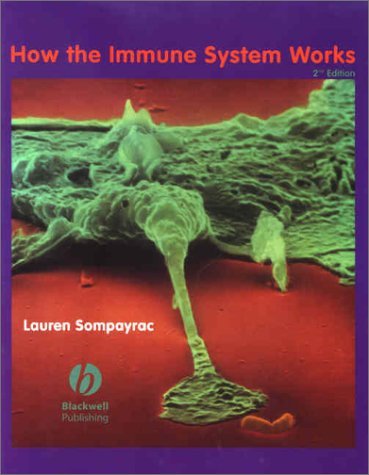
How the Immune System Works
Not just another immunology book, Blackwell now offers the 2nd edition of How the Immune System Works. Written in the same offbeat, "lecture-style" you're familiar with, the second edition provides a perfect introduction to the essential principles of the immune system, covered in 9 humorous but highly informative "lectures." Perfect as exam-prep review or an enjoyable overview of a difficult subject.
This revised edition features:
· New updates on the Pathophysiology of immunology
· System-based approach that examines immunology as a system
· Unique and engaging style for quick and easy learning
This revised edition features:
· New updates on the Pathophysiology of immunology
· System-based approach that examines immunology as a system
· Unique and engaging style for quick and easy learning
144 pages, Paperback
First published January 1, 1999
Ratings & Reviews
Friends & Following
Create a free account to discover what your friends think of this book!
Community Reviews
Displaying 1 - 30 of 58 reviews

July 6, 2007
Immunology is hard. Dr Sompayrac is wonderful. Read this book, if you have even the remotest interest in how your body defends itself in a hostile world.
You could read it in a weekend. You will be a better, more interesting person, if you so.
Or you could watch Seinfeld re-runs and add that amount to your time in purgatory.
Don't say you weren't warned.
You could read it in a weekend. You will be a better, more interesting person, if you so.
Or you could watch Seinfeld re-runs and add that amount to your time in purgatory.
Don't say you weren't warned.
March 8, 2012
The best review of Immunology that I have found. Most review books give a fragmented view. This book provides an intuitive understanding of the immune system.
I highly recommend this book for anyone studying Immunology or reviewing it for USMLE Step 1.
I highly recommend this book for anyone studying Immunology or reviewing it for USMLE Step 1.

October 2, 2014
One hell of a side dish
This book was written for the purpose of clarification.
It was not written for the purpose of full elucidation. Nor was it written for the purpose of competition.
It's simply how the immune system works. Nothing more nothing less. There is no delving into detail here.
It succeeds masterfully in providing euphemisms & pictures of how it all works. The picture of T cell activation as a deposit safe with 2 keys that will blow up if only one is turned on was only one among the greatest you'll come by.
That was really clever.
This book was written for the purpose of clarification.
It was not written for the purpose of full elucidation. Nor was it written for the purpose of competition.
It's simply how the immune system works. Nothing more nothing less. There is no delving into detail here.
It succeeds masterfully in providing euphemisms & pictures of how it all works. The picture of T cell activation as a deposit safe with 2 keys that will blow up if only one is turned on was only one among the greatest you'll come by.
That was really clever.

September 15, 2021
Immunology is a pretty terrifying subject for the newbies. The alphabet soup of different receptors, cytokines, proteins, cell types, etc. can leave anyone bewildered. It is easy to get lost in the minutiae and lose the big picture. This is a pity, because our immune system is a complex but fascinating system, fine-tuned over millions of years of evolution to tackle a variety of different pathogens, while carefully discriminating self from non-self.
Fortunately, this marvelous, lucid book by Prof. Sompayrac is a breath of fresh air amidst the tomes of immunology. In 16 lectures, you get introduced to the main concepts of Immunology in a friendly manner. I think this book perfectly embraces the "Feynman technique" of teaching.
I loved the writing and the ample metaphors provided, as they help you to visualize the concepts and relate them to everyday objects to understand tricky concepts. And on top of it, it is full of humor, you'll be laughing out loud at many of the explanations.
Reading this book will give you a good grip on the big ideas of the field, and help you in getting your feet wet in this amazing subject.
Although the book contains a lot of important details and can serve as a stand-alone textbook, I would recommend tackling the "standard" textbooks of Immunology after you are done with this book.
Fortunately, this marvelous, lucid book by Prof. Sompayrac is a breath of fresh air amidst the tomes of immunology. In 16 lectures, you get introduced to the main concepts of Immunology in a friendly manner. I think this book perfectly embraces the "Feynman technique" of teaching.
I loved the writing and the ample metaphors provided, as they help you to visualize the concepts and relate them to everyday objects to understand tricky concepts. And on top of it, it is full of humor, you'll be laughing out loud at many of the explanations.
Reading this book will give you a good grip on the big ideas of the field, and help you in getting your feet wet in this amazing subject.
Although the book contains a lot of important details and can serve as a stand-alone textbook, I would recommend tackling the "standard" textbooks of Immunology after you are done with this book.

May 10, 2022
The best way to learn about the immune system that I have come across. Immunology textbooks are usually plagued by complicated descriptions that focus too much on immune pathways without explaining the overall general picture. This book does not fall into this trap. It comprehensively explains the topic without delving into unnecessary details. It uses metaphors and analogies in a very fun way that is not only informative but highly entertaining at times. The author's excitement about the field and the way the immune system works is contagious. The first few chapters provide an overview of the immune system and its functions. Then there are chapters that are dedicated to autoimmunity, immunodeficiency, vaccination, and cancer immunity that deal more with clinical immunology and promising areas of research in the field. I highly recommend this for anyone interested in the immune system and is tired of sorting through dense material that leaves you more confused.
August 13, 2015
This provided a nice high level presentation of the immune system.
I had taken immunology courses previously but largely got bogged down in the details and lost sight of the bigger picture.
This will not provide a comprehensive review, but definitely helped me put into context the various players of the immune system and their basic functions.
Would probably serve well as an intro before taking a graduate or undergrad immuno course.
I had taken immunology courses previously but largely got bogged down in the details and lost sight of the bigger picture.
This will not provide a comprehensive review, but definitely helped me put into context the various players of the immune system and their basic functions.
Would probably serve well as an intro before taking a graduate or undergrad immuno course.

March 21, 2020
Great introduction / review of the immune system to the layperson. He really explains it in terms understandable to a golden retriever, which helped given that I hadn't studied biology for over a decade.

June 13, 2020
I'm honestly quite loath to classify this as a textbook - it's more of a blend between a monograph and a lecture transcript.
Every concept is explained from first principles, which makes understanding the content very easy. It's also very succinct, so in theory, one could get through this book within a few days.
The most recent edition has an entire chapter devoted to nascent immunotherapies, with very well weighted considerations of their various pros and cons. In particularly, there is a brilliant appraisal of CAR-T cell therapy, which, despite the rather optimistic coverage in the press, is not quite the silver bullet it would appear to be upon first inspection.
Every concept is explained from first principles, which makes understanding the content very easy. It's also very succinct, so in theory, one could get through this book within a few days.
The most recent edition has an entire chapter devoted to nascent immunotherapies, with very well weighted considerations of their various pros and cons. In particularly, there is a brilliant appraisal of CAR-T cell therapy, which, despite the rather optimistic coverage in the press, is not quite the silver bullet it would appear to be upon first inspection.

July 31, 2025
I had to read this textbook front to back so I’m counting it in my reading. Technically I read the 7e but they didn’t have that here. This is honestly a pretty good textbook one of the better ones I’ve come across. It was interesting bc the 7e has a chapter about Covid which is cool bc the 7e came out in 2023. Wild!

July 17, 2025
I am conflicted. I don’t know if I should believe in God because only he could have made something so complex and so elegant as the immune system, or if I should not believe in God because something so complex and elegant can all be explained to a very large degree.
My basic understanding of the immune system has been significantly improved. Thank you Sompayrac!
My basic understanding of the immune system has been significantly improved. Thank you Sompayrac!

April 30, 2024
This book was a lifesaver! It tells the story of the immune system nicely and in a way that is easy for a first-time immunology student to understand. I recommend this as a supplemental book for anyone struggling in their immunology course. -1 star because what even is immunology and I cannot justify 5 stars for a book about it.

June 19, 2025
really interesting read only read the first chapter as part of my required reading for school but cannot wait to read the rest of the book.
August 4, 2020
Such a great book! Helped me through OMS-I. Made immunology so much simpler.

December 23, 2019
I think students that have already taken, or are currently taking, an immuno course would get the most out of this book. It is written in casual prose, with high-yield points highlighted throughout the text and summarized nicely at the end of each chapter. The first 10 "lectures" are about the fundamentals, and lectures 11-15 are more application-based (e.g. vaccines, immune deficiency, cancers, etc.).
The interactions between the innate and adaptive immune system, between T cells and B cells, between the different receptors and co-receptors can all be very confusing, but I think the author did a fine job laying it all out for us. The chapters seem to add on top of each other organically.
I learned some interesting facts that weren't mentioned in my immunology course, such as why mothers kiss their babies. Apparently the mother is sampling the types of pathogens the baby is exposed to, and creating specific-IgA antibodies in her milk (p.81). She might also love the baby too, of course. I also thought the chapter on the gut immunology was interesting (chapter 11).
I just finished another book on cancer immunotherapy, and I think the author in this book lays out the reasons why it isn't as effective as people had hoped. Solid tumors outside of the lymphatic system are not likely going to be targeted by T-cells, which have a set traffic-pattern, and moreover they will anergize if not exposed to co-stimulatory signals from APCs (p.134).
I recommend this book as a review for students, or members of the general public who have a deep interest in immunology. I took away 1 star because I think the book should have had a more detailed summary figure (p.70) including other cytokines, class switching, etc.
The interactions between the innate and adaptive immune system, between T cells and B cells, between the different receptors and co-receptors can all be very confusing, but I think the author did a fine job laying it all out for us. The chapters seem to add on top of each other organically.
I learned some interesting facts that weren't mentioned in my immunology course, such as why mothers kiss their babies. Apparently the mother is sampling the types of pathogens the baby is exposed to, and creating specific-IgA antibodies in her milk (p.81). She might also love the baby too, of course. I also thought the chapter on the gut immunology was interesting (chapter 11).
I just finished another book on cancer immunotherapy, and I think the author in this book lays out the reasons why it isn't as effective as people had hoped. Solid tumors outside of the lymphatic system are not likely going to be targeted by T-cells, which have a set traffic-pattern, and moreover they will anergize if not exposed to co-stimulatory signals from APCs (p.134).
I recommend this book as a review for students, or members of the general public who have a deep interest in immunology. I took away 1 star because I think the book should have had a more detailed summary figure (p.70) including other cytokines, class switching, etc.

February 15, 2017
The vast majority of textbooks should be written this way. Rather than try to write "The Honking Enormous Definitive Edition of IMMUNOLOGY" (the better to price-gouge you with when it goes obsolete in two months), Sompayrac simply sets out to explain the basics in an understandable, colorful way. He succeeds gloriously.

October 8, 2017
I swear if you are like me and find Immunology tediously difficult to understand, i recommend you to read this.
Its written like its being spoken to you. like a professor is actually conversing with you, teaching you the topic. On top of that its written like a plot to some medieval fantasy novel where the cells of the immune system are the warriors and the pathogens are the Orcs ("invaders").
Its story telling at its heart, and you will come to appreciate Macrophages so bloody much!!!
Immuno has never been this much fun to learn. its not a heavy read, its not dry, and certainly not a big text book. under 200 pages and divided into 15 lectures, each lecture is about 10 pages long. so you can easily finish this book in 15 days if you want to take it slow, and i guess 5-10 days if you do 2-3 lectures daily.
Its written like its being spoken to you. like a professor is actually conversing with you, teaching you the topic. On top of that its written like a plot to some medieval fantasy novel where the cells of the immune system are the warriors and the pathogens are the Orcs ("invaders").
Its story telling at its heart, and you will come to appreciate Macrophages so bloody much!!!
Immuno has never been this much fun to learn. its not a heavy read, its not dry, and certainly not a big text book. under 200 pages and divided into 15 lectures, each lecture is about 10 pages long. so you can easily finish this book in 15 days if you want to take it slow, and i guess 5-10 days if you do 2-3 lectures daily.

April 24, 2019
At 141 pages, including glossary and index, this excellent work bridges the gap between a popular science book on immunology and a full blown, no-stone-unturned, academic textbook. Being of a manageable size, it is an interesting read for anyone who seeks a reasonably detailed explanation of how the immune system works, but who doesn't require the fine details and minutiae that might be needed by an undergraduate studying immunology. The author, Lauren Sompayrac, is a retired professor from the University of Colorado and he has a talent for presenting a complex subject in a readable and easy to understand style. Neatly-drawn, colourful diagrams summarise many of the main points.
The edition I read was the fourth, published in 2012. A sixth, and thus updated, edition was published this year (2019) but unfortunately my budget didn't extend to that!
The edition I read was the fourth, published in 2012. A sixth, and thus updated, edition was published this year (2019) but unfortunately my budget didn't extend to that!

Did Not Finish
October 16, 2021I wanted to learn more about the Immune System, and this book helped - I read the first few chapters and then skipped to the end to get a feel for applications.
In the end, I sought out a different book that would give more narrative “mental velcro” on *how* we know that this is how the system works - what experiments were done and what observations were made that led to this current understanding of how the Immune System works. I found a Commotion in the Blood, by Stephen Hall, which was helpful, but only up to date through the mid-1990s. Wish there were an updated version of that book. (Maybe that’s Emperor of Maladies? I have that on my library holds.)
I did end up buying my own copy of this book for a quick reference, and I think it will be good for that.
In the end, I sought out a different book that would give more narrative “mental velcro” on *how* we know that this is how the system works - what experiments were done and what observations were made that led to this current understanding of how the Immune System works. I found a Commotion in the Blood, by Stephen Hall, which was helpful, but only up to date through the mid-1990s. Wish there were an updated version of that book. (Maybe that’s Emperor of Maladies? I have that on my library holds.)
I did end up buying my own copy of this book for a quick reference, and I think it will be good for that.

September 13, 2011
so I used this book as a primer to my other, more detailed book on the immune system (by P. Parham). This is its only real function. It is a great book for understanding the basics of what is going on, but it is not detailed enough for the comprehensive understanding that is required in a medical school education.
(side note) it is also written by a very religious man that doesn't believe in evolution (he has written many books trying to disprove evolution) and there are weird passages that are clearly his attempt to sidestep the evolutionary nature of the immune system.
side note #2 - yes, HIS name is Lauren.
(side note) it is also written by a very religious man that doesn't believe in evolution (he has written many books trying to disprove evolution) and there are weird passages that are clearly his attempt to sidestep the evolutionary nature of the immune system.
side note #2 - yes, HIS name is Lauren.

June 22, 2018
This really dumbs down immunology and while that makes for enjoyable reading, it doesn't help more than a solid immunology textbook. Don't waste your time with this. get an immunology textbook and a couple review texts (Q&A's).
August 27, 2022
كتاب جميل جدًا يشرح كيف يعمل الجهاز المناعي بطريقة شيقة ومبسطة.
December 26, 2025
I don’t know if or when I will finish this book. I got maybe a third or a half way through it. It was quite good. A very good explanation of the immune system for normal people.
I thought it provided good background for understanding allergies vs biotoxins and for understanding how the body clears viruses and other harmful pathogens.
If you’ve ever watched influencers or Reddit users recommending supplements and wondering why they might work I think this is a necessary pre reading. Modern science doesn’t really understand the immune system but I think this gives a good framework. At the very least I think this helps explain how viruses, bacteria, and other pathogens are handled differently and why treatment should be catered appropriately.
I think it also gives appreciation for how much signaling the body does through various pathways. It’s very complex. I think this gives credibility to the cell danger response explained in Neil Nathan’s book. Furthermore, I think this opens up the possibility that the mind can control some of this signaling and therefore mind-body practices can cause ‘miracle’ healing. I think this is more in line with eastern medicine which tends to treat one’s energy rather than running high tech labs and using pharmaceuticals.
Stopped reading it since I had other stuff to read and things to do. Definitely more of a hardcore book for learning. Not as philosophical or profound as many of my other reads and definitely not an entertainment book.
I thought it provided good background for understanding allergies vs biotoxins and for understanding how the body clears viruses and other harmful pathogens.
If you’ve ever watched influencers or Reddit users recommending supplements and wondering why they might work I think this is a necessary pre reading. Modern science doesn’t really understand the immune system but I think this gives a good framework. At the very least I think this helps explain how viruses, bacteria, and other pathogens are handled differently and why treatment should be catered appropriately.
I think it also gives appreciation for how much signaling the body does through various pathways. It’s very complex. I think this gives credibility to the cell danger response explained in Neil Nathan’s book. Furthermore, I think this opens up the possibility that the mind can control some of this signaling and therefore mind-body practices can cause ‘miracle’ healing. I think this is more in line with eastern medicine which tends to treat one’s energy rather than running high tech labs and using pharmaceuticals.
Stopped reading it since I had other stuff to read and things to do. Definitely more of a hardcore book for learning. Not as philosophical or profound as many of my other reads and definitely not an entertainment book.

November 14, 2021
I know this is a textbook, but I'm still counting it and writing a review cause it was a good(s)read :)
Simply but it's about the immune system. It's not super thorough, but it's also not a general summary. It goes over processes, and explains trends; all of which is awesome, but for me what won me over was the way this book was written.
I'm a microbiology student, and I've had to read a lot of biology books throughout my education. To be honest it's not the most fun to read about biology: the text is usually very dense, descriptions can be vague, and logic can be hard to follow. But this book is giving me a rekindled hope about how good biology textbooks can be.
The author keeps things very simple and clear. They don't use fancy confusing language, and they don't try to sound smart. They just paint a clear picture that is easy to follow. I was on a time crunch with this book, but still, it was a very manageable and enjoyable read.
So if you're similar to me in that you really love biology and want to learn more about it without excess confusing jargon, I strongly recommend this read.
Simply but it's about the immune system. It's not super thorough, but it's also not a general summary. It goes over processes, and explains trends; all of which is awesome, but for me what won me over was the way this book was written.
I'm a microbiology student, and I've had to read a lot of biology books throughout my education. To be honest it's not the most fun to read about biology: the text is usually very dense, descriptions can be vague, and logic can be hard to follow. But this book is giving me a rekindled hope about how good biology textbooks can be.
The author keeps things very simple and clear. They don't use fancy confusing language, and they don't try to sound smart. They just paint a clear picture that is easy to follow. I was on a time crunch with this book, but still, it was a very manageable and enjoyable read.
So if you're similar to me in that you really love biology and want to learn more about it without excess confusing jargon, I strongly recommend this read.

October 15, 2017
An informative and complete survey of the human immune system: what it is; how it works; how it fails. Be advised, this book is not a newspaper feature article explanation of science with diagrams and processes overviews meant for everyone. Be prepared to think.
Although it doesn't require any specific background except some basic knowledge of cellular terminology, the book uses names and terms that will not be familiar to the average reader. The terms are all explained but there are a lot of them. It also lays out processes that are much more complex than you might imagine. This survey doesn't get into the nitty-gritty chemical basis for the processes it describes, but even at the operational level these processes are remarkably sophisticated.
I am a science nerd, so I found the book enjoyable. And even if you don't grasp everything, this book will leave you marveling at how well your immune system can identify an unwelcome guest and deal with any random cellular invader that shows up in your system.
Although it doesn't require any specific background except some basic knowledge of cellular terminology, the book uses names and terms that will not be familiar to the average reader. The terms are all explained but there are a lot of them. It also lays out processes that are much more complex than you might imagine. This survey doesn't get into the nitty-gritty chemical basis for the processes it describes, but even at the operational level these processes are remarkably sophisticated.
I am a science nerd, so I found the book enjoyable. And even if you don't grasp everything, this book will leave you marveling at how well your immune system can identify an unwelcome guest and deal with any random cellular invader that shows up in your system.

August 2, 2021
A nice blend of professional level textbook and an approachable readble text for those who want to know a bit more specific details about what immune system is and how it actually works.
The book is structured as independent lctures/chapters, and I can't recomment enough the first few chapters that provide an overview of the immune system, and the last few chapters that talk about:
- Autoimmune diseases
- Cancers (which are to a degree the opposite of autoimmune diseases)
- Vaccines
- Allergies
While the middle chapters become very technical very quickly, and it's pretty hard to follow for someone outside of the field, the first and last chapters are very approchable and fascinating - they will give a reader more knowledge than perhaps an average non-specializing doctor has, and since they talk about the things everyone encounters in their lives it's just an amazing source of useful knowledge.
Highly recommend!
The book is structured as independent lctures/chapters, and I can't recomment enough the first few chapters that provide an overview of the immune system, and the last few chapters that talk about:
- Autoimmune diseases
- Cancers (which are to a degree the opposite of autoimmune diseases)
- Vaccines
- Allergies
While the middle chapters become very technical very quickly, and it's pretty hard to follow for someone outside of the field, the first and last chapters are very approchable and fascinating - they will give a reader more knowledge than perhaps an average non-specializing doctor has, and since they talk about the things everyone encounters in their lives it's just an amazing source of useful knowledge.
Highly recommend!

March 31, 2018
I'm doing my MSc in Medical Microbiology and Immunology. This book is a life saver and I'll always be grateful for Lauren Sompayrac. This book explains it all so simply, and clearly while ensuring you are aware of the incredible and intricate way the immune system works and how it all ties in with the body. I will recommend this book forever to anyone. Perfect studying companion! This is the only reason I've aced my immunology based courses so far.
November 23, 2018
I read the fourth edition as a supplement to my immunology course in medical school. This was an extremely accessible book for those new to immunology (but not new to science, it does move quickly). Provided a nice amount of detail for a "first pass" before diving in deeper with my coursework. I highly recommend to those starting to study the immune system, especially if you've been overwhelmed with detail from other resources.

July 17, 2022
Great for a beginner, the concepts are presented plainly (if not over illustrated) and there are helpful review images and summary paragraphs at the end of each chapter.
If you have even an undergraduate immunology course, this book will feel frustrating at times because of how much effort the author puts in to understanding simple concepts. I frequently found myself scanning through paragraphs to try and find the point at which the concept is stated in one sentence.
If you have even an undergraduate immunology course, this book will feel frustrating at times because of how much effort the author puts in to understanding simple concepts. I frequently found myself scanning through paragraphs to try and find the point at which the concept is stated in one sentence.
June 24, 2019
Great book for everyone who would like to know more about the inner workings of the immune system. It maintains perfect balance, being accessible for those who lack medical education and at the same time being detailed and comprehensive enough.

January 8, 2024
I'm not a medical professional or medical student but I found this accessible and informative. Truly eye opening with regard to how the immune system functions. My library had the 5th edition, but I will definitely read the most recent edition when it becomes available.
Displaying 1 - 30 of 58 reviews