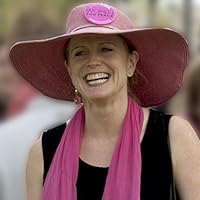
The fascinating narrative of an amazing from child TV star to poet and feminist activist. Robin Morgan is known as a prize-winning author, a political theorist, and a founder of the contemporary women's movement. But these adult accomplishments eclipsed an earlier fame. "Saturday's child has to work for a living," and Morgan has--since the age of two. She was a tot model, had her own radio show at age four, and was a child star on television, including on the popular series "Mama." Unlike most child actors, she emerged to reinvent a life filled with literary achievement and constructive politics.
Here Morgan tells the whole story--the years as a child so famous she was named "The Ideal American Girl," her fight to become a serious writer, marriage to a fiery bisexual poet, motherhood, lovers (male and female), and decades working on civil rights, the radical underground, and global feminism. This is the intensely personal, behind-the-scenes story of her life.
An award-winning poet, novelist, political theorist, feminist activist, journalist, editor, and best-selling author, Robin Morgan published 21 books, including the now-classic anthologies Sisterhood Is Powerful, Sisterhood Is Global, and Sisterhood Is Forever. A leader in contemporary US feminism, she also played an influential role internationally in the women’s movement for more than 25 years.
Morgan traveled — as organizer, lecturer, and journalist — across North America and Europe and to Australia, Brazil, the Caribbean, Central America, China, Indonesia, Israel, Japan, Nepal, New Zealand, Pacific Island nations, the Philippines, and South Africa. She twice (1986 and 1989) spent months in the Palestinian refugee camps in Jordan, Lebanon, Egypt, Syria, West Bank, and Gaza, reporting on the conditions of women.
As founder and president of The Sisterhood Is Global Institute and co-founder and board member of The Women’s Media Center, she co-founded and served on the boards of many women’s organizations in the US and abroad. In 1990, as editor-in-chief of Ms. magazine, she relaunched the magazine as an international, award-winning, ad-free bimonthly, resigning in late 1993 to become consulting global editor. She was a recipient of the National Endowment for the Arts Prize for poetry and numerous other honors.
Robin Morgan has written a riveting, passionate, politically inspiring memoir. I was fascinated by the stories she told about her childhood as a radio and TV child actress and her emergence as one of the leaders of the second wave of feminism. This memoir is a perfect example of how the personal and political inform each other and I rooted for the author as she as she painstakingly began to listen to her own voice. She is honest about her flaws and of her sorrows and of her determination to create a useful life. This included a model of parenting that is based on supporting the integrity and personhood of her child which has caused a re-examination of my own parenting philosophy and style. One of my favorite parts of the book is when she states that she does not miss the "old days" of an earlier type of political organizing and firmly informs us that there is plenty (politically) to do without being stuck in false nostalgia. I agree. There is plenty to do and this memoir helps me keep on doing it.
Thank you Netgalley for giving me this opportunity to review this book.
Robin Morgan is one of the mothers of contemporary feminism. She has charted history, together with other women and those who support them, in more ways than I can even keep track of. Although she was once famous for her performances as a child actor, it is for her feminism that I know her, and for that reason I was eager to read her memoir. Thank you to Net Galley and Open Road Integrated Media for the ARC.
Now a social warrior of advanced age, she is still undoubtedly one of the most articulate individuals alive. However the heat that came from her discussion of her childhood all but singed my eyebrows. Some of us grow mellower with age and learn to let go of things that happened when we were small, but I suppose for some, outrage and sorrow compound faster than interest on a credit card.
You see, Morgan was raised as a child celebrity. From the age of two years her life was a constant swirl of organdy dresses, auditions, and performances. She rode in parades and promoted a doll that resembled her, though she was not permitted to play with one. She wasn’t allowed to nurture friendships, and would not have had time for them in any case. Work, education, and rehearsal took up all of her time, and special arrangements had to be made in order for her education to be completed because of her exhausting schedule. She was a highly capable student and is clearly extremely literate, but her formal education ended with high school; her mother, who lived off of Morgan’s pay from Morgan’s toddlerhood until her death (including investments that lived on after Morgan retired from show business), told her that college was out of the question. She deals articulately and extensively with issues surrounding the exploitation of child actors by adults during this period, as well as the surprise revelation that came about when she tracked down the father she had never known.
I found my long dead and slightly famous great-uncle buried in her text; Sherman Billingsley, owner of The Stork Club, named a drink for her, similar to a Shirley Temple, but with a chunk of pineapple. Funny stuff, though Morgan’s childhood experiences were mostly grim.
The rest of the book gave me what I came for. Morgan came of age during the antiwar era of the late 1960’s and early 1970’s. The era of protest surrounding the US war against the people of Vietnam radicalized the youth who participated in it; the women who had been side-lined during this time period by their male counterparts began to realize that they should be taking part in the decision-making process instead of rustling up sandwiches and coffee while the men talked politics.
“Free love” really meant group sex, and Morgan learned quickly that it was not liberating for her, but rather it was traumatic. From Eldridge Cleaver to Abbie Hoffman, one radical male after another showed himself to be a member of the old boys’ club where women were concerned. It gave her and several other women pause, and soon led to a number of publications, including Sisterhood is Powerful, an anthology I treasure to this day. Morgan’s energy and achievements appear to have been boundless.
The urban myth in which feminists all burn their bras appears to have originated with Morgan and other feminists’ boycott and picket of the Miss America Pageant in 1968. At this event a certain amount of street theater took place to draw attention to the objectification and trivialization of women in US society. One of these involved whirling bras, symbol of the restriction and shaming of women, in the air and then dramatically dropping them in trash cans. (No fire.)
Morgan’s achievements are too many to enumerate here, but her history, and that of other feminists, from Betty Friedan, bell hooks and Bella Abzug to Gloria Steinem, founder of Ms. Magazine, should be part of every general course in American history, and here the author weighs in once more. She is absolutely correct in reminding us all that the history of women does not belong isolated in a women’s studies department, but is a part of history in general. Pick up a textbook and list the names; how many are male, and how many are female, even for the relatively recent period since World War II? Nor is this problem limited to the USA; in fact, it appears to extend all over the world. There can be no post-feminist era until women enjoy social, political, and economic equality. It hasn’t happened yet.
In fact, Morgan’s internationalism, which has been a large part of her career since the first publication of Sisterhood is Global, is where she shines brightest.
After reading Saturday’s Child, I have found myself once more becoming conscious of the imbalance in the world around me. I have noted that if I mention in one instance or another that women are under-represented, even my own children give me a look that says I am bringing up trivial, petty matters that I should have let pass. And then I hear Morgan, reminding me that trivializing women is part of the problem.
If you are a woman, or if you love one, reading Saturday’s Child may leave you feeling dissatisfied and in need of social change. And until the world becomes equal for everyone, that is as it should be. If Morgan’s legacy is that more women raise hell for their reproductive freedom and economic equality until both are gained, then what better thing could she have done for the world?
I have read Robin Morgan since the late 1980's, a long-time fan of her theory and work. Her memoir is a fairly sprawling look at her life, motivations and arc of memory. I can't say I was riveted, and I just didn't quite finish it, but the first half made for a nice walk down memory lane. I would have preferred to see stronger developmental editing.
DID YOU KNOW THE ‘PERSONAL IS POLITICAL’ FEMINIST WAS A CHILD STAR?
Robin Morgan is an activist, poet, and author, who was editor-in-chief of Ms. magazine from 1989-1994, and a co-founder of The Women’s Media Center.
She wrote in the ‘Acknowledgments’ of this 2001 book, “This is a brave book---which is not to imply that its author is courageous. On the contrary, [this book] got itself written despite … my own resistances to it,.. my previous editor… urged me years ago to do a memoir, believing that the somewhat bizarre life I’ve led would make for fascinating reading. I declined… Over the year, [my editor] wore me down. Then, once I finally began the book, she blithely quit New York publishing and moved to Australia… Now, having completed the book I thank her for the idea… This is all her fault.” (Pg. xiii)
The first part of the book recounts her earlier life: [Quoting from the dust jacket] “She was a tot model, had her own radio show at age four, and was a child star on television, including on the popular TV series ‘Mama’ in the 1940s and 1950s. Unlike most child actors, she emerged to reinvent a life filled with literary achievement and constructive political engagement.”
In her early 20s, she feared she had become pregnant from her boyfriend Kenneth (who was an openly gay man): “I heard myself softly announcing to the dusk, ‘If it turns out that I’m pregnant, I’ll have an abortion. I’ll find out where and who. Somehow.’ … there was no support in those days for reaching such a decision.” However, soon “like a reprieve, my period began.” She adds, “Many, many menstrual cycles later, in the early 1970s, the young feminist movement assembled signatures under a now famous statement: ‘I have had an illegal abortion.’ It was signed by hundreds of courageous women, well-known and lesser-known. I never signed it, because I was one of the luckier ones who had been ‘let off with a scare.’” (Pg. 196-197)
Then, “Nine days after he proposed, Kenneth and I were married… Everyone we know disapproved of this match… All of Kenneth’s … friends … flipped at the notion that he would (a) marry at all, (b) marry a woman, (c) marry an only recently virginal former child actress ten years his junior… Then there was my mother… In tears, moans, and shouts, she and I 'Had At It'… I begged her to attend the wedding and be happy for me. But … denying me her presence was the one thing she could control. And probably… she felt that if she didn’t witness it, the ceremony wouldn’t really have taken place.” (Pg. 203-205)
She participated in a variety of protests (antiwar, etc.), but also decided to participate in the feminist protest at the Miss America pageant. (Pg. 245-246) She also coined the phrase, ‘The personal is political’: “Because politics is about power. That insight genuinely altered our national consciousness.” (Pg. 255-256) She also reports: “I even had buttons made, with a new feminist logo in red on a white background: a circle with a cross beneath (the universal sign for the female) and a clenched fist raised inside the circle… almost a decade later, in ‘Going Too Far,’ I finally came out of the closet and admitted having designed this symbol---which, astonishingly, has become the global sign for feminism.” (Pg. 260)
She gave birth to a son, named Blake, and observes, “So this is what is meant by being in a state of grace. A whole new poetry begins here, miraculous, celebratory; a whole new politics begins here, too.” (Pg. 277)
When her ‘Sisterhood is Powerful’ anthology was about to be published, “back at WITCH, several women are uncomfortable with the idea of this book. They worry that it will make me rich and famous… I explain… that I’ve already BEEN famous and found it overrated… This is the first time I’ve dared ‘defy’ anyone in our own tight group, so I’m a wreck with the stress of losing even one woman’s approval.” (Pg. 288) Later, “I resign from the RAT collective. I stop calling myself a women’s liberationist. I start calling myself a feminist. A radical feminist, of course.” (Pg. 303)
She admits to Kenneth that she had an affair: “[He] kept saying that it wasn’t the fact of my having had an affair that pained him so; it was that the affair had been with another MAN.” (Pg. 338)
She reports, “We weren’t formally divorced for another seven years… Kenneth has been able to pull his life together and live it honorably, always continuing to write and to be there for Blake in the special ways only he can.” (Pg. 367)
She begins a relationship with a woman: “[But] I didn’t become involved with a woman for the sake of rebelling.” (Pg. 369)
She becomes editor-in-chief of Ms. magazine: “I burst out laughing and shook my head, remining [Gloria Steinem] that I knew zero about editing a magazine. ‘No problem,' she said, ‘you’ve compiled and edited two now-classic anthologies. Think of this a series of temporary anthologies.’” (Pg. 442)
This book is pretty ‘light’ on her life as a feminist and activist, but it contains some genuine and interesting insights on her life.
Robin Morgan defines a slice of the Sixties and its impact as profoundly as Abbie Hoffman. A terrific memoir, tracking from her childhood as a four year old child actor--American's Ideal Girl--to the driving force behind the Atlantic City Miss America protests and the Women's International Terrorist Conspiracy from Hell. Plus, she can write.
Being a contemporary of Robin Morgan, with memories of her childhood acting career, and having been very conscious of the women's movement, in fact, modifying my views and life because of it, Ms Morgan has had my admiration and respect for decades. No less so now that I have read a large portion of this purposeful and involving memoir. The only reason I haven't finished it is that the drama level in my own life has been somewhat on the upswing and it wasn't going to work, sharing her increasingly intense life experiences at the same time. Not when they brought back so many contemporary recollections of my own that it felt that I had known her and her pain back then. She has really turned out a vivid testimony here, no surprise, and no one interested in the state of womanhood in the second half of the 20th Century (and for all I know the beginnings of the 21st), should deny themselves this experience. Especially at this time in the civic life of these United States.
Robin is a fantastic storyteller, she weaves you through her world with a window into becoming and the wild road it is messed with a sharp political eye witnessing all she passes. Inspiring, engaging and deliciously feminist.