

What do you think?

The Black Angel
A panic-stricken young wife races against time to prove that her convicted husband did not murder his mistress. Writing in first person from her viewpoint, Woolrich makes us feel her love and anguish and desperation, as she becomes an avenging angel to rescue her husband from execution.
320 pages, Paperback
First published January 1, 1943
About the author
Cornell Woolrich
454 books485 followersCornell Woolrich is widely regarded as the twentieth century’s finest writer of pure suspense fiction. The author of numerous classic novels and short stories (many of which were turned into classic films) such as Rear Window, The Bride Wore Black, The Night Has a Thousand Eyes, Waltz Into Darkness, and I Married a Dead Man, Woolrich began his career in the 1920s writing mainstream novels that won him comparisons to F. Scott Fitzgerald. The bulk of his best-known work, however, was written in the field of crime fiction, often appearing serialized in pulp magazines or as paperback novels. Because he was prolific, he found it necessary to publish under multiple pseudonyms, including "William Irish" and "George Hopley" [...] Woolrich lived a life as dark and emotionally tortured as any of his unfortunate characters and died, alone, in a seedy Manhattan hotel room following the amputation of a gangrenous leg. Upon his death, he left a bequest of one million dollars to Columbia University, to fund a scholarship for young writers.
Source: [http://www.hardcasecrime.com/books_bi...]
Source: [http://www.hardcasecrime.com/books_bi...]
Ratings & Reviews
Friends & Following
Create a free account to discover what your friends think of this book!
Community Reviews
Displaying 1 - 30 of 108 reviews
April 4, 2016
Output is not quality, of course, but as Ray Bradbury noted, it produces quality, and Cornell Woolrich was prolific. He also is one of the greatest writers of the twentieth century. What cinches his place in history is a stretch where he published one great novel of gripping, enduring suspense after another. In essence, he created his own noir sub-genre where before there had been none. His use of the language was extraordinary, his ability to cast a mood magical, and his mastery of creating heart-pounding suspense remains unequaled today. Purple prose some of it may be, but few if any were ever able to create atmosphere like Cornell Woolrich did so regularly.
Along with Raymond Chandler, they practically invented the darkened noir streets of fiction. Woolrich perfected a smothering feeling of fate having us in its grasp, and it is still gripping today. One of the reasons he isn't as well remembered today is that he didn't fall back on a single familiar figure in each work. Woolrich chose not to have a go-to detective to base each story around. Through the darkness, however, there was a romanticism to Woolrich’s best works. Reading him at times there is an almost tangible sense that he wanted things to turn out alright. Fate seemed to conspire against him as a writer, just as it did for many of his protagonists.
The Black Angel is a terrific example of Woolrich-style suspense. This is noir at its quintessential best. But there exists within the story, something darkly romantic, even intoxicating. Beginning to read this story is like swallowing that first shot of whiskey, feeling it burn our throat as we get dizzy, and fall into a fever dream, which is how Chandler described his work.
In a sense, The Black Angel is a type of pub crawl, the female protagonist going from one name on her list to the next in order to clear the man she loves of murder. In perusing through some of the reviews here, some of which I enjoyed very much, a few had me wondering if we had read the same book. Below will be a few — but not major — spoilers in order to clear up some misconceptions.
The premise is that Alberta, who loves her husband very much, discovers he has strayed. While crushed, she remains certain her husband does love her. He calls her Angel Face when they are alone, and she is convinced he has simply fallen for a predatory woman. The reader senses that she is the smarter member of the troubled couple. She recognizes what the woman is, whereas her husband cannot. Going to the woman’s apartment, Alberta discovers she’s been murdered. Fearful her husband will be blamed for the murder, she removes a book with his name in it so the police won’t find it.
This actually makes perfect sense because of the psychology Woolrich gives the reader through Alberta’s first-person narrative. One must remember this has all happened over a very short period of time. Because the husband calls the woman to speak with her while Alberta is actually inside the dead woman’s apartment, it is clear he has not committed the murder.
He is arrested despite Alberta’s best efforts, and the two have a very moving conversation through a fence in which he is not only remorseful, but convinces Alberta, and the reader, that he had already chosen Alberta, and was breaking things off. This of course, adds to the criminal case against him, but for the reader, and Alberta, it sets up the largest portion of Black Angel, which is a suspenseful search through the names in the book for the real killer.
As with many a Woolrich story, time is of the essence, as the chair awaits Kirk unless Alberta can find Mia’s killer. Emboldened by her husband’s choice, knowing they might just have a chance to put this behind them if she can get him out of this jam, she will take great risks, making for great suspense. But something happens which she hadn’t counted on, and it will haunt both Alberta and the reader at the exciting ending. No more can be revealed without spoiling this terrific novel of suspense.
In 1946 this book, as was the case with many a Woolrich tale, was adapted both for radio’s Suspense program, and a classic Hollywood film. For those who would like to listen to the radio adaptation, here is a link where someone has put it out there — https://www.youtube.com/watch?v=Mc3nx... —
And for those who wish to watch a terrific film adaptation considered a classic here is that link — https://www.youtube.com/watch?v=VAord...
The Black Angel has an unusual framework, as many of Woolrich's best works did, and will not appeal to everyone. To a certain audience, however, it is a real find. I highly suggest reading other Woolrich books before this one, to get a sense of his style. A true masperiece of noir and suspense, but not for everyone.
Along with Raymond Chandler, they practically invented the darkened noir streets of fiction. Woolrich perfected a smothering feeling of fate having us in its grasp, and it is still gripping today. One of the reasons he isn't as well remembered today is that he didn't fall back on a single familiar figure in each work. Woolrich chose not to have a go-to detective to base each story around. Through the darkness, however, there was a romanticism to Woolrich’s best works. Reading him at times there is an almost tangible sense that he wanted things to turn out alright. Fate seemed to conspire against him as a writer, just as it did for many of his protagonists.
The Black Angel is a terrific example of Woolrich-style suspense. This is noir at its quintessential best. But there exists within the story, something darkly romantic, even intoxicating. Beginning to read this story is like swallowing that first shot of whiskey, feeling it burn our throat as we get dizzy, and fall into a fever dream, which is how Chandler described his work.
In a sense, The Black Angel is a type of pub crawl, the female protagonist going from one name on her list to the next in order to clear the man she loves of murder. In perusing through some of the reviews here, some of which I enjoyed very much, a few had me wondering if we had read the same book. Below will be a few — but not major — spoilers in order to clear up some misconceptions.
The premise is that Alberta, who loves her husband very much, discovers he has strayed. While crushed, she remains certain her husband does love her. He calls her Angel Face when they are alone, and she is convinced he has simply fallen for a predatory woman. The reader senses that she is the smarter member of the troubled couple. She recognizes what the woman is, whereas her husband cannot. Going to the woman’s apartment, Alberta discovers she’s been murdered. Fearful her husband will be blamed for the murder, she removes a book with his name in it so the police won’t find it.
This actually makes perfect sense because of the psychology Woolrich gives the reader through Alberta’s first-person narrative. One must remember this has all happened over a very short period of time. Because the husband calls the woman to speak with her while Alberta is actually inside the dead woman’s apartment, it is clear he has not committed the murder.
He is arrested despite Alberta’s best efforts, and the two have a very moving conversation through a fence in which he is not only remorseful, but convinces Alberta, and the reader, that he had already chosen Alberta, and was breaking things off. This of course, adds to the criminal case against him, but for the reader, and Alberta, it sets up the largest portion of Black Angel, which is a suspenseful search through the names in the book for the real killer.
As with many a Woolrich story, time is of the essence, as the chair awaits Kirk unless Alberta can find Mia’s killer. Emboldened by her husband’s choice, knowing they might just have a chance to put this behind them if she can get him out of this jam, she will take great risks, making for great suspense. But something happens which she hadn’t counted on, and it will haunt both Alberta and the reader at the exciting ending. No more can be revealed without spoiling this terrific novel of suspense.
In 1946 this book, as was the case with many a Woolrich tale, was adapted both for radio’s Suspense program, and a classic Hollywood film. For those who would like to listen to the radio adaptation, here is a link where someone has put it out there — https://www.youtube.com/watch?v=Mc3nx... —
And for those who wish to watch a terrific film adaptation considered a classic here is that link — https://www.youtube.com/watch?v=VAord...
The Black Angel has an unusual framework, as many of Woolrich's best works did, and will not appeal to everyone. To a certain audience, however, it is a real find. I highly suggest reading other Woolrich books before this one, to get a sense of his style. A true masperiece of noir and suspense, but not for everyone.

July 25, 2017
Cornell Woolrich was called the Father of Noir, and I listened to this book because I have been dipping back into some noir, thanks to my reading of some graphic novels by Ed Brubaker and Sean Phillips. And I discovered Woolrich had written the short story, “It Had to Be Murder,” on which Hitchcock’s Rear Window had been based. I’ve also been reading the noir-ish novels of Patrick Modiano. So why not pick one of the great noir mystery and suspense writers, who turned out book after book, many of them blockbuster successes, from the 1930’s through 1968, the year he died. This book confirms what some have said about him, that he is more a suspense writer than a mystery writer. The thrill is his primary game, not the meticulous, Hercule-Poirot-style investigation. He is usually mentioned in the same breath as Hammett, Chandler, and Gardner. His best known novels include The Bride Wore Black, Black Alibi, and Waltz Into Darkness. Dozens of films were adapted from his books, including Black Angel, Fear in the Night, Rear Window, The Bride Wore Black, and Original Sin, many of which I had never heard about. I wanted to listen to The Bride Wore Black or another of his higher rated books, but this one was available, so I started here, though it is not supposed to be among his very best work. But I liked it a lot.
The book is unusual for one published in 1943 in that it is narrated by a woman, Alberta, who discovers her husband has been having an affair. Going to the woman’s apartment to confront her, Alberta discovers she’s been murdered. She also soon discovers that her husband has gone to the apartment close to this time, caught by the police there, and eventually convicted of murder. He gets “The Chair,” yup. But Alberta loves her husband, believes this was a one time affair, and furthermore believes he didn't kill his mistress. She goes to see him and confirms their love:
“It's hard to say goodbye for good at any time or any place. It's harder still to say it through a meshed wire. It crisscrossed his face into little diagonals, gave me only little broken-up molecules of it at a time. It stenciled a cold, rigid frame around every kiss.”
He still calls her Angel Face! He loves her! He made a mistake! With the mistress out of the way, Alberta can be with him again. . . oops. She has just weeks to save him from the electic chair!
Alberta embarks on a journey that leads her to the ex-husband of the murdered woman, a drug-dealing doctor, a rich playboy who was in love with the victim, and a gangster whose connection to the victim is unknown. One of these, our Black Angel is sure, is the real killer. Down, down, down into darkness Alberta goes, into the Bowery of Manhattan, into seedy bars, embroiling herself in various sinful activities, making compromising deals with criminals (and the devil). Her husband, having travelled to Hell, drags her through his affair down with him, one way or the other.
There’s a sort of seedy Calvinistic tone to Black Angel, rooted in some kind of bleak nihilism that is appealing to me for some reason. Like Jim Thompson’s The Killer in Me, maybe it serves as a kind of antidote to all these upper-class Agatha Christie mysteries I am reading. Woolrich's writing is generally sparse, lacks poetic descriptions or amusing dialogue as you find in many mysteries seeking to entertain. There’s a tone that echoes some of Dostoevsky’s novels such as Crime and Punishment and the Gambler, emotional, sometimes overwrought portraits of the seamy side of life—alcohol, prostitution, drugs, murder. In it there’s the unsentimental and yet at the same time romantic tone of Hemingway, as in A Farewell to Arms. Part of the appeal is dramatic writing to the point of melodrama. (The drug-dealing doctor’s name is Mordant). And in the end, though she is in Hell, she visits her husband in prison. Aw, he still calls her Angel Face! But things have changed. She’s no longer the same woman he married.
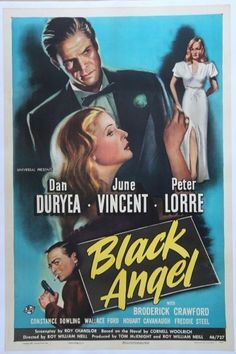
The ex-Calvinist in me liked this a lot. The ending doesn’t surprise as much as I wanted it to, the prose is a little too purple for me at times (and who uses the word Propinquity?!), but the journey into the Dark Night of the Soul she takes is suspenseful and interesting. I’ve ordered the film based on the novel, which features Dan Duryea, June Vincent and Peter Lorre. I’m kinda looking forward to it! I’m also going to finally read Woolrich’s short story on which Hitchcock’s Rear Window is based.
The book is unusual for one published in 1943 in that it is narrated by a woman, Alberta, who discovers her husband has been having an affair. Going to the woman’s apartment to confront her, Alberta discovers she’s been murdered. She also soon discovers that her husband has gone to the apartment close to this time, caught by the police there, and eventually convicted of murder. He gets “The Chair,” yup. But Alberta loves her husband, believes this was a one time affair, and furthermore believes he didn't kill his mistress. She goes to see him and confirms their love:
“It's hard to say goodbye for good at any time or any place. It's harder still to say it through a meshed wire. It crisscrossed his face into little diagonals, gave me only little broken-up molecules of it at a time. It stenciled a cold, rigid frame around every kiss.”
He still calls her Angel Face! He loves her! He made a mistake! With the mistress out of the way, Alberta can be with him again. . . oops. She has just weeks to save him from the electic chair!
Alberta embarks on a journey that leads her to the ex-husband of the murdered woman, a drug-dealing doctor, a rich playboy who was in love with the victim, and a gangster whose connection to the victim is unknown. One of these, our Black Angel is sure, is the real killer. Down, down, down into darkness Alberta goes, into the Bowery of Manhattan, into seedy bars, embroiling herself in various sinful activities, making compromising deals with criminals (and the devil). Her husband, having travelled to Hell, drags her through his affair down with him, one way or the other.
There’s a sort of seedy Calvinistic tone to Black Angel, rooted in some kind of bleak nihilism that is appealing to me for some reason. Like Jim Thompson’s The Killer in Me, maybe it serves as a kind of antidote to all these upper-class Agatha Christie mysteries I am reading. Woolrich's writing is generally sparse, lacks poetic descriptions or amusing dialogue as you find in many mysteries seeking to entertain. There’s a tone that echoes some of Dostoevsky’s novels such as Crime and Punishment and the Gambler, emotional, sometimes overwrought portraits of the seamy side of life—alcohol, prostitution, drugs, murder. In it there’s the unsentimental and yet at the same time romantic tone of Hemingway, as in A Farewell to Arms. Part of the appeal is dramatic writing to the point of melodrama. (The drug-dealing doctor’s name is Mordant). And in the end, though she is in Hell, she visits her husband in prison. Aw, he still calls her Angel Face! But things have changed. She’s no longer the same woman he married.
The ex-Calvinist in me liked this a lot. The ending doesn’t surprise as much as I wanted it to, the prose is a little too purple for me at times (and who uses the word Propinquity?!), but the journey into the Dark Night of the Soul she takes is suspenseful and interesting. I’ve ordered the film based on the novel, which features Dan Duryea, June Vincent and Peter Lorre. I’m kinda looking forward to it! I’m also going to finally read Woolrich’s short story on which Hitchcock’s Rear Window is based.

April 19, 2010
Alberta Murray is convinced her husband is having an affair. Imagine her shock when her husband is arrested for his mistress's murder! Alberta happened upon the crime scene before the police and the only clue is a matchbook with the letter M embossed on the cover. She pilfers the victim's address book and starts going down the M's one by one. Can she find the killer before her husband is executed?
My problems with this book started with the premise. If a woman found out her husband was cheating on her and the police thought he killed his mistress, would she go to such great lengths to clear him? Somehow I doubt it. I know I wouldn't in her place.
Despite my initial misgivings, I liked the story. Alberta went up against some interesting characters: the mistress's ex husband who had degenerated to a drunk in the Bowery, a drug pusher, a lady's man, and a gangster. Too bad the story dragged on a bit. If it would have been 150 pages, it would have been perfect. Instead, it felt bloated.
The ending was a little on the weak side. After the Bride Wore Black, I was hoping Woolrich would sucker punch me with the revelation that the husband did it all along and Alberta had gone through hell for nothing. The ending wasn't bad but wasn't as good as I was hoping for. After three of his books, I'm convinced Woolrich was a misogynist. All of his female characters are either whores, psychopaths, or doormats.
I'm giving this a 2.5. It was on the good side of okay but I didn't really think it was a good book.
My problems with this book started with the premise. If a woman found out her husband was cheating on her and the police thought he killed his mistress, would she go to such great lengths to clear him? Somehow I doubt it. I know I wouldn't in her place.
Despite my initial misgivings, I liked the story. Alberta went up against some interesting characters: the mistress's ex husband who had degenerated to a drunk in the Bowery, a drug pusher, a lady's man, and a gangster. Too bad the story dragged on a bit. If it would have been 150 pages, it would have been perfect. Instead, it felt bloated.
The ending was a little on the weak side. After the Bride Wore Black, I was hoping Woolrich would sucker punch me with the revelation that the husband did it all along and Alberta had gone through hell for nothing. The ending wasn't bad but wasn't as good as I was hoping for. After three of his books, I'm convinced Woolrich was a misogynist. All of his female characters are either whores, psychopaths, or doormats.
I'm giving this a 2.5. It was on the good side of okay but I didn't really think it was a good book.

June 17, 2017
Cornell Woolrich was one of the most accomplished noir writers of the century and is often ranked just behind Hammett, Chandler, and Gardner. He also wrote under the pen names William Irish and George Hopley. Dozens of films were adapted from his books, including Black Angel, Fear in the Night, Rear Window, The Bride Wore Black, and Original Sin. His work is dark and brooding and often features a protagonist who has sinned and cannot ever get his or her hands clean. His best known novels include The Bride Wore Black, Black Alibi, and Waltz Into Darkness.
This is a very unusual book and not everyone is going to like it. At its best, there is a dreamlike quality to the world that Woolrich creates and one doesn't even realize until far along that it takes place in NYC in the mid twentieth century. Woolrich was a master at taking the reader inside the character's thoughts and the first person narration can be fairly intense and suspenseful.
Plot-wise, here is a young innocent wife, Alberta Murray, who to her shock and dismay, finds clues that her husband has been unfaithful. The first scene where she puts it together is fantastic. She begins by talking about his endearments, calling her "Angel Face." "And things like that your husband says to you." She muses that it has suddenly stopped and she didn't know why. She notices his blue suit is missing, but it's her job to take things to the cleaners. But it wasn't just the suits. "There had already been one or two little things before this. And that made it something else again." And there were the little lies and other things.
Alberta figures out who the mistress is and finds a photo of her in the paper. And, now, dear reader, you start to wonder if Alberta was telling the truth or if she went right off the rails when she found out her husband was having an affair. Alberta goes to confront Mia, to have it out with her. Alberta has a few drinks, dresses up in her finest to make an impression, and when she closes her door, for the first time in a long time, doesn't give a damn what's for supper. She's going to look her enemy in the eye. She's going to war and she's going to get her dear husband back. Once there, Alberta tells the reader that there was no answer, that the door was unlocked, that she wandered in and surveyed her enemy's lair, and cautiously trespassed only to find that someone had smothered Mia to death.
Alberta then does what any woman would do in such circumstances. She protects her husband who is now truly hers what with the competition out of the way. She removes any clue to her husband's connection to Mia, including the address book. What then follows is the heart of the book when her husband is arrested and tried for the murder. Alberta has to free him. She figures out that someone with the initial M did it and proceeds to investigate the M's in Mia's address book. After all, someone has to take Kirk's place in prison. Her investigation technique is nutty at best and cuckoo at worst. She goes and meets the M men from the address book, pretending to be a friend of Mia's. This leads her to bars in the Bowery, to drug addicts elsewhere in the city, to a blind date, and to an affair with the city's leading gangster. How she expects to solve the crime is a mystery as she engages in these mini- episodes that are terrifying to her. Or she just gone completely nuts? All in all, a remarkable book that is of a different world than most noir novels.
This is a very unusual book and not everyone is going to like it. At its best, there is a dreamlike quality to the world that Woolrich creates and one doesn't even realize until far along that it takes place in NYC in the mid twentieth century. Woolrich was a master at taking the reader inside the character's thoughts and the first person narration can be fairly intense and suspenseful.
Plot-wise, here is a young innocent wife, Alberta Murray, who to her shock and dismay, finds clues that her husband has been unfaithful. The first scene where she puts it together is fantastic. She begins by talking about his endearments, calling her "Angel Face." "And things like that your husband says to you." She muses that it has suddenly stopped and she didn't know why. She notices his blue suit is missing, but it's her job to take things to the cleaners. But it wasn't just the suits. "There had already been one or two little things before this. And that made it something else again." And there were the little lies and other things.
Alberta figures out who the mistress is and finds a photo of her in the paper. And, now, dear reader, you start to wonder if Alberta was telling the truth or if she went right off the rails when she found out her husband was having an affair. Alberta goes to confront Mia, to have it out with her. Alberta has a few drinks, dresses up in her finest to make an impression, and when she closes her door, for the first time in a long time, doesn't give a damn what's for supper. She's going to look her enemy in the eye. She's going to war and she's going to get her dear husband back. Once there, Alberta tells the reader that there was no answer, that the door was unlocked, that she wandered in and surveyed her enemy's lair, and cautiously trespassed only to find that someone had smothered Mia to death.
Alberta then does what any woman would do in such circumstances. She protects her husband who is now truly hers what with the competition out of the way. She removes any clue to her husband's connection to Mia, including the address book. What then follows is the heart of the book when her husband is arrested and tried for the murder. Alberta has to free him. She figures out that someone with the initial M did it and proceeds to investigate the M's in Mia's address book. After all, someone has to take Kirk's place in prison. Her investigation technique is nutty at best and cuckoo at worst. She goes and meets the M men from the address book, pretending to be a friend of Mia's. This leads her to bars in the Bowery, to drug addicts elsewhere in the city, to a blind date, and to an affair with the city's leading gangster. How she expects to solve the crime is a mystery as she engages in these mini- episodes that are terrifying to her. Or she just gone completely nuts? All in all, a remarkable book that is of a different world than most noir novels.
December 13, 2014
04/2018
When I see this review now, I cringe, only because I said Highsmith is the one significant female Crime writer of the mid twentieth century. Since then we have had the printing of Library of America's Women Crime Writers of the 1940s and 50s books. And Kindle or e-reading has created a whole renaissance of availability of old books, and wonderfully this includes many novels by women. So, anyway, whether it is timing or my own ignorance back in 2014, I am glad to have been wrong.
12/2014
Blackness within darkness, and sequences within sequences, hypnotically Woolrichean. Stunning and amazing, despite a big logic flaw towards the end (why would Alberta investigate the 4th "M" from the victim's address book, once she knew who the monogramed matches belonged to? Makes no sense). But other than that, cool weird interestingness and strangely moving depth. Did I mention the narrative is 1st person from a female's perspective? Awesome. As far as I can tell, this is extremely unusual for pulp crime from 1943. Even Highsmith, the one significant lady crime writer of the mid century era, almost always wrote about men.
When I see this review now, I cringe, only because I said Highsmith is the one significant female Crime writer of the mid twentieth century. Since then we have had the printing of Library of America's Women Crime Writers of the 1940s and 50s books. And Kindle or e-reading has created a whole renaissance of availability of old books, and wonderfully this includes many novels by women. So, anyway, whether it is timing or my own ignorance back in 2014, I am glad to have been wrong.
12/2014
Blackness within darkness, and sequences within sequences, hypnotically Woolrichean. Stunning and amazing, despite a big logic flaw towards the end (why would Alberta investigate the 4th "M" from the victim's address book, once she knew who the monogramed matches belonged to? Makes no sense). But other than that, cool weird interestingness and strangely moving depth. Did I mention the narrative is 1st person from a female's perspective? Awesome. As far as I can tell, this is extremely unusual for pulp crime from 1943. Even Highsmith, the one significant lady crime writer of the mid century era, almost always wrote about men.

October 25, 2015

 https://www.youtube.com/watch?v=VAord...
 Description: A novel as hypnotic as it is suspenseful, its atmosphere haunting, its shadows long, this intimate thriller by past master of noir fiction Cornell Woolrich delivers its unfailing angel from her waking nightmare into a chillingly impossible dream.
From the 1930s until his death in 1968, Cornell Woolrich riveted the reading public with his pulp noir. Classic films like Alfred Hitchcock's Rear Window earned Woolrich the epithet "the twentieth century's Edgar Allan Poe.

September 17, 2017
The Black Angel
By Cornell Woolrich
Published 1943
Blackstone Audio
Read by Hillary Huber
5 Stars
This outstanding classic crime story is about a newly married pretty young woman, Alberta French, who believes her husband is cheating on her. As she discovers it’s true, she goes to confront her husbands lover. As she approaches the woman’s apartment, seeing the door ajar, she enters calling out. No answer. She slowly walks around the apartment criticizing the decor, then heads toward the bedroom. She sees a foot extended beyond the edge of a chaise from under a blanket. As she uncovers a body, she sees the neck extended at an odd angle. Her husband’s lover, the actress Mia Mercer, is dead. In her surprise and panic, her first thought is to protect her husband and looks for incriminating evidence. She grabs the deceased’s address book from her purse and departs the place in a hurry. Immediately she calls her husband’s office to warn him, but she’s too late. He is on his way to Mia’s apartment. As he arrives, he sees the police and is arrested, eventually tried and convicted of murder. He is sentenced to death.
While the case against her husband was air tight, she believed of her husband’s innocence. Because of an embossed initial M on a personalized matchbook she found at Mia’s apartment, Alberta begins the search for the real killer. She is alone and has no help from the police. This is the best part of the story, because this 22 year old woman is fearless as she goes through the address book belonging to the dead woman, looking for men with initial M or names beginning or ending with the letter M. One by one, she seeks the men out. What happens is artfully told, keeping me engrossed in the story and impressed with Alberta’s strength of character. A dark, memorable tale and the ending? Well i assure you it is worth reading the book to find out.
By Cornell Woolrich
Published 1943
Blackstone Audio
Read by Hillary Huber
5 Stars
This outstanding classic crime story is about a newly married pretty young woman, Alberta French, who believes her husband is cheating on her. As she discovers it’s true, she goes to confront her husbands lover. As she approaches the woman’s apartment, seeing the door ajar, she enters calling out. No answer. She slowly walks around the apartment criticizing the decor, then heads toward the bedroom. She sees a foot extended beyond the edge of a chaise from under a blanket. As she uncovers a body, she sees the neck extended at an odd angle. Her husband’s lover, the actress Mia Mercer, is dead. In her surprise and panic, her first thought is to protect her husband and looks for incriminating evidence. She grabs the deceased’s address book from her purse and departs the place in a hurry. Immediately she calls her husband’s office to warn him, but she’s too late. He is on his way to Mia’s apartment. As he arrives, he sees the police and is arrested, eventually tried and convicted of murder. He is sentenced to death.
While the case against her husband was air tight, she believed of her husband’s innocence. Because of an embossed initial M on a personalized matchbook she found at Mia’s apartment, Alberta begins the search for the real killer. She is alone and has no help from the police. This is the best part of the story, because this 22 year old woman is fearless as she goes through the address book belonging to the dead woman, looking for men with initial M or names beginning or ending with the letter M. One by one, she seeks the men out. What happens is artfully told, keeping me engrossed in the story and impressed with Alberta’s strength of character. A dark, memorable tale and the ending? Well i assure you it is worth reading the book to find out.

February 6, 2022
“How strange, it came to me then, are the patterns of human experience! The meaningless life lines that start out singly and so simply from here, from there, draw slowly toward one another over a period of time, until finally they come together, mesh, to form into a design that never could have been guessed at, foretold, by what had gone before.”
After The Bride Wore Black and Black Alibi, The Black Angel is my third encounter with Cornell Woolrich’s novels, and this time, Woolrich spins his yarn around a 22-year old wife, Alberta Murray, who is in for three shocks on one single day. First of all, she realizes that her beloved husband not only cheats her with a dancer called Mia Mercer but is also on the point of walking out on her with his dame. Then, when she goes to take a look at that Mia Mercer, to her great horror, she finds the woman dead, smothered with a cushion – but the biggest blow is still to come when her straying husband suddenly stands in front of her door, accompanied by two detectives who have handcuffed him, and when she is told that her husband is arrested on suspicion of murder. Alberta knows for sure that her husband cannot have committed this crime because when she was in Mia’s apartment, there was a phone call from her husband, who wanted to speak to the victim of the crime, and what is more, her love for her husband is unabated despite his lack of loyalty and the awkward position he finds himself in. Since the police do not believe any word she says in defense of her liege lord, the man soon finds himself tried and sentenced for murder, with the result of the electric chair waiting for him.
Alberta is undaunted, however, and she decides to find out the real murderer in order to exonerate her husband and save his life. When she was at the scene of the crime, she found the victim’s address book and took it lest the police find her husband’s name in it. Other circumstantial evidence makes her think that there is a high chance, the murderer must be someone whose name also begins with an M, and in the course of the next few weeks, she gets to know the other four men whose names she found on the M page in Mia Mercer’s address book – Marty Blair, the victim’s devastated ex-husband, whose life has been ruined by Mia’s callousness, Dr Mordaunt, a shady drug-peddler who hardly sticks at anything mean, Ladd Mason, a debonair playboy, and McKee, a gangster and club owner. One of them, she is sure, has killed Mia Mercer, and she is driven by a deadly resolution to bring the killer to justice, not so much for the abstract sake of justice itself but for the concrete sake of getting her husband back.
Okay, the hardest bit for the reader to swallow is to accept that a wife who has been cheated on would actually want her husband back instead of laughing up her sleeve in contemplation of the fine mess he has gotten himself into – all the more so since the husband in this story has the nerve to ask his wife never to fall in love with anyone again when he is dead –, but once you are ready to put these doubts and reservations behind you, you will probably enjoy the thrill ride Woolrich sends his heroine on – a ride that often brings her into extreme danger. However, there is another little detail that made me go into this adventure with the mental handbrake on: All the Woolrich novels I have read so far work on the same structural principle in that the same basic situation is played out again and again in one book. In The Bride Wore Black, the female avenger kills five men one by one, slipping into a different role each time – and we find the same pattern here, when Alberta Murray, taking on her maiden name of French, also takes on a different role whenever she enters into the life of a new suspect. We have a similar pattern in Black Alibi, where each chapter introduces us into the life of a new victim of the nefarious killer. I don’t know enough of Woolrich to say whether this is a typical structure of his longer works, and if this is the case, they may well grow a little bit monotonous to the regular reader, but in the case of The Black Angel, this pattern works out well because it reinforces the moral change – can we even say decline? – the heroine experiences in that she is constantly becoming harder and more callous herself. When dealing with Dr Mordaunt, for instance, she even stoops to becoming a drug trafficker in order to win the doctor’s confidence, and one of the encounters even winds up in the death of the – innocent – man involved, a casualty she glibly sugarcoats to herself by saying that at least, the victim of her machination died with a feeling of there having been a sense in the last hours of his life. This is truly noir and also goes with the title of the book. But Woolrich does not stop here, he even goes a step further – but mind that here there are big spoilers ahead now:
So, despite the familiar pattern of the story, The Black Angel, with its caustic irony in which we can see Fate’s hollow grin, did the trick for me.
After The Bride Wore Black and Black Alibi, The Black Angel is my third encounter with Cornell Woolrich’s novels, and this time, Woolrich spins his yarn around a 22-year old wife, Alberta Murray, who is in for three shocks on one single day. First of all, she realizes that her beloved husband not only cheats her with a dancer called Mia Mercer but is also on the point of walking out on her with his dame. Then, when she goes to take a look at that Mia Mercer, to her great horror, she finds the woman dead, smothered with a cushion – but the biggest blow is still to come when her straying husband suddenly stands in front of her door, accompanied by two detectives who have handcuffed him, and when she is told that her husband is arrested on suspicion of murder. Alberta knows for sure that her husband cannot have committed this crime because when she was in Mia’s apartment, there was a phone call from her husband, who wanted to speak to the victim of the crime, and what is more, her love for her husband is unabated despite his lack of loyalty and the awkward position he finds himself in. Since the police do not believe any word she says in defense of her liege lord, the man soon finds himself tried and sentenced for murder, with the result of the electric chair waiting for him.
Alberta is undaunted, however, and she decides to find out the real murderer in order to exonerate her husband and save his life. When she was at the scene of the crime, she found the victim’s address book and took it lest the police find her husband’s name in it. Other circumstantial evidence makes her think that there is a high chance, the murderer must be someone whose name also begins with an M, and in the course of the next few weeks, she gets to know the other four men whose names she found on the M page in Mia Mercer’s address book – Marty Blair, the victim’s devastated ex-husband, whose life has been ruined by Mia’s callousness, Dr Mordaunt, a shady drug-peddler who hardly sticks at anything mean, Ladd Mason, a debonair playboy, and McKee, a gangster and club owner. One of them, she is sure, has killed Mia Mercer, and she is driven by a deadly resolution to bring the killer to justice, not so much for the abstract sake of justice itself but for the concrete sake of getting her husband back.
Okay, the hardest bit for the reader to swallow is to accept that a wife who has been cheated on would actually want her husband back instead of laughing up her sleeve in contemplation of the fine mess he has gotten himself into – all the more so since the husband in this story has the nerve to ask his wife never to fall in love with anyone again when he is dead –, but once you are ready to put these doubts and reservations behind you, you will probably enjoy the thrill ride Woolrich sends his heroine on – a ride that often brings her into extreme danger. However, there is another little detail that made me go into this adventure with the mental handbrake on: All the Woolrich novels I have read so far work on the same structural principle in that the same basic situation is played out again and again in one book. In The Bride Wore Black, the female avenger kills five men one by one, slipping into a different role each time – and we find the same pattern here, when Alberta Murray, taking on her maiden name of French, also takes on a different role whenever she enters into the life of a new suspect. We have a similar pattern in Black Alibi, where each chapter introduces us into the life of a new victim of the nefarious killer. I don’t know enough of Woolrich to say whether this is a typical structure of his longer works, and if this is the case, they may well grow a little bit monotonous to the regular reader, but in the case of The Black Angel, this pattern works out well because it reinforces the moral change – can we even say decline? – the heroine experiences in that she is constantly becoming harder and more callous herself. When dealing with Dr Mordaunt, for instance, she even stoops to becoming a drug trafficker in order to win the doctor’s confidence, and one of the encounters even winds up in the death of the – innocent – man involved, a casualty she glibly sugarcoats to herself by saying that at least, the victim of her machination died with a feeling of there having been a sense in the last hours of his life. This is truly noir and also goes with the title of the book. But Woolrich does not stop here, he even goes a step further – but mind that here there are big spoilers ahead now:
So, despite the familiar pattern of the story, The Black Angel, with its caustic irony in which we can see Fate’s hollow grin, did the trick for me.

March 16, 2019
Imagine: your husband has been cheating on you for quite some time already and he is being accused of killing his mistress.
Me: Let him rot in jail.
But the heroine in Woolrich's novel reacts rather differently! That's why we have this novel! LOL
3.5 stars, the opening is strong and captivating but the ending feels a bit rushed and underwhelming with not enough emotional impact and shock beyond the final revealing (though it's nice to know ), still it has been a good read.
The atmosphere created by Mr. Woolrich---one of the few masters in the sub-genre of the romantic noir is simply fucking perfection, it feels like I was watching a black-and-white Hollywood thriller from the 1950s, plus the heroine is well written (Mr. Woolrich is a master of writing female characters!) the sense of dark romance is in fact charming; but I do hope the ending can be better, like the one in I Married a Dead Man.
Me: Let him rot in jail.
But the heroine in Woolrich's novel reacts rather differently! That's why we have this novel! LOL
3.5 stars, the opening is strong and captivating but the ending feels a bit rushed and underwhelming with not enough emotional impact and shock beyond the final revealing (though it's nice to know ), still it has been a good read.
The atmosphere created by Mr. Woolrich---one of the few masters in the sub-genre of the romantic noir is simply fucking perfection, it feels like I was watching a black-and-white Hollywood thriller from the 1950s, plus the heroine is well written (Mr. Woolrich is a master of writing female characters!) the sense of dark romance is in fact charming; but I do hope the ending can be better, like the one in I Married a Dead Man.

July 15, 2021
Strano giallo narrato in prima persona dalla protagonista che, non pienamente riuscito, risente di una eccessiva verbosita' (anche se di classe) e di descrizioni troppo pesanti che rallentano inesorabilmente il ritmo. Alcune pagine felici sono di piacevole lettura, soprattutto per la notazione sociale di un'epoca ormai lontana. Nel complesso il libro non decolla mai e arriva stancamente alla conclusione non particolarmente originale.

June 7, 2022
Τέταρτο βιβλίο του Κόρνελ Γούλριτς που διαβάζω, μετά τα "Η νύφη φορούσε μαύρα", "Φάντομ Λέιντυ" και "Το κορμί της Τζαίην Μπράουν", μου φάνηκε και αυτό αρκετά καλογραμμένο, ατμοσφαιρικό και σκοτεινό. Αν μη τι άλλο πρόκειται για ένα αρχετυπικό νουάρ με κάποια λυρικά στοιχεία στη γραφή, με την πρωταγωνίστρια να γνωρίζει με τον πιο έντονο τρόπο τη σκοτεινή πλευρά της Νέας Υόρκης, στην προσπάθειά της να βρει στοιχεία ικανά που θα γλιτώσουν τον σύζυγό της από την ηλεκτρική καρέκλα, για τον φόνο της ερωμένης του που όμως δεν διέπραξε. Μου άρεσε πολύ όλη αυτή η καταβύθιση της ηρωίδας στον υπόκοσμο της πόλης, είχε τη γοητεία της αν και σίγουρα και τις υπερβολές της. Όσον αφορά τη γραφή, είναι πολύ καλή, με λιτές περιγραφές και λίγο μαύρο χιούμορ. Πρόκειται για ένα πολύ ωραίο και κλασικό νουάρ, και μπορεί να έχει τα θεματάκια του σε πλοκή και χαρακτήρες και να μην είναι για όλα τα γούστα, αλλά πιστεύω ότι έχει την απαραίτητη ποιότητα για να ικανοποιήσει τους λάτρεις του είδους. (7.5/10)

January 12, 2018
Αρχετυπικό νουάρ, ενός από τους Γενάρχες του είδους. Η πλοκή με τα σημερινά μέτρα δεν είναι κάτι ιδιαίτερο, πολλώ δε μάλλον, ρεαλιστική. Το σκοτάδι είναι εκεί όμως, το Ύφος του συγγραφέα περνάει από τις "χαραμάδες" και σε στιγμές μάς ταρακουνά. Σίγουρα ενδιαφέρον.

December 6, 2023
⭐️⭐️⭐️1/2 — rounded to four.
Cornell Woolrich was a prolific American novelist and short story writer who is considered by many to be one of the best crime writers of his day along with Dashiell Hammett, Erle Stanley Gardner and Raymond Chandler and was one of the inventors of noir fiction. Many of his novels and short stories were made into movies including Alfred Hitchcock's Rear Window, The Bride Wore Black, Black Angel, and many others.
This is the first Woolrich novel I have read. I've had this one along with a few others of his on my shelves for several years. I first heard about Woolrich after reading about some of his collectible novels in the magazine "Firsts" but for some reason hadn't gotten around to reading any of them until now.
BLACK ANGEL was published in 1943 and takes place in New York. It is told in the first person by a female protagonist, Alberta Murray, whose husband has been convicted of the murder of his mistress. Alberta is convinced that her husband is not guilty of the murder and basically the novel deals with her trying to track down the real murderer. To do this she uses a clue that she found at the murder site before the police arrived that indicates the murderer's name starts with the letter 'M'. While she was there, she also took the murdered woman's address book and she uses it to track down the men listed under 'M'. As she does this, she gets involved in the shadier side of the city including down-and-outs on skid row, drug dealers, gangsters, and murderers. But is she able to find the real killer?
This was really an unusual crime novel. Being told from a woman's perspective was definitely different and a little strange for a noir story. Some of what Alberta did in her quest was very bold especially for a woman of the 1940s. Also, I didn't understand why she continued looking for the killer after she discovered who left the clue with the "M" at the murder scene. After that, it seemed like anyone in the address book could have been the killer. There were also some things included in the story that were not fully explained including a blackmail storyline involving one of the suspects. I did enjoy the writing with Woolrich painting a vivid picture of the underside of New York. I can see why he is considered one of the great crime writers of the 40s. This was also made into a movie in 1946 starring Dan Duryea, June Vincent and Peter Lorre but a lot of the story points were changed. Cornell Woolrich disliked the film version and stated after seeing it, "I was so ashamed when I came out of there ... it took me two or three days to get over it. All I could keep thinking of in the dark was: Is that what I wasted my whole life at?" Based on this, I'm not sure if I will try to find and watch it online.
Cornell Woolrich was a prolific American novelist and short story writer who is considered by many to be one of the best crime writers of his day along with Dashiell Hammett, Erle Stanley Gardner and Raymond Chandler and was one of the inventors of noir fiction. Many of his novels and short stories were made into movies including Alfred Hitchcock's Rear Window, The Bride Wore Black, Black Angel, and many others.
This is the first Woolrich novel I have read. I've had this one along with a few others of his on my shelves for several years. I first heard about Woolrich after reading about some of his collectible novels in the magazine "Firsts" but for some reason hadn't gotten around to reading any of them until now.
BLACK ANGEL was published in 1943 and takes place in New York. It is told in the first person by a female protagonist, Alberta Murray, whose husband has been convicted of the murder of his mistress. Alberta is convinced that her husband is not guilty of the murder and basically the novel deals with her trying to track down the real murderer. To do this she uses a clue that she found at the murder site before the police arrived that indicates the murderer's name starts with the letter 'M'. While she was there, she also took the murdered woman's address book and she uses it to track down the men listed under 'M'. As she does this, she gets involved in the shadier side of the city including down-and-outs on skid row, drug dealers, gangsters, and murderers. But is she able to find the real killer?
This was really an unusual crime novel. Being told from a woman's perspective was definitely different and a little strange for a noir story. Some of what Alberta did in her quest was very bold especially for a woman of the 1940s. Also, I didn't understand why she continued looking for the killer after she discovered who left the clue with the "M" at the murder scene. After that, it seemed like anyone in the address book could have been the killer. There were also some things included in the story that were not fully explained including a blackmail storyline involving one of the suspects. I did enjoy the writing with Woolrich painting a vivid picture of the underside of New York. I can see why he is considered one of the great crime writers of the 40s. This was also made into a movie in 1946 starring Dan Duryea, June Vincent and Peter Lorre but a lot of the story points were changed. Cornell Woolrich disliked the film version and stated after seeing it, "I was so ashamed when I came out of there ... it took me two or three days to get over it. All I could keep thinking of in the dark was: Is that what I wasted my whole life at?" Based on this, I'm not sure if I will try to find and watch it online.

April 4, 2024
A truly excellent novel; not quite "noir" given the protagonist is a woman whose husband is on death row for a murder she is convinced he did not commit. Since the police will not pursue the case any further she decides to find the true murderer by herself, at least until she has solid evidence the police will believe.
Her adventures (or mis-adventures) are all surprising and quite effectively conveyed with rising tenstion. I guess it's really a murder mystery, but unlike any other I can remember reading.
Her adventures (or mis-adventures) are all surprising and quite effectively conveyed with rising tenstion. I guess it's really a murder mystery, but unlike any other I can remember reading.

January 10, 2023
Before reading this short novel, you should know a bit about the author, Cornell Woolrich, in order to understand the book’s flaws, and not put it down immediately as a dnf at the 20% mark. Bear with the story flaws and you might find it mesmerizing, as I did.
Woolrich (1903-1968) was a homosexual who despised himself. As far as I can determine, this may have been because his father was a Catholic. I’m not certain about this but I do know that he spent his early years in Mexico with his father, before moving to New York to live with his mother. On his deathbed, he converted to Catholicism. During his lifetime, he lived mainly in New York with his mother in a seedy hotel in Harlem, even though his fiction brought in enough income for them to live in a more upscale place. After she died, he did move into a slightly more comfortable hotel. Woolrich was lonely, an alcoholic, and a diabetic who neglected his health to such a degree that he allowed a foot infection to become gangrenous, which resulted in the amputation of his leg, and led to his early death at age 65. His mental torture and self-doubt are constantly reflected in his stories. He appeared to have loved New York, where his homosexuality would have been tolerated (even though, at the time, it would have been illegal), but there is little evidence that he participated—as did many of his literary contemporaries—in the easily accessible gay lifestyle of that city.
Thus, when you begin reading THE BLACK ANGEL, which is narrated in the voice of the female protagonist, Alberta, your immediate reaction is that this is not a woman’s voice. And indeed it is not. It appears to be the voice of an idealized woman—an “angel” in Woolrich’s world. Throughout the story, constant reference is made to Alberta’s angel-like appearance, and she certainly behaves like an angel would, from Woolrich’s viewpoint. She stays true to her husband, who has been cheating on her with a definitely non-angelic woman, an evil temptress. When he is convicted of killing this temptress, she believes him when he tells her that he didn’t, and then sets about following a set of clues to prove his innocence.
Alberta discovers the murdered woman before the police do and finds a notebook and a monogrammed card that she pockets before the police arrive. These clues, she believes, narrow the true killer down to one of four other people, and she searches out each of them in turn. So the novel reads as four short stories tied together by Alberta’s journey to find the real murderer.
The first of these suspects is the temptress’s former husband, and Alberta’s exploration through the seedy streets of New York’s depression-era Bowery district are what makes this part so intriguing. The second possible murderer is a creepy drug-dealing doctor, and Alberta is almost killed during this “mini-tale”. (Also, her naivety during this sequence is not at all believable, unless we accept that she truly is an innocent angel.) The third possible murderer is a rich, and very charming, playboy; in fact, Alberta finds herself more attracted to this playboy than she is to her own husband. The fourth possible murderer is a gangster, who falls in love with her, and then decides to have her killed after she is caught snooping.
I was hooked by this tale even though it was completely unrealistic. It reads like a parable—the angel, the seductress, the philandering husband, the evil other men, sinful activities, and the angel’s near downfall. I was more drawn to the reflective thoughts scattered throughout the sections than to the story itself which, as mentioned above, is rather implausible.
How strange, it came to me then, are the patterns of human experience! The meaningless life lines that start out singly and so simply from here, from there, draw slowly toward one another over a period of time, until finally they come together, mesh, to form a design that never could have been guessed at, foretold, by what had gone before. And the completed fabric is the sum of all the threads that have gone into it.
“Dance, dance, dance, little lady, Life is fleeting to the rhythm beating Through your mind.”
Thus, it was Woolrich’s use of rhythmic language, mixed with the parable of good and evil, that hooked me.
Like several other Woolrich stories, this one was made into a film, but the low-budget movie disappeared quickly. Today it is considered a noir classic. (You can easily view it. Search YouTube for: Black Angel (1946), detective, drama, film-noir.)
~~~~~~~~~~~~~~~~~~~~
My other reviews for stories written by Woolrich:
Rear Window and Other Murderous Tales
The Bride Wore Black
~~~~~~~~~~~~~~~~~~~~
Woolrich (1903-1968) was a homosexual who despised himself. As far as I can determine, this may have been because his father was a Catholic. I’m not certain about this but I do know that he spent his early years in Mexico with his father, before moving to New York to live with his mother. On his deathbed, he converted to Catholicism. During his lifetime, he lived mainly in New York with his mother in a seedy hotel in Harlem, even though his fiction brought in enough income for them to live in a more upscale place. After she died, he did move into a slightly more comfortable hotel. Woolrich was lonely, an alcoholic, and a diabetic who neglected his health to such a degree that he allowed a foot infection to become gangrenous, which resulted in the amputation of his leg, and led to his early death at age 65. His mental torture and self-doubt are constantly reflected in his stories. He appeared to have loved New York, where his homosexuality would have been tolerated (even though, at the time, it would have been illegal), but there is little evidence that he participated—as did many of his literary contemporaries—in the easily accessible gay lifestyle of that city.
Thus, when you begin reading THE BLACK ANGEL, which is narrated in the voice of the female protagonist, Alberta, your immediate reaction is that this is not a woman’s voice. And indeed it is not. It appears to be the voice of an idealized woman—an “angel” in Woolrich’s world. Throughout the story, constant reference is made to Alberta’s angel-like appearance, and she certainly behaves like an angel would, from Woolrich’s viewpoint. She stays true to her husband, who has been cheating on her with a definitely non-angelic woman, an evil temptress. When he is convicted of killing this temptress, she believes him when he tells her that he didn’t, and then sets about following a set of clues to prove his innocence.
Alberta discovers the murdered woman before the police do and finds a notebook and a monogrammed card that she pockets before the police arrive. These clues, she believes, narrow the true killer down to one of four other people, and she searches out each of them in turn. So the novel reads as four short stories tied together by Alberta’s journey to find the real murderer.
The first of these suspects is the temptress’s former husband, and Alberta’s exploration through the seedy streets of New York’s depression-era Bowery district are what makes this part so intriguing. The second possible murderer is a creepy drug-dealing doctor, and Alberta is almost killed during this “mini-tale”. (Also, her naivety during this sequence is not at all believable, unless we accept that she truly is an innocent angel.) The third possible murderer is a rich, and very charming, playboy; in fact, Alberta finds herself more attracted to this playboy than she is to her own husband. The fourth possible murderer is a gangster, who falls in love with her, and then decides to have her killed after she is caught snooping.
I was hooked by this tale even though it was completely unrealistic. It reads like a parable—the angel, the seductress, the philandering husband, the evil other men, sinful activities, and the angel’s near downfall. I was more drawn to the reflective thoughts scattered throughout the sections than to the story itself which, as mentioned above, is rather implausible.
How strange, it came to me then, are the patterns of human experience! The meaningless life lines that start out singly and so simply from here, from there, draw slowly toward one another over a period of time, until finally they come together, mesh, to form a design that never could have been guessed at, foretold, by what had gone before. And the completed fabric is the sum of all the threads that have gone into it.
“Dance, dance, dance, little lady, Life is fleeting to the rhythm beating Through your mind.”
Thus, it was Woolrich’s use of rhythmic language, mixed with the parable of good and evil, that hooked me.
Like several other Woolrich stories, this one was made into a film, but the low-budget movie disappeared quickly. Today it is considered a noir classic. (You can easily view it. Search YouTube for: Black Angel (1946), detective, drama, film-noir.)
~~~~~~~~~~~~~~~~~~~~
My other reviews for stories written by Woolrich:
Rear Window and Other Murderous Tales
The Bride Wore Black
~~~~~~~~~~~~~~~~~~~~

July 29, 2018
Scrivevo nel novembre 2016 su Annobi:
Letto per staccare da Mann e dalla sua Montagna incantata, ma se questo è quanto preferisco tornare al tedesco.
Una lettura trascinata, saltando alcuni passaggi, cosa che faccio raramente, terminato perché era breve e perché la curiosità di sapere chi fosse il colpevole spesso diventa l’unico motivo per cui ci si dilunga in gialli poco avvincenti.
Peccato, avevo percepito buone valutazioni su Woolrich, e invece per me si è rivelato una delusione, per non parlare della monotonia di stile, forse non sono capitata su uno dei suoi noir più riusciti.
Letto per staccare da Mann e dalla sua Montagna incantata, ma se questo è quanto preferisco tornare al tedesco.
Una lettura trascinata, saltando alcuni passaggi, cosa che faccio raramente, terminato perché era breve e perché la curiosità di sapere chi fosse il colpevole spesso diventa l’unico motivo per cui ci si dilunga in gialli poco avvincenti.
Peccato, avevo percepito buone valutazioni su Woolrich, e invece per me si è rivelato una delusione, per non parlare della monotonia di stile, forse non sono capitata su uno dei suoi noir più riusciti.

November 27, 2018
The 1946 movie adaptation of this novel is one of my favorite B-noirs; it offers what's arguably Dan Duryea's finest hour, and on top of that you have June Vincent, Peter Lorre, Broderick Crawford, Constance Dowling and Marion Martin. The story is also one of noir's cleverest; its denouement comes right out of left field, and is really quite moving. For this reason, and because I was uncertain if I had ever read a Woolrich novel (I've read plenty of his short stories), I was quite eager to read The Black Angel.
I discovered that the movie really took no more than the bare bones of the plot -- a woman's husband is convicted of the murder of his floozie, and the wronged wife must race against time to prove his innocence -- before inventively taking the story in quite different directions. The trouble is that most of the things I like best about the movie, including the performances by Duryea and Vincent, are as a consequence of those "quite different directions."
But let's now stick to the book.
Alberta French Murray knows that husband Kirk is innocent of killing chanteuse Mia Mercer because she reached Mercer's apartment before he did and Mercer was already dead by then. The quirks of the judicial system rule out her giving evidence of this in court. After Kirk has been convicted, Alberta realizes she seized Mercer's address book in her panic, and still has it. A clue that she found in the dead woman's apartment has made her believe the killer's initial was "M"; there are four entries on the book's "M" page aside from that for Alberta's husband, Kirk Murray, so off Alberta goes on four investigations that she hopes will reveal the murderer.
The bulk of the book is devoted to those four investigations. While each is interesting enough in itself, the structure of the narrative strongly reminded me of those novels that John Clute christened "coupon fantasies": the protagonist has to pick up various plot coupons (the sword of Brothenswiper, the Gray Grimoire of the Dells, the Key Parlous, etc.) in order to get to the end of the book (or trilogy), where at the last moment he saves the world from Chaos and wins the babe. Here, it's as if Woolrich had four novellas that weren't going anywhere, so he recast them slightly, added a few links, and: Bingo! Something that looks like a novel.
As a consequence of this and of some pretty egregious overegging of the literary pudding, I found much of the middle portions of the novel a slog. Alberta's first investigation, which leads her to the dead woman's tragically degraded husband, generates some real pathos, which helps, and is overall a pretty good piece of work; but the second is vastly overwritten and very obviously has virtually nothing to do with the rest of the book save Alberta's presence. I found the third segment to be, fortunately, more interesting and, by the time it segued into the fourth, I was at last becoming gripped by the story. The last fifty pages or more went by in a bit of a blur, but I felt I'd had to work harder than I should to get to that helterskelter finale.
So, for me, the jury is still out on Woolrich. I feel rather the same way about the novels of Philip K. Dick, another author whose fictions have spawned innumerable good movies. Obviously Woolrich is a hugely significant figure in the history of crime fiction, especially noirish fiction, so I'm sure to try more of his work in the future. And there's plenty to choose from, of course.
I discovered that the movie really took no more than the bare bones of the plot -- a woman's husband is convicted of the murder of his floozie, and the wronged wife must race against time to prove his innocence -- before inventively taking the story in quite different directions. The trouble is that most of the things I like best about the movie, including the performances by Duryea and Vincent, are as a consequence of those "quite different directions."
But let's now stick to the book.
Alberta French Murray knows that husband Kirk is innocent of killing chanteuse Mia Mercer because she reached Mercer's apartment before he did and Mercer was already dead by then. The quirks of the judicial system rule out her giving evidence of this in court. After Kirk has been convicted, Alberta realizes she seized Mercer's address book in her panic, and still has it. A clue that she found in the dead woman's apartment has made her believe the killer's initial was "M"; there are four entries on the book's "M" page aside from that for Alberta's husband, Kirk Murray, so off Alberta goes on four investigations that she hopes will reveal the murderer.
The bulk of the book is devoted to those four investigations. While each is interesting enough in itself, the structure of the narrative strongly reminded me of those novels that John Clute christened "coupon fantasies": the protagonist has to pick up various plot coupons (the sword of Brothenswiper, the Gray Grimoire of the Dells, the Key Parlous, etc.) in order to get to the end of the book (or trilogy), where at the last moment he saves the world from Chaos and wins the babe. Here, it's as if Woolrich had four novellas that weren't going anywhere, so he recast them slightly, added a few links, and: Bingo! Something that looks like a novel.
As a consequence of this and of some pretty egregious overegging of the literary pudding, I found much of the middle portions of the novel a slog. Alberta's first investigation, which leads her to the dead woman's tragically degraded husband, generates some real pathos, which helps, and is overall a pretty good piece of work; but the second is vastly overwritten and very obviously has virtually nothing to do with the rest of the book save Alberta's presence. I found the third segment to be, fortunately, more interesting and, by the time it segued into the fourth, I was at last becoming gripped by the story. The last fifty pages or more went by in a bit of a blur, but I felt I'd had to work harder than I should to get to that helterskelter finale.
So, for me, the jury is still out on Woolrich. I feel rather the same way about the novels of Philip K. Dick, another author whose fictions have spawned innumerable good movies. Obviously Woolrich is a hugely significant figure in the history of crime fiction, especially noirish fiction, so I'm sure to try more of his work in the future. And there's plenty to choose from, of course.

August 8, 2013
This was my 3rd Cornell Woolrich book to read, and I think I have to say it's been my favorite of his that I have read so far. It's all about a girl who's husband is accused of murdering his mistress and of course doesn't believe he was the guilty party so goes on a venture to discover the real murderer. At first I was a little unsure as to how much I would enjoy it, for one thing the format was told in a different way than I'm used to for a mystery, and on top of that it was all told through the point of view of a woman; who ever heard of a hardboiled novel through a woman's point of view? But boy was I wrong. This book was excellent, full of suspense, thrills and chills galore. There were multiple points where I could hardly bring myself to put it down I was so anxious to get on with the story, which really was an unexpected surprise. Something I've enjoyed so far about Woolrich, with my very limited experience, is that he presents his mysteries in a different way than pretty much any other mystery writer, which I suppose is why, from what I've been able to pick up, he's considered more of a suspense writer than a "mystery" writer. But this book was great. Go read it.

January 31, 2022
Αρχετυπικό 'νουάρ' μυστηρίου από τον περιβόητο Woolrich σε αρκετά λυρικό τόνο και με έντονες εναλλαγές στη πλοκή. Στο μυθιστόρημα, το παράδοξο και η υπερβολή αντιπαλεύουν το μαύρο χιούμορ και κάποιους θολούς διαλόγους στο 2ο μέρος.
Υπάρχει, όμως, κάτι το άκρως γοητευτικό και ατμοσφαιρικό στη νυχτερινή περιήγηση της κεντρικής ηρωίδας στον υπόκοσμο της Αμερικής των αρχών της δεκαετίας του '40, όπως καί στην αναπάντεχη ερωτική ιστορία που προκύπτει αιχμαλωτίζοντας κάποιους από τους ήρωες στον ιστό της αράχνης.
Βαθμολογία: 7,4/10.
Υπάρχει, όμως, κάτι το άκρως γοητευτικό και ατμοσφαιρικό στη νυχτερινή περιήγηση της κεντρικής ηρωίδας στον υπόκοσμο της Αμερικής των αρχών της δεκαετίας του '40, όπως καί στην αναπάντεχη ερωτική ιστορία που προκύπτει αιχμαλωτίζοντας κάποιους από τους ήρωες στον ιστό της αράχνης.
Βαθμολογία: 7,4/10.

June 7, 2020
One expects Golden Age mystery plots to be preposterous, but they need to be internally consistent and two of the four subplots here failed in this respect. Add a third subplot which was entirely irrelevant to the story, and you’ve got a poor potboiler.
January 21, 2017
Not my favorite of his, but I had tons of distractions while reading this, so it might just be me.

November 14, 2022
Closer to 4.5
A woman is found dead by another woman. The connecting link is the husband of the latter - who firmly and naively believes her husband is innocent. The police have not shared that belief and, in fact, her husband will most likely be sentenced to die. But the dead woman kept a 'little black book'. Working against time, the wife uses that book to find the real killer.
Like a number of other Cornell Woolrich novels, the 1946 film version of 'The Black Angel' is a mere shadow of the original. At 80 minutes, the film leaves a lot of things out. Significantly, it leaves out the little black book. It leaves out most of the things that make the novel interesting. Eccentric, of course (this is Woolrich, after all), but interesting.
Unsurprisingly, Woolrich hated the film.
If, like me, you have read enough Woolrich novels and short stories to become a fan, you will also have noted tics in his behavior. With some frequency, you will have seen flaws (i.e., excesses) and eccentricities (which also tend to be excesses). No doubt you will also have noted when he's right-on-the-money and when his storytelling power is super-charged and sharply focused.
I've come to see Woolrich as a kind of edgy but colorful family relative - the kind who, during a holiday dinner, can tell fascinating tales that can keep you riveted. Nutty, far-fetched tales. Some are better than others - and there are stand-out times where he utilizes odd turns-of-phrase - but you tend to never really doubt the sincerity of his intent.
~ not even when, at some point in 'Waltz into Darkness', Woolrich went right off the rails with his narrative and may possibly have never gotten back on, at least not gracefully.
Woolrich doesn't go off the rails in 'The Black Angel', though the story does begin on ground that's a little shaky, as the heroine (Alberta) is first seen as someone whose love for her husband is depicted in a way that can only be described as sappy; jejune. But the murder forces Alberta to grow up... fast... and act like it.
The novel has a welcome number of extended sequences that pack a punch: one very creepy one in New York's Bowery; another, psychopathic one involving a medical doctor; one more, detailing a dance audition which brings to mind the over-the-top audition sequence in the camp classic 'Showgirls'.
This is among Woolrich's more-successful novels. There's a lot of good stuff here. Most of the writing is vintage pulp noir - like the way the protagonist describes a suspect who is particularly seductive:
A woman is found dead by another woman. The connecting link is the husband of the latter - who firmly and naively believes her husband is innocent. The police have not shared that belief and, in fact, her husband will most likely be sentenced to die. But the dead woman kept a 'little black book'. Working against time, the wife uses that book to find the real killer.
Like a number of other Cornell Woolrich novels, the 1946 film version of 'The Black Angel' is a mere shadow of the original. At 80 minutes, the film leaves a lot of things out. Significantly, it leaves out the little black book. It leaves out most of the things that make the novel interesting. Eccentric, of course (this is Woolrich, after all), but interesting.
Unsurprisingly, Woolrich hated the film.
If, like me, you have read enough Woolrich novels and short stories to become a fan, you will also have noted tics in his behavior. With some frequency, you will have seen flaws (i.e., excesses) and eccentricities (which also tend to be excesses). No doubt you will also have noted when he's right-on-the-money and when his storytelling power is super-charged and sharply focused.
I've come to see Woolrich as a kind of edgy but colorful family relative - the kind who, during a holiday dinner, can tell fascinating tales that can keep you riveted. Nutty, far-fetched tales. Some are better than others - and there are stand-out times where he utilizes odd turns-of-phrase - but you tend to never really doubt the sincerity of his intent.
~ not even when, at some point in 'Waltz into Darkness', Woolrich went right off the rails with his narrative and may possibly have never gotten back on, at least not gracefully.
Woolrich doesn't go off the rails in 'The Black Angel', though the story does begin on ground that's a little shaky, as the heroine (Alberta) is first seen as someone whose love for her husband is depicted in a way that can only be described as sappy; jejune. But the murder forces Alberta to grow up... fast... and act like it.
The novel has a welcome number of extended sequences that pack a punch: one very creepy one in New York's Bowery; another, psychopathic one involving a medical doctor; one more, detailing a dance audition which brings to mind the over-the-top audition sequence in the camp classic 'Showgirls'.
This is among Woolrich's more-successful novels. There's a lot of good stuff here. Most of the writing is vintage pulp noir - like the way the protagonist describes a suspect who is particularly seductive:
The first sip of a cocktail in it. The wind up at the prow of a motorboat in it. A walloping good dance tune in it, the kind that takes your feet and lifts them. The spanking bliss of the first gushing cascade when you turn on an ice-cold shower on a melting August day. The turn on a breakneck toboggan run in it. All those things in it. Everything that makes life swell in it. Everything that is life. What a voice.

June 22, 2020
La protagonista di questo giallo/noir è Alberta Murray, alla quale il marito ha attribuito il vezzeggiativo di viso d'angelo per le sue aggraziate fattezze.
Un giorno la vita della donna viene sconvolta dalla consapevolezza che il marito stia per lasciarla, fuggendo con un'altra. Un po' grottescamente Alberta scopre il nome della donna e, colta da un istinto irrefrenabile, decide di andare da lei per guardarla negli occhi. Quando, però, arriva in quella casa, scopre con orrore che la donna è stata uccisa. L'istinto di protezione nei confronti del marito, la induce a prendere la rubrica della donna, in cui è segnato il numero del suo uomo.
Purtroppo le precauzioni della nostra protagonista si rivelano vane: l'uomo è arrestato e condannato alla sedia elettrica.
Alberta ripesca nella memoria il ricordo di un dettaglio importante per scoprire l'identità dell'assassino e individua nell'agendina della donna uccisa 4 sospettati.
Inizia, quindi, delle indagini personali, immergendosi nei bassifondi newyorkesi e vive 4 avventure oltremodo pericolose.
A parte qualche coincidenza superfortuita, che stona un pochino, la storia è coinvolgente e ben scritta. Alberta risulta eccessivamente imprudente, ma si muove abilmente nei luoghi più bui e tra sconosciuti tenebrosi e dal grilletto facile.
Insomma un noir a cui non manca alcun ingrediente!
Un giorno la vita della donna viene sconvolta dalla consapevolezza che il marito stia per lasciarla, fuggendo con un'altra. Un po' grottescamente Alberta scopre il nome della donna e, colta da un istinto irrefrenabile, decide di andare da lei per guardarla negli occhi. Quando, però, arriva in quella casa, scopre con orrore che la donna è stata uccisa. L'istinto di protezione nei confronti del marito, la induce a prendere la rubrica della donna, in cui è segnato il numero del suo uomo.
Purtroppo le precauzioni della nostra protagonista si rivelano vane: l'uomo è arrestato e condannato alla sedia elettrica.
Alberta ripesca nella memoria il ricordo di un dettaglio importante per scoprire l'identità dell'assassino e individua nell'agendina della donna uccisa 4 sospettati.
Inizia, quindi, delle indagini personali, immergendosi nei bassifondi newyorkesi e vive 4 avventure oltremodo pericolose.
A parte qualche coincidenza superfortuita, che stona un pochino, la storia è coinvolgente e ben scritta. Alberta risulta eccessivamente imprudente, ma si muove abilmente nei luoghi più bui e tra sconosciuti tenebrosi e dal grilletto facile.
Insomma un noir a cui non manca alcun ingrediente!

June 23, 2019
A delicate portrayal of Alberta's mind and the ever-darkening atmosphere into which she sinks. It's been quite a while sense I've read a character and thoughts demonstrating such sensitivity, vulnerability, and self-awareness. . . to a point.
Alberta is very aware of her own mindset and observations, but not necessarily the impact of her actions. Her husband is falsely accused of murdering his mistress, and she sets out to find the true killer among a handful of suspects based on her personal role as an almost-witness to the murder.
The back cover copy of my paperback is a bit of a spoiler unto itself, saying, "To prove her husband innocent, she descends into the black world of
But the novel ran counter to my expectations for this subgenre, which would be for a male protagonist with a female character doubling as his love interest and antagonist. Is it possible for the architect of an entire genre to subvert the very genre he created?
Anyway, I really enjoyed the writing style: broody, fearful, yet tender somehow.
The plot? Illogical, messy, and unbelievable, nearly causing me to ding the book a star. But the writing style is so original, engaging, and eerily contemporary that I have to give it five stars.
Alberta is very aware of her own mindset and observations, but not necessarily the impact of her actions. Her husband is falsely accused of murdering his mistress, and she sets out to find the true killer among a handful of suspects based on her personal role as an almost-witness to the murder.
The back cover copy of my paperback is a bit of a spoiler unto itself, saying, "To prove her husband innocent, she descends into the black world of
But the novel ran counter to my expectations for this subgenre, which would be for a male protagonist with a female character doubling as his love interest and antagonist. Is it possible for the architect of an entire genre to subvert the very genre he created?
Anyway, I really enjoyed the writing style: broody, fearful, yet tender somehow.
The plot? Illogical, messy, and unbelievable, nearly causing me to ding the book a star. But the writing style is so original, engaging, and eerily contemporary that I have to give it five stars.

June 30, 2016
I bought and read this book for two reasons. One is that I had seen a couple of film noirs I thoroughly enjoyed based on Woolrich's books, so I was curious about his work. The second is that I realized I haven't been reading as much 'pulp fiction' as I should.
"The Black Angel" was written in 1943 and is filled with characters and places very reflective of the era. It is, in simplest form, about a woman whose husband is sentenced to death for murdering someone, and her efforts to prove his innocence. A very basic plot, indeed, that is told with a master's touch. Woolrich cleverly unravels the story in a series of encounters the woman has with various shady suspects so that she can lure more information from them to help her cause.
Woolrich's story is far from complicated. It is a straightforward, linear novel without a lot of sidebars or minor characters. Unlike Raymond Chandler or Dashiell Hammett, Woolrich's writing is sparse and lacks flowery descriptions or amusing dialogue. But it is compelling, clever and fast paced, with a lot of suspense and a surprise ending. Highly recommended for film noir fans and mystery/suspense afficionados.
"The Black Angel" was written in 1943 and is filled with characters and places very reflective of the era. It is, in simplest form, about a woman whose husband is sentenced to death for murdering someone, and her efforts to prove his innocence. A very basic plot, indeed, that is told with a master's touch. Woolrich cleverly unravels the story in a series of encounters the woman has with various shady suspects so that she can lure more information from them to help her cause.
Woolrich's story is far from complicated. It is a straightforward, linear novel without a lot of sidebars or minor characters. Unlike Raymond Chandler or Dashiell Hammett, Woolrich's writing is sparse and lacks flowery descriptions or amusing dialogue. But it is compelling, clever and fast paced, with a lot of suspense and a surprise ending. Highly recommended for film noir fans and mystery/suspense afficionados.
January 15, 2021
Excellent Noir/suspense novel from a master of the genre.

March 26, 2019
The Black Angel by Cornell Woolrich (1943)
After her husband’s mistress is murdered, his wife tracks down the suspects, systematically destroying them.
https://chadschimke.blogspot.com/2019...

After her husband’s mistress is murdered, his wife tracks down the suspects, systematically destroying them.
https://chadschimke.blogspot.com/2019...

Want to Read
April 11, 2016This is copy 40 of 300 signed numbered copies, signed by:
Rex Burns (Introduction)
Matt Mahurin(Cover Illustrator)
Jacob McMurray (Jacket Design)
Rex Burns (Introduction)
Matt Mahurin(Cover Illustrator)
Jacob McMurray (Jacket Design)

August 15, 2026
A great idea for a classic noir mystery — a wife has to prove her unfaithful husband's innocence when he's convicted of murdering his mistress — but feels like Cornell Woolrich on full autopilot. The plot setup is virtually identical to Phantom Lady (since Woolrich was not a writer who would ever let a good idea or effective narrative construction go to waste), but with very little of that book's well-sustained tension or atmosphere. The Black Angel, on the other hand, feels very overwritten and patched together, like it's never not trying to struggle toward a novel-length word count.
There are some interesting scenes with the wife trawling through various seedy social underbellies while trying to find the real killer, and also falling in love with another man in the process, but it all reads quite sluggishly and disconnectedly. And it's hard to connect with character beats and deeper themes when the characters all feel so thin and connected solely to their positions as plot devices. These are negatives that are usually present in other Woolrich books, but typically the highs of his brilliantly suspenseful plots and atmospheric prose override the lows of his tendancy towards illogicalness, lack of character depth, and sometimes way overly-florid writing. This one just didn't to the same effect.
There are some interesting scenes with the wife trawling through various seedy social underbellies while trying to find the real killer, and also falling in love with another man in the process, but it all reads quite sluggishly and disconnectedly. And it's hard to connect with character beats and deeper themes when the characters all feel so thin and connected solely to their positions as plot devices. These are negatives that are usually present in other Woolrich books, but typically the highs of his brilliantly suspenseful plots and atmospheric prose override the lows of his tendancy towards illogicalness, lack of character depth, and sometimes way overly-florid writing. This one just didn't to the same effect.
February 25, 2022
Beeindruckend düstere Literatur. Leider konnte ich nicht wirklich mit dem Hauptcharakter mitfühlen und vor allem zu Beginn entwickelt sich die Handlung in meiner Empfindung sehr schleppend. Trotzdem stehen noch weitere Bücher von Woolrich auf meiner Wunschliste.
Displaying 1 - 30 of 108 reviews