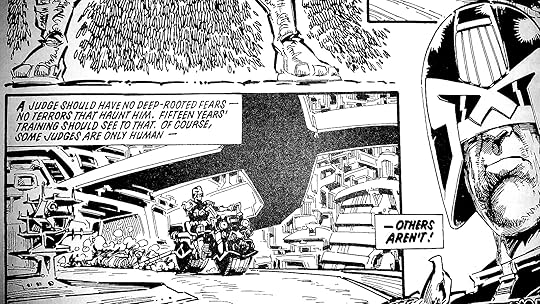
In Mega-City One crime doesn't pay!Judge Dredd - the future lawman with the powers of judge, jury and executioner at his disposal - faces some of his most challenging cases yet in this fourth volume of his earliest adventures. From the all-time classic Judge Child saga to the first appearance of legendary perp Chopper in Un-American Graffiti this collection is heaving with thrills and action-packed entertainment!
John Wagner is a comics writer who was born in Pennsylvania in 1949 and moved to Scotland as a boy. Alongside Pat Mills, Wagner was responsible for revitalising British boys' comics in the 1970s, and has continued to be a leading light in British comics ever since. He is best known for his work on 2000 AD, for which he created Judge Dredd. He is noted for his taut, violent thrillers and his black humour. Among his pseudonyms are The best known are John Howard, T.B. Grover, Mike Stott, Keef Ripley, Rick Clark and Brian Skuter. (Wikipedia)
The book starts with the introduction of some of the most iconic characters in Dredd’s universe: the Angel gang and Judge Barbara Hershey. The book ends with another: Marlon “Chopper” Shakespeare. But the most interesting thing about these early stories is 1. Grant’s world building is getting more solid and thoughtful (The Apocalypse War basically starts in a throwaway pirate story) 2. Grant’s confidence in creating popular villains he’ll then happily kill off (with a now regretted exception, most of the Angel gang apart from Fink and Mean Machine are written off here) 3. He’s getting the best out of his writing collaborators but 4. The seeds of that collaboration’s demise is already apparent
We’re not quite onto Dredd questioning his role in the world or his world yet, but there are moments where you can see the older, more haunted Dredd looking back at earlier decisions he made when more convinced of his righteousness. The epilogue to the Judge Child saga (less a saga, more a collection of mad ideas with a vague thread to bring them together) feels like the sort of stories that within a few years Grant will use as a way of poking about the world of the Judges and the ride of the democracy movement. The series is beginning to show the introspective streak that leads to some of the richest stuff done with the character. Pivotal to this is the death of Judge Lopez, a throwaway moment that must be one of the most important moments plot moments in Dredd’s persona: it’s the first and really nagging doubt he’ll get about his actions and the series still uses it for this purpose
That’s why Dredd is such a fascinating character: an initially simple action comic about a super cop slowly mutates into a wild satire before focussing on the darker side of an ostensibly heroic figure basically being a fascist and then, obviously with more than several exceptions, showing that heroic figure as something far more interesting than merely flawed: a questioning, doubt filled fascist super cop well into his seventies and still not entirely sure why he does what he does. Dredd must eventually be facing death within the next few years so the series still has fascinating things to explore, stuff that few superhero comics ever get to poke through. That’s quite an achievement
And my final thought is linked to that last point: we have settled in this era on several iconic Dredd artists - Ron Smith, Mike McMahon, Brian Bolland, Steve Dillon. With perhaps an exception for the last two, they are all deeply, peculiarly and utterly British in their art style. McMahon and Smith particularly are using art that would simply never fit in an American comic of the period (or before). They’re more European and eccentric and unique... I think we often forget how strange Dredd often looks compared to some of the American comics and here that world view is really snapping into visual focus. It’s really under appreciated how much that unique artistry has allowed for the longevity of the comic and it’s characters
This Judge Dredd Case Files opens with a cracking long story: the search for Owen Krysler or the Judge Child, a psychic boy which a precognitive Judge predicts would save Mega City One from destruction in the future. The search would lead Judge Dredd to Texas City and then outer space after Krysler is kidnapped by the infamous Angel Gang. But as the quest continues, Dredd begins to doubt his mission and at the end, must decide whether to bring Krysler back or not.
Other short stories would introduce memorable characters like Otto Sump, now the head of a line of Ugly Clinics and Chopper, the teen graffiti artist who, in a change from the usual ending for a Dredd story, gets the final laugh on Dredd and the Justice Department. Another member of the Angel Gang also pops up, looking for revenge for his kin, executed by Dredd during the Judge Child search.
One other story here becomes the prelude to a dramatic storyline in the next Case File: 'Pirates of the Black Atlantic' would turn out to be a plot to nuclear bomb Mega City One by the Sov Block without suspicion. It almost succeeds and Judge Dredd predicts that they would cause more trouble.
The bulk of this Dredd omnibus is taken up by the quite impressive "Judge Child" storyline, where we see the Judge Dredd universe branch out into space opera. Something I genuinely did not see coming, but that story arc surprises and impresses me at every turn. The remainder is taken up by one-shots, even there however you can see the ambition of "The Judge Child" rub off with one of the Angel Gang making a repeat appearance. I can understand why, that clan of murderous religious fanatic hillbilly cowboys have become some of my favourite bad guys in comic book history - no wonder the goth rock group Fields of the Nephilim apparently modelled their image on them! (FoTN's music video for the song "Preacher Man" quite well depicts what everyday life in The Cursed Earth must be like)
Something that continues to impress me about Judge Dredd is how the long form epic story arcs, where Dredd goes outside the Mega-Cities to the Cursed Earth or here into interstellar space, keep throwing a ton of weird and wacky ideas almost with each chapter - one more out there than the other - but at the same time all of those weird ideas still manage to fit into the same consistent look and feel of absurdist totalitarian futurism.
I've pointed out in my other Judge Dredd reviews that most of the look and feel of the Warhammer 40K universe, at least the parts without space orcs and space elves and literal demons, is basically copy-pasted from Dredd: Most of humanity being under a totalitarian government with tons of cod-Roman imagery enforced by fanatical high-tech stormtroopers; the societies that aren't under bureaucratic totalitarianism having reverted to feudalism if not outright lawlessness; strange futuristic cargo cults; tons of mutants and aliens being treated by human authorities as slaves at best, vermin to be exterminated at worst; supernatural fantasy/horror elements being an integral part of an otherwise nuts-and-bolts science-fiction setting; with the glue holding all of that together being British authors making fun of those aspects of American pop culture that look weird and silly to outsiders.
All of that is clearer here in "The Judge Child" than in any of the other story arcs I've read. Come to think of it, I actually like the 40K verse and its background material the most whenever it has that same flavour that's from 2000AD. In any case, out of all the Dredd I've read "The Judge Child" stands with the high marks along with "The Cursed Earth" and "The Day the Law Died".
Mega-City One, 2102. A Psi-Judge has made a dire prediction. Mega-City One will be annihilated in the coming decades if the "Judge Child" is not found and returned to the city. Judge Dredd has located the child, but he has been whisked off into deep space by hostile forces, resulting in the Justice Department having to fund Dredd on a long, expensive trek across settled space in search of the child...with the fate of Mega-City One and perhaps Earth itself hanging in the balance.
The fourth instalment in Judge Dredd's Complete Case Files turns the comic into something a little unexpected: a full-blown space opera. Having traversed the Cursed Earth, saved Mega-City One from an insane tyrant and brought law and order to the Moon, Dredd is now representing humanity and Earth on the interstellar stage as he goes in search of the titular Judge Child. At 26 issues, spanning a full half of a year (and half this collection), the story is a proud epic to follow up on the Cursed Earth and Day the Law Died sagas, but again it's somewhat episodic, an excuse for the writers to come up with increasingly crazy characters, planets and aliens for Dredd to come up against with the search as a framing device.
It's still a reasonably good story and a somewhat iconic one, introducing the Angel Gang and Judge Hershey, who will go on to be a key player in future stories spanning decades (including a sequel in this very volume, where a serial killer starts trying to pick off the survivors of the mission). The ending is interesting but a bit under-explored, and it has to be said that the sudden shift back into standalone adventures and short arcs is a bit jarring, especially when some of these can be best described as "bonkers whimsical." A story about an evolution virus escaping in Charles Darwin Block and "devolving" the inhabitants into angry monkeys is vaguely entertaining, if a bit obvious. A recurring storyline across multiple stories sees Mega-City One gripped by yet another craze, this time for plastic surgery to make people incredibly ugly, which of course makes the creator of the first "Ugly Clinic" insanely wealthy and ripe for criminal exploitation.
The second major story arc, though considerably shorter, is Pirates of the Black Atlantic, in which a pirate group based in the Black Atlantic off Mega-City One's coast causes absolute havoc, even going as far as getting their hands on a nuclear missile, forcing Judge Dredd to storm the vessel. The story itself is slight, despite the devastation inflicted, but more importantly is the ending, in which it turns out that another faction was manipulating the pirates, and Dredd exposing them only delays their plans, not halts them. But that's a story for Volume 05 to pick up on.
The remaining stories have Dredd teaming up with an alien reporter, dealing with pop stars and stopping a graffiti craze in Mega-City One, resulting in the first appearance of Chopper, the Midnight Surfer, a key Dredd character who will recur many times in future stories.
The volume is interesting in being basically made up of a huge epic, several short arcs and a whole bunch of standalones, mixing the approach of previous volumes, where Volumes 01 and 03 were standalones and Volume 02 contained two massive sagas, an approach also favoured in Volume 05. I would say that the Judge Child story, though well-conceived with some great characters, feels a bit slight. The massive build-up to a limp ending is a classic case of storytelling bait-and-switch (albeit one with some further pay-offs down the road), and the story really only ends up being memorable for the secondary characters it introduces. The standalones are a mixed bag, but there's a lot of interesting worldbuilding going on and some good laughs (Walter the Wobot also continues to be a low-key presence, which I am thankful for), as well as a few more, briefly thoughtful moments. The collection ends up being interesting, but it is really the calm before the absolute storm that is Volume 05.
The Complete Case Files Volume 04 (***½) contains every Judge Dredd story printed from Prog (issue) 155 to Prog 207 of the comic 2000AD, published from March 1980 to April 1981. The stories are set in the years 2102 and 2103. The writers in this collection are John Wagner, Alan Grant and Kelvin Gosnell. The artists in this collection are Brian Bolland, Ron Smith, Mick McMahon, Ian Gibson, Steve Dillon and Brett Ewins.
Well here I am, 4 collections into the happenings and goings on of Judge Dredd, and while I am still a fan, and I love the satire and comedic feel of these comics, I gotta say, Dredd sure is a giant douche.
More than once he acts like a spoiled brat, or one of those kids who finally get some power, and then abuse the hell out of it. He clearly has a disdain for people who don't accommodate his certain brand of leadership and goes out of his way to make those people pay for his dislike. In "The Boy Judge" arch, Dredd clearly has a hate hard-on for a member of his own team and constantly figures out ways to irritate them generally be a giant pain in the ass. I culminates when Dredd forces the guy to take a dangerous prophetic acid spice stuff, fully knowing it might kill them. It does. And instead of showing any modicum of respect or decency, Dredd blames the poor sap for not being able to handle the power of the drug.
Later on, in one of the one-off stories, he apprehends a perp and promises them that if they cooperate, he won't press charges, only to backstab the criminal once they confess. Also, throughout the entire collection, Dredd is seen, many times, backtalking his superiors, twisting the law and finding loopholes so that he can arrest the citizens of Mega City 1, and, as he did in the previous collection, leaving innocents to die.
Yet still, i have to say, I sure did enjoy The Complete Case Files: 04. The archs included weren't up to snuff with 02, but it's obvious to see Wagner and Bolland and the other authors were finally starting to find their groove and comfort level. There's a bit more insight into Dredd's character as he is fleshed out through the previously mentioned "Boy Judge" storyline. The stories, while not necessarily strong or as memorable as past and future ones, were slightly less silly than past attempts. And the satire (especially with the "Ugly Face" arch, and the mirroring of early 1980's-Britain own high unemployment in the "UnAmerican Graffiti" storyline) was spot on. Plus, the illustrations are much more consistent and defined (even if there are very few of Brian Bolland's fantastic strips here).
While the majority of stories are still rather child-like in their approach, it is great to see Dredd develop as a character, albeit very slowly, in arcs such as The Judge Child. Much of the wit is now outdated (chiefly the names of Blocks being called after famous people of the era) but as a result has taken on a bizarre humour beyond its original intent.
One of the oddest highlights has to be the new 'ugly trend' which sweeps the city, in which beautiful people take to plastic surgery and other tactics in order to make themselves appear hideous and therefore stand out in a crowd.
The action takes a step up in this volume as we see pirates nuke 4 of Mega City One's 800 million citizens, which the population generally regards as an acceptable, almost casual loss!
Best Dredd Case Files so far. They're totally in a groove by this point and the quality of the strips is very consistent, whether they're epics, stand-alone throwaway tales (well, I guess they're all throwaway!) or refer back to previous story lines. The mixture of childlike swashbuckling, satire and casual violence is always great fun. Ace.
The book opens with the Judge Child arc, which is an intergalactic romp. Bit all over the place, but contains some great ideas/art, like the hungry planet. The rest is mostly shorter Dredd stories in Mega-City 1. Although, Pirates of the Black Atlantic stood out. Can't go wrong with monster octopus' and the brink of Armageddon.
By chance or providence, a friend found a copy of this book and gifted it to me. I knew Judge Dredd and I've even read a couple of stories before. But I didn't expect all the fun I had reading this book. It was quite easy to start at volume 4. The art was beautiful in black and white. The writing was very good with occasional sparks of sheer brilliance and satisfying portions of British humour. It was a good book. It was a good time. Thank you my good friend!
Things start out with a bang with The Judge Child, one of the more famous (or is it infamous?) early Dredd arcs (also available in a stand alone trade paperback). That runs from issues 156 all the way to 181, 26 parts in all. That's one long arc. It ran in weekly six page increments over seven months in 1980. We are treated to some outright gorgeous artwork by Brian Bolland and Ron Smith. Smith's almost as good as Bolland, while Mike McMahon's artwork is merely serviceable. Both the writing and artwork continue to improve as we move along with the series.
The rest of the book is mostly one or two part tales, with some going as high as four parts. Things are definitely scaled down in scope after a 26-part story. The foundation of Dredd's law as an absolute philosophy are reiterated so that there is no doubt in the reader's mind. Some fans refer to this as the “two-dimensional” era of Dredd but I had a good time reading this stuff.
Since comic books in England were not under the Comics Code Authority the violence is way over the top when compared to American comics of similar vintage. The tone and pacing of this comic is so different from US comics of the day. It's obvious that these British comics had a huge impact on American comic books, especially stuff by that Alan Moore guy, whoever he is. This reads pretty smoothly and has aged really well.
It's a good job I'm getting the Case Files books digitally. By the time I' catch up with today's Dredd, I'd be in need of a room just for the books if I were buying paper copies.
File 4 contains another of the great Dredd epics- the Judge Child Quest. This is one I haven't seen the whole of before, because back when I was picking up the Quality/Eagle reprints, this was a mini-series of its own. Disaster is coming to the Big Meg, and it has been predicted that only a child called Owen Krysler can save the city. Dredd sets off to find the boy- who has a justice-eagle birthmark on his forehead and is a powerful precog- first in the Cursed Earth and then outer space. Along the way, he has to battle the King of rubbish, the Angel Gang, ship eating planetoids and a human hating robot empire. The tale is episodic, much like the original Cursed Earth story, with Dredd encountering strange creatures and situations that aren't all directly related to his mission, before the final showdown with the Angels and his important decision about the Judge Child's fate.
The rest of the collection sees Dredd back on Earth, stopping block wars and fending off the poisonous attentions of wayward last Angel, Fink.
This collection begins with our hero tracking an abducted clairvoyant child to the ancient Egypt themed lair of a self styled 'God of Garbage'. Then it gets weird....
The opening Judge Child saga takes us on a whacky road trip through post apocalyptic Cursed Earth and off world to a series of crazy planets. The art from Brian Bolland and Ron Smith is just terrific and everything but the kitchen sink is thrown into this adventure. I loved the dry humour of Dredd's 'Captain's Log' (poor Judge Lopez is given a hard time due to his suspiciously unorthodox moustache). Pity it all ends on an unresolved note (I'm guessing it'll be picked up on later).
The rest of this bumper book of fun consists of mostly short tales back in Mega City One. It's all good knockabout fun with grotesteque characters like the hill billy Angel gang plus Otto Sump and his ugly clinics. There are dashes of satire amongst the action but none of the grandiose hectoring of later stories like "America". There's definitely more wit and imagination in these pages than a dozen bland US superhero comics. Three years into the Dreddverse and we're building the world of Mega City One and laying the groundwork for epics to come. Favourite line: "Fink's gone Pa...and he's taken his hole with him!"
The Judge Child epic didn't work for me. I think it is because MegaCity 1 & the Cursed Earth are part & parcel of the Judge Dredd experience; they are the underrated supporting acts that make Dredd the fascinating character he is. I think one of the reasons JD is such an enduring character is that we can project multiple anxieties about our current environment into his stories. So placing Dredd on alien planets reduces his effectiveness as a fictional character IMO.
The last story introducing Marlon Shakespeare, aka Chopper, is a good example of the JD world capturing contemporary worries. In this case, massive unemployment and fears of young people looking to find a valued place in society.
This volume of Case Files included a one episode story that I remembered vividly reading 30+ years ago. It was about a normal innocent citizen desperately hoping not to attract unwanted attention - firstly by muggers, then at the end by judges. A well-written short story.
After a good year of mostly self-contained episodic stories, Dredd's fourth volume begins with him on the hunt for the Judge Child, a young boy prophesised to lead Mega City One through it's darkest hour (hinting towards the future epic Necropolis).
Unfortunately of Dredd's epics so far I found the Judge Child to be the weakest and I wasn't keen on returning to it in this reread. The stories are just a bit too disparate for me and I don't find most of them very memorable. That being said it does have a few gems, most notably the introduction of the Angel Gang and for that reason alone it's worth reading.
After the Judge Child and it's (intentionally?) anti-climactic ending, Dredd returns to the streets and like with volume 3 the stories are hit or miss. What is good here though is really good. What's shown in this volume is a willingness to build upon the stories that came before (the four-part Fink story the prime example of this). We also get introduced to Chopper in UnAmerican Graffiti and the seeds of Volume 5's legendary Apocalypse War are sown in Pirates of the Black Atlantic.
I also found myself really noticing Ron Smith's artwork here. He's smooth and reliable while also capturing the grit of Dredd's world when required.
As always here are my favourite Progs of this volume: The Hungry Planet (worth it for the Mike McMahon two-page spread), Hell's Angel, The Fink, Knock on the Door (very funny conclusion) and UnAmerican Graffiti (a nice look at Mega City One through its citizens' eyes).
Judge Dredd The Complete Case Files 04 kicks off straight after the previous book! :D Dredd has to overcome the Judge Child who he is sent to retrieve by the Chief Judges! :D It becomes very apparent that things are not all that they seem and the the Judge Child himself is up to no good I the neighbourhood! :D To top all of this off as well the SOV's are also up to no good stirring up trouble in Mega City One! :D The stories all go along at a great pace never letting up at all! :D This of course sends Dredd of to find a being with precognition known as the Judge Child! :D The Judge Child itself is particularly chilling in his ruthlessness but this also gives Dredd a chance to shine and do his thing! :D Dredd wanting to look into the child's eyes to get his measure cuts to to the heart of the character of Dredd really showing that behind the helmet there is more than simple obedience to to the law! :D
The SOV storyline as well gives us an insight and look into the greater politics taking place on Earth and the rivalry between the cities! :D The way that the SOV's go about things really casts them in the classic baddie role and this works excellently for the story! :D The way that the SOV's attempt to even the balance as well is particularly ruthless to boot which really rams home what rivals Mega City One! :D The viscera and the gritty feel the Mega Cities are all on display here and Judge Dredd The Complete Case Files 04 never hesitates to put it all up there! :D There no punches pulled here! :D Dredd's we'll be watching is very much like Picard's in the ST:TNG episode The Wounded or Holden's in the Expanses Leviathan Wakes and really works brilliantly! :D
The art style is bright and vibrant throughout with it all serving the script incredibly! :D The action in the panels flows perfectly really showing off the script! :D At the same time the whole book has a cinematic quality with the vista's complimenting the script perfectly! :D Judge Dredd The Complete Case Files 04 really goes for the World Building as we see Dredd getting off planet looking for the Judge Child and encountering all different kinds of planets and cultures which ironically takes him out of normal environment but at the same time doesn't phase him in the slightest! :D This of course gives sees Wagner Grant et al really go to town really putting it all up in the page there giving the book a truly epic quality to the everything! :D Judge Dredd The Complete Case Files 04 has a very explorative feel to it with each original issue moving to a new location! :D This rally puts Mega City One into context! :D For all that it sits in the wider galaxy it's influence spreads far and wide! :D This can be seen in al the diplomatic contacts Dredd clearly is already in touch with as he travels around! :D The books humour is all on display here and Dredd does his casting around routine and pointing out what he sees about the cultures! :D Dredd diplomacy for sure! :D
Judge Dredd The Complete Case Files 04 works on every level with great world building, character development and exploration all mixed in with action and great humour throughout! :D Judge Dredd The Complete Case Files 04 pulls out all the stops and is full of adventure, cunning, heroics, law-breakers and action packed throughout! :D Brilliant and highly recommended! :D Crisp High Five! :D Go and Get! :D Make sure you have the next one! :D
Fourth in the ongoing series reprinting every Dredd story from 2000AD, this covers progs 156-207 originally published between 1980 and 1981 (my golden period of reading ‘the galaxy’s greatest comic’). The biggest story is “The Judge Child”, which I don’t remember at all and while it starts well, it then sets off on a wild goose chase which now appears little more than an excuse to try Dredd in different settings rather than follow any chain of logic. The bulk of the stories are written by John Wagner (often as T.B. Grover), helped out by Alan Grant and Kelvin Gosnell while the art is by Brian Bolland (absolutely incredible), Steve Dillon, Brett Ewins, Ian Gibson, Mike McMahon and Ron Smith (who I remember most vividly from this period, especially “Chopper”, the story that closes out the piece). A nice mixture of series and one-offs, some of the ideas on display are astonishingly good and there are also some nice flashes of humour to leaven the atmosphere. Great writing and artwork (naturally), superbly reproduced, vivid and iconic (and nicely nostalgic for those of us who caught these stories the first time around), this is an excellent read and I’d highly recommend it.
Part of my ongoing efforts to read all of classic Dredd in chronological order. This latest volume covers well over a year's worth of Dredd strips from 1980-81, right when I was at my peak of buying weekly comics and waaaaay too scared to pick up 2000 AD. Included here is the Judge Child saga which ran over half a year in weekly chapters. I can only imagine how exciting it must have been to watch this play out every time a new issue became available for 10 or 12p at the local newsagents. What a fabulous time to have been alive. Dredd always existed at the nexus between satire and badassery. Individually these stories don't necessarily hold up, but as a record of the things young kids had to cling on to in Thatcher's Britain they are an invaluable historical record and bloody good fun to boot.
The former United States, 2102-2103. Judge Dredd is one of the most (infamous) law enforcement officers of Mega-City One, the sprawling megalopolis that covers the Eastern Seaboard. Sometimes, his cases take him beyond the Big Meg into the radioactive wastelands of the Cursed Earth, the southern megalopolis of Texas City and deep space - and that's just in one case alone, to save a child who is crucial to the future survival of Mega-City One. And other times, there are cases back in the Big Meg like the hunt for Chopper, the spectacular graffiti artist who commits astonishing and death-defying acts of vandalism…
My revisiting the early years of the Judge Dredd comic-book series continues. It's still good fun.
Case Files 4 is a decent affair, but the epic Judge Child saga had me scratching my head. Half the book is devoted to this story, and reads a bit like a pen and paper RPG - the GM has many stories to tell, but can't quite come up with a main plot line. The idea is decent, but the story arc seems a bit to random and scattered for my liking. The rest of the book however is bloody Stella, and a big improvement over Case Files number 3.
Still entirely bonkers and weaving its way into the early 1980s. Seems to be a few issues playing with the art style which is great. No very-long story arcs but there is a completely madcap multi-parter involving 'sov-block' where Judges with hammer & sickle insignias plot to use a cyborg - who thinks a colossal mutant squid is his mother - to launch dozens of nukes against Megacity One. Bizarre fun.
Le run Judge Child est moins inspiré que the Cursed Earth ou Judge Cal, je trouve. Une succession d'épisodes planétaires sans lien les uns avec les autres. Sur les artistes, Ron Smith n'a droit qu'à une toute petite notule en fin de volume alors que c'était un dessinateur exceptionnel (sa couv du prog 186, get ugly !!). Une première apparition de Steve Dillon (alone in the crowd), qui promet mais n'a pas encore la patte qu'on lui connait dans Preacher.
These are some epic Dredd stories from the early days, taking me back to my days at college. The dystopian view of the future is colored by the political and economic upheaval of the 1980s, with, for example, almost universal unemployment and a world post-nuclear holocaust (which was a constant backdrop to life at the time). As such it is a product of its time and a nostalgic view of the future.
I found this an enjoyable read and will probably resume the series after a short break.
I am on a Judge Dredd marathon bing reading of all the Judge Dredd graphic novels book since his appearance in 1977. I have already read them all over 10 years ago, so it was a trip down memory lane to relive these brilliant times and to thoroughly enjoy these graphics novels once again. I simply love the stories plots, the drawings and the dialogue as well. Overall a brilliantly graphic novels. Best wishes Sean
The Judge Child storyline dominates the first half this collection, the second half is a little more eclectic, lots of smaller stories set in the big meg, there's even room for a small sequel of sorts to the JC story, as a previously unknown member of the Angel gang makes an appearance looking for vengeance.
At last! The first appearances of Judges Anderson and Death and of the Angel Gang. Just when you think you're moving towards what Dredd became though, Walter reappears. This is a big step in the evolution of Dredd, stepping away from classic British comic-book tropes and becoming a more mature cannon. That transition's not yet quite complete though.
The first volume so far that felt a little underwhelming. I really enjoyed The Judge Child mega-epic, even if the ending left a little to be desired. But everything after that was incredibly hit or miss, and the writers clearly thing Otto Sump is a WAY funnier concept than he turns out to be (the Beatles one-off parody was gold though).
Uma aula de narrativa , esse volume tem uma grande saga do Dredd em busca do Juiz Criança, sob esse plot de encontrar um suposto messias para MEGA CITY o personagem é levado para vários territórios de seu universo distópico essa viagem abre margem para histórias de suspenses, outras mais policialescas e algumas até bem humoradas , são 350 páginas de diversão e arte de alto nivel
I've been working my way through the case files, and they've been consistently enjoyable, though I think the comic is at its best when Dredd isn't venturing out into the Cursed Earth or, in the Judge Child's case, outer space. I think Mega-City One as a setting holds a lot of the appeal for me.