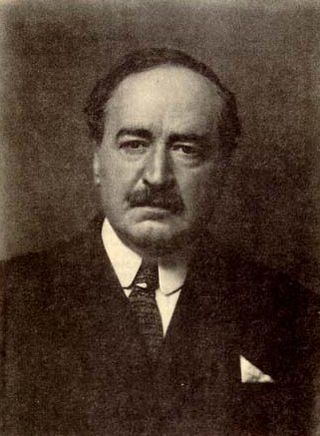
Vicente Blasco Ibáñez (29 January 1867 – 28 January 1928) was a Spanish realist novelist writing in Spanish, a screenwriter and occasional film director.
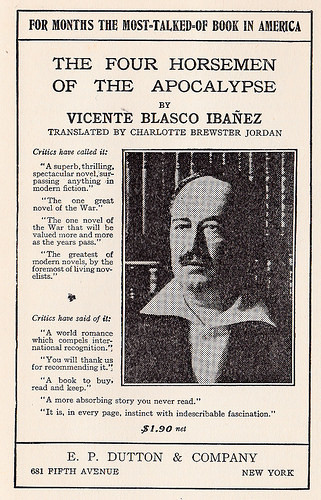
Born in Valencia, today he is best known in the English-speaking world for his World War I novel Los cuatro jinetes del apocalipsis. Filmed in 1921 as The Four Horsemen of the Apocalypse, it was filmed again in 1962, reset in World War II. However, in his time he was a best-selling author inside and outside of Spain, and also known for his controversial political activities. While Sangre y arena (Blood and Sand) and Los cuatro jinetes del apocalipsis are his most popular novels, particularly outside of Spain, his Valencian novels such as La barraca and Cañas y barro are the ones most valued by scholars.
He finished studying law, but hardly practiced. He divided his time between politics, literature and dalliances with women, of whom he was a deep admirer. He wrote with uncanny speed and energy. He was a fan of Miguel de Cervantes.
His life, it can be said, tells a more interesting story than his novels. He was a militant Republican partisan in his youth and founded a newspaper, El Pueblo (translated as either The Town or The People) in his hometown. The newspaper aroused so much controversy that it was brought to court many times and censored. He made many enemies and was shot and almost killed in one dispute. The bullet was caught in the clasp of his belt. He had several stormy love affairs.
He volunteered as the proofreader for the novel Noli Me Tangere, in which the Filipino patriot José Rizal expressed his contempt of the Spanish colonization of the Philippines. He travelled to Argentina in 1909 where two new cities, Nueva Valencia and Cervantes, were created. He gave conferences on historical events and Spanish literature. Tired and disgusted with government failures and inaction, Vicente Blasco Ibáñez moved to Paris at the beginning of World War I.
He was a supporter of the Allies in World War I.
His themes include his native Valencia.
He died in Menton, France, in 1928 at the age of 61, in the residence of Fontana Rosa (also named the House of Writers, dedicated to Cervantes, Dickens and Shakespeare) that he built.
Vicente Blasco Ibáñez (January 29, 1867 – January 28, 1928) was a Spanish realist novelist writing in Spanish, a screenwriter and occasional film director.
Born in Valencia, today he is best known in the English-speaking world for his World War I novel The Four Horsemen of the Apocalypse. He is also known for his political activities.
He finished studying law, but hardly practised. He divided his time between politics, literature. He was a fan of Miguel de Cervantes Saavedra.
His life, it can be said, tells a more interesting story than his novels. He was a militant Republican partisan in his youth and founded a newspaper, El Pueblo (translated as either The Town or The People) in his hometown. The newspaper aroused so much controversy that it was brought to court many times and censored. He made many enemies and was shot and almost killed in one dispute. The bullet was caught in the clasp of his belt. He had several stormy love affairs.
He volunteered as the proofreader for the novel Noli Me Tangere, in which the Filipino patriot José Rizal expressed his contempt of the Spanish colonization of the Philippines. He traveled to Argentina in 1909 where two new cities, Nueva Valencia and Cervantes, were created. He gave conferences on historical events and Spanish literature. Tired and disgusted with government failures and inaction, Vicente Blasco Ibáñez moved to Paris, France at the beginning of World War I.
He was a supporter of the Allies in World War I.
He died in Menton, France at the age of 61.
----------------
Vicente Blasco Ibáñez (1867-1928). España. Nació en Valencia el 29 de enero de 1867. Estudió Derecho pero no ejerció esa profesión y se dedicó a la política y la literatura. Con veintiún años se inició en la Masonería el 6 de febrero de 1887 y adoptó el nombre simbólico de Danton en la Logia Unión nº 14 de Valencia y después en la logia Acacia nº 25. Allí recibió el encargo del presidente Raymond Poincaré de escribir esta novela sobre la guerra: Los cuatro jinetes del Apocalipsis (1916), que fue un auténtico éxito de ventas en los Estados Unidos. Blasco Ibáñez murió en Menton (Francia) el 28 de enero 1928.
Thousands upon thousands of men, victims of day-labor, suffered the tortures of hunger because they had no fields to cultivate, and the land was reserved for beasts … Nor was the dominating animal of that plain the peaceful steer that provides meat for men’s sustenance; it was the wid bull, destined to fight in the arenas … The immense tract of land was easily enough to provide room for four towns and food for hundreds of families; but the land belonged to the animals, whose ferocity was nurtured by man to amuse idlers …
Vicente Blasco Ibáñez (1867 – 1928)
was a best-selling Spanish novelist in various genres, whose most widespread fame in the English-speaking world was from Hollywood films adapted from his works.
Blanco Ibanez (BI) was born in Valencia. He graduated with a law degree, but never practiced law. Wiki list his interests as “politics, journalism, literature and women”, and notes that he was a particular fan of Miguel de Cervantes. Politically BI was a “militant Republican”, though for most of his life a Spanish Republic (as opposed to a monarchy) was but a figment of the Spanish political imagination. (The first Spanish Republic came and went in less than two years in BI’s childhood; the second Republic would not come about until three years after his death.)
At least through middle age BI was a supporter of left-wing views and causes, including anti-clericalism, and a strong advocate for Spain’s vast number of downtrodden, and often near-starving, peasants.
At the start of World War I BI moved to Paris, leaving Spain in “disgust” at the Spanish political situation at the beginning of World War I.
He died in Menton, France, at the residence he had built, called “the House of Writers”, which he had dedicated to Miguel de Cervantes, Charles Dickens and Honoré de Balzac.
Books
Wiki lists more than three dozen works by Blasco Ibanez. These include such things as travel writings and short stories, but most appear to be novels. Few of his works have been translated in English. These include: [The years listed are the Spanish publication date, and the English translation date.]
La Bodega ( The Fruit of the Vine) (1903/1919) La Catedral (The Shadow of the Cathedral) (??/??) Los cuatro jinetes del Apocalipsis (The Four Horsemen of the Apocalypse) (1916/1919 La Maja Desnuda (Woman Triumphant) (??/1920) Mare Nostrum (Our Sea) (??/1919) Sangre y arena (??/translated as The Blood of the Arena in 1911; as Blood and Sand in 1919)
and a collection, The Last Lion: And Other Tales. (??/??)
It is The Four Horsemen for which BI was best known in the United States, a novel about the French and German sons-in-law of an Argentinian land-owner, fighting on opposite sides in the First World War; on the best-seller lists in 1919. In 1921 a film was made, which, according to Wiki, was “the vehicle that propelled Rudolph Valentino to stardom.”)
La Bodega
My copy of the book was published by E.P. Dutton (the house which published most of the English language works above). It is from the eighth printing, in July 1919. The first of those eight printings was in the previous month! Besides an informative Introduction, there is at the end a two page Glossary of Spanish terms left untranslated, and three pages of advertisements for other books by BI and published by Dutton
In that short introduction, the translator, Dr. Isaac Goldberg, lists La Bodega as the third of a series of novels, the first two being La Catedral (dealing with the retrogressive influence of the Catholic Church upon Spain) and La Horda (dealing with the Jesuits). Goldberg writes that La Bodega “is a double assault: first upon the vice of drunkenness, and second, upon the propertied interests that willfully keep the lower class in ignorance.”
Blanco Ibanez was early on influenced by Naturalism, the literary movement founded by Emile Zola. Characters in such a novel are portrayed as trapped in the deterministic interaction of heredity, environment and social conditions.
La Bodega appears to me to be definitely in this Naturalist tradition. It shares, I would guess, some of what can be considered flaws of these fictions, including the preachy moralizing about the social conditions of the lower classes; though it must be said that the discomfort caused the reader by this didacticism will vary, depending on one’s affinity to this view of the human condition.
The novel is set in Andalusia, specifically in and around Jerez. This is in the center of the great sherry producing region of southwestern Spain. At the time of the story (which seems to be in the late nineteenth century) this area was made up of fairly large land holdings owned by the aristocratic class of Spain. Producing land (for, in this case, grapes) was worked by laborers hired for specific parts of the year, then let go to fend for themselves as best they could until the working season returned.
I find it a bit difficult to say who the main character of the tale is. The prime candidate is don Fernando Salvatierra, a “social revolutionist” we could call him, who has spent time in jail, but been released, since he is viewed as a rather gentle revolutionary who won’t incite the peasants to violence.
But perhaps we should select the duo of Pablo and Luis Dupont. Pablo is the head of the “Duport Brothers” wine firm (whose primary profits have become cheap sherry and cognac, rather then the fine wines originally produced). Luis is Pablo’s first cousin. Both of these characters are used by BI as examples of the landed aristocracy: the first characterized by his ultra-religiosity, blended with a somewhat kind, and exceedingly condescending, feeling towards his workers; the second as a degenerate drunkard and lady’s man who comes to have political ambitions.
Or the “middle class” of this social milieu, represented by Fermin Montenegro, his father, and his sister. This family works for the Duponts, Fermin in the town office of the firm as a clerk, the father as an overseer at the main estate. Their sympathies are shown to be naturally towards the working peasants, but sway back and forth between these unfortunates and their own rung on the ladder of society - not very lofty, but certainly worth preserving.
Or the peasants themselves? There are a few depicted in some detail, and the picture is not pretty. At one point Salvatierra despondently judges that due to the total situation (heredity, environment, social conditions) this class must contend with, there is no earthly (nor heavenly) salvation for them.
Rating – 4 ½
I liked the book quite a bit. I’m in sympathy with the Naturalist idea, and Blanco Ibanez’s narrative, despite getting a bit corny once or twice, had for me several powerful sections, particularly the last few chapters concerning a peasant strike/revolt, and a desperate side-story involving some of the characters mentioned above.
Amazon (U.S.) has several of Blanco Ibanez’s works available in English. But the great majority are in Spanish; some of these do not adequately make clear that they are not English translations.
С всяка следваща книга Ибанес ме изумява все повече и повече с лекотата, с която критикува всичко грешно в обществото. Толкова просто и толкова точно, та няма как да не разбереш какво се опитва да каже. Въпреки че романът е писан преди повече от век, докато четеш усещаш колко е актуален, как проблемите са се изменили донякъде, но човекът си е останал същият по нрав. „Стадото“ пак е залъгвано по най-лесния начин, богатите все още имат най-тежката дума, мислещите бягат колкото се може по-далеч, а борците за „правда“ са разпръснати на малки групички. И накрая през погледа на историята от последния век Идеята на Салватиера е нищо повече от една безуспешна „утопия“ именно защото всичко грешно в обществото е невъзможно да се оправи със смяна на единия репресиращ режим с друг, и после с трети и т.н., когато нагласите на хората си остават едни и същи.
Una novela social que recuerda a Germinal de Zola. Las primeras 250 páginas el autor se dedica describir las duras condiciones de vida de los jornaleros de Jerez y los pueblos cercanos. Son en las últimas 100 páginas donde la denuncia sociale dejá paso a un relato más novelesco. En la narración se nota el manejo de los recursos narrativos y el oficio de un gran novelista. Sin embargo, creo que se trata de una obra menor de Blasco Ibáñez, esperaba algo más.
Me ha costado un poco la forma en la que escribe, pero la base y el contexto me han conmovido bastante, por eso le doy 4 estrellas. Un poquito de conciencia social, aunque sea escrita hace más de un siglo, que algunos pareceres no han cambiado tanto.
Retrato naturalista del Jerez del siglo XIX, muy bien documentado y salpimentado con melodramas románticos al estilo de la época. Por suerte o por desgracia, muchas cosas no han cambiado.
N-am prea multe experiente cu literatura sud-americana sau spaniola, probabil din simplul motiv pentru ca am avut nesansa sa studiez aceasta limba in liceu, cu o profesoara ... speciala. Pe langa asta, sunt posesoarea unui accent de muncitor necalificat, pe un santier ordinar din Madrid. Trecand insa, de repulsia mea pentru limba iberica, am sa scriu o serie de cuvinte despre carticica asta.
Spre surprinderea mea, mi-a luat destul de mult sa o termin, desi are doar 240 de pagini. Dificultatea de a o citi provine din intamplarile relativ socante si brutale istorisite pe alocuri, constand in gesturi dezgustatoare ale unor tarani care se aliaza impotriva unui 'outsider', venit pentru a reclama un pamant. In speta, subiectul pare destul de simplu: un teren se considera a fi blestemat, de cand a fost pierdut de un alt arendas, si care, intr-un moment de furie extrema, si-a ucis proprietarul din doua focuri. Barret, pentru ca asta e numele lui, e, bineinteles, condamnat la moarte, iar acest eveniment baga frica in sanul tuturor locuitorilor "huertei", un fel de comunitate sateasca. O vreme [cam vreo 10 ani, din cate am inteles], pamantul ramane parasit. Nimeni nu se muta acolo, nimeni nu decide sa il refaca, sa-l transforme in cel fertil care fusese. Pana intr-o zi, cand o familie noua hotaraste sa se stabileasca pe aceste meleaguri. Gestul in sine atrage mania si revolta intregii comunitati, desi, ca sa fiu sincera, n-am inteles prea bine atitudinea lor. Batiste, personajul principal, pana la urma, e determinat sa-si faca aici un rost, sa cultive graul, sa aiba grija de nevasta si de cei trei copii. Insa, bineinteles, nimeni nu-i suporta, si toti se comporta ca atare. Inca din primele saptamani petrecute in sat, Batiste e dat in judecata pentru a fi [presumably] consumat apa din canal la o ora nepotrivita [am ramas realmente socata de obiceiurile spaniole, din punctul asta de vedere...]. Dupa o serie de intamplari mai mult sau mai putin neplacute, care ar fi trebuit sa ii dea de inteles barbatului ca nu e binevenit si ca gestul cel mai firesc ar fi sa plece, baiatul cel mic, zis "Sfintisorul" cade la pat, bolnav. Asta dupa ce fusese atacat si impins in canal de colegii de scoala, rau-voitori si la fel de plini de venin precum parintii lor. Saracul copil isi da sufletul intr-o seara intunecata, si huerta, emotionata de suferinta familiei, vine sa-i aduca omagiu lui Batiste. Pentru o vreme, lucrurile stau ceva mai bine, si intrusii par a se integra, intr-o oarecare masura, in cadrul comunitatii. Pana cand, bineinteles, se isca un conflict intre Batiste si un localnic ce nu-l avusese niciodata la inima, Pimento. Ca sa ajung la finalitatea povestii, lucrurile evolueaza din ce in ce mai rau, si cei trei raman fara casa, cand aceasta e pusa pe foc de localnici... concluzia cred ca e, pana la urma, sa nu incerci sa te joci cu destinul, si sa nu indraznesti sa crezi ca te poti descurca singur, cata vreme nu ai acceptul unei comunitati. Ceea ce, sincer, mie mi se pare o prostie. Desigur, eu privesc problema din perspectiva unei fete traite si crescute la bloc, motiv pentru care n-am avut, mai niciodata, prea multe contacte cu vecinii. Dar cartea asta, desi e, intr-adevar, foarte bine scrisa, m-a dezgustat profund pe alocuri, pentru ca releva caracterul realmente dezagreabil si dezgustator pe care orice taran il are, deep down inside. Nu numai ca nimeni nu se bucura de succesul pe care il are Batiste cu recolta, dar il invidiaza si ii vor pielea, cu orice pret. Ce ipocrizie, ce spirit de turma, ce scarba de lacomie!!!
Deci, daca vreti sa o cititi, e o lectura frumoasa... dar putin cam neplacuta, din cauza evenimentelor istorisite. De asta mi-a si luat atata timp sa o termin. :|