Millions are wondering what the future holds for mankind, and if we are soon due for a changing global shift. Paramhansa Yogananda (author of the classic Autobiography of a Yogi) and his teacher Sri Yukteswar, offered key insights into this subject. They presented a fascinating explanation of the rising and falling eros that our planet cycles through every 24,000 years.
According to their teachings, we have recently passed through the low ebb in that cycle and are moving forward to a higher age — an Energy Age that will revolutionize the world. They declared that we would live in a time of great social and spiritual change, and that much of what we believe to be fixed and true — our entire way of looking at the world — would ultimately be transformed and uplifted. In The Yugas, Joseph Selbie and David Steinmetz present substantial and intriguing evidence from the findings of historians and scientists that demonstrate the truth of Yukteswar’s and Yogananda’s revelations.
Selbie makes the complex and obscure simple and clear. A dedicated meditator for over forty years, he has taught yoga and meditation throughout the US and Europe. He has also been an avid follower of the unfolding new paradigm of science—with groaning bookshelves to show for it—and he is known for creating bridges of understanding between the modern evidenced-based discoveries of science and the ancient experience-based discoveries of the mystics.
Author and lecturer, Joseph studied ancient Western cultures at the University of Colorado and ancient Eastern cultures at UC Berkeley. He has had a keen interest in ancient history since grade school. He has taught and lectured on the principles of Eastern philosophy for over thirty years.
Selbie has also authored, The Yugas, a factual look at India’s tradition of cyclical history, and a sci/fi fantasy series, The Protectors Diaries, inspired by the abilities of mystics.
Selbie is a founding member of Ananda—a meditation-based community and spiritual movement inspired by Paramhansa Yogananda. He lives with his wife at Ananda Village near Nevada City, California.
When I was 18 I read 'Autobiography of a Yogi' in Camden Town, London, England, and I still remember the rush of sattva one bright Autumn afternoon standing about a block away from the High Street, when I was about two thirds of the way through Paramhansa Yogananda's marvelous book. Later I attended lectures at a school that had got hold of a piece of eastern mythology and, passing it through a quasi-Victorian morality, gave about the most dismal outlook on the Yugas (the great cycles of time) possible.
This book (written by followers of Yogananda and his teacher Sri Yukteswar) is welcome as an optimistic antidote to the pessimism that a too-close awareness of karma without the insight to support it, can create. The posited astronomy and astrology, and the social observation, is extremely plausible, supported by a forward looking analysis of the history of the past few hundred years.
Notwithstanding that we are still a long way off from the next Golden Age, the coming advances, and the idea that we are presently in the early stages of an ascending cycle is very hopeful. Will the crises in human affairs suddenly cease or transform? Will politics become enlightened? Will we all convert to clean energy tomorrow? Will peace suddenly prevail? No way. But in this book, the idea is insisted upon that incrementally, year by year, the level of our solar vibrational environment will rise.
After reading “The Physics of God” by this same author I was very interested in exploring this book. Prior to this I knew nothing of the Yugas Cycle. A Hindu sage in the 1800’s described that time is not linear but cyclical and humanity repeats 4 ancient cycles. He also explored the relationship of time to consciousness. I read this book to see what cycle they say we are currently in and what do they believe lies ahead in the future.
The 4 cycles are: Satya Yuga Treta Yuga Dvapara Yuga Kali Yuga
Each of these displays a steady decline in virtue and spirituality until humanity reaches a maximum hedonism before finally returning to a Golden Age of Enlightenment and Virtue (Satya Yuga).
I suppose Sri Yukteswar (who this book heavily referenced) was basing much of this concept on astrology and the belief in a creator Brahma (which as a Christian I do not aspire to any of these philosophies). However I did have to say that many topics touched on in this book are so intriguing to my brain, things I’ve always wondered about are explored in detail. For example...
The Egyptian Pyramids India’s Vedas The Nazca Lines Stone Megaliths Magic/Dark Magic Reincarnation Eternity Telepathy Mind over matter
Exodus 7-8 in the Bible details how Moses and Aaron performed great signs and wonders in Egypt when God sent the plagues...and Pharoah’s magicians were able to duplicate this as well. Was it the power of God vs. the power of the devil? How was this possible? What kind of magic did they utilize? The authors explore this in the book.
Anyway, one big takeaway for me is how strikingly intelligent ancient man and civilizations were. They definitely possessed technology we have not even come close to duplicating. Great read if you want to hear facts and philosophies on many past civilizations.
A yuga in Hindu philosophy is the name of an epoch or era within a four age cycle. According to Hindu cosmology, life in the universe is created and destroyed once every 4.1 to 8.2 billion years. The cycle of the yugas are said to repeat like the seasons, waxing and waning within a greater time-cycle of the creation and destruction of the universe. Like Summer, Spring, Winter and Autumn, each yuga involves stages or gradual changes which the earth and the consciousness of mankind goes through as a whole. A complete yuga cycle from a high Golden Age of enlightenment to a Dark Age and back again is said to be caused by the solar system's motion around another star.
"The Yugas: Keys to Understanding Our Hidden Past, Emerging Present and Future Enlightenment" discusses the ascending and descending cycles of the yugas and how this influences our past, present and future. The book makes an interesting read and provides a novel hypothesis for the rise and fall of human civilization and consciousness. The book discusses everything from the golden age of man, ancient history, the dark ages, the renaissance, the 'modern era', and contemplates what the future would be like.
This piece on the Yugas is one of the best I have read. It covers a vast number of subjects regarding the Yugas, but it goes in depth to the knowledge of how is is consciousness and not time that goes through these cycles. I have been studying the Yugas for quite some time and after I wrote my first book "Way of the Weirdo" I created a film which goes into this and many other topics. Here is the film "The Sacred Sound of Creation" https://www.youtube.com/watch?v=O57AQ...
This is easily one of the best books I've read. Human mind is a rational cognitive agent and this is seen in our tendency to rationalize all facts that we pay attention to.
One of my biggest concerns about Indian "mythology", which incidentally is known as "Itihaas" in Hindi (i.e. History), has always been its temporal context in human history. If Indian history begins with the Indus Valley as we popularly read, then there is no reason for events and characters described in epics like Ramayan or Mahabharat to ever exist.
Flying gods and vanishing demons might be poetic exaggeration, but these epics cannot be all but figments of imagination of some very fertile minds.
The Yugas has offered me a new paradigm to think of human history in general and Indian history in particular. It helps reduce my cognitive dissonance on many fronts.
The propositions in the book might not be all correct (I don't think even the author would say that), leading some skeptics to dismiss it as another story. Yet, even if the skeptics were correct, this is nothing short of a very beautiful story. To the more scientifically inclined readers, I would suggest to open their minds to questions posed in the text in the true spirit of science and try to question our beliefs, which as history has repeatedly shown, are often moulded by new questions and their answers.
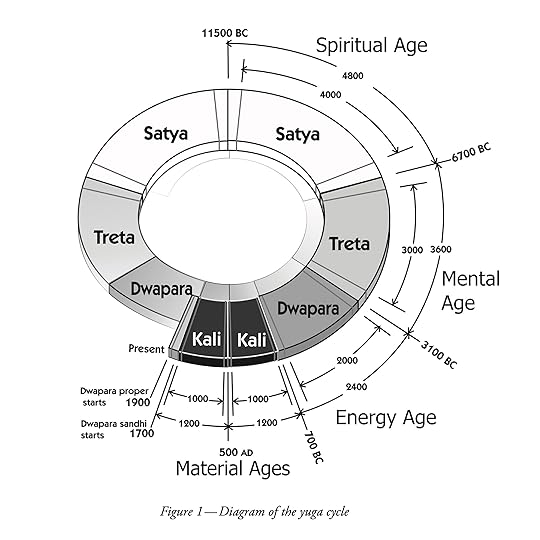
This must be the most comprehensive and accessible book about the yugas written to date. The Yugas is full of insights, it's clear and concise, with diagrams and lots and lots of examples. It's optimistic, our future is bright. Unless we nuke it. Then it's still going to be bright, I guess, haha... Anyway. I don't understand why more people don't talk about devolution. Everywhere I look at it points out that we were devolving as species both mentally and spiritually. After hitting our rock bottom as humans about 1500 years ago, we stayed fast asleep in this nightmare for another 1200-1400 years. Truly dark ages. According to Sri Yukteswar and the authors, this is our current place in the cycle:
Since there are huge gaps in the known history, it's unavoidable to have some speculations about it. What I love is that the authors are clear about what's their speculation and belief and what information they got to get to this conclusion. Also, I find that a healthy dose of that ignites your imagination and curiosity, so you yourself are prone to discover more and make sense of it all. After finishing the book I'm left with a long reading list. The rabbit hole is sucking me in and I'm surrendering to it.
Our understanding of human evolution so far has been that we are the peak of intellectual growth, that mankind is at its most intelligent stage at present and we have evolved from previous generations of hunter gatherers with limited potential beyond survival instincts. We also believe we are going through a phase of Kaliyug now where mankind will go through total destruction and annihilation before the world regenerates itself into a fresh new phase of Satya yuga, or the golden era.
This book offers an alternative point of view, with its contrary explorations, unanswered questions and hypothesis. It bases a lot of its information on the writings of Sri Yukteshwar Giri, the guru of Sri Yogananda Paramahansa (the author of Autobiography of a Yogi). According to the Yuga model in this book, there is a 24,000-year cycle, and humanity goes from a high spiritual state to a low spiritual state and back up again, and this has been happening since millions of years.
As per commonly accepted knowledge, the Hindu Yuga Cycle lasts for 4,320,000 years (12,000 divine years), the four yugas being Satya Yuga (1,728,000 Earth years/4,800 divine years), Treta Yuga (1,296,000 Earth years/3600 divine years), Dwapara Yuga(864,000 Earth years/2400 divine years), Kali Yuga( 432,000 Earth years/1200 divine years) in a ratio of 4:3:2:1. Starting from 3,891,102 BCE, this would imply that we hit Kaliyug in 3102 BCE and will be drudging along till 428,899 CE. Not a very promising vision. Here Sri Yuketeswar and consequently this book offers us hope in his proposition that the yuga lengths for Satya, Treta, Dvapara, and Kali are respectively 4,800, 3,600, 2,400, and 1,200 "human" years, and human kind goes through descending and ascending stages of yuga cycle over these 24000 years, and as per this hypothesis we have left the Kaliyug behind in the 1900s and are in the ascending stages of Dwaparyug.
The book dwells into the characteristics of each yuga and how the collective human consciousness varies across the yugas and our capacity to realize our own power and potential and how we choose to live our lives. 12000 years ago, we associate with the ending of the Ice Age and floods that ravaged the world to transform it into a shape that we identify with today. The primary hypothesis that this book disagrees with is that we are currently the peak of human civilization and the generations before lacked the intelligence or means to envision or develop anything that involved innovation. It gives examples of the pyramids (2500 BCE), the Vedas (1500 BCE), the Indus valley civilization(2500 BCE), Goebekli Tepe in Turkey (8500 BCE) and many others that are intellectual and architectural marvels and a definite indication that there existed during these eras, immense potential that we have possibly underestimated. Graham Hancock in his documentary "Ancient Apocalypse" alludes to similar speculation through interviews with archaelogists and geologists around places like the Gunung Padang, The Megalithic temples of Malta, Bimini road, nazca lines and the lost city of Atlantis. The argument is very similar, how could simple minded hunter gatherers with their limited tools be the creators of such monumental craftsmanship.
Trying to understand the cycle, we have been descending from the Satya Yuga (12000 years earlier and aligning with the timing of the Ice age), to the Treta, Dwapara and Kaliyuga (17th century) and then the ascent from Kaliyuga to Dwapara onwards to Satya Yuga. The 1900s where we saw wars and destruction, along with major scientific breakthroughs are said to be the transition from Kali to Dwapara. As the mentality of the common man progresses beyond materiality and self centred outlook, mankind will begin to harness the power of thought, communicate with our surroundings and nature and even across the universe. This utopia is a beautiful place to imagine, but considering the latest disasters fuelled by our short sightedness, it becomes increasingly difficult to believe that we might last that long. This is an optimistic book, trying to tie historical proof, ancient wisdom, the writings of seers and a good amount of scientific research to convince the reader and make them question their simplistic belief of evolution.
My personal feedback is positive, I found the book interesting and intriguing, although a tad long winded. A lot of content is repetitive and could have been curtailed, there is a good amount of research and explanations that may feel a bit dry and documentary like. Yet there are interesting insights, some moments in the book that keep you on the edge to know more and for those (like me) who the concept of Yugas itself was superficial at best, this book lends a lot of clarity. It cannot be taken as the absolute truth, and I have seen that nothing really can be, there are counter questions and arguments to every philosophical idea. There are disagreements even in the timeline and span of yugas and different narratives if you go to research further. This book attempts to summarize the concept of yugas, describes the characteristics associated with each yuga cycle and produces an amalgamation of science and spirtuality. It will definitely not leave you with a sense of conclusion and neat endings. We can take it as an introductory course to the Yugas and build further on our personal understanding over time.
This entire review has been hidden because of spoilers.
Incredible, mind blowing, over and over again. I have a brand new positive outlook for and perspective on the past, present, and future of mankind. This led me to Sri Yukteshwar's the Holy Science, which I also highly recommend.
Irrespective of our age or the age we live in, many of us during many a phase in life tend to think that we are living in increasingly progressive times, having progressive thoughts, doing progressive things than what a generation or 2, or any generation of humans before, experienced. Look at the technology, look at the relative ease with which we sit and enjoy a diverse palette, the ease with which we travel, entertain ourselves, share our experiences, and what not. We somehow tend to feel fortunate that we live in this age and pity those who lived before us.
And then there are some of us who tend to think that despite all the technological advancements and seeming ease of life there is an emptiness, a lack of fulfillment, a lack of joy, a lack of conviction, a constant search for meaning and what not. Looking back at previous generations makes this feeling worse. We hear first hand reports from our fathers and grandfathers of how close-knit and happy the families and societies of their childhood were, how nothing ever bothered them even in the most adverse of conditions or circumstances. Looking further back is lots of elegant poetry, dealing both with the divine and the mundane, well mostly divine, that pour forth with such astonishing conviction that make us ponder why should only we be chosen for these God-forsaken times.
And then the thing is that many of these many and some of these some of us tend to think both the above thoughts simultaneously, or differentially at different phases of our own lives.
But what if both these thoughts aren't what reality is? Or what if both these thoughts ARE what reality is?
Well, there are several mainstream disciplines - Archaeology, Anthropology, Paleontology and the like that have made an attempt to construct a coherent version of this reality, but ploughing through the findings of even the best of them is more exertion than excursion. One awesome finding here, one brilliant observation there, one astonishing inference elsewhere, but where is that convincing, coherent narrative? Make no mistake, there are several narratives(most of them dry except if Bill Bryson writes them) expounded from the findings, but some of these are stereotypical hyperboles, some are gross oversimplifications, and some of these are apologetic at every other line on the limitations of the methods available to piece together the narrative in the first place. Even the most respected ones like Guns, Germs and Steel, you plod and plod through for hours, give it five stars more for the effort, and quietly shelve the other respected books in that genre that were in your to-read list, getting tired sick of the thought of once again attempting to imagine how the Neanderthals went about their daily business.
I do not say that this book provides that definitive narrative, because come on who knows, but boy doesn't this get close? intuitively close? Eerily close?
The concept of Yugas is familiar to most of us from historical and mythological lore but what many of us might not be familiar with is the personal touch that the Guru of Paramahansa Yogananda, Shri Yukteshwar provided to this concept. He wrote a ten-pager in the 1890s on the concept of Yugas, how they work, calculations involved etc and with a contra assertion that we are actually living in the early stages of Dwapara Yuga and not in Kali Yuga as is widely believed(what with the geopolitical chaos in the last few months). What Joseph Selbie and David Steinmetz do is a fascinating juxtaposition of this Yuga model with modern scientific disciplines in attempting to construct that definitive narrative.
There is mudslinging on the mainstream scientific narrative every other page, which initially made me feel why are these guys complicating things for themselves by so much mudslinging, what are they going to present to justify all this mudslinging, but then came the facts, the logic and their perspective most of which weren't just watertight but also very thought-provoking if you enter with an open mind. Data that we know about the rise and fall of civilizations and their timelines, geological events and their timelines, the evolution of human language, large scale warfare in ancient times, large scale constructions of the past like the pyramids, unanswered stuff like the Nazca lines and evidences of alien visits, and many familiar historical data are all reinterpreted using the Yuga model and the resulting argument makes a compelling case for the evolution and devolution of human consciousness with the Yugas rather than the widely accepted linear Darwinian evolution model.
This is one of my favourite and most eye-opening books of all time. It explores the concept of cyclical ages, or yugas, as described in ancient Indian philosophy, specifically from the teachings of Swami Sri Yukteswar. Drawing on esoteric wisdom from the East, particularly from Hindu and yogic traditions, the authors outline a theory of time that challenges the linear view of history. They propose that human civilization and consciousness progress through recurring cycles of enlightenment and decline, a pattern that influences everything from human behavior to technological advancement.
The book is structured around the idea of a 24,000-year cycle made up of four yugas or ages: 1. Satya Yuga (Golden Age) - An age of high consciousness, spiritual enlightenment, and unity. 2. Treta Yuga (Silver Age) - An age where advanced knowledge, telepathy, and high morality predominate, though with a gradual loss of the pure enlightenment seen in the Satya Yuga. 3. Dwapara Yuga (Bronze Age) - An age where people become more materialistic, but still retain an awareness of energy and interconnectedness. 4. Kali Yuga (Iron Age) - The lowest age of consciousness, marked by materialism, conflict, and an almost total disconnect from spiritual truth.
According to the authors, these yugas create a cycle of rise and fall in human consciousness, culture, technology, and spirituality, where civilizations experience periods of great enlightenment followed by times of darkness. Selbie and Steinmetz present a historical model that challenges mainstream views, suggesting that ancient civilizations, particularly those of India and Egypt, once possessed knowledge and wisdom far more advanced than what is typically recognized today. The authors draw on archaeological and scriptural sources to argue that remnants of these “golden” civilizations are visible in ancient monuments, texts, and legends. For example, they interpret the construction of the Egyptian pyramids and other ancient engineering marvels as evidence of advanced technologies or consciousness that surpasses current understanding, particularly during the high yugas.
As the world transitions through the yugas, the authors argue, humanity alternates between phases of scientific and spiritual understanding. They propose that civilization is currently emerging from the dark ages of the Kali Yuga and entering the Dwapara Yuga, where there is a renewed interest in consciousness, spirituality, and a more holistic view of life and science. • They support this with examples like the rise of modern technology, quantum physics, and a broader interest in meditation and Eastern philosophy as markers of this shift. They also suggest that advances in energy and consciousness will continue to evolve as we move further into Dwapara Yuga.
The authors describe how each yuga influences human attitudes and societal values. For instance, the Satya Yuga is marked by profound unity and peace, where people naturally live in harmony. By contrast, the Kali Yuga, or the “dark age,” is characterized by a preoccupation with material success, rigid hierarchical structures, and widespread conflict. • Understanding these patterns, the authors suggest, can help individuals make sense of the world. This read was a total gamechanger for me, as I realised that human consciousness, like everything else in nature, is cyclical, and we learn different things from different times. Such an excellent book - a must read.
I found The Yugas: Keys to Understanding Our Hidden Past, Emerging Energy Age and Enlightened Future by Joseph Selbie to be a really interesting and unique read. The idea that human history follows long cycles of roughly 24,000 years gives a very different perspective compared to the usual linear view of progress. It suggests that our level of awareness and capability rises and falls over time, which makes you rethink what humans are actually capable of depending on the era.
What stood out most to me was the way the book frames us as spiritual beings who often only experience ourselves as physical. Depending on where we are in the cycle, our perception, knowledge, and abilities can either expand or become more limited. That concept carries over into how the book looks at ancient civilizations. The discussion around the Great Pyramids in Egypt was especially interesting, offering the idea that they may have been built during a time when human understanding was far more advanced than we typically assume today.
Overall, I would rate this book very highly. It is a unique and thought-provoking exploration of the Hindu view of the universe and the cyclical nature of human existence. It is a quick read, but the ideas stay with you and take time to fully think through.
I wanted to love this book as the subject is of great interest to me, and it did not disappoint. The premise is that the humankind develops not in a linear, one-directional way, but rather in circular patterns, called yugas that go through both ascending and descending repeat cycles. Along the way, there are many references to historic and archeological facts that support this view. Whether one believes that the linear development is the truth, the descriptions of past events in connection to the yuga ages are truly thought-provoking. The book left me feeling optimistic for humanity and what the future holds, as well as the power of each individual to tap into their individual potential. While the book does not focus on any particular philosophical tradition, it does provide nice references to major philosophies, and in particular, I found the description of the Vedic tradition useful. It also contains many references to major historic and geographical events, linguistic facts, myth references, etc. A worth-while read on so many levels!
The most amazingly mind blowing book i have read since a long long time. This book changes your world, your perspective. It crushes the human ego that believes we are superior to our ancestors and have evolved over a linear growth over the last several years. Human beings have lived on this earth for 3 mn years (this is proven) and maybe more (yet to be proven). So why do we believe that we evolved only in the last 7,000 years. Does it then mean that for 2.999993 mn years man refused to evolve? that he remained primitive? That's a difficult proposition to believe which is debunked in this book. The bigger revelation is that probably humans have devolved (and not evolved) from our stone age ancestors. Many perspectives may be speculative, but one realises so are our current beliefs, which may be less of 'proof' and more of speculation (speculation that we believe is true by repetition and self fulfilling prophecies over ages). A must read for anyone wanting to get in touch with their spiritual side.
A very interesting collection of overlapping scientific and spiritual insights regarding the non-linear nature of humanity, the environment and the universe. I particularly enjoyed reading this after Pleiadian Keys to The Living Library by Barbara Marciniack as it has opened up a deeper line of inquiry about human interpretations of social, historical and archaeological findings throughout different periods in our existence. Both books- from complimentary perspectives- explore the human conception of linearity and further demonstrates that the worlds we experience are vastly due to our own capacities to perceive and manipulate energies, which is also influenced by the timelines we incarnate into.
Imagine one of the illustrious saints of the Catholic faith would have written or promoted some of the « eastern » wisdom contained in this book we might not be in this awful quagmire of « true science » vs « alternative science ». We could finally acknowledged that we are not the epitome of human development that wiser civilisations were before us, left us with astounding buildings and knowledge which we might just have been able to understand and put to better use than just tourism… We might also be living THE life we are given thoroughly awaiting the next with anticipation and reverence.
Although the author made a good effort in trying to convince this concept of the yuga cycles is a real thing, I still have my doubts. His explanations are not real evidence that we on earth have been going through these cycles. The reason why the yugas exist as given in the appendix bordered on the far fetched. I have rated it two stars instead of one for the author’s efforts in trying.
There are some kernels of wisdom, but for the most part, there was nothing new for me in this book. I've received a lot of this insight over the years and I think it's common knowledge for anybody interested in the subject. I really like this author's other works, with this one being my least favorite one. Not sure why the profundity of what was being discussed did not intrigue or fascinate me.
Everything makes sense now. It explains how we were so advanced and then lost almost all knowledge of the things of the world and ourselves. It's all a cycle of consciousness.