Swept off to live in Sydney by his Australian bride, American writer Tony Horwitz longs to explore the exotic reaches of his adopted land. So one day, armed only with a backpack and fantasies of the open road, he hitchhikes off into the awesome emptiness of Australia's outback. What follows is a hilarious, hair-raising ride into the hot red center of a continent so desolate that civilization dwindles to a gas pump and a pub. While the outback's terrain is inhospitable, its scattered inhabitants are anything but. Horwitz entrusts himself to Aborigines, opal diggers, jackeroos, card sharks, and sunstruck wanderers who measure distance in the number of beers consumed en route. Along the way, Horwitz discovers that the outback is as treacherous as it is colorful. Bug-bitten, sunblasted, dust-choked, and bloodied by a near-fatal accident, Horwitz endures seven thousand miles of the world's most forbidding real estate, and some very bizarre personal encounters, as he winds his way to Queensland, Alice Springs, Perth, Darwin--and a hundred bush pubs in between. Horwitz, the Pulitzer Prize-winning author of two national bestsellers, Confederates in the Attic and Baghdad Without a Map, is the ideal tour guide for anyone who has ever dreamed of a genuine Australian adventure.
Tony Horwitz was a Pulitzer Prize-winning journalist and author whose books include Blue Latitudes, Confederates In The Attic and Baghdad Without A Map. His most recent work, published in May 2019, is Spying on the South, which follows Frederick Law Olmsted's travels from the Potomac to the Rio Grande as an undercover correspondent in the 1850s. Tony was also president of the Society of American Historians. He lived in Massachusetts with his wife, novelist Geraldine Brooks.
What a fun and entertaining read. And you have to be fun and entertaining if you want me to be interested in any desert, for a desert to me is like looking at an Old abandoned outhouse.
So, what does he do for fun? Is hitchhiking in the outback in stopping in towns to have drinks at the pubs. This is because there is nothing else to do in the outback but drink. There is nothing else to do in any small town America either. I spent many a day in the bars in creston California with my husband, a town of 200 people. The people that we met were great characters just like those in this book. My husband drank beer, I drank orange juice. Just in case anyone wanted to know.
And what kind of music did he have to listen to when people picked him up to take him to the next town? Country music. The music that one man played on his car radio was by Slim Dusty. The title of my review is actually the title of a song that he sings. He is very popular there and sounds like Jimmy Rogers, our 1st country music singer in America. To me, both have horrible voices. Had in the case of Roger's. I am more of a merle haggard fan And Keith Whitley.
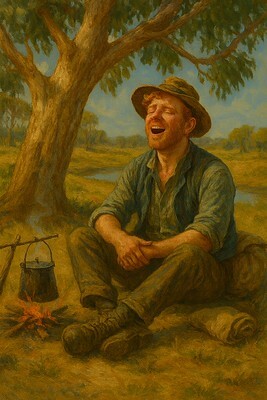
__________________________ Once a jolly swagman camped by a billabong Under the shade of a Coolibah tree And he sang as he watched and waited till his billy boiled You'll come a-Waltzing Matilda with me —Banjo Paterson, 1895
When I was young and my brain was as mature as that of a newly hatched chicken, I attended a small, conservative college that would have expelled me if they had known I was reading the Iliad in the original Greek while sipping a mint julep in my dorm room. At the same time though, they had no objections if I cruised down the interstate at 80 miles an hour with a crew of fraternity bros chugging beer by the quart in a blizzard. But I have never been a risk taker, so I have studiously avoided translating anything from the original Greek ever since.
Tony Horwitz, the author of this 1980s non-fiction book, on the other hand, was a risk junkie, a thrill-seeker, and daredevil. When he was 17, he hitchhiked across the entire United States—solo. After college, he became a journalist and war correspondent—maybe he enjoyed dodging the bullets. I don’t know. His wife Geraldine was also a war correspondent, so wide-eyed daredevilry runs in the family.
As One for the Road begins Tony and Geraldine are living in Australia—Geraldine’s country of origin—and Tony has a brilliant idea. He is rapidly approaching 27 now and wants to relive his youth and write about his adventures and misadventures on the road. Well, you can’t blame him: he is getting old and decrepit. He intends to go on a wander and hitchhike from Sydney to Alice Springs to Adelaide and then across the southern coast to Perth and eastward to Darwin. This is roughly the equivalent to thumbing rides from Miami to St. Louis and then to Phoenix and San Diego and up the California coast and eastward to Detroit. Tony’s slog is 6000-miles long, much of it through the Outback—the 3rd hottest and most unforgiving desert in the world. Geraldine, who was always up for a good adventure, wants to go with him in a car. I suspect that she wanted to play the role of the beautiful female Pulitzer Prize winning journalist who is driving through the desert, as Pulitzer Prize winning journalists are wont to do, when she notices a handsome and jolly swagman standing by a billabong and looking for a ride… [Well, never mind…that last sentence may not be true, but a book reviewer can dream, can’t he?]
Tony turns down her help. A man can’t go around having heroic solo misadventures in the wilderness if his wife is tagging along, can he? And Tony does have some misadventures. For instance, he quickly learns that he should bring more water when he is trying to catch a lift from a passing ute on a road where only 1 or 2 cars pass by every couple hours. He is going to be waiting in the sun when it’s 120 ℉ in the shade and he has forgotten his shades. He also learned that car trips in Outback inevitably involve drinking and an abundance of “tinnies”(beer), “plonk” (cheap wine), Goon (boxed cheap wine), or other giggle juice. A majority of the drivers who picked him up would be guzzling one while driving and [no worries] would happily share his supply with Tony. In one memorable instance, a young man had a bottle of champagne between his legs and said he was celebrating his wedding of the previous weekend and the birth of his daughter a day later by going on a lengthy wander down the highway. I don’t know what happened to this young man. I hope the wombats ate him.
According to Tony, alcohol and driving are so closely connected in the Outback that residents of that sunblasted hellscape actually use beer as a unit for measuring distance. For instance, if someone asks them how far it is to Oodnadatta, their reply might be “one case and a six pack” meaning that if you drink 3 tinnies (cans) of beer an hour while driving to Oodnadatta, you will knock back one case and a six pack of beer before you get there.
About 30% of the way through the book, Tony finally makes it to Alice Springs–the legendary town in the middle of nowhere. He calls his editor to check in, and his editor requests that that he rent a car and drive to the famous Ayers Rock monolith to interview people about how they feel about the fact that this landmark was recently (1985) turned over to the Aboriginal people living in the area. On the way back to Alice Springs, he may have been trying out the traditional Outback driving regime. He sped up to 90 miles an hour on a road that was rougher than a swagman’s facial hair. He lost control. The car flew off the road, flipped over several times, and ended up on its roof, leaving Tony trapped inside in the brain boiling heat. Miraculously, a police officer from Alice Springs passes by before Tony’s brain actually melts down. No worries. The copper pulls him out the car, pours a couple of ice-cold beers down his gullet and throws him in the backseat of patrol car.
I’m going to leave Tony stuck in this predicament because I have to go to the corner gas station and purchase enough Fosters to make it to my daughter’s house, which is three six-packs and a couple of loose tinnies down the ol’ bitumen.
🔅🔅🔅½ Stars.One for the Road —an apt title—is not a book about Tony fighting off escaped madhouse kookaburras, blood-sucking wombats, and man-eating koala bears. In fact, he barely mentions them. It is a book about the people he met on his journey. The stories are sharp, strange, and worth a read — preferably at a rate of no more than 3 tinnies per chapter.
My fondness for Australia notwithstanding,I didn't like this at all.To begin with,the Australian outback is not such a cheerful,welcoming place.
But what made the book totally unpalatable to me,was all the references to pubs and drinking.Yes,drinking is such a big part of Australian culture,but that doesn't interest me at all,and that is what this book seems to be all about.
I gave up on this,halfway through.In addition to all the drinking,the writing style is not that elegant.
I was reminded of Bill Bryson's book,In a Sunburned Country.He too travelled the outback,but in the comfort of a train and made it sound interesting.
Being actually on the road in the outback has to be rough going,anyway.
As a recently married transplant to Australia, Horwitz decided that he wanted to see the outback. Now, obviously, the sensible way of doing this would be to rent a car, load up on necessities, and make a detailed itinerary to follow. So, as will be obvious to anyone who has read any of his books, he had his wife drop him on the far side of Australia, and began hitchhiking. It's a pretty good travel book, one of my favorite genres. It was also a gateway to a lot of memories. I went through my hitchhiking phase, some ten or fifteen years ago. And though I never saw Australia in such a manner, I did spend copious amounts of time in the panhandle of Oklahoma. And there is something that haunts me to this day about walking along the road in the middle of nowhere, a land so desolate that you can see forever, where the only signs of the hand of man, beyond the road you stand on, are the ruins of dreams, the decrepit farmhouses and such, abandoned, and weathered in such a way that there is no way to tell how long they've stood vacant. You feel attached to the country, in a way you never could somewhere that man's tenancy shouts to all that someone was here. Anyway, good memories brought back, and I would have to thank this book for that, even if I hadn't been so enjoyable. His discussion of the type of drivers who pick up hitchhikers is dead on, and his observation that people in pickup trucks are more likely to stop than people in sedans- dead on. Recommended.
Since I can’t hop into a car and spend the next few months exploring the byways, small towns, and off the map places of my, or any other, country, I return again to Tony Horwitz to learn a bit about the world and the people who inhabit it. And to live vicariously through this wonderful, well-traveled writer. This time it’s the deceptively complex nation of Australia in a stinking hot December (I still can’t get used to this). And as always, it didn’t disappoint.
Tony Horwitz’s wife, Geraldine Brooks, is an award winning journalist and novelist, that I was introduced to in Horwitz’s fantastic Baghdad Without A Map; while I’ve never read any of her novels (though I plan to after finishing Horwitz’s bibliography), I have heard of her and just learned they had met on their travels and married shortly after. She’s also Australian. Around the time this book was written (90s), the two of them were living together in Sydney; Horwitz decided on a whim that he was going to hit the road to explore this massive country with a few changes of clothes, a pen and a pad, and no way to get anywhere other than his thumb, or in this case, his index finger. This starts a journey from New South Wales, into Queensland, and then straight into the red hot center of the Outback: Alice Springs. He then circles around the south to Perth, up through the Kimberley, before going to the Northern Territory and returning to Sydney.
This book is typical Horwitzian fare; I say that in a complimentary way of course. We get introduced to all kinds of interesting people and landscapes, peppered throughout with historical tidbits. What I found interesting here, and sometimes depressing, involves Horwitz’s encounters with aborigines and the hard life so many of them have had since white people with guns showed up. Not to say that life here was ever easy; much of Australia is literally a hellscape. Scorched, ancient red dust, a terrifyingly wide range of insects and reptiles that can kill you, and the ever-present sun. I also enjoyed his time with the trucker hauling loads back and forth, back and forth across the barren Northwest, all to support a family he never gets to see.
Horwitz transcribes it all wonderfully, as always. Another excellent book from Tony, recommended.
I read this book 30 years ago, after finding it in a Dallas library. I read recently of Tony Horwitz's untimely death from heart attack, so I picked up another copy to see if it was as good as I remembered. I have to say, it has aged well; it is not as laugh-out-loud funny as I remembered, but it is wise in a way that's unusual for a young author (Tony was not yet 30 when he wrote it). The book appealed to me because I had been to Australia as a young man, and loved the place, but I'd never gotten far outside Sydney. Tony Horwitz did the full tour, and his account held my attention just as well the second time as the first.
I read Mr. Horwitz' obit in the Sydney paper (https://www.smh.com.au/national/tony-...), and I think it explains why he had such success in drawing people out and getting their stories; he was a mensch with a unique ability to disarm people and connect with them, even if they were very different from him.
Someday I'd like to do a tour of Australia, but I think I'd do it the way Horwitz ultimately did - mostly around the perimeter. Broome and the area around Perth sounded particularly attractive. Someday.
The author, an American ex-pat living and working as a newspaper reporter in Australia, gets the wanderlust and decides to hitch around Australia. He circumnavigates the continent, nearly, and travels deep into the Northern Territory and South Australia. (He wisely avoids the utter emptiness of Western Australia.) He meets a variety of Australians: truckies, anti-environmental loggers and tourists, racists, Aborigines in beat-up “utes” (utility vehicles, like pickup trucks), and professional wanderers. He hunkers down in a ditch during a cyclone, wonders at the oddities of Australian cartography (“rivers” and “lakes” are plentiful in name, but dry as dust in reality), and watches as his chauffeurs down dozens of beers per hour. It seems that the Outback, for all its barren aridity, is dotted with pubs.
Horwitz is an excellent writer. He describes the heat and the flies with great detail, finds poignancy in meeting one of the only other Jews in Broome at Passover, and draws humor from the most aggrieving situations, such as the publican who hates serving food or letting rooms. This book is a page-turner, but more than that, it introduces a great part of Australian culture with wit and skill. Great reading.
Armchair traveling is by far the cheapest most stress free way to travel. One might even end up places one would never venture out to on their own accord, like outback Australia. Not the habitable civilized urban east coast, but the rest of the country, scarcely populated, desert like and generally not suitable for comfortable living. Tony Horwitz traversed that area in 1987 and just to make things more interesting(alternatively infinitely more difficult) he did primarily by hitchhiking. The whole concept reeks of masochism, but it was certainly fun to read about. No idea what sort of changes took place there since Horwitz's trip, but at the time the place is represented as a land of crude yet affable backwardy racist alcoholics for the most part. With alcoholism being something of a epic phenomenon. Not sure who'd want to visit the place or live there, sounds like one of Dante's levels, but makes for an entertaining read. Horwitz writes as well as one would expect from Pulitzer winning author, which is very. Recommended.
I'll never hitchhike around Australia, but I'm glad Tony Horwitz did so that I can read about it. Smart and funny. That country runs on beer and dust though.
Loved this book. I'm headed to Australia in the fall, and it was just delightful to read Tony's hitchhiking adventures across the continent. He's very funny, and observant. I'm a big fan of his work and mourn the loss of his voice.
This review is totally unfair- it is a review of Australia, not the book.
I read this because I have read and enjoyed other works by this author. He writes well, but here's the thing: I have always thought it would be sooo amazing to go to Australia- and then I read a travel book about it. Like this one.
And then I don't want to go.
Why? That's fairly easy to answer: flies, wasteland, heat and oceans of alcohol. (Oh...and racism.)
Australia sounds, frankly, awful. Hitchhiking around and through it made it sound miserable and unlovely. I'm sure there are many fine things to experience there, but this book served only as a warning: don't go.
Regardless, I fully intend to read more by Tony. This was written in his younger days, when dirt and booze mixed freely in his life. I'm glad he's moved on, and I'll do the same.
I pulled this off my unread shelf thinking I had seen it on the wishlist of an attendee at the upcoming 2020 BookCrossing Convention in Gold Coast. When I checked again, I didn't find it. But since this is a book about visiting Australia, it will likely make the trip with me anyway.
I have acquired a new appreciation for the sanity and mild-mannered company of my Aussie friends after reading this tour of the hardscrabble and hard-drinking sections of the country/continent. This tour of Australia was interesting, but not always pleasant. I think the best part was Broome, which I don't know if anyone has ever said about Australia. This book may be more than 20 years old, but I don't know if it is outdated at all -- guess I will find out in a few months.
Perhaps because I hitched back and forth from Sydney to Perth and down and around Tasmania, this is a favorite. When I finished reading this, the book was stuffed with sticky notes for passages I wanted to reread.
Might be an interesting companion read to Cold Beer ...
You know, for a book I stumbled upon at a library book sale, it's not bad.
(Swept off to live in Sydney by his Australian bride, American writer Tony Horwitz longs to explore the exotic reaches of his adopted land. So one day, armed only with a backpack and fantasies of the open road, he hitchhikes off into the awesome emptiness of Australia's outback. What follows is a hilarious, hair-raising ride into the hot red center of a continent so desolate that civilization dwindles to a gas pump and a pub. While the outback's terrain is inhospitable, its scattered inhabitants are anything but. Horwitz entrusts himself to Aborigines, opal diggers, jackeroos, card sharks, and sunstruck wanderers who measure distance in the number of beers consumed en route. Along the way, Horwitz discovers that the outback is as treacherous as it is colorful. Bug-bitten, sunblasted, dust-choked, and bloodied by a near-fatal accident, Horwitz endures seven thousand miles of the world's most forbidding real estate, and some very bizarre personal encounters, as he winds his way to Queensland, Alice Springs, Perth, Darwin--and a hundred bush pubs in between. Horwitz, the Pulitzer Prize-winning author of two national bestsellers, Confederates in the Attic and Baghdad Without a Map, is the ideal tour guide for anyone who has ever dreamed of a genuine Australian adventure.) ~ Blurb from Goodreads
One thing that surprised me about this book was the tone. Based on the cover and the blurb, you think it's gonna be something wacky and over the top like National Lampoon's Vacation or even Tent for Seven. But, while there are some eccentric characters here (like Boots, the cunning, multi talented vagrant who has been traveling all over Australia ever since he was a teenager), it's actually more grounded and serious. Considering that this book characterizes the outback as generally super bleak and unforgiving, where death is a legitimate possibility, this was a really smart move.
There were some interesting bits of culture here too. I think some of the most interesting bits were how some of the aboriginal people live and how the Northern Territory is so obsessed with alcohol out of necessity, that they use beer as a measurement system and make boats out of beer cans and have races. Bits like this really make Tony's quest so much more fun and interesting and shows off the sheer amount of character a place like the outback can have.
I thought the message of this book was pretty cool. Basically, this book very clearly shows that, if you're willing to look for it, you can find life and culture, even in the harshest and most desolate of places. I will admit. It's not the kind of message I was expecting to get, but I'm so glad it's here. It's the kind of thing that gives the reader a sense of hope and may even inspire them to look at the world around them a little more closely. Now, the book is a little on the nose about it at points, but for the most part, it is subtly shown through Tony's experiences throughout the book.
That said though, at times, it does feel rather repetitive. Tony goes to a town, finds out it's run down and/or has at least one or two pubs, goes to the pub, wash, rinse, repeat. I know the outback in this book is characterized as having a lot of pubs and stuff, but a lot of the pubs Tony goes to don't have a lot of interesting character and we don't really get a lot of insight into much of anything. What makes it even worse is that this book is less than two hundred and fifteen pages long. So not only are these scenes a lot more noticeable, but they just come off as filler, like the publisher was allergic to books that are under two hundred pages. I mean, would it have killed anybody if at least a couple of these scenes were cut or shortened?
Overall, One for the Road: An Outback Adventure was an interesting little gem that I'm glad to have stumbled upon.
This is Tony Horwitz at 27: the book he wrote that launched a wildly chronicled number of road trips, best known by his later award winning entries.
As a writer and modern day explorer, Tony learned much that carried through to his later adventures. Don’t hitchhike. Background research is relevant and weird. Folks will share - and over share, especially at a bar. Even the crazies deserve respect. We are united by our humanity. Have a tolerant wife who accepts your spontaneity. And, most importantly for him as a writer, hone an intimate conversational style with readers.
He’s Tony, your more daring bud, inviting you along. Yes, you are on a first name basis.
While later writings display more research and polish, this Aussie trek shares a cast of colorful figures and countless pubs. While written in the mid 1980s, it’s aged well. Many of the wildly unimaginable events still survive. There is still time to make the Henley on Todd Regatta.
3 & 1/2 stars I do like Tony Horwitz's writing style, but I would've liked a bit more of the history of the Australian Outback which he only touched on in the briefest of stories instead of so many stories of stopping at pubs and such in the Outback of today. Also, the fact that this book is now nearly 30 yrs old, it makes me wonder how the Outback has changed. I will admit that a place that sounded at least a bit intriguing to me, has lost most of it's charm! And he wasn't even overly negative--his style is more that of a journalist reporting what he sees. The Outback is about as opposite as you can get to my kind of place! It was interesting that he was hitch hiking and talking about how much hitching a ride had changed since he did it in the '70's. I imagine that has changed to almost not even be possible today.
It took me a couple of tries to get into this book. In the end it was ok. I expected better - I've read other books by Tony Horwitz and enjoyed them much more, but it was ok.
I'm a sucker for amusing travelogues, but this one just wasn't quite that entertaining. There's really two reasons for this: 1. The outback of central Australia is a boiling hot, desolate, lonely place. 2. Tony Horwitz, whom I enjoy, is just not that humorous or interesting on this go around. I think most of us forget that when we think of Australia the majority of us are thinking of the coast. It's because that's where almost the entire population resides. The heart of the continent is a wasteland and what towns survive, if you can call it that, exist solely because they are or were attached to an industry or because they are a stopping point for food, gas, or mostly alcohol between two other sad and dull places on the road. I find Australia fascinating still, but an entire book on hitching around the outback is really just as boring as it sounds. If you want a better travelogue on the continent check out "In a Sunburned Country" by Bill Bryson, which is both more interesting and far more well rounded.
I don't usually give up on books about Australia and travel, but this felt more like a book about the author and cars... with annoying present tense thrown in for no reason.
I enjoyed this Australian adventure by a young, newly married Horwitz and so glad he survived it. It was a bittersweet read given his recent death. He will be missed.
I'm at the stage of quarantine where my travel itch is getting bad, so it's time for all the travel memoirs where I can live vicariously through the authors (and hours on Google Maps).
I read a lot of Horwitz a decade or so ago, and I'm re-reading his works. Horwitz hasn't quite developed into a seasoned writer at this point of his writing career, but there's plenty of humor to show you where he can go. His ability to weave humor and history into a deft narrative isn't there yet, and I would have loved to have learned more about Australia than what Horwitz included here. But thankfully, there's now the internet to fill in the blanks he leaves behind amid all (ALL) the drinking of pretty much everyone in Australia, at least as depicted here.
It took me a long time to finish this book because I was jumping over to Google Maps every 2 paragraphs to look up where he was: poke through the town (on street view, even, on rare occasions), marvel at the distances between towns/roadhouses, and attempt to wrap my head around just how truly large--and empty--parts of Australia can be.
Of note: - the mostly underground town of CooberPedy - Pink Lake (which is apparently no longer pink) - the "ghost town" of Cossack - the internet deep dive I did on Dr. Ian Wronski (and his wife, Maggie) from Horwitz's Passover seder in Broome. (The sections from Horwitz's time in Broome are some of the best in the book.)
As a fellow Virginian, I loved his commentary on the similarities of a part of Western Australia and Virginia: "The southwest corner of Western Australia is Tasmania without the wild edge. The woods are open, easy to walk through, and never too far from a weatherbeaten cottage or an old stone chimney where a homestead used to be. All the signs of a land gently settled, long ago, that never grew fat enough to attract less gentle development. Only the soft, unmistakable imprint of a rural counterculture: the Old Bakery Restaurant in one town, the Cheese Factory Craft Centre in another, and brightly colored cabins nestled in the valleys. A hard squint and it could be the Shenandoah." (130)
Tony Horwitz is the husband of writer Geraldine Brooks. After reading _Year of Wonders_, I recalled that I had Tony's book about hitchhiking around Australian in the 1980s, pulled it out to read. It is short, easy to read, highly entertaining.
I couldn't help but feel nostalgic for an era gone forever as I read this book. Not only was it written in a time when someone could actually hitchhike across a continent, but it was written before many commonplace (for today) things were in place. It felt like reading from a time capsule, giving the reader insight into something that they could never visit or recreate today.
I have read a handful of Mr. Horwitz's books, all feel similar in that he sends himself off on an adventure and then writes about it. This book, I suspect, was among the first of his books, certainly it felt the least polished and was much more about wandering than any of the subsequent books I've read. This rawness or lack of refinement didn't put me off as much as charm me as I imagined a relatively young (but not as young as he thought he was) Tony running off into the Australian Outback. Nights spent roadside, hours spent in cars passing cigarettes and beers around the car for all (including the driver), and the general lack of modernity gave the whole book a feel of unreality. However, it is also what made it so compelling, so interesting, and ultimately so enjoyable.
Perhaps my favorite scene in the book comes near the end, as Mr. Horwitz not only is nearing the actual end of his journey, but as it's dawning on him that he's reaching the end of a phase of his life. Stuck in remote North West Australia, he realizes it's Passover and he's lonely. Without much hope, but with enough to try, he sets out to see if he can find a Seder to join. He's looking for a community within the small and odd community he happens to be in on this most sacred of Jewish holidays. Despite his lapsed faith, he feels his sense of isolation particularly keenly on a day marked by gathering and remembering ancient gatherings. The whole chapter was quite poignant and served as a perfect capsule of some of the lessons he (and by extension, we) learned throughout his travels.
Mildly interesting, with a few laughs. It eludes me why anyone would want to hitchhike through hell. Tony Horowitz gives only a vague notion of what propelled him. Not my wheelhouse.