

What do you think?
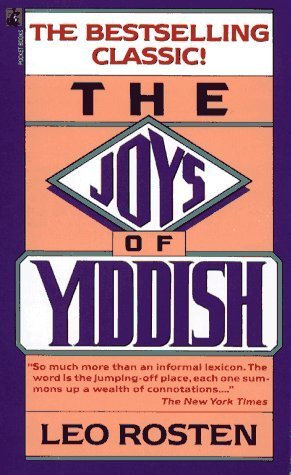
Joys of Yiddish
Describes the history and folklore behind Yiddish and Hebrew words and offers liberal translations
534 pages, Mass Market Paperback
First published January 1, 1968
About the author
Leo Rosten
51 books44 followersLeo Calvin Rosten was born in Lodz, Russian Empire (now Poland) and died in New York City. He was a teacher and academic, but is best known as a humorist in the fields of scriptwriting, storywriting, journalism and Yiddish lexicography.
Ratings & Reviews
Friends & Following
Create a free account to discover what your friends think of this book!
Community Reviews
Displaying 1 - 30 of 61 reviews
July 24, 2022
I've been treated to reviews of THE DICTIONARY OF AFRICAN-AMERICAN ENGLISH (edited by my old employer, Henry Louis Gates), THE DICTIONARY OF JAMAICAN ENGLISH and THE DICTIONARY OF AUSTRALIAN ENGLISH. But, nothing beats the grandady of them all, THE JOYS OF YIDDISH, which I bought in Amsterdam and read on the Transatlantic flight. Rosten’s book is not an exhaustive dictionary rather a tour by words through a world that seemed lost after the Holocaust and then came back to life in the Sixties. Although, as Rosten notes, ironically, not in Israel, where Yiddish is associated with the Holocaust and the immigrant generation instead of the Sabra. This is that rare book that lives up to its title. It is incisive, funny and recounts the history of a people. Sample: "Some Jews argue that shlemiel and schlimazel must denote the same character, a fool. Not at all. A shlemiel is an idiot; the type of person who pours soup on himself. A schlimazel is a chronically unlucky person; the kind waiters spill soup on in restaurants." One drawback to this masterpiece is that Rosten has at best a condescending view of Sephardic Jewry and its tongue Ladino. One wonders why since the Sephardic diaspora produced, among others, Baruch Spinoza, David Ricardo and US Supreme Court Justice Cardozo. Otherwise, enjoy! PS: you'll finally be able to figure out the theme song to LAVERNE AND SHIRLEY.

September 23, 2018
It's not often that you see a book written with such love.
It's a 'dictionary' of Yiddish words (of Germanic, Hebraic, Aramaic, Slavic and English origins), but, as it is specified in the subtitle, more of a "humorous encyclopedia", in which the entry on Shabes serves as an incentive for the author to tell about Shabbat in his family in an incredibly loving way. And many, many entries (especially on many, many Yiddish insults) prompt telling a couple of seemingly inexhaustible reservoir of Jewish jokes.
If I had a cafe or a business with waiting room, I'd definitely put this book there (and probably attach it to something heavy, so that my imaginary customers don't steal it).
My only issue here was with the orthography. I've read the French translation (from English), and the translator mentions he's using the French transcription of Poylish Yiddish, which he had heard at home, while translating from English original (with English transcription), which made the whole thing a bit confusing for me, since I've learned only standard Yiddish, which is based on Litvish Yiddish. Often it took me a while to equate a word written in this transcription with a Yiddish word I know. It is, of course, a minor inconvenience and this book doesn't aim to teach one Yiddish, but I feel it would benefit greatly by including a Yiddish word in Hebrew letters.
For example, a fairly easy one, but nevertheless confusing French transcription writes "Maasèh bouh'" (French), which is written as "Mayse-bukh" in English and "מעשׂה־בוך" in Yiddish.
It's a 'dictionary' of Yiddish words (of Germanic, Hebraic, Aramaic, Slavic and English origins), but, as it is specified in the subtitle, more of a "humorous encyclopedia", in which the entry on Shabes serves as an incentive for the author to tell about Shabbat in his family in an incredibly loving way. And many, many entries (especially on many, many Yiddish insults) prompt telling a couple of seemingly inexhaustible reservoir of Jewish jokes.
If I had a cafe or a business with waiting room, I'd definitely put this book there (and probably attach it to something heavy, so that my imaginary customers don't steal it).
My only issue here was with the orthography. I've read the French translation (from English), and the translator mentions he's using the French transcription of Poylish Yiddish, which he had heard at home, while translating from English original (with English transcription), which made the whole thing a bit confusing for me, since I've learned only standard Yiddish, which is based on Litvish Yiddish. Often it took me a while to equate a word written in this transcription with a Yiddish word I know. It is, of course, a minor inconvenience and this book doesn't aim to teach one Yiddish, but I feel it would benefit greatly by including a Yiddish word in Hebrew letters.
For example, a fairly easy one, but nevertheless confusing French transcription writes "Maasèh bouh'" (French), which is written as "Mayse-bukh" in English and "מעשׂה־בוך" in Yiddish.

November 25, 2025
Lexicographies and dictionaries are usually humourless affairs. Samuel Johnson did his anecdotal best to liven up his English language definitions but, generally dictionaries are useful if tiresome things. Then along comes Leo Rosten with his "relaxed lexicon of Yiddish, Hebrew and Yinglish words often encountered in English" and we find ourselves swimming in jokes, stories, history, folk sayings added to the basic lexicography. The humour of the Jewish people is here, as is their tragedy and sorrow. It's the idea one gets, considerably underplayed I know, when writing or talking about poverty, "if you don't laugh about it, you'd cry."
Some of my favourite Jewish jokes are here. I think I heard Milton Berle give a version of the first, an exposition of the Jewish way of tackling a problem:
For twenty years Mr. Sokoloff had been eating in the same restaurant... On this night, as on every other, Mr. Sokoloff ordered chicken soup. The waiter set it down and started off. Mr. Sokoloff called, "Waiter? Please taste this soup."
The waiter said, "Hanh? Twenty years you've been eating the chicken soup here, no? Have you ever had a bad plate?"
"Waiter, " said Sokoloff firmly, "taste the soup..."
"All right, all right," grimaced the waiter. "I'll taste - where's the spoon?"
"Aha!" cried Sokoloff.
I think Woody Allen used a variant of the next in his stand up days.
Mrs. Fleischman was checking out of Rosenbaum's Riviera Spa, in the Catskills.
"Did you enjoy your stay?" asked the owner.
"Well, to tell the truth, the food you serve here - it's terrible. A chaloshes! And such small portions!"
For the others I have picked out, I don't recall where I first heard them.
Waiter: "Tea or coffee, gentlemen?"
1st customer: "I'll have tea."
2nd customer: "Me too - and be sure the glass is clean!"
(Waiter exits, returns)
Waiter: "Two teas. Which one asked for the clean glass?"
Next, a fine example of a put down.
A Texan is making fun of the size of a Jewish man's home and property.
"Back home, on my ranch, I get up and get in my car around 9 a.m. and I start to drive, and I drive and drive and drive - and I don't reach the end of my property until 6 o'clock that night!"
"Tchk!" sighed the Jew. "I once owned a car like that."
And finally, the value of a punchline.
Benny and Moe wanted to give their mother a new and different birthday present. They went from shop to shop until, to their wonder and delight, they found - a parrot that spoke Yiddish! This astonishing bird cost $500, but the devoted sons decided it was worth it. Think of the hours and hours their old-fashioned mother would derive from conversing with the extraordinary parrot...
So the sons bought a beautiful gilded cage, and placed the parrot inside, and had the singular birthday gift delivered to Mamma.
Then, in great excitement, they telephoned: "Mamma, mamma, how did you like your present?"
"Delicious!" said Mamma.
It is such an enjoyable book, lexicography with a smile, and beneath the smile are many lessons of the Jewish experience.
Some of my favourite Jewish jokes are here. I think I heard Milton Berle give a version of the first, an exposition of the Jewish way of tackling a problem:
For twenty years Mr. Sokoloff had been eating in the same restaurant... On this night, as on every other, Mr. Sokoloff ordered chicken soup. The waiter set it down and started off. Mr. Sokoloff called, "Waiter? Please taste this soup."
The waiter said, "Hanh? Twenty years you've been eating the chicken soup here, no? Have you ever had a bad plate?"
"Waiter, " said Sokoloff firmly, "taste the soup..."
"All right, all right," grimaced the waiter. "I'll taste - where's the spoon?"
"Aha!" cried Sokoloff.
I think Woody Allen used a variant of the next in his stand up days.
Mrs. Fleischman was checking out of Rosenbaum's Riviera Spa, in the Catskills.
"Did you enjoy your stay?" asked the owner.
"Well, to tell the truth, the food you serve here - it's terrible. A chaloshes! And such small portions!"
For the others I have picked out, I don't recall where I first heard them.
Waiter: "Tea or coffee, gentlemen?"
1st customer: "I'll have tea."
2nd customer: "Me too - and be sure the glass is clean!"
(Waiter exits, returns)
Waiter: "Two teas. Which one asked for the clean glass?"
Next, a fine example of a put down.
A Texan is making fun of the size of a Jewish man's home and property.
"Back home, on my ranch, I get up and get in my car around 9 a.m. and I start to drive, and I drive and drive and drive - and I don't reach the end of my property until 6 o'clock that night!"
"Tchk!" sighed the Jew. "I once owned a car like that."
And finally, the value of a punchline.
Benny and Moe wanted to give their mother a new and different birthday present. They went from shop to shop until, to their wonder and delight, they found - a parrot that spoke Yiddish! This astonishing bird cost $500, but the devoted sons decided it was worth it. Think of the hours and hours their old-fashioned mother would derive from conversing with the extraordinary parrot...
So the sons bought a beautiful gilded cage, and placed the parrot inside, and had the singular birthday gift delivered to Mamma.
Then, in great excitement, they telephoned: "Mamma, mamma, how did you like your present?"
"Delicious!" said Mamma.
It is such an enjoyable book, lexicography with a smile, and beneath the smile are many lessons of the Jewish experience.

April 6, 2011
I tried to not enjoy this book but couldn't help myself. It is a romp of a good time rolled up into a reference book. A summary of Leo Rosten's points and a small sampling of anecdotes and aphorisms follow. I find it personally odd that I had to leave New York for a year in Jerusalem before I discovered this book. One of my colleagues here said the volume was like sacred scripture for him growing up in Brooklyn.
A reference built for lovers of language, culture, and laugh-out-loud witticism, The Joys of Yiddish is two thirds cultural encyclopedia, two thirds joke book, and 100% Yiddish language reference. The serious theses of this book are simple: Yiddish inflects English, and everything else it touches (in this order German [75%], Hebrew, English, Slavic, other, including a fair amount of American cultural references). Thus for Western English speakers, Yiddish is worth the acquaintance if for no other reason than understanding one's own terms better. He writes "Yiddish, 'the Robin Hood of languages.' It has stolen right and left from its richer neighbours, and showed not the slightest hestation in taking in house guests--who never left and were often transformed. A delightful remark, credit to Charles Rappaport, runs: 'I speak ten languages--all of them in Yiddish.'" Of course all languages interact and intermix, but Rosten's case is that Yiddish, ever the language of the home, never that of the nation or scripture, has gainfully survived as an inferior dialect for the last 900 years--a tradition that has also seeded its wild spread and success. He puts it: "Yiddish has long been beset by schism and fevers and ambivalences from within its own community. Jewish purists derided Yiddish for its 'bastard origins,' 'vulgar' idioms, 'hybrid vocabulary'; Hebraicists have long called Yiddish 'uncivilised' cant; German Jews, who despies the Ashkenazi, called Yiddish 'A barbarous argot' and a 'piggish jargon.' (They forgot that English, French, Italian, German, too began as the vernacular of the people.)" Yiddish's strengths, according to Rosten, have historically sprung from many of its supposed weaknesses. Never the language of the nation in which they lived (German, Polish, Russian, Hungarian, Turkish, Greek, etc.), Yiddish was the language of the home--the mama loshen ("mother's tongue"). It has also been distinctly not the "sacred tongue" of the Torah and the Talmud, which has historically been reserved for male learners. Ever in tension with the market place, the street, and several other languages, Yiddish matured in a competitive linguistic environment, coming fully into its own only in the middle of the 19th century. It makes sense, both historically and culturally, that the praises for a scrappy language like this would be well delivered in jokes and anecdotes. Of course, the significance of Yiddish need not be only light-hearted itself: the writer I.L. Peretz once observed mournfully that "Yiddish, the language which will ever bear witness to the violence and murder inflicted on us, bears the marks of our expulsions from land to land, the language which absorbed the wails of the fathers, the laments of the generations, the poison and bitterness of history, the language whose precious jewels are undried, uncongealed Jewish tears." It's a beautiful sentiment, although I fear it sounds a bit overwrought left out of context like this. In any case, if we follow Max Weinreich's snappy phrase, "a language is a dialect--with an army and a navy," then perhaps the purest joy one can take in Yiddish is that it has never really been a language. Or as Isaac Bashevis Singer reminds us that Yiddish may be the only language on earth that has never been spoken by men in power.
With that, here are some anecdotes and jokes that bear repeating, as recorded by Rosten (1968 edition). Some come up in the context of illustrating Yiddish terms (in italics). All rendered here just for the joy of it.
--
--
On folk wisdom:
When a Jewish farmer eats a chicken, one of them is sick. --Folk saying
When a father helps a son, both smile; but when a son must help his father, both cry. --Folk saying
If I am not for myself, who will be for me? And if I am only for myself, what am I ... And if not now--when? --Hillel
There is a saying: "A potch fargeyt, a vort bashteyt," "A slap passes, but a word (an insult) remains."
"Many complain of their looks, but none complain of their brains." Proverb.
"Which is more important: money or wisdom?
"Wisdom," says the philosopher.
"Ha!" scoffs the cynic. "If wisdom is more important than money, why is it that the wise wait on the rich, and not the rich on the wise?"
"Because," says the scholar, "the wise, being wise, understand the value of money; but the rich, being only rich, do not know the value of wisdom."
--
On riddles:
The first riddle I ever heard, one familiar to almost every Jewish child, was propounded to me by my father:
"What is it that hangs on the wall, is green, wet--and whistles?"
I knit my brow and thought and thought, and in final perplexity gave up.
"A herring," said my father.
"A herring?!" I echoed. "A herring doesn't hang on a wall!"
"So hang it there."
"But a herring isn't green!" I protested.
"Paint it."
"But a herring isn't wet."
"If it's just painted, it's still wet."
"But--" I sputtered, summoning all my outrage, "A herring doesn't whistle!"
"Right," smiled my father. " I just put that in to make it hard."
--
A joke on the importance of inflection in Yiddish (and English, think Woody Allen):
During a gigantic celebration in Red Square, after Trotsky had been sent into exile, Stalin, on Lenin's great tomb, suddenly and excitedly raised his hand to still the acclamations :"Comrades, comrades! A most historic event! A cablegram --of congratulations--from Trotsky!"
The hordes cheered and chortled and cheered again, and Stalin read the historic cable aloud:
Joseph Stalin
Kremlin
Moscow
You were right and I was wrong. You are the True Heir of Lenin. I should apologize.
Trotsky
You can imagine what a roar, what an explosion of astonishment and triumph erupted in Red Square now! BUt in the front row, below the podium, a little tailor called, "Pst! Pst! Comrade Stalin."
Stalin leaned down.
The tailor said, "Such a message, Comrade Stalin. For the ages! But you read it without the right feeling!"
Whereupon Stalin raised his hand and stilled the throng once more. "Comrades! Here is a simple worker, a loyal Communist, who says I haven't read the message from Trotsky with enough feeling! Come, Comrade Worker! Up here! You read this historic communication!"
So the little tailor went up to the reviewing stand and took the cablegram from Stalin and read:
Joseph Stalin
Kremlin
Moscow
Then he cleared his throat, and sang out:
You were right and I was wrong? You are the true heir of Lenin? I should apologize??!!!..
Trotsky
--
On (over-)education:
A nudnik is a pest: a phudnik is a nudnik with a Ph.D.
Jewish dropout: a boy who didn't get his Ph.D. --Anon.
--
On the trickiness of relationships:
A wisecrack defines a shadchen as "a marriage broker who knows the perfect girl for you--and married the wrong girl himself."
The two traveling salesmen, competitors in selling notions, spied each other on the platform. "Hello, Liebowitz."
"Hello, Posner."
Silence.
"So--where are you going?" asked LIebowitz.
"To Minsk," said Posner.
Silence.
"Listen, Posner," sighed Liebowitz, who was a very bright shaygets (rascal, mischievous devil), "When you say you're going to Minsk, you want me to think you're going to Pinsk. But I happen to know that you are going to Minsk--so why are you lying?!!"
--
On cleverness:
A Jew, crossing the street, bumped into an anti-Semite.
"Swine!" bellowed the paskudnyak (a term of contempt).
"Goldberg," bowed the Jew.
Pincus and Bernstein were walking down a street in Berlin when they saw an SS cop approaching. Only Pincus had an identity card. Bernstein said, "Quick, run! He'll chase you, and I'll get away."
So Pincus broke into a run, and he ran and he ran until he thought his heart would plotz (explode).
"Stop! Stop!" cried the policeman, who finally caught up. "Jew!" He roared. "Show me your papers."
The gasping Pincus produced his papers.
The Nazi examined them and saw they were in order. "But why did you run away?"
"Eh--my doctor told me to run half a mile after each meal!"
"But you saw me chasing after you and yelling! Why didn't you stop?"
"I--thought maybe you go to the same doctor!"
A reference built for lovers of language, culture, and laugh-out-loud witticism, The Joys of Yiddish is two thirds cultural encyclopedia, two thirds joke book, and 100% Yiddish language reference. The serious theses of this book are simple: Yiddish inflects English, and everything else it touches (in this order German [75%], Hebrew, English, Slavic, other, including a fair amount of American cultural references). Thus for Western English speakers, Yiddish is worth the acquaintance if for no other reason than understanding one's own terms better. He writes "Yiddish, 'the Robin Hood of languages.' It has stolen right and left from its richer neighbours, and showed not the slightest hestation in taking in house guests--who never left and were often transformed. A delightful remark, credit to Charles Rappaport, runs: 'I speak ten languages--all of them in Yiddish.'" Of course all languages interact and intermix, but Rosten's case is that Yiddish, ever the language of the home, never that of the nation or scripture, has gainfully survived as an inferior dialect for the last 900 years--a tradition that has also seeded its wild spread and success. He puts it: "Yiddish has long been beset by schism and fevers and ambivalences from within its own community. Jewish purists derided Yiddish for its 'bastard origins,' 'vulgar' idioms, 'hybrid vocabulary'; Hebraicists have long called Yiddish 'uncivilised' cant; German Jews, who despies the Ashkenazi, called Yiddish 'A barbarous argot' and a 'piggish jargon.' (They forgot that English, French, Italian, German, too began as the vernacular of the people.)" Yiddish's strengths, according to Rosten, have historically sprung from many of its supposed weaknesses. Never the language of the nation in which they lived (German, Polish, Russian, Hungarian, Turkish, Greek, etc.), Yiddish was the language of the home--the mama loshen ("mother's tongue"). It has also been distinctly not the "sacred tongue" of the Torah and the Talmud, which has historically been reserved for male learners. Ever in tension with the market place, the street, and several other languages, Yiddish matured in a competitive linguistic environment, coming fully into its own only in the middle of the 19th century. It makes sense, both historically and culturally, that the praises for a scrappy language like this would be well delivered in jokes and anecdotes. Of course, the significance of Yiddish need not be only light-hearted itself: the writer I.L. Peretz once observed mournfully that "Yiddish, the language which will ever bear witness to the violence and murder inflicted on us, bears the marks of our expulsions from land to land, the language which absorbed the wails of the fathers, the laments of the generations, the poison and bitterness of history, the language whose precious jewels are undried, uncongealed Jewish tears." It's a beautiful sentiment, although I fear it sounds a bit overwrought left out of context like this. In any case, if we follow Max Weinreich's snappy phrase, "a language is a dialect--with an army and a navy," then perhaps the purest joy one can take in Yiddish is that it has never really been a language. Or as Isaac Bashevis Singer reminds us that Yiddish may be the only language on earth that has never been spoken by men in power.
With that, here are some anecdotes and jokes that bear repeating, as recorded by Rosten (1968 edition). Some come up in the context of illustrating Yiddish terms (in italics). All rendered here just for the joy of it.
--
--
On folk wisdom:
When a Jewish farmer eats a chicken, one of them is sick. --Folk saying
When a father helps a son, both smile; but when a son must help his father, both cry. --Folk saying
If I am not for myself, who will be for me? And if I am only for myself, what am I ... And if not now--when? --Hillel
There is a saying: "A potch fargeyt, a vort bashteyt," "A slap passes, but a word (an insult) remains."
"Many complain of their looks, but none complain of their brains." Proverb.
"Which is more important: money or wisdom?
"Wisdom," says the philosopher.
"Ha!" scoffs the cynic. "If wisdom is more important than money, why is it that the wise wait on the rich, and not the rich on the wise?"
"Because," says the scholar, "the wise, being wise, understand the value of money; but the rich, being only rich, do not know the value of wisdom."
--
On riddles:
The first riddle I ever heard, one familiar to almost every Jewish child, was propounded to me by my father:
"What is it that hangs on the wall, is green, wet--and whistles?"
I knit my brow and thought and thought, and in final perplexity gave up.
"A herring," said my father.
"A herring?!" I echoed. "A herring doesn't hang on a wall!"
"So hang it there."
"But a herring isn't green!" I protested.
"Paint it."
"But a herring isn't wet."
"If it's just painted, it's still wet."
"But--" I sputtered, summoning all my outrage, "A herring doesn't whistle!"
"Right," smiled my father. " I just put that in to make it hard."
--
A joke on the importance of inflection in Yiddish (and English, think Woody Allen):
During a gigantic celebration in Red Square, after Trotsky had been sent into exile, Stalin, on Lenin's great tomb, suddenly and excitedly raised his hand to still the acclamations :"Comrades, comrades! A most historic event! A cablegram --of congratulations--from Trotsky!"
The hordes cheered and chortled and cheered again, and Stalin read the historic cable aloud:
Joseph Stalin
Kremlin
Moscow
You were right and I was wrong. You are the True Heir of Lenin. I should apologize.
Trotsky
You can imagine what a roar, what an explosion of astonishment and triumph erupted in Red Square now! BUt in the front row, below the podium, a little tailor called, "Pst! Pst! Comrade Stalin."
Stalin leaned down.
The tailor said, "Such a message, Comrade Stalin. For the ages! But you read it without the right feeling!"
Whereupon Stalin raised his hand and stilled the throng once more. "Comrades! Here is a simple worker, a loyal Communist, who says I haven't read the message from Trotsky with enough feeling! Come, Comrade Worker! Up here! You read this historic communication!"
So the little tailor went up to the reviewing stand and took the cablegram from Stalin and read:
Joseph Stalin
Kremlin
Moscow
Then he cleared his throat, and sang out:
You were right and I was wrong? You are the true heir of Lenin? I should apologize??!!!..
Trotsky
--
On (over-)education:
A nudnik is a pest: a phudnik is a nudnik with a Ph.D.
Jewish dropout: a boy who didn't get his Ph.D. --Anon.
--
On the trickiness of relationships:
A wisecrack defines a shadchen as "a marriage broker who knows the perfect girl for you--and married the wrong girl himself."
The two traveling salesmen, competitors in selling notions, spied each other on the platform. "Hello, Liebowitz."
"Hello, Posner."
Silence.
"So--where are you going?" asked LIebowitz.
"To Minsk," said Posner.
Silence.
"Listen, Posner," sighed Liebowitz, who was a very bright shaygets (rascal, mischievous devil), "When you say you're going to Minsk, you want me to think you're going to Pinsk. But I happen to know that you are going to Minsk--so why are you lying?!!"
--
On cleverness:
A Jew, crossing the street, bumped into an anti-Semite.
"Swine!" bellowed the paskudnyak (a term of contempt).
"Goldberg," bowed the Jew.
Pincus and Bernstein were walking down a street in Berlin when they saw an SS cop approaching. Only Pincus had an identity card. Bernstein said, "Quick, run! He'll chase you, and I'll get away."
So Pincus broke into a run, and he ran and he ran until he thought his heart would plotz (explode).
"Stop! Stop!" cried the policeman, who finally caught up. "Jew!" He roared. "Show me your papers."
The gasping Pincus produced his papers.
The Nazi examined them and saw they were in order. "But why did you run away?"
"Eh--my doctor told me to run half a mile after each meal!"
"But you saw me chasing after you and yelling! Why didn't you stop?"
"I--thought maybe you go to the same doctor!"

July 10, 2009
I had never read this before! The perfect bathroom/bathtub book! Very funny! I hope to assimilate at least half of the words in here.

June 29, 2015
This book was highly recommended by Rick Moranis on the Nerdist podcast, where he discussed its influence on his comedy and on his recent country album. It mostly takes the form of a dictionary, but the definitions vary. Some are very cut and dry. Others are humorous, or include humorous stories to illustrate the definition. And a few are more like wikipedia entries on a broad subject, like the brief history of False Messiahs. And then there is an entry, like the long passage on Shabbos, which are achingly beautiful, written so evocatively that the rituals described feel like one’s own memories, and I am not even Jewish.
In various definitions, we frequently return to certain topics such as Ladino, a Sephardic equivalent of Yiddish, but one which did not catapult itself to the heights of Yiddish in popular culture. Also, we are reminded of the nations (Mediterranean countries) where Ashkenazi Jews did not speak Yiddish, and the frequent efforts to marginalize Yiddish as a mongrel tongue. The book also focuses on the America immigrant experience, since much of the language’s prominence is due to its incorporation into mainstream English language and American popular culture (see Simon Schama’s “Story of the Jews: Episode Four – Over the Rainbow” to see how the language migrated to the pinnacle of Hollywood art).
Even if you do not find yourself interested in reading the definitions to words you may already know, the introductory chapters, particularly “Colloquial Uses in English of Yiddish Linguistic Devices”, illuminate uses of intonation, repetition, and dark humor that are familiar to anyone who has seen a comedic sketch, watched a sitcom, or spoken to a New Yorker.
In various definitions, we frequently return to certain topics such as Ladino, a Sephardic equivalent of Yiddish, but one which did not catapult itself to the heights of Yiddish in popular culture. Also, we are reminded of the nations (Mediterranean countries) where Ashkenazi Jews did not speak Yiddish, and the frequent efforts to marginalize Yiddish as a mongrel tongue. The book also focuses on the America immigrant experience, since much of the language’s prominence is due to its incorporation into mainstream English language and American popular culture (see Simon Schama’s “Story of the Jews: Episode Four – Over the Rainbow” to see how the language migrated to the pinnacle of Hollywood art).
Even if you do not find yourself interested in reading the definitions to words you may already know, the introductory chapters, particularly “Colloquial Uses in English of Yiddish Linguistic Devices”, illuminate uses of intonation, repetition, and dark humor that are familiar to anyone who has seen a comedic sketch, watched a sitcom, or spoken to a New Yorker.
October 6, 2008
Yes, it's a dictionary, but the best definitions ever! If you've ever wondered what the difference is between a schlemiel and a schlamazel, or the grades of 'oy' (oy, oy vey, oy gevalt!) this is the book for you. Lots of practical examples and real-life usages. There's even a few serious entries. A great reference to have around.

December 16, 2016
Love this book.

December 15, 2008
This is the only dictionary I have ever read cover-to-cover, and the only dictionary I'd call a must-read. I read it, and came to an earth-shattering conclusion: all the people I know who think they're Afrikaners are actually, secretly, deep in their bones, Yiddish. And the reverse is probably true, too.
May 17, 2011
A dictionary to fall in love with: I never wished I'd studied Linguistics as badly as I did while reading this book. In the preface, Rosten writes "I think Yiddish a language of exceptional charm ... a tongue that never takes its tongue out of its cheek." and then he goes on to demonstrate that charm and cheekiness for 500 some-odd pages.

October 12, 2014
Very useful and informative book, especially for the uninitiated (enjoyable and colorful, too). Unfortunately one cannot read it without reflecting on the obliteration of the vibrant centers of Yiddish culture in central and eastern Europe in the middle years of the 20th century. Terrible loss for humanity.

April 29, 2009
The book I turn to whenever I am writing about Yiddish. Not only a language book--there are wonderful classic Jewish jokes here as well.

Read
September 14, 2009JOYS OF YIDDISH by Leo Rosten (1991)

June 8, 2010
Vat can I say...I was in love with a Vonderful Jewish man...I read everything I could to keep up with all the crazy things he said. It was a funny, fun book. It was a long time ago. Life goes on.

November 14, 2010
I read this book many years ago. Pulled it out recently for my husband to use for research. I love Leo Rosten and this book is both entertaining and informative.

June 8, 2012
What's not to love?
May 23, 2026
Very joyful
November 22, 2012
No one can say it better than Leo Rosten whose subtitle to "Joys" reads: "A relaxed lexicon of Yiddish, Hebrew and Yinglish words often encountered in English, plus dozens that ought to be, with serendipitous excursions into Jewish humor, habits, holidays, history, religion, ceremonies, folklore, and cuisine, the whole generously garnished with stories, anecdotes, epigrams, Talmudic quotations, folk sayings and jokes-from the days of the Bible to those of the beatnik."
Written in 1968 and an instant best seller, it became a standard reference work on the Yiddish language. The format is that of a lexicon, i.e. each Yiddish entry (tranliterated into english) is follwed by a brief definition, with, in most cases, a story, epigram or joke to illustate the Yiddish word.
This book can be picked up and broused, can be read cover to cover, or can be used as a reference book.
If you like to laugh, or are interested in Jewish cuture or religion, or are just sometimes stumped by a Yiddish word now and then, you will love "The Joys of Yiddish."
Written in 1968 and an instant best seller, it became a standard reference work on the Yiddish language. The format is that of a lexicon, i.e. each Yiddish entry (tranliterated into english) is follwed by a brief definition, with, in most cases, a story, epigram or joke to illustate the Yiddish word.
This book can be picked up and broused, can be read cover to cover, or can be used as a reference book.
If you like to laugh, or are interested in Jewish cuture or religion, or are just sometimes stumped by a Yiddish word now and then, you will love "The Joys of Yiddish."

December 17, 2016
Many thanks to my dear friend and colleague, Rev. Steven Greenebaum, for loaning me his copy of this gem -- the "unreconstructed" version. A true delight as Rosten pairs lexicographical entries with marvelous anecdotes and the wit that has marked generations of Jewish storytellers. His occasional notation that persons in the world of entertainment know and use more Yiddish than they suspect is right on the mark. Whether it's through my long career in that industry, my interfaith work, or just being a fan of the Jewish comedians of yesteryear, I found that I recognized a substantial amount of this fascinating language.

August 5, 2011
I've owned this book for about 20 years, and I still pick it up and browse through it periodically. With his fabulous sense of humor Rosten takes the reader through a history of Yiddish and common words and phrases, explaining them with in a really witty way. I can remember my grandparents and parents using some of these words and phrases, but as they were all born in America they weren't fluent speakers of Yiddish.
I'd recommend this book for anyone interested in learning about Yiddish and incorporating some of its words and phrases in their speech. Quite a funny book!
I'd recommend this book for anyone interested in learning about Yiddish and incorporating some of its words and phrases in their speech. Quite a funny book!
June 26, 2012
Whether you get the older or the newer edited version, if you like language you must have this on your shelf. Leo Rosten, the original writer/editor, lists Yiddish words and their definitions, but also adds cultural explanations, stories and jokes, to explain the sense of the words in depth. Essential for anyone who wants a better understanding of the contributions of Yiddish to English. You can dip into it anywhere to learn and enjoy.
February 27, 2014
This is an absolute, funny and hilarious book. A joy to read. I couldnt stay away from reading the anecdotes, jokes and little stories. The famous humor from the Jewish people. Yiddish is a combination of German, mixed with Eastern languages and some Hebrew. Its a dying language. Highly recommended !

July 12, 2017
The Joys of Yiddish is partly a dictionary and partly an explanatory non-fiction of the Yiddish language and the Jewish religion. Written by Leo Rosten over 50 years ago the information is timeless. After each entry there is a joke popular to those who already grew up in this culture. These funny stories may or may not have anything to do with the word being defined.

September 14, 2017
An older work (1968), given to me by a friend, I think because I like to study Hebrew. This book was a lot of fun to look through. I learned a lot about Jewish culture, and the jokes (there are a lot of them) kept me in hysterics. Plus, I learned a lot of words I can use to insult people without them knowing it. Unless they know Yiddish.
December 31, 2017
An enjoyable dictionary to work you way through. Of course, not many dictionaries have at least one joke to go with nearly every entry. The book does show its age with the entries about gay men and some of the references to women. The jokes and definitions chosen would not be used today. But this is a minor quibble.

January 17, 2011
Yiddish is such fun, bubeleh! And we use it all the time without knowing it.
Leo Rosten is hilarious but so snobby ("Mother would never...") and not
culturally-sensitive. Was it the '60s or just the way he was?
Leo Rosten is hilarious but so snobby ("Mother would never...") and not
culturally-sensitive. Was it the '60s or just the way he was?

January 26, 2013
Enjoyable book about the Yiddish language which is a mixture of German and Hebrew. It was spoken by the Eastern European Jews (like Tevya in the Fiddler on the Roof), many of whom came to the U.S. We have fun words from this language like schlemiel and kitsch.

December 18, 2013
This author is a man I like coming back to since my mum instoruced me to Mr. Kaplan who is just a brilliant man. Joys of Yiddish is filled with most amazing anecdote's that would just lighen up everyone even Snape perhaps.
January 15, 2014
A wonderful book whether you are Jewish or not. Funny and enlightening Leo Rosten's typically Jewish self depricating humour makes you laugh out loud and also gives insight into this culture.
Anyone with an interest in Jewish culture will enjoy I am sure.
Anyone with an interest in Jewish culture will enjoy I am sure.
October 23, 2014
For some reason my parents, mid-western blue collar Catholics, enjoyed books about Yiddish and the Jewish experience. I remembered the joke about the moyel (moehel?) for about twenty years before I understood it. So I still remember it. Look it up.
Displaying 1 - 30 of 61 reviews