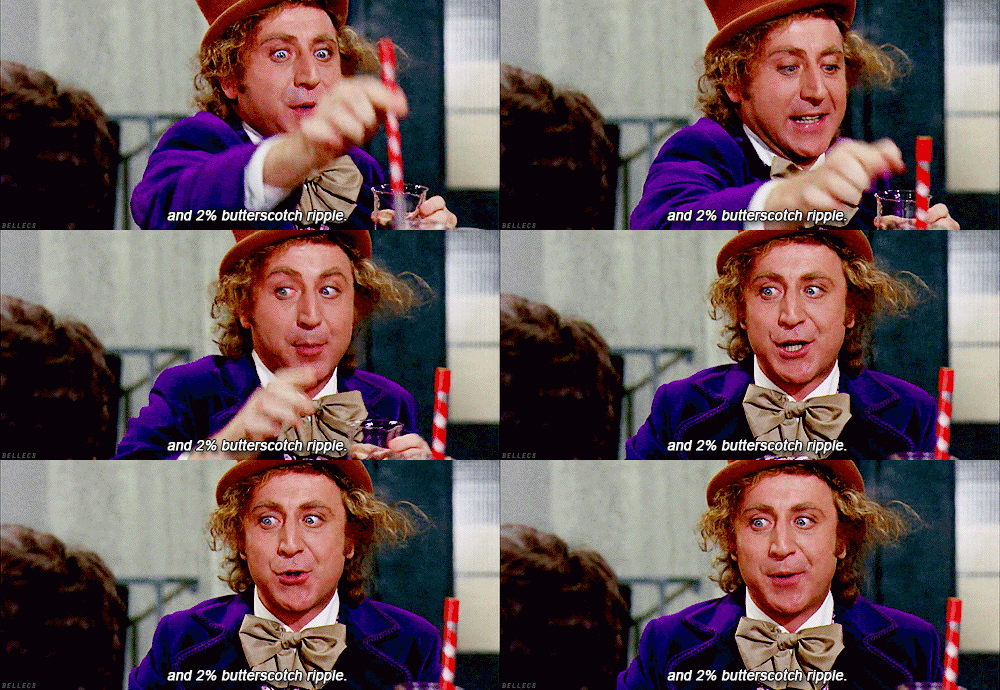
After Gene Wilder’s death last week, I binged on interviews he did at various stages of his career. The most poignant was in 2013 at the 92nd Street Y because you can see that he was in the early stages of Alzheimer’s, but the most in-depth interview, unsurprisingly, was with Terry Gross in promotion of this book. The interview, like the book, covers his personal life as well as his career, but included things he never went public with anywhere else. The most notable of these, and the thing that made me pick up the book, was that for a time, he suffered from a compulsion to pray for hours at a time. He doesn’t name the disorder, but I recognized it immediately as scrupulosity, a form of OCD. Religious Jew that I am, I could not help but wonder how different his life might have been had he gone to a rabbi for help instead of a therapist. But while his therapist is a major character in the book, the scrupulosity part (lucky for him) didn’t last long.
Now, I should confess that when I was about twelve, I had a huge crush on Gene Wilder. No doubt it started with Willy Wonka, but it was really about him and what he brought to his characters. There’s nothing like a gentle intellectual to win over the heart of a Jewish woman. So it was an uncanny confirmation to me when he married Gilda Radner. In the years that I was crushing on him the hardest, she was at the height of her fame, and people everywhere were saying how much I resembled her. Plenty of people called me “Gilda” and sometimes, even worse, “Roseanna Danna.” Then came Coincidence #2: his longest and happiest marriage was with a woman named Karen, which happens to be my English name. So I always thought that if I would ever actually meet Gene Wilder, the attraction might be mutual. That’s the kiss he earned from this stranger, the kind of love he says he and so many other actors crave. Of course, we fans crave the kiss from those larger-than-life stars at least as much they do. That’s what keeps the wheels of the Hollywood dream machine turning.
All of that is my long way of saying that Gene Wilder had a pretty high pedestal to fall from where I’m concerned, and after this book, fall he did. I liked reading about his development as an actor, and the most poignant parts are at the end with his own triumph over cancer. He’s an authoritative voice on that subject, having experienced it both as a loved one and as a patient. But there was way Too Much Information about his romantic affairs. He’s certainly not one of Hollywood’s most shameful cads, but he was no saint either. So if you don’t want to tarnish your image of Gene Wilder as Charlie Bucket’s secret advocate (and we all envision ourselves in Charlie’s position in that scenario), stick with the interviews and skip this book.