Jump to ratings and reviews
Rate this book

There Are No Names for Red

Rate this book
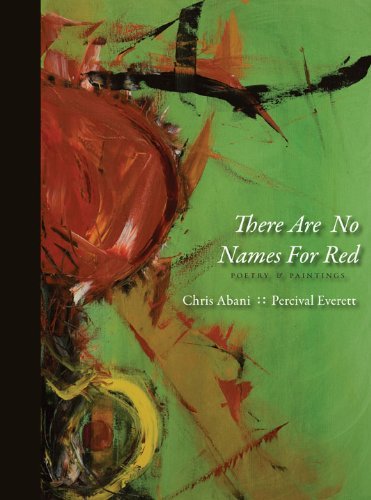
There Are No Names for Red is a collaborative work featuring the poetry of Chris Abani and the paintings of Percival Everett.

56 pages, Paperback

First published April 1, 2010

100 people want to read

About the author

Chris Abani

62 books282 followers
Christopher Abani (or Chris Abani) is a Nigerian author.

He was a political prisoner in Nigeria at various times during 1985 and 1991. At times he was held in solitary confinement and he was held on death row for some time after being sentenced to death for treason.

He is a Professor at the University of California, Riverside and the recipient of the PEN USA Freedom-to-Write Award, the 2001 Prince Claus Awards, a Lannan Literary Fellowship, a California Book Award, a Hurston-Wright Legacy Award and the Hemingway Foundation/PEN Award. Selections of his poetry appear in the online journal Blackbird.

Ratings & Reviews

What do you think?
Rate this book

Friends & Following

Create a free account to discover what your friends think of this book!

Community Reviews

5 stars
13 (40%)
4 stars
16 (50%)
3 stars
1 (3%)
2 stars
2 (6%)
1 star
0 (0%)
Displaying 1 - 4 of 4 reviews
Profile Image for Caterina.
259 reviews82 followers
August 27, 2019
There is something soft here. Smooth as a stone in water.
A trick of the light, perhaps, or this; the cold nonchalance
of fate and beauty is nothing more than this
canvas this skin and the hope we covet.


The way desire is a body eroding
into a pile of salt marked by a crown of birds:
and black. This fall is not rain, grain too subtle
for that dissolution. A constellation wrapped
in a stitch spreading like sand charting
thread across time, a tender weave
and hope. This is resurrection.


Streaming words thoughts images like water eddying, gestural fragments catching above barely sunken terrible memories, catching detritus, catching glimpses, these thirty poems flow with Chris Abani’s consciousness and conscience, reflecting and echoing the inspiration of the bright slabs of color, suggestions of human and animal figures, and heavy black lines like bonds or bars but also like letters or symbols writ large, in Percival Everett’s fourteen paintings in this collaboration between two original voices, both known primarily as novelists. Like abstract painting or music, this poetry has no narrative per se, but rather makes use of ambiguous run-on sentences to create a stream of images and ideas that create sense as they are read and re-read together as a whole with the paintings. Hope, or sometimes only the hope of hope, rises like smoke from burnt remains of political violence and family violence. What is strong is the sense of being alive, and from time to time even amidst the terrible memories, some poems lapse into casual, even humorous, conversation between the two authors, as well as between the paintings and poems.

When I returned from Auschwitz brimming with sorrow
and love I said, I will write a poem so profound it will
core the earth like an apple. Instead all I can say is:
daises have grown over the train tracks and a sparrow
lays blue eggs high in a tree like an incinerator chimney.
Percival’s cat was called Cat.
Look closely at that painting. See the outline of her x-rays?
Jim was the Crow he carried on his left shoulder.
It grew strong and flew away but left a heavier burden.
This is no parable.


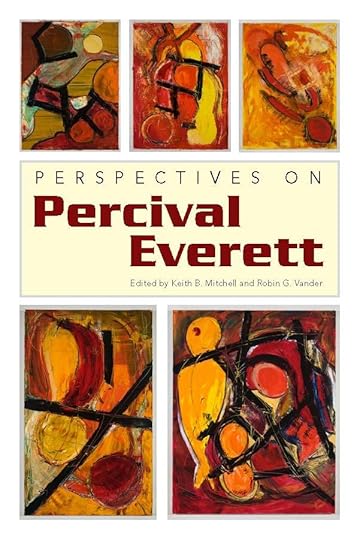
The poem above was paired with the upper left image that appears on the cover of the recent book Perspectives on Percival Everett. Most of the other images on this cover were part of There are No Names for Red

Abani was jailed and tortured in his native Nigeria, the first time when he was in his teens and had published a novel that was viewed as anti-government. He now lives and works in California, as does American author Everett. Abani has been described as gentle and soft-spoken in person. This poetry is my first introduction to his work, thanks to Trish Rooney here on Goodreads. In this work I feel not only an underlying ability to face things that cannot be faced, but an intensity of creativity that to me speaks to a man fully alive.

A taxi through night and palms that gather desire like dew.
A window opens onto the hiss of rain on tarmac and this smell
is old earth, and a grave, grace even and flowers rotting
at the edge of time, at the edge of the road where a child died.
It’s like the way the little white plane hovers on the vastness of
the ocean between Godthab and St. John’s. The Atlantic tamed
momentarily by the flight information screen and yet in the dark cabin,
all that keeps it aloft is the soft breathing of the other sleeping passengers.
And nothing is lonelier in the world at this moment
than that little white cross on the expanse of the blue screen.
Faith is something like this, I imagine. Not of God. But of a pen or a brush
held up like the last flaming torch of the century, and yet flimsy—
this desire of the artist to keep the blue from swallowing it all up.


The physical book is lovely, a larger format paperback (about 8”x10”) beautifully printed on glossy paper.
Profile Image for Trish.
1,418 reviews2,710 followers
January 10, 2016
This collaborative work features the poetry of Chris Abani and the oil paintings of Percival Everett, also a novelist. Published in 2010, the 7.5" x 10" format with a wainscoting of gray in the bottom third of a white page gives plenty of space to display Everett’s work alongside numbered stanzas of what might be a single poem by Abani.

Desire is a theme Abani returns to again and again in his writing, and the first line of the first stanza holds that word aloft for us to contemplate:
“The way desire is a body eroding
into a pile of salt marked with a crown of birds:
and black.”
While I cannot be exactly sure what Abani meant by those lines, it sounds a great deal like death, outside, a feast for birds, blackening in the sun.

Desire and death, "all the terror we can bear", "survival", "hunger", "sorrow, of weight beyond measure", "drowned". These poems describe the "box of wood and canvas…red lines cut thick as paste."
"My first death was a butterfly."
The poems describe the perpetrators, so many over the years, over the continents: Auschwitz, Jim the Crow, Boer, Mau Mau, Rwanda.
"If I were a better man, I would have compassion."

and
"I walk the stations of that pain
with all the relish of a self-flagellating
monk…"
Everett’s paintings are bold, saturated with color, reds, golds, deep indigo with definite forms and irregular thick black grids.
"Like Van Gogh it is what is not alive that lives here…
…This knife pulls a jagged wish
through oils thick as butter…
…Percival’s heart bleeds on a stiff white canvas window."
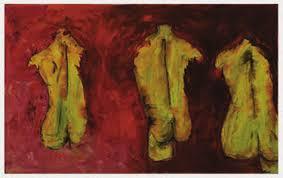
And then, suddenly, three torsos, painted warm on a red background, without heads, arms or legs standing backs to us, graceful in form and beautiful, male and two females, without ethnicity, race, or national origin, undeniably alive, and in motion.

Abani finishes "It’s not hard to kill a childhood," and
"How nicely they’ve fixed the bullet holes in the walls,
in Rwanda. Painted bright petals around some areolas."
Abani sees Rwanda in the torsos. We bring ourselves to the interpretation of paintings, photographs, literature. But now we must admit that Percival’s paintings no longer share the same horror of Abani’s vision. We must begin again, and see how Abani is caught in the web of his nightmare and cannot get free:
"There is a green one above my desk.
Ripe, viridity fairer than lime and yet darker...
...Some nights,
when I look up suddenly, I am back in a cell and fear
chokes me and then my guilt...

...In the end, there are no names for red but fire,
hydrant, apple, ball, heart, blood, sacrifice, and altar.
Look, my nephew says, fire engine."


A remarkable collaboration by two remarkable artists.
Profile Image for Naori.
165 reviews
June 8, 2018
This was like the best jazz duo playing music you think you know, until you realize they are teaching you another language. It was impossible to tell whether words inspired art or vice verse in this collection. Viewed on their own these paintings could lend many interpretations. However, when pluralized by Abani’s poetry they did not lose any of those possible interpretations; rather, they gained voices.

For example, next to one of Percival Everett’s pieces which incorporates more orange oblong and softer abstract images, Abani writes:

“There is something soft here. Smooth as a stone in water. A trick of the light perhaps, or this;
the cold nonchalance of fate and beauty is
nothing more than this
canvas this skin and the hope we covet.” (30)

An earlier piece that is more jagged, red and divided is coupled with:

“What attempts survival here has no words
but hunger. A white backcloth that devours
the blackening. Then red cut in lines thick
as paste and obscuring the once figurative.
This desire wears cerements of yellow and sun.
And at the edge of this world, a box of wood
and canvas; light and light and light.

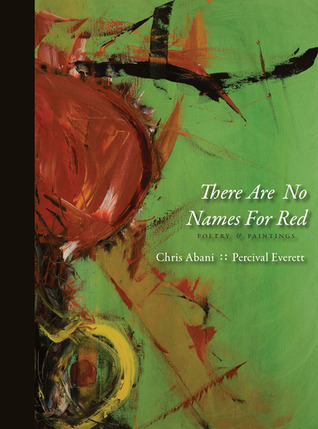
While I thought the final piece would be just a volcanic explosion, it was actually the tamest and least red piece in the collection. In fact, half of it was just uninterrupted green canvas with all of the fantastical painting on one side, as if it knew the book was ending and that was its cue to gracefully back out....and with the same denouement, Chris Abani finished the book, not with a cataclysmic or wise pondering on the color red, but with the simple words of his nephew...

“In the end, there are no names for red but fire, hydrant, apple, ball, heart, blood, sacrifice, and altar. Look, my nephew says, fire engine.” (51).

So yeah, check it out.
Displaying 1 - 4 of 4 reviews

Can't find what you're looking for?

Get help and learn more about the design.