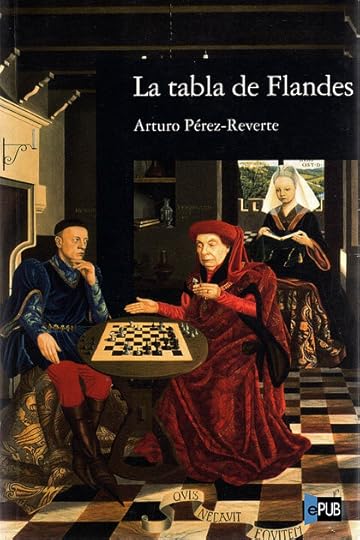
Not (also a chessplayer) told me I had to read this, and she was indeed right. I couldn't put it down and finished it in about a day. It's... well, what is it? I read it as a kind of postmodernist reimagining of Alice Through The Looking-Glass. Other books I immediately thought of were The Name of the Rose, Gödel, Escher, Bach and Luzhin's Defense.
Formally, it's a very stylized murder mystery. Julia, the sexy but childlike Alice figure, is a Madrid art restorer. She receives an unusual commission, a 15th century painting of a chess game. There are multiple layers of reference: two of the people in the painting are playing chess, while the third one, a mysterious lady in black, watches. But they are also identified with the pieces, since it turns out that the picture contains a hidden message about the relationships between them, coded in the position of the game itself. Which in turn is reflected in the mirror shown on one side of the painting.
So, self-reference, reflections, semantics, maps and territories. And, just as in Looking-Glass, the chess game escapes into the real world, or possibly the people fall into the chess world, and everything is simultaneously several other things. César, the older man who has known Julia/Alice since she was a little girl and is her dearest friend, stands in for Lewis Carroll, but he is also the murderer. I was reminded of Michael Dibdin's The Last Sherlock Holmes Story, where Holmes turns out to be also Moriarty and Jack the Ripper. Muñoz, the strange, emotionless chessplayer who helps Julia, is Sherlock Holmes, William de Baskerville and Luzhin. And I wonder if his name is a coincidence. In 1960, Bobby Fischer had a very surprising loss to an unknown Ecuadorian player called César Muñoz. Their encounter is moderately famous.
One of the best and most unexpected meta-jokes is about the chess itself. I'm a strong chessplayer, so at first I found the game annoying. The author is clearly not very good at chess, and there are some weird moments. Yet, as the play escapes into the real world, and captured pieces become dead bodies, the chess began to make more sense. At the end, the combinations, previously dream-like and impossible, do in fact become more or less coherent, but still only in a very odd way. Who on earth had been advising him? I couldn't understand it, until he finally revealed that he had been getting help from a chess program. As he points out, once we had the Mechanical Turk, where the machine hid a human player; but here, in the looking-glass world, the machine is hidden in the human. So, this is also one of the first novels I've come across that's been composed partly by a computer; and, now I think of it, the association between Julia and the automaton-like Muñoz is yet another reflection. You were given a clue here too.
What a clever, original, beautiful book. Thank you Not!
__________________________
I woke up this morning and... of course! It was staring me in the face all along! Watson, how could I have been so blind!
I said that he admitted to receiving help from a machine, and I still think he did. The play at the end has a machine-like quality, and César's admission about his chess computer seems to refer to the author too. But the position in the van Huys painting is a retrograde analysis problem - a chess puzzle where the task is to work out the preceding moves - and no machine can compose a retrograde analysis problem. He needed assistance from a strong human player as well. So the real mystery is not the identity of the murderer, but the question of who composed the problem.
Well... he certainly gives you plenty of hints. The references to Bach pieces where the composer's name is hidden in the notes. I was sure there was a message hidden here, but I couldn't see it. And consider Julia's two helpers. César is always referred to by his first name, Muñoz always by his last. All of this together is too much to be just an accident.
César Muñoz, step forward and take a bow. You've had a very unusual chess career. You beat Bobby Fischer as black, and you helped write this marvellous book. And you were so modest about your contribution that you were willing for it to remain hidden in this cypher. I wonder if I am the first person to crack the code. I just looked around on Google, and if anyone else has spotted it they've been very quiet. The riddle has been lying there for 21 years, waiting for me, the reader.
Of course, of course! He shows you all those semantic reference diagrams and insinuates that the game can reach out into the real world. It has! Now I am in the picture too!
Applause!!!