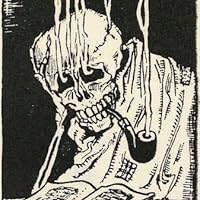
An Emporium of Automata is a sewn hardcover book of 222 pages with dust-jacket, silk ribbon, endpapers and a full-colour frontispiece. Edition limited to strictly 150 copies.
Whether it be recalling the fading entertainments of the British seaside and the infant graves of a forgotten Welsh lead-mining town, or conjuring a troupe of fantastical travelling players that divert a mediocre Soviet official, the tales gathered in An Emporium of Automata embrace collectors and obsessives whose passions corrode even the narratives that enact them. History and storytelling collide in these peculiar literary manifestations, often interrupted by a vengeful narrator intent on disturbing both story and reader.
An Emporium of Automata draws together stories spanning a decade of writing. From the incredible clockwork mechanisms of ‘Erbach’s Emporium of Automata’ to the disturbing images on a grainy reel of film in ‘Dr Dapertutto’s Saturnalia’, section I: Phantasmagorical Instruments unearths the magical transformations of matter and the desperation of memory. The determinations of the book enthusiast are revealed in ‘Of Those Who Follow Emile Bilonche’. The cunning rituals of an ancient tradition offer a destitute woman otherworldly hope in ‘They Dwell in Ystumtuen’. And ‘The Butcher’s Daughter’ continues the family business in a fashion most unwelcome to the new tenants of her old home. The pomposity of a fading traditionalist is mirrored in the fate of a left-wing radical in ‘Room 89’. ‘The Condition’ finds the destiny of culture to be somewhat other than one might expect.
The five stories collected in section II: Genealogical Devices circle around a curiously ordinary femme fatale, Roberta Reid, whose quiet mystery captivates those who encounter her. But is her past as certain as it appears? Under the watchful gaze of a powerful, and decadent, landowner these characters reveal a local conspiracy that undermines the very tales themselves.
Section III: Ex Nihilo begins with two tales from beyond, erupting from the authors’ lives they were written against. The stories continue bookish themes as an academic encounters a living archive hungry for knowledge in ‘Bibliophobia’. ‘1 = 0’ find the perpetual battle between theology and philosophy enacted between father and son, with unfortunate consequences. An ageing collector has a few surprises for his dubious visitor in ‘Memento Mori’. ‘The Comrade’ gives a bereaved and broken man a new direction in life following the teachings of his new companions. We end with a tortured fable of power and madness in ‘The Tyrant’.
So, roll up! Roll up! And witness this phantasmagoria of metempsychosis. Stick a penny in the slot and marvel as these mechanical tableaux come to life; be careful though that their covetous gaze does not finally come to rest upon you, for the hollow eyes of toys and dolls are nothing less than visions of our own decrepit souls.
D.P.Watt is a writer living in the bowels of England. He balances his time between lecturing in drama and devising new ‘creative recipes’, ‘illegal’ and ‘heretical’ methods to resurrect a world of awful literary wonder. His first fiction collection, Pieces for Puppets and Other Cadavers (InkerMen Press) was published in 2006.
Contents:
I: Phantasmagorical Instruments Erbach’s Emporium of Automata Of Those Who Follow Emile Bilonche They Dwell in Ystumtuen The Butcher’s Daughter Room 89 The Condition Dr Dapertutto’s Saturnalia
II: Genealogical Devices Telling Tales Making History Strategies Zarathustra’s Drive Inn The Architect
III: Ex Nihilo Archaic Artificial Suns Pulvis Lunaris, or, The Coagulation of Wood Bibliophobia 1=0 Memento Mori The Comrade The Tyrant First Editions: An Afterwords Acknowledgements
D.P. Watt is a writer living between Scotland and England in an otherworldly, misty borderland. His collection of stories, An Emporium of Automata was reprinted by Eibonvale Press in 2013, and his second collection, The Phantasmagorical Imperative and Other Fabrications, is now available in paperback. A third collection, Almost Insentient, Almost Divine, appeared with Undertow Publications in 2016 and was nominated for a Shirley Jackson Award. He won the Ghost Story Award 2015 for his story ‘Shallabalah’ published in The Ghosts and Scholars Newsletter, no 26.You can find him at The Interlude House: www.theinterludehouse.co.uk
I have had two books by D P Watt on my shelves for several years. As much as I wanted to read them, something held me back. It was simple lack of confidence. Would I understand everything that I read? Well, no, I had some moments in which I rubbed my head in frustration, but this is pretty normal for me. In this, my first collection by D P Watt, I enjoyed every story, whether it clicked with me or not. Now I don't know why the author is not more widely appreciated. All that dark magic beneath the wit and the compelling oddness hidden within kept me in rapt attention. Now I'm ready for more by this author. Bring the Vermin!
This was a wonderful collection of the bizarre, supernatural, uncanny, and flat-out weird. The collection is separated into three parts: Phantasmagorical Instruments, Geneological Devices, Ex Nihilo.
I think a far more insightful and discerning reader can make better sense than I as to how each story was placed in one of those three sections... unfortunately, I can only surmise a few key themes in each section. In fact, when I thought I started to comprehend, one of the stories in Ex Nihilo (Archaic Artifical Suns), seemed to be a a beautifully complementary piece to Dr. Dapertutto's Saturnalia (found in Phantasmagaorical Instruments). I will say this, Geneological Devices seemed to be comprised of a number of vignettes that all tied to together through the focus on a female character. Whatever the case may be, I was unable to solve this little puzzle box... my frustrations aside, I thoroughly enjoyed this collection of fantastic literary gems.
While I found the vast majority of all of these tales to be entirely captivating, I think that I was most enchanted by the stories in Ex Nihilo and Phantasmagorical Instruments... not to say that I didn't like the stories in Geneological Devices.
A common leitmotif that makes a fairly ubiquitous appearance throught out the collection is the art of performance (or more specifically, how performance can have a devasating effect through the shaping and even warping of individual reality). This theme was nicely explored in "Erbach's Emporium of Automata" (1st story), "Dr. Dapertutto's Saternalia", "Archaic Artifical Suns", and "Pulvis Lunaris".
So as to not deliver an overly verbose review, the following are one or two stories from each of the three sections of the collection that I was most enchanted by...
"Room 89": Really spooky weird tale that explores the mind set of a classist misanthrope who finds himself cast into a harrowing oubliette. The scene with the mirror and what transpires afterwards had a very Jean Ray eeriness to it.
"The Condition": Talk about an absolute and horrific cultural "armageddon". This one was a bit haunting, particularly by the immediate effect it has on the patient who's condition could only be assuaged by the playing of his favorite record.
"The Architect": Ah yes... the quintessential discovery of esoteric knowledge. But I really liked the metaphor of the children's school being built onto a sinking swamp... it seemed to nicely represent the sinking fortunes and dreams of the main character.
And from the last section... "Memento Mori": A nifty conte cruel told from a very strange perspective. The author did a wonderful job masking the irony until delivering a wicked denouement. The irony in this cruel tale was exquisite... a little more artful than a Level tale and a bit more soulful/introspective than a Birkin.
I gladly recommend this collection to any reader of the weird, fantastic and supernatural (or any reader of great lit). Dan from Ex Occ seems to have a real knack for picking winners. This is now three straight EO titles (Valentine, Berguno, and Watt) that I have been blown away by. Well done Mr. Watt... I look forward to 10 DICTATES OF ALFRED TESSLER.
A feast of strangeness from a writer of great originality and growing ambition. Very varied tales but with recurrent ingredients such as puppets and automata. Sometimes a little reminiscent of Ligotti but a number of stories have an Eastern Europe setting and outlook that is very different from him. Extra star for the afterword which is credited to Peter Holman. I don't know if Watt is Peter Holman too, but the story acts like a kind of critical review while being good in its own right, funny and unsettling. Watt is definitely one to watch and this book is highly recommended...if you can get a copy!
I might be getting a bit tired with all these short story collections exploring the same themes again and again (good thing that this book did not contain the Machen pastiche of the white people) by the usual authors from the usual publishers. I have to admit though that "An emporium of automata" is among the best collections of the genre and Mr Watt one of the best writers of the weird.
"The Emporium of Automata" is an excellent introduction to D.P. Watt's writing. An amazing collection of "weird" stories that were so good that the collection has to be savored and not read too quickly. Eibonvale Press has produced a beautiful edition of this book.
The First Edition was Published September 2010 by Ex Occidente Press and was a much sought after book, now highly collectable, However Eibonvale has done an admirable job.
Highly recommended.
The contents of this collection are:
The Imperium of Automata: An Introduction by Daniel Corrick I: Phantasmagorical Instruments Erbach's Emporium of Automata Of Those Who Follow Emile Bilonche They Dwell in Ystumtuen The Butcher's Daughter Room 89 The Condition All His Worldly Goods Dr Dapertutto's Saturnalia II: Genealogical Devices Telling Tales Making History Strategies Zarathustra's Drive Inn The Architect III: Ex Nihilo Archaic Artificial Suns Pulvis Lunaris, or, The Coagulation of Wood The Subjugation of Eros Apotheosis 1 ≤ 0 Memento Mori The Comrade The Tyrant First Editions: An Afterword by Peter Holman
You sit in the darkened theater waiting for the show to begin, at a table close to the stage. The glass of absinthe sweats in your hand, and you can't recall if it is your third or your fourth. Come to think of it, you can't recall how you came to be here. Quiet murmurs and muted laughter blend together into an incoherent background noise. As you glance around you have trouble making out any of your neighbor's features in the dim, murky light yet you are sure that a man in a top hat two tables to your left is staring at you intently. You take another sip of the sweet drink, and the taste of anise burns in your throat. Although it didn't seem possible, the lighting grows even dimmer, as the background noise fades to a thick silence. The man two tables down clears his throat, and the stage curtains open.
When I reviewed Shadows Edge, I noted how much I enjoyed D.P. Watt's story, and said that I wanted to read more of his work. As luck would have it, Eibonvale Press recently printed an expanded reprint of his hard to find first collection, An Emporium of Automata. Watt's background in theater is apparent in his stories, and his unique, eloquent voice lends an ethereal beauty to his fiction.
The collection is broken into three sections: Phantasmagorical Instruments, Genealogical Devices, and Ex Nihilo. divided among these three sections are a total of 21 stories (22 counting the afterword), with most stories averaging about ten pages apiece.
Mr. Watt's fiction puts one in mind of decaying Europe cities. Bizarre, archaic secrets hide behind the facade of fringe theater, puppetry, and mechanical toys. The language is reminiscent of older theater, poetic, and at times using words that have an eccentric, archaic feel to them. This itself is present in the titles of the stories (which are wonderful): Erbach's Emporium of Automata, Dr. Dapertutto's Saturnalia, Of Those Who Follow Emile Bilonche, Archaic Artificial Suns, and Pulvaris Lunaris or The Coagulation of Wood just to name a few. Almost every single story in this book is deep enough for the reader to benefit from re-reads.
The first section, Phantasmagorical Instruments, features eight weird tales, each one a pleasure to read. Although it's hard to choose favorites from this section, as all eight stories are great, there are some I enjoyed even more than others. In Erbach's Emporium of Automata a man recounts his childhood memories of a mysterious arcade of mechanical toys that opened in his seaside town. Of Those Who Follow Emile Bilonche features a crazed narrator obsessed with the works of Emile Bilonche. They Dwell in Ystumtuen looks at a small excerpt from a history book about a woman's hanging, and then takes readers to see the history behind it which involves fairies and sacrifice. It's a sad, beautiful story. The Butcher's Daughter features a couple who moves into the house of a recently deceased 110 year old woman. After a startling discovery in the woodshed, the couple starts to uncover the woman's disturbing secrets. Room 89 follows a grumpy, misanthropic man on holiday in a mysterious hotel. The story blends humor and scares for a particularly effective weird tale. Dr. Dapertutto's Saturnalia sees an inspector (in Russia or some Eastern European country) drawn into investigating a film reel sent to him by a mysterious "entertainer", and makes for one of the best stories in the book.
The second section, Genealogical Devices, features five short, interconnected stories. I know I wasn't able to put the entire puzzle together, but it did not keep me from enjoying this section.
The final section, Ex Nihilo is more reminiscent of the first section, and features eight more weird tales, further exploring weird little pockets of Russia/Eastern Europe and Britain. Again, it's hard to pick favorites as the entire section is great. Archaic Artificial Suns follows a narrator (I'm pretty sure it's Mikhail Bulgakov) encountering mysterious, impish actors and witnesses them commit a horrible crime. Pulvaris Lunaris, or The Coagulation of Wood is another story that vies for my overall favorite with Dr. Dapertutto's Saturnalia. This story follows a man recently released from jail who detours into a "puppet theater/brothel" and witnesses true magic. The Subjugation of Eros is another sad story, in which a father tells the tale of his son, who becomes isolated and obsessed with his own imaginary world. The Comrade is about a man who, after the bizarre death of his father, is approached by two mysterious men who offer to show him the "truth" about the world.
This collection offers much to weird fiction connoisseurs, and up until now was only available as an expensive, hard to find hardcover. Watt's collection appeals to the curious child in all of us; the macabre mysteries within shot through with a melancholy, captivating beauty.
Originally appeared on my blog, The Arkham Digest.
This is my first encounter with D. P. Watt, a writer I've heard about for years. I love Watt's writing style, his ability to create atmosphere and interesting plots. I think meaning in some stories is purposefully lost in obscurity. I usually like this brand of weird fiction, but it has its good and bad points.
Even when these stories leave me wondering and feeling a bit unresolved, they're somehow more satisfying than most stories of this type I've encountered. Obsession is a theme that runs through many of these stories, along with puppets, theater and a bit of bibliomania. My favorites were The Butcher’s Daughter, Room 89, Dr Dapertutto’s Saturnalia, Pulvis Lunaris, or, The Coagulation of Wood and perhaps my favorite of all; The Subjugation of Eros.
The middle section is a series of interconnected stories. Several of them come off as mere episodes or vignettes, but as a whole they're quite good, even if they leave us with far more questions than answers.
I: Phantasmagorical Instruments
Erbach’s Emporium of Automata - This is a great little story, a melancholic and nostalgic tale of childhood and the disenchantment of the world, with a bit of creepiness too. A young man recalls the opening of a strange gallery of automata in his seaside town.
Of Those Who Follow Emile Bilonche - A tale of obsession with a particular author. It is kept rather vague as to what his work is about, except that the journey and seeking is usually most of the reward.
They Dwell in Ystumtuen - This isn't a bad story, but it feels like it was building to something more and didn't quite arrive there. It delves into the fairy theme, but only in passing. The history of a woman who lived a life of misery centuries ago and was hung for her crime are recalled.
The Butcher’s Daughter - I liked this one a lot, very weird and full of unsettling details. Perhaps not subtle enough to be an Aickman story, but his work certainly came to mind at moments. A young couple move into the home of a recently-deceased old woman and make several disturbing discoveries.
Room 89 - This is one of the obvious stand-outs, a sort of tribute to the stories of M. R. James. It has several nice spooky moments and a clever ending I certainly didn't see coming. A scholar staying at a seaside hotel finds some curious hints about a man who was staying in his room previously.
The Condition - This story has an interesting idea at base, but it's one of the lesser stories, and this one lacks the creepiness that I like in so many others. A man revisits an old friend of his, war-torn like himself, who claims to have acquired a unique power in his suffering.
All His Worldly Goods - This is a melancholy story, it reflects a bit on the emptiness of modernity and seemingly how a little arcane knowledge can open up trapdoors in our minds we wish were left alone. I liked the tone and characters, but didn't like how it resolved. A man working a humdrum job at a small bookstore who never reads is fascinated by a book of horror tales dropped off by a very odd donor.
Dr Dapertutto’s Saturnalia - After a couple of non-creepy stories, this is a return to form. This is one of the better stories with some nice moments, and I like any horror stories that involve films. In the U.S.S.R. a state investigator receives a disturbing piece of film which sends him on a search for its creator.
II: Genealogical Devices
Telling Tales - This story left me with a raised eyebrow, and little else. It has an interesting set up, lots of evocative language, but doesn't seem to go anywhere. The spirit of an ancient house recounts a strange conversation that once occurred there, as an example of the atmosphere of the place.
Making History - I like this story, it's not one of the best, but it is one of my favorites among the "milder" stories in the collection. A young man spends an evening with a woman who creates a past for various people.
Strategies - This is a fascinating, and brief, little character study, with a character, Roberta, from the previous story. A man living a quiet life feels something stir within him when he studies a co-worker from afar.
Zarathustra’s Drive Inn - This story has a Ligotti feel to me, the decaying and lonely urban landscape. Roberta from previous stories appears here as well. A young man sits in a quiet, empty bar and reflects on his stunted writing career, and a violent dream recounted to him.
The Architect - This is the final entry in the second section of inter-connected stories, book-ending it all by bringing back a character from the first story "Telling Tales." It's all so delightfully weird, with hints at something terrible (?), but it just leaves us wondering. An architect is amazed when he gets a shadowy group of investors to help him build a medieval building on a swamp.
III: Ex Nihilo
Archaic Artificial Suns - This is a wild, surreal story, more so than most in this collection. It has some good nihilistic, cosmic horror touches toward the end. A playwright in Soviet Russia follows an odd troupe of players through the streets as they sow chaos.
Pulvis Lunaris, or, The Coagulation of Wood - This story starts with an evocative description of a walk down the dark, mysterious streets of Prague. This uncanny city could kill a man solely with its atmosphere. This story was first published in a collection that was an homage to Gustav Meyrink and it shows! A man fresh out of prison stumbles into a tavern/brothel where he witnesses a puppet show that's too realistic to be natural.
The Subjugation of Eros - This is possibly my favorite story here. There's so much achingly beautiful nostalgia for the limitless imagination of youth, and the language is so florid and mesmerizing and yet ugly all at once. A boy becomes entranced with the carvings on his school desk, it opens up a world of imagination for him, the first (and last) passion of his life.
Apotheosis - I detect a bit of Borges in this one. It's an interesting, obsessive story. A struggling writer gets a letter from another author of some renown who has written an inordinate number of books, and who is asking for fragments from various lesser-known authors to incorporate into a larger collection.
1≤0 - I like this one for the "Fathers and Sons" theme, although it feels like a minor story. The use of faded text in the book was neat. A priest's arguments with his atheist son seem to cause him to fade from existence.
Memento Mori - This was another of my favorites, it reflects on the act of collecting, how all-encompassing and time consuming it can be. The end comes off as a bit...tongue-in-cheek perhaps, but I liked it. An experienced thief plans to steal from a reclusive collector, but he has no idea what he's in for.
The Comrade - This story seems to exist as a build up to the ending in which "all is revealed," which was OK -- it's a good story I suppose, but mostly in terms of building suspense. After a man's father dies in a most mysterious manner, he feels stalked.
The Tyrant - This brief entry isn't so much a story as a strange character study. It's quite well-written, just not to my taste.
First Editions: An Afterwords - This is a fun little tale, about a writer named D.P. Watt who has disappeared. Where have I heard that name...wait a gosh darn minute. Anyway, it plays out like a Ramsey Campbell story, full of little hints of the impending horror coming after the narrator.
A stunning collection, suffused with mystery, wonder and dread. Ranging in tone from M.R James esque supernatural chillers like the brilliant 'Room 89', to cryptic Liggottian puzzle pieces such as the incredible 'The Subjugation of Eros', there is not a single filler in this book. My personal favourite was the disturbing 'Of Those Who Follow Emile Bilonche'. Highly recommended, the book has already become something of a classic, and deservedly so.
Note! This review is based upon the Eibonvale Press edition of An Emporium of Automata (2013).
Eibonvale Press has done a very big favour for all readers, who enjoy imaginative and beautifully written speculative fiction, by re-publishing D. P. Watt's An Emporium of Automata. If I'm not mistaken, this collection was originally published by Ex Occidente Press in September 2010 and hasn't been available since then, until now. This new edition contains two new stories.
The contents of this collection are:
The Imperium of Automata: An Introduction by Daniel Corrick I: Phantasmagorical Instruments Erbach's Emporium of Automata Of Those Who Follow Emile Bilonche They Dwell in Ystumtuen The Butcher's Daughter Room 89 The Condition All His Worldly Goods Dr Dapertutto's Saturnalia II: Genealogical Devices Telling Tales Making History Strategies Zarathustra's Drive Inn The Architect III: Ex Nihilo Archaic Artificial Suns Pulvis Lunaris, or, The Coagulation of Wood The Subjugation of Eros Apotheosis 1 ≤ 0 Memento Mori The Comrade The Tyrant First Editions: An Afterword by Peter Holman
My first impression of this collection was "Ah, what a marvelous collection!", because finding this kind of literary treasure troves of weird fiction is extremely rare nowadays. Although weird fiction has become increasingly popular during the last decade, there aren't many authors who are as good and versatile as D. P. Watt. I have to confess that I'm tempted to use the words "unparalleled excellence" when writing about Watt's stories, because they're exceptionally good and well written stories.
In my opinion D. P. Watt's An Emporium of Automata is a collection which makes its reader use all the possible superlatives when trying to describe its strange and captivating beauty to other readers. I'm sure that several readers will think of such adjectives as weird, supernatural, uncanny, bizarre, absurd and surreal when they try to describe what kind of stories D. P. Watt writes.
I have to confess that after I had read this collection I wondered how it was possible that I hadn't read D. P. Watt before, because I normally read quite a lot of weird fiction and literary fantasy (I'm a big fan of weird fiction and literary fantasy). I immediately added Watt to my "must read" list, because he seems to be a talented author.
An Emporium of Automata is a collection of stories, which can clearly be categorized as literary fantasy and especially as literary weird fiction. As certain readers may know, weird fiction can easily be divided into several sub-genres depending on the content of the stories. In this collection, D. P. Watt demonstrates that he's able to write all kinds of weird fiction. These stories contain in equal measures traces of fantasy and horror, but not always in the expected way, because the author has interesting surprises in store for his readers.
Here's a bit of information about this collection and certain stories, and my thoughts about the stories:
This collection has been divided into three sections: Erbach's Emporium of Automata, Genealogical Devices, and Ex Nihilo.
Erbach's Emporium of Automata is a beautifully written and touching story about childhood memories and how a child sees things. In this story the author shows amazing talent for writing about wondrous things.
Room 89 is one of my favourite stories, because it's a disturbingly brilliant piece of horror. This story reminded me a bit of classic horror stories.
The Butcher's Daughter is a fascinating and twisted story about a couple who moves in the house of the late Amy Coulton and they begin to go through her things. (This story has quite a lot of good illustrations.)
They Dwell in Ystumtuen is a powerful and captivating tale in which thestory of a hanged woman is told in a fable-like way. This dark fable is one of the best stories in this collection.
Dr. Dapertutto's Saturnalia also deserves to be praised, because it's a fascinatingly written story and features an Eastern European setting.
The Architect is a short masterpiece of architectural absurdism.
Memento Mori also made an impression on me, because the author writes fascinatingly about collecting items etc. The ending of this story is excellent.
The Tyrant is an amazing story about madness and power. It's a short, but powerful story.
The above mentioned stories and the other stories offer so much fantastical entertainment, observations about humanity, complex storytelling and absurd and bizarre elements that it's difficult to forget them. I can guarantee that readers will be thinking of these stories for a long time after they've finished reading them.
Watt combines history, weirdness, surrealism and literary prose in these stories and creates a magically charged and alluring atmosphere which will leave readers spellbound. The author's beautiful literary prose highlights the strange atmosphere and literally seduces the reader with nuanced descriptions of the happenings and places.
In my opinion D. P. Watt is one of the best authors of literary fantasy and weird fiction at this moment. He seems to have a vast imagination and he wonderfully exhibits signs of being able to write beautiful and macabre stories, which will charm readers with their unique weirdness and gothicness. The macabre elements perfectly manifest themselves in the way the characters act and what happens to them.
D. P. Watt's beautiful prose deserves an extra mention, because his prose is stunningly beautiful. He uses plenty of descriptive expressions and sentences, and hooks his readers with them.
What separates D. P. Watt from other authors of weird fiction is that he explores the world, characters and happenings through a wonderfully twisted sense of wonder and darkness. He addresses several themes from identity to morality and pays attention to the atmosphere. He is an observant author and he offers fascinating glimpses into the lives of humans.
To be honest, D. P. Watt is one of the rare authors who can write weird stories and make them his own. He has a unique voice of his own and he is clearly a master of his art, because he writes about humane and philosophical elements in an unforgettable way. For example, everybody who reads Erbach's Emporium of Automata will be very impressed by the author's way of describing the happenings in delicate details.
D. P. Watt's writing style is heavily influenced by classic authors of weird stories, but Watt doesn't imitate their writing style. Watt writes totally original weird fiction. He uses melancholy and disturbing elements, violence and weirdness as his tools to create original fiction. For example, in They Dwell in Ystumtuen he demonstrates that he is able to captivate the readers by writing beautifully and shockingly about what happens to Elizabeth and her children.
If I had to compare D. P. Watt to other authors, I'd probably say that his writing style reminds me a of Brendan Connell (he is the first author that comes to my mind when I think of these stories and their structures) and also of Douglas Thompson, David Rix and Thomas Ligotti. A careful reader may also notice that Watt's stories contain echoes of Edgar Allan Poe, Clark Ashton Smith and M. R. James.
An Emporium of Automata is a fantastic treasure trove of weird stories. It's a truly outstanding achievement in every possible way. D. P. Watt's stories will charm everybody who loves weird fiction and beautifully written prose. If you love speculative fiction, literary fantasy and weird fiction, you must buy An Emporium of Automata, because it's full of exquisitely beautiful prose and impressive stories.
I'm still trying to sort out how I feel about D.P. Watt's particular style of telling strange tales (I'm also reading The Phantasmagorical Imperative and Other Fabrications from Egaeus Press), but I feel comfortable stating 'The Condition' is one of the most conceptually terrifying tales to which I have ever subjected myself.
I am not (currently) fortunate enough to have access to the limited Ex Occidente edition, but I am grateful to Eibonvale Press for this paperback re-publication and to the Daniel Boone Regional Library (Columbia Public Library branch, Columbia, MO) for the inter-library loan of one of the few publicly available copies in the U.S. My apologies for returning it a few days late.
This book, by retrocausality of night’s fidgeting words, now takes on a new vantage point, where aeon swallows moment, and vice versa. Its gestalt is ‘being’ in everything I found above blended together. It is in the slowly emerging flavour I found in the book while I hope you, the review-reader, find a similar or, even, different flavour during the course of reading my own personal findings of Wattian leitmotif in the book. Leitmotif and Elgarian Variation, each a potential comrade or tyrant, each an enigma, each a condition of music.
The detailed review of this book posted elsewhere under my name is too long or impractical to post here. Above is one of its observations at the time of the review.
Watt’s first collection, originally published in a small printing, is a sumptuous buffet. The stories are gathered into three sections, which Daniel Corrick, in the Introduction, offers a sketchy roadmap. The opener, “Dr. Erbach’s Emporium Of Automata,” sets the tone. The seaside pleasure fair of a simpler age, pre-internet, where favored diversions include a peculiar museum of mechanical curiosities. Luring those whose curiosity is matched by their innocence. One hundred and ten years old, what an age to reach! The sweep of history, what a life! Or was it such a life? She seldom did anything, aside from the annual holiday. After all, she was only “The Butcher’s Daughter”. “Room 89” should strike an dissonant chord with M. R. James devotees. Weatherby decides to spend a month in Ryde. Diverting enough burg, close enough to other sites, towns, should boredom prod investigation. The proprietress is efficient, and he makes a steady friend in Major Turnbull. The room is another matter altogether. And yet, Weatherby keeps to a parsimonious budget, so cheaply bought, dearly paid, as they say. The second section, on surface, are mostly mundane observations of Roberta. An odd creature, intelligent, morose, manipulative, dismissive, holding fixed opinions that she may, or just as likely may not, elaborate upon. I have known, and continue to meet, others of this type. Best avoided, should you ask me. Not so the various male narrators who share a morbid fascination for Roberta. The third section is more difficult to categorize (possibly why Mr. Corrick was so vague in his intro). Tales wander through theatre and puppets, the fog of Kafka permeates. Traumatized villages and dimly remembered czar … or was that commissar? Less straightforward, less traditional, these nudge the reader off-axis into so much loose sand, only to abandon the baffled traveler.
Short stories traversing vaguely similar veins as Aickman and Ligotti. Strange tales and odd happenstances.
Erbach's Emporium Of Automata - 4 Of Those Who Follow Emile Bilonche - 3 They Dwell In Ystumtuen - 3 The Butcher's Daughter - 4 Room 89 -4 Th Condition -4 All His Worldly Goods -2 Dr Dapetutto's Saturnalia -5 Telling Tales - 3 Making History - 2 Strategies - 3 Zarathustra's Drive Inn - 3 The Architect - 4 Archaic Artificial Suns - 5 Pulvis Lunaris, Or, The Coagulation Of Wood - 4 The Subjugation Of Eros - 5 Apotheosis - 3 1<0 - 4 Memento Mori - 2 The Comrade - 5 The Tyrant - 4
I had never heard of D.P. Watt, but when a friend recommended it sounded like something I would enjoy. What a welcome surprise. If you like weird fiction at all you owe it to yourself to track down a copy of his work. As this is my first, I'm not sure how it compares to his others, but I already have a few more books on the way and I'm looking forward to reading more.
Some favorite stories included: Erbach’s Emporium of Automata The Butcher’s Daughter Room 89 The Condition All His Worldly Goods