

What do you think?

Big Planet #1
Big Planet
The objective of the mission from Earth: to stop the ruthless Barjarnum of Beaujolais from expanding his empire on the Big Planet...and to prevent the whole world from falling under this tyrant's domination. Then sabotage forces the craft to crashland and the priority changes. The survivors face an epic 40,000-mile trek to safety across a vast and unknown landscape where monsters, natives, and government agents harass them and fight each other. The sophisticated concept of the Big Planet itself, with its huge size and negligible resources, along with Jack Vance's baroque style, changed the planetary romance forever. An epic work and a sci-fi landmark.
158 pages, Mass Market Paperback
First published January 1, 1952
About the author
Jack Vance
806 books1,644 followersAka John Holbrook Vance, Peter Held, Ellery Queen, Alan Wade.
John Holbrook Vance was an American writer widely celebrated for his imaginative contributions to science fiction, fantasy, and mystery literature. Over a career that spanned more than six decades, he became known for richly detailed worlds, inventive language, and stories that combined adventure with sharp social observation. His work influenced generations of speculative fiction writers and helped expand the literary possibilities of the genre. Vance wrote more than sixty books and numerous short stories, many first appearing in science fiction magazines before later being expanded into novels and collections. His fiction was widely translated and developed an international readership.
Vance grew up in California and spent part of his youth on a ranch near the Sacramento River delta, where he developed a love of the outdoors and an appetite for reading. The family experienced financial hardship during the Great Depression, prompting him to take a variety of jobs before completing his studies at the University of California, Berkeley. During these years he worked in several trades and cultivated interests in music, travel, and sailing, experiences that later informed many of the settings and themes in his fiction. Before becoming a full-time writer he held numerous occupations, including shipyard worker, merchant seaman, carpenter, and surveyor.
His earliest published story appeared in the mid 1940s in a science fiction magazine, marking the beginning of a long writing career. Throughout the following decades he produced stories across multiple genres, though he became best known for science fiction and fantasy cycles that combined imaginative settings with elaborate cultures and social systems. Among his most famous works are The Dragon Masters and The Last Castle, both of which received Hugo Awards. The Last Castle also earned the Nebula Award, confirming Vance's reputation as one of the most distinctive voices in speculative fiction. His fantasy trilogy Lyonesse later received the World Fantasy Award, while his memoir This Is Me, Jack Vance! earned another Hugo decades later.
In addition to speculative fiction, Vance wrote several mystery novels, some under pseudonyms including Ellery Queen. These works often blended crime elements with psychological or social themes and sometimes anticipated ideas that later appeared in his science fiction. His storytelling frequently emphasized cultural conflict, moral ambiguity, and intricate social customs rather than large-scale warfare, setting him apart from many contemporaries in the genre.
Vance maintained close friendships with other science fiction writers and participated in literary communities that shaped postwar American speculative fiction. He traveled widely with his family and spent extended periods abroad, experiences that influenced the exotic settings and cosmopolitan tone found in many of his books. Music also played a role in his life and writing, reflecting his long-standing enthusiasm for traditional jazz.
Despite gradually losing his eyesight later in life, Vance continued writing with the aid of specialized software and completed both fiction and autobiography in his later years. Over time his reputation grew steadily, and he received numerous honors, including the World Fantasy Award for Life Achievement and recognition as a Grand Master by the Science Fiction and Fantasy Writers of America. Critics and fellow writers often praised his distinctive style, wit, and imagination, and his stories remain widely read within the science fiction and fantasy community.
John Holbrook Vance was an American writer widely celebrated for his imaginative contributions to science fiction, fantasy, and mystery literature. Over a career that spanned more than six decades, he became known for richly detailed worlds, inventive language, and stories that combined adventure with sharp social observation. His work influenced generations of speculative fiction writers and helped expand the literary possibilities of the genre. Vance wrote more than sixty books and numerous short stories, many first appearing in science fiction magazines before later being expanded into novels and collections. His fiction was widely translated and developed an international readership.
Vance grew up in California and spent part of his youth on a ranch near the Sacramento River delta, where he developed a love of the outdoors and an appetite for reading. The family experienced financial hardship during the Great Depression, prompting him to take a variety of jobs before completing his studies at the University of California, Berkeley. During these years he worked in several trades and cultivated interests in music, travel, and sailing, experiences that later informed many of the settings and themes in his fiction. Before becoming a full-time writer he held numerous occupations, including shipyard worker, merchant seaman, carpenter, and surveyor.
His earliest published story appeared in the mid 1940s in a science fiction magazine, marking the beginning of a long writing career. Throughout the following decades he produced stories across multiple genres, though he became best known for science fiction and fantasy cycles that combined imaginative settings with elaborate cultures and social systems. Among his most famous works are The Dragon Masters and The Last Castle, both of which received Hugo Awards. The Last Castle also earned the Nebula Award, confirming Vance's reputation as one of the most distinctive voices in speculative fiction. His fantasy trilogy Lyonesse later received the World Fantasy Award, while his memoir This Is Me, Jack Vance! earned another Hugo decades later.
In addition to speculative fiction, Vance wrote several mystery novels, some under pseudonyms including Ellery Queen. These works often blended crime elements with psychological or social themes and sometimes anticipated ideas that later appeared in his science fiction. His storytelling frequently emphasized cultural conflict, moral ambiguity, and intricate social customs rather than large-scale warfare, setting him apart from many contemporaries in the genre.
Vance maintained close friendships with other science fiction writers and participated in literary communities that shaped postwar American speculative fiction. He traveled widely with his family and spent extended periods abroad, experiences that influenced the exotic settings and cosmopolitan tone found in many of his books. Music also played a role in his life and writing, reflecting his long-standing enthusiasm for traditional jazz.
Despite gradually losing his eyesight later in life, Vance continued writing with the aid of specialized software and completed both fiction and autobiography in his later years. Over time his reputation grew steadily, and he received numerous honors, including the World Fantasy Award for Life Achievement and recognition as a Grand Master by the Science Fiction and Fantasy Writers of America. Critics and fellow writers often praised his distinctive style, wit, and imagination, and his stories remain widely read within the science fiction and fantasy community.
Ratings & Reviews
Friends & Following
Create a free account to discover what your friends think of this book!
Community Reviews
Displaying 1 - 30 of 93 reviews

May 1, 2022
so the commission sent to dampen down the ambitions of a sneaky tyrant crash lands, ouch, due to the machinations of that tyrant. and off the survivors go! across this very big planet known as Big Planet, full of all sorts of crazy places and crazy customs and crazy people who fled from the boring Earth and her boring federated planets. oh man this book took me back. the commission basically ziplines across this world, seeing all the sights, which reminded me of ziplining in Costa Rica. they accidentally and then purposely smoke some hella hallucinogenic plants which reminded me of my time in the Netherlands. they visit some really cosmopolitan cities right next to some let's just say religiously excitable cities which reminded me of my time in Turkey. they see a lot of countryside vistas and also enjoy some nightlife and also get into some fights which reminded me of my various times in Mexico. they even get to scale a fucking gigantic mountain which reminded me of my time in Kenya. a couple of the commissioners take on some eager slaves to help out with rest and relaxation which reminded me of my time in Cambodia. oh and they get to betray and kill each other too which reminded me of my times in Italy and the various murder parties that lessened the number of my friend group but also helped release some pent-up tensions. gosh all the memories that came flooding back!

May 29, 2016
So, here’s what you want to know: you already know that Jack Vance is the granddaddy of several streams of science fiction and fantasy. You already know that Big Planet was the first genuine attempt in the genre to create a full-fledged society on an alien planet. You already know that Big Planet is the ancestor of masterpieces like Le Guin’s Left Hand of Darkness and Aldiss’ Helliconia. So you know it was influential, seminal. But here is what you want to know: you want to know, alright, it's important, you get that, but does it still work? Is it any good?
And the answer to that question is, well, no, not really. But that’s okay. It's just a start, right?
So, long ago, Big Planet was the destination for Earth’s misfits; the criminals, the outcasts. One town, we are informed, was founded by the members of a disaffected ballet troupe. Over the generations, the descendants of those first settlers divided into various societies across the globe, and Big Planet is now a patchwork of random nations and cultural groups with no overarching government, and with constant conflict among them. Recently, though, the Bajurnum of Beaujolais (whose name is too evocative of Lewis Carroll’s Boojum to be a coincidence) has begun purchasing weapons and invading neighboring nations. Our heroes from Earth have been sent to Big Planet to stop the Bajurnum from forming an Empire (why this should bother Earth is never entirely made clear.) But someone on board the Earth ship is a traitor. The ship is sabotaged. The crew crash lands. The adventure begins as Claude Gystra and his men realize they will have to trek 40, 000 miles across Big Planet to arrive at Earth Enclave (essentially the Earth embassy) in order to contact Earth authorities and be rescued. That the projected journey is 40, 000 miles, and yet the book is under 200 pages, tells you something about how seriously this book ought to be taken.
The set-up, at least, is instantly engaging. In the first three pages, the Captain and first mate are murdered, the ship crashes, a nun is crushed to death, our hero is fed soup by a country maiden on an alien planet, and adventure beckons. We discover the planet possesses no heavy metals, which means no machinery, no electricity, nothing we would consider modern civilization. The ideas here, the natural possibilities of the story, are stimulating. Who will our heroes meet? What have these descendants of Earth done with themselves? How will the lack of metals determine the living conditions of the planet’s inhabitants? The attitude of the novel seems, at first, to be that of a sociologist, or an anthropologist - this won’t be like Burrough’s Mars, we feel, not just some mountains and valleys to present obstacles and hide bad guys, but an honest-to-goodness living and breathing civilization, with economics, local leadership styles, class structures, and an existence before the heroes arrived that will continue after they leave. That was Vance’s contribution. That is what later writers picked up and ran with - the sociological approach to alien civilizations. It's not that Vance did it well. It's that he did it at all, and that's nothing to be scoffed at.
But other than that, there isn't much here for a modern reader to be excited about. The sociological approach turns out to be mostly window dressing, a pose the characters take before hopping to the next adventure. Gystra asks a couple of sociological questions, but we don’t delve deeply into any of the alien societies, and the plot (which is extremely episodic) consists mainly of entering and escaping from various places by various creative means with a myriad variety of bad guys in pursuit. The final adventure, true to form, entails the rescuing of a girl. And the intellectual attractions begin to wane when we realize the novel, at its heart, is merely an enactment of the standard trappings of pulpy adventure fantasy fiction. Emotions are absent. The pacing is breathless monotony. Death and violence are treated with the casualness of 1930’s space opera. Characterization is non-existent. When we discover the identity of the saboteur, the reveal is meaningless, because the crew are just a bunch of names, interchangeable, empty. The only thing I can tell you about Gystra is that he's in charge, don't ask me why. As they cross the planet, the crew members are killed off one by one, and none of the deaths trigger even the vaguest of responses, other than, “Um, which one was he again?” When Gystra and Nancy have a disagreement, and Gystra worries that their relationship will “never again be quite the same,” the notion that the reader had any investment whatsoever in this so-called relationship in the first place is laughable.
This book will work on you about as well as you can enjoy simply crafted and relatively mindless adventure stuff. It is not bad on that score, just ordinary. If identifying with characters, or even being able to discern character, is something you need from your novels, then this one will pose a problem for you. There are some neat touches. The nation of Kristendale, for example, is a marvelous invention, a mysterious city of sport and luxury. One morning, one of Gystra’s crew members has vanished, and the leader of Kristendale announces with pride that a rare and delicious meat will be served at table that evening. Vance has some fun with our expectations here, and the secret to the nation’s mysterious nature is a nice conceit, probably the best stab at social criticism the book undertakes. There is also a cool chase by some black-clad riders mounted on demonic beasts with naked skulls for heads that, though reminiscent of the equivalent scene in Fellowship of the Ring, works for about the same reasons. But the rest is just filler, the chase, the adventure, and not done with any particular panache or style, either. Readers of The Dying Earth will find that surprising. The thing that is new, the sociological approach to alien civilizations, seems almost secondary, like something Vance invented by accident. It would be later writers, and later Jack Vance himself, who would confront the idea head on, and make it sing.
It’s worth reading, of course, if you’re a fan of the genre interested in origins. Otherwise, allow me to strongly recommend The Dying Earth, if you haven't read it, which, being the masterpiece that it is, makes Big Planet seem like a trifle.
And the answer to that question is, well, no, not really. But that’s okay. It's just a start, right?
So, long ago, Big Planet was the destination for Earth’s misfits; the criminals, the outcasts. One town, we are informed, was founded by the members of a disaffected ballet troupe. Over the generations, the descendants of those first settlers divided into various societies across the globe, and Big Planet is now a patchwork of random nations and cultural groups with no overarching government, and with constant conflict among them. Recently, though, the Bajurnum of Beaujolais (whose name is too evocative of Lewis Carroll’s Boojum to be a coincidence) has begun purchasing weapons and invading neighboring nations. Our heroes from Earth have been sent to Big Planet to stop the Bajurnum from forming an Empire (why this should bother Earth is never entirely made clear.) But someone on board the Earth ship is a traitor. The ship is sabotaged. The crew crash lands. The adventure begins as Claude Gystra and his men realize they will have to trek 40, 000 miles across Big Planet to arrive at Earth Enclave (essentially the Earth embassy) in order to contact Earth authorities and be rescued. That the projected journey is 40, 000 miles, and yet the book is under 200 pages, tells you something about how seriously this book ought to be taken.
The set-up, at least, is instantly engaging. In the first three pages, the Captain and first mate are murdered, the ship crashes, a nun is crushed to death, our hero is fed soup by a country maiden on an alien planet, and adventure beckons. We discover the planet possesses no heavy metals, which means no machinery, no electricity, nothing we would consider modern civilization. The ideas here, the natural possibilities of the story, are stimulating. Who will our heroes meet? What have these descendants of Earth done with themselves? How will the lack of metals determine the living conditions of the planet’s inhabitants? The attitude of the novel seems, at first, to be that of a sociologist, or an anthropologist - this won’t be like Burrough’s Mars, we feel, not just some mountains and valleys to present obstacles and hide bad guys, but an honest-to-goodness living and breathing civilization, with economics, local leadership styles, class structures, and an existence before the heroes arrived that will continue after they leave. That was Vance’s contribution. That is what later writers picked up and ran with - the sociological approach to alien civilizations. It's not that Vance did it well. It's that he did it at all, and that's nothing to be scoffed at.
But other than that, there isn't much here for a modern reader to be excited about. The sociological approach turns out to be mostly window dressing, a pose the characters take before hopping to the next adventure. Gystra asks a couple of sociological questions, but we don’t delve deeply into any of the alien societies, and the plot (which is extremely episodic) consists mainly of entering and escaping from various places by various creative means with a myriad variety of bad guys in pursuit. The final adventure, true to form, entails the rescuing of a girl. And the intellectual attractions begin to wane when we realize the novel, at its heart, is merely an enactment of the standard trappings of pulpy adventure fantasy fiction. Emotions are absent. The pacing is breathless monotony. Death and violence are treated with the casualness of 1930’s space opera. Characterization is non-existent. When we discover the identity of the saboteur, the reveal is meaningless, because the crew are just a bunch of names, interchangeable, empty. The only thing I can tell you about Gystra is that he's in charge, don't ask me why. As they cross the planet, the crew members are killed off one by one, and none of the deaths trigger even the vaguest of responses, other than, “Um, which one was he again?” When Gystra and Nancy have a disagreement, and Gystra worries that their relationship will “never again be quite the same,” the notion that the reader had any investment whatsoever in this so-called relationship in the first place is laughable.
This book will work on you about as well as you can enjoy simply crafted and relatively mindless adventure stuff. It is not bad on that score, just ordinary. If identifying with characters, or even being able to discern character, is something you need from your novels, then this one will pose a problem for you. There are some neat touches. The nation of Kristendale, for example, is a marvelous invention, a mysterious city of sport and luxury. One morning, one of Gystra’s crew members has vanished, and the leader of Kristendale announces with pride that a rare and delicious meat will be served at table that evening. Vance has some fun with our expectations here, and the secret to the nation’s mysterious nature is a nice conceit, probably the best stab at social criticism the book undertakes. There is also a cool chase by some black-clad riders mounted on demonic beasts with naked skulls for heads that, though reminiscent of the equivalent scene in Fellowship of the Ring, works for about the same reasons. But the rest is just filler, the chase, the adventure, and not done with any particular panache or style, either. Readers of The Dying Earth will find that surprising. The thing that is new, the sociological approach to alien civilizations, seems almost secondary, like something Vance invented by accident. It would be later writers, and later Jack Vance himself, who would confront the idea head on, and make it sing.
It’s worth reading, of course, if you’re a fan of the genre interested in origins. Otherwise, allow me to strongly recommend The Dying Earth, if you haven't read it, which, being the masterpiece that it is, makes Big Planet seem like a trifle.

January 30, 2026
Big Planet is one of Vance's earlier novels and has not aged as well as most of his other work, nor does it seem as lyrical or carefully written. It's a big idea/concept book and the main attraction is the Big Planet itself, setting for a fairly simple quest story about survivors of a crashed spaceship having to make their way across 40,000 miles of unfamiliar and quirky territory. They don't all make it, but their journey is interesting. The characters are mostly not very likable or feel somewhat contrived. The ship had been sent to investigate/influence the planetary leaders and crashed due to sabotage. The planet is inhabited by the descendants of criminals and dissidents who have formed all manner of odd societies and was perhaps influenced by Australia. The native fauna and terrain are impressively conceived, and led to more convincing worlds in sf, such as Silverberg's Majipoor and Herbert's Arrakis. It was published in the September issue of Startling Stories in 1952 and wasn't printed in book format until Avalon did a hardbound edition in 1957, and then Ace released it as half of one their Double volumes in 1958 backed by another Vance novel, Slaves of the Klau. (Which, curiously, had appeared as a complete novel in an issue of Space Stories magazine, also in 1952, as Planet of the Damned. It later was also published as Gold and Iron.) Big Planet saw several printings and was an often-cited work by genre scholars; Vance wrote a sequel in 1975 called Showboat World. Big Planet was a fun and important book at the time, but it's an example of first not always staying best.

November 11, 2016
Big Planet is a very early, planetary adventure, science fiction novel by Jack Vance that will probably appeal more to Vance fans than the general reader. It was first published in the pulp magazine Startling Stories in September of 1952. It was cut and reissued as a novel by Avalon Books in 1957. I would avoid the out of print cut version. My copy is the nicely printed, 211 page, oversize, out of print, paperback edition published in 2000 by Gollancz. Fortunately Big Planet is in print with a 2017 Spatterlight Press edition being available on Amazon and from other booksellers. I've been impressed with the excellent quality of Spatterlight Press books so recommend any of their books.
For the most recent review and other Vance reviews please see:
https://vancealotjackvanceinreview.bl...
Big Planet is much larger than Earth and has been colonized by people and groups that left Earth, often to avoid persecution or prosecution. These diverse people, including many misfits and cultists, are not ruled by the government on Earth and are not at all united. All laws are highly localized and various groups, towns and tribes often are often in conflict or even at war with each other. There is no planetary government or leadership. There is also no metal on the planet so it has no industrial development, electricity or advanced technology. The standard of exchange are pieces of metal from off planet. Persons who have the most metal are the richest.
One local tyrant named Charley Lysidder has been attacking other towns with his army to attempt to be the planetary leader. He hopes to unite and rule the planet. He is also involved with the slave trade and with importing technologically advanced weapons that are forbidden on the planet. Authorities on Earth have sent representatives to negotiate with him but they rarely returned. This time they decide to send Claude Glystra and his crew by spaceship. But the ship is sabotaged and crashes on the planet 40,000 miles from its destination, the Earth Enclave where it would be safe. The crew abandon the craft and begin the long journey to the Earth Enclave but are pursued by dangerous wild creatures, tribes of cannibals, Charley Lysidder's army and many others. Each group they meet and village or town they encounter has a different culture with varying rules, laws and acceptable behaviors. These diverse tribes and cities are only minimally developed by Vance, but it is still somewhat interesting to read.
But basically this very early novel by Vance is a mixed bag. The plot is minimal and, except for the main character, Claude Glystra, there is almost no character development. You will find little of Vance's brilliant, often witty dialog that invigorate most of his later novels. Although there is some description of interesting or unusual tribes and towns, there is really minimal "world building" in the complex, fascinating way that Vance presents in many of his later works. The love affair between Claude Glystra and "Nancy" is flat and unconvincing.
Despite these and other flaws, there is plenty of action, things move very quickly. It hints at the superb novels Vance would eventually write. For those who can be less critical and go with the flow, Big Planet can be interesting, even fun to read. But it is clearly not top notch Vance and will appeal mostly to Vance devotees who are interested in seeing how Vance developed as a great writer. I understand Big Planet also has historical importance in the development of early science fiction. Apparently because of the description of a new world ("world building") and its presentation of a "planetary romance" it was considered somewhat groundbreaking for a 1952 pulp science fiction work. I've read this novel three times and rate it a 4-.
For the most recent review and other Vance reviews please see:
https://vancealotjackvanceinreview.bl...
Big Planet is much larger than Earth and has been colonized by people and groups that left Earth, often to avoid persecution or prosecution. These diverse people, including many misfits and cultists, are not ruled by the government on Earth and are not at all united. All laws are highly localized and various groups, towns and tribes often are often in conflict or even at war with each other. There is no planetary government or leadership. There is also no metal on the planet so it has no industrial development, electricity or advanced technology. The standard of exchange are pieces of metal from off planet. Persons who have the most metal are the richest.
One local tyrant named Charley Lysidder has been attacking other towns with his army to attempt to be the planetary leader. He hopes to unite and rule the planet. He is also involved with the slave trade and with importing technologically advanced weapons that are forbidden on the planet. Authorities on Earth have sent representatives to negotiate with him but they rarely returned. This time they decide to send Claude Glystra and his crew by spaceship. But the ship is sabotaged and crashes on the planet 40,000 miles from its destination, the Earth Enclave where it would be safe. The crew abandon the craft and begin the long journey to the Earth Enclave but are pursued by dangerous wild creatures, tribes of cannibals, Charley Lysidder's army and many others. Each group they meet and village or town they encounter has a different culture with varying rules, laws and acceptable behaviors. These diverse tribes and cities are only minimally developed by Vance, but it is still somewhat interesting to read.
But basically this very early novel by Vance is a mixed bag. The plot is minimal and, except for the main character, Claude Glystra, there is almost no character development. You will find little of Vance's brilliant, often witty dialog that invigorate most of his later novels. Although there is some description of interesting or unusual tribes and towns, there is really minimal "world building" in the complex, fascinating way that Vance presents in many of his later works. The love affair between Claude Glystra and "Nancy" is flat and unconvincing.
Despite these and other flaws, there is plenty of action, things move very quickly. It hints at the superb novels Vance would eventually write. For those who can be less critical and go with the flow, Big Planet can be interesting, even fun to read. But it is clearly not top notch Vance and will appeal mostly to Vance devotees who are interested in seeing how Vance developed as a great writer. I understand Big Planet also has historical importance in the development of early science fiction. Apparently because of the description of a new world ("world building") and its presentation of a "planetary romance" it was considered somewhat groundbreaking for a 1952 pulp science fiction work. I've read this novel three times and rate it a 4-.

May 25, 2021
First published in 1952 (serialized) by Standard Magazine, BP has a lot of firsts, such as a fairly detailed sociological exposes of various human societies on BP and it also helped establish the 'romantic fantasy' genre. Given that it is a product of the times (especially gender relationships), it still reads well along the lines of Burroughs adventure. The big planet is really a huge planet-- 30 times of the volume of Earth. Yet, owing to the lack of metals and heavy elements, the gravity is similar. Claude Glystra leads a team to the Big Planet from Earth; the purpose of the team to assess the planet's politics (this happens every 20 years or so), especially given that a certain kingdom lead by the Bajarnum has made its presence felt on Earth itself.
While Vance is never very clear here, it seems that there is something of a known space settled by humanity and the Big Planet is outside of that sphere, serving as basically the dumping ground for rebels and malcontents. The surface area is huge and various groups started settling areas over 600 years ago. As the planet does not really have any metal, it is now precious, but the lack of it means that societies have devolved into fairly primitive groups. As Glystra's team approaches the planet, however, the spaceship is sabotaged and forced to make a crash landing. So, we know right away that the Bajarnum had some plants among the crew. The ships lands fairly close to his empire, and Glystra only hope it to reach the Earth Enclave-- a place where Earth's government rules. The only problem is that it is 40,000 miles away!
This quickly turns into a 'quest' type fantasy, albeit laced with pulse guns and such the remnants of the crew still possess. The intrepid survivors start their journey and encounter all kinds of people along the way-- tree dwellers, Cossacks, a swamp kingdom that makes rope, etc. This is rather fun, as even given that is really light space opera, Vance still manages to probe a little into the human condition-- what would happen to societies after generations of fairly primitive existence? How would they (de)volve? Vance also serves us a fairly twisty plot, albeit not a very complicated one. I can see this making a big splash back in the day but it lacks the 'edge' of his more serious work. Still, after almost 70 years, it holds up pretty well. 3 cheesy stars.
While Vance is never very clear here, it seems that there is something of a known space settled by humanity and the Big Planet is outside of that sphere, serving as basically the dumping ground for rebels and malcontents. The surface area is huge and various groups started settling areas over 600 years ago. As the planet does not really have any metal, it is now precious, but the lack of it means that societies have devolved into fairly primitive groups. As Glystra's team approaches the planet, however, the spaceship is sabotaged and forced to make a crash landing. So, we know right away that the Bajarnum had some plants among the crew. The ships lands fairly close to his empire, and Glystra only hope it to reach the Earth Enclave-- a place where Earth's government rules. The only problem is that it is 40,000 miles away!
This quickly turns into a 'quest' type fantasy, albeit laced with pulse guns and such the remnants of the crew still possess. The intrepid survivors start their journey and encounter all kinds of people along the way-- tree dwellers, Cossacks, a swamp kingdom that makes rope, etc. This is rather fun, as even given that is really light space opera, Vance still manages to probe a little into the human condition-- what would happen to societies after generations of fairly primitive existence? How would they (de)volve? Vance also serves us a fairly twisty plot, albeit not a very complicated one. I can see this making a big splash back in the day but it lacks the 'edge' of his more serious work. Still, after almost 70 years, it holds up pretty well. 3 cheesy stars.

December 2, 2012
CVIE vol III
Most Vance novels include a travelogue in one form or another, as cool but perceptive characters wander through weird and beautiful landscapes. Big Planet takes that approach to its extreme as we follow Earthman Claude Glystra, who, having crashed on the planet due to sabotage, must survive a dangerous journey back to the safety of Earth Enclave.
The standard Vance tropes are in place here - strange fashions, bizarre habits, mysterious strangers. There's less of the clever language that Vance loves, and that makes his books so much fun. On the other hand, the lead characters are more approachable and less aloof than they often are. The ending won't surprise you much if you've read a lot of Vance, and could have been stronger. In particular, the emotional resolution of Gold and Iron/ Slaves of the Klau, written a few years later, is much more convincing.
Nonetheless, an engaging adventure, and fun for both Vance fans and newcomers. Recommended.
Most Vance novels include a travelogue in one form or another, as cool but perceptive characters wander through weird and beautiful landscapes. Big Planet takes that approach to its extreme as we follow Earthman Claude Glystra, who, having crashed on the planet due to sabotage, must survive a dangerous journey back to the safety of Earth Enclave.
The standard Vance tropes are in place here - strange fashions, bizarre habits, mysterious strangers. There's less of the clever language that Vance loves, and that makes his books so much fun. On the other hand, the lead characters are more approachable and less aloof than they often are. The ending won't surprise you much if you've read a lot of Vance, and could have been stronger. In particular, the emotional resolution of Gold and Iron/ Slaves of the Klau, written a few years later, is much more convincing.
Nonetheless, an engaging adventure, and fun for both Vance fans and newcomers. Recommended.

October 29, 2011
A commission is sent from Earth to Big Planet to investigate the new Conqueror and see whether there should be any kind of intervention. Unfortunately, the ship crashes due to sabotage and the group sets out on a 40,000 mile journey to the other side of the planet and the safety of Earth Enclave. Not Everyone Is Going To Make It. Danger Lurks At Every Corner. Fantastic Creatures Abound. I gather this is an early example of the Quest through a Strange Land type of novel, so you can't fault it for being unimaginative, and some might call it a progenitor, but unfortunately it's not one of the first that I read.
Now that I think about it, I was enjoying it just fine until my favorite character died [I don't consider this a spoiler because you don't have any idea who my favorite character is.] and now I'm just pissed. And sad. I don't want to talk about this anymore.
Now that I think about it, I was enjoying it just fine until my favorite character died [I don't consider this a spoiler because you don't have any idea who my favorite character is.] and now I'm just pissed. And sad. I don't want to talk about this anymore.

August 21, 2018
Read in the VIE

April 28, 2024
A 50s romp mixing pulp adventure, pop-sociology and Vance’s inability to resist a silly name (at one very tense point our hero is told he must disguise himself as a Dongman). The planet is big, the page count is low, the characterisation is non existent, but there’s an idea every few pages (some of them strikingly good even at 70 years distance) and who could deny the appeal of a book where villains are called things like “Heinzelman The Hell-Horse”?

November 16, 2007
Jack Vance is a sci-fi writer who concocts grand, majestic space operas packed with action, brainless but hot women, and tough, grizzled male heroes. He's like the Hemingway of the sci-fi world, his prose spare and hard, yet poetic and full of startling descriptions and word choices. Big Planet is about exactly what the title suggest: an enormous planet inhabited by humans. A ship full of intrepid earthlings arrive to check the place out and clean up some of the corruption that's been going on outside of earth's jurisdiction. But their ship is hijacked and crashes. From there, they must journey across this gigantic, untamed planet on foot, trying to get to the Earth Enclave so they can go home. Mostly, they battle other humans en route, who have developed wild tribes and rogue bands of cannibalistic pirates outside of law and civilization. Vance is technically a sci-fi writer, but he's most interested in the way humans interact in strange and alien places. His alien creatures and space-age situations are merely a backdrop to explore the latent savagery and hedonism that emerges from all persons when pushed in the wrong direction. Vance is the most cynical adventure-teller you'll ever read, and also the most talented. His women are pieces of cardboard with tits; his male characters are all exactly the same, and yet his prose is beautiful and instantly recognizable. Few have ever captured the heat and suspense of combat with such grace and conciseness. Vance is best described as a manly poet of the sci-fi world, and should be read at least once if only because you'll never read anyone like him.

September 24, 2011
One of the worst books I've ever read. All aspiring writers should check it out just to get a HUGE confidence boost. I'll read your story about a long, slow painful death from dysentery and enthusiastically rate it 5 stars before I'll recommend this book to anyone.
I knew it was bad when one of the male characters pats a woman on the head without any irony or humor. Let me repeat that just in case the gravity of the situation hasn't sunk in: A man. pats a full grown woman. On the head. And then the man says "she's a good nurse"!
I wanted to kiss the feet of the feminist pioneers after that one.
However defending this book by saying it's the "attitude of the times!" won't hold up. Because the bigger problem is Vance's inability to invest his stories in anything remotely resembling relatable human behavior. In addition to the sexism, the inexplicable shifting perspectives (starts omniscient then moves to 3rd person limited?), the hero who goes on a killing rampage across the planet (am I supposed to cheer every time he shoots a native person who stands in his way?) and the forgettable array of secondary characters combine to make this book a "classic" LOSER.
I knew it was bad when one of the male characters pats a woman on the head without any irony or humor. Let me repeat that just in case the gravity of the situation hasn't sunk in: A man. pats a full grown woman. On the head. And then the man says "she's a good nurse"!
I wanted to kiss the feet of the feminist pioneers after that one.
However defending this book by saying it's the "attitude of the times!" won't hold up. Because the bigger problem is Vance's inability to invest his stories in anything remotely resembling relatable human behavior. In addition to the sexism, the inexplicable shifting perspectives (starts omniscient then moves to 3rd person limited?), the hero who goes on a killing rampage across the planet (am I supposed to cheer every time he shoots a native person who stands in his way?) and the forgettable array of secondary characters combine to make this book a "classic" LOSER.

December 1, 2017
The more Jack Vance novels I read, the more formulaic they appear to be.

November 24, 2020
A surprisingly engrossing and entertaining classic science fiction, where the star of the show is the planet itself.
The story is quite simple. A small group of Terrans crash on Big Planet, a world colonized centuries ago by different groups, all of whom have remained isolated from one another and have thus evolved socially in different ways. The survivors elect to travel 40,000 miles across the world in search of their original quarry and a way home.
This book surprised me. I honestly thought it was going to be a bit of a slog, given how pre-post-modern the writing style is, but it’s closer to Star Trek (original series) than Forbidden Planet in terms of pace.
There was also a surprising twist on the part of a female character that started the story as rather bland, stereotypical, and underdeveloped. The twist itself didn’t exactly come out of nowhere, but I didn’t expect Vance to carry through with it.
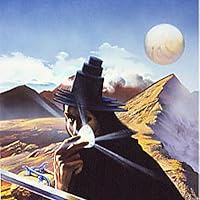
The other characters are rather boring. Claude, our main man, is very much an unconflicted, rah-rah typical hero. He’s not very deep, overly just in his decisions, and boring. All the other men blend together so much that when they die I barely blink. It is interesting that Claude, the main character, is a person of colour, something that wasn’t seen that often in the 1950s. Clearly, it is not him on the cover.
The places don’t get enough detail. Except for one zone, we’re given a thin overview of the society by either another character telling us or some omniscient narration explaining it. We also don’t spend nearly enough time in any of the locations.
Yet, there were two interesting concepts that kept me reading. Big Planet has no metal deposits, so the colonies have remained somewhat “as is” in terms of technology. It was interesting to see how different groups adapted to this. I also found it fun that the world’s currency was metal, given how precious a commodity it is.
There were some silly tech, alien creatures, and a giant pile of weed.
Overall, I found it more interesting conceptually than as a story. It’s far too short and the characters are rather bland, but it was a fun short novel with the occasional poetic line such as: “A spatter of meteorites scratched bright lines down the sky.”
If you want to check out my deeper dive into this novel (including a tech overview, female representation analysis, and more discussion about the weed pile), check out my blog where I analyze Old School Sci-Fi!
The story is quite simple. A small group of Terrans crash on Big Planet, a world colonized centuries ago by different groups, all of whom have remained isolated from one another and have thus evolved socially in different ways. The survivors elect to travel 40,000 miles across the world in search of their original quarry and a way home.
This book surprised me. I honestly thought it was going to be a bit of a slog, given how pre-post-modern the writing style is, but it’s closer to Star Trek (original series) than Forbidden Planet in terms of pace.
There was also a surprising twist on the part of a female character that started the story as rather bland, stereotypical, and underdeveloped. The twist itself didn’t exactly come out of nowhere, but I didn’t expect Vance to carry through with it.
The other characters are rather boring. Claude, our main man, is very much an unconflicted, rah-rah typical hero. He’s not very deep, overly just in his decisions, and boring. All the other men blend together so much that when they die I barely blink. It is interesting that Claude, the main character, is a person of colour, something that wasn’t seen that often in the 1950s. Clearly, it is not him on the cover.
The places don’t get enough detail. Except for one zone, we’re given a thin overview of the society by either another character telling us or some omniscient narration explaining it. We also don’t spend nearly enough time in any of the locations.
Yet, there were two interesting concepts that kept me reading. Big Planet has no metal deposits, so the colonies have remained somewhat “as is” in terms of technology. It was interesting to see how different groups adapted to this. I also found it fun that the world’s currency was metal, given how precious a commodity it is.
There were some silly tech, alien creatures, and a giant pile of weed.
Overall, I found it more interesting conceptually than as a story. It’s far too short and the characters are rather bland, but it was a fun short novel with the occasional poetic line such as: “A spatter of meteorites scratched bright lines down the sky.”
If you want to check out my deeper dive into this novel (including a tech overview, female representation analysis, and more discussion about the weed pile), check out my blog where I analyze Old School Sci-Fi!

February 27, 2019
It would be three stars from anybody but Vance, as it's a very early work and really not much more than a trek with interesting episodes along the way. But, because it's Vance, those episodes are very interesting. Spending time in his company and being invited inside his imagination is always a pleasure. As one early example of his matchless originality, he comes up with and throws away the entire concept of Limitless in a few pages.
Vance returned to the setting in Showboat World, aka The Magnificent Showboats of the Lower Vissel River, Lune XXIII, Big Planet. That's much more of a baroque Rhialto-style science fantasy, and isn't connected to this story. Incidentally, this is also an example of a science fiction novel whose hero is a "person of colour" as modern parlance has it. Vance makes no big deal about that, but it locates this in the same progressive, outward-looking vision as Star Trek -- the opposite, in a way, of libertarian fantasies like Firefly.
This being very early Vance, it doesn't have the beautifully stylized dialogue of later books, but the prose is economical, pleasing, and effective. For example: "A spatter of meteorites scratched bright lines down the sky."
Vance returned to the setting in Showboat World, aka The Magnificent Showboats of the Lower Vissel River, Lune XXIII, Big Planet. That's much more of a baroque Rhialto-style science fantasy, and isn't connected to this story. Incidentally, this is also an example of a science fiction novel whose hero is a "person of colour" as modern parlance has it. Vance makes no big deal about that, but it locates this in the same progressive, outward-looking vision as Star Trek -- the opposite, in a way, of libertarian fantasies like Firefly.
This being very early Vance, it doesn't have the beautifully stylized dialogue of later books, but the prose is economical, pleasing, and effective. For example: "A spatter of meteorites scratched bright lines down the sky."

May 13, 2023
This was a bit of a disappointment. It's basically the story of a small group of earthmen who are supposed to help guiding the eponymous Big Planet towards more stable political systems and eventuell progress. However, their space ship is sabotaged, and the group does not land in Earth Enclave, but crashes on the opposite side of the planet. They try to hike around the planet, encountering men and beasts and landscapes of different kinds, and, of course, complications.
The star of the book is Big Planet - a planet with three times the diameter of the Earth (and hence about 10 times the surface area), but of low enough density that gravity on its surface is about the same. Big Planet has a native ecosphere that is compatible with Earth live (at least as far as eating and getting eaten is concerned), and has also been chosen by several groups of misfits from Earth for emigration. These have formed a number of distinct cultures spread over the giant surface of the planet, most at the technological level of our middle ages. At least one of the cultures encountered is based on a really interesting and funny premise, but the topic is not really explored to any depth.
The odyssey of the main protagonist and the dwindling group of his companions is somewhat predictable. Indeed, the whole story is a near-perfect instance of Campbell's Hero's journey, including a nearly literal death and rebirth scene in the abyss. What also turned me off a bit was the attitude of the Earthmen, who really project a colonialist overseer frame of mind, implicitly considering themselves superior, and killing off natives of the local culture with minimal provocation and little regret.
Overall not a book that has aged well. Ok if you need to while away a few hours and can get it from the half-price isle, but there are many much better books to read. Just about 2.5 stars, rounded up.
The star of the book is Big Planet - a planet with three times the diameter of the Earth (and hence about 10 times the surface area), but of low enough density that gravity on its surface is about the same. Big Planet has a native ecosphere that is compatible with Earth live (at least as far as eating and getting eaten is concerned), and has also been chosen by several groups of misfits from Earth for emigration. These have formed a number of distinct cultures spread over the giant surface of the planet, most at the technological level of our middle ages. At least one of the cultures encountered is based on a really interesting and funny premise, but the topic is not really explored to any depth.
The odyssey of the main protagonist and the dwindling group of his companions is somewhat predictable. Indeed, the whole story is a near-perfect instance of Campbell's Hero's journey, including a nearly literal death and rebirth scene in the abyss. What also turned me off a bit was the attitude of the Earthmen, who really project a colonialist overseer frame of mind, implicitly considering themselves superior, and killing off natives of the local culture with minimal provocation and little regret.
Overall not a book that has aged well. Ok if you need to while away a few hours and can get it from the half-price isle, but there are many much better books to read. Just about 2.5 stars, rounded up.

January 4, 2026
Big Planet is one of Jack Vance's earliest novels, first published in 1952. I read the Ace edition of 1978 with restored, original text and cover art by Vincent Di Fate.
I chose to read Big Planet now, having recently completed Robert Silverberg's Lord Valentine's Castle, a later representative of the "big planet" subgenre. It would be interesting to see if and how Silverberg's invention was inspired by Vances's.
Big Planet does read like an early novel by Vance. I felt that the writing doesn't have the cleverness and artistry of Vance's later work. A joyful aspect of Vance's developed style is his use of a kind of science fiction of sociology or anthropology, with gloriously bizarre societies and beautiful descriptions of alien environments. Some of Vance's developed style is present in Big Planet, particularly in the society of Kirstendale, in which the citizens take turns as nobles and servants—despite it's apparently rigidly stratified social structure, Kirstendale is surprisingly egalitarian.
Otherwise, bearing in mind the comparison between Majipoor of Lord Valentine's Castle and Big Planet, I felt that Silverberg does a much better job of giving us a sense of a huge, light planet with vast surface area. Both books concern extended journeys across their respective planets, but the events of Big Planet could easily have taken place on a planet the size of Earth, or even smaller. The concept of a massive, light planet with a benign Earth-like surface is very good, though Vance does not develop it fully in Big Planet. Majipoor entails a much stronger sense of extension in both space and time.
I am interested to see now how Vance further develops the "big planet" idea in the second volume of the duology, Showboat World, which was published much later, in 1975.
I chose to read Big Planet now, having recently completed Robert Silverberg's Lord Valentine's Castle, a later representative of the "big planet" subgenre. It would be interesting to see if and how Silverberg's invention was inspired by Vances's.
Big Planet does read like an early novel by Vance. I felt that the writing doesn't have the cleverness and artistry of Vance's later work. A joyful aspect of Vance's developed style is his use of a kind of science fiction of sociology or anthropology, with gloriously bizarre societies and beautiful descriptions of alien environments. Some of Vance's developed style is present in Big Planet, particularly in the society of Kirstendale, in which the citizens take turns as nobles and servants—despite it's apparently rigidly stratified social structure, Kirstendale is surprisingly egalitarian.
Otherwise, bearing in mind the comparison between Majipoor of Lord Valentine's Castle and Big Planet, I felt that Silverberg does a much better job of giving us a sense of a huge, light planet with vast surface area. Both books concern extended journeys across their respective planets, but the events of Big Planet could easily have taken place on a planet the size of Earth, or even smaller. The concept of a massive, light planet with a benign Earth-like surface is very good, though Vance does not develop it fully in Big Planet. Majipoor entails a much stronger sense of extension in both space and time.
I am interested to see now how Vance further develops the "big planet" idea in the second volume of the duology, Showboat World, which was published much later, in 1975.

July 16, 2022
This book probably only deserves three stars, but I give it four because, as a Vance fan, it is so enjoyable to engage with his juvenilia - with the proto-Vance, as it were. The elements of his writing that made him great are all present here, but in devolved form: the prose hints at the sublimely spare beauty of his mature work, but remains under the heavy influence of 1950s hardboiled SF; the fascination with varied cultures is there, but none are developed in truly interesting ways; there are flourishes to the dialogue (I noted at least one 'punctilio'), but not yet the verve and vivacity of later years; there is some dark humour but none of the wryness that usually makes his books so plainly pleasurable to read. The story is nothing to get excited about (though it certainly kept me engaged) but for the modern Vance reader, it is almost beside the point - we're here to see where he came from, and in that respect it doesn't at all disappoint.
December 29, 2025
A fun and quick little romp, definitely antiquated, but quite fun. The Jack Vance magic is still there, despite this book being relatively quick and dirty. It was a nice break from the bigger, heavier books I’m also reading


January 20, 2024
Definitely a pulp writer, but it's all good fun. John Dolan's description of Vance as a worldbuilder holds true, and there's a lot built in these few pages. It ends too quickly, but if it didn't end when it does I'd probably complain it dragged on too long.

January 21, 2024
La premisa inicial sembla una xorrada que a penes s'arregla al final. Un llibre d'altre temps, ciència ficció sense gaire imaginació. Podria ser una bona peli d'acció, però.
May 9, 2014
Big Planet by Jack Vance
Big Planet is a lawless and fragmented world many times larger than Earth, which is largely self-governed, save for a small administrative safe area known as Earth Enclave. The story begins as a spaceship arrives at the planet carrying a commission of people from Earth who have been sent to keep up good relations with the inhabitants and to investigate Earth's growing concern with the Bajarnum of Beaujolais, Charley Lysidder, who is trying to unify the various peoples of Big Planet and take control of it. However, the ship is sabotaged by one of the crew members and crash landed into a remote village of Big Planet called Jubilith and thus begins a quest to travel 40,000 miles across the planet to the safety of Earth Enclave, with the Bajarnum on their tails at every step.
The plot is quite straight forward and primarily serves as a means for Vance to do what he does best—that is, take the reader on a grand tour of an exotic, alien world. This was Vance's typical brand of science fiction which he so fondly used throughout his career—the so called planetary romance—and whilst this book was quite unique in it's day and helped establish the genre, in retrospect it suffers from being a little uneven at times due to it being an early work, showing evidence of a young Jack Vance still perfecting his craft.
The book begins a little clumsily and descends into a 'whodunit', with the main protagonist Claude Glystra taking charge of the impossible mission and trying to establish who has betrayed the commission and crash landed the ship. But as the novel progresses and the quest goes on, Vance hits his stride and begins to paint an interesting travelogue which becomes very enjoyable. The highlight of the book is no doubt the intriguing settlement of Kirstendale, to which the central characters arrive at by means of the monoline—which is a sort of wind-powered overhead cable car stretching many hundreds of miles. The group realise that Kirstendale is not what it first appears to be as they discover that an interesting system is in place which allows all of it's settlers to enjoy a part-time life of luxury by dividing their time up between acting as a masters in their own estate and then acting as a servant to other residents at other parts of the day!
Myrtlesee Fountain was another highlight of the book—the religious zealotry built an intense and creepy atmosphere and learning about the bizarre process of how Oracles are created was particularly enjoyable, and quintessential Vance.
The book's main weakness is probably it's characterisation. Our main protagonist, Claude Glystra is your typical hero, who is endlessly motivated to the task at hand. The book's love interest is a local girl called Nancy who joins the group at the crash site of Jubilith, and the relationship between her and Claude is rather predictable. Charley Lysidder, the books villain, is probably the most intriguing character, and his role reminded me of the various villains in Vance's later Demon Princes books. But unfortunately, the rest of the cast—including the other members of the commission—are rather unmemorable and are not really fleshed out enough to make them distinguishable.
Big Planet was a very satisfying read, it was a little slow to get going, but there were lots of interesting and unique ideas as the book progressed. Perhaps not a book to recommend for readers new to Vance, but definitely one that will be enjoyable to those already accustomed to his style.
Big Planet is a lawless and fragmented world many times larger than Earth, which is largely self-governed, save for a small administrative safe area known as Earth Enclave. The story begins as a spaceship arrives at the planet carrying a commission of people from Earth who have been sent to keep up good relations with the inhabitants and to investigate Earth's growing concern with the Bajarnum of Beaujolais, Charley Lysidder, who is trying to unify the various peoples of Big Planet and take control of it. However, the ship is sabotaged by one of the crew members and crash landed into a remote village of Big Planet called Jubilith and thus begins a quest to travel 40,000 miles across the planet to the safety of Earth Enclave, with the Bajarnum on their tails at every step.
The plot is quite straight forward and primarily serves as a means for Vance to do what he does best—that is, take the reader on a grand tour of an exotic, alien world. This was Vance's typical brand of science fiction which he so fondly used throughout his career—the so called planetary romance—and whilst this book was quite unique in it's day and helped establish the genre, in retrospect it suffers from being a little uneven at times due to it being an early work, showing evidence of a young Jack Vance still perfecting his craft.
The book begins a little clumsily and descends into a 'whodunit', with the main protagonist Claude Glystra taking charge of the impossible mission and trying to establish who has betrayed the commission and crash landed the ship. But as the novel progresses and the quest goes on, Vance hits his stride and begins to paint an interesting travelogue which becomes very enjoyable. The highlight of the book is no doubt the intriguing settlement of Kirstendale, to which the central characters arrive at by means of the monoline—which is a sort of wind-powered overhead cable car stretching many hundreds of miles. The group realise that Kirstendale is not what it first appears to be as they discover that an interesting system is in place which allows all of it's settlers to enjoy a part-time life of luxury by dividing their time up between acting as a masters in their own estate and then acting as a servant to other residents at other parts of the day!
“Some of us here in Kirstendale subscribe to the Doctrine of Illogical Substitution, which in many respects disputes your theory of causation. And then there is the Tempofluxion Dogma—very interesting, although I for one cannot entirely accept the implications. Possibly the central postulates are unkonwn on Earth? The advouters claim that as the river of time flows past and through us, our brains are disturbed—jostled, if you will—by irregularities, eddies, in the flow of the moments. They believe that if it were possible to control the turbulence in the river, it would be possible to manipulate creative ability in human minds. What do you say to that?”
Myrtlesee Fountain was another highlight of the book—the religious zealotry built an intense and creepy atmosphere and learning about the bizarre process of how Oracles are created was particularly enjoyable, and quintessential Vance.
The Voivode hitched himself forward. “Oracle, answer well, how long have I to live?”
The Oracle smiled wearily. “You ask triviality—and I shall answer. Why not? So—from the position of your body, from your gait, from certain mental considerations, it is evident that you are eaten by an internal canker. Your breath reeks of decay. I judge your life at a year, no more.”
The book's main weakness is probably it's characterisation. Our main protagonist, Claude Glystra is your typical hero, who is endlessly motivated to the task at hand. The book's love interest is a local girl called Nancy who joins the group at the crash site of Jubilith, and the relationship between her and Claude is rather predictable. Charley Lysidder, the books villain, is probably the most intriguing character, and his role reminded me of the various villains in Vance's later Demon Princes books. But unfortunately, the rest of the cast—including the other members of the commission—are rather unmemorable and are not really fleshed out enough to make them distinguishable.
Big Planet was a very satisfying read, it was a little slow to get going, but there were lots of interesting and unique ideas as the book progressed. Perhaps not a book to recommend for readers new to Vance, but definitely one that will be enjoyable to those already accustomed to his style.

April 22, 2009
At first I just wanted to write a quick dismissal of Big Planet. Even setting aside a casual and complete disregard for women, "built for pleasure", as weak willed dimwits, the entire surprise plot is glaringly apparent from about chapter two. In fact, you have to believe women are morons for the plot to work.
These fatal flaws obscure a wittily curlicued prose and some interesting ideas. As the shipwreck investigators flee across Big Planet they come across a number of societies. In one the high and low positions are rotated continously. A waiter at one party might easily be a lord at the next. The planet may be really big but lacks any significant mineral deposits so as a result the big bad guy has to trade in the only available resource, enslaving women and children. Vance takes this reality and spins out all number of intriguing consequences.
Reportedly (no historian of science-fiction am I) Big Planet is the start or near the start of the constructed societies genre, world building. From Big Planet to The Left Hand of Darkness? My mind boggles.
Published in 1952, before the welcome revolution of feminism, I'm probably falling into historical relativism by jumping up on down on Big Planet. Odd how, at least for myself, I can read Victorian fiction and the way women are treated and portrayed, and while it is reprehensible, it doesn't spoil much of the fiction for me, while when I read stuff, such as Big Planet from the fifties and I just want to crawl under a rock and die it is sooooo damn bad. Victorian England is another world to me, fifties America is uncomfortably close to now. Yet other early authors of science fiction, Asimov and Heinlein for example, while not paragons of proto-women's lib, don't depress me as the female characters in this work do.
These fatal flaws obscure a wittily curlicued prose and some interesting ideas. As the shipwreck investigators flee across Big Planet they come across a number of societies. In one the high and low positions are rotated continously. A waiter at one party might easily be a lord at the next. The planet may be really big but lacks any significant mineral deposits so as a result the big bad guy has to trade in the only available resource, enslaving women and children. Vance takes this reality and spins out all number of intriguing consequences.
Reportedly (no historian of science-fiction am I) Big Planet is the start or near the start of the constructed societies genre, world building. From Big Planet to The Left Hand of Darkness? My mind boggles.
Published in 1952, before the welcome revolution of feminism, I'm probably falling into historical relativism by jumping up on down on Big Planet. Odd how, at least for myself, I can read Victorian fiction and the way women are treated and portrayed, and while it is reprehensible, it doesn't spoil much of the fiction for me, while when I read stuff, such as Big Planet from the fifties and I just want to crawl under a rock and die it is sooooo damn bad. Victorian England is another world to me, fifties America is uncomfortably close to now. Yet other early authors of science fiction, Asimov and Heinlein for example, while not paragons of proto-women's lib, don't depress me as the female characters in this work do.

December 23, 2014
This is one of the few books of Vance I didn't read yet. I did read the other Big Planet book (Showboat World), which was a fun read in the picaresque style of Cugel.
Already in the first few pages it is noticable this is one of his earlier works. Not as polished, and let's say old fashioned attitudes (or should I say borderline misogynistic?). It reminded me a lot of the planetary adventure of the Planet of Adventure books.
Naming things was not Vance's strong point at this time. The Bajarnum of Beaujolais as title for a dictator, Politburos as a name for certain nomads.
Might be mend to be funny, but feels a bit juvenile, and it did break the suspense of disbelief more than I would have liked.
Story wise is just not that strong. A very abrupt start and ending, and no character development. It;s very episodic, but also not directly the picaresque fun of the Cugel books. Lot's of tell instead of show.
Fun to read knowing he got much, much better. But I'd recommend this only for completists.
Already in the first few pages it is noticable this is one of his earlier works. Not as polished, and let's say old fashioned attitudes (or should I say borderline misogynistic?). It reminded me a lot of the planetary adventure of the Planet of Adventure books.
Naming things was not Vance's strong point at this time. The Bajarnum of Beaujolais as title for a dictator, Politburos as a name for certain nomads.
Might be mend to be funny, but feels a bit juvenile, and it did break the suspense of disbelief more than I would have liked.
Story wise is just not that strong. A very abrupt start and ending, and no character development. It;s very episodic, but also not directly the picaresque fun of the Cugel books. Lot's of tell instead of show.
Fun to read knowing he got much, much better. But I'd recommend this only for completists.
May 21, 2016
Avventura a non finire
Qui siamo di fronte ad una fantascienza dilatata, non strettamente tecnologica, governata da un senso d'avventura che tende a non lasciar respirare il lettore, quasi in corsa contro le pagine. Aspetto, quest'ultimo, che restituisce indubbiamente una lettura dinamica, vivace — Vance è dotato di una frizzante fantasia e in grado di creare differenti atmosfere, con ritmi serrati e affascinanti al tempo stesso —, ma col rischio di far perdere al lettore qualche pezzo durante la corsa.
Qui siamo di fronte ad una fantascienza dilatata, non strettamente tecnologica, governata da un senso d'avventura che tende a non lasciar respirare il lettore, quasi in corsa contro le pagine. Aspetto, quest'ultimo, che restituisce indubbiamente una lettura dinamica, vivace — Vance è dotato di una frizzante fantasia e in grado di creare differenti atmosfere, con ritmi serrati e affascinanti al tempo stesso —, ma col rischio di far perdere al lettore qualche pezzo durante la corsa.

April 12, 2018
Il grande guaio di un qualsiasi genere letterario, quando passa per la sua età dell'oro, è che ci sono troppi grandi autori, troppi capolavori, e numerose gemme passano inosservate.
Jack Vance è meno citato di altri autori Fantasy e Fantascientifici, il suo Glystra non ha mai avuto una trasposizione cinematografica o una serie televisiva.
Eppure lo meriterebbe.
Da leggere per tutti i cultori del genere.
Jack Vance è meno citato di altri autori Fantasy e Fantascientifici, il suo Glystra non ha mai avuto una trasposizione cinematografica o una serie televisiva.
Eppure lo meriterebbe.
Da leggere per tutti i cultori del genere.

September 14, 2011
Early Vance, but still worth a read, considering how short it is. The story is simple as are most of the characters. The main draw here are the strange societies of Big Planet. If you are a Vance fan, check it out.

May 8, 2012
Interesting but somehow not satisfying

July 3, 2020
Le vaisseau d’une commission terrienne est victime d’un attentat et s’écrase sur la Planète géante. Pour rejoindre l’Enclave terrienne, les survivants doivent parcourir soixante-cinq mille kilomètres (eh oui, la planète est… géante) en traversant des zones contrôlées par des peuplades souvent hostiles.
Ce roman, écrit une dizaine d’années avant le Cycle de Tschaï, en contient toutes les prémisses, même s’il n’est pas exempt de défauts qui seront atténués dans la saga la plus connue de l’auteur. La trame de fond est similaire : une aventure dans un environnement dangereux, au sein d’un univers aux multiples paysages, peuples, faunes et flores, couleurs… Cependant, les sociétés rencontrées sont généralement moins travaillées (et parfois pas du tout), les décors naturels sont trop rapidement esquissés, et à l’exception du héros principal les personnages sont peu ou pas approfondis, donc on se s’attache pas à eux. L’intrigue elle-même très linéaire.
Le récit ressemble à un prétexte pour présenter le monde imaginaire de l’auteur. La Planète géante est peuplée de descendants d’humains qui ont quitté la zone d’influence terrienne pour leur « indépendance » car ils refusaient de vivre comme des robots obéissants et sans âme (selon eux), mais pour les Terriens les premiers colons étaient avant tout des inadaptés. Dans ce monde sans technologie car sans métal, l’auteur imagine qu’au fil des générations les colons ont inévitablement recréé des sociétés primitives et inégalitaires, ce qui est une idée intéressante. On y croise souvent des esclaves, les femmes sont méprisées et elles ne s’appartiennent pas, les enfants ne connaissent pas l’école et apprennent très jeunes un métier traditionnel. Il vaut mieux être armé et savoir se battre quand on entame un voyage. Quelques villes plus évoluées existent cependant, mais elles ont fondé des microsociétés parfois luxueuses mais peu attirantes. Et soyons clairs, la vie n’a pas de valeur sur la Planète géante.
La méconnaissance des femmes qu’a l’auteur (si on veut exprimer les choses gentiment) transparaît, notamment avec deux adolescentes décrites comme très piailleuses et frivoles. Et des hommes soi-disant civilisés (car venant de la Terre) sont ravis de les prendre comme compagnes ! Si on fait le lien avec une protagoniste apparaissant dans le dernier tome du Cycle de Tschaï, on ne peut pas s’empêcher de penser que l’auteur a un problème avec les adolescentes. C’est vraiment le sujet le plus gênant chez Jack Vance, au-delà d’une misogynie dans le traitement de ses personnages (fréquente dans les romans de SF écrits à cette époque).
En conclusion, un roman qui n’est pas le plus grand de l’auteur car il y a encore beaucoup d’éléments à travailler et à approfondir, malgré tout le livre se laisse lire.
La suite a été écrite une vingtaine d’années plus tard, je vais découvrir si elle est meilleure.
Ce roman, écrit une dizaine d’années avant le Cycle de Tschaï, en contient toutes les prémisses, même s’il n’est pas exempt de défauts qui seront atténués dans la saga la plus connue de l’auteur. La trame de fond est similaire : une aventure dans un environnement dangereux, au sein d’un univers aux multiples paysages, peuples, faunes et flores, couleurs… Cependant, les sociétés rencontrées sont généralement moins travaillées (et parfois pas du tout), les décors naturels sont trop rapidement esquissés, et à l’exception du héros principal les personnages sont peu ou pas approfondis, donc on se s’attache pas à eux. L’intrigue elle-même très linéaire.
Le récit ressemble à un prétexte pour présenter le monde imaginaire de l’auteur. La Planète géante est peuplée de descendants d’humains qui ont quitté la zone d’influence terrienne pour leur « indépendance » car ils refusaient de vivre comme des robots obéissants et sans âme (selon eux), mais pour les Terriens les premiers colons étaient avant tout des inadaptés. Dans ce monde sans technologie car sans métal, l’auteur imagine qu’au fil des générations les colons ont inévitablement recréé des sociétés primitives et inégalitaires, ce qui est une idée intéressante. On y croise souvent des esclaves, les femmes sont méprisées et elles ne s’appartiennent pas, les enfants ne connaissent pas l’école et apprennent très jeunes un métier traditionnel. Il vaut mieux être armé et savoir se battre quand on entame un voyage. Quelques villes plus évoluées existent cependant, mais elles ont fondé des microsociétés parfois luxueuses mais peu attirantes. Et soyons clairs, la vie n’a pas de valeur sur la Planète géante.
La méconnaissance des femmes qu’a l’auteur (si on veut exprimer les choses gentiment) transparaît, notamment avec deux adolescentes décrites comme très piailleuses et frivoles. Et des hommes soi-disant civilisés (car venant de la Terre) sont ravis de les prendre comme compagnes ! Si on fait le lien avec une protagoniste apparaissant dans le dernier tome du Cycle de Tschaï, on ne peut pas s’empêcher de penser que l’auteur a un problème avec les adolescentes. C’est vraiment le sujet le plus gênant chez Jack Vance, au-delà d’une misogynie dans le traitement de ses personnages (fréquente dans les romans de SF écrits à cette époque).
En conclusion, un roman qui n’est pas le plus grand de l’auteur car il y a encore beaucoup d’éléments à travailler et à approfondir, malgré tout le livre se laisse lire.
La suite a été écrite une vingtaine d’années plus tard, je vais découvrir si elle est meilleure.

April 14, 2023
In the myriad worlds and works of Jack Vance, the permutations of culture seem unlimited: like the way Dickens maintains character in such a fashion that even the merest stablehand that steps into a chapter feels replete with an entire interior world, Vance's horizons seems limitless with fanciful construction, and even the slightest mention of far-off vistas, lakes and townships that are never granted an explanation never feel like he couldn't supply a rich cultural and environmental narrative with the snap of a finger. In the case of Big Planet, a planet ostensibly sized as large a Jupiter-sized gas giant but of Earth-like atmosphere with similar flora and fauna, we have his case in point: one is reminded of the Kafka parable of An Imperial Message, where he describes a series of unending walls, courtyards, palaces and doors that effectively make obsolete the nature of communication across it—the message will never get to you. Similarly, Big Planet is inexhaustible—you will never transverse it in it's entirety. Politically, since Big Planet serves as metaphor for early American studies, it's a refuge for Luddites, fanatics, dogmatists, slavers, mystics and rebels—the list goes on, and the concept of a governmental unification is moot and the kind of entropic world view becomes the Mos Eisely of Worlds and Parables. What Vance lacks in characterizations—and he uses simple forms here, that I daresay are less the Golden Age tropes of the cigar-chewing Advertising execs of Asimov and Clarke and more the Knights of the Round Table as ethos personified—he makes up for with the labyrinthine fecundity of his imagination, all swathed in his tones of irony that place him apart from most Space Opera. Here lies the brambles of The Faerie Queen, the endless ruins of Hypnerotomachia Poliphili, the shaded pastures of Arcadia and more.
Displaying 1 - 30 of 93 reviews