

What do you think?

Long Time Gone
Rock superstar David Crosby describes his early days as an actor, his tenure with the Byrds and the tremendous success of Crosby, Stills, Nash, and Young; his severe drug addiction, and the road to recovery and renewed prosperity
489 pages, Hardcover
First published October 15, 1988
Ratings & Reviews
Friends & Following
Create a free account to discover what your friends think of this book!
Community Reviews
Displaying 1 - 30 of 102 reviews

February 10, 2023
CRITIQUE:
Long Time Quarreling
Rarely has such harmonious music been made by such a disharmonious group of musicians as Crosby, Stills & Nash (or Crosby, Stills, Nash & Young).
Their photographer, Bobby Hammer, described their relationship as "big explosions followed seconds later by incredible harmonies."
It was an issue they had to confront from the outset.
Their ideal was to "[combine] talents without submerging identities or sublimating individual aspirations."
The reason they used the name of every member in the name of the band, was that, if one of the founding members left, they couldn't replace him with somebody else and continue to use the original band name. For example, if David Crosby left and was replaced by James Taylor, the name Crosby, Stills & Nash would have to be changed to Taylor, Stills & Nash.
Another problem/ challenge was that all of the members wrote songs, and each of them had a huge ego. While they all respected each other's contributions as singers, song-writers and musicians, they wrote songs at different paces.
Crosby and Nash each wrote only two to three songs a year for CSN, while Stills could write an entire album each year. How do you decide which songs to include on the album, and which to exclude or reject?
They dealt with the problem by giving each of them the right to make their own solo albums, play with other bands (e.g., Crazy Horse), offer their songs to other musicians, and appear on other people's albums.
Crosby had a more positive take on the issue:
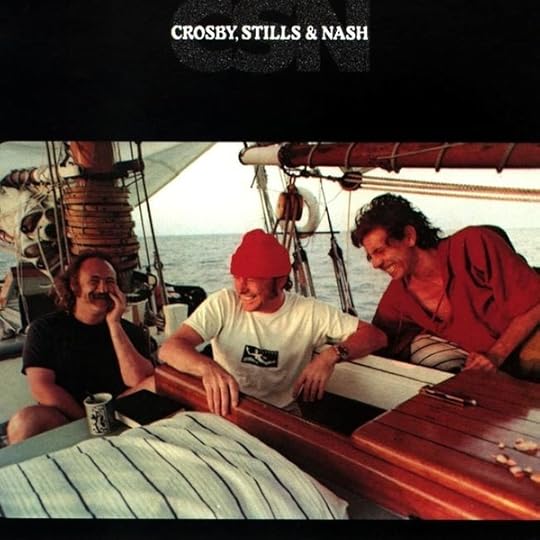
Crosby, Stills & Nash on board Crosby's schooner, Mayan, his great love, muse and tonic (Source:)
Triadic Congress
It shouldn't come as a surprise that each chapter of the book has a triadic structure.
First, David Crosby's friend and co-writer, Carl Gottlieb, writes from a more third person, omniscient, objective, factual and contextual point of view.
Secondly, there are a significant number of quotations (probably derived from interviews with Gottlieb) from friends, associates and rivals (I suspect Stephen Stills and Neil Young didn't paricipate), who (occasionally) express alternative perspectives on personalities and events.
Crosby lets these people express their views without criticism or modification. It's their story, just as much as it might be his. In the end, this is a biography (in the form of an oral history), just as much as it might be an autobiography.
Thirdly, Crosby's own personal perspective comes at the end of these other perspectives, with a view to adding a more intimate, subjective perspective (though these passages often sound like they've been extracted from interviews with Gottlieb). He doesn't seem to be particularly defensive about explicit or implicit criticism.
He's occasionally apologetic, particularly when discussing the implications and repercussions of his drug addiction for his close relationships. However, contrary to how he would have behaved at the time, he seems genuinely remorseful (at least in retrospect) about what he calls his "drug behaviour", rather than trying to shirk or deny responsibility.
His views clearly moderated after his 1986 imprisonment, rehabilitation and release on parole after five months. This more conciliatory approach is reflected in the video interviews in the soundtrack below.
A Childlike Joy
There is much external insight into the man who was such a big contributor to the band.
Grace Slick highlights Crosby's joie de vivre:
Joni Mitchell agrees:
David Geffen is less generous:
Long Time Coming
Needless to say, Crosby's sense of joy made him sexually attractive to a lot of (young) long-legged, long-haired women, often at the same time. During the first half of the book, his relationships constitute what you can only call "hierarchical polyamory".
No matter how many women were involved, there was always one who was the principal "lady of the house". Everybody was supposed to know and comply with the rules of the hierarchy.
Whether or not Crosby entered into this type of relationship for selfish or egotistical reasons, everybody was supposed to spend a "long time coming."
These relationships inspired one of his best songs, "Triad":
Of course, not everybody was content with this type of relationship. One of the secondary girlfriends explains her point of view, "David is definitely worth waiting for, but he's not worth standing in line."
Long Time Freebasing
By the second half of the book (1978 onwards), Crosby's principal relationship was with Jan Dance (whom he subsequently married). He describes her as "an incredibly vivacious, funny, bright, happy, smiley human being, and I fell in love with her" when he first met her. Soon, "she wore her hair in a stocking cap, looked to be about ninety or ninety-five pounds, her teeth were unattractive, and she looked very unkempt."
Unfortunately, this part of their life coincided with their extreme co-addiction to smoking freebase cocaine. Ironically, Crosby had had to discontinue snorting cocaine, because he had a perforated septum. However, freebasing was even worse for his and their health.
Crosby's health started to detract from his role in the band. He was in no state to record a scheduled album with Graham Nash. Nash told Crosby:
Things had got even worse by 1981, when Crosby and Jan both had grand mal seizures while freebasing.
In May, Nash and 20 of Crosby's friends arranged a "crisis intervention", in the hope that Crosby and Jan would go into hospital for treatment. After the first night, they checked themselves out of the hospital and disappeared without telling anyone their destination. They had betrayed the trust of their friends. Many of them felt that Crosby couldn't recover, while his relationship with Jan continued.
In Dallas the following year, Crosby was arrested for possession of drug paraphernalia and a .45 Colt automatic pistol. Crosby was eventually sentenced to six years imprisonment, of which he served one year, before his conviction was overturned in 1987 after several appeals. Still, Crosby credits his time in prison for finally getting him off drugs. Fortunately, Jan became drug-free at the same time, and they got married when Crosby was released from prison.
Long Time Lasting
Crosby is believed to have died in his sleep from complications of COVID-19 on January 18, 2023 at age 81. This book was published in 1988, after he got out of prison. Most people, including Crosby himself, were surprised that he lived that long. He was a long time here; now, he'll be a long time gone, even if it's less than a month since he died. I'm glad he left this book and his music behind.
SOUNDTRACK:
Long Time Quarreling
Rarely has such harmonious music been made by such a disharmonious group of musicians as Crosby, Stills & Nash (or Crosby, Stills, Nash & Young).
Their photographer, Bobby Hammer, described their relationship as "big explosions followed seconds later by incredible harmonies."
It was an issue they had to confront from the outset.
Their ideal was to "[combine] talents without submerging identities or sublimating individual aspirations."
The reason they used the name of every member in the name of the band, was that, if one of the founding members left, they couldn't replace him with somebody else and continue to use the original band name. For example, if David Crosby left and was replaced by James Taylor, the name Crosby, Stills & Nash would have to be changed to Taylor, Stills & Nash.
Another problem/ challenge was that all of the members wrote songs, and each of them had a huge ego. While they all respected each other's contributions as singers, song-writers and musicians, they wrote songs at different paces.
Crosby and Nash each wrote only two to three songs a year for CSN, while Stills could write an entire album each year. How do you decide which songs to include on the album, and which to exclude or reject?
They dealt with the problem by giving each of them the right to make their own solo albums, play with other bands (e.g., Crazy Horse), offer their songs to other musicians, and appear on other people's albums.
Crosby had a more positive take on the issue:
"The other advantage that we had all along is that the three (or four) of us all write wildly divergent material. We are such different people and we write so differently that it gives us what I like to call a much wider palette out of which to paint the album, much more than most people have...We write an incredible spread of stuff - it's really soup to nuts..."
Crosby, Stills & Nash on board Crosby's schooner, Mayan, his great love, muse and tonic (Source:)
Triadic Congress
It shouldn't come as a surprise that each chapter of the book has a triadic structure.
First, David Crosby's friend and co-writer, Carl Gottlieb, writes from a more third person, omniscient, objective, factual and contextual point of view.
Secondly, there are a significant number of quotations (probably derived from interviews with Gottlieb) from friends, associates and rivals (I suspect Stephen Stills and Neil Young didn't paricipate), who (occasionally) express alternative perspectives on personalities and events.
Crosby lets these people express their views without criticism or modification. It's their story, just as much as it might be his. In the end, this is a biography (in the form of an oral history), just as much as it might be an autobiography.
Thirdly, Crosby's own personal perspective comes at the end of these other perspectives, with a view to adding a more intimate, subjective perspective (though these passages often sound like they've been extracted from interviews with Gottlieb). He doesn't seem to be particularly defensive about explicit or implicit criticism.
He's occasionally apologetic, particularly when discussing the implications and repercussions of his drug addiction for his close relationships. However, contrary to how he would have behaved at the time, he seems genuinely remorseful (at least in retrospect) about what he calls his "drug behaviour", rather than trying to shirk or deny responsibility.
His views clearly moderated after his 1986 imprisonment, rehabilitation and release on parole after five months. This more conciliatory approach is reflected in the video interviews in the soundtrack below.
A Childlike Joy
There is much external insight into the man who was such a big contributor to the band.
Grace Slick highlights Crosby's joie de vivre:
"...My first impression of David was I had never seen anybody who had that much interest and joy and spontaneous reaction. He was like a child in his willingness to put his feet into it, into everything. He would react to a carving of a boat or a whale or a girl's body or something that somebody had made or music or carpentry or whatever with this joy. You didn't even have to look at what the object was, you could just look at his face and be delighted because there was a human being getting that childlike excitement out of stuff. He did that continuously!"
Joni Mitchell agrees:
"David was wonderful company and a great appreciator. When it comes to expressing infectious enthusiam, he is probably the most capable person I know. His eyes were like star sapphires to me. When he laughed, they seemed to twinkle like no one else's and so I fell into his merry company..."
David Geffen is less generous:
"In my experience, there was never anything quite like the egos in Crosby, Stills, Nash & Young. It was not easy. David was obnoxious, loud, demanding, thoughtless, full of himself - of the four of them, the least talented. And I think that he felt the least talented."
Long Time Coming
Needless to say, Crosby's sense of joy made him sexually attractive to a lot of (young) long-legged, long-haired women, often at the same time. During the first half of the book, his relationships constitute what you can only call "hierarchical polyamory".
No matter how many women were involved, there was always one who was the principal "lady of the house". Everybody was supposed to know and comply with the rules of the hierarchy.
Whether or not Crosby entered into this type of relationship for selfish or egotistical reasons, everybody was supposed to spend a "long time coming."
These relationships inspired one of his best songs, "Triad":
"You want to know how it will be
Me and her, or you and me
You both stand there, your long hair flowing,
Your eyes alive, your mind still growing
"Saying to me what can we do
Now that we both love you
I love you too
And I don't really see
Why can't we go on as three."
Of course, not everybody was content with this type of relationship. One of the secondary girlfriends explains her point of view, "David is definitely worth waiting for, but he's not worth standing in line."
Long Time Freebasing
By the second half of the book (1978 onwards), Crosby's principal relationship was with Jan Dance (whom he subsequently married). He describes her as "an incredibly vivacious, funny, bright, happy, smiley human being, and I fell in love with her" when he first met her. Soon, "she wore her hair in a stocking cap, looked to be about ninety or ninety-five pounds, her teeth were unattractive, and she looked very unkempt."
Unfortunately, this part of their life coincided with their extreme co-addiction to smoking freebase cocaine. Ironically, Crosby had had to discontinue snorting cocaine, because he had a perforated septum. However, freebasing was even worse for his and their health.
Crosby's health started to detract from his role in the band. He was in no state to record a scheduled album with Graham Nash. Nash told Crosby:
"Look, I can't handle it. It's madness."
Things had got even worse by 1981, when Crosby and Jan both had grand mal seizures while freebasing.
In May, Nash and 20 of Crosby's friends arranged a "crisis intervention", in the hope that Crosby and Jan would go into hospital for treatment. After the first night, they checked themselves out of the hospital and disappeared without telling anyone their destination. They had betrayed the trust of their friends. Many of them felt that Crosby couldn't recover, while his relationship with Jan continued.
In Dallas the following year, Crosby was arrested for possession of drug paraphernalia and a .45 Colt automatic pistol. Crosby was eventually sentenced to six years imprisonment, of which he served one year, before his conviction was overturned in 1987 after several appeals. Still, Crosby credits his time in prison for finally getting him off drugs. Fortunately, Jan became drug-free at the same time, and they got married when Crosby was released from prison.
Long Time Lasting
Crosby is believed to have died in his sleep from complications of COVID-19 on January 18, 2023 at age 81. This book was published in 1988, after he got out of prison. Most people, including Crosby himself, were surprised that he lived that long. He was a long time here; now, he'll be a long time gone, even if it's less than a month since he died. I'm glad he left this book and his music behind.
SOUNDTRACK:

December 12, 2014
At one point, while reading this book in a coffee shop, two policemen sat at a table next to me and I got paranoid.
What I liked about "Long Time Gone" is the unique way that the story was told, alternating between Crosby's personally written recollections, co-author Carl Gottlieb's third-person accounts where he could lasso in Crosby and place his story in a broader context, and the stories shared by the witnesses. I can't recall reading a book written in this style before, and I thought it worked extremely well.
What I didn't like about the book is that it is too long. I know that the life of a junkie is harrowing and repetitive, but there were many sections where I thought "didn't I already read this?".
I know that drugs are what have defined Crosby's life and career, and if you come at this book simply as a story about a user who reached 'rock' bottom 7 or 8 times, then it works. What was missing from this book is a little more insight into the process of music making. It's not completely absent, as Crosby discusses his career with the Byrds, CSNY, and solo ventures. But whenever Crosby would start to delve deeper into music making, the story would meander back to the drug use. Which, I suppose, is the point of the book: for Crosby, the drugs became more important than the music.
David Crosby is a very gifted musician, with a voice that ranks with the likes of Art Garfunkel, Don Henley and Dan Fogelberg. His story is so sad that there is actually happiness and good feelings when he is in jail, away from the drugs that would have killed both him and his wife Jan. The book made me listen to the CSN catalog, along with Crosby's solo work and projects with Graham Nash. Overall, it was worth reading, but the length and repetition made me give it 3 stars (because I can't give 3.5).
What I liked about "Long Time Gone" is the unique way that the story was told, alternating between Crosby's personally written recollections, co-author Carl Gottlieb's third-person accounts where he could lasso in Crosby and place his story in a broader context, and the stories shared by the witnesses. I can't recall reading a book written in this style before, and I thought it worked extremely well.
What I didn't like about the book is that it is too long. I know that the life of a junkie is harrowing and repetitive, but there were many sections where I thought "didn't I already read this?".
I know that drugs are what have defined Crosby's life and career, and if you come at this book simply as a story about a user who reached 'rock' bottom 7 or 8 times, then it works. What was missing from this book is a little more insight into the process of music making. It's not completely absent, as Crosby discusses his career with the Byrds, CSNY, and solo ventures. But whenever Crosby would start to delve deeper into music making, the story would meander back to the drug use. Which, I suppose, is the point of the book: for Crosby, the drugs became more important than the music.
David Crosby is a very gifted musician, with a voice that ranks with the likes of Art Garfunkel, Don Henley and Dan Fogelberg. His story is so sad that there is actually happiness and good feelings when he is in jail, away from the drugs that would have killed both him and his wife Jan. The book made me listen to the CSN catalog, along with Crosby's solo work and projects with Graham Nash. Overall, it was worth reading, but the length and repetition made me give it 3 stars (because I can't give 3.5).

May 9, 2025
I really enjoyed this book. It was written very well and told the story of David Crosby through 1988, when he wrote this book. The most interesting part about this book is that David and Carl Gottlieb (co author) were able to get quotes from various people in his life (band mates like Graham Nash and Neil Young), friends (like Grace Slick, Jackson Brown and many other very famous name from that era), work associates (like David Geffen, Ahmet Ertegun, and many others), ship mates and crew from the Mayan, his boat, doctors, people in the justice system, and much more. The most enlightening part of this book is the story of his drug addiction, which I knew about, but not in such detail, nor did I previously understand just how fucked up he was. The book ends on a good note with him being straight and moving forward with his life as. Musician. Other tails included his adventures on his boat, a wooden schooner that he refurbished. Crosby became an accomplished sailor and very knowledgeable on the topic. His excursions included from Florida to the West Coast, out to Hawaii and further west from there. Really cool stuff. The book also discussed his early life, his family and high school, where he first learned that he enjoyed singing and was very good at it. It covers his life in LA (Laurel Canyon) and Marin County up north, as well as his early days traveling from city to city to perform. The book also discusses his life with many girls and his approach toward them, having no commitment or responsibilities toward them. This was a brutally honest introspection by Crosby. The book ends with him finally settling down and getting married. Well worth reading.

March 30, 2023
The extraordinary David Crosby gives us the extraordinary tale of his life until 1987, and the story is loaded with the enthusiasm and energy that has always defined him. You can’t say that he hasn’t experienced a full life. From the peaks of fame and the utter fall into near fatal addiction, he roars back, with a little help from his friends.

May 24, 2008
you can learn a lot from biographies/autobiographies. this was no exception.
when it comes to rock and roll excess, who can separate truth from fiction from legend? when i saw the book i thought, cool—i can hear all about it from him. and that’s kind of the way the book goes, except that it augments what he says with what everyone else says: roadies, ex-lovers, business partners, damaged hippie freaks, ex-managers, fellow musicians and everything inbetween. all of that stitched up together gives a fuller picture than him, telling it like he remembers it. more often than not, everyone else reinforces whatever he says, and there’s the co-author with a timeline and photos and other documentation in case anyone goes off track. nice detail all around, especially when things go straight to hell and then get even worse.
there's him in the early days, riding around on a motorcycle wearing a leather cape. his love of/insistence upon three ways and little harems to take care of him. that whole hippie commune mentality, that share everything, with that everybody-in-and-out-of-everybody’s-house at all hours /everybody having sex with each other lifestyle. and him being a dick at any and every given opportunity because he thought he was soooooo great.
i don’t know. i think david crosby has a beautiful voice and he’s written some beautiful songs but after reading this and barney hoskyn’s “waiting for the sun” i think neil young is sooooooo great.
everyone else in rock and roll that does this level of drugs and debauchery for as long as he did dies in a pool of their own vomit. not “the cros”—probably because he got sent to prison for several years, and that’s what ultimately forced him to get clean. i knew some junkies in my day but at one point, just about everyone decided they didn’t want to die and they stopped doing it. somewhere in the 80s (the 80s!) he was looking at his rotting teeth and his swollen ankles and the sores and severe burn marks all over his face and body and he’d cry and feel sorry for himself and then he'd do some more freebase. (yikes-a-doodle-doo.)
sure, he went through hell with gasoline drawers on, but by his own admission, he was the one that bought the ticket for that ride -- triggered in part by his choice to deal with the sudden loss of his then girlfriend christine hinton with heroin instead of therapy.
and this was the guy that melissa etheridge chose to borrow a cup of sperm from to have not one but two kids with her then partner julie cypher? they couldn’t find jeff beck or eric clapton or something?
i don’t smoke and i don’t even do drugs and this book made me want to stop drinking coffee and eating meat and freaking detox whatever funk i had out of my system, just get it off of me. i just wanted to steam and sauna and take three showers and thank Jesus i never tried heroin. or cocaine. or freebase. or crack. or whatever everybody’s gotta be smoking or snorting these days. whatever.
and wow. he and his then girlfriend jan (who was even more strung out than he was) got clean and sober enough to get married and have a kid. i read that and i had to put the book down and when i did, i thought, the human body is a miraculous thing. or as the old black folks down south would say, He’s a wonder-working God.
bizarrely enough, i knew all their songs so well that when any particular ditty were mentioned in the book, i could hear it in my head. and i’ve never owned any of their records. even now, i don’t sit around listening to any of their songs. they were on permanent rotation that hardcore on the radio when i was a kid.
PS: um, yeah. this is kind of a must-read. especially if you’re a musician and you want to half-way know your rock and roll history.
when it comes to rock and roll excess, who can separate truth from fiction from legend? when i saw the book i thought, cool—i can hear all about it from him. and that’s kind of the way the book goes, except that it augments what he says with what everyone else says: roadies, ex-lovers, business partners, damaged hippie freaks, ex-managers, fellow musicians and everything inbetween. all of that stitched up together gives a fuller picture than him, telling it like he remembers it. more often than not, everyone else reinforces whatever he says, and there’s the co-author with a timeline and photos and other documentation in case anyone goes off track. nice detail all around, especially when things go straight to hell and then get even worse.
there's him in the early days, riding around on a motorcycle wearing a leather cape. his love of/insistence upon three ways and little harems to take care of him. that whole hippie commune mentality, that share everything, with that everybody-in-and-out-of-everybody’s-house at all hours /everybody having sex with each other lifestyle. and him being a dick at any and every given opportunity because he thought he was soooooo great.
i don’t know. i think david crosby has a beautiful voice and he’s written some beautiful songs but after reading this and barney hoskyn’s “waiting for the sun” i think neil young is sooooooo great.
everyone else in rock and roll that does this level of drugs and debauchery for as long as he did dies in a pool of their own vomit. not “the cros”—probably because he got sent to prison for several years, and that’s what ultimately forced him to get clean. i knew some junkies in my day but at one point, just about everyone decided they didn’t want to die and they stopped doing it. somewhere in the 80s (the 80s!) he was looking at his rotting teeth and his swollen ankles and the sores and severe burn marks all over his face and body and he’d cry and feel sorry for himself and then he'd do some more freebase. (yikes-a-doodle-doo.)
sure, he went through hell with gasoline drawers on, but by his own admission, he was the one that bought the ticket for that ride -- triggered in part by his choice to deal with the sudden loss of his then girlfriend christine hinton with heroin instead of therapy.
and this was the guy that melissa etheridge chose to borrow a cup of sperm from to have not one but two kids with her then partner julie cypher? they couldn’t find jeff beck or eric clapton or something?
i don’t smoke and i don’t even do drugs and this book made me want to stop drinking coffee and eating meat and freaking detox whatever funk i had out of my system, just get it off of me. i just wanted to steam and sauna and take three showers and thank Jesus i never tried heroin. or cocaine. or freebase. or crack. or whatever everybody’s gotta be smoking or snorting these days. whatever.
and wow. he and his then girlfriend jan (who was even more strung out than he was) got clean and sober enough to get married and have a kid. i read that and i had to put the book down and when i did, i thought, the human body is a miraculous thing. or as the old black folks down south would say, He’s a wonder-working God.
bizarrely enough, i knew all their songs so well that when any particular ditty were mentioned in the book, i could hear it in my head. and i’ve never owned any of their records. even now, i don’t sit around listening to any of their songs. they were on permanent rotation that hardcore on the radio when i was a kid.
PS: um, yeah. this is kind of a must-read. especially if you’re a musician and you want to half-way know your rock and roll history.

March 9, 2023
David Crosby was a bastard.
It might shock you to see that as the first line for a review of his memoir, especially in the wake of Crosby's passing earlier this year, but it's true: in many ways, over many of the years documented in this book, he was a selfish, arrogant, unpleasant bastard. He used people like he used drugs, and he let down the people who cared the most for him. If he'd died prior to his stay in a Texas prison, he'd have died as a bastard.
But he lived through his state-sponsored detox, and lived for another thirty-plus years after the publication of this book, and that's saying something. Whatever else he did in the intervening years between the appearance of this book and his death in January 2023, David Crosby lived a full and lengthy life after his arrest and imprisonment. Like addicts before him, he probably had relapses after the publication of this book; I know that, for addicts, each day is a struggle to maintain sobriety, and falling off the wagon isn't a personal fault but a symptom of that illness. So taking Crosby at face value circa 1987-88, when this book was composed, I'd say that the David Crosby who wrote this memoir was sober, and blessed with a newfound appreciation for life.
"Long Time Gone" is actually a book that I attempted to read many years ago, when I was first getting into rock music and discovered (among others) the work of The Byrds, of which Mr. Crosby was a founding member. The local library had this book and I checked it out to read about his work with the Byrds, which takes up a brief portion of the narrative as it turns out. Much of the book was over my head at the time, but coming back to it with a more mature perspective, I can say that it works better now than it did when I was a young teenager. I will be honest: I don't much care for Crosby, Stills, and Nash (or Crosby, Stills, Nash, and Young). They're fine for what they were (I'd classify many of their best-known songs as "easy listening," though "Ohio" is a genuine rocker and one of the best protest songs of its era), so I didn't necessarily give much of a damn about the stories of how various albums were made. But the main thrust of the book is how much Crosby overdid the rock-star lifestyle, and how close it came to costing him his life. That life was blessed with music early on, and his formative years growing up in Southern California, being exposed both to music and to the film industry of which his father was a part, is fascinating.
We see David Crosby not just through his own eyes and those of his co-author (Carl Gottlieb), but also through the voices of many people who crossed paths with Crosby over the years, well-known and obscure. Crosby's bandmates in CSNY show up here (Graham Nash, to whom Crosby was closest, is the most frequently-heard-from voice of the group), while those who encountered Crosby in efforts to curb or end his drug dependency testify to his almost uncontrollable appetite to get high. Crosby had many women in his life, and like a lot of rock stars of his era, he liked them young; in today's climate, such behavior would likely be viewed more harshly. David Crosby could satisfy any of his voracious appetites at any time because, from a young age, he was a rock star, and rock stars were the royalty of the Sixties and Seventies.
This book doesn't shy away from the facts of Crosby's many years of addiction to cocaine, including freebase, and it can make for arduous reading when yet another attempt to get him to clean up goes awry because he's not ready to admit that he has a problem. Indeed, my rating for the book was hovering around the three-star option for a long time because of how often Crosby seemed to fly in the face of the kindness of his friends and their concern for his welfare just because he needed a fix. But again, addicts aren't addicts because of a personal failing; they're addicts because of a genetic predisposition towards it. And David Crosby, rich rock-star that he was, was no different from crack addicts from lower-socioeconomic backgrounds, many of whom he met in prison in Texas. He got clean (at least at the time that this book was written), and he survived. He was a bastard for a long time, but at the time that this book was written, he acknowledged it and was trying to make amends. For that, I have to rate this book very highly.
It might shock you to see that as the first line for a review of his memoir, especially in the wake of Crosby's passing earlier this year, but it's true: in many ways, over many of the years documented in this book, he was a selfish, arrogant, unpleasant bastard. He used people like he used drugs, and he let down the people who cared the most for him. If he'd died prior to his stay in a Texas prison, he'd have died as a bastard.
But he lived through his state-sponsored detox, and lived for another thirty-plus years after the publication of this book, and that's saying something. Whatever else he did in the intervening years between the appearance of this book and his death in January 2023, David Crosby lived a full and lengthy life after his arrest and imprisonment. Like addicts before him, he probably had relapses after the publication of this book; I know that, for addicts, each day is a struggle to maintain sobriety, and falling off the wagon isn't a personal fault but a symptom of that illness. So taking Crosby at face value circa 1987-88, when this book was composed, I'd say that the David Crosby who wrote this memoir was sober, and blessed with a newfound appreciation for life.
"Long Time Gone" is actually a book that I attempted to read many years ago, when I was first getting into rock music and discovered (among others) the work of The Byrds, of which Mr. Crosby was a founding member. The local library had this book and I checked it out to read about his work with the Byrds, which takes up a brief portion of the narrative as it turns out. Much of the book was over my head at the time, but coming back to it with a more mature perspective, I can say that it works better now than it did when I was a young teenager. I will be honest: I don't much care for Crosby, Stills, and Nash (or Crosby, Stills, Nash, and Young). They're fine for what they were (I'd classify many of their best-known songs as "easy listening," though "Ohio" is a genuine rocker and one of the best protest songs of its era), so I didn't necessarily give much of a damn about the stories of how various albums were made. But the main thrust of the book is how much Crosby overdid the rock-star lifestyle, and how close it came to costing him his life. That life was blessed with music early on, and his formative years growing up in Southern California, being exposed both to music and to the film industry of which his father was a part, is fascinating.
We see David Crosby not just through his own eyes and those of his co-author (Carl Gottlieb), but also through the voices of many people who crossed paths with Crosby over the years, well-known and obscure. Crosby's bandmates in CSNY show up here (Graham Nash, to whom Crosby was closest, is the most frequently-heard-from voice of the group), while those who encountered Crosby in efforts to curb or end his drug dependency testify to his almost uncontrollable appetite to get high. Crosby had many women in his life, and like a lot of rock stars of his era, he liked them young; in today's climate, such behavior would likely be viewed more harshly. David Crosby could satisfy any of his voracious appetites at any time because, from a young age, he was a rock star, and rock stars were the royalty of the Sixties and Seventies.
This book doesn't shy away from the facts of Crosby's many years of addiction to cocaine, including freebase, and it can make for arduous reading when yet another attempt to get him to clean up goes awry because he's not ready to admit that he has a problem. Indeed, my rating for the book was hovering around the three-star option for a long time because of how often Crosby seemed to fly in the face of the kindness of his friends and their concern for his welfare just because he needed a fix. But again, addicts aren't addicts because of a personal failing; they're addicts because of a genetic predisposition towards it. And David Crosby, rich rock-star that he was, was no different from crack addicts from lower-socioeconomic backgrounds, many of whom he met in prison in Texas. He got clean (at least at the time that this book was written), and he survived. He was a bastard for a long time, but at the time that this book was written, he acknowledged it and was trying to make amends. For that, I have to rate this book very highly.
June 15, 2020
I clearly remember the first time I heard Crosby, Stills and Nash. I was driving my parents car running an errand for my mother, and I can even picture the stretch of road I was on. I wanted to pull over and stop so I could focus on the bliss full harmonies I was trying to take in. I still love listening to C,S,N&Y in all their permutations. I've seen them in various combinations and deeply appreciate the high caliber of their music. I will admit, that David Crosby was never my favorite from the band, but I remember seeing him in concert with Graham Nash in the early 70s--and I could not take my eyes off him. He, of course, has that leonine vibe going--and the mischievous cherub shtick , but I was totally blown away by the shear presence of the man. He glowed--I mean, literally--there was a golden aura around him and his voice was as pure and pristine and sweet as honey. He was beautiful! It didn't change his position of my favorites within C,S,N&Y, but it certainly impressed on me that he was his own musical force to be reckoned with. And then we watched his descent into the hell of extreme drug addiction and all that goes with that....
I loved this book for a lot of reasons. The first being that it is more than just another rock star memoir. We have Crosby's narrative that moves us along. Interspersed through that is a political, social, economic and general fill-in-gaps commentary as well as passages from all kinds of other people who were participants in the story in some way. So it is both an autobiography and a biography at the same time, which gives a fairly balanced presentation. I was never bored, even with technical aspects of music recording, or outfitting boats. His sexual and pharmaceutical adventures are not choices I would ever make, but he shares them with honesty and straightforwardness. It is not always an easy book to read. But it is captivating and direct and a well told tale. It is well worth the read!
I loved this book for a lot of reasons. The first being that it is more than just another rock star memoir. We have Crosby's narrative that moves us along. Interspersed through that is a political, social, economic and general fill-in-gaps commentary as well as passages from all kinds of other people who were participants in the story in some way. So it is both an autobiography and a biography at the same time, which gives a fairly balanced presentation. I was never bored, even with technical aspects of music recording, or outfitting boats. His sexual and pharmaceutical adventures are not choices I would ever make, but he shares them with honesty and straightforwardness. It is not always an easy book to read. But it is captivating and direct and a well told tale. It is well worth the read!

December 31, 2022
I liked David's 2007 book better because he had
more insight. Gave this Kindle book 3 stars.
David in this book was too casual about everything
IE he was asked to leave his prep school after soph-
omore yr (he wasn't expelled), in his teen years he
and his buds stole cars & broke into houses, casual
about drugs, women seemed interchangeable. R'n'R
guys had a rebel image, yet ea. Byrd bought a sports
car, mostly Porsches, once the money rolled in. How
does a rebel persona succumb to materialism?
I've read a dozen or more musician bios or autobios
and they all have huge egos in common.
David was in the Byrds, then CSN, CSNY, CN etc. &
they guested on each other's albums. And albums of
friends. CSNY clashed on whose songs got on what album.
I watched David in some video interviews. He claimed
"a true (CSNY) fan" knew who wrote what song. After all
their various pairings & stop/starts? David should know
that each of the 4 wrote some songs not memorable, not
golden.
David at times had a harem on his boat & elsewhere. Some
of these women thought they had a chance, but they were
actually part of his collection. I hope he found love w/ Jan
and his now-adult kids.
Revised 01/02/23.
more insight. Gave this Kindle book 3 stars.
David in this book was too casual about everything
IE he was asked to leave his prep school after soph-
omore yr (he wasn't expelled), in his teen years he
and his buds stole cars & broke into houses, casual
about drugs, women seemed interchangeable. R'n'R
guys had a rebel image, yet ea. Byrd bought a sports
car, mostly Porsches, once the money rolled in. How
does a rebel persona succumb to materialism?
I've read a dozen or more musician bios or autobios
and they all have huge egos in common.
David was in the Byrds, then CSN, CSNY, CN etc. &
they guested on each other's albums. And albums of
friends. CSNY clashed on whose songs got on what album.
I watched David in some video interviews. He claimed
"a true (CSNY) fan" knew who wrote what song. After all
their various pairings & stop/starts? David should know
that each of the 4 wrote some songs not memorable, not
golden.
David at times had a harem on his boat & elsewhere. Some
of these women thought they had a chance, but they were
actually part of his collection. I hope he found love w/ Jan
and his now-adult kids.
Revised 01/02/23.

June 13, 2018
"The Autobiography of David Crosby" is something of a misnomer, since Crosby's memoir is actually more of an oral history, comprising big block quotes from friends, bandmates, managers, and other associates in between first person narration by Crosby and third person narration by co-writer/editor Carl Gottlieb. This isn't a criticism, mind you -- if anything, the panoply of voices is appropriate for a singer who is best known for his harmonies, first in The Byrds and later in CSNY (and all various permutations emanating therefrom). It does, however, mean that there is some repetition and jumping back and forth chronologically, as folks like Grace Slick, Graham Nash, manger Elliot Roberts, or spouse Jan Dance chime in to share their own iterations of events related by Crosby several pages earlier. This is a minor quibble, especially as it allows the reader to appreciate the personality and syntax of each of the individual contributors while at times achieving a Rashomon-esque multivalence.
My only real criticism is that about two thirds in, the book does become something of a downer; I admire Crosby's willingness to portray himself in a suitably unflattering light and to cop to his myriad personal and professional failings, but the balance is simply weighted too much toward the decade of his life leading up to the book's publication (1988), which was essentially a protracted and disheartening slide into the darkest depths of addiction. At nearly five hundred pages, and with some albums and tours meriting little more than passing mention, there's definitely some fat to be trimmed from the second half. Overall, though, it's a swift, compelling, and frequently illuminating account of a life that is both singular and archetypal, tragic and triumphant.
My only real criticism is that about two thirds in, the book does become something of a downer; I admire Crosby's willingness to portray himself in a suitably unflattering light and to cop to his myriad personal and professional failings, but the balance is simply weighted too much toward the decade of his life leading up to the book's publication (1988), which was essentially a protracted and disheartening slide into the darkest depths of addiction. At nearly five hundred pages, and with some albums and tours meriting little more than passing mention, there's definitely some fat to be trimmed from the second half. Overall, though, it's a swift, compelling, and frequently illuminating account of a life that is both singular and archetypal, tragic and triumphant.

February 21, 2013
Meh. This was written very shortly after Crosby got out of rehab, so (understandably) he focuses quite a lot on his drug abuse. Now, I enjoy a good addiction/recovery story, but I do not need 200 pages of detailed descriptions of how tricky it is to freebase (or just "base," as the cool kids apparently call it).
Especially when the addict in question is David Crosby, who is at least partially responsible for some of my most favorite music in the world. I love the Byrds, I adore CSN/Y, the Crosby/Nash stuff is great, and I even like a lot of his solo stuff. The man can harmonize astoundingly well, and he does that super-tricky middle part that you can't quite pick out but that adds immeasurable depth to the chords. It's not immediately noticeable but it practically defines the CSN sound.
So imagine my disappointment when he spends maybe half a page talking about Woodstock and doesn't even mention that CSN played at Altamont, pays no attention to the songwriting processes, and behaves as if songs like "5D" and "Helplessly Hoping" don't even exist.
It was all right in the end, I guess, but could have been so very much better. I was hoping for a discussion of my favorite music, but that is not what I got at all.
Especially when the addict in question is David Crosby, who is at least partially responsible for some of my most favorite music in the world. I love the Byrds, I adore CSN/Y, the Crosby/Nash stuff is great, and I even like a lot of his solo stuff. The man can harmonize astoundingly well, and he does that super-tricky middle part that you can't quite pick out but that adds immeasurable depth to the chords. It's not immediately noticeable but it practically defines the CSN sound.
So imagine my disappointment when he spends maybe half a page talking about Woodstock and doesn't even mention that CSN played at Altamont, pays no attention to the songwriting processes, and behaves as if songs like "5D" and "Helplessly Hoping" don't even exist.
It was all right in the end, I guess, but could have been so very much better. I was hoping for a discussion of my favorite music, but that is not what I got at all.

March 29, 2015
I've seen CSN&Y in their various formations many times over a period of 30 years and they've always been one of my all time favorite groups. I was captivated by David's rise to fame and felt sorry for him over his addictions, but came to almost hate him as I read the details and realized I could never imagine such a selfish person.
And then I came to understand that SO much of his dysfunction was drug related. He is one lucky man to have the love of so many true friends and one brave and strong individual to kick a habit as horrific as the one he had.
This is an old book and I googled him to see how he's doing - he's a trooper and I'll be there to cheer him on at his next concert.
The book was brutally honest, well written, and David Crosby is one hell of a guy to have the courage to reveal so much. I cried all the way through the last 30 pages or so - what a happy, happy ending - and a true one!!
And then I came to understand that SO much of his dysfunction was drug related. He is one lucky man to have the love of so many true friends and one brave and strong individual to kick a habit as horrific as the one he had.
This is an old book and I googled him to see how he's doing - he's a trooper and I'll be there to cheer him on at his next concert.
The book was brutally honest, well written, and David Crosby is one hell of a guy to have the courage to reveal so much. I cried all the way through the last 30 pages or so - what a happy, happy ending - and a true one!!
July 22, 2020
Finally got round to reading this book getting dusty on bookshelf along with one on the Grateful Dead. My wife and I miss our annual pilgrimage to the Olympia in Paris to see CSN. Unfortunately, David Crosby managed to upset Stills and Nash again. The book covers the period upto his jail time. It confirms a picture of a man with issues. Even before the drugs as a schoolboy he is not a nice person. Story is told in 3 chunks. Interviews, Gottlieb the Co- author and then Crosby. How he has managed to stay alive with the volume of freebase cocaine consumed is amazing. A sad read even though he finally kicks the drugs. The damage he did to others around him is upsetting. That said he does write and play beautiful music👌

July 14, 2019
Surprisingly similar format to Dizzy Gillespie's autobiography, albeit polar opposite as far as drugs and other behavior. It’s amazing he’s still alive, amazing how long he resisted treatment. The last 25-35% was compelling. I’ve never seen any member of CSNY, but the only autobiography of theirs I haven’t read is Stills', curiously.

May 6, 2017
Follow Cros from his early life in California to early music beginnings in folk and on to rock. A cultural history lesson of the progression of folk into rock. Meeting Joni, Cass, Graham, Stills, Neil and others in music. The women in his life. His schooner Mayan. This is a talented sensitive man. A driven man with a strong ego. A guy who is a leader, a friend, and supportive to many. He accomplishes much, the good and the bad. His descent into cocaine/heroin addiction is mind-blowing. How is he still alive? How did he not overdose like so many other rock stars? The fix, wasting time and money, life, talent. Others follow into the hell. But, there is also the story of recovery and redemption, and the return to a productive life. A fascinating journey of great success and the lowest of lows.

December 30, 2010
This is actually a pretty unique and admirable book. It might be one of the earliest versions of the combination autobiography supplemented with bit-player oral history memoir - and for Crosby's truly "lock him the f' up" lifestyle - it really works. Basically for a solid 10-15 years of his life "the Cros" (as he is called) was chained to the crack pipe. Day by day he was pouring money and talent into the cesspool of umm. . .Dionysus? That's putting too fine a point on a grotesque display of rampant self-indulgence. But yeah - it's a great read - mainly because it's a rare star-memoir that doesn't puff away all the dark stuff. Crosby loves to sail too. . .It's pretty wrong that this man was allowed to be famous - but perhaps he deserved his life which sounds like it was pretty grim.

January 9, 2016
I have read many rock bios, yet none stand out as seminal as this one. David Crosby holds nothing back regarding his rise and fall from stardom. I was especially intrigued by the interview format, which includes other musicians' perspectives regarding the events outlined by David. It gives the reader a more fleshed out feeling of so many jaw-dropping experiences. I highly recommend this book for anyone who survived the 60's and 70's, and anyone who wishes to experience that time up close and personal. David, are you ever lucky to be alive...

October 20, 2025
More than half way through the book and I get it - he is Pan, tootin his flute, tip toeing through the tulips while he merrily imbibes endless quantities of pot, hash and coke and beds one woman after another, not always taking responsibility for resulting offspring. Endless asides by various others. This book went nowhere for me. So much of it is repetitive.
October 7, 2021
Too much, never enough
Not so much an autobiography than a rambling, disjointed story of privilege, enabled destructive behavior induced by drug addiction and Crosby’s constant exploitation of women.
Not so much an autobiography than a rambling, disjointed story of privilege, enabled destructive behavior induced by drug addiction and Crosby’s constant exploitation of women.

November 30, 2009
cant believe this guy is still alive

December 28, 2020
Wow. I have always loved the music of Crosby, Stills, Nash and Young, but knew very little of the dramatic history that brought them together and pulled them apart time after time. “Long Time Gone” tells a story of a gregarious, successful, confident folk-rock star, who completely lost himself in fame and fortune. David Crosby recalls a privileged West Coast upbringing. As a young boy he had an angsty distrust of authority figures and a strong will to be different. Crosby gained a love of music from his jazz musician brother. This soon developed into his own folk career, playing original (exceedingly depressing) songs at small cafes. He lived in New York City, Miami and Chicago, getting a taste for different music styles and all different types of paraphernalia a musician can get their hands on. He became a band member of the Byrds, producing several hits, but eventually being asked to step down, as he was difficult to work with. Crosby then worked with Buffalo Springfield, harmonizing with Stephen Stills and Neil Young. Eventually, Stills, Crosby and Graham Nash (who was a friend and previously a member of the British band “the Hollies”) came together, frustrated by the lack of freedom that their previous recording arrangements gave them. Neil Young joined on and off and obviously the group achieved enormous success. David Crosby found tranquility and seclusion aboard his schooner sailboat “Mayan”. On his time away from touring, Crosby would gather a group of friends and experienced sailers to take adventurous expeditions. “Mayan” went from Florida to San Diego through the Panama Canal. She also sailed to the Bahamas and Hawaiian Islands. Each time carrying the likes of Graham Nash, Joni Mitchell, stars of the Eagles and of course, David Crosby. These were some of the healthiest and most beautiful moments that David recalls in this novel. On land, a life of sex, drugs and rock n’ roll lead to a downhill slide for David’s mental state, as well as his physical disrepair. Chemical dependency caused Crosby to wrong people who loved him most, lose his creative spirit, blow every last dime he had, and made him at odds with the law on multiple occasions. Ironically, prison, the thing that David was sure would kill him, ended up being his saving grace. Dedicated friends and a loving partner are to credit for the return of “the Cros”.
This was an eye-opening narrative about the lives of the rock n’ roll elite in the 1970s/80s. It becomes very obvious how someone who rubbed shoulders with the likes of Janis Joplin and Jimi Hendrix could fall so far from grace. This book will leave you saying “it’s amazing that this guy is still alive!” And while you may hate the guy who is labeled a criminal and an egomaniac, you can’t help but admire the musings of a clean, reflective, David Crosby.
This was an eye-opening narrative about the lives of the rock n’ roll elite in the 1970s/80s. It becomes very obvious how someone who rubbed shoulders with the likes of Janis Joplin and Jimi Hendrix could fall so far from grace. This book will leave you saying “it’s amazing that this guy is still alive!” And while you may hate the guy who is labeled a criminal and an egomaniac, you can’t help but admire the musings of a clean, reflective, David Crosby.
This entire review has been hidden because of spoilers.

December 23, 2025
Using the title of his elegy for RFK as a title for his own autobiography, David Crosby makes a chilling comparison between assassination and freebase addiction.
The “Cros” (as many friends & fans refer to him) tells a tale—with the help of Carl Gottlieb—that is so fraught with reversals that it would probably be dismissed as contrived if it weren’t so well documented in the entertainment media. Cros & Gottlieb contrast their own recollections with quotes from entertainment media and from witnesses who remembered a case in point differently. The effect instills the book with some credibility, which is no small feat considering the unreliability of Cros during the depths of his addiction.
For some readers, the book feels too long. I somewhat understand (how did multiple references to Stills dousing a comatose Cros with ice water make it past the editor? One eyewitness account is sufficient). It’s a long Act II because Cros had both the resources not only to hit bottom but the cunning to tap dance there long after the music had ended. The frustration felt while waiting for his well-known incarceration in Texas gives readers a small sense of the despair Cros’ colleagues must’ve felt.
As a musician, I frequently want more clarification about the specifics of the music. Cros and Joe Walsh give some passing attention to the importance of the middle voice on most of CSN’s songs. There is more to Cros as a musician than the middle harmony. But that’s another book.
April 30, 2020
I was honestly excited to get my hands on this one.
My favorite member of CSNY, and the most overlooked in my opinion.
Well, within the nearly 500 pages you will hardly find most of it covers CSNY, or the music that was created.
These stories are there, they just don't dominate the book.
However, if you want to hear all about groupies, sailboats, and his drug problem, then this book is for you.
The groupie stories aren't even salacious, its just more about how they were always there and how Crosby jumped from one to another, finally settling down with a junkie gone straight.
In Crosby's defense, this book was written on the heels of his release from jail, so he had a lot to say about that I'm sure.
The last 200 pages cover his drug depths, the obstacles, and overcoming them.
The book would be great for anyone who is interested in the vicious cycle the drug game has to offer, and how it is all a dead end, you lose everything...and in the process you might even get some talk about music too.
I guess I expected a little more out of this tail of redemption, and at this point should search on a book detailing the band of CSNY itself.
The style in which the book is written is very interesting.
Real time quotes by characters who were there, words from Crosby, and clarification from the co-author during the journey.
The tail end of this read was the most gripping, but music was far and few in between talks of sailing and sex.
My favorite member of CSNY, and the most overlooked in my opinion.
Well, within the nearly 500 pages you will hardly find most of it covers CSNY, or the music that was created.
These stories are there, they just don't dominate the book.
However, if you want to hear all about groupies, sailboats, and his drug problem, then this book is for you.
The groupie stories aren't even salacious, its just more about how they were always there and how Crosby jumped from one to another, finally settling down with a junkie gone straight.
In Crosby's defense, this book was written on the heels of his release from jail, so he had a lot to say about that I'm sure.
The last 200 pages cover his drug depths, the obstacles, and overcoming them.
The book would be great for anyone who is interested in the vicious cycle the drug game has to offer, and how it is all a dead end, you lose everything...and in the process you might even get some talk about music too.
I guess I expected a little more out of this tail of redemption, and at this point should search on a book detailing the band of CSNY itself.
The style in which the book is written is very interesting.
Real time quotes by characters who were there, words from Crosby, and clarification from the co-author during the journey.
The tail end of this read was the most gripping, but music was far and few in between talks of sailing and sex.

August 30, 2020
You know you’re in the 70s with this memoir— a no holds barred account of sex, drugs and rock and roll from one of the biggest hedonists around. David Crosby could harmonize like an angel. But his rampant addictions made him the devil you’re not sure you really wanted to know. He was such a manipulator. Such a depraved piece of work. But for all his flaws his story is irresistible. You can’t put it down. The self-destruction is at times hard to take. But he discovered Joni Mitchell! He hanged with the Beatles! So he wasn’t always a total degenerate. Only most of the time. Who comes out a saint? Graham Nash— his long suffering former band mate and genuine friend. Other takeaways? Mama Cass likely didn’t die from choking on a sandwich. She was Crosby’s drug buddy from way back. The amount of junk they both did would topple a mastodon. Which is another wonder of this book- that Crosby who burned himself in more ways than one and did time in a serious Texas prison actually survived to tell the tale. This is the book you give to your kids before they ever think of lighting up as it just might scare the shit out of them.
January 13, 2026
This book paints a vivid picture of the early history of Crosby and the Byrds,CSN/CSNY but is ultimately a cautionary tale about excess...heroin, freebasing, cocaine. The re-creation of those times is excellent. It's hard to fathom that such a world existed, not that long ago. Crosby is intially incredibly generous, helping those around them to find professions and paying for their tools or education. As the book moves forward with huge commerical success and money we see Crosby as increasingly paranoid and drug-hungry. The beginning of the story is captivating; by the end I was wondering how Crosby could squander so much goodwill and love. Carl Gottleib shows the good, the bad, and the ugly. I just found the last parts of the book so depressing and hard to get through, but they showed the reality of what happened. Crosby himself would agree that he really messed things up. This book was from 1987, and from the headlines since, he never gave up being a person who made life difficult for himself. The hard part to swallow was his misogyny, best illustrated when he hired a woman manager and refused to acknowledge or compensate her as a manager.
November 5, 2017
I give this 5-stars in recognition of what an incredibly thorough and wide-ranging job that not just David Crosby has done with this book, but - and probably more so - also his co-author Carl Gotlieb. While the book details Crosby's life (until publication in 1988), the book includes a LOT of detail about the genesis of CSN and sometimes Y, and also of the times, including the 60s-70s drug scene, which nearly did in Crosby (and his eventual wife, Jan Dance). To be clear, the book has its flaws (for one it could have used a good proof reader), and David Crosby is not s/o that, frankly, I think I'd really like to know, but this was a Herculean task to put together and there is a lot of interesting detail. Not surprisingly the book will likely appeal more to CSN (and sometimes Y) fans, of whom I count my self one; however, I think it's an engrossing read for anyone with an interest in that time period and the beginnings of "classic" rock and roll.
December 8, 2022
This is a really interesting story. It chronicles David Crosby, who was basically given a primo spot in a boy band - The Byrds. He shot to fame and fortune in the Laurel Canyon brand new post-Beatles Rock era, after starting out as a wannabe folk singer. He made the connections into CSNY as the Byrds flamed out. And he was living the life. And then came a truly horrible descent into drug abuse.
The author uses a clever technique. Since Crosby is an ex-drug addict, ever thing the author wrote was then interpreted by Cosby, and then interpreted by other people involved in that episode. This three level telling of each chapter gets you hopefully to a truer feeling.
I read a number of Laurel Canyon books (and Grace Slicks autobio). This one just hits you at a different level. Crosby never comes across as a good guy, and I guess he isn't. But you pity him because this is a horror story from the monster's point of view.
The author uses a clever technique. Since Crosby is an ex-drug addict, ever thing the author wrote was then interpreted by Cosby, and then interpreted by other people involved in that episode. This three level telling of each chapter gets you hopefully to a truer feeling.
I read a number of Laurel Canyon books (and Grace Slicks autobio). This one just hits you at a different level. Crosby never comes across as a good guy, and I guess he isn't. But you pity him because this is a horror story from the monster's point of view.
This entire review has been hidden because of spoilers.
September 6, 2018
CSNY is one of my all time favorite bands and their music is the background to my “coming of age”. 50 years later I still listen to it and so do my children. Reading David Crosby ‘s biography was an eye opener to the crazy, chaotic, drug fueled culture of Rock music. He is such a talented man that it was hard to understand why he would throw away all he had to live the way he did. The paranoia, lack of hygiene and losing so much money are the hallmarks of addiction. I heard Mr. Crosby lecture about drug addition and his recovery in the late 80’s. I am glad he was able to overcome and still produce beautiful music. As someone who used to sing when I was younger, I find it remarkable the he did all the things he did to his body and didn’t loose his voice. Last I listened to him the man can still sing. Amazing!

November 8, 2021
This was a fabulous read if a bit too long. There is quite a bit of repetition of some scenarios in regards to his drug period. However his insights into the dynamics of his music collaborations was fascinating. He puts his point of view across as to how he left the Byrds and the how the comings and goings of Crosby Still Nash and sometimes Young. Others in those groups have different views as to the events he describes. For me the first half of the book was of most interest. His family history is amazing, with one side of the family going back to Dutch settlement of New Amsterdam in the 1600's, same as my Mom's side of the family. His father was a well known figure in Hollywood as a cinematographer as well as documentary film maker. His love of and description of his sailing trips was also quite amazing. Overall a worthy history of the times.
December 27, 2019
I started and stopped this book a few times before it really grabbed me. It also helped reading some biographies of other members of CSNY before this book.
It’s simply amazing what our bodies can be out through and survive; that such beautiful music could be made by someone so whacked out on drugs. Keith Richards said in his book that the reason he and others survived their heavy drug use was because they were “fortunate” enough to use pharmaceutical grade drugs that were pure. I don’t know.
David Crosby is blessed to have such good friends, because he doesn’t sound like the easiest person to be around. Glad that he and his wife were able to recover and remain sober.
It’s simply amazing what our bodies can be out through and survive; that such beautiful music could be made by someone so whacked out on drugs. Keith Richards said in his book that the reason he and others survived their heavy drug use was because they were “fortunate” enough to use pharmaceutical grade drugs that were pure. I don’t know.
David Crosby is blessed to have such good friends, because he doesn’t sound like the easiest person to be around. Glad that he and his wife were able to recover and remain sober.
August 26, 2026
I've been listening to David Crosby's music for over 30 years now and I honestly didn't know much about his background besides his well known history of alcohol and drug abuse. I found the story of his life very intriguing and it's obvious from the text that he's a wordsmith. As he mentioned in the beginning of this book he dedicates it to those of us that are shocked that he survived such a wild and insane self-inflicted downfall. I'm even more shocked having finished his book and realizing it was a lot crazier than I imagined. What a fun ride though. He lived hard, and although he's passed now, his music and stories live on and I imagine that's as much as he had hoped for. Good read.
Displaying 1 - 30 of 102 reviews