Jump to ratings and reviews
Rate this book

Ruskin's Venice: The Stones Revisited

Rate this book
John Ruskin's masterpiece "The Stones of Venice" (1851-53) was one of the most influential books on art and architecture ever written and is still regarded as a classic work. However, the problems posed by its length (almost half a million words in three volumes) make it a challenge to read in its entirety. Sarah Quill has resolved this challenge by selecting Ruskin's descriptions of individual buildings and linking them to her own photographs of the same buildings, so creating a guide that fuses Ruskin's vision of the city with images of the present day. Covering a wide range of subjects - from palaces, churches and town houses, to bridges, courtyards and capitals - Quill's photographs illuminate Ruskin's words and record the fine architectural details described by intricate brickwork, coloured marble, carvings and sculpture. In addition, many of Ruskin's own drawings and watercolours are reproduced, along with 19th-century engravings, providing a visual comparison between the Venice he encountered in the 1850s and the city we see today. Also included are extracts from Ruskin's letters and introductory chapters that provide background on Ruskin in Venice and Venetian architecture. The result is a book that communicates the writer's passion for Venice and his concern for her architectural heritage. Uniting the historical with the present day, "Ruskin's The Stones Revisited" is a companion guide for both the seasoned and first-time traveller to Venice.

208 pages, Paperback

First published January 1, 2000

Loading...
Loading...

About the author

Sarah Quill

7 books

Ratings & Reviews

What do you think?
Rate this book

Friends & Following

Create a free account to discover what your friends think of this book!

Community Reviews

5 stars
12 (42%)
4 stars
12 (42%)
3 stars
3 (10%)
2 stars
0 (0%)
1 star
1 (3%)
Displaying 1 - 8 of 8 reviews
Profile Image for Kalliope.
788 reviews21 followers
October 7, 2013

A city of marble did I say? Nay, rather a golden city, paved with emerald. For truly, every pinnacle and turret glanced or glowed, overlaid with gold or bossed with jasper. Beneath, the unsullied sea drew in deep breathing, to and from its eddies of green wave. Deep-hearted, majestic, terrible as the sea.
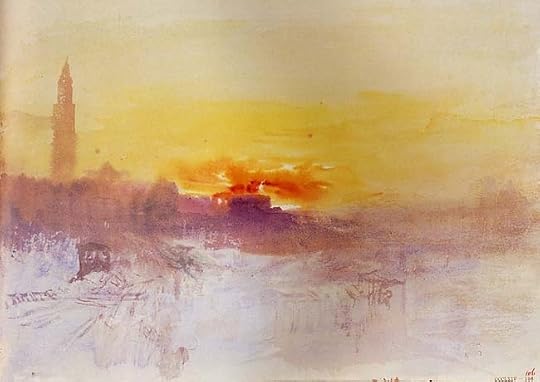

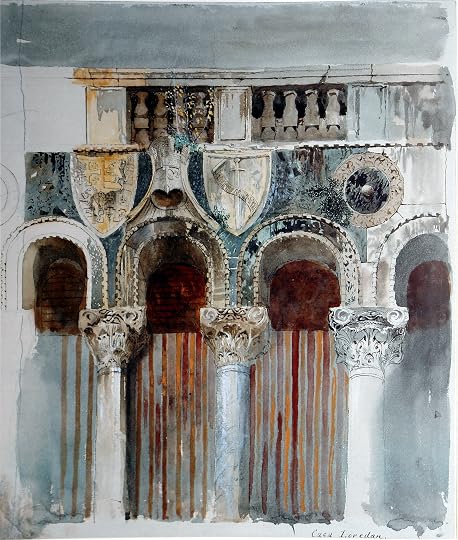
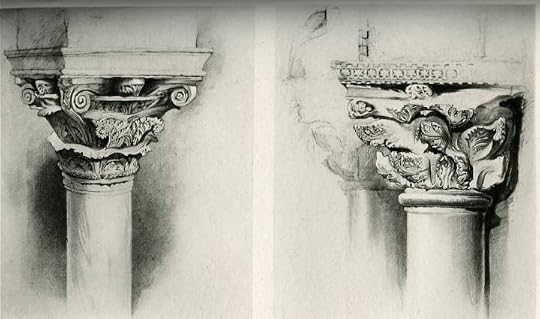


What a felicitous idea Sarah Quill has had preparing this book. She has taken the three volumes of John Ruskin’s Stones of Venice--close to half a million words of architectural descriptions of various Venetian façades--, has made a careful selection, and has accompanied each section with one of her luminous photographs. She has also included several of Ruskin’s drawings and organized the material along a chronological order.

John Ruskin visited Venice six times in his life and all in all he spent almost eighteen months there. His first visit was with his parents when he was just around sixteen years old in 1835. In his youth he was fashioning himself to become a poet and it was through the pen of a laureate poet that he felt the inspiration of the floating city. Byron’s writings opened Venice for him. Ruskin travelled once more in 1844, now without his parents, and by that time he had published already the first two volumes of the successful Modern Painters as well as his Seven Lamps of Architecture. The first one of these works, published in 1846, had as a primary purpose to defend Turner from his critics. Ruskin’s mental framework during his second visit had shifted then to the pictorial as it was illuminated by Turner’s art. This is clear in Ruskin’s own watercolours of the place. He has left us some exquisite sketches that capture the legendary glowing light of Venice and the effects of subtle colours and shades.


As Ruskin continued with subsequent periodic visits, by then with his unfortunate wife Effie during the years 1849-51, he began noticing the deterioration in some buildings. Not only the passage of time and the humid settings were eating away the stones, but the current political and economic conditions were near disastrous. Ever since Napoleon ended the independence of the Republic, the city-no-longer-a-state had also become the fighting area of the Austrians and the French. In 1849 when the Venetians tried to rebel against the Austrians, bombardments took place. And this was not all. The few renovations of the buildings undertaken by the Venetians were atrocious. Ruskin was expectedly horrified and his objective shifted. He became an archivist, a surveyor, and a historian. He wanted to preserve what time and carelessness could dissolve.

And he began a huge project that entailed a meticulous study of most of the buildings –the stones in Venice-- paying close and careful attention to the details. He set up scaffoldings so that he could draw from up close the ornaments and the minutiae, ordered casts from select pieces, and all in a relentless aim of preserving the architectural beauty of Venice.


As a testimony to a testimony, Quill has included parallel photographs of some of these stone beauties to show the deterioration that they have undergone in about 150 years, as predicted by Ruskin.

And from this determined and exhausting discipline the major work of the Stones resulted and published in a relatively short time, from 1851 to 1853.


With his precious Stones he has really left us a jewel, but for the plain aficionado they would be a demanding chore to study. I can just picture myself in a library reading through meticulous descriptions of façades wishing that I could be, instead, in a gondola enjoying the view of those marbles in all their presence reflecting the sun and the water and veiled with tinted air.


That is why Quill’s selection of Ruskin’s copious rendering in text of the architectural ornaments accompanied by her pristine photographs is so very welcome. Because even if one had the resources to be able to devote a few months navigating up and down the canals, looking for the sites described in Stones, some of these are not easy to reach with our eyes.

Quill has done that for us and served it on a tray of glossy paper.


Sarah Quill is a British photographer who has lived in and recorded the visual Venice for four decades. Her photographs are splendid, and even though she is offering us only a selection and even if Ruskin’s prose is elegant and his insights sharp, they add extraordinarily to Ruskin’s work.

Strong recommendation and I have just learnt that a new edition is coming out in 2014.


This is her website:

www.sarahquill.com
Profile Image for Linnea.
178 reviews4 followers
October 9, 2008
This is an abridged version of John Ruskin's _The Stones of Venice_, which I couldn't find a copy of before our trip. Quill has added current pictures of some of the buildings and art that Ruskin discusses (compared with his illustrations from the original book). It turned out to be a fantastic way to prepare for a trip to Venice--Ruskin's observations and categories are very helpful for opening one's eyes to the layers of history represented in Venice's buildings. I found myself noticing all sorts of details that I don't think I would have seen otherwise. Ruskin held strong and uncompromising positions on the widely varying (in his opinion) value of Byzantine, Gothic and Renaissance architecture, but I often found myself in agreement with him after seeing the work in its true setting.
191 reviews1 follower
January 6, 2016
Having been to Venice several times, and having in the past perused Ruskin's book, I knew I would enjoy this one. And I did. It was almost like walking around Venice again, but in the comfort of my cozy home. I recommend this book to anyone who plans a visit to Venice. You don't need to read every word: just look at the pictures and the captions and take your time. Ruskin loved the city, of course, and he was a fine draftsman. According to Sarah Quill, Ruskin sent home letters every day, filled with his sketches, rather than keep a journal. His sketches are all of architectural exteriors, so anyone can view these same things for herself.
Profile Image for ReviewingTheChapters.
97 reviews1 follower
October 26, 2026
Sarah Quill’s Ruskin’s Venice: The Stones Revisited examines the architectural and artistic heritage of Venice through the observations of John Ruskin. Drawing upon his The Stones of Venice, Quill brings together selections from his writings, original drawings, and her own photographs to illustrate the city’s development and the cultural influences that shaped its appearance.

What should not be taken for granted is the opportunity to compare Ruskin’s original drawings with Quill’s photographs of the same architectural features. These side-by-side illustrations demonstrate the precision of his observations while revealing changes since the nineteenth century. The deterioration of carved ornament, alterations to building surfaces, and loss of decorative color become readily apparent, as do the surviving details that connect his Venice with the city today.

Alan Windsor’s introductory essays provide historical context for Ruskin’s relationship with Venice, tracing his early fascination with the city and subsequent efforts to document its threatened buildings. His examination of Byzantine, Gothic, and Renaissance traditions also highlights Ruskin’s appreciation of craftsmanship and his belief that architecture reflects the artistic and social values of its time.

The book’s emphasis on preservation lends further significance to Ruskin’s concerns over neglect and insensitive restoration, many of which remain relevant today. Quill’s thoughtful arrangement makes his extensive writings more accessible while underscoring the importance of safeguarding Venice’s historical character. The result is an informative visual and literary study that carries forward Ruskin’s efforts to document a city he so deeply admired.
Profile Image for Arjen Taselaar.
132 reviews8 followers
August 9, 2024
This is a beautifully produced book. The text is an abridgment of John Ruskin’s ‘The Stones of Venice’, which was published in the 1850s. The book is meticulously illustrated with Sarah Quill’s photos and some of Ruskin’s drawings, all closely matching the text. The stones of Venice are mostly arches, columns, decoration and sculptures on Venice’s Byzantine, Gothic and Renaissance buildings. Ruskin loved San Marco and the Palazzo Ducale, and he hated the Renaissance (from which he does not distinguish Baroque). But the text is really about looking and carefully describing and analyzing what you see. Even when Ruskin’s hatred for the Venetian Renaissance sometimes borders on the ridiculous, he carefully explains why he doesn’t like it. Although I won’t forgive Ruskin for his ranting about San Giorgio Maggiore, which is really one of the most beautiful buildings on earth, I thoroughly enjoyed most of this book, which merits careful reading and looking.
Profile Image for Karen Watson.
Author 4 books6 followers
April 15, 2021
a beautiful re-telling of Ruskin's Venice with his stunning details drawings and gorgeous photos -- all in context of the present.
Profile Image for Alivia.
72 reviews14 followers
March 29, 2020
This is a lovely art book, perfect for the traveler (actual or armchair) who is interested in Italian architecture and particularly the watery city of Venice. Ruskin's excerpted prose is highly readable considering its age and contains many beautiful descriptive passages, especially those concerning color. The paper in this 2000 printing is thick and semi-glossy, with gorgeously printed color photographs and drawings (210 of them). The endpapers are color prints of marble mosaics representative of those found on older buildings in Venice, which Ruskin lavishes his praise on. Although he is contemptuous towards the Renaissance, he heaps compliments on the Byzantine and Gothic style "Palazzi," especially those buildings with incrusted marble and naturalistic carved foliage.
Profile Image for Ned.
292 reviews16 followers
March 28, 2008
nice picture book. great to have modern photos of many of these spots that Ruskin detailed.
Displaying 1 - 8 of 8 reviews