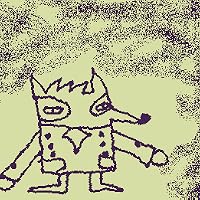
First edition of this spoof of natural history. Illustrated throughout. With the bookplate of Richard Wormser, former President of the International League of Antiquarian Booksellers and someone who enjoyed humor no doubt . xiv, ii , 92 pages. cloth, dust jacket. 8vo..
Eines der wenigen "komischen" Bücher, die ich als zertifizierter Humorloser mit 15 Jahren gelesen habe - und damals wie heute klasse fand. Das dünne Bändchen ist mir beim Stöbern in den ewigen zweiten Reihen wieder in die Hände gefallen und verdient es, demnächst nochmals gelesen zu werden (ich hatte schon befürchtet, dass es bei irgend einem Umzug auf der Strecke geblieben ist). Eine angemessene Review folgt hoffentlich in Bälde.
A very short, brilliant little book of para-natural history. Little in-jokes and clever nomenclature reward a formal zoological education, but the sheer imagination of the book is accessible to anyone. And the ending! I didn't expect to be blindsided by the epilogue to a fake scientific text, but it really hit me out of nowhere.
Marvellous tongue-in-cheek 'zoological' treatise on an impossible creature. Possibly best appreciated by those with previous exposure (pun intended) to scientific academic literature to get the depth & breadth of this fabrication. A wonderful parody.
1) Deutsche Rezension Manche dieser Naslinge klingen als wären sie Pokemon die zum Leben erwacht sind. Nicht nur wurden ihre Tränengänge Teil des Atmungssystems, oder andere gehen auf ihren Nasen, aber mehrere haben ihre Hinterbeine verloren und benutzen ihre Schwänze zum springen. Und trotz all jener Merkwürdigkeiten ist es faszinierend wie sehr der Autor es geschafft hat dies wie ein echtes Biologiebuch klingen zu lassen. Und das bedeutet schon etwas, denn z.B. Ein Exemplar bewegt sich auf der Nase wie eine Schnecke und eine andere Art benutzt Nasenschleim zum Fischen. Nicht dass es immer geklappt hat, denn obwohl ein aquatisches Säugetier welches seine Nase als Schnorchel benutzt plausibel ist, so sind manche andere hier doch so weit vom Bauplan eines Säugetieres entfernt, dass ich mich frage ob sie überhaupt existieren könnten oder wenn ja, ob man sie dann noch als Säugetiere klassifizieren könnte (z.B. Jene deren Körper zu 90% Nase sind). Daher sind auch Blumennachahmer welche auf ihren langen Schwänzen bis zum Tod stehen oder was pony-große Mammutnaslinge nicht das schrägste in diesem Buch. Und der Nasling welcher mit mindestens 20 Nasen Musik machen kann ist es auch nicht, nicht mal dass diese alle starben weil der Forscher eine Erkältung hatte. Es ist wohl die Tatsache, dass keine mehr gefunden wurden oder keiner was über sie weiß, weil ihre Inseln und alle Forscher einem Atomwaffentest zum Opfer fielen. Also, wenn man mal eine schräge Tour in die Pseudobiologie machen will, dann sollte man dieses Buch unbedingt lesen.
2) English Review Some of these noselings sound like they are Pokemon that have come to life. Not only have their tear ducts become part of the respiratory system or others are walking on their noses, but several have lost their hind legs and are using their tails to jump. And despite all those oddities, it is fascinating how much the author has managed to make it sound like a real biology book. And that means something, because e.g. one specimen moves like a snail on the nose and another type uses nasal mucus for fishing. Not that it always worked, because although an aquatic mammal that uses its nose as a snorkel is plausible, some others are so far from the blueprint of a mammal that I wonder if they could exist or if so, if one then can classify them as mammals (e.g. those whose bodies are 90% nose). Therefore, imitators of flowers which stand on their long tails until death or pony-sized mammoth noselings are not the weirdest in this book. And the noseling who can make music with at least 20 noses is not, not even that they all died because the researcher had a cold. It is probably the fact that none have been found or nobody knows anything about them because their islands and all researchers fell victim to a nuclear test. So, if you want to take a weird tour of pseudobiology, you should definitely read this book.
This book is an imaginative taxonomic treatise on the now lost mammalian order Rhinogrades which completely disappeared when a nuclear test destroyed the archipelago where these mammals were endemic. The book is intended as a critique on claims that selection by itself can completely explain evolution. Thus, using the fictitious, adaptive radiation of the Rhinogrades, the book summarizes descriptions of these small mammals including a discussion of phylogenetic relationships, physiology, reproduction, behavior, and ecology, as well as any controversy. The book opens with general information, followed by several chapters which describe the different groups. There are many imaginative illustrations of the animals in the wild, as well as a few illustrations of internal anatomy. The book closes with an epilogue describing how this portion of information has survived, what has been lost, and an extensive bibliography. This book will delight taxonomists and students of zoology. Enjoy.
I love these weird nonfiction/academic looking fictions. Hats off to the translators as well!! (And to the librarian who displayed this on the “how about one more book?” shelf at the local library.)
“The Snouters” is a short, monograph-length work on a strange and fictitious species, and its various subspecies. How to describe these critters in a sentence or two? They rely on cauda to locomote and to prop themselves up, and also have star-nosed mole style papillae on the ends of their oddly phallic noses. In the plainest terms, they use their tails to move around and the little mini penile things on the ends of their penis-looking noses to both lure food to them and to eat it. Some of the snouters—officially Rhinogrades—live fairly benignant lives somewhere in the lower-middle rungs of the food chain. Others of them are predacious, territorial, and vicious. The work is definitely a considerable feat of imagination. It takes not just a lot of creativity to pull something like this off, but a lot of knowledge about the morphology of real animals. The people at the Natural History Press did their due diligence here, ensuring that form follows function, and they’ve even taxonomized this creature under the old Linnean, pre-cladal system. The illustrations are also striking, and impressive. They remind me of the simultaneously disturbing and oddly cute creations of the old comic book artist Basil Wolverton, whose grotesqueries would go on to greatly influence the next generation of artists during the “comix” era. Still, the book also has its considerable demerits. Too much of it is taken up with the aforementioned taxonomy, with hardly any faux field study reports to match the kinds of details one could determine in a lab setting. According to what backstory is provided here, the rhinogrades lived among indigenous tribes in a mostly unexplored series of archipelagos near Bikini Atoll. Contact with Western explorers—and the viruses they brought with them—wreaked havoc on the immune systems of the locals. Then a series of atomic bomb tests wiped out all the snouters and their entire ecological niche. It's a cool story, and a quick and convenient way to explain why no snouters exist into the present, for those of a literal bent of mind not wanting to play along with the monograph’s central imaginative conceit. But considering how cool this idea is, why was it only given a couple paragraphs’ worth of short shrift in an afterword, rather than being integrated into the main text? Could not some Margaret Meade-style faux anthropology have been mixed in to complement the cool Darwinian stuff about this unspoiled Tierra Del Fuego style series of islands? Including and incorporating the material treated in the afterword—and expanding on it in the main text—would have added some narrative heft to the proceedings. As it stands, the images and not the text end up making the lasting impression. Despite its fiercely original approach to what’s ultimately science fiction, it feels like a wasted opportunity, or rather a great idea only half-developed.
If you’re a biologist, anatomist or someone with a penchant for the curious corners of natural history, The Snouters is a delightful oddity that deserves a spot on your public book shelf. This book is a whimsical deep-dive into the fictional world of the Rhinogrades—a group of imaginary mammals so vividly described, you might find yourself wondering why you didn’t encounter them in your zoology classes!
The anatomical details Stümpke weaves are overflowing with cleverness and subtle satire, making this book especially amusing for those with a scientific background. Still, its charm extends beyond specialists; any scientist or science lover will find it an irresistible conversation starter.
Perhaps the most poignant aspect is the fate of the Snouters and the mysterious island they inhabited which anchors the playful premise with real emotional weight.
While reading, I found myself inspired to tinker with some speculative non-fiction of my own and I'm actively seeking out more of the genre. The Snouters has certainly provided a unique spark and fodder for discussion among colleagues and friends.
Це чудесна книга сама по собі та відмінний зразок наукового гумору. Серйозним тоном тут описується розмаїття тваринок, які населяють далекий архіпелаг. Звичайні собі землерийки, якби не їхні... носи. На них вони - "носохідки" - ходять, ними ж ловлять здобич, та навіть літають! Де сміятись? Ця книга з особливого гумору, що випробовує вашу довірливість. Хто хоч раз попадався на першоквітневі жарти чи пародійні новини, знає як це - ходити по межі між "вірю - не вірю" та зійти з неї хоч на міліметр. А тут така ціла книга від першого й до останнього абзацу. З такою любов'ю описано їхні різновиди й поведінку, що починаєш хотіти аби носохідки справді десь ходили. Чи літали. Чи плавали. На носах, звичайно ж. Тут навіть Борхес із його "Книгою вигаданих істот" пасе задніх, бо якусь Свиню з ланцями чи Триногого віслюка ми навряд чи хотіли б зустріти. На відміну від пухнастих, милих носохідок. І, між іншим, їх таки знаходять. Опудала носохідок можна побачити в деяких музеях як жарти. Хоча хто їх знає...
In the kid realm again, and I must give a shout-out to Link Plus library service off the top. One of my kids wanted to track this down, so we got it.
I read it, and while it's not necessarily Greek to me, it was pretty Latin. Fitting that a dead language drive the jokes here for an imaginary and extinct species. And yes, there is actually a double exchange going on here as I read the English translation of the German original. So maybe some of the humor (I believe this was meant as a lark) is lost upon me.
The steadfast commitment to the educational tone may produce more laughs in the combo comedy club/library where you dwell. There are pictures, and I definitely like encouraging my son into the realm of speculative and/or xeno biology.
Hey Salvador Dali had a pretty productive rhinocentric phase as well, but here the shrew-ish creatures (well they can get quite big too) often seem like a nasal take on gastropods.
Ik vind het ontzettend tof om een voor mij compleet nieuw genre te hebben ontdekt (wetenschappelijk fantasy, who knew). Ik ben echter totaal niet wetenschappelijk aangelegd en bepaalde biologische en pseudo-biologische termen waren voor mij daarom echt te ingewikkeld. Was dus wel echt de moeite waard, maar ik zat er zelf gewoon niet lekker in.