Jump to ratings and reviews
Rate this book

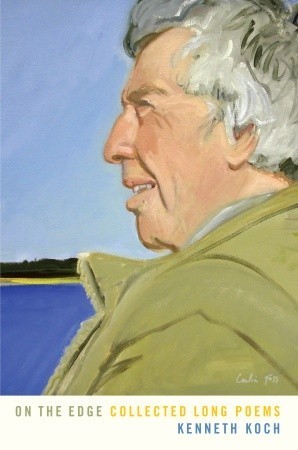
On the Edge: Collected Long Poems

Rate this book
On the Edge is a collection of the six longer masterpieces by one of the most beloved and accomplished poets of our time.

Full of exclamation and exaggeration but also graced with dry wit and comic sophistication, these poems contain some of Kenneth Koch’s most original work. When the Sun Tries to Go On is a young man’s radical song of himself and his freshly discovered and expanding universe. Ko, or A Season on Earth is an epic invention filled with such memorably powerful characters as a rookie baseball star whose pitches knock down grandstands, and Joseph Dah, whose poems transform him into whatever he writes about. In The Duplications Koch’s inventions expand into Ovidian twists as Commander Papend builds a life-sized replica of Venice in Peru and a chemist discovers a way to make young women out of the soil of Finland. In the elegiac Seasons on Earth and in two meditative autobiographical sequences, Impressions of Africa and On the Edge , Koch’s protean expressions of emotion make obvious his genius for evoking the mystery and excitement of the fact of existence and the passage of time.

Distinctly and irrepressibly Koch throughout, these works heighten our appreciation of his achievement. On the Edge is the perfect companion volume to the critically acclaimed Collected Poems of Kenneth Koch, about which John Ashbery, in Publishers Weekly, said, “The products of a lifetime are on display in this awe-inspiring banquet of a book.”

432 pages, Hardcover

First published March 4, 1986

2 people are currently reading
49 people want to read

About the author

Kenneth Koch

110 books88 followers
Kenneth Koch is most often recognized as one of the four most prominent poets of the 1950s-1960s poetic movement "the New York School of Poetry" along with Frank O'Hara, John Ashbery and James Schuyler. The New York School adopted the avant-garde movement in a style often called the "new" avant-garde, drawing on Abstract Expressionism, French surrealism and stream-of-consciousness writing in the attempt to create a fresh genre free from cliché. In his anthology The New York Poets, Mark Ford writes, "In their reaction against the serious, ironic, ostentatiously well-made lyric that dominated the post-war poetry scene, they turned to the work of an eclectic range of literary iconoclasts, eccentrics and experimenters."

Fiercely anti-academic and anti-establishment, Koch's attitude and aesthetic were dubbed by John Ashbery his "missionary zeal." Ford calls him "the New York School poet most ready to engage in polemic with the poetic establishment, and the one most determined to promote the work of himself and his friends to a wider audience." Koch died of leukemia at age 77, leaving a legacy of numerous anthologies of both short and long poems, avant-garde plays and short stories, in addition to nonfiction works dealing with aesthetics and teaching poetry to children and senior citizens.

Ratings & Reviews

What do you think?
Rate this book

Friends & Following

Create a free account to discover what your friends think of this book!

Community Reviews

5 stars
18 (56%)
4 stars
8 (25%)
3 stars
3 (9%)
2 stars
3 (9%)
1 star
0 (0%)
Displaying 1 - 6 of 6 reviews
Profile Image for Eddie Watkins.
Author 48 books5,558 followers
September 29, 2014
You'll never catch me saying a poem is the greatest poem I've ever read but goddamn if The Duplications isn't the funniest, most entertaining, and life affirming poem I've ever read. Koch squeezed all the inventiveness out of Roussel, hypercharged each word of it with juice and sunshine, and whipped it into a near-hallucinatory clarity and instant accessibility Roussel only dreamed of, and without that chilling a-human void at its core (not that I have a gripe with chilling a-human voids). After reading 20 - 30 pages I'm so keyed up with positivity and humor and surging juices that when I dip back into Mishima I can't read even Runaway Horses without construing it as a comedy. Even gut-spilling Mishima is a laugh riot after Koch!

And Donald's doom was on him in two days...
A Chinese gentleman named Hu Ching Po
Was interested in living different ways
Spending the month on Crete, he wished to know
The black, the white, the intervening grays
Of all that happened there. Well, he was so
Surprised to see a duck walk up and speak
To him that he stared madly at its beak -

Or "bill" - men have a lot of names for noses:
"Schnozzola," "target," "ray-gun," and "proboscis";
And "implement for getting kicks from roses,"
Or "helpful, with the eyes, in winning Oscars,"
And "fresh air opens up what clothespin closes."
Whether by cows or beautiful young Toscas
Borne in the midst of face, it has the beauty
Of being both delicate and heavy-duty;

We breathe all day and then we breathe all night -
Sometimes, it's true, the mouth takes over for it,
But mainly it's the nose, when sun shines bright
Or when stars gleam, that does, like Little Dorrit,
More than it seems it ought to do. Our sight
Is veiled by lids, our hands in sleep lie forward
And do not touch, our ears the brain takes care of
By making dreams of sounds we're not aware of -

But nose, you go on breathing all night long!
What was I speaking of? Oh, Donald's bill.
Yes, well, an animal, chicken or King Kong,
Will have a different nose than humans will.
A nose which on a girl might look all wrong
Would on a hen be beautiful; yet still
We think our own of a superior grade.
Don's was two dots upon a bony blade.

When Hu Ching Po, astonished, saw the beak
Of Donald Duck, and heard him talk, he couldn't
Believe he'd not gone crazy. In a week
They had him out of surgery, a wooden
Brain inside his head, and in his cheek
A "thinking cathode," which would help him gooodn-
Ess knows get through life's ordinary duties.
But now to Mickey and his "You, too, Brutus:

Attitude toward Donald, for he found him
In Minnie's arms, with Minnie gently sighing!
"Minnie, goddamn, you've your two arms around him!
I see, cried Mick, "a duck will soon be dying!"
And, seizing a huge rock, began to pound him
(Poor Donald Duck) to death. "I'm not denying
I hugged him hard, but good Lord, Mickey, listen!"
He stopped; he saw her eyes with teardrops glisten.




There are 115 pages of such as this! Pure pleasure!
316 reviews8 followers
April 25, 2023
I had the late Kenneth Koch’s 1986 collection ON THE EDGE for some time without taking it off the shelf, even though Koch is a poet I regard as indispensable.. Yes, this is odd, but somehow it fits perfectly with the inexplicability and ambivalence that motivated Koch and generated the screwy celebration that is his signature.

This is a poe who can end one stanza with a line in which he goes downstairs “to the Colbert Bar, the ampersand of my nights and days” and open the next stanza, startlingly, with “A bird is its own balcony.”

Koch is ever alert to the variance of possibilities, as when he notes that a newspaper is “uninterestingly out of date.” And he may suddenly break into rhyme (and, just as suddenly, away from it, at “flamingo”) in this stanza:

If I set out in my pirogue
And you in yours, we’re quite the vogue
Floating up the river, yet we notice
Very, very, very little lettuce
Is being grown on either shore
And there’s no magic anymore,
At least none that we know of, on the river,
Which doesn’t change the strange way we feel, either,
At daybreak, when a gaggle of flamingo
Starts twisting us to the shore.

Miracle of miracles, Koch is a poet who can actually be fun to read., Remember that even in his arguably impenetrable 1965 book-length poem WHEN THE SUN TRIES TO GIO ON, he arrives at the memorable line: “The dirty jingling beautiful pajamas.” That’s one of the lines Larry Rivers understandably chose to illustrate for the Black Sparrow Press edition of that work.

I have to confess that I was lost a great deal of the time in this collection, although another reading (for instance, yours) might yield more light. I can hold on without connection longer with Koch than with other poets.
Profile Image for Peter Landau.
1,102 reviews75 followers
January 7, 2022
It seems right to read a New York School poet while slowly going through a book of essays on art that spends much time on that mid-century dominance of my birth city, which once filled me with irrational exuberance. I miss New York like waking from a dream in which you have something you always wanted only to find it wasn’t real. But the city has moved on and even my mother, who spent much of the last century in its concrete canyons, says it’s gone. New York is for the new and they can have it, even if I’m still tethered to its narcotic charms.
390 reviews5 followers
June 23, 2023
Disapointing

Koch is at his best in the shorter poems he is better known for. These long poems are really verse travelogues, and lack the easy humour and surprising turns of phrase of his best work. Every poem though has some fine moments.
Profile Image for Terry.
Author 17 books25 followers
March 9, 2008
The conversations within conversations are delightful in this book, enacting what really happens on the edge of reality. And this edge is portrayed as a consciousness, a quest for something more, something that will explain everything. The intensity of its lines keeps coming back in a buzzing swarm of impulses and sensory experiences that forms a limen complex enough to be interesting, direct enough to be clear.
Profile Image for Daniel.
108 reviews18 followers
February 15, 2016
I enjoy Koch's shorter poems, but did not like the poems in this collection (I was only able to finish one of them, and started the rest but abandoned them) because they are all mostly in rhyme, and I detest poetry that rhymes because it is a slave to form rather than content. Readers who don't mind rhyme will have a good chance of enjoying the book.
Displaying 1 - 6 of 6 reviews

Can't find what you're looking for?

Get help and learn more about the design.