

What do you think?

London Labour and the London Poor
London Labour and the London Poor originated in a series of newspaper articles written by the great journalist Henry Mayhew between 1849 and 1850. A dozen years later, it had grown into the fullest picture we have of labouring people in the world's greatest city in the nineteenth century: a four volume account of the hopes, customs, grievances and habits of the working-classes that allows them to tell their own stories. Combining practicality with compassion, Mayhew worked unencumbered by political theory and strove solely to report on the lives of the London poor, their occupations and trades. This selection shows how well he succeeded. From costermongers to ex-convicts, from chimney-sweeps to vagrants, the underprivileged of London are uniquely brought to life - their plight expressed through a startling blend of first person accounts, Mayhew's perceptions, and sharp statistics.
529 pages, Kindle Edition
First published January 1, 1851
About the author
Henry Mayhew
274 books36 followersHenry Mayhew (1812-1887) was an English social researcher, journalist, playwright and advocate of reform. He was one of the co-founders of the satirical and humorous magazine Punch in 1841. He is also known for his work as a social researcher, publishing an extensive series of newspaper articles in the Morning Chronicle that was later compiled into the book series London Labour and the London Poor (1851), a groundbreaking and influential survey of the city's poor.
Ratings & Reviews
Friends & Following
Create a free account to discover what your friends think of this book!
Community Reviews
Displaying 1 - 30 of 95 reviews

Read
December 31, 2020Oh my God I finally finished this book.
"By what special virtue of your own are you different from them? How comes it that you are well clothed and well fed, whilst so many go naked and hungry?...get down from your moral stilts and confess it honestly to yourself, that you are what you are by that inscrutable grace which decreed your birthplace to be a mansion or a cottage rather than a 'padding-ken...'"
"By what special virtue of your own are you different from them? How comes it that you are well clothed and well fed, whilst so many go naked and hungry?...get down from your moral stilts and confess it honestly to yourself, that you are what you are by that inscrutable grace which decreed your birthplace to be a mansion or a cottage rather than a 'padding-ken...'"

December 8, 2024
A fascinating, really interesting read. It's quite dense, a little dry in places, but overall, there are so many intriguing and insightful moments and real-life stories within this. I'd definitely recommend it to anybody interested in Victorian history.

June 16, 2015
This was interesting. The work doesn't have much of a central thesis, it just set out to holistically describe how a huge and diverse group of people lived. Mayhew decided to meticulously chronicle the professions and activities of people living in penury in 1840s London, and that's exactly what he did. But calling his work 'meticulous' just doesn't do it justice.
I've always thought of cities as these massive, churning processes that are completely beyond comprehension, but Mayhew wasn't having any of that. You think of an orphan in Victorian London selling dolls in the streets, and it's easy to just think of them as part of the fabric of the city, one fish in an endless sea; there are tons of orphans selling dolls in the streets, and that's just one dodge. You probably don't count them, work out how much money they spend and make, how much it contributes to the city's economy, how much capital you need to start in the business of selling dolls in the streets, detail where they eat and sleep, and lay out a distribution of which areas of the city are the best for street doll selling. And you probably wouldn't go on to find the two people in the entire city who make the eyes for those dolls, what colors they make, what kinds are most popular in London, the differences that set quality doll eyes apart, or why they don't export many doll eyes to the Americas (the climate isn't good for setting the wax they make the dolls out of, so they mostly import whole dolls). But Mayhew pulls at those threads until he unravels the whole tapestry. And then he unravels those threads. And then he finds the weavers who produced them and asks about how they shear their sheep and how much their looms cost. His relentless devotion to cataloging the small area of anthropology he's set aside for himself borders on psychotic. It's astonishing. This book also had the only account of a 19th century ride along that I've ever seen. He wanted to learn more about how thieves lived.
Still, this was written in the mid-1800s. It makes a point of disabusing the notion that the unfortunate were somehow deficient compared to the aristocracy, and that's good; it was definitely not widely accepted at the time. But sometimes it's uncomfortably anachronistic to the point of being outright racist or startlingly sexist. Still, as a chronicle of the struggles that the unprivileged went through around the dawn of industrialization, or even just a more detailed backdrop for your favorite Dickens novel, it's worth reading.
I've always thought of cities as these massive, churning processes that are completely beyond comprehension, but Mayhew wasn't having any of that. You think of an orphan in Victorian London selling dolls in the streets, and it's easy to just think of them as part of the fabric of the city, one fish in an endless sea; there are tons of orphans selling dolls in the streets, and that's just one dodge. You probably don't count them, work out how much money they spend and make, how much it contributes to the city's economy, how much capital you need to start in the business of selling dolls in the streets, detail where they eat and sleep, and lay out a distribution of which areas of the city are the best for street doll selling. And you probably wouldn't go on to find the two people in the entire city who make the eyes for those dolls, what colors they make, what kinds are most popular in London, the differences that set quality doll eyes apart, or why they don't export many doll eyes to the Americas (the climate isn't good for setting the wax they make the dolls out of, so they mostly import whole dolls). But Mayhew pulls at those threads until he unravels the whole tapestry. And then he unravels those threads. And then he finds the weavers who produced them and asks about how they shear their sheep and how much their looms cost. His relentless devotion to cataloging the small area of anthropology he's set aside for himself borders on psychotic. It's astonishing. This book also had the only account of a 19th century ride along that I've ever seen. He wanted to learn more about how thieves lived.
Still, this was written in the mid-1800s. It makes a point of disabusing the notion that the unfortunate were somehow deficient compared to the aristocracy, and that's good; it was definitely not widely accepted at the time. But sometimes it's uncomfortably anachronistic to the point of being outright racist or startlingly sexist. Still, as a chronicle of the struggles that the unprivileged went through around the dawn of industrialization, or even just a more detailed backdrop for your favorite Dickens novel, it's worth reading.

Currently Reading
May 10, 2024"I never yet beheld so much destitution borne with so much content. Verily the acted philosophy of the poor is a thing to make those who write and preach about it hide their heads."
I'm not sure if I'll ever finish this (I was reading the unabridged version in 3 volumes and the minutiae can get a bit much) but it is a truly fascinating book. There are so many well observed details and conversations directly from the people actually working the streets. Obviously these are filtered through Mayhew's own preconceptions and general tidying up, but compared to many others of the time he generally separates his moral pronouncements from his observations and lets us get the closest we can to how people lived. He's concerned deeply with practical economy and how people somehow make it - as a casual reader the specifics of exactly how much things cost can be a bit overwhelming but they're important details even on a human level, showing how tight things were and how every halfpenny was eked out to make ends meet. Even when you have to deal with his prejudices, his openness and commitment to observing in detail allow you to read against him - for example, he clearly has anti Irish prejudice along with many of his informants and yet he has to admire the community's commitment to helping each other and gives a long section to the words and home of a poor working Irish woman. His reform mindedness comes out as hostility to things like how costermongers entertain themselves (they need more High Minded Art) and yet he still gives a clear and directly observed account of a typical night out. He also directs attention to practical things like the high rate of interest they're charged for hiring a barrow and how there should be effort to fix it.
There's no other book like it. Unless you're really dedicated to the time period you'll probably want an abridgement or to dip in and out of the different sections that you're interested in, but if you have any interest in how people lived in London in the past it's invaluable and has so many fascinating details everywhere.
"Do I understand what behaving to your neighbour is?—In coorse I do. If a feller as lives next me wanted a basket of mine as I wasn’t using, why, he might have it; if I was working it though, I’d see him further! I can understand that all as lives in a court is neighbours; but as for policemen, they’re nothing to me, and I should like to pay ’em all off well. No; I never heerd about this here creation you speaks about. In coorse God Almighty made the world, and the poor bricklayers’ labourers built the houses arterwards—that’s my opinion;"
“I’ve got a good jacketing many a Sunday morning,” said one dealer, “for waking people up with crying mackerel, but I’ve said, ‘I must live while you sleep.’”
I'm not sure if I'll ever finish this (I was reading the unabridged version in 3 volumes and the minutiae can get a bit much) but it is a truly fascinating book. There are so many well observed details and conversations directly from the people actually working the streets. Obviously these are filtered through Mayhew's own preconceptions and general tidying up, but compared to many others of the time he generally separates his moral pronouncements from his observations and lets us get the closest we can to how people lived. He's concerned deeply with practical economy and how people somehow make it - as a casual reader the specifics of exactly how much things cost can be a bit overwhelming but they're important details even on a human level, showing how tight things were and how every halfpenny was eked out to make ends meet. Even when you have to deal with his prejudices, his openness and commitment to observing in detail allow you to read against him - for example, he clearly has anti Irish prejudice along with many of his informants and yet he has to admire the community's commitment to helping each other and gives a long section to the words and home of a poor working Irish woman. His reform mindedness comes out as hostility to things like how costermongers entertain themselves (they need more High Minded Art) and yet he still gives a clear and directly observed account of a typical night out. He also directs attention to practical things like the high rate of interest they're charged for hiring a barrow and how there should be effort to fix it.
There's no other book like it. Unless you're really dedicated to the time period you'll probably want an abridgement or to dip in and out of the different sections that you're interested in, but if you have any interest in how people lived in London in the past it's invaluable and has so many fascinating details everywhere.
"Do I understand what behaving to your neighbour is?—In coorse I do. If a feller as lives next me wanted a basket of mine as I wasn’t using, why, he might have it; if I was working it though, I’d see him further! I can understand that all as lives in a court is neighbours; but as for policemen, they’re nothing to me, and I should like to pay ’em all off well. No; I never heerd about this here creation you speaks about. In coorse God Almighty made the world, and the poor bricklayers’ labourers built the houses arterwards—that’s my opinion;"
“I’ve got a good jacketing many a Sunday morning,” said one dealer, “for waking people up with crying mackerel, but I’ve said, ‘I must live while you sleep.’”

March 28, 2024
Mayhew sets himself a mammoth task. He wants to capture and detail as much as possible of 19th century London exactly as he saw it. And he does just that. But his interest is not the palaces and pleasure gardens of the nobs nor yet the new-found wealth of England’s new business elite living in style in London’s best districts. Far from it.
Instead you get an in-depth look at the men women and children: where they live, how they live and it’s not by any means a pretty sight. He watches them day and night, sees where they make their living producing goods or selling them in the markets, taverns, on the street, door-to-door.
More than that he talks to them and has some tell their own stories for us to hear for ourselves how deep the poverty, how dirty and utterly miserable the conditions they have to endure. Others fare better and are on their way onward and upward into better trades, professions – a brighter life.
It’s a huge story and very well worth reading.
Instead you get an in-depth look at the men women and children: where they live, how they live and it’s not by any means a pretty sight. He watches them day and night, sees where they make their living producing goods or selling them in the markets, taverns, on the street, door-to-door.
More than that he talks to them and has some tell their own stories for us to hear for ourselves how deep the poverty, how dirty and utterly miserable the conditions they have to endure. Others fare better and are on their way onward and upward into better trades, professions – a brighter life.
It’s a huge story and very well worth reading.

April 7, 2011
London Labour and the London Poor began life in a newspaper around 1850 and went through several editions, culminating in four volumes. Mayhew sought to survey at first-hand the lives of the impoverished, and analyse the causes of their poverty. Modern popular editions like this one are selections from the larger work. The editors in this case have sought not merely to provide a 'colourful' selection of Mayhew's interviews with the poor, but to represent the breadth of his writings and concerns. Thus, this edition is rearranged and chaptered thematically, whilst the knowledgeable introduction explores Mayhew's life and the context of and reactions to his work.
Nonetheless, the voices of the poor bubble to the surface incessantly throughout the book, their sober testimonials often shocking. There is a good deal on the subculture of costermongers, but we also hear from the Jews, the Irish, street entertainers, labourers, thieves, cabinet-makers, scavengers, "pure-finders", etc. The longest chapter here, and perhaps the most trenchantly polemical, presents Mayhew's exhaustive account of the methods by which unscrupulous employers exploit the workers, who, desperate to earn a crust, are forced to collude in cruelly inventive systems that can only depress their own wages. (One reads of the shamelessly profiteering system for hiring ballast-heavers with astonishment that such practices could be legal.) There are also chapters on criminality, domestic life, culture, etc.
Mayhew's determined efforts to support his case with statistics suffer from a paucity of good data and unsophisticated methodology at the time; but with both this and his copious direct experience he still succeeds in undermining the glib arguments of contemporary economists that the poor had essentially made their own beds, and that their capitalist employers should not be expected to help. Mayhew is against charity and for the working man (indeed, he divides the poor into "deserving" and "undeserving"...), but insists that wages must not be artificially depressed by exploitation. (In the closing section of this edition he draws economists' attention to the unmentioned 600 million "steam men" introduced into the labour market by industrialisation.)
Mayhew lets the poor speak for themselves - in itself a great service to social history - and earnestly draws his arguments out of his discoveries. His analytical writing is clear and cogent, while his reportage, as for instance in describing the street markets, is often vibrant and vivid, and would not disgrace the pages of Dickens.
This 600-page edition's appendices are a bibliography of Mayhew's works, the full table of contents of the larger work, and an expansive list of his sources and authorities - though oddly, no index. There are also 16 illustrations and 4 maps. Though I'm not able to compare other editions, this one seems to me a satisfying, informative, diverse and persuasive selection from one of the classics of social history.
Nonetheless, the voices of the poor bubble to the surface incessantly throughout the book, their sober testimonials often shocking. There is a good deal on the subculture of costermongers, but we also hear from the Jews, the Irish, street entertainers, labourers, thieves, cabinet-makers, scavengers, "pure-finders", etc. The longest chapter here, and perhaps the most trenchantly polemical, presents Mayhew's exhaustive account of the methods by which unscrupulous employers exploit the workers, who, desperate to earn a crust, are forced to collude in cruelly inventive systems that can only depress their own wages. (One reads of the shamelessly profiteering system for hiring ballast-heavers with astonishment that such practices could be legal.) There are also chapters on criminality, domestic life, culture, etc.
Mayhew's determined efforts to support his case with statistics suffer from a paucity of good data and unsophisticated methodology at the time; but with both this and his copious direct experience he still succeeds in undermining the glib arguments of contemporary economists that the poor had essentially made their own beds, and that their capitalist employers should not be expected to help. Mayhew is against charity and for the working man (indeed, he divides the poor into "deserving" and "undeserving"...), but insists that wages must not be artificially depressed by exploitation. (In the closing section of this edition he draws economists' attention to the unmentioned 600 million "steam men" introduced into the labour market by industrialisation.)
Mayhew lets the poor speak for themselves - in itself a great service to social history - and earnestly draws his arguments out of his discoveries. His analytical writing is clear and cogent, while his reportage, as for instance in describing the street markets, is often vibrant and vivid, and would not disgrace the pages of Dickens.
This 600-page edition's appendices are a bibliography of Mayhew's works, the full table of contents of the larger work, and an expansive list of his sources and authorities - though oddly, no index. There are also 16 illustrations and 4 maps. Though I'm not able to compare other editions, this one seems to me a satisfying, informative, diverse and persuasive selection from one of the classics of social history.

December 16, 2023
Zu Henry Mayhews "Die armen von London" bin ich über die Fußnoten der "Geschichte des Alltags" gekommen. Es ist eine ungewöhnlich methodisch-moderne Analyse der Londoner Unterschichten in der ersten Hälfte des 19. Jahrhunderts von einem Autor, der in erster Linie Interviews mit Armend geführt hat und ein plastisches Panorama der Welt der Dreigroschenoper schreibt und hierbei scharfsinnig die Schwachpunkte der damaligen Sozialfürsorge aufzeigt. Besonders bedrückend ist insoweit die damals grassierende Kinderprostitution und die Probelematik der ungewollt Schwangeren.
Diese Ausgabe der Anderen Bibliothek ist eine Exzerpt des wohl deutlich über 1000 Seiten umfassenden Gesamtwerks, klug eingeführt durch W.H. Auden und lang genug, um ein umfassendes Panorama zu geben, ohne zu langweilen.
Diese Ausgabe der Anderen Bibliothek ist eine Exzerpt des wohl deutlich über 1000 Seiten umfassenden Gesamtwerks, klug eingeführt durch W.H. Auden und lang genug, um ein umfassendes Panorama zu geben, ohne zu langweilen.

July 13, 2021
Highly recommend this, very old, book. (It's in the public domain, so it's not hard to find - even for free). As a warning, before I go on, some of what Mayhew thinks of as "truth" is wrong. Mayhew was educated in the 1820s / 30s and there are some statements he make that are racist or sexist by today's standards that were just considered true at that time. However, there is no apparent malice in him toward anyone and his career was devoted to journalism about, and advocacy on behalf of the poor. You might just want to skip his introduction. With that said …
The work is extensive and very long. He examines the lives, cultures (and sub cultures), work lives, economic conditions, housing, diets and pastimes of the poor. A good portion of the book is devoted to interviews with people - men, women and children, craftspeople, manual laborors, dock workers, street vendors, "flower girls" (who sold flowers but were mostly prostitutes), immigrants, the unemployed and disabled, and many, many others. In short, he examines the lives of just about everyone who constituted the "London poor" in the Victorian era in great detail and with an (educated) economic and social overview.
It is a great look at a bleak period in history (for the history buffs), it provides a great deal of context if you like to read Victorian novels and it provides context for our own (Canadian and North American) history because most of the settlers in the 1800s (and before) came from this class of people - not from the gentry, aristocracy or nobility. It is also interesting from a 21st century current affairs perspective because many of the conditions that kept the poor in poverty in the Victorian era, have been allowed to sneak back (in new clothes) in the current economy - things, for example, like precarious, casual and 'on demand' labour as well as rules / regulations that heavily favour "job creators" and social attitudes that assumed that the poor were drunk/lazy and deserving of their fate.
All in all a fascinating collection - though it can be a bit dry in stretches, I'd advise taking it in smaller chunks.
The work is extensive and very long. He examines the lives, cultures (and sub cultures), work lives, economic conditions, housing, diets and pastimes of the poor. A good portion of the book is devoted to interviews with people - men, women and children, craftspeople, manual laborors, dock workers, street vendors, "flower girls" (who sold flowers but were mostly prostitutes), immigrants, the unemployed and disabled, and many, many others. In short, he examines the lives of just about everyone who constituted the "London poor" in the Victorian era in great detail and with an (educated) economic and social overview.
It is a great look at a bleak period in history (for the history buffs), it provides a great deal of context if you like to read Victorian novels and it provides context for our own (Canadian and North American) history because most of the settlers in the 1800s (and before) came from this class of people - not from the gentry, aristocracy or nobility. It is also interesting from a 21st century current affairs perspective because many of the conditions that kept the poor in poverty in the Victorian era, have been allowed to sneak back (in new clothes) in the current economy - things, for example, like precarious, casual and 'on demand' labour as well as rules / regulations that heavily favour "job creators" and social attitudes that assumed that the poor were drunk/lazy and deserving of their fate.
All in all a fascinating collection - though it can be a bit dry in stretches, I'd advise taking it in smaller chunks.
July 3, 2012
The reality of a Dickens novel. This book also inspired From Hell. It's a fascinating read with details about how Fleet Street people ("the poor") lived. This reads like a documentary rather than a narrative, but I love randomly opening it and delving into this world.

October 23, 2017
London Labour and the London Poor is Henry Mayhew’s classic investigation into the lives of nineteenth century street traders, who made their living making, finding and selling things on the streets of London.
My favourite parts of the book were portraits of individuals based on interviews. All of Mayhew’s subjects speak in their own voices. The eight year old cress seller, the clothing salesman describing his dodges, the penniless old woman nursing her dying husband, and the toshers finding lost items in London’s sewers - all are particularly memorable. The life of a mudlark, tearing bare feet open on hidden glass or nails hidden in the Thames mud, is truly haunting. Mayhew has a vivid style of writing which brings these people and their world alive. We visit late night street markets, vibrant with light and energy. There is a real drama in the various struggles to run businesses. Parts of the book made me think of a nineteenth century version of The Apprentice, though the consequences of getting fired were much more severe.
Other sections detail facts and figures of, for example, how much coal dust was collected by London’s dustmen each day. While these sections have the air of a Home Office report, they remain interesting
The book is less good when Mayhew comes between his readers and the people he writes about. Mayhew is good-hearted, but his interjections can betray a moralising religious tone, which I would say has not aged well. Mayhew struggles to accept that some of the people he encounters actually enjoy their lives, difficult, godless and rough though they seem to be to an educated, religiously conservative Victorian. As with most writing, it is best to show rather than tell. Mayhew does best when he shows, allowing us to draw our own conclusions. He is less good when he tells.
My favourite parts of the book were portraits of individuals based on interviews. All of Mayhew’s subjects speak in their own voices. The eight year old cress seller, the clothing salesman describing his dodges, the penniless old woman nursing her dying husband, and the toshers finding lost items in London’s sewers - all are particularly memorable. The life of a mudlark, tearing bare feet open on hidden glass or nails hidden in the Thames mud, is truly haunting. Mayhew has a vivid style of writing which brings these people and their world alive. We visit late night street markets, vibrant with light and energy. There is a real drama in the various struggles to run businesses. Parts of the book made me think of a nineteenth century version of The Apprentice, though the consequences of getting fired were much more severe.
Other sections detail facts and figures of, for example, how much coal dust was collected by London’s dustmen each day. While these sections have the air of a Home Office report, they remain interesting
The book is less good when Mayhew comes between his readers and the people he writes about. Mayhew is good-hearted, but his interjections can betray a moralising religious tone, which I would say has not aged well. Mayhew struggles to accept that some of the people he encounters actually enjoy their lives, difficult, godless and rough though they seem to be to an educated, religiously conservative Victorian. As with most writing, it is best to show rather than tell. Mayhew does best when he shows, allowing us to draw our own conclusions. He is less good when he tells.

November 1, 2020
I had to read this book for my uni course, otherwise I would almost certainly have never embarked upon such an endeavor.
I have to say, however, that while very dense with endless facts and figures, there are also some incredibly interesting first-hand accounts of London life in the Victorian era.
Mayhew's meticulously documented research goes hand-in-hand with Dickens' fictionalised depictions of how greatly the poor suffered, how hard children labored, and how difficult it was to rise above and recover from hardship.
I found the criminal accounts especially fascinating - seeing people flogged mercilessly or put to prison for years for a very minor theft.
There were definitely some passages that were uncomfortable to read due to old-fashioned prejuduces and stereotypes, but Mayhew seems to strive for a non-biased sort of journalism. I found it touching that he treated an entire population of people in the poorhouse to a roast dinner after witnessing their depravity.
I have to say, however, that while very dense with endless facts and figures, there are also some incredibly interesting first-hand accounts of London life in the Victorian era.
Mayhew's meticulously documented research goes hand-in-hand with Dickens' fictionalised depictions of how greatly the poor suffered, how hard children labored, and how difficult it was to rise above and recover from hardship.
I found the criminal accounts especially fascinating - seeing people flogged mercilessly or put to prison for years for a very minor theft.
There were definitely some passages that were uncomfortable to read due to old-fashioned prejuduces and stereotypes, but Mayhew seems to strive for a non-biased sort of journalism. I found it touching that he treated an entire population of people in the poorhouse to a roast dinner after witnessing their depravity.

April 25, 2013
Occasionally a bit laborious (no pun intended) to read, but many of the anecdotes - people who train dancing pigs, the reminiscences of burglars, those who wade thru sewers to find valuables - are fascinating. The fourth volume is largely written by others than Mayhew, and is a bit of a different book. This section is more concerned with judging those profiled rather than allowing them to speak for themselves.

June 11, 2022
A bit of a slog, but definitely worth the effort. What struck me while reading it is how much of Mayhew's analysis is still germane to the present-day. Zero-hour contracts and insecure work. Skilled labour and wages undercut by workers brought in from abroad or through the use of semi-skilled or unskilled workers. The deleterious effects of new technology. The lack of a proper welfare system for those whose luck or health has run out. Mayhew is no Marxist - his description of strikes as savage is testimony to that. But here he lays bare all the evils - child labour, excessive profits, low wages, insecure work, long hours - of the capitalist system unfettered. There are some who would like us to return to those times. And with workers' rights going in reverse, the cost of of living crisis, below inflation pay awards, the growth of food banks and zero hour contracts, we might get there sooner than we think.
I wouldn't say the book was an easy read. There are a lot of statistics and economic analysis. The best bits are when Mayhew is interviewing an individual worker and letting them talk in their own voice. And there are some fine descriptions of London street life and its culture. The former made me think of the Tony Parker; the latter Charles Dickens.
I wouldn't say the book was an easy read. There are a lot of statistics and economic analysis. The best bits are when Mayhew is interviewing an individual worker and letting them talk in their own voice. And there are some fine descriptions of London street life and its culture. The former made me think of the Tony Parker; the latter Charles Dickens.

June 12, 2016
đọc để biết Svetlana bị ảnh hưởng từ đâu.

December 27, 2025
Henry Mayhew's monumental multi-volume study of the myriad occupations of working class londoners from the mid-19th century is an essential resource for anyone who is researching the livelihoods of their ancestors. I have found it really useful in filling in the gaps in my research into my maternal forebears who, for several generations, worked as purveyors of cat's meat and horse flesh.
This selection of some of the most interesting parts of Mayhew's study is a really good introduction to his unrivaled portrait of the early Victorian underclass and is recommended for anyone wishing to gain an insight into the daily struggles of London's population nearly two centuries ago.
This selection of some of the most interesting parts of Mayhew's study is a really good introduction to his unrivaled portrait of the early Victorian underclass and is recommended for anyone wishing to gain an insight into the daily struggles of London's population nearly two centuries ago.
February 6, 2026
The development of London and how people lived in the city over time is one of my special interests, and so this was a fascinating read for me in terms of the subjects interviewed and the descriptions of the city. Beyond that, I thought it was also a genuinely impressive piece of writing/journalism. The lives of casual labourers are examined in a way that, to me, feels sympathetic without falling into patronising noble working class style tropes. The analysis of supply, demand, wages, and labour markets, and their impact on the conditions of labour is not something I’ve seen in any material written prior. There are obviously some attitudes present that reflect the time in which it was written, but when you consider that this was researched and written at around the same time as the great exhibition, the famine in Ireland, and predates Darwinism and its subsequent misapplication to justify social inequalities by multiple decades, I think this book is staggeringly ahead of its time.

September 2, 2026
"A class of people whose misery, ignorance, and vice, amidst all the immense wealth and great knowledge of 'the first city in the world', is, to say the very least, a national disgrace to us."

November 1, 2022
Surprisingly enjoyable and thoroughly interesting.
Although this 500-page version is abridged from the 3-volume original, there is a huge wealth of material here. I'm not sure why they chose to keep all of the many sections on costermongers but to leave out most of the sections on poultry and game vendors and the suchlike, but the accounts we do have are mostly very readable.
The first person accounts are well written, giving anonymous voice to London's poor and their hardships. The author's questions are silent but apparent, bracketed by his own clarifications and verifications - although Mayhew chooses not to let us know the source of his many quoted figures they often seem to be in line with what his informants tell us.
Some bits do feel a bit reparative. I don't suppose it matters much to us now how the difference in profit of baked potato vendors has worsened between the 1840s and 50s and the many quoted costs associated with each persons business. Sometimes a whole paragraph will be devoted to shillings and pence accounts, but these can of course be skipped over when they become tiresome.
Some of the author's beliefs are clearly well out of date now. The author tells us at the start about ethnological differences between they 'nomadic types' of street seller which he likens to hunter-gatherers with different genetic qualities to their social superiors. We are also told many of the poor are lazy (perhaps it was true) and the author is aghast at the lack of Christian adherence among the costermongers and has some judgements on the Irish and Jewish populations. All that considered, the author was clearly out to try and better the lives of the poor and his beliefs are those of his age. It is a good read and a valuable resource for anyone wanting to research life around the time of The Great Exhibition.
Although this 500-page version is abridged from the 3-volume original, there is a huge wealth of material here. I'm not sure why they chose to keep all of the many sections on costermongers but to leave out most of the sections on poultry and game vendors and the suchlike, but the accounts we do have are mostly very readable.
The first person accounts are well written, giving anonymous voice to London's poor and their hardships. The author's questions are silent but apparent, bracketed by his own clarifications and verifications - although Mayhew chooses not to let us know the source of his many quoted figures they often seem to be in line with what his informants tell us.
Some bits do feel a bit reparative. I don't suppose it matters much to us now how the difference in profit of baked potato vendors has worsened between the 1840s and 50s and the many quoted costs associated with each persons business. Sometimes a whole paragraph will be devoted to shillings and pence accounts, but these can of course be skipped over when they become tiresome.
Some of the author's beliefs are clearly well out of date now. The author tells us at the start about ethnological differences between they 'nomadic types' of street seller which he likens to hunter-gatherers with different genetic qualities to their social superiors. We are also told many of the poor are lazy (perhaps it was true) and the author is aghast at the lack of Christian adherence among the costermongers and has some judgements on the Irish and Jewish populations. All that considered, the author was clearly out to try and better the lives of the poor and his beliefs are those of his age. It is a good read and a valuable resource for anyone wanting to research life around the time of The Great Exhibition.
May 6, 2025
Henry Mayhew was racist, sexist, classist and anti-semitic. However, he was also a product of his time and his time and his social class and he does seem to have tried to counter some of these things in what he recorded. What's even more valuable - to a prospective writer and lovers of Victorian history - is his transcribed, literal interviews with people from all walks of life, his descriptions of their homes, their shops, their backstories - this makes the work an invaluable resource to writers looking for Victorian character backstories among the poor, as well as an authentic list of workers to populate your story with - i.e. if your character is taking a carriage through town, what kinds of people would they see on the street, what kinds of shops, which costermongers, what would they loo like, etc. If your character IS a costermonger, what kind of clothes would they wear, how would it vary by trade, and their success or failure on the street.
It is highly repetitive, which is why I gave it 4 stars. That makes sense, given the nature of the work - it was released in a serialized fashion. But it does make the listener roll their eyes periodically and increase the speed.
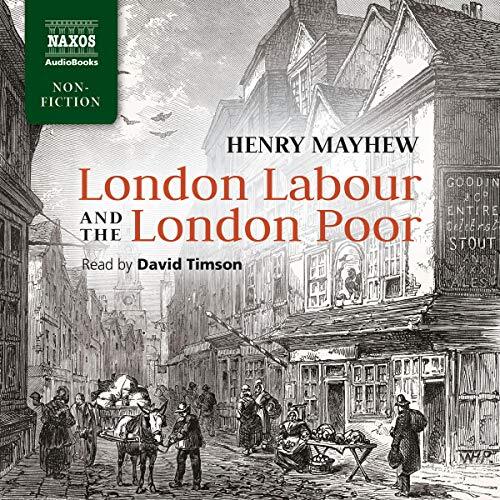
I listened to the Naxos Publishing edition, which is, of course, an abridgment. They explained their selection criteria and I think it's sound. If you need to see things they left out, you'd have to loo to the original.
Overall, if you want to write about the Victorian era, especially the 1850's and 1860's, and need character and descriptive ideas, this is your book. Likewise, if you just love Victorian History, this is also worth reading.
It is highly repetitive, which is why I gave it 4 stars. That makes sense, given the nature of the work - it was released in a serialized fashion. But it does make the listener roll their eyes periodically and increase the speed.
I listened to the Naxos Publishing edition, which is, of course, an abridgment. They explained their selection criteria and I think it's sound. If you need to see things they left out, you'd have to loo to the original.
Overall, if you want to write about the Victorian era, especially the 1850's and 1860's, and need character and descriptive ideas, this is your book. Likewise, if you just love Victorian History, this is also worth reading.

March 11, 2023
This was a book recommended to me by Roman Krznaric - probably at a time when he was preoccupied by empathy. It is a remarkable insight into the lives and livelihoods of the poor in London around the time of the Great Exhibition (1851). It is full of colour and biographical portraits of ways to earn a living: costermongers, pure (dog shit) gatherers, dock workers, carpenters, street sweepers, dog collar salesmen - dozens of trades and unskilled labourers. It is a work of journalism and gathering of statistics, but Mayhew also includes first-person accounts using the language and dialect of the poor, acted out in different accents by the narrator, David Timson, in this audiobook edition. It's notable that the same issues of low wages and poor working conditions are still common in today's society. However, thankfully, Mayhew's racism and prejudice are less common. It has a Dickensian feel: revelling in the dirt and squalor of life in the streets of London. Some of the images will stay with me. A fascinating insight into some trades that are now, thankfully, obsolete.

July 4, 2021
This one actually took me a few years to get all the way through. It’s over 27 hours and you can’t read a lot at once if you want to process what’s written. It was well worth it though, and not just for my research, which is why I picked it up. Mayhew’s interviews bring to life the kinds of people history generally overlooks. He records their speech verbatim with all its grammatical inconsistency and slang and if you listen to the audiobook, the narrator does a great job inhabiting the voices so that you feel someone is speaking to you from the past. There’s also some good social commentary, a lot of which is still relevant today.

December 14, 2021
Fascinating book and so well written. It is a great introduction (written contemporaneously) about the poor in Victorian London mid-19th C. It’s almost like he wrote a blog, certainly it’s investigative journalism. Full of rich anecdotes and cleverly divided by subject matter like exploring doss houses or the details of various types of street sellers trying to get by with enough to eat. I loved the chapter about penny photographers and their work. It tells so much about the times and of unchanging human nature.
A bit long and sometimes repetitive at times, especially for the average reader like me, but still a wonderful social history of that time and place.
A bit long and sometimes repetitive at times, especially for the average reader like me, but still a wonderful social history of that time and place.

December 1, 2018
Mayhew really was ahead of his time when he worked on this study. What Dickens did for the 19th century poor through his works of fiction, Mayhew did through the use of statistics and a novel (for the time) sociological approach.
The edition I read was rather plagued by repetition, especially in Chapter 4, but this was down to bad editing and no fault of the original author's.
Overall, a great read for anyone interested in how "real" people lived in days past.
The edition I read was rather plagued by repetition, especially in Chapter 4, but this was down to bad editing and no fault of the original author's.
Overall, a great read for anyone interested in how "real" people lived in days past.

August 17, 2021
Absolutely loved this one, right up my street. Listened on audiobook and found it all fascinating, the interviews, the background and even the statistics, just found it all really interesting. I suspect easier to listen to than read as it's very thorough, and conjoured all sorts of images of London's underbelly and the lives of the working (and struggling) poorer classes.

June 27, 2017
A quite extraordinary book - there's just so much (too much, for me) detail about wages, prices, diets, street games...it's full to bursting with information. And so many glaring similarities with today, too.

April 6, 2009
Who can resist a book that includes an essay "A Night at the Rat Pit?"

August 15, 2018
Informative, passionate, amazing. The amount of detail is astounding. Every interview reads like a short novel. Very much recommended!

September 30, 2019
Fascinating historical perspective

September 28, 2022
Amazing research and wonderfully told. Lives devastated by poverty, oppression, prejudice, ... Extensive data.

April 1, 2024
I was inspired to read this book based on fantasy author Neil Gaiman’s recommendation: “Like a big mad Dickens novel that just keeps going. Real life interviews with the Victorian working poor.” In a lecture he gave in Hartford, Connecticut on July 10, 2017, he discussed the fascinating information he keeps finding in London Labour and the London Poor (1851). I most remember Gaiman talking about citizens who earned a living by collecting dog feces! Indeed, Henry Mayhew’s work is the most in-depth examination of lives of common people of 19th century London that you can possibly find. I would argue it is essential reading for anyone writing about Victorian England. That London was the richest city in the richest nation in the world makes the material particularly tragic. The majority of citizens were just scraping by day to day. I am reminded of major cities in the United States nowadays, such as San Francisco: the nation’s richest people surrounded by homeless encampments. That such wealth can exist alongside such poverty is deeply disturbing; it’s also disturbing how history keeps repeating itself.
As Gaiman points out, London Labour and the London Poor is filled with interviews with the laboring poor. These appear most often as monologues, with each person telling the story of his or her life. I kept thinking about how these would make great actor monologues for auditions. Not only are they a wealth of information and human pathos, they are also a wonderful records of the many local accents and dialects of the era. Mayhew doesn’t stick just to individual interviews: he writes a great deal about economics. The book is a case study of how much misery capitalism can cause when it is unchecked by effective labor laws and trade unions. Admittedly, Mayhew was not the most rigorous social scientist or economist - there were many flaws in his methods and analysis of quantitative data. I strongly disagree with some of his views, particularly his judgements of certain groups of poor people - he was a man of his times. Even with these flaws, the book is a very good read.
**
Citation:
Mayhew, H. (2018). London Labour and the London Poor. Naxos Audiobooks. https://www.audible.com/pd/London-Lab... (Original work published 1851)
Title: London Labour and the London Poor: a cyclopaedia of the condition and earnings of those that will work, those that cannot work, and those that will not work. et al.
Author: Henry Mayhew
Year: 1851
Genre: Nonfiction - Journalism, social science, economics
Page count: 688 pages
Date(s) read: 3/22/24 - 4/1/24
Reading journal entry #72 in 2024
**
As Gaiman points out, London Labour and the London Poor is filled with interviews with the laboring poor. These appear most often as monologues, with each person telling the story of his or her life. I kept thinking about how these would make great actor monologues for auditions. Not only are they a wealth of information and human pathos, they are also a wonderful records of the many local accents and dialects of the era. Mayhew doesn’t stick just to individual interviews: he writes a great deal about economics. The book is a case study of how much misery capitalism can cause when it is unchecked by effective labor laws and trade unions. Admittedly, Mayhew was not the most rigorous social scientist or economist - there were many flaws in his methods and analysis of quantitative data. I strongly disagree with some of his views, particularly his judgements of certain groups of poor people - he was a man of his times. Even with these flaws, the book is a very good read.
**
Citation:
Mayhew, H. (2018). London Labour and the London Poor. Naxos Audiobooks. https://www.audible.com/pd/London-Lab... (Original work published 1851)
Title: London Labour and the London Poor: a cyclopaedia of the condition and earnings of those that will work, those that cannot work, and those that will not work. et al.
Author: Henry Mayhew
Year: 1851
Genre: Nonfiction - Journalism, social science, economics
Page count: 688 pages
Date(s) read: 3/22/24 - 4/1/24
Reading journal entry #72 in 2024
**
Displaying 1 - 30 of 95 reviews