

What do you think?
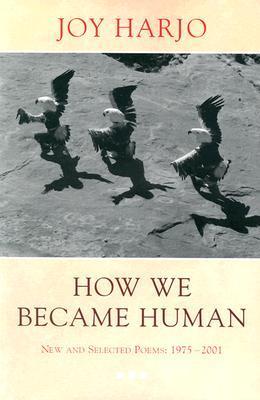
How We Became Human: New and Selected Poems 1975-2001
Over a quarter-century's work from the 2003 winner of the Arrell Gibson Award for Lifetime Achievement.
This collection gathers poems from throughout Joy Harjo's twenty-eight-year career, beginning in 1973 in the age marked by the takeover at Wounded Knee and the rejuvenation of indigenous cultures in the world through poetry and music. How We Became Human explores its title question in poems of sustaining grace.
This collection gathers poems from throughout Joy Harjo's twenty-eight-year career, beginning in 1973 in the age marked by the takeover at Wounded Knee and the rejuvenation of indigenous cultures in the world through poetry and music. How We Became Human explores its title question in poems of sustaining grace.
272 pages, Paperback
First published January 1, 2002
About the author
Joy Harjo
109 books2,073 followersBio Joy Harjo
Joy Harjo was born in Tulsa, Oklahoma and is a member of the Mvskoke Nation. She has released four award-winning CD's of original music and won a Native American Music Award (NAMMY) for Best Female Artist of the Year. She performs nationally and internationally solo and with her band, The Arrow Dynamics. She has appeared on HBO's Def Poetry Jam, in venues in every major U.S. city and internationally. Most recently she performed We Were There When Jazz Was Invented at the Chan Centre at UBC in Vancouver, BC, and appeared at the San Miguel Writer’s Conference in San Miguel de Allende, Mexico. Her one-woman show, Wings of Night Sky, Wings of Morning Light, which features guitarist Larry Mitchell premiered in Los Angeles in 2009, with recent performances at Joe’s Pub in New York City, LaJolla Playhouse as part of the Native Voices at the Autry, and the University of British Columbia. Her seven books of poetry include such well-known titles as How We Became Human- New and Selected Poems and She Had Some Horses. Her awards include the New Mexico Governor’s Award for Excellence in the Arts, the Lifetime Achievement Award from the Native Writers Circle of the Americas, and the William Carlos Williams Award from the Poetry Society of America. She was recently awarded 2011 Artist of the Year from the Mvskoke Women’s Leadership Initiative, and a Rasmuson US Artists Fellowship. She is a founding board member and treasurer of the Native Arts and Cultures Foundation. Harjo writes a column Comings and Goings for her tribal newspaper, the Muscogee Nation News. Soul Talk, Song Language, Conversations with Joy Harjo was recently released from Wesleyan University Press. Crazy Brave, a memoir is her newest publication from W.W. Norton, and a new album of music is being produced by the drummer/producer Barrett Martin. She is at work on a new shows: We Were There When Jazz Was Invented, a musical story that proves southeastern indigenous tribes were part of the origins of American music. She lives in the Mvskoke Nation of Oklahoma.
Joy Harjo was born in Tulsa, Oklahoma and is a member of the Mvskoke Nation. She has released four award-winning CD's of original music and won a Native American Music Award (NAMMY) for Best Female Artist of the Year. She performs nationally and internationally solo and with her band, The Arrow Dynamics. She has appeared on HBO's Def Poetry Jam, in venues in every major U.S. city and internationally. Most recently she performed We Were There When Jazz Was Invented at the Chan Centre at UBC in Vancouver, BC, and appeared at the San Miguel Writer’s Conference in San Miguel de Allende, Mexico. Her one-woman show, Wings of Night Sky, Wings of Morning Light, which features guitarist Larry Mitchell premiered in Los Angeles in 2009, with recent performances at Joe’s Pub in New York City, LaJolla Playhouse as part of the Native Voices at the Autry, and the University of British Columbia. Her seven books of poetry include such well-known titles as How We Became Human- New and Selected Poems and She Had Some Horses. Her awards include the New Mexico Governor’s Award for Excellence in the Arts, the Lifetime Achievement Award from the Native Writers Circle of the Americas, and the William Carlos Williams Award from the Poetry Society of America. She was recently awarded 2011 Artist of the Year from the Mvskoke Women’s Leadership Initiative, and a Rasmuson US Artists Fellowship. She is a founding board member and treasurer of the Native Arts and Cultures Foundation. Harjo writes a column Comings and Goings for her tribal newspaper, the Muscogee Nation News. Soul Talk, Song Language, Conversations with Joy Harjo was recently released from Wesleyan University Press. Crazy Brave, a memoir is her newest publication from W.W. Norton, and a new album of music is being produced by the drummer/producer Barrett Martin. She is at work on a new shows: We Were There When Jazz Was Invented, a musical story that proves southeastern indigenous tribes were part of the origins of American music. She lives in the Mvskoke Nation of Oklahoma.
Ratings & Reviews
Friends & Following
Create a free account to discover what your friends think of this book!
Community Reviews
Displaying 1 - 30 of 133 reviews

August 4, 2023
I do not know your language though I hear the breaking of waves through the vowels.
A Muscogee writer from Oklahoma, Joy Harjo was US Poet Laureate from 2019–2022. She's been writing consistently since the 1970s, but I'd somehow never heard of her; although, now I come to think of it, I think I have seen her memoir Crazy Brave in a few bookshops over the years. Probably she's more widely read as a memoirist than a poet, but then no one really reads poetry nowadays.
This collection draws on her first seven volumes of poetry, and adds a few new ones too. It's a collection infused with an awareness of the natural world, full of striking word choices, mythical allusions, and a sense of deeper meaning to everything she describes.
A self-consciously Indian poet, Harjo often draws on Native American beliefs and religion, and is always alert to the symbolic significance in nature: crows, ghost crabs, the wind in the grass, the sun on the horizon. Not infrequently, she refers directly to the history of her people:
Much of her verse shows an effort to get away from traditional Western forms of poetry, and find something new, closer to the rhythms of tribal chants and storytelling. Towards the end of the 80s she began experimenting with poems in prose, a form which in her hands I found especially rewarding:
Her poems range across the length of the United States, from Alaska to Hawaii, Chicago to New Mexico, Washington to LA. Wherever she goes she finds traces of ‘native’ feelings and stories, and presents an attitude that is wry, rather than bitter, towards current geopolitics – ‘this land of nightmares which is also the land of miracles’. I found her writing gentle, surprising, and often very beautiful.
A Muscogee writer from Oklahoma, Joy Harjo was US Poet Laureate from 2019–2022. She's been writing consistently since the 1970s, but I'd somehow never heard of her; although, now I come to think of it, I think I have seen her memoir Crazy Brave in a few bookshops over the years. Probably she's more widely read as a memoirist than a poet, but then no one really reads poetry nowadays.
This collection draws on her first seven volumes of poetry, and adds a few new ones too. It's a collection infused with an awareness of the natural world, full of striking word choices, mythical allusions, and a sense of deeper meaning to everything she describes.
A self-consciously Indian poet, Harjo often draws on Native American beliefs and religion, and is always alert to the symbolic significance in nature: crows, ghost crabs, the wind in the grass, the sun on the horizon. Not infrequently, she refers directly to the history of her people:
My family still has the iron cooking pot that was traded to us
when treaties were forced with blood. Those who signed were killed.
Now I have a gas range and there is no end to the war.
Much of her verse shows an effort to get away from traditional Western forms of poetry, and find something new, closer to the rhythms of tribal chants and storytelling. Towards the end of the 80s she began experimenting with poems in prose, a form which in her hands I found especially rewarding:
INVISIBLE FISH
Invisible fish swim this ghost ocean now described by waves of sand, by water-worn rock. Soon the fish will learn to walk. Then humans will come ashore and paint dreams on the drying stone. Then later, much later, the ocean floor will be punctuated by pickup trucks, carrying the dreamers' descendants, who are going to the store.
Her poems range across the length of the United States, from Alaska to Hawaii, Chicago to New Mexico, Washington to LA. Wherever she goes she finds traces of ‘native’ feelings and stories, and presents an attitude that is wry, rather than bitter, towards current geopolitics – ‘this land of nightmares which is also the land of miracles’. I found her writing gentle, surprising, and often very beautiful.
I AM NOT READY TO DIE YET
My death peers at the world through a plumeria tree
And the tree look out over the neighbor's house to the Pacific
And the blue water god commands this part of the world
Without question, rules from the kingdom of secrets
And tremendous fishes. I was once given to the water.
My ashes will return there,
But I am not ready to die yet
Nor am I ready to leave the room
In which we made love last night.
This morning I carry the desire to live, inside my thigh
It pulses there: a banyan, a mynah bird, or a young impatient wind
Until I am ready to fly again, over the pungent flowers
Over the sawing and drilling workmen making a mess
In the yard next door, over water
And the memory of your shoulders
In candlelight.
It is endless, this map of eternity, like a watermonster
Who swallows everything whole including the bones
And all the terrible words and how it blooms
With delectable mangoes, bananas
With the most faithful of planets,
But I am not ready to die yet.
And when it happens, as it certainly will, the lights
Will go on in the city and the city will go on shining
At the edge of the water—it is endless, this map
And the waves of longing from the kingdom of suffering
Will linger in the room in which we made love last night—
When I am ready to die I will know it,
As surely as I know your gaze
As we undressed close to the gods in that room.
There will be flowers, there are always flowers,
And a fine blessing rain will fall through the net of the clouds
Bearing offerings to the stones, to all who linger
Here—It will be a day like any other.
Someone will be hammering
Someone frying fish
The workmen will go home
To eat poi, pork, and rice.

February 27, 2023
As I was finishing this collection, my repeated thought was, "I lament all that I still do not know."
I consider myself a bad poetry reader (in that it often feels hard for me, like I am not understanding things). I am glad I was concurrently reading Black Elk Speaks: Being the Life Story of a Holy Man of the Oglala Sioux and Columbus and Other Cannibals: The Wétiko Disease of Exploitation, Imperialism, and Terrorism, both of which gave me added context for reading this poetry. Plus, at the end, Harjo has some fairly extensive notes that give further background for various poems. (Wish I had found the notes section prior to finishing the poems.)
From Harjo's poem "Emergence":
I consider myself a bad poetry reader (in that it often feels hard for me, like I am not understanding things). I am glad I was concurrently reading Black Elk Speaks: Being the Life Story of a Holy Man of the Oglala Sioux and Columbus and Other Cannibals: The Wétiko Disease of Exploitation, Imperialism, and Terrorism, both of which gave me added context for reading this poetry. Plus, at the end, Harjo has some fairly extensive notes that give further background for various poems. (Wish I had found the notes section prior to finishing the poems.)
From Harjo's poem "Emergence":
I remember when there was no urge
to cut the land or each other into pieces,
when we knew how to think
in beautiful.

September 27, 2019
I read this in preparation for my third annual Poetry Advent, which I'm sure Lauren will be happy to hear I have been preparing for since January.
These poems are magical, slightly transcendent yet grounding. Reading them on a Sunday morning at a coffee shop on a rainy day is a /mood/ that should be repeatedly twice a month for your spiritual health.
But because I am basic, some poems did get a little far out for me to wrap my head around. And so I'm very grateful for the notes on the poems printed in the back, which were often as touching and beautiful as the poems themselves.
These poems are magical, slightly transcendent yet grounding. Reading them on a Sunday morning at a coffee shop on a rainy day is a /mood/ that should be repeatedly twice a month for your spiritual health.
But because I am basic, some poems did get a little far out for me to wrap my head around. And so I'm very grateful for the notes on the poems printed in the back, which were often as touching and beautiful as the poems themselves.

February 26, 2021
"The power of the victim is a power that will always be reckoned with, one way or the other."
-- Joy Harjo, The Flood
Exposure to many works of poetry was intentionally selective. We cannot fathom the unimaginable universe of authors and poets who were ignored, downplayed, or buried before birth.
Since Joy Harjo was appointed as the first Native American to hold the honor of United States Poet Laureate in June 2019, I wanted to taste the art of her life's experiences, and culture through poetry. Her poetry is a beautifully woven tapestry of life experiences and historical events which is evident through her display of love and respect for Mother Earth, the paths of tears, and pain the injustices and hatred Native Americans faced in the climate of prejudice. Native Americans were also treated inhumanely in their search for justice, amid terrible human rights abuses, greed, and oppression so many tribal cultures faced.
Her notes at the end of the book explain the impetus behind her poetry. Joy illustrates the chorus that outlines how Native Americans were also singled out, searched, detained, and questioned. I couldn't pick out which poem I liked above the others, even though these were selected poems from 1975-2001. Excerpts from the one below, however, resonates profoundly.
Rain opens us, like flowers, or earth that has been thirsty for more than a season.
We stop all of our talking, quit thinking, or blowing sax to drink the mystery.
We listen to the breathing beneath our breathing.
This is how the rain became rain, how we became human.
--Joy Harjo, excerpts from the poem "It's Raining in Honolulu"
Some people may find difficulty in understanding Harjo's poetry because it abandons the strict metrics and patterns of European form. If you're looking for greater poetic cultural awareness through the art of words, check out this book with an open mind and a voracious appetite. There were so many takeaways from this book and one that I truly enjoyed exploring.
This is a good-read of poetry I highly recommend.
-- Joy Harjo, The Flood
Exposure to many works of poetry was intentionally selective. We cannot fathom the unimaginable universe of authors and poets who were ignored, downplayed, or buried before birth.
Since Joy Harjo was appointed as the first Native American to hold the honor of United States Poet Laureate in June 2019, I wanted to taste the art of her life's experiences, and culture through poetry. Her poetry is a beautifully woven tapestry of life experiences and historical events which is evident through her display of love and respect for Mother Earth, the paths of tears, and pain the injustices and hatred Native Americans faced in the climate of prejudice. Native Americans were also treated inhumanely in their search for justice, amid terrible human rights abuses, greed, and oppression so many tribal cultures faced.
Her notes at the end of the book explain the impetus behind her poetry. Joy illustrates the chorus that outlines how Native Americans were also singled out, searched, detained, and questioned. I couldn't pick out which poem I liked above the others, even though these were selected poems from 1975-2001. Excerpts from the one below, however, resonates profoundly.
Rain opens us, like flowers, or earth that has been thirsty for more than a season.
We stop all of our talking, quit thinking, or blowing sax to drink the mystery.
We listen to the breathing beneath our breathing.
This is how the rain became rain, how we became human.
--Joy Harjo, excerpts from the poem "It's Raining in Honolulu"
Some people may find difficulty in understanding Harjo's poetry because it abandons the strict metrics and patterns of European form. If you're looking for greater poetic cultural awareness through the art of words, check out this book with an open mind and a voracious appetite. There were so many takeaways from this book and one that I truly enjoyed exploring.
This is a good-read of poetry I highly recommend.

November 4, 2019
I was not familiar with Joy Harjo until I stumbled on this poetry collection, and I'm so glad I did.
It's a contemporary account of modern-day plagues (drifting, purposelessness, loneliness) but also timeless joys and meaningful coming-into-an-insight moments, fleeting community touches, and Native-American lore (such as The-Woman-in-the-Sky, original names for landmarks known to us by their USA government name, references to battles and significant events, etc.).
I also loved her introduction about coming into poetry and the people who inspired her along the way, from her aunt and grandmother artists to other poets she met later. It feels raw and carries the same mix of hopelessness and hope that the poetry itself carries.
---------------------------------------------------------------
One of my favorites:
I AM A DANGEROUS WOMAN
The sharp ridges of clear blue windows
motion to me
from the airport’s second floor.
Edges dance in the foothills of the Sandias
behind security guards
who wave me into their guncatcher machine.
I am a dangerous woman.
When the machine buzzes they say
to take off my belt,
and I remove it so easy
that it catches the glance
of a man standing nearby.
(Maybe that is the deadly weapon
that has the machine singing.)
I am a dangerous woman,
but the weapon is not visible.
Security will never find it.
They can’t hear the clicking
of the gun inside my head.
It's a contemporary account of modern-day plagues (drifting, purposelessness, loneliness) but also timeless joys and meaningful coming-into-an-insight moments, fleeting community touches, and Native-American lore (such as The-Woman-in-the-Sky, original names for landmarks known to us by their USA government name, references to battles and significant events, etc.).
I also loved her introduction about coming into poetry and the people who inspired her along the way, from her aunt and grandmother artists to other poets she met later. It feels raw and carries the same mix of hopelessness and hope that the poetry itself carries.
---------------------------------------------------------------
One of my favorites:
I AM A DANGEROUS WOMAN
The sharp ridges of clear blue windows
motion to me
from the airport’s second floor.
Edges dance in the foothills of the Sandias
behind security guards
who wave me into their guncatcher machine.
I am a dangerous woman.
When the machine buzzes they say
to take off my belt,
and I remove it so easy
that it catches the glance
of a man standing nearby.
(Maybe that is the deadly weapon
that has the machine singing.)
I am a dangerous woman,
but the weapon is not visible.
Security will never find it.
They can’t hear the clicking
of the gun inside my head.

February 10, 2017
There is a great deal of beauty in this collection. Many of the poems are strong in form and have a song-like rhythm. The endnotes are entertaining, telling stories ranging from poets getting wasted and waking up in the wrong places to tragic injustice and early death. They also deliver a great deal of information on various Native American cultures and languages, which I found interesting.
However, I feel that the endnotes are relied on too heavily to interpret the poems. The poems will drop a first name, and then the notes will explain who the person is, and without the notes, it is impossible to feel much of the effect of the poem, or even to find its theme. This extremely personal content annoyed me, because I think that a poem should function on its own. A poet who wrote personally but without needing to explain herself after every poem was Sexton, whom Harjo mentions as having been an influence on her. It's a shame that Harjo doesn't quite live up to her influencer's skill.
Overall, though, this is a strong collection, and I would recommend it to anybody who is interested in contemporary poetry as a whole and Native American poetry specifically.
However, I feel that the endnotes are relied on too heavily to interpret the poems. The poems will drop a first name, and then the notes will explain who the person is, and without the notes, it is impossible to feel much of the effect of the poem, or even to find its theme. This extremely personal content annoyed me, because I think that a poem should function on its own. A poet who wrote personally but without needing to explain herself after every poem was Sexton, whom Harjo mentions as having been an influence on her. It's a shame that Harjo doesn't quite live up to her influencer's skill.
Overall, though, this is a strong collection, and I would recommend it to anybody who is interested in contemporary poetry as a whole and Native American poetry specifically.

October 27, 2019
THE INDIAN GENOCIDE ALSO MEANS CULTURAL-CIDE
Of course, this book is old, and the author has published a lot since 2002. It is obvious a collection of selected poems from seven volumes plus an eighth section of more recent poems can only be slightly distorted and the vision we get of the author and her work is slightly warped. The only thing that comes up strong is the perspective this selection tries to put forward. And yet this perspective is like a second thought thirty years later. There is thus no beginning and no end. There is only a first page, then a succession of pages right through to the last page which is no end, and we know the author has published a lot since then. This sort of timeless drift is slightly disappointing up to page 125 because the Indian theme and the Indian culture or mythology are vastly absent up to this point. There is some, but the dominant images and impressions are universal and could concern any human being. Luckily in the second part of the book, the Indian theme comes back very strong. The author says somewhere she has been influenced by modern Navajo literature and poetry, which is probably true, but I expected more about the past, the Indian culture, particularly that before the arrival of the Spaniards and their horses. The mythology is vastly absent apart from some rather blunt allusions. For example, there are a lot of twin brothers in the book but they are not related in any way to the famous twins of Indian mythology, for example the Hero Twins of the Mayas. But these are not the only twins. Then twins being extremely universal in most mythologies and religions these pairs of twins in the book are no longer Indian for a reader who does not connect the twins to what he or she knows of Indian mythology that he or she may project into the twins in the poems, but most readers do not know much about Indian mythology and culture. But the tone is given in the introduction that concludes with “even as we are dying something always wants to be born.” That’s exactly what I mean by saying this is universal. Contradiction, antagonistic even, and yet I am not satisfied entirely because the book carries a third option: just enjoying things the way they are, the way they come, like we enjoy the image we can capture with a kaleidoscope, ever-changing, never-ending, never the same and only enjoyable in its instantaneous patterns, exploded gestalts, fugitive forms. But more about this later.
Let me go over some themes that are recurrent in this poetry. The first one is a vision of the family, and here she says, Indian family. The husband and father is often an alcoholic who spends the money of the family to get into regular binges and can even borrow money to do it. He may be violent and definitely promiscuous and unfaithful. But at the same time she does not entirely consider the fact that the first person who is speaking in most cases is the one who falls for every man that comes along and has some charm or appeal, and there is no safe sex, and there is, nearly all the time, a child fast and after two or three years two or three children. “Johnny and his two brothers” (p. 96) or “Lila gave birth to three children… The twins in her arms… her daughter grabbed her skirt.” (p. 98) And when she tries to identify God, she comes to “some call God a father of saints or a mother of demons.” I guess we are speaking here of Saint Adam and Demon Eve. That modernized vision of the Christian God is so banal, and there is no other real elaboration on the concept of god that is most of the time in the plural.
The second theme is just as surprising as the first one. She identifies Indians with horses and horses are part of the vague and distant mythology or culture of Indians. But horses are not Americans by origin. Only one draught animal was actually domesticated in Peru by the Incas, and it was the lama. The Mayas had no draught animal and most Indians were in this situation. Even if in the far distant north they used dogs on the snow and yet did they do it before the colonization or after? The title and burden of the poem page 47-49 is repeated eight times, nine with the title: “She had some horses.” And each line of each stanza starts with the similar phrase “she had horses” expanded in a way or another. And page 113 the poem entitled “Promise of Blue Horses” is a long expansion of the five words at the beginning: “A blue horse turns into …” It is an interesting and rich poem not about the horse but around the poetess speaking and her vision of the world. We can wonder why this horse is blue, knowing that blue was necessarily blue-green since the two colors were captured by the same word. We would say today it is the color jade of the stone jade or color turquoise of the stone turquoise. This color reduced to blue, a shade of blue, in modern English is the symbol of wisdom and intuition for face paint and confidence for war paints. On the other hand, nowadays green is seen as the symbol of nature, harmony, and healing for face-paint, and endurance for war paint. But the real double color was turquoise and of course it had a different name in every Indian language but most of the time it meant “fallen-sky-stone” for the gem itself and it referred to the sky when it was only the color. The stone and the color had spiritual and life-giving qualities for over 7000 years. It is the birthstone of December and signifies success. To Native Americans, turquoise is life. Stones and crystals have unique attributes that support and heal us. Turquoise is known for its positive healing energy, an aid in mental functions, communication, and expression and as a protector. If you’re wearing a turquoise ring and you look down and see a crack in your stone, Native Americans would say “the stone took it”, meaning the stone took the blow that you would have received otherwise. And that’s why these horses are blue, and they are a promise, “a promise made when no promise was possible.” (p. 113)
Yet the horses are also four in number in a song (p. 17-18): “the white horse from the north,” “the red horse from the eastern sunrise,” “[the gray horse] stayed south,” and “yellow horse [who] gallops home near Taile” and has to be on the west side of the world. I was surprised by the order of the four colors representing the cardinal points since I generally, along with the Mayas, consider them as going from east (red) to north (white) to west (black) and to south (yellow). The fifth color blue-green is at the center of these four cardinal directions. We can note the normal order is counterclockwise, starting with east, and that there are two colors that do not fit with the traditional colors which are what I have just given. Black is associated with west because the sun goes down there and enters the underworld, Xibalba for the Maya, and it will stay in the dark and lightless underworld till the next sunrise in the east. There is a strange assumption that the underworld is the world of perpetual night and yet there is no complete darkness because there is some light there which is not always clearly identified. But the most surprising in this poem is the direct parallel it contains with the four horses of the Apocalypse of the Book of Revelation. These horses are in order of appearance: white and the first rider was holding a bow and he was given the victor’s crown; then bright red and the second rider was given this duty, to take away peace from the earth and set people killing each other, and he received a huge sword; then black and the third rider was holding a pair of scales and he received the mission of instating the following rule: “a ration of corn for a day’s wages, and three rations of barley for a day’s wages, but do not tamper with the oil and the wine”; then deathly pale, generally seen as grey or green, and the fourth rider was called Plague, and Hades followed at his heels. And the four horses were given authority over a quarter of the earth, “to kill by the sword, by famine, by plague and wild beasts.” (Revelation 6:1-8, edited). The parallel of the four horses of different colors is so strong that we could have expected the use of this classic Christian reference, and at the same time the four horses are not fully embodying the American Indian mythology and culture. In a way it is uncomfortable. The introduction of horses in America in the 15th century by the Spaniards transformed this continent and its population. Horses should have been a scourge and they were not because they multiplied so fast that American Indians were able to capture wild ones and break them and use them. It changed their life for the better. But the confrontation with the horse-riding Spaniards, and later English or French people and their cavalries, meant the story we know and the poetess here from time to time alludes to. The famous picture of the Trail of Tears has a defeated Indian warrior riding on a horse, and one of the most famous Indian chiefs was named Crazy Horse and the Sioux are building a monument to him, carving the mountain to his effigy and developing a cultural center, a university and many other things around it. That recalls the first volume I reviewed, Crazy Brave. Yes indeed you have to be both crazy and brave to assume the name of Crazy Horse, even if “crazy” does not mean insane in Indian languages, but means unpredictable, indomitable, untamable, some would even consider him to be of a divine nature or essence, divine meaning of a superior nature as compared to an average human being. That’s what Paul Radin explains in his books: a section of a primeval community is composed of people who are so intense on their goals and so strong in their visionary ability that they stand apart and above the rest of their communities and play a special role leading them, healing them, inspiring them, and helping them establish some connection with the spirits and gods.
There would be so much to say on the openly crossed theme and topic of these four horses, but as it stands there I am rather disappointed. And yet the poetess knows about the center of this cardinal world when she speaks of “an earth house made of scarlet, of jet, of ochre, of white shell. It is more than beautiful at the center of the world.” (p. 62). But this time she has Christianized the cardinal points corresponding to the colors: scarlet (East), jet (West), ochre (South), and white (North). And of course, the center is defined by this cross though Indians believed that at this center of the cardinal plane a special tree of life was growing pushing its roots into the underworld, erecting its trunk in the human middle world, and projecting its branches and foliage into the upperworld, into the sky. The poetess’s vision in this three-line poem is meaningful by the cross and frustrating by the reduction of the Indian culture behind.
But this brings me to a very common image, that of circles. This figure of circles is definitely central with North American Indians, not with Mesoamerican and South American Indians where squares and pyramids are dominant. But that circle is associated systematically with dancing, and dancing is an essential activity of the night. That leads to the concept of “revolving” (p. 40) and of singing, which itself implies music though there appears to be no music or not much music in this collection of poems, I am thinking of jazz and blues I have already spoken of. “The sun revolves and sing… earth, sky, stars circling my heart centrifugal.” (p. 40-41) We can perfectly see the circle figure in this poem and the centrifugal dynamic that centers the circle on the poetess herself in the middle but moves from that center to the outside space, like an explosion or like a milk-centrifuge and a butter-churn, but between the two quoted section there is a mysterious line that introduces dance but also a horse, a strange horse: “I did dance with the prehistoric horse… near a cave wall…” (p. 41) There is no prehistoric horse in America and certainly not in caves. Is the poetess projecting a trip to Europe into her poem? And if we take prehistoric in its classic meaning of before writing existed, that pushes the horses very far, since The Maya could write, and the Olmec before them probably had experienced the very first steps of this emergence of a writing system that has only survived carved in stone, painted on the walls of palaces and in four miraculously preserved codices. We can estimate that this writing system was in the process of being devised something like 3,000 years BCE, at about the same time as the Sumerian Cuneiform writing was reaching its mature form (slightly before 3,000 BCE, and the first elements were found as far as Romania some 6,000 BCE. Of course, North American Native Americans did not write and the first to write were the Iroquois in the 18th century. If that is the meaning of Prehistoric, we are living in another universe. Africa has proved that a civilization can develop and become even very advanced without any writing, and that’s all the more important in western Africa that was converted to Islam in the 13th century and yet this western African civilization remained mostly oral and unwritten (Kurukan Fuga, the first African Charta of civil rights in the Mali Empire after the conquest by the Muslims in 1235, and this Charta was only transcribed on paper in 1998 in Guinea). And human history started in Black Africa something like 300,000 years ago. Human history and I should even say Hominin history, started as soon as these Hominins developed from their heritage of calls a threefold articulated language, and the first steps were made by several known Hominin species from Homo Erectus onward, even though only Homo Sapiens developed three articulations. That is the real invention of civilization because without this articulated language no other evolution was possible in the field of intellectual, spiritual and cognitive activities. The concept of prehistory is typical of a euro-centered intellectual vision from the 19th century that does not correspond to the reality of the emergence of Homo Sapiens 300,000 years ago.
I will now turn my interest towards “fire” and “women.” The title of a poem is “Fire” (p. 25) but the subject is “a woman” meaning “women” in general. In the third person first, the poetess asserts this woman “knows the voice of the mountains,” “recognizes the foreverness of blue sky,” and “flows with the elusive bodies of night winds.” You have here a triad of characteristics, but we will speak of, that later on. Then the poem shifts to the first person and yet ends up in the third person, a mysterious third person. “I am not a separate woman / I am the continuance / of blue sky / I am the throat / of the mountains/ a night wind / who burns / with every breath / she takes.” And this final third person is a reference to the individual woman of the beginning. [...]
Of course, this book is old, and the author has published a lot since 2002. It is obvious a collection of selected poems from seven volumes plus an eighth section of more recent poems can only be slightly distorted and the vision we get of the author and her work is slightly warped. The only thing that comes up strong is the perspective this selection tries to put forward. And yet this perspective is like a second thought thirty years later. There is thus no beginning and no end. There is only a first page, then a succession of pages right through to the last page which is no end, and we know the author has published a lot since then. This sort of timeless drift is slightly disappointing up to page 125 because the Indian theme and the Indian culture or mythology are vastly absent up to this point. There is some, but the dominant images and impressions are universal and could concern any human being. Luckily in the second part of the book, the Indian theme comes back very strong. The author says somewhere she has been influenced by modern Navajo literature and poetry, which is probably true, but I expected more about the past, the Indian culture, particularly that before the arrival of the Spaniards and their horses. The mythology is vastly absent apart from some rather blunt allusions. For example, there are a lot of twin brothers in the book but they are not related in any way to the famous twins of Indian mythology, for example the Hero Twins of the Mayas. But these are not the only twins. Then twins being extremely universal in most mythologies and religions these pairs of twins in the book are no longer Indian for a reader who does not connect the twins to what he or she knows of Indian mythology that he or she may project into the twins in the poems, but most readers do not know much about Indian mythology and culture. But the tone is given in the introduction that concludes with “even as we are dying something always wants to be born.” That’s exactly what I mean by saying this is universal. Contradiction, antagonistic even, and yet I am not satisfied entirely because the book carries a third option: just enjoying things the way they are, the way they come, like we enjoy the image we can capture with a kaleidoscope, ever-changing, never-ending, never the same and only enjoyable in its instantaneous patterns, exploded gestalts, fugitive forms. But more about this later.
Let me go over some themes that are recurrent in this poetry. The first one is a vision of the family, and here she says, Indian family. The husband and father is often an alcoholic who spends the money of the family to get into regular binges and can even borrow money to do it. He may be violent and definitely promiscuous and unfaithful. But at the same time she does not entirely consider the fact that the first person who is speaking in most cases is the one who falls for every man that comes along and has some charm or appeal, and there is no safe sex, and there is, nearly all the time, a child fast and after two or three years two or three children. “Johnny and his two brothers” (p. 96) or “Lila gave birth to three children… The twins in her arms… her daughter grabbed her skirt.” (p. 98) And when she tries to identify God, she comes to “some call God a father of saints or a mother of demons.” I guess we are speaking here of Saint Adam and Demon Eve. That modernized vision of the Christian God is so banal, and there is no other real elaboration on the concept of god that is most of the time in the plural.
The second theme is just as surprising as the first one. She identifies Indians with horses and horses are part of the vague and distant mythology or culture of Indians. But horses are not Americans by origin. Only one draught animal was actually domesticated in Peru by the Incas, and it was the lama. The Mayas had no draught animal and most Indians were in this situation. Even if in the far distant north they used dogs on the snow and yet did they do it before the colonization or after? The title and burden of the poem page 47-49 is repeated eight times, nine with the title: “She had some horses.” And each line of each stanza starts with the similar phrase “she had horses” expanded in a way or another. And page 113 the poem entitled “Promise of Blue Horses” is a long expansion of the five words at the beginning: “A blue horse turns into …” It is an interesting and rich poem not about the horse but around the poetess speaking and her vision of the world. We can wonder why this horse is blue, knowing that blue was necessarily blue-green since the two colors were captured by the same word. We would say today it is the color jade of the stone jade or color turquoise of the stone turquoise. This color reduced to blue, a shade of blue, in modern English is the symbol of wisdom and intuition for face paint and confidence for war paints. On the other hand, nowadays green is seen as the symbol of nature, harmony, and healing for face-paint, and endurance for war paint. But the real double color was turquoise and of course it had a different name in every Indian language but most of the time it meant “fallen-sky-stone” for the gem itself and it referred to the sky when it was only the color. The stone and the color had spiritual and life-giving qualities for over 7000 years. It is the birthstone of December and signifies success. To Native Americans, turquoise is life. Stones and crystals have unique attributes that support and heal us. Turquoise is known for its positive healing energy, an aid in mental functions, communication, and expression and as a protector. If you’re wearing a turquoise ring and you look down and see a crack in your stone, Native Americans would say “the stone took it”, meaning the stone took the blow that you would have received otherwise. And that’s why these horses are blue, and they are a promise, “a promise made when no promise was possible.” (p. 113)
Yet the horses are also four in number in a song (p. 17-18): “the white horse from the north,” “the red horse from the eastern sunrise,” “[the gray horse] stayed south,” and “yellow horse [who] gallops home near Taile” and has to be on the west side of the world. I was surprised by the order of the four colors representing the cardinal points since I generally, along with the Mayas, consider them as going from east (red) to north (white) to west (black) and to south (yellow). The fifth color blue-green is at the center of these four cardinal directions. We can note the normal order is counterclockwise, starting with east, and that there are two colors that do not fit with the traditional colors which are what I have just given. Black is associated with west because the sun goes down there and enters the underworld, Xibalba for the Maya, and it will stay in the dark and lightless underworld till the next sunrise in the east. There is a strange assumption that the underworld is the world of perpetual night and yet there is no complete darkness because there is some light there which is not always clearly identified. But the most surprising in this poem is the direct parallel it contains with the four horses of the Apocalypse of the Book of Revelation. These horses are in order of appearance: white and the first rider was holding a bow and he was given the victor’s crown; then bright red and the second rider was given this duty, to take away peace from the earth and set people killing each other, and he received a huge sword; then black and the third rider was holding a pair of scales and he received the mission of instating the following rule: “a ration of corn for a day’s wages, and three rations of barley for a day’s wages, but do not tamper with the oil and the wine”; then deathly pale, generally seen as grey or green, and the fourth rider was called Plague, and Hades followed at his heels. And the four horses were given authority over a quarter of the earth, “to kill by the sword, by famine, by plague and wild beasts.” (Revelation 6:1-8, edited). The parallel of the four horses of different colors is so strong that we could have expected the use of this classic Christian reference, and at the same time the four horses are not fully embodying the American Indian mythology and culture. In a way it is uncomfortable. The introduction of horses in America in the 15th century by the Spaniards transformed this continent and its population. Horses should have been a scourge and they were not because they multiplied so fast that American Indians were able to capture wild ones and break them and use them. It changed their life for the better. But the confrontation with the horse-riding Spaniards, and later English or French people and their cavalries, meant the story we know and the poetess here from time to time alludes to. The famous picture of the Trail of Tears has a defeated Indian warrior riding on a horse, and one of the most famous Indian chiefs was named Crazy Horse and the Sioux are building a monument to him, carving the mountain to his effigy and developing a cultural center, a university and many other things around it. That recalls the first volume I reviewed, Crazy Brave. Yes indeed you have to be both crazy and brave to assume the name of Crazy Horse, even if “crazy” does not mean insane in Indian languages, but means unpredictable, indomitable, untamable, some would even consider him to be of a divine nature or essence, divine meaning of a superior nature as compared to an average human being. That’s what Paul Radin explains in his books: a section of a primeval community is composed of people who are so intense on their goals and so strong in their visionary ability that they stand apart and above the rest of their communities and play a special role leading them, healing them, inspiring them, and helping them establish some connection with the spirits and gods.
There would be so much to say on the openly crossed theme and topic of these four horses, but as it stands there I am rather disappointed. And yet the poetess knows about the center of this cardinal world when she speaks of “an earth house made of scarlet, of jet, of ochre, of white shell. It is more than beautiful at the center of the world.” (p. 62). But this time she has Christianized the cardinal points corresponding to the colors: scarlet (East), jet (West), ochre (South), and white (North). And of course, the center is defined by this cross though Indians believed that at this center of the cardinal plane a special tree of life was growing pushing its roots into the underworld, erecting its trunk in the human middle world, and projecting its branches and foliage into the upperworld, into the sky. The poetess’s vision in this three-line poem is meaningful by the cross and frustrating by the reduction of the Indian culture behind.
But this brings me to a very common image, that of circles. This figure of circles is definitely central with North American Indians, not with Mesoamerican and South American Indians where squares and pyramids are dominant. But that circle is associated systematically with dancing, and dancing is an essential activity of the night. That leads to the concept of “revolving” (p. 40) and of singing, which itself implies music though there appears to be no music or not much music in this collection of poems, I am thinking of jazz and blues I have already spoken of. “The sun revolves and sing… earth, sky, stars circling my heart centrifugal.” (p. 40-41) We can perfectly see the circle figure in this poem and the centrifugal dynamic that centers the circle on the poetess herself in the middle but moves from that center to the outside space, like an explosion or like a milk-centrifuge and a butter-churn, but between the two quoted section there is a mysterious line that introduces dance but also a horse, a strange horse: “I did dance with the prehistoric horse… near a cave wall…” (p. 41) There is no prehistoric horse in America and certainly not in caves. Is the poetess projecting a trip to Europe into her poem? And if we take prehistoric in its classic meaning of before writing existed, that pushes the horses very far, since The Maya could write, and the Olmec before them probably had experienced the very first steps of this emergence of a writing system that has only survived carved in stone, painted on the walls of palaces and in four miraculously preserved codices. We can estimate that this writing system was in the process of being devised something like 3,000 years BCE, at about the same time as the Sumerian Cuneiform writing was reaching its mature form (slightly before 3,000 BCE, and the first elements were found as far as Romania some 6,000 BCE. Of course, North American Native Americans did not write and the first to write were the Iroquois in the 18th century. If that is the meaning of Prehistoric, we are living in another universe. Africa has proved that a civilization can develop and become even very advanced without any writing, and that’s all the more important in western Africa that was converted to Islam in the 13th century and yet this western African civilization remained mostly oral and unwritten (Kurukan Fuga, the first African Charta of civil rights in the Mali Empire after the conquest by the Muslims in 1235, and this Charta was only transcribed on paper in 1998 in Guinea). And human history started in Black Africa something like 300,000 years ago. Human history and I should even say Hominin history, started as soon as these Hominins developed from their heritage of calls a threefold articulated language, and the first steps were made by several known Hominin species from Homo Erectus onward, even though only Homo Sapiens developed three articulations. That is the real invention of civilization because without this articulated language no other evolution was possible in the field of intellectual, spiritual and cognitive activities. The concept of prehistory is typical of a euro-centered intellectual vision from the 19th century that does not correspond to the reality of the emergence of Homo Sapiens 300,000 years ago.
I will now turn my interest towards “fire” and “women.” The title of a poem is “Fire” (p. 25) but the subject is “a woman” meaning “women” in general. In the third person first, the poetess asserts this woman “knows the voice of the mountains,” “recognizes the foreverness of blue sky,” and “flows with the elusive bodies of night winds.” You have here a triad of characteristics, but we will speak of, that later on. Then the poem shifts to the first person and yet ends up in the third person, a mysterious third person. “I am not a separate woman / I am the continuance / of blue sky / I am the throat / of the mountains/ a night wind / who burns / with every breath / she takes.” And this final third person is a reference to the individual woman of the beginning. [...]
December 26, 2021
Bullet Review:
I hated poetry in high school. HATED. It never made a lick of sense even with a brick to explain every syllable to tear down every nuance and meaning. (May not have helped that I was homeschooled and ended up reading mostly poetry by old dead guys.)
But this past fall, you see, the bookstore near me, that had been there since my childhood (20+ years) closed, and I support Native voices and I’m so anxious these days, I turned to poetry in hopes to calm me down and maybe just maybe I could get it. I’ve been watching Rachel Oates on YouTube and she goes into poetry and when she explains it, poetry actually makes sense and is deep and meaningful. Also, being almost 40, I’m starting to see at least a part of poetry is the way the words sound - music, and I can get music. (I love music.)
I don’t know that I got most of what was going on in all the poems but there were some that really hit me and I did find reading them relaxing. Of course, I can’t think of any of those right now. I do wish there was like a bit more detail going into the poems but that’s probably asking too much - I’m a newb after all.
Thank you, Joy, for your works.
I hated poetry in high school. HATED. It never made a lick of sense even with a brick to explain every syllable to tear down every nuance and meaning. (May not have helped that I was homeschooled and ended up reading mostly poetry by old dead guys.)
But this past fall, you see, the bookstore near me, that had been there since my childhood (20+ years) closed, and I support Native voices and I’m so anxious these days, I turned to poetry in hopes to calm me down and maybe just maybe I could get it. I’ve been watching Rachel Oates on YouTube and she goes into poetry and when she explains it, poetry actually makes sense and is deep and meaningful. Also, being almost 40, I’m starting to see at least a part of poetry is the way the words sound - music, and I can get music. (I love music.)
I don’t know that I got most of what was going on in all the poems but there were some that really hit me and I did find reading them relaxing. Of course, I can’t think of any of those right now. I do wish there was like a bit more detail going into the poems but that’s probably asking too much - I’m a newb after all.
Thank you, Joy, for your works.

June 4, 2012
This collection of Harjo's poems opens with an introductory essay that explains her emergence as a poet in the post-Wounded Knee revival of Native culture. It also explains her approach to poetry. I particularly liked this line, "To make art is to replicate the purpose of original creation."
I liked the earlier poems more than the later poems in this collection. The earlier poems are more raw, as if she is finding her voice. They speak often to the experience of Native Americans or of women. They grapple with issues of colonialism and how to create an identity when the larger society is working against you.
The collection was finished in September 2001, and the final poem is written about September 11, 2001. It is entitled "When the world as we knew it ended." She couches the event within the long history of European attack upon the indigenous people.
I liked the earlier poems more than the later poems in this collection. The earlier poems are more raw, as if she is finding her voice. They speak often to the experience of Native Americans or of women. They grapple with issues of colonialism and how to create an identity when the larger society is working against you.
The collection was finished in September 2001, and the final poem is written about September 11, 2001. It is entitled "When the world as we knew it ended." She couches the event within the long history of European attack upon the indigenous people.

July 25, 2015
Some of these poems stay with you. Lingering in the back of your mind for days as you slowly feel them out.

December 10, 2019
Joy Harjo always brings me joy as I hold grief.

June 10, 2024
I loved this collection of poems. Harjo captures grief, history, and folklore in such a compelling way. Her poetry bends time as she connects thousands of years of history with a future that hasn’t happened yet. It’s interesting that she doesn’t write much about her childhood. I love that she includes brief explanations of the poems in the back of the book. I don’t like when poetry makes me guess! Knowing what she felt while writing added so much depth that would otherwise go over my head.

August 4, 2025
Perfect
October 7, 2025
A wonderful selection of Joy Harjo’s poetry I’ve longed to read. Ten stars out of five recommendation :)
+ it’s one of very, very few books where the end notes do matter. Recommendation no 2.
+ it’s one of very, very few books where the end notes do matter. Recommendation no 2.

September 2, 2024
Excelente libro para descubrir una nueva poeta en mi vida. Recomiendo este libro a personas que busquen una poesía muy despierta respecto al sentido de lo humano en el mundo, nuestra relación con el ambiente y la voz del espíritu en nuestra identidad colectiva. Joy Harjo recolecta unos poemas bellísimos en esta antología.

December 7, 2015
Such a bleak interior landscape, reminiscent of the Badlands in South Dakota; yet if you are quiet enough, when the wind blows, spirits whisper their sacred secrets as you survey the desolation, much like Harjo's voice in these poems.

November 25, 2020
I read this book with a reading group; I struggle to rate or even review poetry as it's not something I read very often. There are so many wonderfully evocative lines here, impactful repetition, and some poems left me quite emotional. I'd like to read more of Harjo's work.
August 21, 2008
Wonderful poetry. The prologue is an amazing resource of Harjo's struggle and her persistence and resolve. Read it.

August 16, 2012
i particularly enjoy harjo's histories and stories but after a while her poems tend to say the same things in the same exact ways but there are a lot of magical lines so that's good
February 26, 2024
I've now learned that it's really hard for me to read poetry. I have an all or nothing relationship with it: I'm either deeply moved and in love with a poem, and I think about it often or I feel completely indifferent. I feel like if I were more... attuned? with poetry and if the poetic structures made more sense to me I would've rated this a 5/5 instead of a 4/5
That being said, I do love Harjo's poetry a lot a lot a lot. She breathes so much life in her imagery and I think she is an incredible storyteller. Her poem, "Grace," will forever stick with me as a life-changing poem. I remember the say my AP Lit teacher started class with: "What does grace mean?" and how I left class that day on my own "epic search for grace" as Harjo puts it.
I think one day I'll pick this collection up again and feel warm and comforted by Harjo as new favorite poems reach me.
That being said, I do love Harjo's poetry a lot a lot a lot. She breathes so much life in her imagery and I think she is an incredible storyteller. Her poem, "Grace," will forever stick with me as a life-changing poem. I remember the say my AP Lit teacher started class with: "What does grace mean?" and how I left class that day on my own "epic search for grace" as Harjo puts it.
I think one day I'll pick this collection up again and feel warm and comforted by Harjo as new favorite poems reach me.

June 21, 2022
Gorgeous poetry portraying the nuances of being human in this beautiful, tragic, magical and dreadful world-- a book to read over and over again.
Some of my favourites are:
Fire
The Woman Hanging From The Thirteenth Floor Window
All of "Secrets From The Centre of the World"
The Real Revolution Is Love
Reconciliation, A Prayer
The Woman Who Fell From The Sky
A Postcolonial Tale
A Map To The Next World
Emergence
Songs From The House Of Death, Or How To Make It Through To The End Of A Relationship
Some of my favourites are:
Fire
The Woman Hanging From The Thirteenth Floor Window
All of "Secrets From The Centre of the World"
The Real Revolution Is Love
Reconciliation, A Prayer
The Woman Who Fell From The Sky
A Postcolonial Tale
A Map To The Next World
Emergence
Songs From The House Of Death, Or How To Make It Through To The End Of A Relationship

July 16, 2019
A good deal of my reading time felt dutiful. I want to have absorbed more, to have been captivated, and I worried the disconnect was in me, so it wasn't an easy experience. A handful of poems caught me with their subject matter and her imagery.

June 16, 2025
JOY HARJO!!!!!!!!!!!!!!!!!!!!!!!!!!!!!!!!!

February 2, 2022
Grief, longing, heart, and heartache.
“I am a memory alive, not just a name.”
“I am a memory alive, not just a name.”
April 28, 2021
As always, Harjo delivered. Great collection if you want to familiarize yourself with her work. I know people aren't happy with the endnotes—people hate when poets "explain" their poetry—but I found them really valuable as insights into the Lakota and Mvskoke mythology she incorporates. Harjo is accessible; that's a strength, not a weakness.

November 14, 2022
Love love love her writing. Will definitely be reading more of her works

July 7, 2024
really enjoyed + glad to read this in conjunction w working the folklife fest which was centered on indigenous voices. loved the poetry explanations and really related to many of the poems!

January 31, 2021
I aspire to read more poetry than I do. The part of me that has been taught to dissect everything struggles with the part of me that loves to appreciate something beautiful without needing to understand it. I picked up this anthology of poems in our local bookstore years ago, drawn to it first by the title, How We Became Human. Harjo’s answer: through storytelling, connection to nature, and a multitude of struggles.
November 20, 2017
Annotations
The Last Song
Lots of nature imagery. Focus on the wind, silver, mountains. Native creation legends. Poems are short, around 4 stanzas long.
What Moon Drove Me to This?
Harjo tackles relationships more in this section. There is a stronger sense of narrative and characterization. "Crossing the Border" takes the action which is commonly associated with Mexico and shows how there are still racial tensions on the Canadian border. First strong image of Harjo as mother in this poem.
She Had Some Horses
Distinct variation of poetic tools in this section. Anaphora is used several times. Women are struggling to find balance within place. "The Woman Hanging..." feels like it is about dealing with depression and focusing on her identity as mother. It doesn't seem like an accident, her hanging off the ledge.
Secrets from the Center of the World
It's interesting to see a poet's work evolve over time. In this section we see Harjo using short prose poems as her preferred style.
A Map to the Next World: Poems and Tales
The first poems in this collection feel safe. I think Harjo was not confidant enough in her ability as a poet. "Returning From The Enemy" feels like Harjo is reaching farther than when she first began writing. It is longer, has sections, and is for her father. The first stanza does a great job of showing the strength needed. "It is time to begin. I know it and have dreaded the knot of memory as it unwinds in my gut."
The Last Song
Lots of nature imagery. Focus on the wind, silver, mountains. Native creation legends. Poems are short, around 4 stanzas long.
What Moon Drove Me to This?
Harjo tackles relationships more in this section. There is a stronger sense of narrative and characterization. "Crossing the Border" takes the action which is commonly associated with Mexico and shows how there are still racial tensions on the Canadian border. First strong image of Harjo as mother in this poem.
She Had Some Horses
Distinct variation of poetic tools in this section. Anaphora is used several times. Women are struggling to find balance within place. "The Woman Hanging..." feels like it is about dealing with depression and focusing on her identity as mother. It doesn't seem like an accident, her hanging off the ledge.
Secrets from the Center of the World
It's interesting to see a poet's work evolve over time. In this section we see Harjo using short prose poems as her preferred style.
A Map to the Next World: Poems and Tales
The first poems in this collection feel safe. I think Harjo was not confidant enough in her ability as a poet. "Returning From The Enemy" feels like Harjo is reaching farther than when she first began writing. It is longer, has sections, and is for her father. The first stanza does a great job of showing the strength needed. "It is time to begin. I know it and have dreaded the knot of memory as it unwinds in my gut."
October 19, 2017
Harjo's collection of poetry, which spans over almost thirty years of her career, is impressive, not only in its density, but in the richness of the text. The poems, which mainly focus on Native American life, particularly in the Southwest, is culturally specific yet accessible to a wide variety of audiences.
It is interesting and enjoyable to watch her poetry transform throughout her life. The reader encounters many different styles and structures of poetry, creating the sense that the text imitates life in the way that it adapts and shifts itself over time. In addition to this, the consistent themes of the poem, such as nature, birth, and death are all molded in various ways that are different enough to keep the reader constantly intrigued.
As a resident of the Southwest myself, I found much of the imagery to be related to my own encounters with the land, which made for a richer reading experience. I have internalized many of the lines from Harjo's poems, particularly one from "My House is the Red Earth," when she speaks of a crow, saying "he perches on the blue bowl of the sky, and laughs" (55).
Overall, the collection of poems is nothing short of impressive and should be an integral part of anyone's bookshelf (particularly if they have a fondness for the Southwest).
It is interesting and enjoyable to watch her poetry transform throughout her life. The reader encounters many different styles and structures of poetry, creating the sense that the text imitates life in the way that it adapts and shifts itself over time. In addition to this, the consistent themes of the poem, such as nature, birth, and death are all molded in various ways that are different enough to keep the reader constantly intrigued.
As a resident of the Southwest myself, I found much of the imagery to be related to my own encounters with the land, which made for a richer reading experience. I have internalized many of the lines from Harjo's poems, particularly one from "My House is the Red Earth," when she speaks of a crow, saying "he perches on the blue bowl of the sky, and laughs" (55).
Overall, the collection of poems is nothing short of impressive and should be an integral part of anyone's bookshelf (particularly if they have a fondness for the Southwest).
Displaying 1 - 30 of 133 reviews