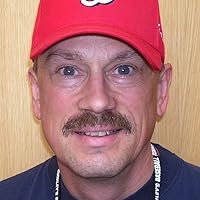
Oliver Pötzsch is a German writer and filmmaker. After high school he attended the German School of Journalism in Munich from 1992 to 1997. He then worked for Radio Bavaria. In addition to his professional activities in radio and television, Pötzsch researched his family history. He is a descendant of the Kuisle, from the 16th to the 19th Century a famous dynasty of executioners in Schongau.
This book was a fun read for me. I didn't love it but I did enjoy reading about life back in the 1600's. I know the title of a book and even the cover is important to me when reading a book but I'm not sure why so many people put so much focus on the title of this book and why the Hangman's daughter didn't play a bigger role in the book. I felt that even though she wasn't in every chapter, she was the reason that some of the events were happening. I don't think Simon would have taken as much of an interest in the hangman if he hadn't been interested in Magdalena and wanting to win her fathers approval.
I was actually pretty disappointed with this book. I expected the book to center around 'The Hangman's Daughter' given that she's the title of the book. Instead, the book focuses around her husband and her father, and 'The Hangman's Daughter' is, at best, a supporting character that plays no real part in the actual story.
That said, I did find the story itself interesting, but I feel like the title is very misleading.
I had a lot of reservations before reading this book and kept putting it to the back of the pile...so glad to have finally read it. Amazing!! Ready for the next books in the series!
The author is a descendent of Kuisls Executioners and has taken that history and translated it into the fictional character of Jacob Kuisl, the hangman of Schongau. The story starts off at a decent pace and briefly tells the story of the grandfather who was the hangman and explains how the son does not want to follow in his fathers’ footsteps. It then it jumps forward 35 years and refers to Jacob as the grandson who is now the hangman in the same town with no real transition or explanation. I was surprised at how hung up I got on this detail, throughout the story I found myself trying to figure out if there was an error in the translation and the current hangman was actually the son, and regardless, how the heck did Jacob become the hangman when the prologue clearly indicates that the son would do anything to avoid becoming the hangman.
Setting that issue aside I found that the story moved well in the beginning with the mystery of who was killing the children and the search for the responsible party. Unfortunately, somewhere in the middle the story got bogged down with talk of medicine versus witchcraft and political structures. I almost gave up reading it. Fortunately, clues to the mystery started to pile up and the story became interesting again. Although, I did find myself “skimming” entire sections just to get through it.
Intriguing and interesting book about the job of executioner. Jakob Kuisl is a cross between Holmes, CSI and Rambo as well as a forerunner in medicine. A different perspective on witch hunts, set in Bavaria. The hangman does his job because that is what his family is, a family of executioners. For centuries. Yet he is sympathetic, compassionate, unbiased and hates his job. But performs it nonetheless. There is potential for a massive witch hunt and Jakob will do what it takes to stop it. He is joined by his daughter Magdalena and Simon, the town's standing physician. It is a good story, with good characters, good plot though the mystery is a little predictable. This is a translation though! The author's is a descendent of the Kuisl's who really were executioners. I believe there is a second book and am looking forward to reading it.
This wasn't a whodunit so much as a whydunit. And that means that understanding character and motivation is everything. And sadly, the author fell down here. I wasn't compelled, I didn't see reasons. It was a letdown, not well written and certainly not very tense. There were a couple of interesting characters in the main protagonist, but that is not enough. The villains, the culture - all these things have to be compelling and instead we got lots of femjep and kidjep that while relevant to the times still seemed somehow at the same time gratuitous and the villain - well that seemed thrown together and not very interesting. I had to force myself to finish this book.
I honestly cannot see why this book merits a four-star rating on Goodreads. The story is only mediocre, the period details are banal and the writing is horrible. And no, it's not the translation. Mr. Potzsch has tendency to start a scene with one character in one place and, wham, before you know it, you're following a different character in a different place. Not only is this annoying, it makes for poor narrative and storytelling. As for the titular Daughter, wtf? Why did he call his book the Hangman's Daughter when she is, at best, a peripheral character?
It was a passable whodunit, weakened by too many narrators and the crutch of scenes where the villains tell us everything except their names. But the story was interesting, the pacing good, the gimmick of a hangman as a protagonist intriguing, and the characters engaging, so the flaws were largely forgivable.
Enjoyed this book. I listened to it on Audible and was thankful since I would never have been able to get the German name pronunciation correct. Interesting story.