Jump to ratings and reviews
Rate this book

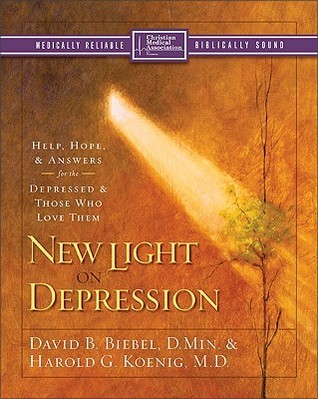
New Light on Depression: Help, Hope, and Answers for the Depressed and Those Who Love Them

Rate this book
Moving Back toward Wholeness What is depression, really? A psychological disorder? An emotional problem? A case of negative self-talk? A spiritual weakness? Unresolved anger? A medical condition? How can it be successfully treated? Whether you need a lifeline to cling to, knowledge to clear confusion, help determining the next step, or strength to help a loved one, New Light on Depression offers hope and healing. With understanding born of personal and professional experience, the authors―one a psychiatrist and the other a minister―untangle the web of depression, guiding you through• an understanding of depression• myths and misunderstandings• symptoms and diagnoses• causes and treatments• spiritual struggles and gifts of graceWritten for those who suffer from depression and those who want to help―family members, pastors, friends―this book equips you with the knowledge and tools to move toward a life of joy once more. It covers the full range of concerns, including the use of antidepressants. With personal applications, questions for reflection, and evaluation guides, New Light on Depression is a medically reliable and biblically sound resource for finding faith and strength in the midst of depression and emerging again whole and healthy.

320 pages, Paperback

First published December 16, 2003

4 people are currently reading
41 people want to read

About the author

David B. Biebel

38 books2 followers

Ratings & Reviews

What do you think?
Rate this book

Friends & Following

Create a free account to discover what your friends think of this book!

Community Reviews

5 stars
10 (35%)
4 stars
16 (57%)
3 stars
1 (3%)
2 stars
0 (0%)
1 star
1 (3%)
Displaying 1 - 2 of 2 reviews
Profile Image for Elizabeth.
1,342 reviews73 followers
Read
January 17, 2015
This book is ~300 pages long, and it's arguably fairly comprehensive. Its comprehensiveness almost felt overdone to me, though -- fully a third of the book is about "Counseling Models and Methods," "Antidepressant Medications: What They Are and How They Work," etc.

Arguably I am not the target audience for this, since I'm not exactly a beginner in this field. The back cover says that this book will "untangle the web of depression, guiding you through: an understanding of depression, myths and misunderstandings, symptoms and diagnoses, causes and treatments, spiritual struggles and gifts of grace."

There wasn't anything that was outright egregious fail, though there were a number of things that made me cranky and/or which I found problematic.

The authors say (p. 26) that they don't use the term "mentally ill" because in their opinion it's "stigmatizing." (In a footnote much later -- Chapter 14, footnote 11 -- they talk a bit more about the usage of the term "mentally ill," connecting it to their definition of depression as something that "affects a person physically, mentally, spiritually, and relationally. Therefore, it is not a state of mind (i.e., not an illness of the mind, per se), but a state of being.")

They also write, "We hope you won't permanently labels yourself or someone you love who may be depressed. Doctors' diagnoses are not made in order to put people in boxes but to enable them all interested parties, especially professionals, to discuss the situation and determine what treatment options may be most effective in a particular case. In most instances, clinical depression can be treated successfully. [...] You are a unique human being, not a diagnosis" (51).

This bothers me because naming and claiming your identity can be very empowering -- plus, the model of depression that implies you'll be "cured" (or at least have extended periods of full-on remission) troubles me, since my experience has been with people for whom depression is a constant presence, even though yes its oppressiveness ebbs and flows.

I was troubled by their discussion of anti-anxiety meds (p. 202) which talks about anxiety as a symptom of depression, completely ignoring the possibility that one might suffer from both and that anti-anxiety meds might be helpful in their own right, not just as treating one of the symptoms of depression.

Given how comprehensive the book is, I was surprised that it doesn't discuss self-injury at all.

Discussing hospitalization, the authors write, "Patients in the hospital are carefully monitored to ensure they don't hurt themselves and also that others don't hurt them," (204) but the context seems clearly about suicide and/or violent behavior (a la psychosis), not about self-injury per se.

Their four main steps for initial treatment of a depressed teenager includes: "4. Firearms, sharp knives, scissors, razors, ropes, twine, dangerous medications, and anything else that might be used to commit suicide should be removed from the adolescent's home" (242). Again, no mention of safety precautions around non-suicidal self-injury.

A story of a depressed teenager: "Over a period of months, the sixteen-year-old began to turn her confusion and frustration on herself by cutting her wrists. Looking back at it, she didn't really want to kill herself in that way" (243). I'm perfectly willing to believe that the teenager didn't have a vocabulary or conceptual schema other than suicide within which to understand her behavior, but I was disappointed that the authors didn't at least mention it.

I'm glad that the authors don't come down on the side of "suicide is unforgivable," but I'm not all that thrilled with the way they articulate it.
Is it possible for a real Christian to commit suicide? Yes. But he or she would most likely have to be clinically depressed in order to do so, which by definition means that his or her thinking was distorted at the time. Unfortunately, when believers do commit suicide, those who remain too often suffer additional heartache caused by other Christians. One mother whose son died of a self-inflicted gunshot wound was told by her brother, a Baptist minister, "I can't absolve him; you'll have to accept that he's probably in hell." You can imagine how this response affected that bereaved mother. Our perspective on this is that while this event was tragic beyond words, God is much more merciful and understanding that we can imagine, and ultimately the issue is between the individual and God. (237)

Profile Image for Marsha.
881 reviews7 followers
November 14, 2011
Excellent resource for families/friends of people struggling with depression. Written by a pyschiatrist and a minister so had a good balance of science and religion. Put a lot of things into words that might be hard for people who haven't dealt with depression to understand. Last chapter or two got a little too deep/extreme for me but great practical advice throughout book up until then to be put into practice.
Displaying 1 - 2 of 2 reviews

Can't find what you're looking for?

Get help and learn more about the design.