Alan Moore is an English writer most famous for his influential work in comics, including the acclaimed graphic novels Watchmen, V for Vendetta and From Hell. He has also written a novel, Voice of the Fire, and performs "workings" (one-off performance art/spoken word pieces) with The Moon and Serpent Grand Egyptian Theatre of Marvels, some of which have been released on CD.
As a comics writer, Moore is notable for being one of the first writers to apply literary and formalist sensibilities to the mainstream of the medium. As well as including challenging subject matter and adult themes, he brings a wide range of influences to his work, from the literary–authors such as William S. Burroughs, Thomas Pynchon, Robert Anton Wilson and Iain Sinclair; New Wave science fiction writers such as Michael Moorcock; horror writers such as Clive Barker; to the cinematic–filmmakers such as Nicolas Roeg. Influences within comics include Will Eisner, Harvey Kurtzman, Jack Kirby and Bryan Talbot.
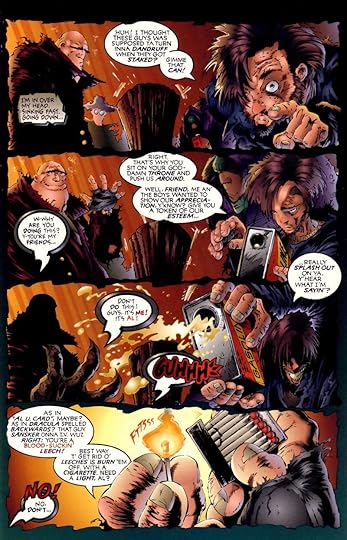
It's undead vs undead mayhem when the Hellspawn battles vampire monster hunter John Sansker! Not as funny as his previous Violator volume, but this come-back to the series by Alan Moore was first Spawn comic-book I've read 22 years ago and it is still as good as I used to remember.
Tony Daniel's artworks are real ☆☆☆☆☆ ones (just look at the killings from the vampire's pov) and Violator's short cameo was just hilarious.
I had no idea that Alan Moore had written a Spawn mini-series. So I gladly picked up this TPB of Blood Feud. I have a decent background on Spawn but am no expert. This was a strange story, as to be expected when penned by the odd genius of Alan Moore.
Spawn is in crisis. People are dying and the public, and Spawn himself, thinks that he is a vampire. Spawn attempts to ditch his suit, which in this telling is sentient and a demon. His nemesis is John Sansker, a "vampire hunter" who is himself a vampire. Sansker desires to be Lord of All Vampires and he is testing his plan on how to take over a large city by first trying it on New York. His goal in 2070 is to do it for "real" in Hong Kong.
The conflict is between Spawn and his cloak, Spawn and Sansker and Spawn against society as a whole. Moore has some great prose in this volume. His descriptions of the bottom of the river where the "lonely things go to die" such as a marriage bed that once knew love..is quite poignant. The story is out there and doesn't feel like a typical Spawn story. It certainly has Moore's touch on it.
The artist tries hard to channel his inner Todd McFarlane but never quite manages to pull it off. But the art, on the whole, is good. The depiction of the Police detectives were particularly well done, though the characters are VERY strange indeed.
This was an interesting story and certainly one I'd recommend to Spawn fans. Alan Moore's take on it is rather original. The whole cape thing reminds me a lot of Spiderman's drama with his symbiotic black suit. Don't know if Moore was poking fun at it, since McFarlane had worked on Spiderman during the black costume run. I have no idea merely thinking. I enjoyed the book and glad to add it to my collection, but it is not some groundbreaking work like some of Moore's other works. Don't go in expecting something revolutionary this is just Spawn done by Moore. It does well for what it is. Enjoy the ride and appreciate AM's unique take on Spawn. I did.
As was the case in another limited series - that sucked so much a$$, it shall not be named - this story fails to capture Al Simmon's voice. Maybe I'm just a Todd McFarlane fan, but the dark tones in the original series are simply not here. The heart of Spawn the comic is missing when Spawn outright screams at his suit. He talks too much in general. He is supposed to be more introverted, more pensive. Later on he turns into a genuine a$$hole when he talks to the homeless who are supposed to be his friends, not his subjects. Is it that difficult to understand what works for this character? At least the artwork is nice - immensely detailed, but with a different flavor from the main series. Also, Spawn's suit is by far the best thing about the story, though the gripes I have with it do get ironed out by the end.
After a phase of sleepwalking Spawn starts to question his suit. He demands of it to reveal more about itself. The suit seems to be assaulting people while Spawn sleeps and then feeding on their blood. John Sansker, a vampire hunter, is convinced Spawn is a vampire.
Al aproximarnos a Spawn: Blood Feud, nos toparemos con una narración plagada de una prosa que coquetea con influencias góticas, que actualmente sabe a cursi e incluso adolescente, haciendo evidente la mano editorial de Todd McFarlane. Pero de igual forma, podemos encontrarnos con los párrafos potentes, oníricos, críticos y melancólicos de Alan Moore. Si bien todo Spawn durante su tiraje cuenta con evidentes fallas, que pueden disculparse con cierta condescendencia, una de las principales virtudes fue el acoger a artistas como Alan Moore, Neil Gaiman, Frank Miller, Ashley Wood, Greg Capullo, y otros más. Y, recorriendo los contratantes paneles sin los lentes de la nostalgia, tiene la virtud de proyectar una valentía y creatividad adolescente. Adolescente, es la palabra más adecuada para describir gran parte de Spawn, ya que se trató de una publicación imaginativa, valiente, atrevida, entusiasta, la cual aspiraba a abordar temas no tratados por la novela gráfica mainstream en ese momento: el existencialismo del ser, la soledad y la construcción de la identidad. Spawn fue un adolescente reflejando esa transición de la pubertad a la vida adulta que la novela gráfica experimentó en los noventas. Si bien Spawn: Blood Feud es considerablemente inferior al promedio de las obras de Alan Moore, su valor radica en reflejar el estado de transición y evolución de la novela gráfica. Una transición, a pesar de sus grandes defectos, debemos a Todd McFarlane.
La obra Spawn de Todd McFarlane debe ser leída como un producto de su tiempo: los años 1990s.
Pleasant read by Alan Moore and Tony Daniel which has successfully developed Spawn’s character and inner conflict. The only deficit is the lack of development of the “villain”, vampire hunter; but put this aside and remember the main focus of this series, blood feud.
The blood feud isn't between Spawn and his foe, but with his presumed inner adversary, his cape (and chains!). The vampire hunter is here to spark off the story (and contribute to some fighting scene, coz its still a 90’s comic). See it as a self-discovery mini-series instead of Spawn vs supernatural guy, and you will love it.
This entire review has been hidden because of spoilers.
Legendary comics writer Alan Moore takes on Todd McFarlane's Image creation: Spawn. "Blood Feud" takes place in the continuity and finds a character coming to New York City to hunt down the infamous brooding anti-hero as he rummages around in alleyways with bums. Sansker is the hunter's name and he is convinced that Spawn is a vampire. Not quite. There is the usual comic action in this book however the most interesting part is Spawn learning about his symbiote costume and how that helps make up his persona. Probably not Moore's best work obviously but fans will certainly be pleased by this book. Great art from Tony Daniels.
Spawn vs some Vampire dude. Stretched into 4 issues. With cluttered and messy art from Tony Daniels and some truly unfortunate writing from none other than Alan Moore.
I wouldn’t even call it “bad.” More like empty, meaningless and boring. The layouts were... different, I guess. But, not in a good way. My eyes never adjusted to the claustrophobic sequences, and I spent most of this just wanting it to end.
Otra historia pasatista de un grande. No es que sea mala pero tampoco brilla demasiado, y menos comparado con otras obras de Moore. Cuando lo relea seguro se gane una reseña más elaborada.