It has been a year of change since Gemma Doyle arrived at the foreboding Spence Academy. Her mother murdered, her father a laudanum addict, Gemma has relied on an unsuspected strength and has discovered an ability to travel to an enchanted world called the realms, where dark magic runs wild. Despite certain peril, Gemma has bound the magic to herself and forged unlikely new alliances.
Now, as Gemma approaches her London debut, the time has come to test these bonds. The Order - the mysterious group her mother was once part of - is grappling for control of the realms, as is the Rakshana. Spence's burned East Wing is being rebuilt, but why now? Gemma and her friends see Pippa, but she is not the same. And their friendship faces its gravest trial as Gemma must decide once and for all what role she is meant for.
What is it about writing an author bio that gives me that deer-in-headlights feeling? It's not exactly like I'm going to say "I was born in Alabama…" and somebody's going to jump up and snarl, "Oh yeah? Prove it!" At least I hope not.
I think what gets me feeling itchy is all that emphasis on the facts of a life, while all the juicy, relevant, human oddity stuff gets left on the cutting room floor. I could tell you the facts–I lived in Texas for most of my life; I live in New York City with my husband and six-year-old son now; I have freckles and a lopsided smile; I'm allergic to penicillin.
But that doesn't really give you much insight into me. That doesn't tell you that I stuck a bead up my nose while watching TV when I was four and thought I'd have to go to the ER and have it cut out. Or that I once sang a punk version of "Que Sera Sera" onstage in New York City. Or that I made everyone call me "Bert" in ninth grade for no reason that I can think of. See what I mean?
God is in the details. So with that in mind, here is my bio. Sort of.
TEN THINGS YOU DON'T KNOW ABOUT ME by Libba Bray
1. I lived in Texas until I was 26 years old, then I moved to New York City with $600.00 in my shoe ('cause muggers won't take it out of your shoe, y'know . . . riiiiight . . .) and a punchbowl (my grandmother's gift) under my arm. I ended up using the punchbowl box as an end table for two years.
2. My dad was a Presbyterian minister. Yes, I am one of those dreaded P.K.s–Preacher's Kids. Be afraid. Be very afraid . . .
3. The first story I ever wrote, in Mrs. McBee's 6th grade English class, was about a girl whose family is kidnapped and held hostage by a murderous lot of bank robbers who intend to kill the whole family–including the dog–until the 12-year-old heroine foils the plot and saves the day. It included colored pencil illustrations of manly-looking, bearded criminals smoking, and, oblivious to the fact that The Beatles had already sort of laid claim to the title, I called my novel, HELP. My mom still has a copy. And when I do something she doesn't like, she threatens to find it.
4. My favorite word is "redemption." I like both its meaning and the sound. My least favorite word is "maybe." "Maybe" is almost always a "no" drawn out in cruel fashion.
5. My three worst habits are overeating, self-doubt, and the frequent use of the "f" word.
6. The three things I like best about myself are my sense of humor, my ability to listen, and my imagination.
7. I have an artificial left eye. I lost my real eye in a car accident when I was eighteen. In fact, I had to have my entire face rebuilt because I smashed it up pretty good. It took six years and thirteen surgeries. However, I did have the pleasure of freezing a plastic eyeball in an ice cube, putting it in a friend's drink, ("Eyeball in your highball?") and watching him freak completely. Okay, so maybe that's not going down on my good karma record. But it sure was fun.
8. In 7th grade, my three best friends and I dressed up as KISS and walked around our neighborhood on Halloween. Man, we were such dorks.
9. I once spent New Year's Eve in a wetsuit. I'd gone to the party in a black dress that was a little too tight (too many holiday cookies) and when I went to sit down, the dress ripped up the back completely. Can we all say, mortified? The problem was, my friends were moving out of their house–everything was packed and on a truck–and there was nothing I could put on . . . but a wetsuit that they still had tacked to the wall. I spent the rest of the party maneuvering through throngs of people feeling like a giant squid.
10. I got married in Florence, Italy. My husband and I were in love but totally broke, so we eloped and got married in Italy, where he was going on a business trip. We had to pull a guy off the street to be our witness. It was incredibly romantic.
This was okay, definitely not as good as the other two books in the series primarily because it was so unnecessarily long. I was pretty bored. Gemma was also much more of an unlikable character than usual. But overall I enjoyed the trilogy a lot!
I am utterly distraught by this book. My first hour free of it's torture I was a ball of fury. Nothing made sense, the writing was crappy, and I had so many questions. My poor husband didn't want to come near me and I didn't want to talk to anyone.
I had such high hopes for this book. Kartik and Gemma would finally find a way to be together, the magic of the realms would be figured out and dealt with, and Felicity and Ann would finally become real friends of Gemma's or else be rid of. I definitely expected a little bir more maturity to be given out by those girls, at least by Gemma, because generally when a person is given a large amount of responsibility, despite their age, and consciously decides that they need to live up to it, they don't act like retarded and petty 12 year olds.
Here are just a few of my troubles...
Why the crap does Kartik turn into a tree? This doesn't make any sense. I understand the sacrifice that he is making, but there is no sign that the magic can't be dealt with in another way until the very point where Libba Bray turns him into a tree. It is retarded. There is no sense in this, unless her goal was to piss people off.
Why are Pippa and Felicity lesbian lovers? I don't get this at all. Some people have mentioned in their reviews that they saw signs of this coming. Whatever signs they saw seemed like normal female friendship to me, especially for Victorian period writing. Besides the fact I think that it was just silly, the kiss was random and out of some teenage boys lesbian lovers fantasy. DUMB! I however, was satisfied when Felicity chose the good side, despite her love for Pippa, who has always irritated me.
The writing was just bad. For someone who has published 2 books already, the writing should have been much better. The plot should have been thought out. The dialogue should have been less George Lucas inspired (by this I am referring to his ability to make very good actors sound like dunces).
I am very frustrated by how poorly the magic of the realms was understood. Obviously Circe was evil, but how did she turn out to be so much better than the the people who were supposed to be good and why did she make so much more sense? Bray turns the evil person back to good - to a degree - and than she turns Kartik into a tree? Whatever!
My final annoyance for this review is that of Bray's obsession with womens rights. Holy crap, she went a bit overboard don't you think? I thought to myself at one point that maybe it was just me and that I was a little sensitive to people and their soap boxes... until at the very end Gemma's last request for the girls to be taught how to think for themselves and blah-blah-blah. Thinking for yourself is not at all a bad idea, but honestly. Themes like that are supposed to be thought provoking, not obnoxiously present.
There are so many, many things that I find very wrong with this book. It was a very huge disappointment. I expected so much more than what I was given here.
There were enough good things that I finished the book, but I definitely would not recommend it to anyone.
This entire review has been hidden because of spoilers.
And so ends the trilogy that began with A Great and Terrible Beauty, continued with Rebel Angels, and concludes in this final volume. I liked the first one well enough because of its unique blend of a wild, magical, mythical realm barely constrained behind stiff Victorian curtains. I really got into the second one as the plot became more complex, Gemma came into her own powers, Felicity and Ann's stories became more layered, and poor beautiful Pippa was relegated to the Realms indefinitely. When I saw how thick the third one was, my eagerness ratcheted up a notch. After all, I have been sitting around lately asking for longer books. Suddenly, here one is.
Unfortunately, 800 pages later, the best thing about it remains the first four words, it's lovely title, taken from a poem by W.B. Yeats. And it does capture the extremely bittersweet feel of the last portion of the book. But somehow this installment failed to capture my imagination. It frustrated me more than anything. Instead of making good use of everything she fought for in Rebel Angels, Gemma spends the entire novel trying to decide whether or not to do what she decided to do at the end of the last book. Not until the final pages does she get a grip on herself and do what needs to be done. I thought we were done with crippling indecision in the previous books. I wanted the Gorgon to just let loose and throttle her! Meanwhile, Felicity and Ann are apparently thirteen again and spend the majority of their time being petty and distrustful, backstabbing Gemma whenever they get the chance. Pippa is the most interesting of the original friends, munching on the berries of the dead in all her Miss Havisham glory. But her path is extremely predictable. And Kartik? Fiery, beautiful Kartik? Sigh. The end to his story had far too much in common with Merlin's fate for my taste. I will say that the scene where Gemma and Kartik place their hands inside the stone was achingly beautiful. But, as with much in this hefty book, it was too little too late and I'm left feeling sad. Wishing, somehow, it could all have gone differently.
This was by far my favorite in the series, and I think a lot of it had to do with what Libba Bray was willing to have happen to her characters. The others have had their dark moments, but this was definitely the darkest of the lot. Makes sense, since it is the conclusion of a trilogy, and so there's got to be pretty big events to keep the story going.
It does take a while for the story to pick up, like in the others. Oh, and there's a veritable ton of Victorian society happenings that some readers might get a little tired of. Gemma also spends a lot of time debating about the decision of what to do with the magic, which might also bore a lot of readers. I actually really loved how much effort Bray put into fleshing out the Victorian culture for her readers, and didn't mind Gemma's brooding. Hey, if I were in her position, I'd totally be brooding, too!
So, while the first half of the book is good but not great, the second half completely makes up for it. This book is packed full of more action and intrigue than the first two, and some really excellent twists.
I just loved how she tied all the characters' individual stories up. Mrs. Nightwing and Mrs. McCleethy both get a lot more interesting in this one, and even Fowlson finally gets some believable characterization rather than coming off as a 1-dimensional jerk. And Pippa. I wasn't sure what would happen with her, but I have to say I loved it.
For the romantics, there are some really beautiful scenes between Gemma and Kartik. I was really glad she resolved things between the two and at least gave them some really great interactions. I can't say much more without spoiling it, though.
The ending was definitely not a perfect, happy conclusion, but it felt fitting for the series. Some readers are actually probably going to be quite disappointed by how some of it ties up, just with how gruesome it could get. Personally, I found the conclusion beautiful and touching, and it really made the series better as a whole than if she had done a cookie-cutter "look, it's a happy ending!" for us. The whole series is bittersweet, and I love it all the more for that very reason.
This was a reread of a reread of a reread et cetera (literally can’t tell you how many times I have put myself through this book). But I knew I needed to read this book again to have it fresh in my mind in order to review it correctly.
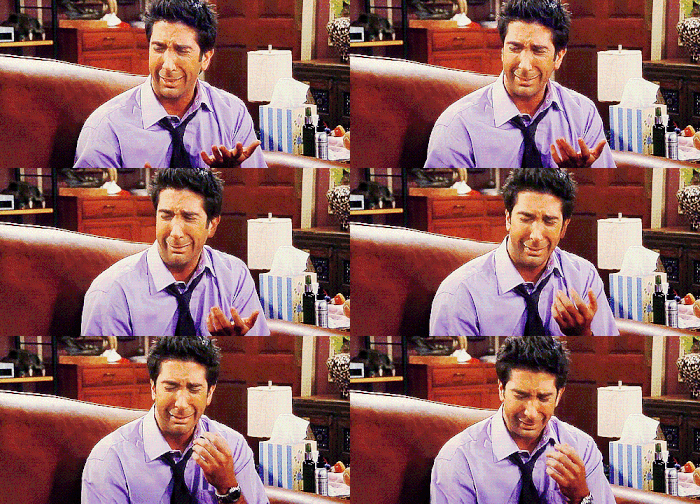
When asking my sister (who introduced this series to me in grade school) how I should review this book, she stated that I should just use crying gifs... so here are a few of those:
Libba Bray does not hold back when it comes to your heart. Yes, this book is a really, really long one, but Bray likes her descriptions and her character development. There are so many things going on in this book that are just on the side, but are so important to the characters and why they make the decisions that they make.
I will let you know that some people believe there is some “fat shaming” in this, and I can see where they are coming from, but you also have to see when the book was written and what time period this is in. You also have to understand this is a bunch of girls who are just trying to get the upper hand on each other, and that is an easy stab. And it isn’t anything that is glorified. Libba is very big in the diversity and acceptance community; with that said, that would never be her intent to do that to anyone.
Our three girls Gemma, Felicity and Anne believe they are in the clear. They put Circe in her place and all they have to do is share the magic with some of the creatures and people in The Realms and things will be great.
But what if Gemma doesn’t want to give up the magic? What if Felicity and Anne want the magic to change the path their parents and guardians carved for them to take? What if, putting Circe in her place actually was exactly where she wanted to be? What if changing the path of the magic opened new doors for the Winterlands?
I can’t review this book properly. It breaks my heart every time I read it and it legitimately makes me cry every time. I read this with a friend this time, knowing she would need emotional support, and she got mad at me because I put her through that roller coaster.
This series is so close to my heart. It is the series that made me not just love books but into a reader.
---
Chapter 69 is the absolute worst omg I hate this I’m dying my heart. I can’t. I.. omg I will never love again.
- - -
50%: I hate the build up because I know what’s going to happen, this being a reread x1000, but it doesn’t make it hurt any less. This book means the absolute world to me. It’s one of those books you always want to reread but then you remember “wait this book murdered me. Why am I reading this again?”
Buddy Read (Re-Read for me) with my main girl Kayla because she doesn't understand the extent of emotional trauma she's about to experience.
Thankfully, this is over. I thought I would never get through this last installment of Gemma Doyle trilogy. Why, oh why does this book have to be so long? Take out 300-400 pages of unnecessary secondary characters and going nowhere plot lines, its 5 epilogues, and "The Sweet Far Thing" would be a reasonably decent book (I suppose). But alas, Bray chooses to ruin her own rather original series with this endless and bizarre last installment.
I've read quite a few reviews and know how many people are disappointed with the ending. I don't really mind where all the characters end up in this story, but I rather mind how and why they get there.
Gemma's books have never been about romance for me. The underlying idea of these books is women's independence, I get it. So I probably wouldn't have minded Kartik's sacrifice if it made any sense. For me, he dies because of Gemma's stupidity. Should she have done what she promised to do in the end of book 2 (divide the magic among the inhabitants of the realms), none of the events in the books would have happened. Thus his death is pointless in my opinion. In fact, the more I think of the details of Kartik's death, the less I understand what and why exactly happened to him. Basically, Gemma stabs the Tree releasing Winterlands' magic, Kartik sucks in this magic, then pours the magic into Gemma and then becomes a part of the Tree. WTH just happened? Why does he even have to do it? If the Tree doesn't have any more magic, how can it have this power to accept his sacrifice and why is it needed? If the Tree still holds on its evil power, how does Kartik's sacrifice change anything? Doesn't it mean that the Tree will continue its evil business in the Winterlands and will eventually corrupt Kartik the same way it did Eugenia? How is this a solution?
Now to Felicity and Pippa. Seriously, where does the gay issue come from? I have no objections to homosexuality being portrayed in YA literature, but it is handled very heavy-handedly by Bray in this book. First of all, there is no clue about this in the first two books - Felicity is caught kissing a gypsy man, Pippa dreams of a knight in shiny armor. This leads me to believe that this turn in the girls' relationship is an afterthought on Bray's part. Another issue here is that considering that Felicity is only 16 and a victim of sexual abuse, can we really be sure that her newly found sexual preference is a real one and not caused by the abuse? I just think Bray shouldn't have brought up this issue if she didn't have time to handle it responsibly and thoughtfully.
Lastly, “The Sweet Far Thing” is an unbearably long and convoluted tale that needs editing badly. First two books have a great balance of real and supernatural with a great women’s independence message. This third book is unnecessarily full of numerous subplots, redundant scenes, and pages of feminist propaganda. I understand Bray wanted to give us her opinion on about every women’s issue out there, but it doesn’t translate into a good book.
Overall, a disappointing conclusion to an imaginative and original series. I don’t necessarily regret reading the trilogy, but I will definitely not recommend it to anyone. Two stars only because I was able to finish it and it gives some kind of closure.
Reading challenge: #14 - 3 of 4
This entire review has been hidden because of spoilers.
I finished the final installment of the Gemma Doyle trilogy last night. It took me over two weeks to finish and I came very close to throwing the damn book across the room with only 70 pages to go. I have to say that I am very upset that Kartik died. VERY. The tension, and affection between Kartik and Gemma was what kept me reading. I was constantly waiting for her to see his red bandanna or meet him in the boathouse. I will admit that the book ended very well but I was still very angry.
I have never cried while reading before, and I have told my friends that I don't understand why people do. I cry in all movies but with a book, you control the tempo. You can stop whenever you please. Simply close the book and try again later, that is how I roll. However, I shed a few tears at the end of Sweet Far Thing. When Kartik died and in the end when Ann and Felicity got what they really wanted, I was very emotional. I am so very glad Libba decided to make both of their characters good in the end. Ann irritated me so much in the first two books, but really held her own in this one, especially towards the end, when she had to stand up to Pippa. I felt like she was always ready to abandon Gemma for the others but in the end that proved false. Felicity could have gone either way right up to the very end because of her love for Pippa, but I was happy to see that she got her inheritance and intends to live as she has always wanted, free and daring, and out from under th hold of her father. I also appreciated how she wrote Circe's character. At work I always tell people that this trilogy is a mix between Harry Potter and the Twilight series, and Circe was Snapelike in my opinion.
I am sad that these books are over. I look forward to reading whatever Libba Bray writes next, but can't imagine a character being a strong, confused, and brave as Gemma. Love her. Definitely one of my favorite characters of all time. I think it is important to remember that a young woman can be powerful and challenge authority, but still long for love and romance.
Final Rating: 4.5/5
I think this book could have easily been written into two installments. Not only because it was 800 pages but because SO much happened. I can't really remember what happened at the beginning of the book.
This entire review has been hidden because of spoilers.
The bad: Wayyy too long. I was bored. The thing wasn't even resolved (they won a battle but not the war). The worst bleeping love triangle I've ever read.
The problematic: Fat shaming. Horrible attitudes toward disability. Sexual orientation used as a plot twist. Issues of non-consent were never addressed. Sexual abuse backstory to excuse a character's meanness.
Okay, I'm going to start off with a warning. I will be talking in detail about how this book made me feel and if you haven't read it yet it is possible that my feelings will give away a crucial plot point. With that all I can say is I feel raw. Absolutely raw. I couldn't breathe. And I cried. A lot of tears were shed. The ending is by far one of the most brilliant, brave things I have EVER read, that does not mean that it wasn't absolutely horrible to read. And knowing that it was necessary, that it had to happen, that it's the perfect ending does not really comfort me but I'll take what I can. The emotion that Libba Bray churned up in me was astounding. From absolute highs, to absolute lows (and I do mean absolute), I loved riding the roller coaster of it all. My second favorite series ever. Read it. Love it. Cry along with me.
Here's what I expected from this book: that it would maintain the part snarky, part serious, part romantic tone of the first two books; that the characters would grow a bit and the relationships would be as fraught as ever; that there would be some good old fashioned suspense leading up to the conclusion of the trilogy.
If any of those elements were present in this book, they got lost under pages and pages of sub-par writing; I don't come to books like this for Great Literature, but the others were enjoyable even when I rolled my eyes. I was too busy slogging through to roll my eyes.
Ultimately, I didn't really care what happened to any of the characters, and the supposed-to-be-heart-wrenching twist towards the end did not wrench my heart - but I did manage to roll my eyes. I didn't buy the vision of Gemma's future that we are given; I didn't care what happened to Felicity; I was pleased for Ann but it was a bit predictable. I never felt like Gemma really came to terms with using the power that was given to her, and that was a big disappointment.
The fantasy elements weren't strong enough to support the whole thing: so many of the characters in the realms had no real purpose to the story, which is pretty unforgivable when you're wrapping up a trilogy. The whole thing felt more like a scene out of that obnoxious movie, What Dreams May Come, than anything else.
I was relieved to be finished with it. I don't recommend it unless you LOVED the first two and just HAVE to find out what happened. But then you'll probably think the ending IS heart-wrenching, and I will lose all respect for you.
I cannot even describe my love for this trilogy. It is simply amazing. Girls finding their wings, and finding their light and dark corners. You will have to read to find out what that means. lol, it is beautifully written, this author does not twist the truth, which i love. She tells the story as if it might happen to everyone, like the characters own personal plots. There are many unexpected twists(huge crying moments) I really did find out more about myself. The person i want to become, and how much life ccan be bent into whatever i choose it to be. This book is my favorite book. Girls kick ass, revenge, love, affairs, deceit, all that good stuff.
Here are some of my favorit quote, go to the authors website, she is quite a character, i love her writing :]]
"In each of us lie good and bad, light and dark, art and pain, choice and regret, cruelty and sacrifice. We’re each of us our own chiaroscuro, our own bit of illusion fighting to emerge into something solid, something real. We’ve got to forgive ourselves that. I must remember to forgive myself. Because there is a lot of grey to work with. No one can live in the light all the time. " — Libba Bray
No one asks how or what I am doing. They could not care less. We’re all looking glasses, we girls, existing only to reflect their images back to them as they’d like to be seen. Hollow vessels of girls to be rinsed of our own ambitions, wants, and opinions, just waiting to be filled with the cool, tepid water of gracious compliance. A fissure forms in the vessel. I’m cracking open.--Libba Bray(the trilogy)
“And that is how change happens. One gesture. One person. One moment at a time.”
I have been reading this book for 2 weeks and I finally finished reading this book at lunch. I am currently in class and since I finished all of the things that I need to do, I thought that I would write a quick review on this book. This book was beautiful, I loved it so much, I was so sad when I finished it. I can't believe I finished the book, it was so crazy and so much happened.
This book is the last book in the Gemma Doyle trilogy. It was an amazing installment and made the perfect ending. Some people were upset with the ending of this book and I was too, but I loved this book so much because there were so many things that I didn't believe would happen in this book. I still can't get over this book and I don't know when I am going to recover.
“People have a habit of inventing fictions they will believe wholeheartedly in order to ignore the truth they cannot accept.”
There were so many powerful statements in this book and I loved how the book was divided and formatted. It was so epic and there was so much action near the end of the book. When everything was starting to get chaotic, I was going crazy myself, I was so excited and jumpy.
"Sometimes, I think you can glimpse it in another.”
When I was reading this book, I was so into it that I didn't realize that my friends were calling me. It felt like I was in a different world. Whenever I read, I always zone out and jump into the beautiful worlds and I never want to leave. Sometimes, I forget where I am and lose track of time.
“I am a jumble of passions, misgivings, and wants. It seems that I am always in a state of wishing and rarely in a state of contentment.”
I felt like one of the things that I didn't like about the book was the decisions Gemma made. Some of the decisions did not make sense and I felt like if she did things differently, nothing horrible would have happened. I wish she would think before she acts and think of a proper plan. I felt bad for her because at parts she felt alone. I felt like I could relate to her in many ways.
“It is funny how you do not miss affection until it is given, but once it is, it can never be enough; you would drown in it if possible.”
The characters were amazing and I loved MOST of them. Kartik was one of the characters that were my favorite. Gemma's character development was amazing and she is so strong. She had Felicity and Ann, but I felt like they weren't that supportive at times and they weren't always there for Gemma. Kartik was one of those characters who had your back. :(
“Power changes everything till it is difficult to say who are the heroes and who the villains.”
This story is one of those stories where you read and you don't know who to trust. Everyone could be untrustworthy at times and it is so hard to find a person who will help you out. Sure there were a few people who were there, but they weren't always there for you because they were selfish.... Anyway, I feel like I kept getting tricked because I trusted the wrong people. Gemma made so many mistakes with trusting the wrong people.
“I do not want to pass the time. I want to grab hold of it and leave my mark upon the world.”
I have so much more to say but so little time. The ending was bittersweet but I still loved the book. Although it was slow in parts, I still enjoyed reading this book and I recommend this to those who haven't read this series. It is amazing and you won't regret it... But at the same time, you might because of the ending... Okay I am scared that I am going to spoil this book so I am going to go to my next class. See ya!
i’ve finally finished the eight hundred some pages of The Sweet Far Thing by Libba Bray. And I must say that in the last two days I have felt what I believe to be every possible emotion there is. I almost find myself at a loss for words in the shock that I still feel.
We once again join in the adventures of the girls of Spence that we have grown to love. The story once is centered on the magic of the Realms and what Gemma must to with it now that she has bound it to herself. Although I rather enjoyed the underlying storyline of Gemma and Kartik, which is just one of many that concludes this tale.
It seems that everyone and everything are against Gemma. She can’t seem to open the portal since Christmas and she no longer feels the magic within herself. She fears that the magic has not chosen her to continue in the Order. The mysterious East Wing is being rebuilt and a masked ball is to be held in its wake. And Gemma has still not seen Kartik, and his whereabouts are also a constant strain on her thoughts.
When all else fails Gemma feels she will never return to the realms until a mysterious stone is found in the midst of the East Wing construction. Which turns out to be a secret door in which she has seen in her visions complements of a Miss Wilhelmina Wyatt, former Spence Lady and author of A History of Secret Societies.
Once back in the Realms, Gemma cannot deny the changes that are happening around her, but yet she is still not ready to share the power. Gemma must carry around the responsibility of the magic, figure out whom she can trust, try to help her friends and also work toward her debut season! No wonder it took eight hundred pages!
Bray does not disappoint in the final chapter of Gemma’s tale. The plot twists where plenty! Felicity was her brash self and Ann as insecure as ever, but in the end these girls surprised me for the better! The writing was detailed and painted vivid pictures even more so than the two previous books. I couldn’t put it down, and now that’s it over I fear I will miss these girls.
In the final book of the Gemma Doyle trilogy, the Order, the Rakshana and the creatures of the realms all want one thing - the magic. Gemma is caught between as everyone around her tumbles into chaos and the fight for the magic begins in earnest. While the creatures of the winterlands make a bid for control and Circe stirs, Gemma struggles to come to terms with the magic she holds and her place in this world and in the realms. As the story unfolds, Gemma discovers that nothing, and noone, is as they seem.
The end of a series is bittersweet. If the author has done her job well, it is at once satisfying and distressing. Libba Bray has done her job very, very well. This is a wonderful conclusion to the series that satisfies on all counts, wrapping up the main threads of the trilogy quite effectively. More suprising is the fact that nothing was cliche or expected. I am sad there will be no more books in the series but in love with the ones we've been given.
Libba Bray seems to possess a magic of her own, peppering words on a page and conjuring a world that is believable and engaging, filled with complex, fully realized characters that are sometimes sympathetic and sometimes repellent. She allows her characters to have flaws, to make mistakes, to be deluded and tricked. She allows them to triumph, to fall, to realize truth and embrace lies. She presents us with a view of the world as it is and then spins that on its side and makes us see it, and ourselves, anew. Gemma's story is beautifully told and I am glad I had the chance to read it.
Out of the three books in this series, this one was probably the best. It contained more of a well-developed, central plot, stronger characters, more twists and turns than one would have expected.
BUT DANG WAS IT LONG.
Eight hundred pages is too long for a YA book, if you ask me.
I really do think Libba stepped up her game with this, though. For once, I actually felt a sense of connection to the realms: they weren't weak and flimsy feeling as they had been for me in the previous two books. I really began to care about what happened to those worlds, instead of putting up with them to get to the Victorian stuff. That was a major improvement.
I also feel like, both throughout the series and this book particularly, almost every single one of the characters went through sometime kind of development. And character development is my favorite. The most notable developing in this book pertains to Mrs. Nightwing, Ann, Felicity, and Fowlson. Mrs. Nightwing's transformation from the strict, Victorian schoolmarm to the strict, Victorian schoolmarm who knows about a secret layer of worlds besides our own, was probably one of my favorite things about this trilogy. I loved her relationship with Gemma. I loved her part in the ending story. I think Libba did an excellent job making use of her character. Ann I ended being so proud of. Though she was relentlessly whiny and helpless through the series, I wanted to give her a standing ovation when she got up the gumption to audition for Charles's show as herself. FINALLY she was making her own decisions and making the most of herself. Felicity Worthington is probably the most complicated character from these books. She is most certainly not the petty mean girl you think she'll be when you first meet her in A Great and Terrible Beauty. Libba had her deal with two controversial topics that are highly disputed in our time, and were never even spoken of in Victorian England: sexual abuse and I personally applaud Libba for including those things. She did very well dealing with them, and I think it's important to remember how they affect anyone, in any time or culture. I was also pleased with how Libba turned Fowlson from It was fun having him on the team, and getting to know him a little more.
Lastly, the ending. I was really happy with how this series wrapped up, more happy than I have been with anything else in a while. There were so many unexpected things about the ending that I loved. Kartik's really surprised me. You don't really see YA authors going around They're just too essential to the genre. I will take any twist to stereotypic YA with open arms, no matter how I feel about any character. I really love that Ann. Felicity, and Gemma all got to make their own choices and go their own ways on new adventures. There was a twinge of sadness to this, but it made for a good ending.
Libba finally sold me on this series completely. And I'm not complaining.
My old review for this sucked so I'll attempt to sum up my thoughts in a slightly better way.
Well, this book is kind of near and dear to my heart because I was reading it on the night right before my little brother was born. (Awww.) So, whenever I think of this book, I think of that. I also remember how it kept me up until like 3 in the morning because it was so scary and thrilling and awesome and whatnot.
The ending was a bit frustrating, but ... oh well. Over all, this is a fantastic series with a fascinating blend of fantasy and history. The characters are compelling, the writing is great, yada yada.
Also, Libba Bray is a super cool person. I met her over the summer and she was really nice. :) Also she signed my copy of this book. So, YAY!
Oh man, the feels and nostalgia. This series will forever be a favorite. I realize that this book was definitely way too long (probably 300 pages too long) but that honestly doesn't make me love it less. Gemma was a full-on badass toward the end. The other girls were total turds for most of the book though. Overall, I like the ending (minus one sad sad thing) and would totally read more if she wrote more. Just sayinnnnnnn.
Can I just start by saying that the 2nd book in this trilogy is the best of all. After reading the third book, I find myself still FULL OF QUESTIONS AND DISAPPOINTED with the ending. Seeing that this book is the last one, I expected to have a lot more resolution to the story of Gemma Doyle. I feel that the book was not edited well enough as well. The plot was all over the place, which means you had no idea where the story could go, and there were no rules to follow. I usually expect that fantasy or science fiction novels will have a universe full of rules that are followed and explained fairly well! This is not the case! I really the author would've set up better "rules" for the realms and the use of its magic. I kept thinking about what Gemma could do and "why doesn't she do this" with her magic. I really think what Gemma chose to use her magic for was odd. She was so strong at the end of the second book. The third book begins and you discover that she has taken a u-turn and is whiny and uses her magic strangely. I kept thinking, "she is still a teenager, so maybe that is how a teenager would act?" I found myself exhausted at the end of this book. The one true source of light in this book was Kartik! Thank goodness for his character or I would've gave up on the book entirely. I really wish for a fourth book "Kartik's Return: Love Conquers All!" That last sentence is my hopelessly romantic side busting out. Can I also say that some of the writing was a bit lame. I laughed inside when I read that someone was "as pale as cheese." That just doesn't speak to me, for I have never considered cheese to be pale. It's just cheese, you know. There were beautiful parts as well and they all involved Gemma and Kartik's romance! I will remember the tiny bits of romance I was given and center my thoughts there. I will try not to remember the rest. And someone please tell me: Why can't Kartik appear to Gemma from the tree just as Eugenia Spence did?" It's driving me nuts!
This entire review has been hidden because of spoilers.
I think it is a great testament to an author’s skill in writing prose, when they can evoke within you such emotions that makes you want to throw your book across the room, when the characters are being stupid, blind, or just acting in ways that are so frustrating you want to scream at them. Or, it is a well written story when your own heart beats against your ribcage when the main protagonist is feeling love, fear, or anger.
In my opinion, what also makes for a good book is when you want to do nothing but read their story, when nothing else matters but getting to the end. I think Libba Bray has written three wonderful books and her magic in writing tripped me in her web. I really enjoyed these books.
The storyline in some people’s opinion has been over done, but I think it is up to the author to use their skills to put a fresh spin on the old and I think Bray has done that.
I'm really sad the story had to end... I felt there's room for another book. I'll hold out hope...
ROSE of all Roses, Rose of all the World! The tall thought-woven sails, that flap unfurled Above the tide of hours, trouble the air, And God’s bell buoyed to be the water’s care; While hushed from fear, or loud with hope, a band 5
With blown, spray-dabbled hair gather at hand. Turn if you may from battles never done, I call, as they go by me one by one, Danger no refuge holds, and war no peace, For him who hears love sing and never cease, 10 Beside her clean-swept hearth, her quiet shade: But gather all for whom no love hath made A woven silence, or but came to cast A song into the air, and singing past To smile on the pale dawn; and gather you 15 Who have sought more than is in rain or dew Or in the sun and moon, or on the earth, Or sighs amid the wandering starry mirth, Or comes in laughter from the sea’s sad lips; And wage God’s battles in the long grey ships. 20 The sad, the lonely, the insatiable, To these Old Night shall all her mystery tell; God’s bell has claimed them by the little cry Of their sad hearts, that may not live nor die.
Rose of all Roses, Rose of all the World! 25 You, too, have come where the dim tides are hurled Upon the wharves of sorrow, and heard ring The bell that calls us on; the sweet far thing. Beauty grown sad with its eternity Made you of us, and of the dim grey sea. 30 Our long ships loose thought-woven sails and wait, For God has bid them share an equal fate; And when at last defeated in His wars, They have gone down under the same white stars, We shall no longer hear the little cry 35 Of our sad hearts, that may not live nor die.
Alright. Let's get to the inevitable...Kartik's death. Normally I would say "what the hell was that?" soon to be followed by "she ought to have done herself in as well" but shockingly Libba Bray has actually left me satisfied with the ending of a book. It's not shocking that Libba did it, just that anyone could. I can't possibly name all the books I'd have rather seen someone else die in that person's place, or seen another kill themselves. [I will name one though, FRED. I fear I'll never get over that.]
Want to talk more about it, certainly feel welcome to message me. [Cyndy-you have to message me.]
The Gemma Doyle trilogy is very well written and I look forward to anything else written by Libba, and of course when she comes to Seattle. Hell to the yes.
This entire review has been hidden because of spoilers.
This book was wonderful! I'm very sad to see the Gemma Doyle trilogy come to an end, but Bray sure took it out with a bang in The Sweet Far Thing.
Rather than talk about what happens in the novel, I want to touch upon one thing that really held my interest throughout all three novels: the discontent that Gemma feels over the restraints and limitations placed upon girls and women. Bray takes the opportunity through Gemma, Felicity, and Ann to make her female readers aware of the expectations placed upon women during that era. Gemma and Felicity, most markedly, do not want to fall victim to the rank and classification system in regards to being female. Ann tries her best to not fall into the social class of servitude, although she doesn't have nearly quite as much spunk as Gemma and Felicity. These girls see no reason why they shouldn't be able to be who they want to be, dress the way they want to, live they way they want to, etc. There's a good little history lesson here for young girls about the fight that in which women have had to engage in order to gain respect and equality in this world. Bray doesn't go overboard with the idea, but she does drive the point home.
One of my favorite passages from this book is below:
Felicity takes both my hands in hers. My bones ache from her grip. "Gemma, you see how it is. They've planned our entire lives, from what we shall wear to whom we shall marry and where we shall live. It's one lump of sugar in your tea whether you like it or not and you'd best smile even if you're dying deep inside. We're like pretty horses, and just as on horses, they mean to put blinders on us so we can't look left or right but only straight ahead where they would lead." Felicity puts her forehead to mine, holds my hands between hers in a prayer. "Please, please, please, Gemma, let's not die inside before we have to." (page 601)
To me, it seems as if Bray might have left this series open-ended enough for another novel. A reader can always hope, right?
After reading the first book it was good enough to keep reading the other books although I didn't love it. I really liked the second book, but after the whole series was finished I was rather disappointed. I thought the story was compelling, but if you're looking for a book appropriate for you teenage girls this is not it. There are far too many points of view that if you call yourself Christian you will probably have a problem with. I really wanted to like these books, but after the insertion on homosexuality (hinted at in the first book, and is clear in the third book) it felt like another way so many are trying to instill homsexualtiy tolerance. I don't believe in persecuting homosexuals but I do believe it is wrong. So much is currently being done to try and change public opinion especially in hollywood to homosexuality and I find that this book ads to that sentiment. If you feel homosexuality is wrong I would not recommend this book especially to your teenagers. There are also some pretty dark moments in the book that I thought too heavy for teenagers. If you take these things out I would have liked the books far better. If I had known this before starting them I don't think I would have started.
700 pages of this book are totally useless. Seriously. I admit that my reading habits during the term aren't conducive to falling in love with long books because I tend to read them in such fragments. But this book I read mostly in enormous hunks. And even though it is a quick read in terms of style, Bray seems to want to be J.K. Rowling and imagines that she has created this huge world here with lots of intricate characters and terrain and oodles of plot twists in the last book of the trilogy. Following every single twist made one wish for open road. And then when you got to open road (like a stunning revelation about one of the main characters...that had been obvious for all three books but had to be hammered out as clearly as possible in this last one lest we misunderstand...), you wished you could hide in the bushes.
I will say that I very much enjoyed the denouement. The last hundred pages or so were a lot of fun. But I was annoyed overall that a book I read purely for fun offered so little of it. I vastly prefer the first two books of the trilogy (and especially the first one).
Overall the series wasn't AMAZING to me, I really enjoyed the time period and the gothic feel, but I was never really in love with the series. With that said, this book is a great book, especially the ending. After 800 and something pages I felt very attached to the characters and the story, and I guess I did not really get that in the other two books. The beginning was fairly boring and sometimes hard to get through, I got a little put off because of the length and I just felt it was taking forever. BUT! The las 100 pages were just.. so sentimental. I loved seeing how the girls grew up and what they came to be. I had to give it 5 stars since it made me cry haha. It's a very well-written book with great characters and the ending ties it up perfectly. It also has some pretty great twists. Although I wish some events had not happened, I understand why they did. This book is definitely my favorite out of the series which is also why I gave it 5 stars, but the series as whole did not exactly captivate me.
Nonostante abbia amato i primi due volumi, questo terzo libro è un grande no. Innanzitutto, tutte queste pagine sono immotivate. Se Libba Bray avesse scritto un romanzo di massimo 500 pagine, la storia avrebbe assunto un ritmo decisamente più serrato e gli eventi si sarebbero verificati nel momento giusto. Invece, qui ho percepito una sensazione di "allunghiamo il brodo" senza andare a parare da nessuna parte. Ci sono scene su scene inutili, tutte uguali e ripetute all'infinito. Insomma, la trama avanza con moltissima fatica e i grandi plot twist quasi non assumono valore, perché si passa subito ad altro. Il ritmo della narrazione poco equilibrato è una problematica che mi ha disturbata parecchio. Inoltre, l'assenza di un villain è stata un'altra debolezza di questo volume conclusivo. Nei libri precedenti, l'antagonista era Circe, mentre qui Libba Bray non è stata in grado di sfruttarla a dovere e le sue azioni sono del tutto confusionarie e senza senso. Credo che l'autrice volesse introdurre altri antagonisti, ma ha fallito miseramente. Altra delusione è stata il trattamento riservato alla relazione tra Gemma e Kartik. Nei volumi precedenti ero molto coinvolta dalla loro storia d'amore, perché c'era il classico cliché degli enemies to lovers che amo sempre. Alla fine di Angeli Ribelli erano giunti a un compromesso, un'alleanza. Invece, qui sembra che nulla sia mai successo e l'autrice ha utilizzato il trope del "non ti parlo, così ti proteggo" CHE IO DETESTO. Quando due personaggi di qualsiasi coppia non si parlano per partito preso, ma quelle informazioni sono fondamentali per la trama, mi parte un embolo. La comunicazione è la chiave di qualsiasi relazione, spoiler! Per non parlare della fine che Libba Bray ha fatto fare a 'sti due. Non commento. Gli alberi lasciamoli alle Winx, grazie. Elenco brevemente (perché non si può fare altrimenti) gli elementi che mi sono piaciuti: -I collegamenti con le trame di Una grande e terribile bellezza e Angeli Ribelli, perché l'autrice è riuscita a riprendere elementi accennati e ad approfondirli. Poi certo, l'esecuzione è un'altra storia, ma almeno l'incipit era interessante. -La coppia f/f che viene rivelata. Nonostante sia una storyline marginale, la rappresentazione LGBTQ+ è sempre importante e per l'epoca (il libro è uscito nel 2009) non era assolutamente scontato trovare una coppia tra due donne. Mi piacerebbe leggere una novella prequel su di loro. -Come si sono concluse le storyline delle varie ragazze della Spence, nello specifico quelle di Gemma, Felicity e Ann. Le ho trovate coerenti con i loro percorsi e sono stata contenta per loro. -Il collegamento con la saga di The Diviners. Per come si conclude la storia, ho avuto una sensazione di full circle e ho capito il cameo che il personaggio di Gemma fa in Lair of Dreams. Nel complesso mi sento di consigliare questa trilogia, ma va letta con la consapevolezza dell'epoca in cui è uscita e di tante "pecche" tipiche di quei libri lì. Sicuramente, se l'avessi letta durante la mia adolescenza, avrei apprezzato di più questo volume conclusivo. Ma ad oggi, essendo una lettrice più critica e con maggiore esperienza nel panorama fantasy young adult, la mia opinione non può che essere questa. 3 stelline, senza (quasi) colpo ferire.
By the end of 2018, I made a promise to myself that I would read the entire Gemma Doyel trilogy even if it took me weeks to complete. Here we are now and I'm really glad I bought this trilogy when it went on sale. Otherwise, I would've been royally pissed had I paid the original cost because as a whole, this trilogy was average.
The Sweet Far Thing is a monster of a book with over 800 pages compared to her previous book, Rebel Angels, which was just over 500 pages. From the start of The Sweet Far Thing to the end, I can say that some parts did hold the book up in the plot department while everything else fell under. This finale was underwhelming considering how much emphasis Libba Bray put into the plot and the conflict of said plot.
There won't be any spoilers in this review however, there is one part I will talk about that depending on the person, could be seen as a spoiler but it was so redundant. It doesn't affect the plot by any means though I will throw a quick warning when I talk about it. Because of that part... I have issues.
The Sweet Far Thing was an underwhelming finale. From the beginning with A Great and Terrible Beauty to Rebel Angels, The Sweet Far Thing didn't give me any reason to care about the plot and characters. If you've read my reviews of the previous two books, you would know my issues lie with the characters and the sense that they're lacking in some ways. Unfortunately, The Sweet Far Things has that. With it being over 800 pages, most of it had plot moments that moved the story forward but was also held back by parts that did seem important but slowed the pacing down. That and I was annoyed by Gemma and the other characters.
Gemma is a character I don't care about. I don't like her nor do I hate her. I feel absolutely apathetic about her. For a character who is feisty, especially a young woman in the late Victorian-era, she can be annoying and pretty stupid at times. The parts where she acts defiantly it comes of as her being whiny and bratty. Gemma's "friend" Felicity was a character who I disliked from the beginning and even after reading The Sweet Far Thing, I still dislike her. Why should I care for her? We also have Ann who is probably the most decent character of the bunch. I was cheering for her instead of the others.
The romance in the series does not take over the plot of the trilogy which was good but, and this is a big BUT, the chemistry between Gemma and Kartik was nonexistent. They hardly had a conversation in the first book and in the second book, she pines for him like she has known him for years. What about Kartik is so attractive? Why does Gemma like him? Again, I felt nothing.
The pacing of the story was mixed. One moment you're reading about the Realms and the magic and the creatures of the Realms, the next there's the personal lives of the girls and I much prefer the magic side compared to the personal lives of the girls. I like a balance between the two but if the magical elements outweigh the other, then my enjoyment of the story drops.
So here's the part that some may consider a spoiler while others may not. It does not affect the overall story and is so insignificant and short it could easily be forgotten. But I still had an issue with it. So here it is, the mild spoiler warning: It's revealed during the last 60-50 pages that Felicity and Pippa were in a relationship. A relationship, mind you, that was only mentioned for like a page or two before it's completely forgotten in favor of the plot. Libba Bray pulled a Disney on us with the whole "we have gay characters" and then does nothing with them. And I'm not the only one with this issue. Felicity being bi or a lesbian is brushed under the carpet since, as I said, it was only brought up for a few pages in contrast to an 800-page story. The bi/gay rep was not even a good one if we only see it for a few seconds. If you're going to have a queer character, write them in a way that makes it feel real and not something that is thrown in at the last second for shock value, because that's what it is, shock value.
What shines throughout this series is the magic of the Realms. That is the only good thing about this trilogy. Everything else was either bland or annoying.
The Gemma Doyel trilogy was underwhelming. I've seen lots of people praise this series. I expected more but I was left with disappointment.
"The rules of magic, my dear, are best not discussed. For once we understand the illusion, we no longer believe in it."
—Dr. Van Ripple, The Sweet Far Thing, P. 314
Libba Bray built up to the finale of her Gemma Doyle trilogy with a pair of quality novels, but neither compares to the ambitious excellence of The Sweet Far Thing. It's an eight-hundred-nineteen-page behemoth, with enough text for four or five lengthy novels, but Libba Bray works her magic as I've never seen from her before. There's a civil war to be waged over the transformative magic of the realms, a war destined to incur casualties on both sides before Gemma can choose her own path in life and move forward in the resolve that if she fails, it's better to do so living out her ideals rather than those of others. There will be scars from the battle for the heart of the realms, wounds ripped open when Gemma and her friends must turn their backs on beloved companions who are already, in truth, lost. But there is a future for the survivors, and it's up to them to find that future even after the pain they've endured.
Gemma wields the magic that is her birthright, but the inhabitants of the realms grow impatient. The time is at hand for a treaty regulating the magic so no group can oppress the others, but Gemma isn't ready to disperse the enchantment vested within her. Enemies in the realms and the regular world pose a threat to Gemma if she reveals that she has the magic, and she's reluctant to let go of the one thing that ever made her special. What if the magic doesn't work the same way once she freely shares it? Gemma experiments by giving modest amounts to Ann and Felicity, her friends from Spence Academy. She does the same for Pippa, an academy girl who died in A Great and Terrible Beauty but lives on in the realms, lovely as ever but with noticeable decomposition of her soul. Pippa has to be confronted eventually, but Gemma will keep the peace until she learns what's going on in the realms.
"Peace is not happenstance. It is a living fire that must be fed constantly. It must be tended with vigilance, else it dies out."
—Gorgon, The Sweet Far Thing, P. 301
"People have a habit of inventing fictions they will believe wholeheartedly in order to ignore the truth they cannot accept."
—The Sweet Far Thing, P. 52
At their house in the city, Gemma's family is unraveling a year after her mother's death, and her own life isn't going much better at Spence Academy. Kartik, who deals with Gemma on behalf of the secret Rakshana organization, is moodier than before. He wavers between not speaking to Gemma at all and passionately confessing his love for her, though Gemma can't afford to be caught with him. 1890s England is an unforgiving place when it comes to class and race differences between a young lady and any prospective suitor, so there's not much of a future for Gemma and Kartik. He'll do his best to assist her work in the realms, though, for the Rakshana are one of many groups whose future depends on Gemma mediating a deal among the realm's people. Kartik is indispensable to what she's attempting to do: unite the realms for the first time in centuries and prevent future outbreak of hostilities over the magic. But even with Kartik and other keen minds on her side, how is Gemma to navigate the labyrinth of competing interests in and out of the realms?
"It is the scorpion's nature to sting. Just because he has no opportunity doesn't mean that he cannot."
—Gorgon, P. 368
Enemies are everywhere, both openly hostile and secretly working to thwart Gemma. But the worst foe is yet unknown to her, a presence more sinister than Circe ever was. Power in the realms can corrupt a soul beyond recognition, and one twisted antagonist is fighting harder than anyone to stymie Gemma's efforts to restore peace. Uncovering the identity of this vexer is an odyssey in itself, but nothing compared to the ensuing battle, which Gemma and her adversary cannot both survive. And it may not turn out the way you'd expect...
A Great and Terrible Beauty is a solid first book of this trilogy, and Rebel Angels surpasses it, in my opinion. The Sweet Far Thing is at least as wise as its predecessors, but far more emotional. I didn't know Libba Bray had a book like this in her. Gemma is uncomfortable with the constraints of Victorian society, and that conflict surfaces throughout the trilogy. How can she lead the life she wants when society demands she follow the orders of men, even when they're at odds with her own desires? Gemma doesn't know how to tame her inner angst. "Can we really conquer chaos so easily? If that were so, I should be able to prune the pandemonium of my own soul into something neat and tidy rather than this maze of wants and needs and misgivings that has me forever feeling as if I cannot fit into the landscape of things." The heart is a labyrinth of needs and desires, and the hope that there's something tangible to find at its center is an illusion. There is only a winding path perpetually extending however far we choose to run down it. How do we find our heart's desire if it's unattainable in any absolute form? Perhaps by tempering our expectations, aiming for small, achievable happinesses and not stewing over the next goal that will always be just out of reach.
"It is funny how you do not miss affection until it is given, but once it is, it can never be enough; you would drown in it if possible."
—The Sweet Far Thing, P. 209
There is much for Gemma to lose now that she has friends. Felicity leans toward Pippa in the realms, loathe to desert her dearest friend in limbo between our world and the afterlife. Ann is unhappy with her own lack of charisma or physical beauty, verging on despair that her soaring singing voice won't save her from becoming a weary governess disrespected by the children in her care. Gemma knows how much Ann and Felicity mean to her. "Absence is a curious thing. When friends are absent, they seem to loom ever larger, till the lack of them is all one can feel." It's easy to take a close friend for granted, until you're without them. Then life feels empty and tedious, and you wish you were together still. Gemma has sorcery at her fingertips, and can gift her friends with limited quantities of it, but the enchantment doesn't change what they want out of life. Gemma marvels when Kartik dismisses the temporary magic she gives him. He believes that nothing he could conjure would please him more than Gemma. "But," she protests, "you could turn stones to rubies or ride in a fine gentleman's carriage." "To each his own magic," Kartik answers, and his statement validates the desire in each of us for nothing so much as the one we love. Why request new magic when the magic you have is your most cherished fantasy? There's nothing finer than realizing that what you want is already yours.
If you long for something different than what society thinks you should, you'll identify with Gemma's continuing plight, feeling stifled by the corsets and aristocratic manners of Victorian England. She's an adventurer, traveler, experimenter, and being shackled by social custom will never do. Gemma can't imagine being happy living someone else's idea of ladylike contentment. "This is what they have in place of freedom—time and gossip. Their lives are small and careful. I do not wish to live this way. I should like to make my mark. To venture opinions that may not be polite or even correct but are mine nonetheless." Whatever curbs your ability to speak up and be proud of your thoughts, whatever cows you into pretending to hold "correct" opinions and denying you have a mind of your own, you won't be free until you escape the borders of acceptable thought and discover for yourself how far you want to go. People will dictate what you're allowed to think if you let them, and you mustn't fall prey to those who would mug you of the right to make up your own mind. You may find that concepts which go largely unquestioned are less stable than society pretends, and you could be the one to topple them. That's the way Gemma wants to live, and though I don't always share her opinions, I support her unwillingness to take the easy road of life in high society. "How terrible it is to have no cares, no longings. I do not fit. I feel too deeply and want too much. As cages go, it is a gilded one, but I shall not live well in it or any cage, for that matter." It is for Gemma, you, and me to forsake our cage, be it gilded or rusty, and find a realm where we can live beyond the yelling of bitter mankind, a place to commune with loved ones we lost along the way, honoring the sacrifices it took to get us where we are, determined not to let the sadness overshadow the joy still out there for us to encounter. Though Gemma Doyle's future is an unwritten page, I feel sure she will do exactly that.
As good as it is, The Sweet Far Thing does feel eight hundred nineteen pages long, and Libba Bray uses Gemma to poke fun at herself for that on page four hundred twenty-nine: "With a sigh, I resign myself to combing through it page by page, though 502 pages is so many to wade through, and I curse authors who write such lengthy books when a few neat pages of prose would do." Touché, Ms. Bray! I won't complain about the size of your book when you have the good humor to do it for us. There's so much insight, plot, and testing of characters in a book this size that I can't unpack it all in a review, but the emotional resonance of the losses suffered in the story is what lifts The Sweet Far Thing into rare air, one loss in particular that you'll know what I'm talking about if you've finished the novel. It radiates through the final chapters with a sweet sadness that connects with the losses in your own life, guaranteeing you won't forget this trilogy. The Sweet Far Thing is arguably Libba Bray's magnum opus, a lifetime's worth of distinguished contribution to teen literature in a single volume. Few have done better.
I know, I just finished reading Rebel Angels less than 24 hours ago, and here I am again. Yes, right after book 2, I immediately read The Sweet Far Thing because I want to finish this series and absorb every detail as much as possible. And boy was I blown away! The best series ever!
The girls are back and the Realms become more sinister than ever in Book 3, The Sweet Far Thing. All have their own agenda and you’re not sure whether it benefits main gal, Gemma Doyle. Pippa and the girls are becoming undead creatures of the realms. But it all rests on their ultimate choice. Unfortunately Pip makes the wrong one, sacrifices Mr. Darcy the bunny and even Wendy to the Winterlands. And so as she becomes more power hungry, Felicity becomes more conflicted.
Felicity, surprise surprise, coincidentally seems to be my new absolute favorite character. Yes, I had a sudden change of heart. When I thought there’s no way she can become more awesome, she proves me wrong yet again. She’s so freaking well written. I honestly did not see the Pip/Fee thing coming. I remember a part in AGATB when they mention Sapphists. And that made me wonder if any of them were lesbians. But after that I never really thought about it. Fee is such an emotional character. Strong and independent. I never thought I’d have a girl crush on a fictional character but there she is.
And Ann, Ann, Ann.. Girl, I’m glad you finally grew a backbone. I actually kind of hated you when you backed out and went on to be a governess. You had this great talent and almost threw it away out of fear. I guess you needed those few weeks looking after those brats to make you see the glint of light and take a chance at a better life.
Oh, the Cave of Sighs. Gemma and Kartik join hands and so begins the Best. Vision. Ever. Although I’m not sure if it was exactly a vision. But as soon as Kartik was riding on that horse I was like, something’s finally gonna happen. Libba Bray leaves it ambiguous as to whether they had sex or not. Personally I like to think they did. At least once before… But, oh well, I’ll just let them be mysterious if they don’t want to be exposed.
And the villain, my villain.. I knew Circe wasn’t bargaining information for magic for no reason. Once Gemma found the dagger she went to her. And she rose out of the well and whipped her butt with magic. Took the dagger. And ran off to help the Winterlands army. Wham!
The birth of May, or Eugena’s birthday, brings chaos to Spence. The pixies, nymphs, and satyrs of the column come to life and go after the school girls. And there’s the case of being chased by trackers on zombie horses, plus a a battle among winterlands creatures and gargoyles. Pure. Genius!
I would like to tell more, but I would be a damned spoiler if I’d do so. So here it it. The verdict: The ending is absolutely perfect. I have fallen in love with these books and plan to read them again in the future.
20 1/2 hours of torture, knowing what I do, but I'm doing it, anyway. Because the story is so lovely in its sadness and life isn't all sunshine and rainbows and at least I can appreciate the fact that Libba Bray didn't lie to me about it.
ETA: Not quite as sad the second time around...I found it more hopeful than anything else. So glad I took the time to revisit this amazing series.