

What do you think?

The Bradbury Chronicles: The Life of Ray Bradbury
Accomplished journalist Sam Weller met the author Ray Bradbury while writing a cover story for the Chicago Tribune Magazine and spent hundreds of hours interviewing Bradbury, his editors, family members, and longtime friends. With unprecedented access to private archives, he uncovered never–before–published letters, documents, and photographs that help tell the story of this literary genius and his remarkable creative journey. The result is a richly textured, detailed biography that illuminates the origins and accomplishments of Bradbury's fascinating mind.
384 pages, Paperback
First published April 1, 2005
About the author
Sam Weller
35 books55 followersSam Weller is the author of The Bradbury Chronicles: The Life of Ray Bradbury (William Morrow, 2005) winner of the Society of Midland Author's Award for Best Biography of 2005. The book was also a finalist for the prestigious Bram Stoker Award. Sam is the former Midwest Correspondent for Publishers Weekly. He is a contributing writer for the Chicago Public Radio program, 848 and his work has appeared on the National Public Radio program, All Things Considered. Sam is a regular contributor to the Chicago Tribune Magazine, a frequent literary critic for the Chicago Tribune, Chicago Sun-Times, as well as Punk Planet magazine. During his tenure as managing editor of Columbia College's Gravity, the publication was given Newsweek magazine's Robert Sibley award for best college magazine. As a staff writer for the Chicago alternative weekly, Newcity, Sam was the recipient of the Peter Lisagor Award for arts criticism. Sam is also a frequent lecturer. In 2006, he spoke across the country as part of the National Endowment for the Arts "Big Read" initiative. He is the author of Secret Chicago: The Unique Guidebook to Chicago's Hidden Sites, Sounds & Tastes (ECW Press) and his short fiction has appeared in Spec-Lit. He received his MFA in Fiction from Columbia College Chicago. Sam lives in Chicago with his family.
Ratings & Reviews
Friends & Following
Create a free account to discover what your friends think of this book!
Community Reviews
Displaying 1 - 30 of 72 reviews

March 9, 2024
He was a very jolly, loud, enthusiastic guy, people liked him but they thought he was a bit naïve and a lot sentimental. He would cry at the drop of a hat. One person said about him at age 17
Ray was a rather boisterous young boy. He liked to imitate Hitler and WC Fields. It’s a wonder we didn’t strangle him.
Like Jack Kerouac and Bob Dylan, Ray Bradbury had a golden decade of high productivity – everything he got famous for was written at speed between 1947 and 1957, Fahrenheit 451, Dandelion Wine, The Illustrated Man, The Martian Chronicles.
A LOVE HATE THING
He had a very conflicted relationship with science fiction. He loved the wonder but didn’t care a hoot about the science. Damon Knight said that though Ray Bradbury
has a large following among science fiction readers, there is at least an equally large contingent of people who cannot stomach his work at all, they say he has no respect for the medium…that – worst crime of all – he fears and distrusts science.
He was in fact a technophobe – never learned how to drive, didn’t fly on a plane until age 62, owned a computer but didn’t use it. In the 50s wrote for television but didn’t own a set.
Author Sam Weller of the unlikely Dickensian name says
Ray’s Mars was beautifully impossible. His planet had an atmosphere and it had blue hills. For the author, science was not the point… it was the metaphor that mattered.
To sf purists he was an often-resented outsider and of course to purveyors of literature he was a lowly sf writer who should quickly be shown the door. When the beautiful fix-up novel The Martian Chronicles was published Ray wrote to his publisher
I think we could have gotten more reviews from the big people on Chronicles if it hadn’t been for that science-fiction label… Can’t we do something about this, please, Brad? Must the light remain under the bushel-basket?
FAMOUS FRIENDS
His stuff was so good that hoity-toity intellectual types who wrote proper literary books noticed it and he got a good review from none other than Christopher Isherwood who invited him round to tea. Some time later at chez Isherwood who should turn up but Aldous Huxley. They offered our Ray some mind-expanding mescaline. They wonderd what effect it would have on the Bradbury brain. He declined and said :
I don’t want to have a lot of perceptions. I want to have one at a time. When I write a short story, I open the trapdoor on the top of my head, take out one lizard, shut the trapdoor, skin the lizard, and pin it up on the wall.
Ray was afraid that if he took mescaline, he would be unable to, as he put it, “ shut the trapdoor and all my lizards would escape”.
As he got more famous (without having any massive blockbusters – but quite quickly stories and novels started popping up in syllabuses) famous people would be encountered quite regularly. Typical evening for Ray Bradbury : I went to the theatre and John Huston was there with his girlfriend Olivia de Havilland.
SPEAKING OF JOHN HUSTON
The tall booming Hemingwayesque director was his favourite and he longed to scriptwrite for him and lo! It came to pass in a highly be-careful-what-you-wish-for way. Mr Huston decided one fine day “Ray Bradbury will write a script for my film of Moby Dick!” And Ray found himself on a boat to Ireland (at this point he refused to fly).
The reason Ray had been summoned to Ireland to work on a screenplay for a film that was to be shot largely in the Canary Islands was so Huston could make the foxhunting season.
John Huston loved to roam the world shootin huntin fishin drinkin and womanizin and directin. He fancied murdering some Irish foxes and they did it in a very wild way, apparently, so Dublin it was for Ray, where he spent months of misery as the butt of Huston’s malicious unpleasant humiliating humour (think Joe Pesci in Goodfellas if Joe Pesci was over 6 feet high and a big shot film director).
BRAND NAME RECOGNITION
Sam Weller says
Short stories. Novels. Radio. Comic books. Movies. Television. The stage. Architecture and design. Arguably, no other twentieth-century literary figure can claim such sweeping cultural impact.
What he is saying is that After writing his handful of famous books (there is a larger armful of non-famous books because he never stopped) Ray Bradbury turned himself into a brand, and affixed his name to all manner of cultural enterprises involving world fairs, Disney, tall buildings, Apollo missions and whatnot. And all without going to college or university. His only college was the local library.
It’s a rather large claim. If it’s true it couldn’t have happened to a nicer guy.
I read this because RB was my first beloved author and I think I still love (some) of his stuff, and I realised I knew absolutely nothing about him. And I’m glad I found out. It’s not especially dramatic as life-stories go, but it left me with a warm glow.
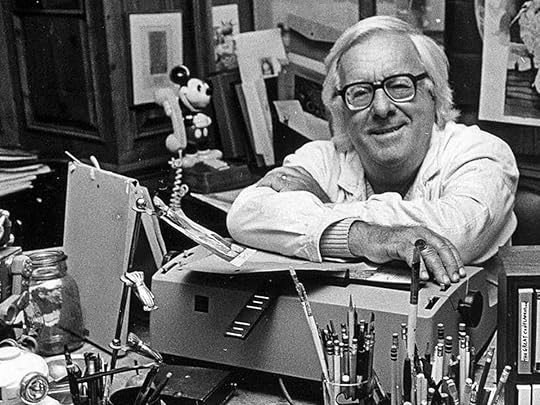
Ray was a rather boisterous young boy. He liked to imitate Hitler and WC Fields. It’s a wonder we didn’t strangle him.
Like Jack Kerouac and Bob Dylan, Ray Bradbury had a golden decade of high productivity – everything he got famous for was written at speed between 1947 and 1957, Fahrenheit 451, Dandelion Wine, The Illustrated Man, The Martian Chronicles.
A LOVE HATE THING
He had a very conflicted relationship with science fiction. He loved the wonder but didn’t care a hoot about the science. Damon Knight said that though Ray Bradbury
has a large following among science fiction readers, there is at least an equally large contingent of people who cannot stomach his work at all, they say he has no respect for the medium…that – worst crime of all – he fears and distrusts science.
He was in fact a technophobe – never learned how to drive, didn’t fly on a plane until age 62, owned a computer but didn’t use it. In the 50s wrote for television but didn’t own a set.
Author Sam Weller of the unlikely Dickensian name says
Ray’s Mars was beautifully impossible. His planet had an atmosphere and it had blue hills. For the author, science was not the point… it was the metaphor that mattered.
To sf purists he was an often-resented outsider and of course to purveyors of literature he was a lowly sf writer who should quickly be shown the door. When the beautiful fix-up novel The Martian Chronicles was published Ray wrote to his publisher
I think we could have gotten more reviews from the big people on Chronicles if it hadn’t been for that science-fiction label… Can’t we do something about this, please, Brad? Must the light remain under the bushel-basket?
FAMOUS FRIENDS
His stuff was so good that hoity-toity intellectual types who wrote proper literary books noticed it and he got a good review from none other than Christopher Isherwood who invited him round to tea. Some time later at chez Isherwood who should turn up but Aldous Huxley. They offered our Ray some mind-expanding mescaline. They wonderd what effect it would have on the Bradbury brain. He declined and said :
I don’t want to have a lot of perceptions. I want to have one at a time. When I write a short story, I open the trapdoor on the top of my head, take out one lizard, shut the trapdoor, skin the lizard, and pin it up on the wall.
Ray was afraid that if he took mescaline, he would be unable to, as he put it, “ shut the trapdoor and all my lizards would escape”.
As he got more famous (without having any massive blockbusters – but quite quickly stories and novels started popping up in syllabuses) famous people would be encountered quite regularly. Typical evening for Ray Bradbury : I went to the theatre and John Huston was there with his girlfriend Olivia de Havilland.
SPEAKING OF JOHN HUSTON
The tall booming Hemingwayesque director was his favourite and he longed to scriptwrite for him and lo! It came to pass in a highly be-careful-what-you-wish-for way. Mr Huston decided one fine day “Ray Bradbury will write a script for my film of Moby Dick!” And Ray found himself on a boat to Ireland (at this point he refused to fly).
The reason Ray had been summoned to Ireland to work on a screenplay for a film that was to be shot largely in the Canary Islands was so Huston could make the foxhunting season.
John Huston loved to roam the world shootin huntin fishin drinkin and womanizin and directin. He fancied murdering some Irish foxes and they did it in a very wild way, apparently, so Dublin it was for Ray, where he spent months of misery as the butt of Huston’s malicious unpleasant humiliating humour (think Joe Pesci in Goodfellas if Joe Pesci was over 6 feet high and a big shot film director).
BRAND NAME RECOGNITION
Sam Weller says
Short stories. Novels. Radio. Comic books. Movies. Television. The stage. Architecture and design. Arguably, no other twentieth-century literary figure can claim such sweeping cultural impact.
What he is saying is that After writing his handful of famous books (there is a larger armful of non-famous books because he never stopped) Ray Bradbury turned himself into a brand, and affixed his name to all manner of cultural enterprises involving world fairs, Disney, tall buildings, Apollo missions and whatnot. And all without going to college or university. His only college was the local library.
It’s a rather large claim. If it’s true it couldn’t have happened to a nicer guy.
I read this because RB was my first beloved author and I think I still love (some) of his stuff, and I realised I knew absolutely nothing about him. And I’m glad I found out. It’s not especially dramatic as life-stories go, but it left me with a warm glow.

January 11, 2021
This book holds the distinction of being the oldest item on my Goodreads TBR list. I decided that now was the time to do something about that. I came to Bradbury's writing late. I'd never read a thing by him until I started an idiosyncratic science fiction & fantasy reading project back in 2011, just a year before the great man's death.
As so many people before me, I was blown away by Fahrenheit 451 (having read it in conjunction with Huxley's Brave New World and Orwell's 1984). I was impressed (and I recycled my television set). My reading also included The Martian Chronicles and Something Wicked This Way Comes, which I must re-read some day as I don't think I appreciated them properly. Timing is everything for my reading enjoyment and I think I rushed into these books, not knowing what to expect.
So this account of Bradbury's life was of interest to me. I started out a bit skeptical, as the author was in many ways an acolyte of Bradbury and I wasn't sure that I would get a balanced account of his life. As I read, however, I realized that he was well aware of Bradbury's flaws and wasn't trying to conceal them.
Ray Bradbury must have been both a joy and a challenge to know. Outgoing and charming, he seems to have made friends easily and seems to have been loyal to them. Easy to talk to, but inclined hog the spotlight. Confident in his own vision, but desperate for applause. There is no doubt that he was a unique voice in American literature and deserves his reputation, but this need for approval surely made his life more difficult.
Definitely an original. Thank you, Mr Bradbury for your many kind words about libraries and librarians. As a retired library worker, I appreciate you in return.
Cross posted at my blog:
https://wanda-thenextfifty.blogspot.c...
As so many people before me, I was blown away by Fahrenheit 451 (having read it in conjunction with Huxley's Brave New World and Orwell's 1984). I was impressed (and I recycled my television set). My reading also included The Martian Chronicles and Something Wicked This Way Comes, which I must re-read some day as I don't think I appreciated them properly. Timing is everything for my reading enjoyment and I think I rushed into these books, not knowing what to expect.
So this account of Bradbury's life was of interest to me. I started out a bit skeptical, as the author was in many ways an acolyte of Bradbury and I wasn't sure that I would get a balanced account of his life. As I read, however, I realized that he was well aware of Bradbury's flaws and wasn't trying to conceal them.
Ray Bradbury must have been both a joy and a challenge to know. Outgoing and charming, he seems to have made friends easily and seems to have been loyal to them. Easy to talk to, but inclined hog the spotlight. Confident in his own vision, but desperate for applause. There is no doubt that he was a unique voice in American literature and deserves his reputation, but this need for approval surely made his life more difficult.
Definitely an original. Thank you, Mr Bradbury for your many kind words about libraries and librarians. As a retired library worker, I appreciate you in return.
Cross posted at my blog:
https://wanda-thenextfifty.blogspot.c...

January 5, 2020
Beni tanıyanlar, büyük bir Ray Bradbury hayranı olduğumu bilir. Gelmiş geçmiş en büyük öykücü olarak gördüğüm Ray Bradbury hakkında okumayı eskiden beri istiyordum. Geçen aylarda fırsatım oldu ve yıllardır kitap listemde olan Bradbury Chronicles'ı satın aldım.
Yazar, Bradbury ile günlerce, haftalarca görüşerek bu yaşam öyküsünü kaleme almış. Oldukça samimi ve detaylı bir anlatım söz konusu. Bradbury'nin üzerine yapışmış "bilim kurgu yazarı" etiketiyle tatlı mücadelesi özellikle ilgi çekici bir detay.
Açıkçası, kitabın sayfaları ilerledikçe, hayranı olduğum bu çocuk-adam ile hayli ortak yönümüz olduğunu farkettim ve bundan mutluluk duydum.
Bradbury hayranları dışındakiler için çok fazla anlam taşımayan bir kitap, ancak sıkı bir Bradbury okuruysanız, bu yaşam öyküsünü de okumanızda fayda var.
Yazar, Bradbury ile günlerce, haftalarca görüşerek bu yaşam öyküsünü kaleme almış. Oldukça samimi ve detaylı bir anlatım söz konusu. Bradbury'nin üzerine yapışmış "bilim kurgu yazarı" etiketiyle tatlı mücadelesi özellikle ilgi çekici bir detay.
Açıkçası, kitabın sayfaları ilerledikçe, hayranı olduğum bu çocuk-adam ile hayli ortak yönümüz olduğunu farkettim ve bundan mutluluk duydum.
Bradbury hayranları dışındakiler için çok fazla anlam taşımayan bir kitap, ancak sıkı bir Bradbury okuruysanız, bu yaşam öyküsünü de okumanızda fayda var.

September 23, 2010
From his childhood in Waukegan, IL to his teen years in Hollywood, CA and beyond,the life of this extraordinary writer is wonderfully conveyed by Sam Weller.
Some interesting facts about the man who often put us aboard rocketships and envisioned the future: He never learned to drive and was afraid to fly (he did eventually get on a plane when he was in his sixties, but never drove a car!). He wrote the screenplay to John Huston's film of "Moby Dick" (something I never knew).
I read many Bradbury books when I was younger and agree with the criticism that the science in his science fiction tales is pretty weak, but his use of language is remarkable and very poetic. He evokes mood, nostalgia, and a sense of "humanity" as well as anyone I've ever read. His work transcends genre fiction (sci-fi, horror, etc...) putting it in the realm of the best that literature has to offer.
An excellent bio. of a great writer.
Some interesting facts about the man who often put us aboard rocketships and envisioned the future: He never learned to drive and was afraid to fly (he did eventually get on a plane when he was in his sixties, but never drove a car!). He wrote the screenplay to John Huston's film of "Moby Dick" (something I never knew).
I read many Bradbury books when I was younger and agree with the criticism that the science in his science fiction tales is pretty weak, but his use of language is remarkable and very poetic. He evokes mood, nostalgia, and a sense of "humanity" as well as anyone I've ever read. His work transcends genre fiction (sci-fi, horror, etc...) putting it in the realm of the best that literature has to offer.
An excellent bio. of a great writer.

March 31, 2021
So, so lovely. I learned so much about Ray Bradbury, the man, as well as his long and illustrious career. As a fan more of his non-fiction, I am now curious about his classics, and will likely enjoy them better now that I understand the man who wrote them.
Highly, highly recommended. A rare 5 stars from me. ⭐️⭐️⭐️⭐️⭐️
Highly, highly recommended. A rare 5 stars from me. ⭐️⭐️⭐️⭐️⭐️

October 24, 2013
I was surprised Ray Bradbury approved this biography, since it is at times in danger of being iconoclastic, and doesn't make him look that good. The book wasn't very well written either, and contained too much that made me doubt the facts. Bradbury either lived a charmed life or a lot of the facts were skewered. I mean, Bradbury walks into a store and bumps into Walt Disney (they later work together). Bradbury walks into a hotel and almost trips over Steinbeck. Bradbury watches a TV show and the next day gets a call, out of the blue, from the show's creator (later they work together) etc etc ... there is too much of this stuff in the book to be believable. And I don't see the point of mentioning Bradbury's infidelities during his marriage or his egotism - at one point, the book claims, he accused Michael Moore of plagiarising a title, for crying out loud. Weller makes Bradbury sound pushy, foisting his work on people all over the place. I'm not sure how much of this stuff I believe. And if you thought Bradbury was a creative genius who did it all alone, then you only have to read the first quarter of the book to change your view about that - mentored for five years by Leigh Brackett, stories rewritten by Henry Kuttner and on and on it goes. By the time I'd finished reading this biography I wished I hadn't. If you know someone who loves Bradbury's stories, DON'T recommend this book to them.

October 25, 2009
Not one to beat around the bush, Weller begins gushing in his first sentence: "Like many in my generation, I am a lifelong, card-carrying member of the Intergalactic, Time-traveling, Paleontology, Mummies, Martians, Jack-o'-Lanterns, Carnivals, and Foghorn-coveting Ray Bradbury fan club." Thankfully, matters improve from there. RB's early days as a poor, struggling writer are fascinating. With no money for a telephone, he gave out the number of the gas station pay phone across the street, pretending it was his, and left his window open so he could hear it ring. Weller is strong on detail but light on analysis, although it may be telling that he devotes 60 pages to the last 40 years, and 270 to the first 40. Indispensable for foghorn-coveters.

Read
January 21, 2012This was interesting. I haven't read much Bradbury, but I've liked what I read, and I was curious to know more about the man behind the books. This biography having been the result of many interviews with Bradbury, it has the positives and negatives of any biography that has its subject's direct input. Future biographers, free to be more analytical and critical, will benefit from the wealth of information here. I did feel, however, that the quality of the writing here was often pedestrian, and there was a certain amount of unnecessary repetition, as well as a tendency to provide information that would be well known to nearly every reader. Another round of editing would have helped there. Ultimately I had the feeling that the author gained a good understanding of everything that makes Bradbury a man much like other Americans, but that the key to Bradbury's brilliance remains a mystery.
September 20, 2016
I do not understand how some reviewers left a 3 star rating for this wonderful Sam Weller masterpiece. A fun and inspiring.

March 8, 2025
I have read a fair amount of Bradbury, but I learned so much about all the other projects he was involved with, as well as his influences behind the stories I love. I thought it was a decent biography.

September 25, 2016
An eye-opening biography of one of my favorite authors. Like Ray Bradbury, I am half Swedish (Ray on his mother's side and me on my father's side). We both were born and grew up in Illinois. I visited Waukegan often as a child. My Swedish grandfather's brother lived there and so did cousins of my own age. Waukegan was a magical place where I could read the comic books and pulp magazines of my relatives. I got to visit the same library as young Bradbury to read some of the same books Ray did, but I didn't know it at the time. I knew who Ray Bradbury was because I loved his illustrated stories in Weird Science Fantasy and Crime Suspense Stories and the other EC horror comics my father made me burn when I was twelve and he made me do away with childish things and forced me to act more like an adult. So, as an adult, I began reading hardbound sf novels and cheap paperback reprints from the pulps. Like Ray recollecting Buck Rogers after he tore up his collection of comic strips, as an adult I recollected all of those ECs and re-read the Bradbury stories again and again. I now own copies of all of Ray's stories and novels, including an autographed copy of the Feb 1951 issue of Galaxy with "The Fireman" by Bradbury. Thank you, so very much, Sam Weller for this wonderful romp through recollections of my childhood imaginings and for providing insights into the mind of one of the greatest authors ever.

March 16, 2017
Such an enjoyable book. I feel a whole new connection to his works.

June 23, 2017
A great biography of an outstanding author who helps pry open the imaginations of young minds.

September 9, 2017
If you love Ray Bradbury you will love this book on his life.

July 18, 2023
Sam Weller opens his bio on Ray Bradbury by admitting he is a Bradbury fan boy. But that doesn't deter how good this look at the fantasy/sci-fi writer is. Weller presents a fair, balanced look at the author of a different type of literary genre. Is it fantasy? Is it sci-fi? Is it fictionalized childhood memories with a dash of drama? Weller takes on the journey of how Bradbury got to be Bradbury.
I was especially interested in his early days in Waukegan, Ill. I met my wife to be near Waukegan in 2015 and took many, many trips up there to see her. One of my favorite places in the country is the harbor park in Waukegan and Sheridan Road that travels along the shore of Lake Michigan. We've seen Bradbury's named park, the Genesee Theater and the library there.
Weller writes of influences on Bradbury... walking home through the ditch near the shore and being frightened when his brother ran off and left him, the lakeshore carnival and an encounter with Mr. Electrico, a stained glass window in his home. Weller is great with those details and writes a very compelling look at Bradbury's life.
Later, he chronicles the author's move to Los Angeles and his slow rise in fame. Bradbury, if not anything else, was confident and boasted how good he would become. Most of his boasts did come true. He wrote constantly, supported by his wife. He was so poor at times that he couldn't afford a telephone and gave out the number of a phone booth at a neighboring gas station to his home. He'd leave his office window open and run out to answer the phone when he heard it.
There are downsides to Bradbury and Weller does point that out. He was egotistical near the end of his career. He often thought others were stealing his work. He was especially accusatory of Rod Serling for "taking" some of his ideas and using them for "The Twilight Zone."
Weller also notes discrepancies in Bradbury's recall of things. He mentioned fleeing from his family's car on the return trip from the funeral of a relative on Labor Day to see the carnival. Weller found that the relative who died actually had his funeral in October, some three weeks later.
Weller doesn't shy way from other indiscretions. He notes two of Bradbury's affairs late in his marriage and writes of how Bradbury's wife asked for divorces twice (not as a result of those affairs, but because she said she no longer loved him). Bradbury's wife, when asked by Weller for the book, said she did not recall wishing for a divorce at any time. Was that Bradbury's made-up excuse for his own affairs, because Weller portrayed Maggie Bradbury as a super supportive wife during Bradbury's writing career.
All of that and much more is in Weller's book. There's the evolution of how his classic Fahrenheit 451 came to be, story origins, discussions with editors and publishers, his scriptwriting days and much more. This is quite the fascinating biography for anyone who is either a fan of Bradbury or, like me, doesn't know much of him.
I was especially interested in his early days in Waukegan, Ill. I met my wife to be near Waukegan in 2015 and took many, many trips up there to see her. One of my favorite places in the country is the harbor park in Waukegan and Sheridan Road that travels along the shore of Lake Michigan. We've seen Bradbury's named park, the Genesee Theater and the library there.
Weller writes of influences on Bradbury... walking home through the ditch near the shore and being frightened when his brother ran off and left him, the lakeshore carnival and an encounter with Mr. Electrico, a stained glass window in his home. Weller is great with those details and writes a very compelling look at Bradbury's life.
Later, he chronicles the author's move to Los Angeles and his slow rise in fame. Bradbury, if not anything else, was confident and boasted how good he would become. Most of his boasts did come true. He wrote constantly, supported by his wife. He was so poor at times that he couldn't afford a telephone and gave out the number of a phone booth at a neighboring gas station to his home. He'd leave his office window open and run out to answer the phone when he heard it.
There are downsides to Bradbury and Weller does point that out. He was egotistical near the end of his career. He often thought others were stealing his work. He was especially accusatory of Rod Serling for "taking" some of his ideas and using them for "The Twilight Zone."
Weller also notes discrepancies in Bradbury's recall of things. He mentioned fleeing from his family's car on the return trip from the funeral of a relative on Labor Day to see the carnival. Weller found that the relative who died actually had his funeral in October, some three weeks later.
Weller doesn't shy way from other indiscretions. He notes two of Bradbury's affairs late in his marriage and writes of how Bradbury's wife asked for divorces twice (not as a result of those affairs, but because she said she no longer loved him). Bradbury's wife, when asked by Weller for the book, said she did not recall wishing for a divorce at any time. Was that Bradbury's made-up excuse for his own affairs, because Weller portrayed Maggie Bradbury as a super supportive wife during Bradbury's writing career.
All of that and much more is in Weller's book. There's the evolution of how his classic Fahrenheit 451 came to be, story origins, discussions with editors and publishers, his scriptwriting days and much more. This is quite the fascinating biography for anyone who is either a fan of Bradbury or, like me, doesn't know much of him.
November 18, 2019
The Bradbury Chronicles was a sheer delight for me to read. I started reading Ray Bradbury books as a child, and was immediately hooked. When I heard about this book, I couldn't wait to read it. What an amazing life he led! He was born in Illinois in a town that he held very dear for his entire life. His father was a dreamer and left Illinois several times when he couldn't find work there. He always went west. It was amazing to me just how many times this man left and returned to Illinois, eventually settling in California. Ray, like his father, was perpetually interested in everything around him, and was not shy about anything, outside of the fact that he refused to drive a car or fly in a plane, which was unbelievable to me, considering that fact that he wrote stories about space travel.
I felt very jealous of Sam Weller while reading this book, as he had the opportunity to not only meet, but to become friends with Ray and write his life story. He did a wonderful job of getting it all down, while keeping it interesting. There is quite a lot to tell. I know some reviewers complained that it was not realistic, and stories were told in a prejudiced fashion, with Ray as the perpetual good guy, but, I think Mr. Weller wrote it as he was told, and the reader is free to make his own decisions on the material. I found the book to be a breath of fresh air. This was not by any means a perfect man, but a man that changed the genre of Science fiction writing and influenced so many future writers, as well as making readers like myself very happy. Thank you Sam Weller for this lovely book.
I felt very jealous of Sam Weller while reading this book, as he had the opportunity to not only meet, but to become friends with Ray and write his life story. He did a wonderful job of getting it all down, while keeping it interesting. There is quite a lot to tell. I know some reviewers complained that it was not realistic, and stories were told in a prejudiced fashion, with Ray as the perpetual good guy, but, I think Mr. Weller wrote it as he was told, and the reader is free to make his own decisions on the material. I found the book to be a breath of fresh air. This was not by any means a perfect man, but a man that changed the genre of Science fiction writing and influenced so many future writers, as well as making readers like myself very happy. Thank you Sam Weller for this lovely book.

May 13, 2024
I've been a fan of the fiction of Ray Bradbury for many years, but I knew very little about the man's life. Bradbury is now considered one of the most important American authors of the 20th century. This biography is a comprehensive overview of the author's life and career. It's easily one of the best literary biographies I've read. Sam Weller has written a well-balanced book, leaving us with a burning enthusiasm for Bradbury's writing whilst simultaneously highlighting the cultural impact that the great man had on the genres of science-fiction, fantasy and horror.
Far from being a hagiography, Bradbury's flaws of character are also laid bare, and I found it a compelling and evocative life story, one that left me with a great sadness as I reached its end. Highly recommended.
Far from being a hagiography, Bradbury's flaws of character are also laid bare, and I found it a compelling and evocative life story, one that left me with a great sadness as I reached its end. Highly recommended.

March 15, 2020
"The Martian Chronicles," "The Illustrated Man," "The Fog Horn," "The Halloween Tree," etc
However you know Ray Bradbury, you have to ask yourself, "Do I really know the man?"
In his book, "The Bradbury Chronicles," Sam Weller takes Bradbury's personal life and tells it step-by-step. While many people may think this is just another biography, it is so much more. It is an inspiration to aspiring writers and authors everywhere.
(HINT: Pay careful attention to the chapter titled "Love and Marriage" cause that's where the book really starts to go from good to great)
However you know Ray Bradbury, you have to ask yourself, "Do I really know the man?"
In his book, "The Bradbury Chronicles," Sam Weller takes Bradbury's personal life and tells it step-by-step. While many people may think this is just another biography, it is so much more. It is an inspiration to aspiring writers and authors everywhere.
(HINT: Pay careful attention to the chapter titled "Love and Marriage" cause that's where the book really starts to go from good to great)

May 2, 2022
I love Ray Bradbury and his work. And this was an interesting look into the events that helped shape him and his writing. But the book becomes really dull about halfway through, but that is not because of Sam or Ray himself. But because being a writer isn't an action-filled adventure. Most of the time a writers life is just writing and churning out stories. And in Rays case it's also about how he met with certain people, how his career went etc.
So this is not a "rise-and-fall-and-rise" of the great Ray Bradbury. Because his career has always been a steady rise.
But I enjoyed it!
So this is not a "rise-and-fall-and-rise" of the great Ray Bradbury. Because his career has always been a steady rise.
But I enjoyed it!
This entire review has been hidden because of spoilers.
May 15, 2022
Very thorough account of Bradbury's life and works. A bit of repeated information as author references repeatedly back to earlier life information or writings. His coverage of Bradbury's life events and interest and their influence on his written work is especially interesting and insightful and helps a fan of Bradbury's stories to see the connection between the man and his work. If your a fan of Bradbury's work, it is well worth the read.
May 17, 2022
A wonderful in-depth look at one of my favorite authors. To look behind the pages and understand Bradbury's strategies and thought processes was a delight. Weller did a great job of letting me see how and why Bradbury wrote certain things and what motivated him when things were tough. There were tears and cheers, surprises and confirmations along the way. I will reread this book, I'm sure, as a revisitation with a man who inspires me. Thank you, Mr. Weller.
September 24, 2020
A Great Overall History of Ray Bradbury
This book is a great tribute to the life and work of the author, Ray Bradbury. The author obviously knew Ray Bradbury well, but the author does sugar coat certain things about his life. He shows all of the warts and the great parts of Ray's life. It's a well rounded biography.
This book is a great tribute to the life and work of the author, Ray Bradbury. The author obviously knew Ray Bradbury well, but the author does sugar coat certain things about his life. He shows all of the warts and the great parts of Ray's life. It's a well rounded biography.

October 1, 2021
This was such an incredible biography. Bradbury is my all-time favorite author and my biggest inspiration as a writer. This riveting and inspirational chronicle of his life only made me love him more.

November 8, 2021
Really got to know Ray Bradbury
Excellent book read. All facets of Bradbury, good and not so good, shared in this incredible book about his life, his hunger for attention, his ability to write and capture the appreciation of millions of readers across the world.
Excellent book read. All facets of Bradbury, good and not so good, shared in this incredible book about his life, his hunger for attention, his ability to write and capture the appreciation of millions of readers across the world.

July 30, 2022
Can I give this book 6 stars?
The sentimental nostalgia that I love of Ray Bradbury was present in his biography as well. Author Sam Weller took great pains to ensure that the readers of this bio feel just as close to "Uncle Ray" as they encounter the man, the myth, the legend up close!
The sentimental nostalgia that I love of Ray Bradbury was present in his biography as well. Author Sam Weller took great pains to ensure that the readers of this bio feel just as close to "Uncle Ray" as they encounter the man, the myth, the legend up close!

June 17, 2023
Quite the American life. A bit thin on the Serling-Bradbury fallout, but great overall. Included Bradbury's two affairs, and his friction with John Huston. This focuses on Bradbury;s life, and is not an analysis of his work.

November 14, 2024
Justo el libro que uno espera cuente la historia de un gran escritor como Bradbury. El foco está puesto en el carácter de Bradbury y su personalidad de niño eterno, lo cual hace entretenida la lectura.
Entra esta bio y la de Asimov siento que aprendí mucho de la industria editorial.
Entra esta bio y la de Asimov siento que aprendí mucho de la industria editorial.

March 29, 2025
Satisfying biography of Ray Bradbury that inspires me to read his books. Bradbury was a remarkable man. I was surprised by how many famous people Bradbury knew. The guy was well integrated into 20th century pop culture.
May 6, 2019
I enjoyed this extensive biography of Ray Bradbury as I not only learned about his life, I also learned how his short stories and books were born.

February 24, 2023
A bit dry, but I learned more about Ray B. than I ever knew before. He led a interesting life. Fascinating man!
Displaying 1 - 30 of 72 reviews